Post View Unavailable:
Post View is currently unavailable due to technical difficulties. More information.Last Updated: 01-08-2026 09:42 AM»
Notice:
VMI.edu has recently been updated and upgraded. Please note that some URLs may have changed. Visitors are encouraged to use the new, expanded site menu and site search to navigate through these changes.
New Website Launched»
After shooting a program-record 587 in smallbore at Saturday’s NCAA Qualifier in Morgantown, VMI Rifle’s Alexander Pohlman became the first shooter in program history to earn an invite to the NCAA Championships, as he was named an alternate for the event.
Pohlman is one of just two shooters nationally to earn the alternate distinction in the smallbore event. There are a total of four individuals overall who were selected as alternates – two in smallbore, two in Air Rifle.
Pohlman, Lt. Col. Bill Bither and the program found out Monday night, during the NCAA Selection Show. Bither is in his 12th year at the helm of the program.
“This is a first for VMI Rifle since I’ve been coaching,” said Bither. “To reach this level of competitive shooting as a college sophomore is an incredible accomplishment. Alexander not only broke the team smallbore record but also placed third against top ranked West Virginia and qualified for the NCAA National Championship as an alternate.”
The NCAA Championships will be held March 13-14 in Columbus, Ohio. The full NCAA release is available online.
Virginia Military Institute hosted the 9th annual Commonwealth Cyber Fusion and Virginia Cyber Cup (VCC) Competition, a state-wide collegiate cyber security competition, February 20 and 21. The invitation-only event is for colleges that are National Security Agency (NSA) / Department of Homeland Security (DHS)-designated National Centers of Academic Excellence in Cyber Defense. It was organized by VMI’s Center for Leadership and Ethics (CLE) as part of its strategic engagement initiatives; and co-hosted by the Virginia Cyber Range, an initiative with a mission to enhance cybersecurity education for students in the commonwealth’s public high schools, colleges, and universities; and the Commonwealth Cyber Initiative (CCI), Virginia’s main access point for cybersecurity research, innovation, workforce development, and news.
VMI founded this cybersecurity event in 2017 at the suggestion of Bryce Bucklin ’17, a computer science major, who suggested the Commonwealth of Virginia create a statewide cybersecurity competition. United States Sen. Mark Warner served as honorary chairman.
Participating were 150 students with nearly 30 of their faculty advisors representing 19 colleges in Virginia: Danville Community College, ECPI University, George Mason University, Germanna Community College, James Madison University, Laurel Ridge Community College, Liberty University, Marymount University, Northern Virginia Community College, Old Dominion University, Radford University, Regent University, Tidewater Community College, University of Virginia, Virginia Commonwealth University, Virginia State University, Virginia Tech, VMI, and making their inaugural appearance, William & Mary.
Activities included a job fair, free professional headshots, a Tech Duels team debate competition, and a faculty/industry round table discussion hosted by representatives from CCI.
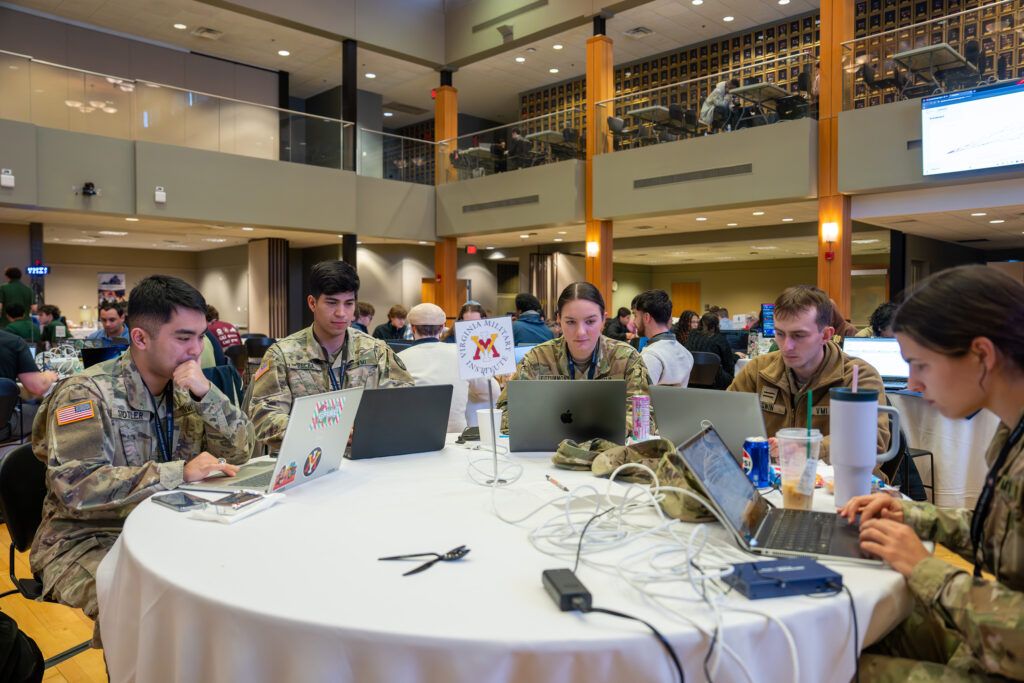
VMI cadets work together to decipher problems across a range of categories during the capture-the-flag competition in the Hall of Valor. –VMI Photo by H. Lockwood McLaughlin.
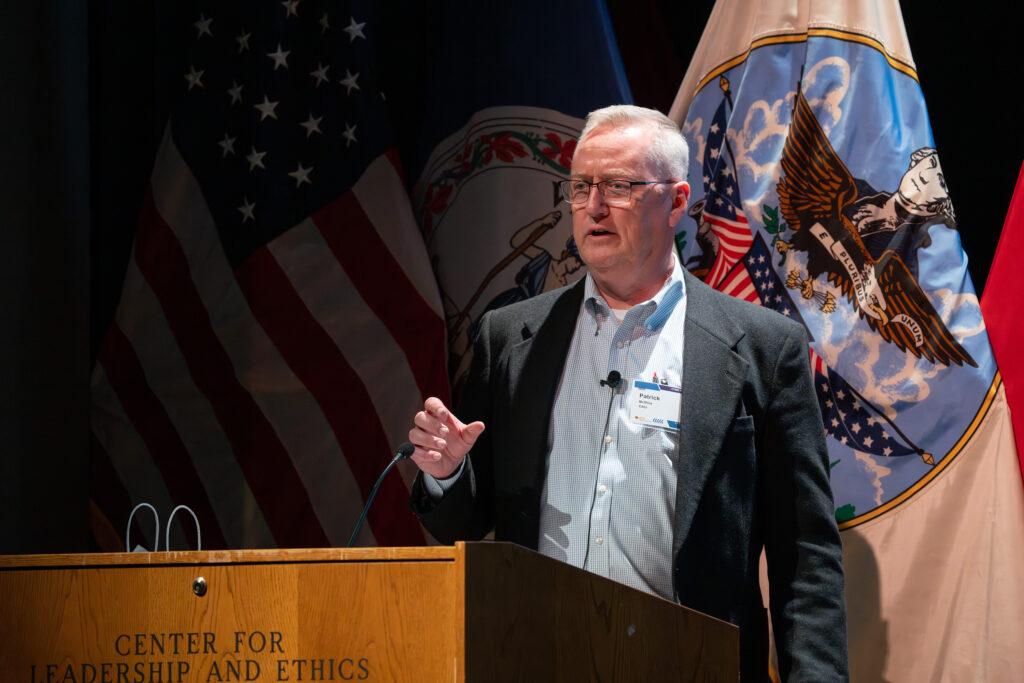
Col. David Gray, executive director of the CLE, served as master of ceremonies for the event. Brig. Gen. Robert W. Moreschi, dean of the faculty and deputy superintendent for academics, welcomed the participants to VMI. “You are here by invitation, which indicates that you are elite students in cybersecurity. Your career starts here with networking and honing your skills. The country needs you, the commonwealth needs you, and businesses need you. Make friends and enjoy your time here.” He then introduced the keynote speaker, Patrick McShea, executive director for cyber mission operations for CACI International Inc.Patrick McShea imparts the importance of soft skills during his keynote speech in Gillis Theater
McShea spoke on the importance of soft skills, such as teamwork, leadership, adaptability, problem-solving, communication, and creativity.
“Why do soft skills matter in a technical world? Employers want well-rounded people. I would take someone with a great attitude and the aptitude to grow into a role, over the smartest person in the room if I feel that the smartest person in the room is going to be a problem. Technical skills are a foundation, but they aren’t the only thing.”
McShea also stressed the importance of a well written and succinct resumé, and being true to oneself in discovering life’s calling. He ended by reminding the students that “Lifelong learning is not an option.”
Patrick McShea imparts the importance of soft skills during his keynote speech in Gillis Theater.—VMI Photo by H. Lockwood McLaughlin.
A highlight of the two days for the student participants was the VCC capture-the-flag competition, in which teams tackled problems in scenarios designed to model real-world computer security challenges across a range of categories including cryptography, network traffic analysis, and reverse engineering. George Mason University was the high scorer in the four-year college division. The University of Virginia finished second, and William & Mary came in third. For the community college division: Germanna Community College was the winner, followed by Danville Community College in second, and Tidewater Community College in third. VMI cadet competitors were Caroline Marini ’26, Sarah Fitzsimmons ’27, Isaac Gwin ’27, Santiago Rocha ’27, and John Stotler ’27. Their coach was Jacob Klein, software engineer in the Cyber Defense Laboratory. Klein stated the cadets did very well despite most of them being new to the competition.
“It was intimidating and nerve-racking, however they buckled down and put up a respectable score. They look forward to future opportunities to compete.”
Lt. Col. Kim Connolly, assistant director of programs and conference for the CLE, stated the collaborative event develops Virginia’s cybersecurity workforce. “Its unique design provides a well-rounded experience for the students, helping them develop both their technical and soft skills before they enter the workforce.”
wo Virginia Military Institute Honors cadets, John Paul Adams ’27, an English major, and Aleck Tiller ’27, an international studies major, presented at the Southern Humanities Conference (SHC) in Annapolis, Maryland, Feb. 6. Founded in 1947, the SHC provides a welcoming and robust space for research presentations that cross disciplines and inspire imaginative discussion. This year’s theme was “Tides and Time, Ebbs and Flows.” The cadets were notably the only undergraduate presenters at the conference. Others were professors, graduate students, and independent scholars.
Adams presented his 2025 Summer Undergraduate Research Institute project titled, “Scriptural Monster: A Study of Tolkien’s Jonah,” in which he connects J.R.R. Tolkien’s translation of the Old Testament book of Jonah for the Jerusalem Bible — a Roman Catholic translation of the Bible — to the theme of mercy in Tolkien’s classic, “The Lord of the Rings.” Adams shared what he likes about the Book of Jonah is that it fits well with Tolkien’s ethos. “It’s a very mythical book of the Bible, and it’s got a lot of fairy tale elements that Tolkien used in his fiction.” Adams added that his experience at SHC was marvelous. “It was exciting to be able to present in front of professionals, and engage in great conversation with them.”
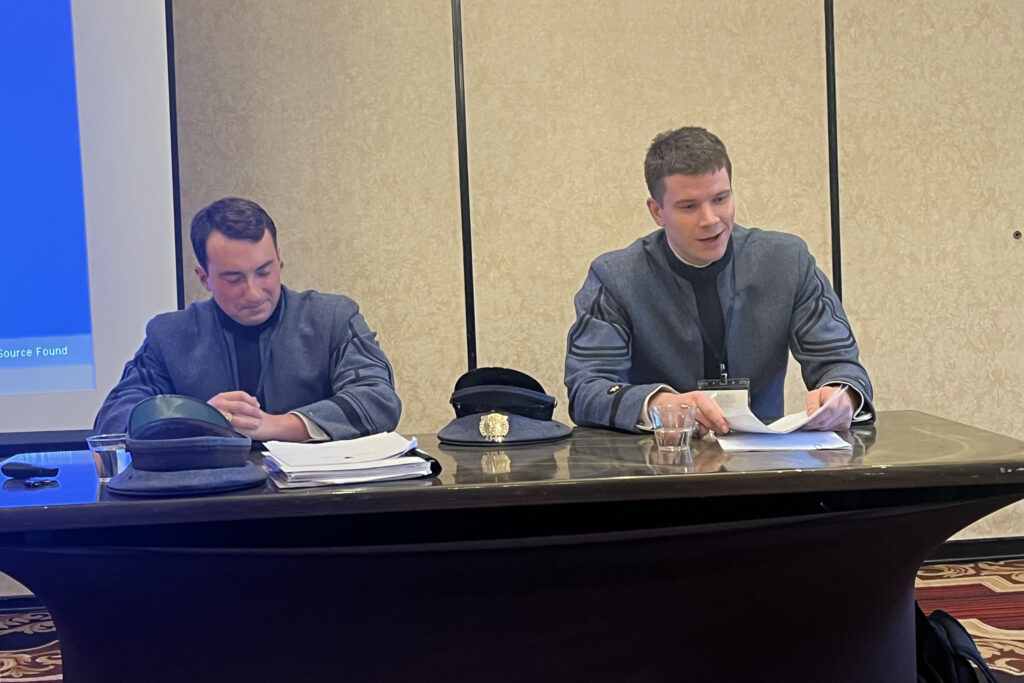
Aleck Tiller ’27 listens as John Paul Adams ’27 discusses his research at the Southern Humanities Conference Feb. 6. –Photo courtesy of Col. Steven Knepper.
Tiller’s presentation entitled, “BrAInpower or ConstrAInt? The Importance of Human-Made Art in an AI World.” His research took up the question of why people respond to a work of art more positively when they know it is created by a human, as opposed to artificial intelligence (AI). He drew on research in psychology as well as the philosophies of G.W.F. Hegel and Susanne Langer. Tiller agreed with Adams that SHC was a wonderful opportunity for them to share their research with other scholars.
“Since we were the only undergraduates, our presentations caught the attention of many professors and academics. This was the first time either of us have presented research, but it certainly won’t be the last. VMI molds a cadet to do things that they never imagined.”
The cadets were accompanied by Col. Robert McDonald, associate dean for academic affairs and director of the honors program, and professor of English and fine arts; Col. Steven Knepper, professor of English and holder of the Bruce C. Gottwald Jr. ’81 Chair for Academic Excellence; and Maj. Henry A. Wise III ’05, assistant professor of English. The three delivered a panel presentation called, “The Art of Past-Haunted Places: Photography, Fiction, and Poetry,” which focused on the role that place plays in their respective creative endeavors. Knepper noted, “Place is more than a backdrop. It actively shapes people and carries both vestiges of the past and a sense of possibility.” McDonald presented photographs from his recently published book, “Studio Notes: My Time With Cy Twombly.” Wise read excerpts from his novel, “Holy City,”and discussed the relationship between the fictional county described in the book and the factual region of Southside, Virginia. Knepper read poems about his family’s Pennsylvania dairy farm. The trio also talked about VMI’s Department of English, Rhetoric, and Humanistic Studies, and how it encourages both interdisciplinary and creative work.
The cadets’ travel was supported with a grant from the VMI Center for Undergraduate Research.
Virginia Military Institute has developed an experiential learning project called, “Students-Led Cyber Defense: Creating a Safer Digital Landscape for Local Businesses and Nonprofits in Rockbridge County,” in which VMI cadets serve as instructors, mentors, trainers, and support to nonprofits and small local organizations in Rockbridge County which have no information technology or cybersecurity team.
The initiative is designed to equip cadets with practical cybersecurity skills, bridging the gap between traditional classroom learning and real-world application, and positioning them for successful careers after graduation. The project is funded by a grant from the Commonwealth Cyber Initiative.
According to Dr. Sherif Abdelhamid, assistant professor in the Department of Computer and Information Sciences, team member of the Cyber Defense Lab at VMI, and project principal investigator, the project began in January 2025.
“We spent last spring preparing the training material and learning modules, and an additional four months developing ‘Aegora,’ a web platform that hosts the material and service tools. Our first instructional class was with the Virginia Innovation Accelerator (VIA) in Buena Vista. Cadets conducted comprehensive cybersecurity threat assessments, advised on securing network systems, delivered cybersecurity training, and provided advisory support for integrating artificial intelligence to enhance daily workflows, marketing strategies, and data analysis while maintaining data integrity.”
Nickie Hawkins, director of VIA, attended the cadet-run class and found it invaluable. She was able to use what she learned the following week, when one of her workplace accounts had a password breach. “I was able to recognize the issue, communicate with my team, and apply the necessary interventions to protect our data and accounts. Having the confidence to move forward quickly reduced the potential impact of the breach and reduced the time spent on securing data,” said Hawkins.
One cadet on the team, James Bangura ’26, a computer science major with a track in cybersecurity, said the program has been one of the most meaningful hands-on experiences of his academic career.
“I have been involved in assessing digital vulnerabilities and helping develop practical security recommendations for local businesses and nonprofits in Rockbridge County. This project has been incredibly rewarding because it allows us to apply classroom knowledge to real-world challenges that directly impact our community. Working on this initiative has strengthened my technical skills, improved my ability to communicate complex security concepts to non-technical audiences, and reinforced my commitment to serving others through cybersecurity.”
In addition to Bangura, there are currently seven other cadets on the team including Benjamin Davis ’26, James Jeffers ’26, Gunnar Romsland ’26, Shahryar Shah ’26, Lucienne Ashmore ’27, Ian Coker ’27, and Katelyn Redlinger ’27. Abdelhamid stated there are plans to provide training to additional local businesses, and to apply for additional grants to extend the program.
Virginia Military Institute’s 2025-26 Leader-in-Residence (LIR) Lt. Col. Scott Mann visited post Feb. 9 through Feb. 13. He is a retired U.S. Army Green Beret and author of The New York Times best seller, “Operation Pineapple Express.” Named in honor of VMI’s 14th Superintendent Gen. J. H. Binford Peay III ’62, the LIR program is an important part of the Center for Leadership and Ethics’ (CLE) efforts to educate, engage, and inspire cadets, faculty, and staff to develop as leaders, and brings to post people of stature within their fields whose distinguished careers exemplify the citizen-soldier model. Mann’s residency will amount to a two-week visit over the course of the academic year. He has interacted with cadets in various formal and informal settings, including the classroom, barracks, and during athletic activities such as club sports. He also met with cadet counselling, VMI police, a group of VMI alumni, recorded an episode of the VMI Leader Journey podcast titled, “Relationship Centered Leadership,” and performed his one-man play, “11 Days” in Gillis Theater.
Mann shared his powerful testimony to cadets in several classes. He talked of being inspired, at the tender age of 14, to become a special operations officer, and described the true mission of the Green Berets, and the services he provided in Afghanistan. He shared his struggles in adjusting to civilian life, and in Col. Polly Atwell’s Artistic Responses to Social and Political Issues class in the Department of English, Rhetoric, and Humanistic Studies, he communicated how he learned to become a storyteller, a skill which led to his healing.
“I had a really crappy transition from the military. I went from being this high performing Green Beret to a dude padding around his house in a bathrobe and not having showered in two weeks.” It got so bad for Mann, that he considered ending his own life. Through a friend, he learned of a workshop in California taught by former Houston Oiler, Bo Eason, who helped people overcome struggles by sharing their stories. Mann flew from his home in Florida across the country to California to hear Eason. “The guy was telling a story about his final moments in the NFL, the moment he blew out his knee during a game. As they were carrying him off the field, he knew his football career was over. He thought he would end up in prison because the only thing he knew how to do was hit people hard. He wanted to learn how to take that TNT inside him and put it toward something productive. He took acting classes, and wrote plays, and actually performed one off-Broadway. The whole time I was listening to him, I was thinking, ‘that’s me.’ When he was done speaking, I went up to him and told him my story, and he agreed to work with me.”
Eason worked with Mann for two years in helping him in the ancient art of storytelling. It was Mann’s goal to share the stories of what he had done in Special Forces, and, more importantly, what his team had done.
Mann’s talent to weave a story blossomed and he authored the New York Times best seller, “Operation Pineapple Express,” which addresses the human cost, moral courage, and extraordinary leadership demonstrated during the final days of the U.S. withdrawal from Afghanistan in August 2021. It is a firsthand account of a covert, volunteer rescue effort led by U.S. special operations veterans and partners who refused to leave Afghan allies behind. Working from kitchens, basements, and living rooms throughout the U.S., the group coordinated across time zones and bureaucratic barriers to help evacuate nearly 1,000 at-risk Afghan interpreters, commandos, and their families. Mann later wrote, “11 Days: The Story of Operation Pineapple Express,” a one-man, one-act play adapted from his book, which he performed Feb. 11 in Gillis Theater to an enthralled audience. Directed by Jason Cannon, the production centers on themes of courage, healing, honor, and leadership under extreme pressure. “11 Days” is Mann’s second play. His first, “Last Out – Elegy of a Green Beret,” has toured throughout the country
Mann is chief executive officer of Rooftop Leadership, a professional training and coaching company specializing in human connection skills, and the founder of The Heroes Journey, a 501(c)(3) committed to helping U.S. and Afghan veterans tell their stories and transition to civilian life. He will return to post April 6-7 to complete his term as LIR, and will be the featured speaker at the Superintendent’s Leadership Dinner. Faculty interested in having Mann visit their classes in April should contact Col. Patrick Looney, deputy director of the CLE.
Virginia Military Institute welcomes Vaughn Scribner, Ph.D., associate professor of British American History at the University of Central Arkansas, for a lecture based on his award-winning book, “Under Alien Skies: Environment, Suffering, and the Defeat of the British Military in Revolutionary America,” Monday, March 2 at 8 p.m. in Gillis Theater, Marshall Hall. The event is free and open to the public.
Scribner will discuss the dynamic experiences of those who fought in the American Revolutionary War and the environmental, psychological, and social impact of combat on those who served at the front lines.
The event is sponsored by the Department of History and the Society of the Cincinnati in the State of Virginia.
Dr. Duncan Richter, professor in the Department of English, Rhetoric, and Humanistic Studies and holder of the Charles Luck III ’55 Institute Professorship at Virginia Military Institute, has recently authored his seventh book titled, “Wittgenstein Versus Anscombe on How to Live: Linked Philosophical Lives,” published by Bloomsbury Publishing.
The book explores the lives of two of the most influential philosophers of the 20th century, Ludwig Wittgenstein and Elizabeth Anscombe. Anscombe was Wittgenstein’s friend and student, chosen by him to be his translator and editor, but the two had very different views on ethics, religion, killing in war, sexuality, politics, God, and the meaning of life. Drawing on previously unpublished work by Anscombe, Richter explains where these beliefs came from, how they affected the lives of these two great philosophers, and some of the strengths and weaknesses of their divergent positions.
All seven of Richter’s books may be purchased on Amazon.
When it comes to school rivalries, the one between Virginia Military Institute and The Citadel is among the most historic and intense. The Military Classic of the South, the annual football game between the two senior military colleges, is their biggest competition, with the winner taking home the coveted Silver Shako trophy. This academic year, the game was held in early November in Charleston, and it was there that Dusand Barrow ’28, a VMI emergency medical technician (EMT), set aside his team partiality to aid a Citadel fan in distress.
For all away NCAA events, VMI Emergency Medical Services (EMS) sends a small contingent of cadet EMTs to provide emergency response services for cadet spectators in need. Originally, Barrow was not intending to attend the football game at The Citadel, but it was the birthday of the cadet who had been assigned to go who wanted to spend the weekend with his family. So, Barrow volunteered to fill in, and, along with three other VMI EMTs and EMS advisor, Donnie McBrayer, found himself on the bus to Charleston on game day.
Upon arriving to Johnson Hagood Stadium at The Citadel, Barrow prepared to march in with the other corporals, but was alerted that McBrayer needed his help with a patient. He sprinted to McBrayer who was aiding an older gentleman who had fallen and was bleeding.
“We treated him, cleaned him up, and sent him to the hospital in an ambulance. After that, I went under the stand area to buy a snack. A group of people high up in the stands saw me, ran down the stairs, and asked if I was an EMT. One of their friends had passed out and needed care. I climbed the stairs with them to their friend, who was fully unconscious. I treated her for about five minutes until the EMTs The Citadel had hired for the game arrived. By that time, the patient was awake but still a bit groggy. I grabbed their equipment and monitored her vital signs. The other EMTs talked to her, and got more information. She had a history of high blood pressure and became overheated in the South Carolina sun. She declined to go to the hospital, so I gave her some water and told her, ‘If anything else happens, please feel free to grab me or somebody who’s in a blue shirt like me, or call one of the other EMTs.’”
It was then the patient and her friends realized that Barrow was a VMI cadet, and were impressed he had come to the home team side of the stadium willingly and without any reservation to render aid.
“I told them this is my job, it is how I was trained, and what’s expected of me. They told me if I ever think of switching from VMI to The Citadel, they can help. I told them, ‘No, no, I’m very happy at VMI,’” laughed Barrow.
The group asked Barrow for his name so they could send a recommendation to VMI’s commandant of cadets, Col. Ley Havird ’90. Though Barrow did not expect to receive anything for what he considered a normal service call, a couple days later he received an email from the group of Citadel friends.
“It turns out they are all faculty members at The Citadel. So that entire group sent an email to our advisor, and to our commandant, who awarded me an optional — an authorized excuse from supper roll call. Then I got another email saying our superintendent wanted to meet with me in his office.”
It was there that Lt. Gen. David Furness ’87 presented Barrow with two challenge coins: One from himself and one from the president of The Citadel. Furness also presented Barrow with a letter of commendation.
According to McBrayer, VMI EMS is a Virginia department of EMS non-transport agency that runs 911 emergency services on VMI property.
“It provides coverage for any cadet-related function that needs EMS support, such as rat activities, parades, NCAA events, and ROTC exercises. VMI has 58 EMTs. Barrow is very competent when working with medical patients. He is constantly striving to learn more when it comes to training as an EMT.”
Barrow is originally from the South American country of Guyana, but now calls Norfolk, Virginia, home. He is majoring in biology and is the cadet in charge of VMI’s firefighting club. He volunteers as a fire fighter for the Lexington Fire Department. Being a first responder is extremely important to Barrow, and because of the EMT and firefighting training and practical opportunities offered at VMI, it is one of the reasons he chose to become a cadet. He is also involved with the climbing team, VMI Theatre, Officers’ Christian Fellowship, and works at the Corps Physical Training Facility. Following graduation, he plans to enlist in the Army Reserves and become a professional EMT or fire fighter.
Maj. Mattie Webb, assistant professor in the Department of History at Virginia Military Institute, was recently named a nonresident fellow with the Institute for Global Affairs at Eurasia Group (IGA), a nonprofitMattie Webb research and public education organization focused on geopolitics. Webb’s tenure as IGA fellow will run until December 2026. Throughout the year, she and other IGA fellows will participate in policy-focused discussions, professional development workshops, and publish public-facing research.
Additionally, Webb’s article, “Diplomacy at Work: The South African Worker, U.S. Multinationals, and Transnational Racial Solidarity,” was recently published in Enterprise & Society, a journal focused on historical relations between businesses and their larger political, cultural, institutional, social, and economic contexts, and serves as a preview of her forthcoming book. The article, which examines the history of corporate reform and anti-apartheid activism through the lens of South African labor and global worker movements, may be read here.
Webb, a Rockbridge County native, has been teaching at VMI since August. Her fields of expertise include Constitutional history, diplomatic history, labor history, and modern Africa.
This morning, I testified before the House Education Committee in support of an amended HB1374.
HB 1374 now focuses on the structure and makeup of the board members and no longer grants oversight of VMI to another school’s board of visitors. The amended bill keeps intact VMI’s Board of Visitors and will allow VMI’s board to continue to provide experienced, non-political oversight that is focused on the Institute’s mission and unique educational model.
I am appreciative to the patron of the bill for the time he spent listening to cadets during his visit to Lexington and his willingness to engage with the Institute. I look forward to working with the General Assembly to make all Virginians proud of VMI.
Many thanks to all who continue to demonstrate professional support and advocacy for VMI. Please keep reaching out to members of the General Assembly to share the value of the VMI experience.
LtGen David J. Furness ’87 (USMC, ret.) Superintendent VIRGINIA MILITARY INSTITUTE
NOTE: Those wishing to offer comment or feedback on this statement may do so through an official form. Responses will be shared with VMI administration.