Post View Unavailable:
Post View is currently unavailable due to technical difficulties. More information.Last Updated: 01-08-2026 09:42 AM»
Notice:
VMI.edu has recently been updated and upgraded. Please note that some URLs may have changed. Visitors are encouraged to use the new, expanded site menu and site search to navigate through these changes.
New Website Launched»
In spring semester 2022, cadets in ERH 314: Technical Communications, taught by Maj. Stephanie Hodde, collaborated with cadets in ME 201: Statics, taught by Col. Jay Sullivan and Maj. Chris Altman. Through ongoing interviews and discussions, cadets in ERH 314 learned about and translated mechanical designs developed by the mechanical engineering cadets for open-source reports accessible to engineering departments at other colleges and universities. These collaborative reports became the basis for another assignment, preparing design proposals for an international client.
Cadets in ERH 314 gained additional technical communication skills to publicize their collaboration. Advised by Mary Price and Christian Heilman of VMI’s “Alumni Review,” the cadets created press releases and podcasts about their experiences designing plastic building materials as well as a skateboard ramp for the city of Lexington. In addition, ERH 314 class members John Barker ’23, Nathaniel Coley ’22, and Noah Goldsmith ’22 presented the projects at the Virginia Conference for the Humanities on March 31, 2022, hosted by Virginia Commonwealth University.
The projects provided cadets with experience in evaluating, composing, and publicizing technical solutions for professional and community contexts. This central course outcome links to the broader learning outcome for English majors to identify and use rhetorical strategies in academic, civic, and professional situations.
Hodde is an assistant professor of English who teaches core curriculum courses in writing and ERH courses in reading, technical writing, and artistic responses to social and political issues. She also teaches and is the faculty advisor for ERH 411: Fieldwork, a required core course for English majors. Hodde often involves cadets in community-based learning and service projects across her courses. In previous years, cadets in ERH 314 have consulted on technical materials and tools for Preston Library’s research guides, recycling initiatives, Friends of the Chessie Trail, and Rockbridge Area Conservation Council to develop environmental campaigns and technical tools for local households.
This article is part of The Next Step series. While the four years at VMI are designed for cadets to push themselves academically, physically, and mentally to tackle the demands of life at a premiere military college, they also prepare cadets for life after graduation. Whether that life be one in the military or one in the private sector, VMI faculty and staff provide guidance to cadets along their journeys. One department specifically dedicated to that endeavor of post-Institute success is the Office of Career Services. In The Next Step series, we highlight cadets preparing to enter the workforce after graduation, as well as those still in the midst of their cadetship preparing for internships over the summer.
Hunter Sipe ’26 entered Virginia Military Institute with one goal — find a job in bridge engineering. However, the more classes he took, the more his interests shifted. The civil engineering major from Vinton, Virginia, found he was drawn to the fast-moving, real-world impact of transportation engineering.
“I realized transportation was more exciting for me,” he explained.
That shift ultimately led him to accept a position as a highway design engineer with AECOM in Roanoke. The global infrastructure consulting firm provides engineering, consulting, planning, architectural, construction management, and program management services to clients around the world. He will begin after graduation this spring.
“I applied for this job because it is close to home and allows me to do something I enjoy while also saving money for the future,” he said.
He will be assisting the team with their current development of new lanes on Interstate 81 through Roanoke and Salem, using programs like OpenRoads. He’ll contribute to projects that directly impact the region’s infrastructure and daily commutes.
During a presentation to VMI’s civil engineering 1st Class cadets, an AECOM representative —himself a VMI graduate — shared insights about the company. Learning that this mentor would also become his boss made the decision even easier. He said he was immediately drawn to the company.
Sipe was able to conduct his interview in one of the career services rooms, which allowed him to have a quiet space with no distractions.
He’s already a step ahead, too. While at VMI he was able to acquire his Fundamentals of Engineering certification, making him an engineer in training. This will allow him to go for his professional engineer (PE) license in four years.
He credits his family for encouraging him at a young age to pursue engineering. Finding the field to be a perfect balance of problem solving and hands-on creation, he knows the job will provide a creative path for him.
Preparing for the professional world, he acknowledges VMI in giving him an edge.
“I 1,000% believe having the title VMI graduate adds immense value to my resume,” he said.
Looking ahead, Sipe has clear ambitions. Within the next decade, he plans to earn his PE license, start a family with his fiancée, and eventually settle in the Durham, North Carolina area, continuing his work in transportation engineering.
“The biggest thing I learned from VMI was not to let life speed up on you and enjoy everything that is given to you,” he said.
“Time just flew by,” was the honest reply Terry McGowan gave when asked why he remained at one job for so long. After 50 years of faithful service working in the Military Store at Virginia Military Institute, McGowan has retired.
A lifelong resident of Rockbridge County, McGowan grew up in a blended family and attended Natural Bridge High School. He began work at VMI in 1976 when he was 17 years old. His neighbor at the time worked in the Military Store, which is the department that provides all uniform items to cadets and uniformed staff, and falls under the domain of the Office of Auxiliary Services (AS). He suggested to young McGowan that he apply for a job in the department as there was need for part-time summer help. He was quickly hired, and because of his strong work ethic and good attitude, later became a full-time classified employee.
Throughout his half-century tenure at the Institute, McGowan has served under seven superintendents, 10 commandants, and five AS directors. He has witnessed many changes at VMI including the admission of women, and helped develop fitting and uniform requirements for them. Lee Clark ’93, the current AS director, originally encountered McGowan when getting his own uniforms as a rat in 1989, and values McGowan’s longevity. “Terry has been a quiet but important presence in the Military Store for many years. He is a skilled uniform fitter who could be counted on for his professionalism, and he has always been a positive force in auxiliary services and the VMI community,” said Clark.
A favorite of his co-workers, McGowan was primarily tasked with fitting cadets for all of their different uniforms. “Chatting with the cadets, and getting to know them when they come in to be measured and fitted, was always a joy and one of the best parts of this job. Some would come back to get refitted as they lost weight or gained muscle, and it was nice to learn of their progress,” he shared.
Though he has no specific plans, McGowan looks forward to tinkering around his house and spending time with his older brother, Donald, who worked for VMI until retiring several years ago. Additionally, he enjoys camping, watching NASCAR, and keeping up with his preferred football team, the Dallas Cowboys. He is a fan of classic television and wants to catch up on movies he has put off watching. When asked about a pencil jar in the shape of Darth Vader placed on his desk, McGowan confessed with a boyish smile that he has never seen a “Star Wars” movie, but intends to marathon watch them all.
A parade was held April 10 honoring VMI employees who recently retired. McGowan, along with six others, joined Lt. Gen. David Furness ’87, superintendent, in taking review of the Corps of Cadets during the parade, and was presented with a meritorious service award in recognition of his many years of service.
The National Academy of Education (NAEd), an honorary educational society, has selected Maj. Zachary Deibel, assistant professor in the Department of History at Virginia Military Institute, as a 2026 NAEd/Spencer Postdoctoral Fellow.
Deibel was one of 25 selected from a competitive pool of nearly 500 scholars, and will receive a fellowship award of $70,000 intended to assist with his salary replacement and research expenses for the fellowship period.
Founded in 1965, the NAEd advances high-quality research to improve education policy and practice, and consists of U.S. members and international associates who are selected on the basis of scholarship related to education. According to Okhee Lee, Ph.D., chair of the NAEd Professional Development Committee, the fellowship encourages and supports the next generation of scholars from a variety of fields and disciplines as they work to improve education.
“These fellowships are more crucial than ever given the recent dramatic declines in education research funding. It is a privilege to work with our new fellows who will contribute to education research and scholarship,” said Lee.
Deibel, who specializes in early American history, will be investigating the revolutionary origins of civic education in America for his project titled, “Liberty’s Lessons: The Educational Politics of the American Revolution,” and is excited to be participating in the fellowship. “It is an amazing opportunity to learn from and alongside some incredible scholars. I am also thrilled to be able to bring all that I learn back to VMI. The workshops, mentorship program, and collaborative learning offered by the fellowship will help me bring new approaches and research to my classes at the Institute. I am looking forward to using my research to foster new and exciting explorations with cadets and colleagues into how we can learn from the past to be informed, empathetic, and engaged citizens.”
Sherif Abdelhamid, Ph.D., assistant professor in the Department of Computer and Information Sciences and team member of the Cyber Defense Lab at Virginia Military Institute, has been selected as a 2026-27 Nielsen Center fellow, a prestigious national fellowship awarded by the Nielsen Center for the Liberal Arts at Eckerd College in St. Petersburg, Florida.
Nielsen fellows are chosen for their demonstrated strong commitment to teaching excellence and their potential to contribute meaningfully to national conversations about liberal arts education.
Founded in 2021, the Nielsen Center supports outstanding faculty at colleges across the United States through sustained interdisciplinary dialogue and collaborative exploration of teaching and learning. The year-long fellowship includes three seminar-based workshop sessions held at Eckerd College, focused on faculty self-understanding, pedagogical innovation, and interdisciplinary connection in small liberal arts college contexts.
Abdelhamid, whose goal is to create learning environments where students feel motivated to explore, collaborate, and think creatively, said he is grateful for the opportunity to engage with faculty from a wide range of disciplines and institutions.
“I hope to gain new perspectives on meaningful learning experiences and bring back ideas that support curiosity, engagement, and academic growth among our cadets.”
As the nation approaches its 250th anniversary, Virginia Military Institute’s Civil Discourse Initiative (CDI) embodies the idea that a healthy democracy necessitates dialogue, compromise, and trust. VMI’s Center for Leadership and Ethics (CLE) started holding debates in 2021, and then partnered with VMI’s Building BRIDGES club in 2022 to grow the opportunities and audiences for the debates. CDI, the name for the program since last year, now offers year-round programming.
The expanding initiative provides a variety of forums for engagement and discussion by using light parliamentary-style Braver Angels debates and A Braver Campus Dialogue (ABCD) workshops to foster a culture of civil discourse and constructive community conversations on important and sometimes controversial topics. These activities encourage listening and public speaking skills and give students more opportunities for rigorous examination of topics through open dialogue. All of these skills align with the mission of VMI to develop leaders and citizen-soldiers.
“Good leaders welcome a variety of viewpoints to help them with decision making,” noted Col. David Gray, executive director of the CLE. “These viewpoints help stress-test and strengthen decisions and strategies. Good leaders are also good listeners and engage effectively with their teams.”
Led by three faculty fellows, Col. Valentina Dimitrova-Grajzl, professor of economics, Col. Sara Whipple, professor of psychology, and Lt. Col. Kim Connolly, assistant director for programs and conferences at the CLE, CDI began the 2025-26 academic year with the support of the Jackson-Hope Fund via a five-year grant to advance VMI’s emphasis on citizenship and leadership through normalizing and internalizing civil discourse at VMI. Four cadet fellows, Katy Layman ’26, Zach Denton ’27, Josiah Farrell ’28, and Zach Richardson ’28, helped develop, organize, and promote the events to cadets and recruit opening speakers. In addition, four cadet ambassadors helped publicize events.
Activities this past year included the introduction of the solutions-based ABCD workshop to both local intercollegiate partners, Washington & Lee, Southern Virginia University (SVU), and Mountain Gateway Community College, and the local community. CDI hosted a workshop in September titled, “How Can We Improve Our Local Economy?” that drew 150 participants and introduced local business owners, economic development officials, and concerned citizens to this civil discourse tool. It also facilitated a meaningful intergenerational exchange of ideas and viewpoints.
In December, VMI hosted a public square debate, a collaborative effort between the VA250 Commission, the State Council of Higher Education for Virginia, the Virginia Department of Education, the College Debates and Discourse Alliance, the American Council of Trustees and Alumni, and Braver Angels. It was part of the commission’s Education Steering Committee’s programs for K-12 and college students to make history come alive, spark a civics renaissance, and celebrate democracy. Select students who participated in the debate will be invited to participate in a debate at the State Capitol in October.
A February debate at VMI focused on honor, integrity, and compliance. Additionally, throughout the academic year cadets traveled to related events at the University of Virginia and SVU.
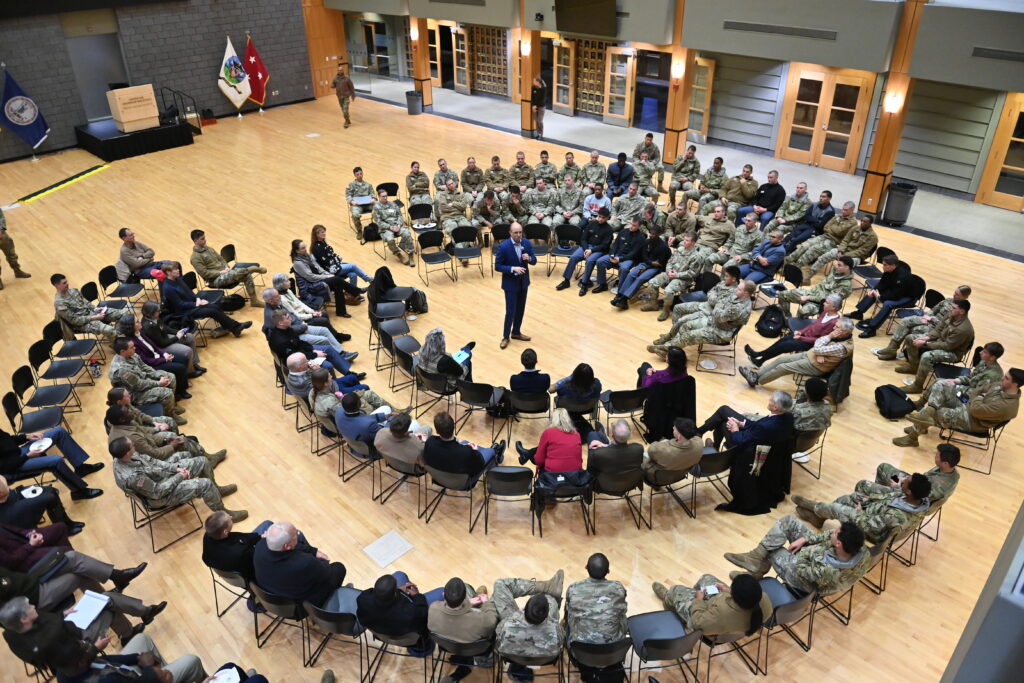
Cadets, faculty, and guests sit around a speaker during a debate in December 2025 in Marshall Hall. VMI Photo by Kelly Nye.
“This year has been great for CDI, as we have continued to expand the program and connect with even more people,” said Farrell. “The opportunity to engage with students from other colleges at the Democracy360 conference at University of Virginia in a civil discourse setting was a great way to expand my views on issues like voter ID and identity politics. Making connections and conversing with students from other backgrounds has allowed me to take a step back and evaluate my own opinions and ideals.”
The initiative’s efforts to fold civil discourse into the everyday culture of VMI took another step forward when VMI’s committee on academic technology collaborated with CDI to host an ABCD workshop on AI, creativity, and critical thinking. This was attended by a cross-disciplinary group of staff and faculty and included two cadet representatives from the Honor Court.
Smaller monthly “Food for Thought” conversations covered a variety of topics in an informal setting during the lunch period, allowing for more engagement between cadets, faculty, and staff. In addition, a half-day workshop titled, “Cultivating Curious Individuals, Teams, and Organizations,” was offered in March by Dr. Todd Kashdan, author and founder of the Well-Being Lab at George Mason University.
Looking at the next academic year, the initiative has expanded to formally include interdisciplinary faculty and staff partners who have supported and participated in programs over the years. They will receive training to become debate moderators and to incorporate debates and ABCD workshops into the curriculum and other programming.
Cadet ambassador Bianca Marlang ’27 reflected on the impact the program has had on her this past year. “I have learned to keep my bearing amidst hearing views that are the complete opposite from mine… I have since learned to listen for genuine understanding and not listen to respond. It seems small, but I’m very proud of it.”
A complete listing of all CDI activities from this past academic year can be found on the Center for Leadership and Ethics’ website.
The Vanguard series highlights cadets of Virginia Military Institute who exemplify promise, perseverance, and the true spirit of leadership. While they may not be the top-ranking students or those in prestigious positions, these individuals’ dedication, resilience, and growth embody the essence of being a VMI cadet. By sharing their stories, including the challenges they’ve faced and overcome, we shine a spotlight on the diverse paths to success at the Institute, proving that leadership and excellence come in many forms.
When Gracie Harlow ’27 started her collegiate career, she felt like she was going through the motions and not obtaining any growth. She started at Hollins University, an all-female college near Roanoke, but ended up transferring to Virginia Military Institute after two years.
“There was no challenge. I was just living,” she admitted. “I wanted a challenge. My brother went to The Citadel and I come from a military family. I wanted something different. I knew I could get somewhere from here.”
The transfer as a junior didn’t mean she’d end up a 2nd Class cadet. She went directly to the Rat Line and started over.
“You can’t skip it,” she said of the Rat Line. She turned 21 right after Breakout.
“It was kind of rough in the beginning. I struggled a lot. My dyke helped me a lot,” she stated. “It took a lot of getting used to, but I feel like everything I went through and I have been through so far has helped me grow in these couple years.”
Harlow also knew she needed financial assistance for school. She received a scholarship for track and field, which she participated in her first two years as a cadet. All of her aid is covered by VMI scholarships, either from the school or alumni.
“These have been crucial to me getting through school due to my financial situation at home,” she explained. “Having those opportunities that are free or I have an avenue to make it free means a lot.”
She has her plate full. A history and English double major, she also has several writing and photography extracurricular activities. Originally, she started out as an international studies major, but felt uninspired and was looking for something she enjoyed more. She switched to history, but found she needed to fill more classes.
“I had a lot of schedule to fill, so I picked up the double major in English. That has helped me branch out and meet people,” she commented.
Maj. Madeleine Ramsey, assistant professor of history and Harlow’s academic advisor, has worked closely with Harlow for the past two years. Although she hasn’t taught her, she’s heard her colleagues speak about Harlow’s influence in the classroom. Ramsey noted Harlow’s academic diligence as even more impressive because she’s been able to achieve it while participating in a DI sport of track and field and the demanding regimental system.
“She is always prepared, ready to engage with the material at hand, and willing to participate actively in classroom discussions. She is a committed student, as I have seen firsthand through the numerous visits to both my colleagues’ offices and mine, to ask questions and seek assistance with her papers,” Ramsey commented. “As she has done throughout her academic career, Ms. Harlow applies the same discipline and dedication to VMI’s Corps of Cadets. She excels both inside and outside the classroom and now holds rank as a corporal.”
The dive into history and English allowed her the opportunity for an internship with the American Battle Monuments Commission where she was given the opportunity to research for them. She also traveled to France to present her research with the commission.
Being involved has been a huge goal for Harlow.
“I like trying new things, but I feel like VMI has given me more opportunities to do that,” she said. “Hard work is more recognized here than a lot of colleges. I know we have the uniforms that look the same, but you can always tell the difference.”
She will be studying abroad this summer in Spain, spending four weeks at the University of Alcalá. She previously went to Poland in the summer of 2024 through the MirYam Institute’s program, I-SAP (Israel Strategy & Policy) tour, which is designed for U.S. military cadets to travel, learn about a country, its place among the nations, and its relationship with the United States.
Despite any shortcomings Harlow has faced in her personal life, Ramsey said she’s been able to hold numerous part-time jobs and also received an internship from John A. Adams ’71 Center for Military History and Strategic Analysis to travel to Normandy.
“Quite simply, Ms. Harlow is one of the hardest -working cadets I have encountered at VMI, a place where hard work is a part of everyday life,” Ramsey said.
As a student, she’s improved with planning things out. She used to be more sporadic with things and the regiment of VMI has pushed her to become more solid in her foundation.
“I feel like I literally have to plan out everything. I’m a big planner,” she stated.
Ramsey said that Harlow is one of the most organized and disciplined students she’s ever met.
“She arrives promptly for every meeting and is always prepared. She has faced a variety of challenging circumstances in her life that for many would have been reason to seek an easier path,” Ramsey stated. “Ms. Harlow sought out, and has excelled in, one of the most challenging systems in higher education, which speaks to her strength of character.”
Her roommate calls her OCD because she’s very strict about her uniform and how tidy their room is. She prides herself on never having any demerits.
“I hate being in trouble. I just do my best to avoid it.”
She tends to be more quiet in the classroom but will always speak up if she needs help.
“I try to do my hardest to work with my professors and get the help I need. I lean a lot on my roommate. My dyke helped me a lot my rat year. I still talk to her a lot. I met my boyfriend here,” Harlow said. “The whole support system is how I buckle down and deal with it. VMI teaches you to move forward no matter what’s in your way right now. You have to get past it. And having that support system to get past it helps.”
The Vanguard series highlights cadets of Virginia Military Institute who exemplify promise, perseverance, and the true spirit of leadership. While they may not be the top-ranking students or those in prestigious positions, these individuals’ dedication, resilience, and growth embody the essence of being a VMI cadet. By sharing their stories, including the challenges they’ve faced and overcome, we shine a spotlight on the diverse paths to success at the Institute, proving that leadership and excellence come in many forms.
Owen Johns ’28 has always been interested in how the world works, which is what drew him to an international studies major at Virginia Military Institute.
“I like to see how things in the past affect current outcomes,” he explained.
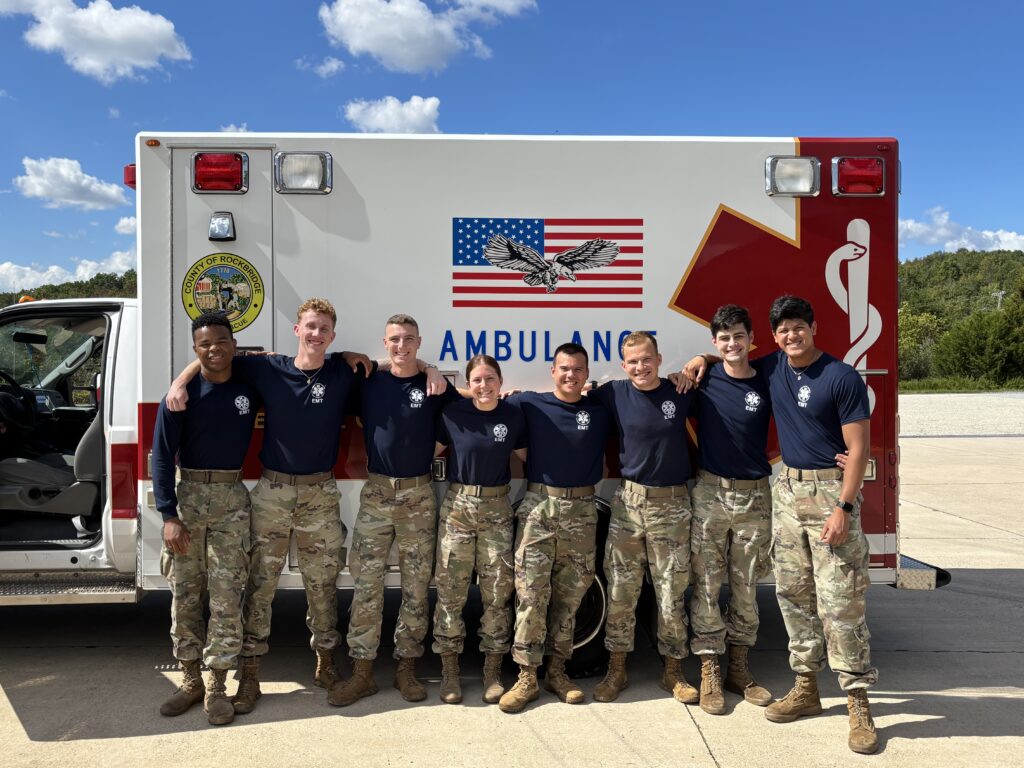
Johns knew he wanted to commission in the U.S. Army, so VMI was the best choice for him. Once he got to VMI and chose his direction, he discovered a whole new world of opportunities. He is a VMI emergency medical technician (EMT), a volunteer firefighter with the City of Lexington, and an S1 corporal.
Maj. Mattie Webb, assistant professor in the Department of History, said Johns is highly respected amongst his peers.
“I could always count on him to ask difficult but well-reasoned questions, something that showed me he was genuinely curious and eager to connect course material to larger themes and debates,” Webb explained.
From taking on leadership roles in the classroom to always engaging in discussion, Johns has impressed Webb since he was in her U.S. Constitutional History course. That course is challenging and requires cadets to learn the material and also communicate it effectively to each other.
“Johns consistently demonstrated a commitment to uplifting those around him, especially during group activities. He was eager to improve and regularly took advantage of opportunities outside the classroom, including attending guest speaker events,” she said. “This attitude reflected his enthusiasm to learn, openness to feedback, and genuine enthusiasm for U.S. constitutional history.”
Johns admits being a cadet at VMI is difficult, but he’s been able to be proactive with time management to keep things in order.
“I was not really that organized before I came here,” he said. “It was a bit of a gut check of needing to learn how to prioritize.”
One word can easily describe Johns — busy. Not only is he balancing a course load of 16 credits and his S1 duties, which includes responsibilities for personnel and administrative actions for the Corps of Cadets, plus various EMT duties throughout the week, he’s also spending his weekend running calls with Lexington Fire Department or with VMI EMS.
“I try to keep my time full between academics, extracurriculars, and EMT,” he said.
When he saw his uncle dyke (his upper-class mentor’s roommate) was an EMT, he was inspired to check it out. Johns attended an interest meeting, then ended up interviewing for the course, which only accepts around 25 cadets for a summer session. The course is completed in four weeks, teaching EMT skills in the classroom, then running calls with local stations in the area — anywhere between Rockbridge and Alleghany counties. The minimum number of runs needed to complete the course is 10. Johns completed around 18 in his time.
“It was fun, but it was stressful, too. It’s one of those things where you learn the subject quickly and you have to go out the next day and see it in person,” he admitted.
Since receiving his certification last summer, Johns has been working as an EMT at VMI. During that time, another EMT got him interested in running calls with the fire department in Lexington. Around five cadets toggle between VMI EMT work and the Lexington Fire Department on a regular basis.
“I’m running calls almost every or every other weekend — either on the ambulance or fire,” he said.
Donnie McBrayer, VMI EMS advisor, said although Johns is a newer EMT, he’s gained a lot of experience in that short time. He said he’s committed to learning.
“Johns has shown a willingness to learn and assist in teaching other new cadet EMTs as related to patient interaction,” McBrayer said. “Like with any new EMT, initially Johns was not confident in his skills. Over the past year, he has become more confident with handling medical emergencies. He has a very good future in fire and EMS.”
Johns is currently working on his Firefighter 1 certification, which requires two nights a week with the department and some skill days. That will allow him to be an entry-level firefighter where he can go into the interiors of buildings during calls.
“I found as an EMT, I still was getting the experience, still giving back, but I just want to take it one step further,” he commented. “I might be working on the ambulance, but I want to jump and help with the other aspects too.”
By taking leadership roles and working as an EMT and with the fire department, Johns said he’s gained knowledge on how to take an active approach to leadership.
“I’m able to know what needs to be done, and help coordinate other people I’m working with, like junior members, and help teach and get the job done at the same time,” he said.
He’s found the most challenging part to be the balance of it all.
“You really have to prioritize your time, always keeping a planner and notes in your phone for when I have a meeting, when I have training, when I have to go anywhere,” he stated. “Sometimes it gets a little rough and overlapping, but keeping on top of a schedule is probably the best way I found to manage that balance.”
Webb noted Johns’ involvement outside the classroom showcases his ability to balance EMT responsibilities with academic work.
“What stood out to me most was his maturity and sense of responsibility, approaching both his academic coursework and his service commitments with a high degree of professionalism,” she stated.
For the cadets of Virginia Military Institute’s Air Force ROTC Detachment 880, the path to a commission is paved with more than just classroom instruction. This year, the detachment has spearheaded a series of high-visibility operations, ranging from elite combat training at Nellis Air Force Base to strategic airlift missions over the VMI Post, ensuring that every cadet is operationally ready for the “Big Air Force.”
Shadowing the Joint Force: C/Buttner at Green Flag
From Feb. 26 to March 12, Cadet Buttner, the former Cadet Wing Commander, traveled to Nellis Air Force Base in Las Vegas to participate in the Green Flag exercise. In collaboration with the 549th Combat Training Squadron, the 74th Fighter Squadron, and Air Education and Training Command (AETC), Buttner joined seven other pilots and intelligence selects for a “mock-deployment” training cycle.
During the two-week exercise, Buttner shadowed critical mission components, including intelligence briefs, Close Air Support (CAS) training, and Combat Search and Rescue (CSAR) operations.
“The exposure to the many elements of Nellis AFB gave me insight into how the big Air Force operates,” said Buttner. “I gained perspective on what the Joint Force looks like and is capable of. This awareness will give me a greater appreciation for the components we may not consider every day.”
For Buttner, who is set to commission this May as an Intelligence Officer (14N), the experience served as a direct bridge to her future career. She noted that the exercise’s tactical depth prepared her for the rigors of Intel tech school. Her advice to fellow cadets is simple: “If you are given the opportunity to go, you need to take it.”
Elevating Perspective: The C-17 Incentive Flight
Closer to home, Detachment 880 collaborated with Virginia Tech’s Detachment 875 on Nov. 21, 2025, to offer a high-stakes incentive flight on a C-17 Globemaster III. Operating out of the Roanoke-Blacksburg Airport, the mission was a highly competitive opportunity coordinated by Maj. Moore.
Cadet Johnson, an AS200 who was recently accepted into Field Training, was among those selected for the sortie. To earn a seat, Johnson had to maintain peak physical fitness, academic excellence, and a high level of detachment and involvement. The flight took the cadets over both the VMI and Virginia Tech campuses, offering a rare cockpit view of their home stations.
“The flight definitely increased my passion to fly,” Johnson remarked. “The crew told us about their daily lives as part of an Air Force Reserve crew and their experiences on active duty. It showed me a brief glimpse into what life would be like as a pilot flying heavies.”
With goals of becoming a pilot, Johnson encourages his peers to be proactive: “Demonstrate that you have an interest in flying and take advantage of any resources. Talk to the detachment staff and sign up as soon as incentive flights are announced.”
Early Exposure to Flight: YCF
Beyond the cockpit of the C-17, Detachment 880 is actively investing in the long-term aviation careers of its members through the Aviation You Can Fly (AYCF) program. Under this initiative, Detachment Commanders are empowered to select General Military Course (GMC) and Professional Officer Course (POC) cadets for the opportunity to gain foundational flight experience.
Cadet W. Johnson. is among the cadets utilizing this resource to pursue his goal of becoming an Air Force pilot. Selected cadets receive up to a $5,000 AYCF Grant to pursue a Private Pilot Certificate (PPC). This training is conducted at local Federal Aviation Administration (FAA) Part 141 or Part 61 Certified Flight Schools, utilizing professional curricula such as Sporty’s, Jeppesen, Gleim, or Cessna.
As these cadets prepare for their next chapters—whether it be Buttner heading to intelligence training or Johnson preparing for the challenges of Field Training—these operational experiences remain the cornerstone of Detachment 880’s leadership development.
The Vanguard series highlights cadets of Virginia Military Institute who exemplify promise, perseverance, and the true spirit of leadership. While they may not be the top-ranking students or those in prestigious positions, these individuals’ dedication, resilience, and growth embody the essence of being a VMI cadet. By sharing their stories, including the challenges they’ve faced and overcome, we shine a spotlight on the diverse paths to success at the Institute, proving that leadership and excellence come in many forms.
Sofia Fleming ’28 describes her older sister as a trailblazer. It just so happens a big part of that is because she graduated from Virginia Military Institute. Although it was before Fleming was born, she grew up idolizing her.
“She was very goal-oriented, very driven,” she said. “I have looked up to her my entire life, so it really inspired me to follow her path here.”
Fleming wasn’t sure what her plans would be after high school — if she would attend community college or a four-year institution. She was faced with a big decision.
“I wanted to get the most out of school. I looked into some other four-year colleges, and I wanted a school that would define me or be a defining experience in my life that set me up for a future career,” she explained. “I saw that in VMI. I saw it could give me more than any other school that I looked into could. And it really has … I’ve seen the changes it’s made.”
She compromised though. Before coming to the Institute, she did a year at community college. This served as a good transition from high school — she was homeschooled — and allowed her to overcome any difficulties.
“Going into classes and having to sit and listen to professors was one thing I wasn’t accustomed to,” she admitted. “I have met some really amazing professors here. I’ve enjoyed the experience of getting to know different professors, getting to have the experience of different teachers, which is something that I never had in high school. It’s shaped me and how I do academically.”
The English major said the past year at VMI has made her more resilient.
“It’s definitely pushed me beyond my limits. I feel like I have come so far and such a long way from when I first came here on Matriculation Day,” she said. “It’s given me better time management skills, self-discipline, and it’s testing me academically in so many ways.”
She said that VMI’s most challenging part is academics.
“Even though it’s something that I excel in, it’s also something I struggled to adjust to, but something I’ve been able to overcome as time has gone on at VMI,” she explained.
Despite VMI’s rigorous academic program, Fleming was able to achieve a 4.0 GPA as a 4th Class cadet. She credits her professors in pushing her academically and helping her improve her writing skills. She also began working at VMI’s Writing Center as a peer writing consultant.
As a disciplined student, Fleming likes to get her work done ahead of time, opting to get started on her work right away.
“I’m very methodical about my work. I like to write it, let it sit for a while, come back to it, and then work on it again,” she stated. “In high school I’d always do it last minute. Here, I learned that it doesn’t work like that, especially since I want to get good grades. I have changed my style of how I write and how I work as a student.”
Col. Steven Knepper, professor in the Department of English, Rhetoric, and Humanistic Studies, agreed on her dedication as a student.
“Sofia is a diligent, high-achieving cadet who excels in the classroom and beyond. She is an excellent writer and an incisive thinker,” he said.
Fleming does lean on her professors for extra help if she gets overwhelmed. To get over the first struggles and nervousness she faced while on the Rat Line, she wrote a poem and attached illustrations to it. It started out with lines like “this rat wants a protein shake,” with an illustration of a cartoon rat drinking a shake. She sent it to her parents and they suggested making a children’s book around it.
“VMI’s funny title for freshman inspired me to write a children’s book on the VMI Rat Line called ‘This Rat … A Military College Story.’ I created each drawing as an actual rodent, completing different activities to add levity to the challenging VMI Rat Line,” Fleming explained. “Each drawing was based on a memory that I have about the Rat Line. It feels nostalgic since I broke out just a year ago. Every time I see one of my drawings, it makes me smile because it reminds me of all the funny moments and good times that I had during that challenge.”
She’s self-publishing the book and is in talks with the VMI Museum for them to carry it.
“Cadets lead busy lives, but Sofia found the time to write and illustrate a children’s book,” Knepper commented. “I expect it will be a hit. It’s very well done. Sofia continues to write fiction, poetry, and creative nonfiction beyond her coursework and Corps responsibilities. She has rare talent and skill, but she also consistently puts in the work.”
Despite the difficulties she has faced and will continue to face at VMI, she likes the structure of her day-to-day.
“There’s certain times for me to work out and rest. I’ve really found that helps me a lot in getting things done,” she said. “I was really amazed that the schedule and the structure that VMI has made such an impact on me, and that’s increased my productivity in so many ways.”
She says she wouldn’t have been able to experience such a wide array of opportunities anywhere else. Last year, she was a member of the pistol team, where she competed in a national college level competition. She’s active in VMI’s Newman’s Society, the aviation club, and became a Matriculation Week corporal to train the next class of rats.
Col. Mary “Polly” Stewart Atwell, associate professor in the Department of English, Rhetoric, and Humanistic Studies, described Fleming as extremely engaged, thoughtful, and conscientious.
“She always goes the extra mile with her assignments on top of what is required. She’s willing to take constructive criticism and wants to learn and improve,” Atwell said. “Although Sofia is a 3rd Class cadet, she always holds her own in class discussions when she is one of the younger students in the class. I think she shows great promise as a writer and a scholar.”