
Post View Unavailable »
New Website Launched »

VMI Commissions Military Officers

Virginia Military Institute commissioned nearly 140 cadets into the armed services at the annual Reserve Officers’ Training Corps (ROTC) joint commissioning ceremony May 15 in Cameron Hall. The ceremony was livestreamed for family and friends who could not attend the event in person.

Gen. Christopher J. Mahoney, 13th vice chairman of the Joint Chiefs of Staff, the nation’s second highest-ranking military officer, who arrived to post by helicopter, offered the commissioning officer remarks and administered the oath of office to the cadets beginning their journey of military service as second lieutenants in the U.S. Air Force, Army, and Marine Corps, and as ensigns in the Coast Guard and Navy.

Lt. Gen. David Furness ’87, who just completed his first academic year as the Institute’s 16th superintendent, welcomed the nation’s newest military officers, their friends and families, faculty and staff, and members of the Corps of Cadets to the ceremony. He thanked the ROTC officers, cadre, and staff who were instrumental in teaching and mentoring the young officers, and acknowledged all the veterans and current military members in the audience. “We appreciate the sacrifices you have made and the leadership you have shown. These cadets are following in your footsteps because of the examples you have set,” he said.

Furness reminded the commissioning cadets that VMI has prepared them to face any challenge or adversary, and how honor, courage, and commitment have been instilled in them. “These fundamentals will serve you well for the rest of your life. The time has come for you to take the next step in your careers and serve our great nation.”

He shared three habits he was advised to adhere to when he was a young officer. “First, embrace lifelong learning. You must continually increase your knowledge through practice and self-study. Second, stay physically fit. You will find that when stress arrives, you will be better disciplined to persevere when you are fit, and always remember that a strong mind never grows in a weak body. Last, but most importantly, you must take care of those you lead. Whether in the military, the civilian sector, or your family, people will depend on you to be an ethical and reliable source of strength, to teach, coach, and mentor those you are responsible for.” He congratulated the cadets on attaining a commission, voiced his pride of them, thanked them for making the decision to serve in the military, and wished them Godspeed.  

Furness then introduced Mahoney as a great friend and noted their paths crossed many times throughout their careers. Mahoney graduated from the College of the Holy Cross in Worcester, Massachusetts, with a bachelor’s degree in economics, and commissioned into the Marine Corps. He has served as a pilot with the Marine All-Weather Fighter Attack Squadron known as the “Bengals,” as well as the fighter squadrons known as the “Werewolves,” the “Crusaders,” and the “Bats.” He has held command at the squadron, group, and wing levels. He is a graduate of the Weapons and Tactics Instructor Course, the Marine Division Tactics Course, and the Navy Fighter Weapons School commonly known as TOPGUN. He holds two master’s degrees. One from the University of Canberra in Australia, and one from Air University at Maxwell Air Force Base in Alabama, both with the highest academic distinction.

Mahoney shared he was honored and humbled to speak at VMI, which he described as hallowed ground. To the commissionees, he stated that the era of America’s uncontested dominance is over. “The adversaries you face are capable. They are hungry, and they’re watching you. You’re about to be handed the greatest responsibility the nation can bestow.” He told them they will be tested. “The enemy will jam your communications. Your screens will go black. You will not be able to call higher headquarters for permission. You will not be able to call in a medical evacuation. Will you freeze? Will you wait for perfect information? What will you do? Answering that question will require everything you have. It will require the lessons of this great institution that is built on unrivaled tradition, and these traditions over time have become legend.” Mahoney then cited legendary VMI alumni like Lt. Gen. Chesty Puller, VMI Class of 1921; Lt. Gen. Charles Kilbourne, VMI Class of 1894; Maj. Gen. William Upshur, VMI Class of 1902; and Gen. Lemuel Shepherd, VMI Class of 1917; who all faced dire situations in battle, but instead of hesitating or panicking, they relied on the steel VMI put in their spines. “They did not shrink from violence. They stepped into the breach.” He warned the new officers that because these VMI legendary ghosts set such a high standard, the military has high expectations of VMI graduates. “When a commander sees a VMI ring on a finger, they don’t see a recent college graduate, they see the ghosts of VMI. They expect you to be unbreakable, they expect you to lead from the front, and they expect you to navigate chaos without losing your bearing. Virginia Military Institute has given you the discipline and uncompromised standard. The rest is up to you. The ghosts of VMI are watching you. Our adversaries are preparing for you. What will you do?”    

He then asked the commissioning cadets to stand as he administered the oath of office. Afterward, the brother rats gave each other congratulatory hugs as the audience applauded and cheered.  

Following the ceremony, the separate military branches conducted individual pin-on ceremonies at various locations on post. It was there that the newly commissioned officers followed a tradition of presenting a silver dollar to the active service member or veteran from whom they received their first salute.

According to Capt. Megan Taylor, assistant professor of military science for the Army ROTC George C. Marshall Battalion—formerly known as the Blue Ridge Battalion—at VMI. Many were exemplary, but two were prominent: James Aldinger, an international studies major from Arlington, Virginia; and Matthew Kleinschuster, an applied mathematics major from Richmond, Virginia. “Aldinger served as the Ranger Challenge platoon leader responsible for the training and preparation of the Ranger Challenge team. Under his leadership, the team successfully competed at Exercise Cambrian Patrol in Wales in the United Kingdom; at the 4th Brigade Ranger Challenge at Fort Pickett, Virginia; and at the Sandhurst Military Skills Competition at the U.S. Military Academy at West Point. His ability to coordinate training, planning, and logistics for local, national, and international competitions far exceeded the traditional cadet experience. He ranked within the top 1% of cadets nationwide and is branching in the infantry. Kleinschuster served as battalion commander and was responsible for the oversight, accountability, and training of four companies and more than 1,000 VMI cadets. He had the single greatest impact on the Army ROTC mission and overall success of the battalion over the past year. Through his leadership, work ethic, and very impressive GPA, Kleinschuster earned the distinction of being ranked the No. 8 cadet in the nation and was selected to branch in explosive ordnance disposal,” Taylor said.

Lt. Cmdr. Tom Campbell, naval science instructor for Naval ROTC, designated two cadets who commissioned into the Navy and two who commissioned into the Marine Corps as truly outstanding. Macallister Clark, a mechanical engineering major from Saint Michael, Minnesota, was a four-year national scholarship recipient, and retained a 4.0 four-year GPA. He was selected to be commissioned as a Naval reactors engineer (NRE), an elite technical officer who manages the lifecycle of Navy nuclear propulsion plants. The last year a VMI cadet commissioned as NRE was 2017.

Nicole Samella, an electrical and computer engineering major from Virginia Beach, Virginia, was a four-year national scholarship recipient, maintained a superior GPA and high physical fitness scores, and served as the NROTC battalion commander. As the top ranked surface warfare officer in the nation, she was handpicked to transfer into the Navy Engineering Duty Officer program. 

Kern Aughinbaugh, a biology major from San Marcos, California, served as the Marine Company commanding officer and advisor for the NROTC Bulldog Program, helping prepare candidates for the physical requirements of the Marine Officer Candidate School. Moreover, he served the Corps as Golf Company commander in the regiment. Devin Auzenne, a history major from Opelousas, Louisiana, was a four-year national scholarship recipient. In addition to serving the Corps as regimental commanding officer, he also was an advisor for the NROTC Bulldog Program. Both Aughinbaugh and Auzenne will go to The Basic School in Quantico, Virginia.

Col. Eric Steele, commander of Air Force ROTC, cited two cadets as exceptional. Reese Lassiter, a mechanical engineering and physics double major from Louisa, Virginia, has earned the coveted Distinguished Graduate (DG) award—established to recognize the top 10% of commissioning cadets—from AFROTC. “He’s been a standout cadet his entire time in our program, winning national awards and earning recognition through several highly competitive military training courses. He will be attending undergraduate pilot training at Columbus Air Force Base in Mississippi after commissioning,” said Steele.  

Hannah Buttner, an international studies major from Williamsburg, Virginia, successfully completed a leadership tour as Cadet Wing commander last fall. “Competing through a highly rigorous process at the national level, she was also selected to attend Green Flag-West at Nellis Air Force Base in Las Vegas, Nevada, and at Fort Irwin, California, where she gained broad exposure to Air Force and Army joint air-to-ground operations in a real-world training environment. She is this year’s recipient of the Captain John W. Kennedy ’69 Award for sustained excellence throughout her time as a cadet. She will attend intelligence officer training at Goodfellow Air Force Base in San Angelo, Texas,” Steele explained.    

According to Command Sgt. Maj. Suzanne Rubenstein, director of cadet activities and VMI liaison for the Coast Guard Auxiliary University Program, one cadet who commissioned in the Coast Guard. Shane McKenna, an international studies major from Salt Point, New York, served as commander for the AUP and was Foxtrot Company executive officer.  

Memorial Parade

Earlier in the day the Memorial Parade was held, commemorating the bravery and sacrifice of all alumni who died on the field of honor including the Mexican-American War, the American Civil War, the Spanish-American War, World War I, World War II, the Korean Conflict, the Vietnam War, the Marine Barracks in Lebanon, the Persian Gulf War, and the Global War on Terrorism. The large garrison flags were flown at half-staff, by order of Gov. Abigail Spanberger, in memory and respect of Peace Officers’ Memorial Day, a fitting backdrop as all 591 alumni names were somberly read by Stone Gardner ’28, Sophia Lurey ’28, Garrett Maye ’28, and Jamie Rodriguez ’28. A wreath was laid at the foot of the monument, “Virginia Mourning Her Dead,” as well as at the three barracks arches. A prayer led by Col. John P. Casper ’04, Institute chaplain, was followed by the firing of a three-volley salute. A stirring echo rendition of “Taps” was played by Louis Marangoni ’27 and resonated by Khaidan Piedmonte ’28, followed by the Pipe Band leading the Regimental Band in an emotional delivery of “Amazing Grace.” Col. Lawrence “Ley” Havird ’90, commandant, was joined by Furness in taking review of the parade as the Corps marched from the Parade Ground down Letcher Avenue and ending in barracks.
I Am VMI: Maximus Ankrah ’26 

What truly defines Virginia Military Institute are the people. Cadets, faculty, and staff, both past and present, are what make it “No Ordinary College.” I AM VMI will showcase the outstanding individuals who have accepted the challenges and embraced the spirit of VMI. Their perspectives provide authentic insights into life at the Institute and the value of this unique military college. 

I Am VMI: Maximus Ankrah ’26 

  • VMI Class: 2026  
  • MajorBiology, with a Psychology Minor
  • Hometown: Dumfries, Virginia
  • Club Sport: Brazilian Jiu Jitsu 
  • Commissioning PlansU.S. Air Force
  • Other Clubs/Societies/Activities: VMI Class President of 2026, Emergency Medical Technician, Former Cadre Instructor   

The choice of attending Virginia Military Institute was a chance for Maximus Ankrah ’26 to obtain a clean slate.

Every accomplishment and accolade I could achieve was earned, not given; I really wanted to deserve what was given to me,” he explained.

The biology major also serves as the president of the VMI Class of 2026, an emergency medical technician (EMT), and a former cadre instructor. Ankrah chose biology because he wants to be a medical doctor in the U.S. Air Force, which he is commissioning into.

Every accomplishment and accolade I could achieve was earned, not given.

“The biology department has been excellent, and I’ve enjoyed the extensive curriculum,” he said. “I want to go through the medical route. Hopefully go across the world, do humanitarian work, and help out those in need. My family is from Ghana, so I want to go to a developing country like Ghana and be able to help other kids, help other parents, help other people.”

It comes down to the people, Ankrah said. There are struggles that come with attending VMI, but he says the people he’s encountered and formed bonds with have made it worth it.

“I’ve met some of the most admirable and motivating people at VMI, and it’s my friends here, my brother rats, that keep me going every day,” he said. “What I enjoy most about VMI is it’s not the place necessarily, but the people. There are some amazing people who I would never have come across if I didn’t choose to come to VMI. Lots of hardworking people, lots of compassionate people in whatever field it is that they decide to do. It definitely pushes me to be better. I’m always constantly looking for the next best thing; what I can do to improve from yesterday. “

Ankrah’s experience at VMI can be compared to work in a laboratory, he said.

“It’s the challenges you face at VMI that help you build resilience, grit, and integrity.”

“The mistakes, the successes, the wins, and losses; VMI is a place where you learn so much about yourself and other people that it forces you to mature as a person,” he commented. “It reveals your potential, and it’s up to you to make the most of it.”

He said it’s helped him grow in the realization that he’s bound to fail — except he’s failing forward.

“It’s the challenges you face at VMI that help you build resilience, grit, and integrity.”

His time at VMI will translate into his future seamlessly.

“Academically, it will translate into giving my absolute best and knowing that I did everything honorably and to the best of my knowledge,” he said. “Leadership-wise, influencing people is achieved through trust and reputation; your example is your most effective tool. Lastly, knowing I attended the hardest school in the nation gives me pride and confidence that I can overcome anything life throws at me.”

He’s done some difficult things and overcome challenges that others may not see, but that shared suffering and battling adversity make Ankrah proud to be a VMI cadet.

This place is difficult, but if you justify the space you occupy, prove why you belong here, and buy into the system, you’ll get so much more out of VMI than you expect,” he stated.

Detachment 880: From the Tactical Ranges of Nevada to the Shenandoah Skies

For the cadets of Virginia Military Institute’s Air Force ROTC Detachment 880, the path to a commission is paved with more than just classroom instruction. This year, the detachment has spearheaded a series of high-visibility operations, ranging from elite combat training at Nellis Air Force Base to strategic airlift missions over the VMI Post, ensuring that every cadet is operationally ready for the “Big Air Force.”

Shadowing the Joint Force: C/Buttner at Green Flag

From Feb. 26 to March 12, Cadet Buttner, the former Cadet Wing Commander, traveled to Nellis Air Force Base in Las Vegas to participate in the Green Flag exercise. In collaboration with the 549th Combat Training Squadron, the 74th Fighter Squadron, and Air Education and Training Command (AETC), Buttner joined seven other pilots and intelligence selects for a “mock-deployment” training cycle.

During the two-week exercise, Buttner shadowed critical mission components, including intelligence briefs, Close Air Support (CAS) training, and Combat Search and Rescue (CSAR) operations.

“The exposure to the many elements of Nellis AFB gave me insight into how the big Air Force operates,” said Buttner. “I gained perspective on what the Joint Force looks like and is capable of. This awareness will give me a greater appreciation for the components we may not consider every day.”

For Buttner, who is set to commission this May as an Intelligence Officer (14N), the experience served as a direct bridge to her future career. She noted that the exercise’s tactical depth prepared her for the rigors of Intel tech school. Her advice to fellow cadets is simple: “If you are given the opportunity to go, you need to take it.”

Elevating Perspective: The C-17 Incentive Flight

Closer to home, Detachment 880 collaborated with Virginia Tech’s Detachment 875 on Nov. 21, 2025, to offer a high-stakes incentive flight on a C-17 Globemaster III. Operating out of the Roanoke-Blacksburg Airport, the mission was a highly competitive opportunity coordinated by Maj. Moore.

Cadet Johnson, an AS200 who was recently accepted into Field Training, was among those selected for the sortie. To earn a seat, Johnson had to maintain peak physical fitness, academic excellence, and a high level of detachment and involvement. The flight took the cadets over both the VMI and Virginia Tech campuses, offering a rare cockpit view of their home stations.

“The flight definitely increased my passion to fly,” Johnson remarked. “The crew told us about their daily lives as part of an Air Force Reserve crew and their experiences on active duty. It showed me a brief glimpse into what life would be like as a pilot flying heavies.”

With goals of becoming a pilot, Johnson encourages his peers to be proactive: “Demonstrate that you have an interest in flying and take advantage of any resources. Talk to the detachment staff and sign up as soon as incentive flights are announced.”

Early Exposure to Flight: YCF

Beyond the cockpit of the C-17, Detachment 880 is actively investing in the long-term aviation careers of its members through the Aviation You Can Fly (AYCF) program. Under this initiative, Detachment Commanders are empowered to select General Military Course (GMC) and Professional Officer Course (POC) cadets for the opportunity to gain foundational flight experience.

Cadet W. Johnson. is among the cadets utilizing this resource to pursue his goal of becoming an Air Force pilot. Selected cadets receive up to a $5,000 AYCF Grant to pursue a Private Pilot Certificate (PPC). This training is conducted at local Federal Aviation Administration (FAA) Part 141 or Part 61 Certified Flight Schools, utilizing professional curricula such as Sporty’s, Jeppesen, Gleim, or Cessna.

As these cadets prepare for their next chapters—whether it be Buttner heading to intelligence training or Johnson preparing for the challenges of Field Training—these operational experiences remain the cornerstone of Detachment 880’s leadership development.

Behind the Balance: Sydney Smith ’26 — Keydet Water Polo

Virginia Military Institute’s cadet-athletes have to juggle cadet life, heavy academic course loads, and their NCAA Division I sport. Committed to both academic and athletic pursuits, balancing their rigorous schedule in both sports and school requires a certain level of commitment and discipline. Behind the Balance is a series that focuses on those cadet-athletes and how they handle the hurdles of the day-to-day. 

Sydney Smith ’26 had her sights set on attending the Air Force Academy after high school. Both of her parents were athletes there and she wanted to follow in their footsteps. One thing made her hesitate; Smith played water polo and there was no NCAA women’s water polo team at the academy. Instead, she forged her own path that led her to Virginia Military Institute.  

“I started to look at schools with ROTC programs where I could also play water polo. Coach [Danielle] Montenegro found me, and I came on my official visit, and I was like, this is it.”

Smith swam her entire life but picked up the sport of water polo because her father played. 

“I like the physicality. I like the aggression. It’s more interactive,” she explained. “I also like that it is a team sport. Swimming, it’s a team sport, but you’re still competing against your teammates for points. Whereas water polo, you can’t do it without each other. I like being on a team, it’s more fun.” 

The biology major will be commissioning into the United States Air Force come May when she graduates. From there, she will head to Pensacola, Florida, to be a combat systems officer at the Naval Navigation School in July. Her time at VMI has helped her prepare for her upcoming post.  

She is one of the three 1st Class cadets on the water polo team who holds rank. Her position as S6 lieutenant gives her firsthand experience with communications, standard operating procedures, radios, and writing — all things she will need to know in the Air Force.  

Holding a leadership position also embodies the four core values the water polo team has — support, pride, energy, and focus. Nearly everyone on the team holds rank. 

“We make it a point to support each other, even if it does get challenging,” she said. “We’ve created these four core values on our team, and we actually say each one of them when we’re doing our cool down at practice and before every lap.” 

The structure of VMI was appealing to Smith, as well as the option to commission. But the bonds she’s made with her brother rats and those on her team have really stood out. 

“We definitely have one of the best team dynamics, but I’m probably a little biased,” she admitted.  

She said it was kind of surreal to see what good friends everyone is on the team. It’s more like a family. They even established a rule that none of them would live together in barracks, just so they wouldn’t get sick of each other. 

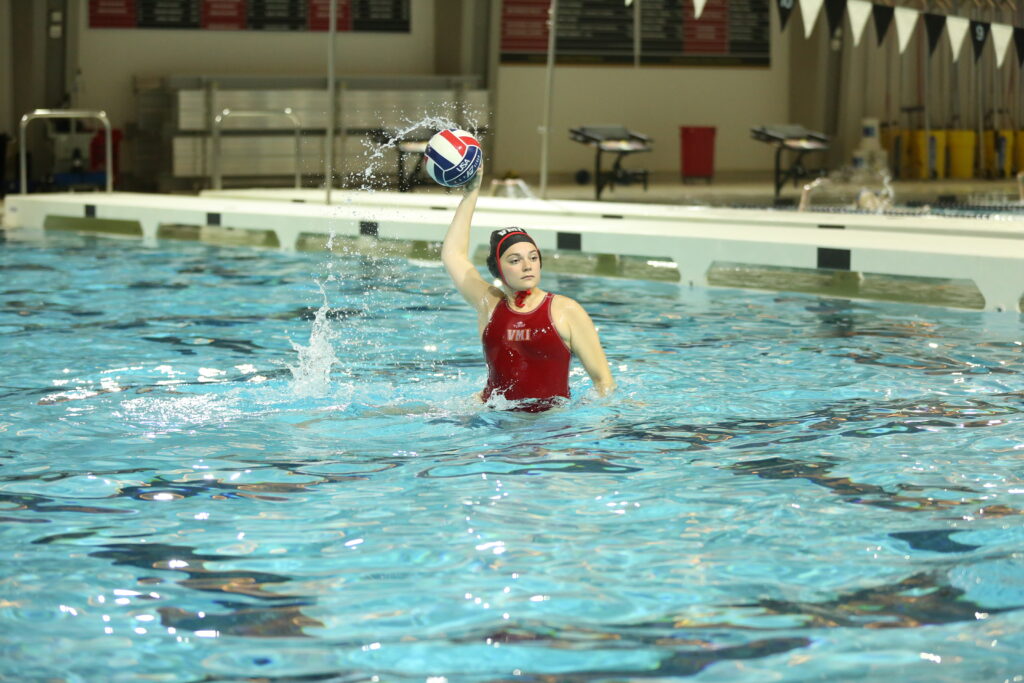
Sydney Smith in the pool playing water polo for Virginia Military Institute.

“It played out very well. None of us were in the same company, so we never lived together, but we’ve never had any issues,” she said. “Through our years here, we’ve told the 4th Class cadets that same thing: try not to live together. That can cause problems. And they’ve all made that a rule, too. And all of them are super close, too. We all hang out, and we do team dinners all the time, especially after practice in season. We make a point to all just go eat together and hang out all the time. A few of us are all the same majors. We have class together.” 

She said those on the team strive to be overachievers. From holding rank to other activities, Smith has a booked schedule.  

Cadet-athletes at VMI not only have their responsibilities with their selected sport but cadet duties on top of that. Cadets are also required to take physical fitness classes twice a week, participate in ROTC all four years, prepare for room and uniform inspections, practice for parade, guard duty, and more. 

Growing up, Smith and her sister, who is at the Naval Academy, were always told they needed to have diverse activities.  

“We’ve both been told you’re going to do other things. You are each going to play a sport, and you are going to play an instrument, and you’re also going to find a leadership role,” she said. 

Smith is also on the Glee Club, while spending two to three hours in the pool a day. That doesn’t include early morning practices or weightlifting. She’s thought ahead though, by taking summer classes every year she’s been here to lighten her academic load while she’s in season. Hence, her last semester is 13.5 credits.  

In order to keep everything straight, Smith has a large calendar she keeps in her room that’s color coded with all her activities and assignments. She said that VMI has prepared her in terms of how to handle a busy schedule. 

“Everything that I’ve had to do and manage with stress, school, and water polo, I’ve kind of compartmentalized all of it,” she said. “I think it has been the most beneficial thing. If I can handle being this busy, I can handle anything.” 

Detachment 880’s Fall FTX: A Weekend of Camaraderie

Every fall semester, VMI’s AFRTOC cadets gather for their Fall Field Training Exercise (FTX), a weekend designed not just to test their skills but to forge lasting bonds and build the kind of leadership that can only come from a shared challenge. This year’s FTX was no exception, blending rigorous training with moments of teamwork, reflection, and even a little fun.

Friday: Settling In

Excitement was high as cadets arrived on Friday afternoon. Once everyone was settled, the detachment gathered in Mallory Lecture Hall for a briefing to go over the plans for the next few days. The air buzzed with anticipation and nerves as C/Maj Boone explained what lay ahead. After, cadets split into groups for introductory rotations; some tackled the obstacle course, others tried their hand at jiu-jitsu. These early events set the stage for teamwork and mutual support, breaking the ice and building trust among flights.

Saturday: Pushing Limits

Saturday dawned early, with cadets forming up on the parade deck in physical training (PT) gear for an intense flight run. The morning chill was quickly forgotten as flights jogged together, carrying rifles and weighted items, encouraging one another throughout the effort.

After breakfast, the real work began. Cadets rotated through stations across campus, each offering a taste of military life: navigating unfamiliar terrain with land navigation, practicing small unit tactics, learning how to treat injuries under pressure with tactical combat casualty care(TCCC), and clearing rooms in simulated combat scenarios. At every turn, the professional officer training course (POC) cadre challenged Basic Cadet Leaders (BCL) and General Military Course(GMC) cadets to think critically, communicate clearly, and rely on their teammates.

Meals were more than just a chance to refuel; they were opportunities to swap stories, share advice, and laugh about the day’s mishaps. By late afternoon, cadets geared up for a spirited round of room-clearing exercises using Nerf guns, with upperclassmen playing the role of “the enemy.” The laughter and adrenaline underscored the importance of quick thinking and adaptability.

As evening fell, everyone regrouped for “Hot Seats,” a candid debrief where cadets reflected on what went well and where they could improve. It was a moment of honesty and growth, capped off by a well-earned dinner and some much-needed rest.

Sunday: Finishing Strong

Sunday offered a change of pace, with optional religious services and specialized workshops for those interested in pilot careers. The morning activities included boxing and aquatic training led by Cadet Webb. These invigorating yet challenging activities pushed cadets out of their comfort zones and taught new skills in a supportive environment.

After cleaning up and sharing one last meal, cadets headed to Kilbourne classrooms for advanced leadership projects. Here, they practiced room-clearing techniques and learned the value of clear communication and decisive action. The weekend wrapped up with final remarks on the Parade Deck, a chance to celebrate successes, acknowledge challenges, and look forward to future opportunities.

By the end of the FTX, tired smiles and high-fives told the story: this wasn’t just a weekend of drills and checklists. It was a time for cadets to push themselves, lean on each other, and discover what it means to lead. Whether mastering a new skill, overcoming a tough moment, or simply sharing a meal, every experience contributed to the growth of these future Air Force officers. Detachment 880’s Fall FTX remains a highlight of the year, a tradition that shapes not just better cadets, but better citizens of the future.

Cadets Attend the 2025 Air, Space, and Cyber Conference

Cadets from AFROTC, Detachment 880 attend the 2025 Air, Space, and Cyber Conference at the Gaylord National Resort and Convention Center in National Harbor, MD.

Each year, the Air and Space Forces Association (AFA) hosts the prestigious Air, Space, and Cyber Conference, coinciding with the Air Force Birthday. This event brings together military leaders, industry experts, and innovators to discuss the current state of the Air and Space Forces, future goals, and emerging technologies that will shape the services for years to come.

This year, a distinguished group of cadets from Virginia Military Institute’s Air Force detachment had the honor of attending the conference.

For these cadets, the conference was more than just a series of panels; it was an invaluable learning and networking experience. The sessions were impactful and highly relevant to their current positions within AFROTC, offering insights into leadership, innovation, and the future direction of the Air and Space Forces. The event fostered meaningful discussions and provided practical knowledge that cadets could bring back to their own detachments.

During the formal panels, Cadets had the opportunity to hear profound speeches from distinguished guests such as the honorable Troy Meink, Gen. David Allvin, Brig. Gen. Houston Cantwell, and many more well-informed and established experts in the air and space career fieBeyond the formal panels, the expo hall buzzed with activity. Cadets engaged with representatives from various organizations, including AAR, Acclient, Adacel Systems, ADS Inc., and many more. Attendees were also allowed to explore cutting-edge technology displays and connect with businesses interested in supporting future activities. One of the most significant aspects of the conference was the opportunity to network with other AFROTC units from across the nation. These interactions allowed cadets to exchange ideas and strategies, strengthening their own programs while contributing to the broader AFROTC community.

Davis T. Clanton, one of the attending cadets, reflected on the experience: “I was extremely grateful to have the opportunity to attend the AFA conference in Washington, DC this year. The panels were impactful, energetic, and relevant to where I stand in my AFROTC career today, so I thought they were of great value. Besides the panels, there was so much to learn and do in the rest of the conference, whether it was networking with people in booths staged in the expo hall, conversing with other AFROTC units from across the nation, or finding local-to-VMI businesses that were interested in future activities. More than anything, this experience was a huge networking opportunity. Utilizing the fact that major AFROTC detachments were there was something I wish I had driven into the second I walked in the door. I found that through talking to many of these cadets, I found ways that we could implement their strategies into our detachment, or they found ways they could implement ours inversely. I made many new friends during this trip, some of whom I talk to regularly. I got to chat with some of Arnold Air Society’s leadership again, which was impactful as we discovered our ability to finally wear our AAS crests on our uniform! Regardless, I thoroughly enjoyed the experience; spending time with friends from VMI, making new contacts, and hearing from critically important speakers made this trip memorable. I am extremely grateful to have had the opportunity and will certainly utilize future opportunities to the fullest of my ability.”

The AFA conference continues to serve as a vital forum for professional development, collaboration, and inspiration for the next generation of Air and Space Force leaders. For these cadets, the experience not only broadened their perspectives but also strengthened their commitment to service and excellence.

Cadets Serve at Major AFROTC Accessions Milestone

Cadets from AFROTC, Detachment 880 served as Cadet Cadre at the Air Force ROTC’s Field Training Event for Summer 2025.

AFROTC Field Training at Maxwell AFB, AL, is a mandatory, boot-camp-style summer program for Air Force ROTC cadets, typically held between their sophomore and junior years, focusing on leadership evaluation through intense physical and mental challenges, military discipline, teamwork, Air Force career indoctrination, and deployment skills to prepare them for becoming Air Force officers. It’s a competitive, high-pressure experience where cadets are assessed on their ability to lead and follow. Cadets who successfully complete field training then go on to enter the next milestone of their journey as a member of the Professional Officer Course of the AFROTC program.

Two Detachment 880 cadets were hand-picked as cadre for Field Training 2025 (FT25). As cadre, they guided BCL cadets through tough field exercises, offering mentorship and setting high standards. Their leadership made a lasting impact on those they mentored throughout the summer.

In vivid detail, Cadet Jada Torrez recounts her experience: “I started Field Training 2025 as a Medical Cadet for approximately the first 2 weeks. I spent around 41 and a half hours over the course of 8 days at the Emergency Room, where I would escort cadets that needed to be seen, and help them with the process of being able to file their information with the Field Training Medical Team. I would also help inform other cadets about the correct processes when it came to needing medical help. I would also attend some of the Field events to include the UXO and Small Unit Tactics at Sim City, and the 3 Mile Run. Additionally, I would also assist when Trainees have symptoms of heat-related injuries by going through the steps to help cool down that cadet. Later, I was switched to be a Cadet MOD 2 Wing Advisor, where I assist/mentor the Expeditionary Cadet Wing Leadership during the second half of Field Training. I advised approximately 860 cadets, with 28 of those cadets being in leadership through Max 4 and 5. In addition to advising cadets, she has also coordinated meeting times for the Chaplain and Form 17 counseling. Lastly, I helped to enforce the standard at the Dining Facility during her free time. Overall, it was a rewarding experience and a great way to experiment with leadership.”

Cadets Participate in Officer Development Training During Summer

Cadets from VMI’s Air Force ROTC Detachment 880 completed specialized officer development training programs at the Air Force Academy during Summer 2025.

Intro to Soaring Program

One cadet spent part of her summer in the Intro to Soaring Program, where she learned the fundamentals of flight using glider aircraft. The program combined hands-on flying with lessons in aerodynamics, safety, and teamwork where she approached every challenge with curiosity and determination, gaining valuable insights into what it means to be innovative and disciplined.

Reflecting on her experience, Cadet Alisa Johnson said, “It was an extremely fun experience because the gliders are so maneuverable, and the USAFA glider training squadron has a great culture. I learned how to take off in a glider behind a tow plane, how to fly aerotow (flying while attached to a tow plane), how to fly basic maneuvers, how to fly a traffic pattern, and how to land. Learning all these in only a few weeks was a bit of a learning curve and a fire hose, but the cadet instructor pilots and flight simulators were a great help. My favorite part of the experience was my AMC Flight. During this flight, I flew us up to a designated area in the sky for aerobatics. Then the instructor pilot took the controls and made the glider do loops and clovers. It was extremely exhilarating to see the world upside down and pull 4-5 Gs! The SOAR program greatly solidified my interest in Air Force aviation. I highly recommend this program to any cadet who is even remotely interested in aviation. Gliders are a great way to be introduced to aviation and get the basic feel of an aircraft.”

Freefall Program

For two other cadets, the summer was all about pushing boundaries in the Freefall Program. They trained in advanced parachuting, mastering everything from jump preparation to mid-air maneuvering and safe landings. Their success in this demanding course showed their readiness to face new challenges, both in the air and on the ground.

Cadet Tristan Bannasch shared, “During my Freefall Program, I felt the true feeling of fear and excitement. Being thrown into a situation where you have never experienced the next thing was surreal. Jumping out of a perfectly fine airplane was nerve-racking but doing it with the group of people you had bonded with next to you was amazing. The scariest part by far was watching your friends fall out of the door and then being the next person to step into the door. Earning your wings is a very honorable and rewarding experience.”

Behind the Balance: Val Tonnu ’26 — Keydet Women’s Swim and Dive

Virginia Military Institute’s cadet-athletes have to juggle cadet life, heavy academic course loads, and their NCAA Division I sport. Committed to both academic and athletic pursuits, balancing their rigorous schedule in both sports and school requires a certain level of commitment and discipline. Behind the Balance is a series that focuses on those cadet-athletes and how they handle the hurdles of the day-to-day. 

With dreams of commissioning into the United States Air Force, Val Tonnu ’26 was aiming for a military college experience. She knew if she deviated from that, her drive to continue the path to the Air Force could diminish, along with her grades potentially suffering. 

Despite not being accepted into the Air Force Academy, she pushed on and decided Virginia Military Institute was the right choice.  

“I think I need to be at this place, or else I’m going to go a little crazy,” she said. 

As a civil engineering major, she’s enrolled in 18.5 credits this semester, while also swimming on VMI’s swim and dive team. 

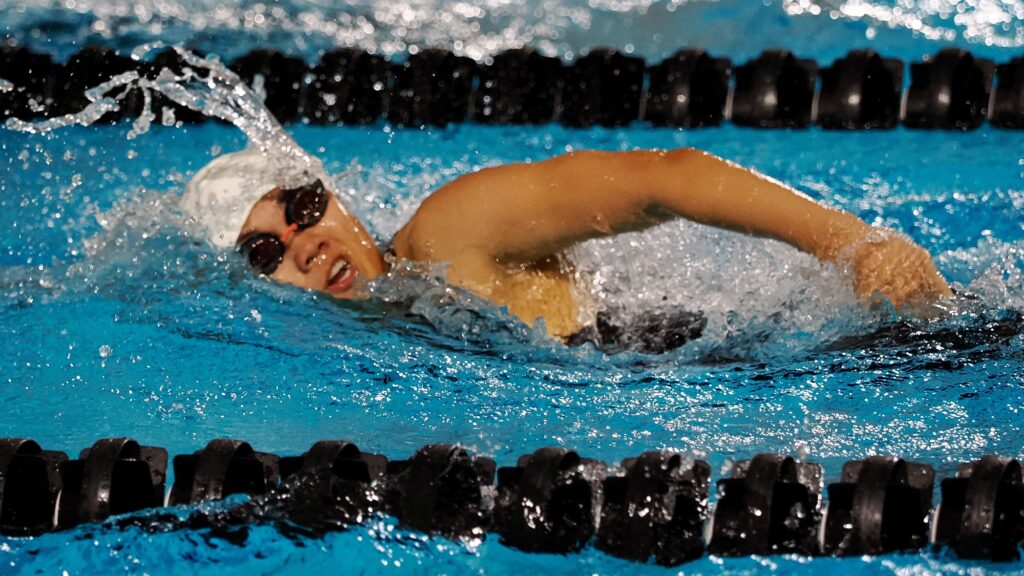
Val Tonnu swims in the pool during a meet for Virginia Military Institute.

“Originally, I wasn’t going to swim, because I really did not enjoy swimming my senior year of high school. I kind of just fell out of love with it,” she admitted. It was much like being burnt out over the sport. 

When she attended the Summer Transition Program before she matriculated at VMI, someone from the team urged her to contact Coach Scott Thacker. Now, she feels like she’s found her purpose on the team, as well as a newfound love of the sport.  

She said she values the effort she and others put in on the team — character is something she respects.  

“I’m never going care about your competitiveness or your performance level, but I’m going to care about the effort and the type of person you are,” she said. “I want to help the younger kids understand that it’s really your character that helps make you.” 

Tonnu is just mirroring what she experienced her first year on the team: a level of leadership that pushed her to succeed. She said the outgoing 1st Class members were caring towards the rats on the team. 

“No matter what, they just wanted us to succeed,” she explained. “And not just in the pool, but they’d always ask us how we were doing in school and how our day was. That’s something I want to carry on throughout the team.” 

It can be a struggle to keep up with the day-to-day outside of the pool. As a long-distance swimmer — swimming the 500-, 1000-, and 1650-meter — she knows about endurance.  

Cadet-athletes at VMI not only have their responsibilities with their selected sport but cadet duties on top of that. Cadets are also required to take physical fitness classes twice a week, participate in ROTC all four years, prepare for room and uniform inspections, practice for parade, guard duty, and more. 

She’s up during the week at 5:25 a.m. to prepare for morning swim, then breakfast and onto classes until lunch. After lunch she either has a lab or can get some schoolwork done. 

“I usually take a lot of the time in between classes to go do work,” she said. “Having a schedule, and the fact that at VMI, it’s a premade schedule for you, it helps a lot. I do prioritize that time in between classes, even if it’s just like the 10 minutes in between class, I can go to my teacher’s office and ask them for help.” 

She credits the engineering department for providing any help she needs to keep her grades in good standing or if she has any questions.  

Swimming allows her to be with herself, she said. She’s able to clear her mind, space out, or even go through what she did in class prior to practice. 

“If I’m upset or have a bad day, I get to practice and don’t think about it anymore,” Tonnu admitted. “It gives me a lot of time to think. During our long sets in the pool, I’m either singing a song, or I think about schoolwork a lot. My friends and I think about schoolwork, and we’ll think about a random problem that we had in class, and I’d be like, ‘oh my gosh, that’s how you do it.’” 

She said not only is the team gaining recruits that are faster and stronger, but they’re more positive and supportive.  

As one of the co-presidents of the Student Athletic Advisory Committee, she’s finding her voice more and more.  

“I think my leadership style is a lot different than it used to be like, because when I came in, obviously you’re a little scared and you don’t want to speak up as much. In high school, I didn’t speak up, I was a huge people pleaser,” she said. “It bled into the way I led, because I let people walk over me. But I think this place has helped me put my foot down. And people are a lot more encouraging and supporting of my ideas.”