
Post View Unavailable »
New Website Launched »

VMI Alums Return for Medical Rotation

Two Virginia Military Institute alumni, Allen Xu ’21 and Thaddeus Wegrzyn ’22, returned to the Institute in late March for two weeks as part of their medical education with a family medicine rotation at the VMI Infirmary.

Xu and Wegrzyn, who are fourth-year medical students at the Edward Via College of Osteopathic Medicine (VCOM) in Blacksburg, chose to serve one of their medical rotations alongside Institute physician, Dr. Melissa S. Krawiec ’01 and family nurse practitioner, Jenny Crance, DNP, FNP-C.

Medical rotations, also known as clinicals, are required hands-on patient care experiences for medical students, and consist of two years of back-to-back four-week durations of training under the supervision of a medical professional in various specialties at many medical facilities. Xu and Wegrzyn have completed about 20 clinicals, with VMI being the last for Xu. Wegrzyn has an additional obligation of two weeks of physical medicine and rehabilitation to complete for Carilion Clinic in Radford.

According to Krawiec, this is the first time alumni have returned to VMI for their clinicals.

“We were delighted to have Allen and Thad with us for two weeks. They were able to closely relate to the cadets and understand the pressures they are under, because they have been cadets themselves. They have come full circle. I trust it was a rewarding experience for them, and I hope they learned some valuable clinical ‘pearls’ in our unique environment. We saw some interesting cases over their time with us,” she said.

Though they arrived to VMI with no set of expectations on what medical conditions they would see during their visit, Xu and Wegrzyn treated a variety of family practice conditions for the cadets including colds, allergies, rashes, burns, dental pain, soft tissue wounds, and orthopedic injuries. They assessed patients and discussed treatment plans with Krawiec and Crance. They also met with cadets who are considering going to medical school. Wegrzyn stated that cadet outreach is important to them. “There is no formal pre-med program at VMI, but there are many cadets who are interested in going into health care. We had many conversations with them and advised them on their options of making that dream a reality.”Xu, a biology major from Ringoes, New Jersey, began his love for healing as a high school student when he became an emergency medical technician (EMT), a skill he continued at VMI. As EMT chief, he would often deliver cadet patients to the infirmary, but was never able to observe their treatment there.

“It’s gratifying to see what happens on this side of the infirmary door,” he observed.

Xu’s chosen medical field of study is psychiatry. Initially entering medical school, he wanted to go into emergency medicine, but changed his mind after witnessing family members facing emotional trials. He noted that returning to VMI at this stage of his training has given him a different perspective on the environment that helped shape him.

“VMI and the military are built on a culture that values discipline, resilience, and composure under pressure. Those are qualities I continue to respect and carry with me. At the same time, my training has reinforced that the reality of life and leadership includes navigating stress, loss, and uncertainty. What I have come to appreciate is that supporting behavioral health does not take away from those core values. If anything, it strengthens them. The ability to reflect, seek support when needed, and maintain personal well-being allows individuals to sustain performance and lead more effectively over time.

Returning in this role has been especially meaningful, and I hope conversations like these continue to evolve in a way that supports both excellence and well-being.” He eventually wants to work with veterans with post-traumatic stress disorder and trauma.
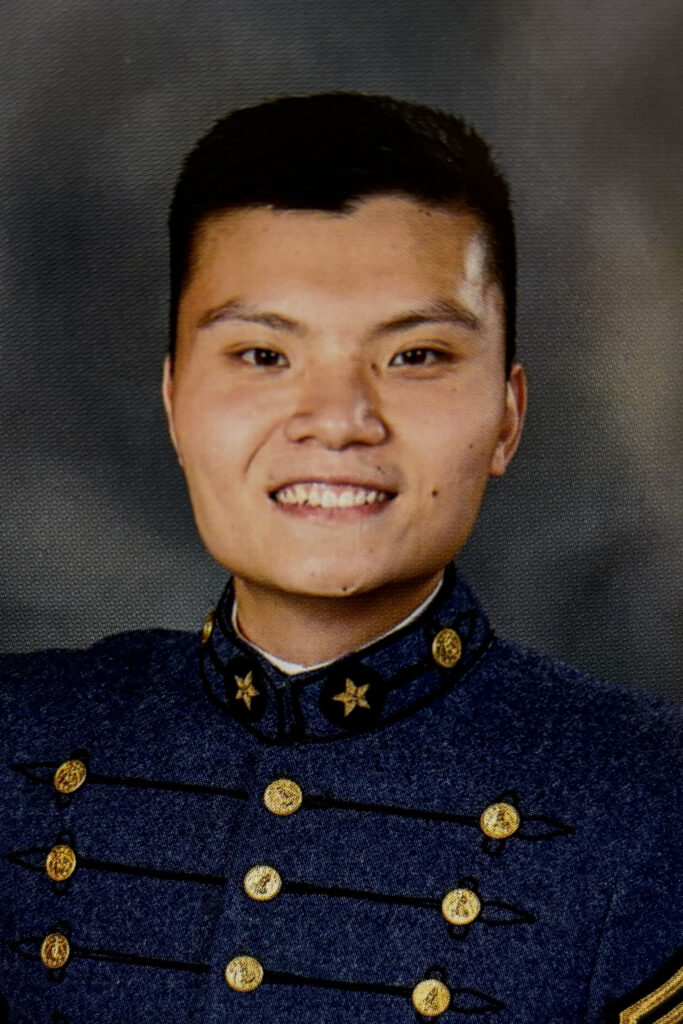
Allen Xu cadet portrait
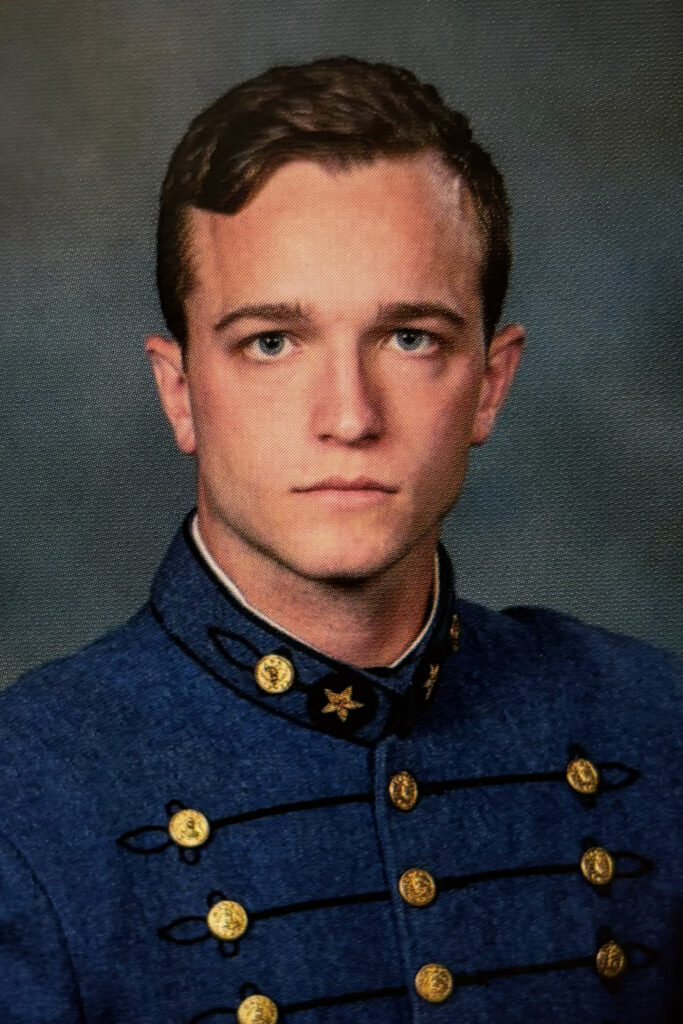
Thaddeus Wegrzyn portrait

Wegrzyn, a biology major with an exercise science minor from Lincoln, Nebraska, served as a cadre member as a cadet. He originally wanted to go into combat in the military. He changed his mind though when he started to enjoy his academic studies at VMI.

“It all started to click with me. My advisor was great, and my interest in going into medicine bloomed. I chose primary care medicine as a specialty, so I’d be in a position to teach patients a better understanding of taking care of their bodies. I feel a strong obligation to educate and mentor patients, so they take control of their health and prevent illnesses and accidents.”

The two originally met in a public speaking class when Wegrzyn was a rat. Since both were biology majors, they shared several more classes, and served on the Honor Court together.

Xu confessed VMI prepared them well for medical school.

“The resiliency we learned at VMI has paid dividends. Cadets are taught how to find out what needs done and to create a plan. They learn good time management skills. And believe it or not, we get more sleep at VCOM than we ever got at VMI,” he laughed.  

Wegrzyn agreed and shared that VMI graduates are highly thought of at VCOM.

“VCOM’s mission is to prepare globally-minded, community-focused physicians, which is similar to that of VMI’s mission of producing citizen-soldiers with a high sense of public service. In fact, there are currently five VMI alumni who are in their first year at VCOM. There is a strong pipeline from VMI to VCOM.”

He added there is a chapter of the Student Association of Military Osteopathic Physicians & Surgeons at VCOM in which he served as president and Xu served as vice president last year. This year, the reins of the two leadership positions are held by two other VMI graduates.

Following graduation from medical school in May, Xu and Wegrzyn will begin their residencies. Xu will serve his for four years in psychiatry at Camp Lejuene, North Carolina, and Wegrzyn, who has commissioned into the Army, will serve his for three years in family medicine at Fort Bragg, North Carolina.
Marshall Leadership and Awards Seminar Returns to VMI

After a hiatus, Virginia Military Institute welcomed the return of the George C. Marshall Leadership and Awards Seminar Feb. 23-24. Each year since 1978, the U.S. Army Cadet Command recognizes and awards the top-tiered cadets at senior ROTC programs and the U.S. Military Academy at West Point, by sending them to the seminar, originally held at VMI, the alma mater of Gen. George C. Marshall, VMI Class of 1901. In addition to being the driving force to get the event back to VMI, the George C. Marshall Foundation led efforts to secure speakers and prepare discussion topics.  

Cadets were nominated from their respective programs based on scholarship, leadership, physical fitness, and community involvement, and are designated George C. Marshall Award recipients for their respective year. This year, a total of 65 cadets were selected to attend. Regrettably, the blizzard that hit the East Coast, prevented the nine cadets from West Point and other New England schools from traveling. The others came from all over the country; as far away as Hawaii, California, and Wyoming; and as close as Richmond, Williamsburg, and Lexington.

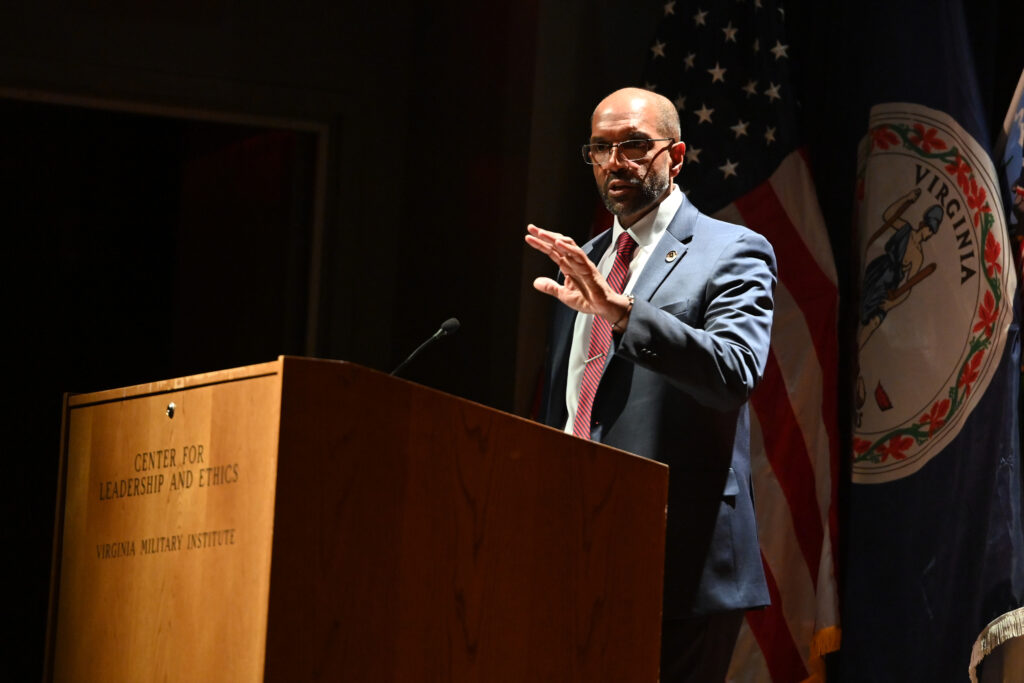
Over the course of the two-day conference, the award recipients learned of Marshall’s legacy as a soldier and as a diplomat. They heard from and engaged with professionals knowledgeable in the military, geopolitics, and history, including Col. Spencer Bakich, professor in the Department of International Studies and Political Science (IS) at VMI; Brig. Gen. Maurice Barnett, commanding general of U.S. Army cadet command; retired Gen. Gary Brito, former commanding general of the U.S. Army Training and Doctrine Command, and president of the Brito Group, LLC; Lt. Gen. Johnny Davis, commanding general of U.S. Army recruiting command; George Foresman ’84, former undersecretary of the Department of Homeland Security; Dr. Paul Levengood, president of the George C. Marshall Foundation; retired Col. Thomas Linn ’73, professor at the Naval War College; retired Lt. Gen. Douglas Lute, former ambassador of the United States to the North Atlantic Treaty Organization; retired U.S.M.C. Gen. John Paxton, former assistant commandant; Dr. Philip Potter, professor of public policy at the Frank Batten School of Leadership and Public Policy at the University of Virginia; Col. Patrick Rhamey, professor of IS at VMI; Command Sgt. Maj. Darrell E. Walls, command sergeant major of the U.S. Army Cadet Command; and Dr. Clyde Wang, assistant professor of politics at Washington and Lee University.Retired Gen. Gary Brito speaks to the George C. Marshall award recipients in Gillis Theater Feb. 23.

Gen. Gary Brito speaks at the podium in Gillis.
Retired Gen. Gary Brito speaks to the George C. Marshall award recipients in Gillis Theater Feb. 23.—VMI Photo by H. Lockwood McLaughlin.

The award recipients listened to speakers, attended a panel discussion, and engaged in small group breakout sessions that covered a wide range of topics including how the military reflects a changing society; operating in a multinational environment; drones and the effects on warfare; the integration of artificial intelligence in warfare; and the great power competition in the South China Sea. They established a long reading list, gained advice to use as young officers, studied, engaged in intense physical training, networked with their peers, and formed new friendships.

A highlight for the award recipients was sharing dinner Feb. 23 with VMI alumnus, Chairman of the Joint Chiefs of Staff Gen. Dan Caine, VMI Class of 1990. Following the meal, Caine gave the keynote speech in Cameron Hall in which the entire VMI Corps of Cadets, along with many members of the faculty and staff attended.

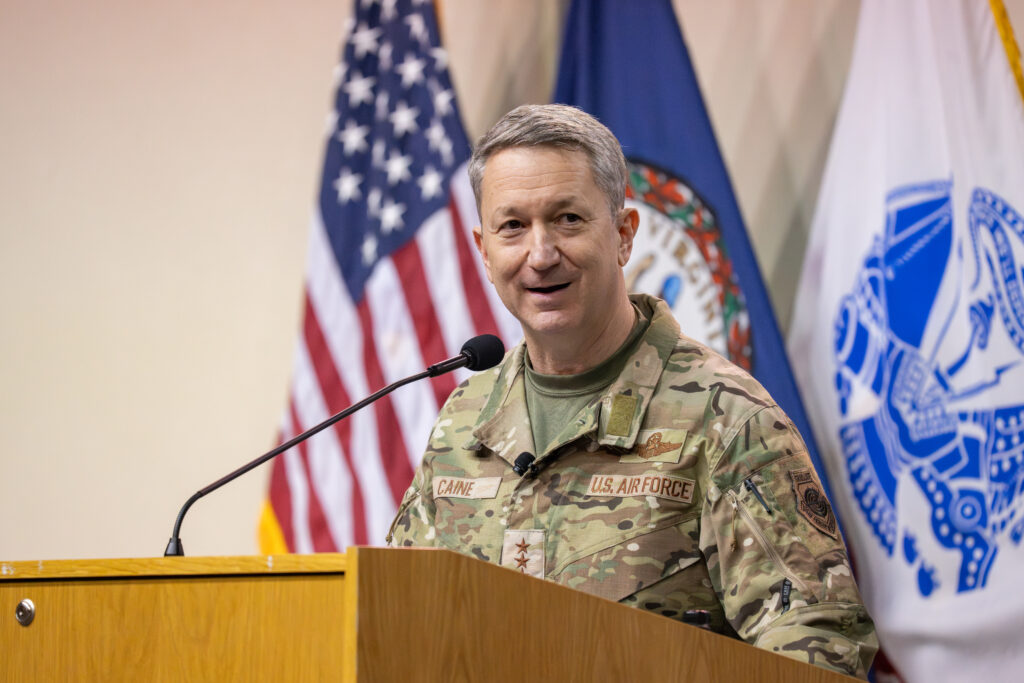
Gen. Dan Caine '90 speaks at a podium wearing Air Force OCPs.
Gen. Dan Caine ’90 speaks about George C. Marshall’s leadership in Cameron Hall Feb. 23.—VMI Photo by H. Lockwood McLaughlin.

Caine opened his speech simply and sincerely, “It is nice to be home. I cannot tell you how overjoyed my inner child is to be back here in Lexington. It’s just a very, very special place.” He immediately bonded with the Corps of Cadets by good-naturedly teasing their superintendent, Lt. Gen. David Furness ’87, reminding the Class of 2026 of the advice he offered them when he spoke to them at their Ring Figure in 2024, and congratulating the Class of 2029 for their recent Breakout of the Rat Line. He referred to both the VMI cadets and the visiting cadets as teammates.

He recalled how when he was a cadet, he helped with the Marshall seminar when it was previously held on post. To the award recipients he said, “It was striking to me then, and it’s striking to me now, how lucky we are to have you entering into the service. We are proud of you and grateful for you.” To all the cadets in the arena he said, “Your path and service will not always be easy. You will be tested and challenged. You will be asked to make tough decisions. From time to time, you will find yourselves at a crossroads where you simply don’t know what to do… I encourage you at that point in time to ask yourself the question: ‘What would Marshall do?’ There are many leaders that I’ve learned from in my career, but there is only one George Marshall.” Dr. Phil Potter and Gen. Jay Paxton participate in a panel discussion at the George C. Marshall Leadership and Awards Seminar in Gillis Theater.

Caine stated that leadership for Marshall was a passion, and something he studied his entire career. “It all started and stopped with people; how to properly lead them, how to connect with them, how to care for them, and how to love them. Marshall was humble. It was never about him. It was about doing the right thing. It was always about the deed and never about the glory. He believed, as I do, that every day we have a responsibility to get out of bed and earn it, in a quiet, humble way.”

Caine confessed that after he graduated from VMI, he didn’t always wear his class ring. But as he started to grow in responsibility, he returned to wearing it again.

“Because it reminded me every time I looked at it, ‘What would Marshall do?’ The most precious thing you have as a leader is the people you are blessed to lead. People were everything to Marshall, so I became a people person. I encourage you to do the same thing. Relationships are essential in your path of service, in or out of the military. It means asking folks a simple yet beautiful question, ‘What’s your story?’ Sometimes they’ll tell you good things. But every once in a while, they’ll tell you when they need your help. Listen carefully to the answers to that question. Marshall was a master at this.”

Caine closed by asking the assembly to remember the members of the Joint Force doing the nation’s business, the deployed and their families, and most importantly, the fallen and their families.

“They show us what courage looks like. It is through all of them and Marshall that we find the gift of a perfect example. Thank you. Congratulations to our Marshall award winners, and to the Corps Cadets. It’s nice to be home with you.” Caine’s audience gave him a standing ovation, and he returned the affection as he left the arena, with a smile and wave.

Matthew Kleinschuster ’26, a VMI cadet, was one of the award recipients. Kleinschuster is an applied mathematics major with a business minor, from Richmond. He is commander of Foxtrot Company, as well as Battalion commander of VMI’s Blue Ridge Battalion, the largest ROTC program in the country. Upon commissioning, he will branch in explosive ordnance disposal. He shared attending the seminar was a huge honor.

“Learning about all of Marshall’s accomplishments has given me confidence, and I am excited to join the Army and hopefully carry out his legacy. I have learned so much during our civil discussions, and hearing all the perspectives of very successful AROTC cadets. I plan to take everything I have learned and implement it into my approach in becoming a future officer.”