Post View Unavailable »
New Website Launched »

Cadet–Alumni Networking Forum Focuses on Opportunities

More than 50 alumni and nearly 1,100 cadets gathered in Memorial Hall and Cocke Hall Saturday, Sept. 29, for the Cadet–Alumni Career Networking Forum, an annual event designed to help cadets take advantage of one of VMI’s top resources: The alumni network. 

Ongoing now for more than 15 years, the forum offers cadets the chance to mix and mingle, either in small groups or one-on-one, with alumni representing a wide range of fields. This year, career fields represented included health and healthcare, information technology and cybersecurity, law enforcement, banking and finance, government, National Guard/reserve, and more.

New this year was an event specially designed for members of the Rat Mass of 2024+3. They gathered in Memorial Hall to hear from two alumni—retired U.S. Army Lt. Gen. J.D. Johnson ’77 and Bill Miller III ’89—about how to start the process of preparing for life after VMI. 

Miller, the father of both an alumnus and a current cadet, urged his listeners to focus on the end goal of employment from the beginning of their cadetships. “Every college student needs to get multiple full-time job offers,” he said. To that end, it’s important to focus on internship season, which begins in the summer after a cadet’s 3rd Class year, and make sure to reach out to alumni working for companies offering internships. 

“Older VMI people help younger VMI people,” said Miller, a founding partner of the boutique investment firm 1839 Capital. “That’s what makes VMI people unique and different.”

Johnson, who was attending the event for the first time because he’d been overseas in years past, echoed Miller’s statement about the importance of not putting off career preparation. “This is important to start as early as possible, helping the cadets to think about what’s next, whether it’s a military career or a career in business, and how to go about doing that,” he stated. “It’s spooky, sometimes intimidating to people to get started, so to have an opportunity to speak to people who’ve been through that and have managed to make it out alive is an opportunity that cadets need to have.”

Johnson noted that he graduated in the era of mandatory commissioning—but now, with a multitude of opportunities available to them, cadets need guidance in navigating those opportunities. “Especially nowadays, it’s a competitive world,” he said. “I think VMI sets the cadets up to compete in ways with all kinds of advantages. But they need to understand how to take advantage of that, and they have to be willing to step forward.”

In Cocke Hall, upperclass cadets had the chance to speak directly with alumni and sit down one-on-one with select alumni for resume reviews.

Whitney Matthews ’07, a professional chef who’d attended the forum in the past, said she makes the event a priority on her calendar. “For me, it’s important that the female cadets see female alums,” she stated. “That’s what I hope to accomplish. In addition to talking to all the cadets, I try to show the female cadets that we are here … that there’s [an] alumnae base that wants to support them.”

Also attending the forum was Chuck Story ’91, who works in sales for Wesco Distribution, a global wholesale distributor of electronic equipment. “I’m finding that most cadets don’t really understand what the alumni network is,” he commented.

Story’s message to cadets was simple—make those connections, attend local chapter events back home, and for those commissioning, attend officer calls when they have the chance, as connections made now can be of enormous benefit down the road. “I know handfuls of brother rats that were in the service that can say, ‘Hey, I served with Major General Wins [’85] when we were in the Army,’” he said.

Cadets attending the networking forum said the event was well worth attending. “I’m going into the Army, but it’s great to hear about career paths after the Army because I don’t plan on staying in that long,” said Cadet Rachel Roberson ’25, a psychology major who was attending the forum for the first time this year. Roberson is still weighing her options in terms of post-Army careers with thoughts toward either law or nursing and was very appreciative of the chance to meet with so many alumni. 

“There’s not a lot of schools that have [events like these],” she commented. “We’re really lucky at VMI—they care where we go after [graduation] and want us to succeed.” 

Cadet Nathan Vanness ’25, a physics major, also noted his appreciation for the “spectacular” opportunity the networking forum provided. “This is an opportunity that a lot of people don’t realize is useful until they come down here and see it,” he said. Vanness added that one of his roommates, who is interested in law, took some coaxing to come to the networking forum but was fully engrossed in the event from the moment he arrived.

After VMI, Vanness plans to commission into the Air Force—and while his initial career path is set, he was very glad to have help with soft skills like networking. “I’ve been able to look at making a resume and connecting and doing networking with the rest of the alumni network, which I’m sure is like 100% a useful skill that I’m going to need to know,” he stated. “VMI is a place that provides opportunities that are unexpected.”

Story originally published by VMI Alumni Agencies.
VMI Alumnus Has ‘Best Job Ever’ as Commander in the Cavalry

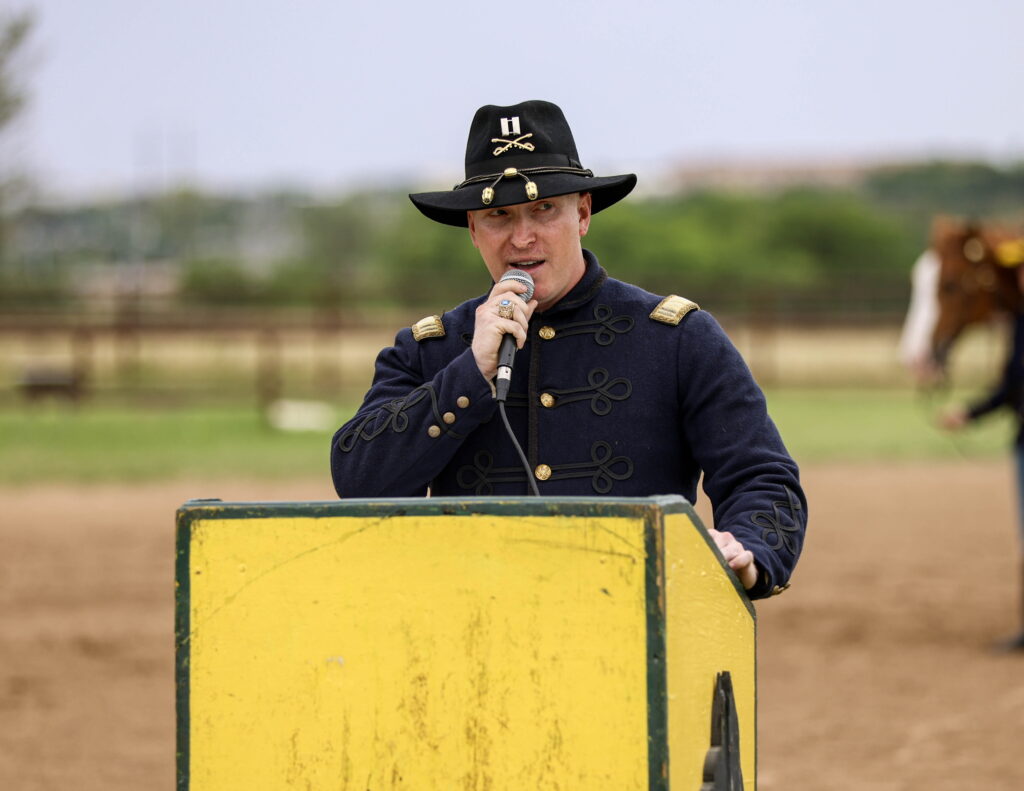
Capt. Michael Gates’ ’17 former Virginia Military Institute roommate refers to him as the modern-day Teddy Roosevelt. Gates said that was a bit of an exaggeration and joked he could never be at Teddy Roosevelt’s caliber.

Instead, he is the commander of the Horse Cavalry Detachment for the First Cavalry Division in Fort Cavazos, Texas, formerly Fort Hood. He took command of the division at the beginning of June. Prior to that, he was the commander of the horse detachment at the 11th Armored Cavalry Regiment in Fort Irwin, California; a similar role to what he does now, just about a quarter to a third of the size in terms of horses, manpower, and missions, he explained.

VMI alumnus part of the cavalry in the US Army. He says he has the best job ever.

“Being able to represent a piece of military history while you’re in active duty is an honor,” he said. “We get to choose our own team and choose the people who get to continue this, this tradition, this unbelievable tradition that’s just romanticized today, but we get to go live that, not just in day-to-day, but in military ceremonies.”

But how does one with no equestrian experience come to command a mounted cavalry unit?

“I really just stumbled upon this world,” he said.

Capt. Michael Gates’ ’17 the commander of the Horse Cavalry Detachment for the First Cavalry Division in Fort Cavazos, Texas, formerly Fort Hood.

While he was working with 1st Sgt. Chris Stemple in the same company as engineers, Stemple left to become the 1st Sgt. at the horse detachment in the 11th Armored Cavalry and turned to Gates to be a commander.

“I originally turned it down because I didn’t have any horsemanship experience or knowledge or anything,” he said. “And he was like, I just need a competent officer out here, I need a partner, I need somebody who I can rely on. I went out to the unit and I fell in love immediately. So I put my name in for the position.”

The next thing he knew he was given the position and heading out to California just as COVID-19 restrictions were subsiding. Even with his lack of horse experience, he said that, as an officer, he’s more focused on leading and those in that position tend to have less experience than the soldiers.

“I didn’t necessarily need equestrian experience. I needed to understand our mission set and be able to utilize my soldiers and noncommissioned officers in roles that would allow the unit to thrive,” he said.

VMI alumnus part of the cavalry in the US ArmyHe did receive training and won the intermediate level of the National Cavalry competition last year, taking first place in three events, second place in two events, and dominating the class. Events included historic cavalry tasks like mounted sabers, mounted pistols, military field jumping, and dressage.

“So, I’m getting there,” he said, modestly.

His unit is one of seven active duty Army units that work with horses, so it’s a very unique position — with less than 200 soldiers that do it, Gates shared.

“It is an extremely tight-knit community,” he said. “And all of them are hand selected to the teams. So as opposed to the rest of the Army where the team you’re dealt, is the team you got to war with. Out here we take only the best. You have to try out to be on the team. You can’t have any infractions while you’re on the team. It’s a higher level of commitment and discipline. These soldiers give up most of their weekends to go to our traveling events. We also get more face time than 99% of the military does with the public. So they have to be as professional as possible.”

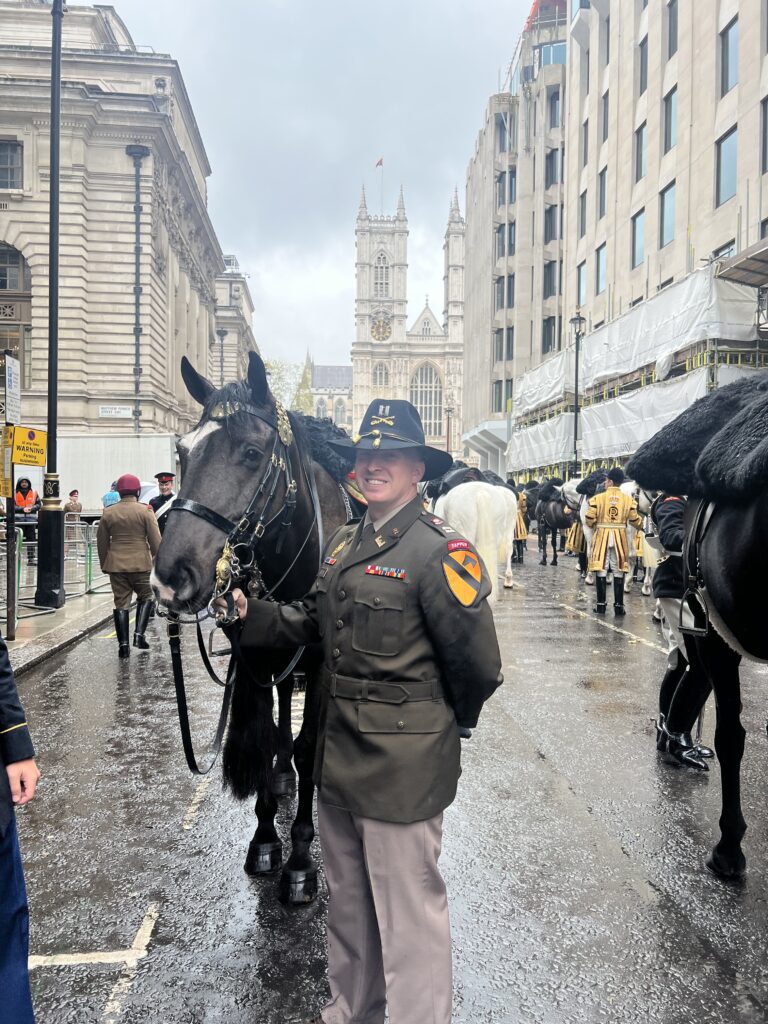
By far the coolest thing about his job so far was leading the envoy for the King of England’s coronation. Within two weeks of receiving his new post, he was asked to represent not only his unit but the United States Army and the cavalry to a foreign military unit. VMI alumnus part of the cavalry in the US Army.

Capt. Michael Gates’ ’17 the commander of the Horse Cavalry Detachment for the First Cavalry Division in Fort Cavazos, Texas, formerly Fort Hood.

“Yeah, of course, it’s in the job description, but the scale varies pretty wildly from local ceremonies to, I mean, that is probably one of the biggest international ceremonies that any of us will ever be able to see in person,” he said. “We were right there with the Household Cavalry mounted regiment, the King’s guard as they were preparing to escort the King to Westminster Abbey.”

Gates said he and others were staged ahead of time and got to watch the King get escorted.

“We were maybe 100 yards from him. It was unbelievable,” he said. “It was so surreal … almost inception-like, dream state. Being there, living in the moment.”

Gates never held rank at VMI but he thinks that benefited him.

“I think it gave me the perspective similar to my soldiers, and it helps me be relatable and be empathetic to what a soldier is going through just from day to day, whether it’s barracks life or standing in formation or you know, waiting for orders or not being in the decision-making process,” he said. “You don’t realize how little gets put out as a leader until you have the perspective of a soldier. And that was incredibly important to my development as a leader. So the information dissemination, understanding motivations of a soldier and priority sets; they helped me in my decision making process as a leader today.”

‘Finding a Calling’ Forum Shines Light on the Joy of Teaching From Two Alumni

Annika Tice always wanted to be a teacher. Spending time in her grandmother’s classroom growing up, she would play pretend school with her siblings. The small act of pretending blossomed into her love for the selfless service of education and impacting generations to come.

“I hope to teach in order to build a foundation towards working in higher administration,” she said. “I want to be a leader of change in our education systems.”

Tice was one of two speakers for Virginia Military Institute’s Department of English, Rhetoric, and Humanistic Studies (ERHS) Alumni Forum, “Finding a Calling” held Feb. 20 in Scott Shipp Hall. Tice, a 2019 VMI graduate, was joined by Joseph Murray, VMI Class of 2021, to speak to cadets on how they discovered the joy of teaching.

ERHS’ forum showcased the discoveries and decisions of two English graduates, who found their major gave them flexible and enduring skills, and courage to discover callings in and out of the military, educating various populations. As Tice and Murray expressed, life after VMI can feel incredibly open with possibility, brimming with choices. The transition is exciting, but it can also overwhelm, unless one listens to and pursues what calls them.

In recent years, the ERHS department has invited English alumni back to share careers in the military, business, education, and communications. They discovered the best attended forums featured newer graduates who pursued diverse fields and callings. Continuing that success, their newest series, ‘Finding A Calling’ offers current students a glimpse of life after VMI in teaching, law and other fields. As forum co-planner Lt. Col. Mary “Polly” Stewart Atwell, associate professor in the Department of English, Rhetoric, and Humanistic Studies, notes, “VMI’s enthusiastic and engaged alumni are one of the Institute’s greatest resources. These forums give us the opportunity to showcase our department’s strengths and connect current cadets with alumni in their fields.”

Tice and Murray both discovered their interest in education through their forays in ERHS Fieldwork courses, and in their Honors Projects — Tice in language, educational theory and practice, and Murray in philosophy. They made, and continue to make their own success after VMI, offering current students not just career models, but an attitude towards shaping interesting paths that bring meaning, even reward surprises in their lives ahead.

Tice, who completed a Fulbright Teaching Assistantship teaching English in Africa’s Ivory Coast, went on to four years active duty as an Adjutant General Officer for the Army at Fort Jackson, South Carolina, while completing a M.Ed from University of Virginia’s Curry School of Education. This June she starts a teaching residency in California’s High Desert region with Alder Graduate School of Education, which will earn her another M.A. to teach multiple subject disciplines in K-6.

She said it’s important for cadets to hear from alumni in order to build a network between the VMI community — both past, present and future.

“To this day, VMI still impacts my life and literally has changed the course of my future for the better,” she said. “I wouldn’t be who I am today without the never-ending support and connections along the way.”

While at VMI, Tice worked four on-post jobs, completed double Honors in English and French, and was the first woman to serve as an officer on the Honor Court. Tice chose VMI because she craved structure and discipline, but also saw it as a challenge. She hopes her discussion of her experiences, like the Fulbright, the Army, and VMI will help shed some light for cadets on charting a path after graduation.

“I am hoping to be candid and answer any questions that cadets may have. I am bringing my most vulnerable self,” she said. “The truth is that I am no expert in my field, but I am a lifelong learner. I hope the audience can appreciate this message on life.”

Murray graduated from VMI with a B.A. in English with concentrations in philosophy, literary studies, and writing and rhetoric. He served as Regimental Executive Officer of the Corps of Cadets, participating in the VMI Newman Club, and presented his honors thesis on Aristotelian and Thomistic philosophy. After graduating, he began working as a high school English teacher at Riverside Academy, a preparatory boarding school in Georgia. He is currently applying to doctoral programs in philosophy for next year.

“Every experience, from participating in the ratline to planning the ratline to presenting my honors thesis, was deeply formative,” he said. “Aside from my work on the ratline and in barracks, the ERHS department at VMI influenced me deeply, and I would not have enjoyed my time at VMI nor embarked on the path I am on if it were not for the excellent curriculum provided to English majors. My professors in the ERHS department continue to inspire and guide me in my career.”

Originally, Murray came to VMI seeking to commission in the Marine Corps, but ended up pursuing education and academia.

“Teaching was the logical next step for me, and it has been an extremely formative and rewarding experience,” he said. “I highly recommend education as a field for cadets who desire to follow their love of learning and hone the skills of leadership and mentorship they learn at VMI.”

He hopes his discussion on taking the road less traveled will inspire other cadets to explore their options outside of VMI, which are endless. “The education and experience at VMI is valuable for reasons other than military training”, he said.

“The ‘varied works of civil life’ for which cadets are prepared — according to the VMI Mission — are not confined to a single profession or skillset, they represent the ocean of possibilities that are open to cadets as VMI men and women,” he said. “Wherever they go, whether or not it involves military service, cadets are equipped with the tools to excel.”