Post View Unavailable »
New Website Launched »

Cadets Present Research at NCUR

Eighteen Virginia Military Institute cadets joined approximately 5,000 participants at the National Conference on Undergraduate Research (NCUR) held at the Greater Richmond Convention Center in Richmond April 13-15.

NCUR is an organization dedicated to promoting undergraduate research, scholarship, and creative activity in all fields of study. It offers a unique environment for the celebration and promotion of undergraduate student achievement, as well as student career readiness development. The location for the conference changes each year, in various places across the country. In 2005, it was held at VMI and Washington and Lee University. 

Lt. Col. Molly Kent, director of the VMI Center for Undergraduate Research (VCUR) and associate professor in the Department of Biology, also attended the conference. She said this year’s group of cadets who applied and were accepted to present their work at NCUR was the largest since she assumed the role of VCUR director in 2024.

“We were pleased that the close proximity of this year’s conference allowed so many cadets to attend, and VCUR was able to fully fund the trip. Our cadets showcased the full breadth of the Institute’s academic excellence — from the arts and humanities to cutting‑edge engineering — through research conducted by cadets, alongside dedicated faculty mentors.”

Nicholas Eynon ’26, an applied mathematics major minoring in philosophy, presented a poster based on his honors thesis, “Testing Dissimilar Metals and their Interface Strength: How do the Interface Characteristics of Collision-welded Metals Affect the Shear Strength of their Weld?”
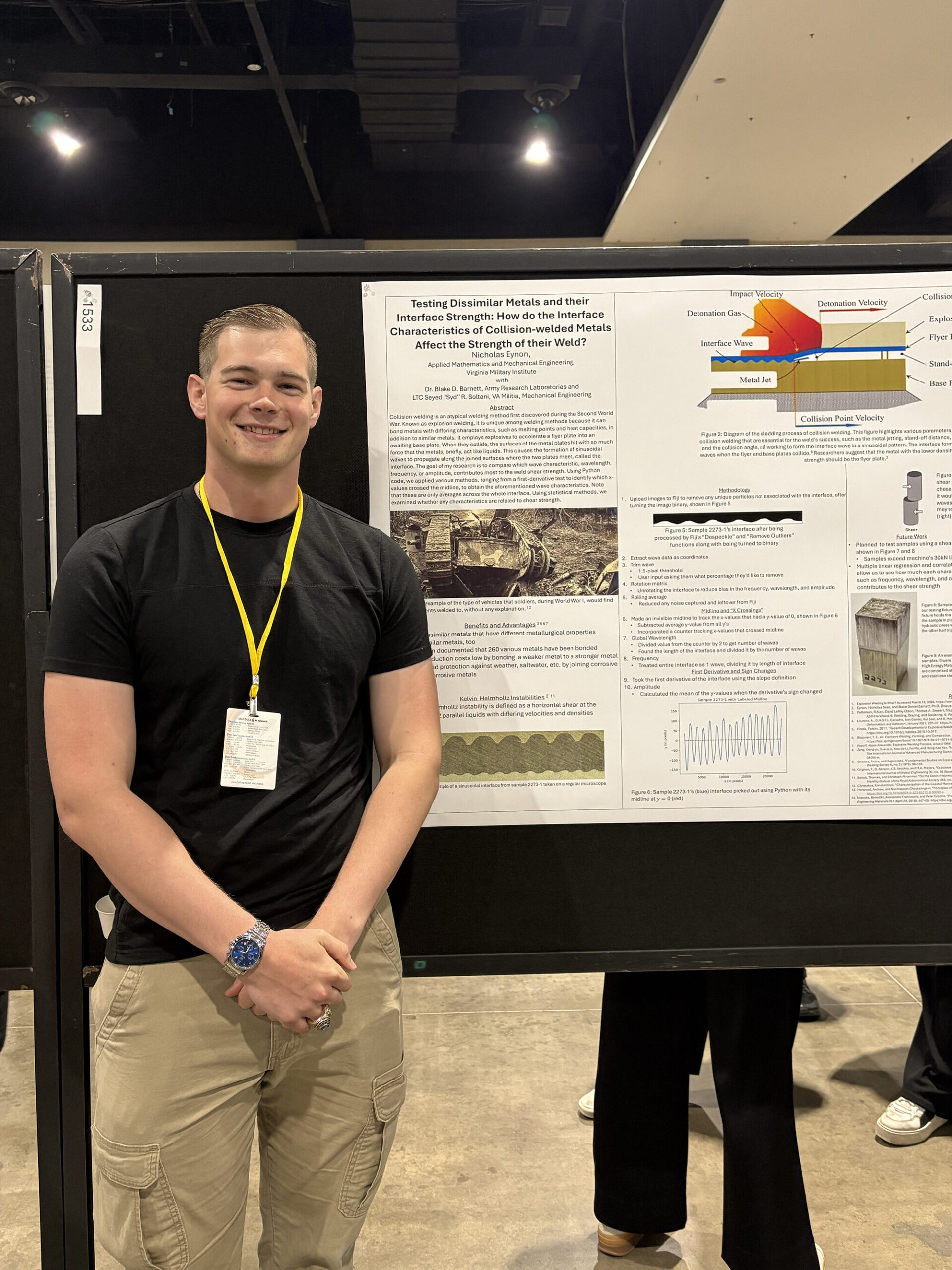
Nicholas Eynon ’26 presents his poster at NCUR in Richmond. –Photo courtesy of Lt. Col. Molly Kent.

His research focused on collision welding, specifically its relationship between its shear strength and its interface characteristics. Eynon admitted he had fun at NCUR. “It was very enjoyable to present my work, not only as a reward, but to share the name and vision of VMI to other college students, show them the hard work I put into my research, and show them the same respect. It was interesting to hear about other students’ research, and in some instances, we discussed how our topics overlapped and could be used in tandem. Overall, I am very grateful for my time with NCUR.” Following graduation in May, Eynon will commission into the U.S. Army.

Nickole Chávez ’26, an English major minoring in Spanish, presented her project, “Bridging the Confidence Gap: ELL Mentorships and Narrative Exploration of the Mexican- American Student Experience.”

Her research involved an independent study working with an English Language Learner (ELL) student in Lexington, which led her to write a narrative of her own education using reflexive thematic analysis. “I used my experience of working in the school and my memories of growing up in a failing education system to corroborate articles I read about the lack of resources in schools for bilingual and immigrant students,” Chávez explained. She presented her findings in a crowded room, which she admitted was a little nerve wracking. “NCUR was an amazing experience. I was able to share a personal project that I worked on for two semesters. Sharing my story and experiences with a room full of students and professors from other schools was something I never thought I would do.” Chávez hopes to work for the Department of Homeland Security after graduating.
Cadets Present Research Projects at SURF

Five Virginia Military Institute cadets, with Dr. Sherif Abdelhamid, assistant professor in the Department of Computer and Information Sciences and outreach liaison officer for VMI’s Cyber Defense Laboratory, traveled to Spartanburg, South Carolina, to present research projects at the SoCon Undergraduate Research Forum (SURF), at Wofford College Oct. 24-25.

SURF brings together students from across the Southern Conference league’s member institutions to showcase their academic excellence.

Cadets who attended include Benjamin Davis ’26, who is double majoring in applied mathematics and computer science; Jackson Pelt ’26, a mechanical engineering major; Shahryar Shah ’26, a computer science major; Gracie Harlow ’27, who is double majoring in history and English; and Jeremiah Woods ’27, a history major.

Woods said SURF was a great opportunity to share his first research experience. His project titled, “African Americans at VMI: 1851-1865,” explores the contributions of the enslaved and free Black men and women who lived and worked in connection with the Institute during the years leading up to and throughout the Civil War.

“It highlights their lives, labor, and legacies, while reflecting on how their presence shaped the foundation of VMI and how their stories can be more fully recognized today,” he explained.

In her project titled, “Commemorating Service: Preserving Memory Through Archival Research at the American Battle Monuments Commission,” Harlow focuses on U.S. military personnel who died during the Normandy campaign in World War II, and the importance of preserving their stories. Last summer, she presented her research at the Normandy American Cemetery in France.

“I am extremely thankful to have had the opportunity to also present my research at SURF. The feedback from graders who evaluated the presentations, allowed me to move forward and broaden my views,” she said.

According to Abdelhamid, attending SURF was an invaluable experience for the cadets. “They not only showcased their research with confidence and professionalism, but also engaged deeply with peers and faculty from across the Southern Conference. SURF provided them with a meaningful platform to exchange ideas, receive constructive feedback, and see firsthand how their academic work connects to larger conversations in their disciplines.” 

The Vanguard — Aidan Carman ’27

The Vanguard series highlights cadets of Virginia Military Institute who exemplify promise, perseverance, and the true spirit of leadership. While they may not be the top-ranking students or those in prestigious positions, these individuals’ dedication, resilience, and growth embody the essence of being a VMI cadet. By sharing their stories, including the challenges they’ve faced and overcome, we shine a spotlight on the diverse paths to success at the Institute, proving that leadership and excellence come in many forms.  

Aidan Carman ’27 can be described as committed to whatever Virginia Military Institute can do for him. His professor, Col. John David, professor in the Department of Applied Mathematics and Jackson-Hope Distinguished Professor of Natural Science, said Carman is trying to get everything he can from his time at the Institute — utilizing his math degree track and plans of commissioning into the U.S. Navy.

“I feel like there’ s been a lot of good Naval officers come out of our department, and I think he’s going to be another one,” David said. “I think beyond his effort and hard work is the fact that he seems to fit in well with his [brother rats] and other math majors. He’s a great kid. My job would be easy if they were all like him.” 

Carman says he’s focused and confident in himself, but he’s still trying to improve himself. The math major said he’s academically sound.  

“I’m fortunate that I can grasp a lot of material. Not to say that I don’t have to put in any work, but it seems, for the most part, I pick up things pretty quickly, so that’s good. I’ve been able to keep good grades,” he admitted. 

There was a bit of a learning curve in his first year, especially when it came to time management.  

“That was a very big shock coming here, especially throughout the Rat Line, was learning how to manage my time,” he stated. “As a high school student, I didn’t have to put any effort at all into it. I never brought home homework. It was all done by the end of the day. I didn’t have labs. So, learning how to balance school with also getting sleep and managing all that time to do the little in between things. 

“The biggest thing I had to learn was not doing homework the night before it was due, but when it was assigned,” he said. “Procrastination is what really gets people. All the little things start to add up. Once I started just getting the smaller stuff out of the way, I had a lot more time for bigger projects and tests.” 

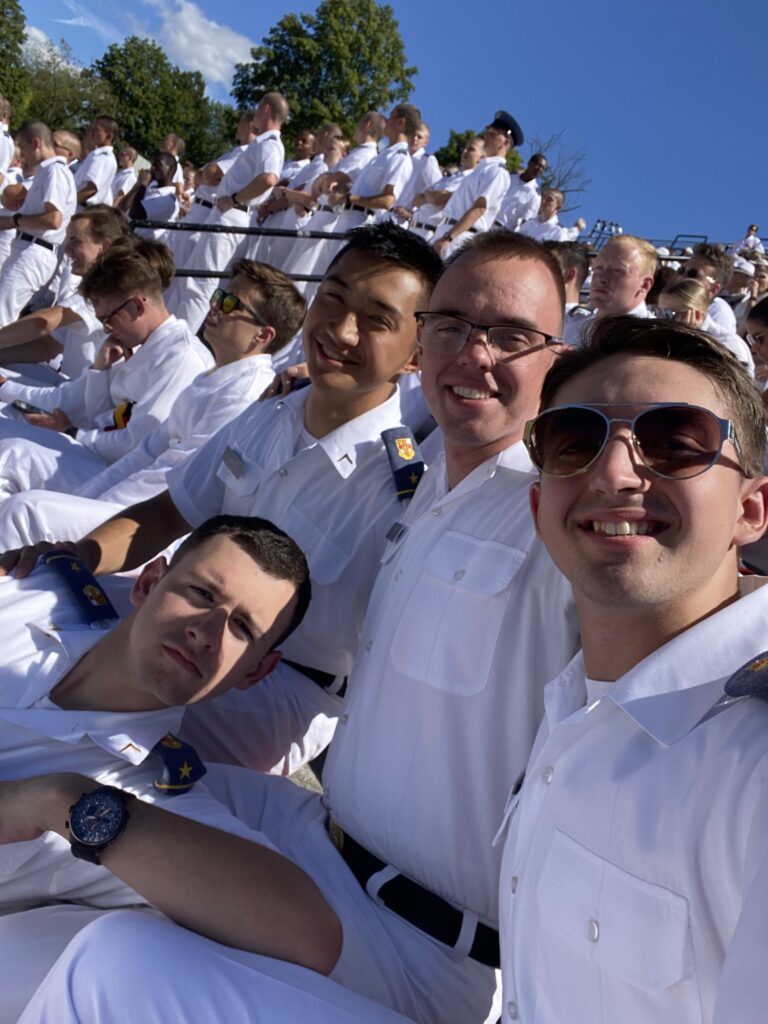
Aiden Carmen with his brother rats at a football game at Virginia Military Institute.

One of the biggest lessons Carman has learned is to be comfortable with being uncomfortable.  

“Throughout the Rat Line, just some of the mental challenge of not quitting when that’s the easy way out, and even if something’s harder to do, still doing it and just grit your teeth and do it,” he explained. “I feel like I was not that way before coming here. I was the, ‘take the easy way out,’ but that changed when I got here. I learned to just grit my teeth and do the hard way over the easy.”

As a platoon sergeant for the Old Corps, his day begins and ends with accountability.  

“Mostly it’s just being accountable at formations,” he explained. “For BRC [breakfast role call] and SRC [supper role call] every morning and evening, I stand out in front, get accountability, report it back, and then march down.” 

But even with a system in place, each year at VMI brought its own unique challenges.  

“As a rat, you just do what you’re told and go where you’re told — you’ve got your dyke (senior mentor) to support you,” he said. “By 2nd Class year, you know the people who will have your back, and you know the school a lot better. Third Class year, though, is tricky. You’re not completely alone, but it feels like it sometimes. You’re trying to figure out your support system, both personally and academically, and really learn what works for you and what doesn’t.”

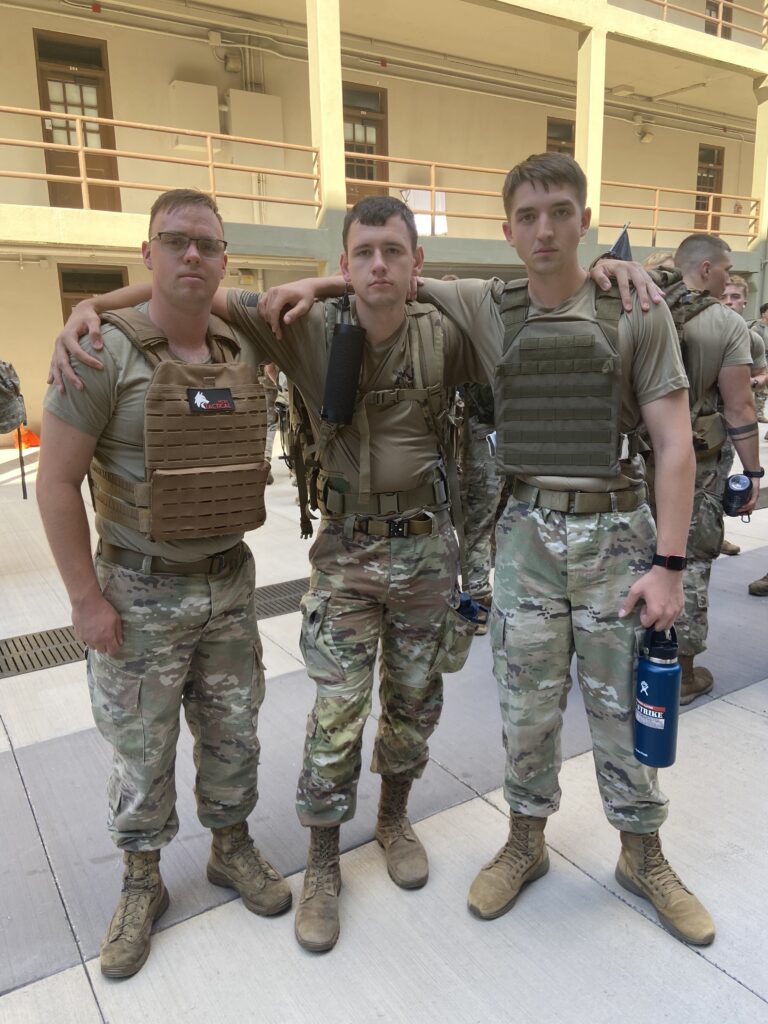
Aiden Carman with his brother rats in barracks at Virginia Military Institute.

One of the places he found direction was in the math department, where he got involved in research opportunities. Through the Summer Undergraduate Research Institute (SURI), there’s a program called AIM, or Applied Industry Mathematics. Carman explained that it’s focused on working with local businesses or even departments at VMI. He’s worked with VMI’s financial aid and administration office, but most recently he partnered with a company in Buena Vista.

Those experiences gave him something more than classroom learning — real-world work experience. 

“You get credits, a stipend, and, most importantly, the chance to apply what you’ve learned to actual problems. Sometimes in class you’re just solving for a number,” he explained. “I feel like I got a very wide breadth of experience from working with different entities in a professional line of work and applied the things I’ve learned in class and put them into practice to see how they can solve real world problems. That’s a valuable skill.” 

“He always does what he’s supposed to do,” David, director of the AIM program, said.  

Carman has enrolled in three of David’s classes and in 2024, did research to help VMI’s admissions and financial aid offices analyze what factors best predict whether cadets will stay at the Institute and ultimately graduate. 

“He just seems to be really committed to getting everything he can out of his time at VMI,” David commented. 

From VMI to Government Defense: Kevin Dougherty ’25

This article is part of The Next Step series. While the four years at VMI are designed for cadets to push themselves academically, physically, and mentally to tackle the demands of life at a premiere military college, they also prepare cadets for life after graduation. Whether that life be one in the military or one in the private sector, VMI faculty and staff provide guidance to cadets along their journeys. One department specifically dedicated to that endeavor of post-Institute success is the Office of Career Services. In The Next Step series, we highlight cadets preparing to enter the workforce after graduation, as well as those still in the midst of their cadetship preparing for internships over the summer. 

Dreams of commissioning may have been eliminated over a year ago for Kevin Dougherty ’25, but his call to duty did not diminish.  

The applied mathematics major from Virginia Beach, Virginia, had an original plan to commission in the U.S. Navy as an explosive ordnance disposal officer, but he was medically removed from the Naval ROTC unit over a year ago. Instead, he has accepted a job with Lockheed Martin. 

“I still wanted to contribute to defense capabilities in as much of a capacity as I could and I thought of no better way to move forward in my life than work for the top defense contracting organization in the United States,” he explained.  

He will be a guidance, navigation, and control modeling and simulation engineer in which he will be working within the missiles and fire control sector of the company. He will help develop, analyze, and test algorithms that govern the aspects of missile systems and other defense platforms. 

“I think the skills I have learned here at VMI, both technical and nontechnical, have prepared me for a job in an industry like defense contracting,” he said. “Going through classes with both a military basis and a non-military basis, I believe that I have a step up from individuals who go to a ‘normal’ college and want to get into defense contracting. I also believe that the alumni pipeline is huge with defense contracting and understood that with using the alumni network I would have a shot at getting into such a massive organization like Lockheed Martin.” 

He credits the help of friends, family, and some alumni in getting the opportunity to work for Lockheed Martin.  

“I think having VMI on my resume doesn’t necessarily give an advantage, but I think if that same resume crosses the right person’s desk at the right time, it can lead to something big for sure,” he admitted. “I believe VMI has had an impact on much of my non-technical skills. It teaches you so many soft skills that make someone successful like time management, public speaking, self-discipline, and my personal favorite, resilience. Life is difficult, but I think these skills can take you very far in both the military world and the civilian world because at the end of the day they all develop you as a leader in today’s society.” 

Dougherty said he’s not sure what the future holds, but he’s focused on the today — knowing if he can focus on that, success will come on its own.  

“I think what really inspired me to embark on this career path is the possibilities of where it will take me and where it will lead in the future.” he commented. “I am super excited to move somewhere I have never lived and work with new individuals in a new environment.” 

Exploring Cost-Efficient Exercise Programs for the Elderly Through SURI

VMI cadet Hai-Hsin Huang ’25, an applied mathematics major with a minor in physics, is evaluating cost-efficient exercise programs for the elderly as part of the Summer Undergraduate Research Institute (SURI) at the Virginia Military Institute. 

Huang has a keen interest in mathematical modeling and its applications across scientific fields and has previously undertaken independent studies and research projects in biological mathematical modeling and operations research. 

This summer, he is combining his mathematical expertise with a meta-analysis of existing studies to determine which types of exercises. These include aerobic, strength training, or balance exercises that offer the best health outcomes for the elderly while remaining economically viable. 

“SURI is a great opportunity that allows me to focus on my research without distractions,” said Huang. “The environment here at VMI is conducive to academic exploration and provides the resources necessary for thorough research.” 

Huang’s research, supervised by Col. Mike Krackow, professor of human performance and wellness, aims to generate recommendations for healthcare providers and policymakers. These recommendations will help optimize aging and reduce healthcare costs.  

Krackow, whose background includes healthcare and strength conditioning focusing on fall prevention for the elderly, has guided Huang through the research process. 

“My role is to advise him on the process, provide resources, and ensure he produces a high-quality paper that could potentially be published or presented at a conference,” said Krackow. 

Huang is optimistic about the potential impact of his work. 

“Eventually, I hope this research can inform healthcare providers and policymakers about which exercise programs are most beneficial for the elderly while being cost-effective,” Huang explained. 

Both Huang and Krackow agree on the importance of the SURI program for cadets, noting the development of critical thinking and problem-solving skills that are invaluable for future academic and professional endeavors. 

“SURI helps cadets gain research experience that is beneficial for graduate school and professional fields,” Krackow said. “It allows them to disseminate relevant information and develop expertise in their specific areas of interest.” 

Huang encourages future cadets to participate in SURI, advising them to take full advantage of available resources, seek guidance, stay organized, and choose research topics they are passionate about. 

“SURI is a fantastic program that offers a unique opportunity to engage in academic research beyond regular coursework,” Huang said. “I highly recommend it to anyone interested in expanding their academic horizons.” 

From VMI to Pioneering Defense Technologies at DEVCOM: Jonathan Tumwikirize ’24

This article is part of The Next Step series. While the four years at VMI are designed for cadets to push themselves academically, physically, and mentally to tackle the demands of life at a premiere military college, they also prepare cadets for life after graduation. Whether that life be one in the military or one in the private sector, VMI faculty and staff provide guidance to cadets along their journeys. One department specifically dedicated to that endeavor of post-Institute success is the Office of Career Services. In The Next Step series, we highlight cadets preparing to enter the workforce after graduation, as well as those still in the midst of their cadetship preparing for internships over the summer. 

Jonathan Tumwikirize ’24 wanted to gain firsthand experience in a military environment, while also getting his degree. It’s what drew him to Virginia Military Institute and allowed him to explore federal-civilian positions to pursue upon graduation.  

The recent graduate from Ashburn, Virginia, majored in electrical and computer engineering and minored in mathematics, and he has accepted a position at the U.S. Army Combat Capabilities Development Command (DEVCOM) Command, Control, Communications, Computers, Cyber, Intelligence, Surveillance, and Reconnaissance (C5ISR) Center. DEVCOM is an information technologies and integrated systems center that develops technologies for the U.S. Army to use on platforms: from soldier to ground vehicle, and from air to space. 

“DEVCOM’s reputable contributions to advancing defense capabilities aligned perfectly with my career aspirations,” he said. “Their cutting-edge technology was frequently a talking -point in my electrical and computer engineering classes.” 

Tumwikirize said he applied to a handful of engineering positions but found that DEVCOM’s eagerness to find potential leaders was the most attractive thing about the position and work environment.

“They offered a dynamic and forward-thinking environment where employees can collaborate with top talents, take on complex challenges, and have a tangible impact on national security,” he said. “Besides their unmatched employee benefits and great location, they provide a similar environment to VMI: they are committed to nurturing the growth of their engineers.” 

At DEVCOM, he will be an electrical engineer specializing in embedded software, where he will be contributing to the company’s countermine division by deriving technologies and strategies that contribute to directly saving lives and enhancing mission effectiveness. 

He plans on pursuing a master’s in electrical and computer engineering at Virginia Tech. 

“As technology continues to grow in complexity, the need for individuals with refined skills also expands; complex solutions require subject matter experts,” he said. “A master’s degree allows me the opportunity to gain specialized knowledge, demonstrate leadership potential, and cultivate my overall ability to support the nation’s critical technological objectives.”  

VMI providing a strong path for success 

Tumwikirize said that with VMI Career Services, there were several opportunities to engage with various employers on post. He said he had met with an operations specialist from DEVCOM through a career fair held at VMI, who then assisted him in his job searching, making the process seamless.  

“I also wrote my first resume through career services, often sitting down and refining each statement to articulate my skillsets and potential,” he said. 

The foundation he received by attending VMI has allowed him to prosper. Shortly after joining the Rat Line, his leadership journey began with the responsibilities of a corporal.  

“Through various leadership positions, I have been able to experiment and develop leadership methodologies that are optimal for a variety of scenarios,” he said. “VMI has given me the opportunity to develop integrity, adaptability, resilience, empathy, and effective communication through their leadership course and positions in cadet government.” 

The inspiration for his path stems from his parents, who contributed to the United States Agency for International Development expatriate work. From that, Tumwikirize was exposed to a plethora of international affairs and the need for innovation within the defense community.  

“Exposed to the harsh reality of instability of five different countries, I often witnessed disastrous events commonly catalyzed by unsettling and armed extremists,” he said. “The unique exposure sparked my interest in contributing to global solutions within the defense community.” 

It also played into why he chose the electrical and computer engineering track. When he was younger, he had an interest in computers, but found that tinkering with various operating systems was what he found to be challenging. 

With the achievement of graduating from VMI, he said it exemplifies one’s resolute commitment to serve. It also served as an aid to him finding exemplary employment.  

“Only individuals who have experienced a cadetship at VMI know the tenacity in everything required to graduate,” he said. “This immediate recognition from alumni was a drastic competitive advantage in my job search. Alumni are familiar with the characteristics required to be successful within such a rigorous environment, and they desire the same type of people within their network.” 

His hope for the next decade is to become a seasoned engineer and leader. 

“I aspire to guide teams that foster groundbreaking solutions and lead individuals that have an unyielding commitment to advancing defense solutions,” he said. “I aspire to achieve collective goals in my career such as navigating complex engineering challenges, completing my master’s degree, and a decade of resilient service to the nation.” 

The Cadet Collective: The Kleinschusters

Virginia Military Institute requires structure and dedication. It also becomes a place where bonds are created that can last a lifetime. Maybe it’s a professor, a coach, or a fellow cadet. No one makes it through VMI alone. The Cadet Collective tells the stories of those relationships that help pave the way for success. 

Matthew Kleinschuster ’26 tagged along to college tours with his brother Jacob “Jake” Kleinschuster ’24, so he got an inside look at whatever places his brother was interested in. Virginia Military Institute wasn’t the immediate choice for Jake, but his senior year of high school he was decided.  

They kept it in the family. Their grandfather, also Jacob, Class of 1964, attended VMI.  

“Seeing him have his buddies over all the time, telling the Rat Line stories … I’ve always wanted something like that with a group of guys I can live life with,” Jake said. 

Jake didn’t pressure Matthew in picking VMI, but he was really gunning for him to.  

“When he did decide, I was very excited that he came here,” Jake said. “I enjoyed being the older brother for the Rat Line because I knew what was coming up for him. Also, I could have some of my other friends go pay Matthew a visit, which was great. Being able to see Matthew go through that, knowing what the weeks and days to come for him would be and get to kind of mess around with him here was really enjoyable for me, but just solidifying our relationship.” 

It wasn’t even a question when Matthew had decided where to attend. 

“Having my brother here was definitely a perk,” Matthew said. “It was nice to know where I’m going to go, I already have a guaranteed friend. We were best friends growing up.” 

The two have always been close — sharing a room growing up, starting a landscaping business during the first year of the COVID-19 pandemic, where they’d work together every afternoon. Their relationship grew as they spent more one-on-one time together as young adults.  

“Fast forward to college. Once I got to the Rat Line, he was always shooting glances here and there kind of encouraging me. Then after the Rat Line, we did Ranger Challenge, which was a lot of fun,” Matthew said.  

He said they wake up and work out together, attend classes, and more.  

“It really solidified that friendship. And that’s what I think kind of encapsulates our relationship,” Matthew said.  

Jake said his friends have become Matthew’s friends and vice versa, making a larger family unit for them both on post. 

“We’re like the glue that links everybody together, because we’re brothers and I’m hanging out with his buddies now,” Jake said. “Having a brother here has been really special because I get to see those friendships I’ve made with my brother rats, but also at the end of day I get to share everything with Matthew.” 

Matthew was intimidated to come to VMI, especially after his brother. He said that Jake had made a name for himself here. 

“Jake definitely excelled here. He made a big name for himself,” Matthew said. “Coming in, I was nervous. It’s hard to hide the last name Kleinschuster. I felt like I had targeted my back. But after a while, I realized at the end of the day, VMI wants you to become your own man.” 

Matthew said having his brother here served as a form of encouragement.   

“I have big shoes to fill, but someone behind me who’s going to support me, whatever I do,” Matthew said. “That was probably the biggest motivation of having a brother here. Not the nerve-wracking and being nervous of not living up to his title, but just knowing no matter what happened, I had someone in my corner.” 

The brothers say after their time at VMI, their relationships will continue to strengthen after having shared the camaraderie of going through the same experience. They even have corresponding majors. Jake, an economics and business major with a math minor, and Matthew, a math major with a business minor. The two plan on entering the U.S. Army after graduating — another shared bond that will continue.  

“We’ll continue to make connections there. Then when I go to the Army, I’m excited to do the same thing,” Matthew said. “We get different furloughs off, come back and hang. The more and more we experienced separately, the more we get to share together, which I’m excited about.” 

Jake said that having Matthew at VMI made him appreciate the small things and not take any day for granted. 

“Knowing that in a few months I’ll be gone for a handful years and just taking these days, slowly enjoying the time to spend with Matthew,” Jake said. “Being here studying, being able to go to the gym with Matthews is a blessing.” 

For Matthew, it’s served as a motivation.  

“It’s fun to know that whatever happens, my brother’s going to support me,” Matthew said. “I push myself every day to be better than Jake, which is pretty difficult, but it’s fun to try and strive for. And he encourages me in all aspects. He’s always behind me, motivating me and then vice versa. We’re kind of pushing off each other.” 

Jake said they’ve created a bond that many admire. 

“When our friends see our relationship, it’s a fun special relationship that I think they look up to,” Jake said. “Being able to just create that big group of guys, everyone just getting along and hanging out regardless of where they came from. It’s been fun.” 

After Jake graduates in the spring, Matthew said he’s not looking forward to finding a new routine without his brother on post.  

“I’m going to continue making a name for myself and lead,” Matthew said. “I’m excited to see what that looks like when he’s gone, when I don’t have that guy in my corner. I’m not too worried knowing that I’ve got other guys in my corner just for me, but I’ll miss him. I’ll need to find another gym partner, another study partner. But, I’m excited for him and I’m excited to see where I go and do my thing.” 

Midshipmen Moments: Sebastain Ramirez ’24

Sebastian Ramirez ’24 became fond of the challenging lifestyle that came with attending Virginia Military Institute after attending an open house. He said the high standards that cadets endured on a daily basis was something he wanted. 

“I wanted to go through the system myself and experience a transformation from such an intense and demanding environment,” he said. 

The applied mathematics major was originally enrolled in the Air Force ROTC for the first two years of his cadetship. Towards the end of his 3rd Class year, he had a change in heart and decided that he wanted to try to become a Marine.  

“I admired the leadership philosophies of the Marine Corps and the unrelentingly high standard that is expected of all Marines,” he said.  

He said the standard of the Naval services, especially the Marine Corps, is one of the highest of all the branches, which made it something he was drawn to. He also saw similarities in VMI’s culture and that of the Marine Corps — intimate and sacred. 

“The mission of the Marine Corps is unique; we are called upon at a moment’s notice with the expectation of fighting and winning in any clime or place,” he said. “The thing that makes me most proud to be a Marine is the legacy. To have the privilege of carrying on the legacy of the Marine Corps is indescribable. I look forward to serving and supporting Marines and feel privileged to be given the opportunity to lead.” 

He’s currently contracted as a student naval aviator with hopes of flying the F/A-18 or F-35. 

The Naval ROTC program provides two programs in which cadets can enroll in — U.S. Navy or U.S. Marine Corps. 

The mission is to develop midshipmen mentally, morally, and physically, and to instill the highest ideals of duty, honor, and loyalty to commission them as Navy or Marine officers. The NROTC program fosters high-level responsibilities of command, citizenship, and government. 

This past summer, Ramirez attended Officer Candidate School (OCS) at Marine Corps Base in Quantico. OCS is to educate and train officer candidates in Marine Corps knowledge and skills within a controlled and challenging environment. The school evaluates and screens individuals for the leadership, moral, mental, and physical qualities required for commissioning as a Marine Corps officer. 

Some trainings and activities included: combat conditioning, obstacle courses, close order drill, academic classes and discussions, fire team assault course, leadership reaction course, stamina and endurance course, small unit leadership evaluation, and daily platoon staff evaluation. 

The 10-week training was focused on small unit leadership in a stressful and fatigue-inducing environment, Ramirez said.  

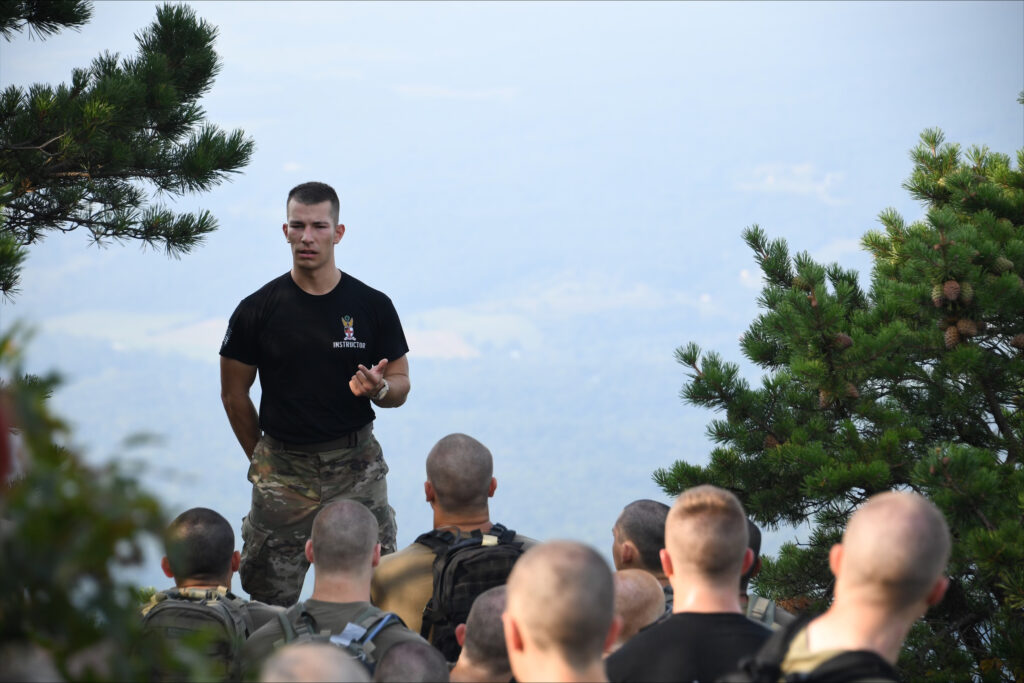
Sebastian Ramirez addresses the Corps of Cadets atop a mountain.

“There’s also a significant amount of physical training events varying from long-distance runs to courses designed to simulate the physical rigors of a combat environment,” he said. 

He is currently in the Marine Company as the midshipman company gunnery sergeant and physical training instructor.  

“My responsibilities include planning, overseeing all physical training events, and managing gear distribution and maintenance,” he said.

He’s had the privilege of leading the company in physical training and ensuring their success in physical fitness tests and combat fitness tests, but all aspects of life where one’s physical fitness is put to the test. 

“We’re trying to build someone who is balanced in strength, endurance, and adaptability,” he said. 

Ramirez said that a benefit of VMI is the open doors it provides.  

“My decision to join NROTC came very late in my cadetship, relatively speaking. Fortunately, I was willing to put in the work and as a result, I’ve been given amazing opportunities despite having joined the program so late,” he said. “Finally, nothing makes the journey more meaningful than being able to take on every challenge with your best friends. Make friends wherever you go, and you will enjoy the work.”