Post View Unavailable »
New Website Launched »

VMI Commissions Military Officers

Virginia Military Institute commissioned nearly 140 cadets into the armed services at the annual Reserve Officers’ Training Corps (ROTC) joint commissioning ceremony May 15 in Cameron Hall. The ceremony was livestreamed for family and friends who could not attend the event in person.

Gen. Christopher J. Mahoney, 13th vice chairman of the Joint Chiefs of Staff, the nation’s second highest-ranking military officer, who arrived to post by helicopter, offered the commissioning officer remarks and administered the oath of office to the cadets beginning their journey of military service as second lieutenants in the U.S. Air Force, Army, and Marine Corps, and as ensigns in the Coast Guard and Navy.

Lt. Gen. David Furness ’87, who just completed his first academic year as the Institute’s 16th superintendent, welcomed the nation’s newest military officers, their friends and families, faculty and staff, and members of the Corps of Cadets to the ceremony. He thanked the ROTC officers, cadre, and staff who were instrumental in teaching and mentoring the young officers, and acknowledged all the veterans and current military members in the audience. “We appreciate the sacrifices you have made and the leadership you have shown. These cadets are following in your footsteps because of the examples you have set,” he said.

Furness reminded the commissioning cadets that VMI has prepared them to face any challenge or adversary, and how honor, courage, and commitment have been instilled in them. “These fundamentals will serve you well for the rest of your life. The time has come for you to take the next step in your careers and serve our great nation.”

He shared three habits he was advised to adhere to when he was a young officer. “First, embrace lifelong learning. You must continually increase your knowledge through practice and self-study. Second, stay physically fit. You will find that when stress arrives, you will be better disciplined to persevere when you are fit, and always remember that a strong mind never grows in a weak body. Last, but most importantly, you must take care of those you lead. Whether in the military, the civilian sector, or your family, people will depend on you to be an ethical and reliable source of strength, to teach, coach, and mentor those you are responsible for.” He congratulated the cadets on attaining a commission, voiced his pride of them, thanked them for making the decision to serve in the military, and wished them Godspeed.  

Furness then introduced Mahoney as a great friend and noted their paths crossed many times throughout their careers. Mahoney graduated from the College of the Holy Cross in Worcester, Massachusetts, with a bachelor’s degree in economics, and commissioned into the Marine Corps. He has served as a pilot with the Marine All-Weather Fighter Attack Squadron known as the “Bengals,” as well as the fighter squadrons known as the “Werewolves,” the “Crusaders,” and the “Bats.” He has held command at the squadron, group, and wing levels. He is a graduate of the Weapons and Tactics Instructor Course, the Marine Division Tactics Course, and the Navy Fighter Weapons School commonly known as TOPGUN. He holds two master’s degrees. One from the University of Canberra in Australia, and one from Air University at Maxwell Air Force Base in Alabama, both with the highest academic distinction.

Mahoney shared he was honored and humbled to speak at VMI, which he described as hallowed ground. To the commissionees, he stated that the era of America’s uncontested dominance is over. “The adversaries you face are capable. They are hungry, and they’re watching you. You’re about to be handed the greatest responsibility the nation can bestow.” He told them they will be tested. “The enemy will jam your communications. Your screens will go black. You will not be able to call higher headquarters for permission. You will not be able to call in a medical evacuation. Will you freeze? Will you wait for perfect information? What will you do? Answering that question will require everything you have. It will require the lessons of this great institution that is built on unrivaled tradition, and these traditions over time have become legend.” Mahoney then cited legendary VMI alumni like Lt. Gen. Chesty Puller, VMI Class of 1921; Lt. Gen. Charles Kilbourne, VMI Class of 1894; Maj. Gen. William Upshur, VMI Class of 1902; and Gen. Lemuel Shepherd, VMI Class of 1917; who all faced dire situations in battle, but instead of hesitating or panicking, they relied on the steel VMI put in their spines. “They did not shrink from violence. They stepped into the breach.” He warned the new officers that because these VMI legendary ghosts set such a high standard, the military has high expectations of VMI graduates. “When a commander sees a VMI ring on a finger, they don’t see a recent college graduate, they see the ghosts of VMI. They expect you to be unbreakable, they expect you to lead from the front, and they expect you to navigate chaos without losing your bearing. Virginia Military Institute has given you the discipline and uncompromised standard. The rest is up to you. The ghosts of VMI are watching you. Our adversaries are preparing for you. What will you do?”    

He then asked the commissioning cadets to stand as he administered the oath of office. Afterward, the brother rats gave each other congratulatory hugs as the audience applauded and cheered.  

Following the ceremony, the separate military branches conducted individual pin-on ceremonies at various locations on post. It was there that the newly commissioned officers followed a tradition of presenting a silver dollar to the active service member or veteran from whom they received their first salute.

According to Capt. Megan Taylor, assistant professor of military science for the Army ROTC George C. Marshall Battalion—formerly known as the Blue Ridge Battalion—at VMI. Many were exemplary, but two were prominent: James Aldinger, an international studies major from Arlington, Virginia; and Matthew Kleinschuster, an applied mathematics major from Richmond, Virginia. “Aldinger served as the Ranger Challenge platoon leader responsible for the training and preparation of the Ranger Challenge team. Under his leadership, the team successfully competed at Exercise Cambrian Patrol in Wales in the United Kingdom; at the 4th Brigade Ranger Challenge at Fort Pickett, Virginia; and at the Sandhurst Military Skills Competition at the U.S. Military Academy at West Point. His ability to coordinate training, planning, and logistics for local, national, and international competitions far exceeded the traditional cadet experience. He ranked within the top 1% of cadets nationwide and is branching in the infantry. Kleinschuster served as battalion commander and was responsible for the oversight, accountability, and training of four companies and more than 1,000 VMI cadets. He had the single greatest impact on the Army ROTC mission and overall success of the battalion over the past year. Through his leadership, work ethic, and very impressive GPA, Kleinschuster earned the distinction of being ranked the No. 8 cadet in the nation and was selected to branch in explosive ordnance disposal,” Taylor said.

Lt. Cmdr. Tom Campbell, naval science instructor for Naval ROTC, designated two cadets who commissioned into the Navy and two who commissioned into the Marine Corps as truly outstanding. Macallister Clark, a mechanical engineering major from Saint Michael, Minnesota, was a four-year national scholarship recipient, and retained a 4.0 four-year GPA. He was selected to be commissioned as a Naval reactors engineer (NRE), an elite technical officer who manages the lifecycle of Navy nuclear propulsion plants. The last year a VMI cadet commissioned as NRE was 2017.

Nicole Samella, an electrical and computer engineering major from Virginia Beach, Virginia, was a four-year national scholarship recipient, maintained a superior GPA and high physical fitness scores, and served as the NROTC battalion commander. As the top ranked surface warfare officer in the nation, she was handpicked to transfer into the Navy Engineering Duty Officer program. 

Kern Aughinbaugh, a biology major from San Marcos, California, served as the Marine Company commanding officer and advisor for the NROTC Bulldog Program, helping prepare candidates for the physical requirements of the Marine Officer Candidate School. Moreover, he served the Corps as Golf Company commander in the regiment. Devin Auzenne, a history major from Opelousas, Louisiana, was a four-year national scholarship recipient. In addition to serving the Corps as regimental commanding officer, he also was an advisor for the NROTC Bulldog Program. Both Aughinbaugh and Auzenne will go to The Basic School in Quantico, Virginia.

Col. Eric Steele, commander of Air Force ROTC, cited two cadets as exceptional. Reese Lassiter, a mechanical engineering and physics double major from Louisa, Virginia, has earned the coveted Distinguished Graduate (DG) award—established to recognize the top 10% of commissioning cadets—from AFROTC. “He’s been a standout cadet his entire time in our program, winning national awards and earning recognition through several highly competitive military training courses. He will be attending undergraduate pilot training at Columbus Air Force Base in Mississippi after commissioning,” said Steele.  

Hannah Buttner, an international studies major from Williamsburg, Virginia, successfully completed a leadership tour as Cadet Wing commander last fall. “Competing through a highly rigorous process at the national level, she was also selected to attend Green Flag-West at Nellis Air Force Base in Las Vegas, Nevada, and at Fort Irwin, California, where she gained broad exposure to Air Force and Army joint air-to-ground operations in a real-world training environment. She is this year’s recipient of the Captain John W. Kennedy ’69 Award for sustained excellence throughout her time as a cadet. She will attend intelligence officer training at Goodfellow Air Force Base in San Angelo, Texas,” Steele explained.    

According to Command Sgt. Maj. Suzanne Rubenstein, director of cadet activities and VMI liaison for the Coast Guard Auxiliary University Program, one cadet who commissioned in the Coast Guard. Shane McKenna, an international studies major from Salt Point, New York, served as commander for the AUP and was Foxtrot Company executive officer.  

Memorial Parade

Earlier in the day the Memorial Parade was held, commemorating the bravery and sacrifice of all alumni who died on the field of honor including the Mexican-American War, the American Civil War, the Spanish-American War, World War I, World War II, the Korean Conflict, the Vietnam War, the Marine Barracks in Lebanon, the Persian Gulf War, and the Global War on Terrorism. The large garrison flags were flown at half-staff, by order of Gov. Abigail Spanberger, in memory and respect of Peace Officers’ Memorial Day, a fitting backdrop as all 591 alumni names were somberly read by Stone Gardner ’28, Sophia Lurey ’28, Garrett Maye ’28, and Jamie Rodriguez ’28. A wreath was laid at the foot of the monument, “Virginia Mourning Her Dead,” as well as at the three barracks arches. A prayer led by Col. John P. Casper ’04, Institute chaplain, was followed by the firing of a three-volley salute. A stirring echo rendition of “Taps” was played by Louis Marangoni ’27 and resonated by Khaidan Piedmonte ’28, followed by the Pipe Band leading the Regimental Band in an emotional delivery of “Amazing Grace.” Col. Lawrence “Ley” Havird ’90, commandant, was joined by Furness in taking review of the parade as the Corps marched from the Parade Ground down Letcher Avenue and ending in barracks.
Vijayan Studies Military Logistics

Jai Vijayan ’26, an economics and business major at Virginia Military Institute, researched military logistics during World War II for his honors project, “Move and Maintain: American Last-Mile Logistics in the Solomon Islands Campaign, 1942-1944.”

Vijayan, who will commission into the U.S. Army as a logistics officer after he graduates in May, explained the definition of military logistics as the practice of moving armies, including transporting military forces, keeping them supplied, planning and road building, and the administrative work carrying out those activities. The focus of his thesis was the final, crucial step of the supply chain; moving supplies from friendly, established bases to contested front lines, known as “the last mile,” specifically, to the Solomon Islands following the Japanese attacks on Pearl Harbor, Southeast Asia, and the South Pacific in 1941.

The Solomon Islands are a chain of islands in the South Pacific, northeast of Australia, and include Guadalcanal, New Georgia, and Bougainville, all locations of significant WWII battles. The Japanese attacks threatened the American supply lines to Australia and New Zealand. For that reason, the Solomons became decisive in ensuring those supply lines remained open and the Japanese advance was halted.

“Guadalcanal is widely regarded as an allied tactical victory, but a logistics disaster. Initially, isolated Marines were forced to subsist on two rations per day and captured Japanese rice. Aircraft sat idle because there was not enough fuel. Gradually, the allied forces were able to sustain their offenses in New Georgia and Bougainville, thanks to the idea of ‘island hopping,’ taking control of the islands one by one, and turning them into support bases,” explained Vijayan.

He went on to report that most historians agree that the U.S. logistics system was a big factor in winning the war for the allies, but they differ on what part of that logistics system was significant. To that end, Vijayan sought to answer the research question, “How and why did last-mile logistics improve past the crises at Guadalcanal?”

To answer his question, Vijayan examined the various logistics methods the military incorporated during the three operations to secure the islands. He discovered the successes, the failures, and how the methods progressively improved throughout the “island hopping.” The first, the Battle of Guadalcanal, codenamed Operation Watchtower, took place from August 1942 to February 1943; followed by the invasion of the New Georgia, codenamed Operation Toenails, from June to October 1943; then the Battle of Bougainville, codenamed Operation Dipper, from November 1943 to May 1944.   

He concluded by confirming that circumstances improved with each new operation due to improved access to military facilities, shortened supply lines, absence of time pressure, and diminished enemy capabilities. “It’s easy to understand why the last model was much more effective. Improvements helped the allied forces avoid the crises that took place on Guadalcanal. There was better unloading coordination, supply lines were deliberately planned and proactively built inland, and supply dumps were deliberately placed for a more effective system. All these decisions improved last-mile logistics. There was definitely a learning curve that moved past the mistakes at Guadalcanal,” closed Vijayan.

Vijayan’s advisor, Lt. Col. Joel Christenson ’99, associate professor in the Department of History and director of the John A. Adams ’71 Center for Military History & Strategic Analysis, said it was a pleasure working with Vijayan. “Jai’s project is thoughtful, innovative, timely, and applicable, and I think his investigation into logistics and the Solomon Islands campaign in the Second World War proves that there is new information even in the most studied of conflicts.”

Vijayan is minoring in military history and Chinese. He is an alumnus of the Canadian International School in Singapore and the son of Bharat Vijayan and Archana Velukutty of Tully, New York.

The Vanguard — Jackson Geisendaffer ’28

The Vanguard series highlights cadets of Virginia Military Institute who exemplify promise, perseverance, and the true spirit of leadership. While they may not be the top-ranking students or those in prestigious positions, these individuals’ dedication, resilience, and growth embody the essence of being a VMI cadet. By sharing their stories, including the challenges they’ve faced and overcome, we shine a spotlight on the diverse paths to success at the Institute, proving that leadership and excellence come in many forms.  

Playing a part in the bigger picture was one of Jackson Geisendaffer’s ’28 goals when he came to Virginia Military Institute. He wanted a school that would challenge him to be the best leader and prepare him to move forward, especially when those plans are to commission into the U.S. Army.  

“I saw that to become that leader of value, I would have to go through challenges and struggle with myself,” he said.  

His father was a VMI graduate. Growing up, he learned of his time at the Institute and said it was a big determining factor in attending versus enlisting. 

It’s also the reason he became a corporal in the Old Corps. Geisendaffer said he wanted to be part of the team and serve as a leader, while taking accountability and ensuring everyone is responsible and doing their best. 

“I take accountability for everybody that’s in my squad, make sure that their uniform appearance is up to standard and make sure that people are doing what they’re supposed to do in my company,” he explained. 

Originally entering the Institute on the cross country team, Geisendaffer switched to Ranger Challenge, which is described as an Army ROTC varsity sport. Teams form early in the semester and train nearly every morning of the week all the way up until the Sandhurst Military Skills Competition at the U.S. Military Academy (USMA) at West Point in mid-spring.  

“I think the biggest factor is being able to work within a team. When I was in high school, I was doing sports throughout. I had a hard time expressing my ideas and my thoughts within a group, and hearing out other people’s ideas,” he said. “But here, you have a job to do, so you must get along, and be able to communicate in a way other people understand. I think fundamentally, that’s probably one of the biggest things for officers to have. I think it sets me up for success.” 

The English major is forward thinking. He grew up reading and loved literature, especially classics like Charles Dickens’ novels. It was something he was naturally good at and was drawn to. He also saw the merit of choosing that major. 

“I feel like having an English degree is going to give me the skills to be an effective communicator as an officer and as a team leader in general,” he said.  

Maj. Adam Cody, assistant professor in the Department of English, Rhetoric, and Humanistic Studies, describes Geisendaffer as insightful and inventive, with a strong work ethic, precise attention to detail, and a productive rapport with peers. 

During an in-class peer review workshop, Cody said Geisendaffer showed great promise in his leadership skills. He had a constructive and conscientious approach to peer mentorship, where he was patient and attentive with his classmates and his instructor, and his feedback on his peers’ writing reflected a diligent commitment to helping others improve their writing skills.

“Cadet Geisendaffer may consistently be relied upon for his keen understanding and thoughtful judgment,” Cody said. “In class, he displays a tendency to notice key details that other students overlook, and his critical and lateral thinking skills enable him to make connections between ideas and to integrate unfamiliar concepts into a coherent system of knowledge.” 

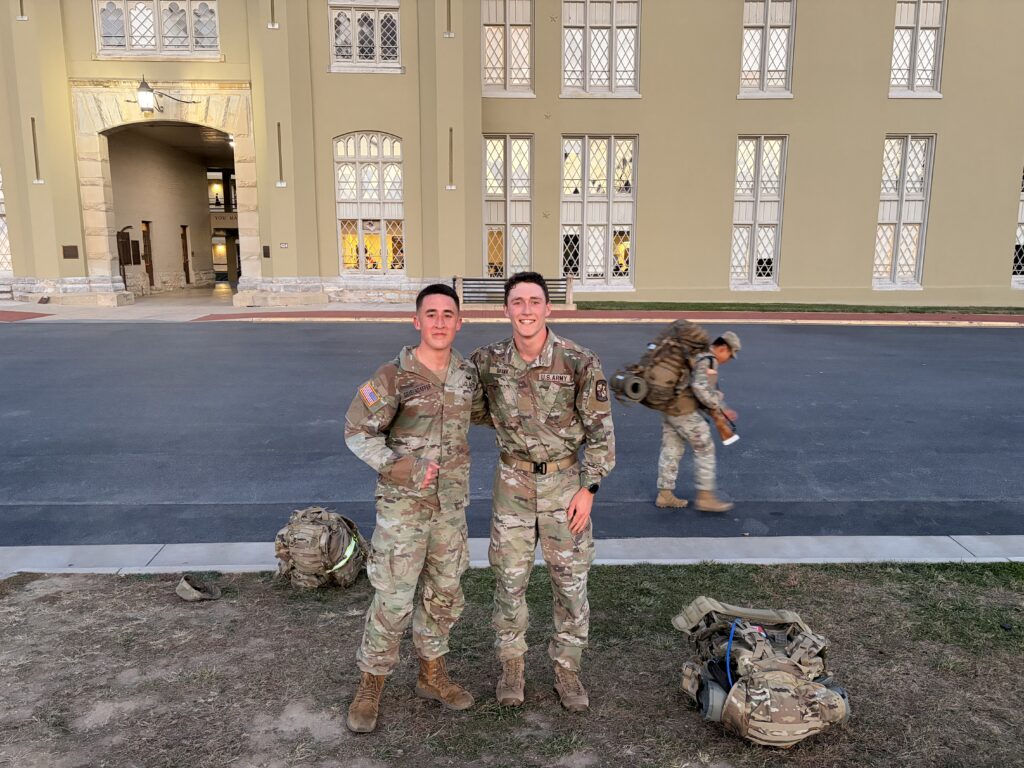
Cadet Jackson Geisendaffer with his brother rat outside of barracks at Virginia Military Institute.

Geisendaffer prefers not to procrastinate, which is a complete departure from his days in high school. Admitting that he was below average in high school, he didn’t take pride in his grades or think he was going to college. He decided he needed to make a change. Since coming to VMI, he’s disciplined and on the ball. 

“I kind of blew a lot of the stuff off and went by doing the bare minimum,” he stated. “Then I got here, and I realized that there’s more opportunities that come when you actually dedicate yourself to the grades and to these challenges. I found when I applied myself and I studied hard, I got the results that I wanted and the results that I deserved because of the changes that I made. 

 “I stayed on top of everything, especially during rat year, and I saw results, so I just kept sticking with it,” he continued. “I keep a detailed schedule of where I need to be, when I need to be there. I ask questions. I don’t waste time.” 

Lt. Col. Jochen Arndt, associate professor in the Department of History, has known Geisendaffer since he was a rat and enrolled in his world history course. He was impressed with his vigor for learning and his ability to earn high marks.  

“Cadet Geisendaffer navigated the Rat Line with aplomb and performed in the top ten percent of my course, earning an ‘A’ for that semester — far above the average grade of a ‘C,’” he said. “He paid attention to detail, completed the assigned readings, came to class ready to participate, and took good notes. Given the amount of work required to perform well in this class, I am sure Cadet Geisendaffer had to work many late hours, especially in preparation for the course’s two research paper assignments and the 3-hour final exam, all of which he completed with superior grades.” 

Arndt also noted that he uses his skills well by becoming a writing center consultant, where he’s able to help his peers become better writers and students. It was something that set him apart from his classmates. 

“Cadet Geisendaffer struck me always as modest in spite of his superior performance. He went about his work in a professional manner, with seemingly no drama and no wasted energy,” he commented. “When he showed up at my door to discuss his paper assignments, for instance, I was pleasantly surprised to find that he came well prepared with completed drafts ready for my review. When I suggested changes, he listened carefully, asked good questions, and then implemented the required changes.” 

Dr. Luke McNulty, adjunct professor in the Department of English, Rhetoric, and Humanistic Studies, said of his 57 students in a course where the current average grade is a C, Geisendaffer is one of 12 currently sitting at an A.  

“I can rely upon Cadet Geisendaffer to have read and understood these difficult materials before our class meetings, and to share his thoughts as a leading participant in our group discussions,” he said. “He has served me as a valuable interlocutor, and he has served his peers as a model of clear, careful thinking and speaking. I hasten to add that he has also been a model of character in his willingness publicly to express and defend his ethical principles.” 

VMI Army Cadets Win Bronze in Wales

For the second year in a row, the Virginia Military Institute Army ROTC Ranger Challenge team won the bronze medal at Exercise Cambrian Patrol (ECP), the British Army’s premier patrolling event held Oct. 3-12 in the Brecon Beacons, a mountain range in Wales in the United Kingdom (UK). Last year was the team’s first year to compete, and the first ROTC unit from the United States to participate.

Ranger Challenge is the “varsity sport” of the Army ROTC program, and is made up of eight cadets who tried out for the team last spring. Members include team captain James Aldinger ’26, Owen Brunk ’26, Gavin Hudson ’26, Jackson Karam ’26, Colin Russell ’26, Bradford Seery ’26, Raymond Moffett ’27, and David Townsend ’27. The team was coached by Sgt. 1st Class Robert Bain, military science instructor; Capt. Tyler Brians, assistant professor of military science; Capt. Pauline Johnson, assistant professor of military science and officer in charge of Ranger Challenge; and Capt. Christopher Lopez, military science instructor.

ECP is a continuous, 48-hour long-range international military patrol exercise across rough terrain. It originated in 1959 when a group of Welsh Territorial Army (now Army Reserve) soldiers designed a weekend training event which included long distance marching and a shooting competition.

ECP is both mentally and physically demanding, and considered to be one of the most difficult and esteemed of military competitions. Participants carry 80-pound rucks, get limited sleep, and have minimal food. It is open to regular military, reserve military, and ROTC units. Units outside the U.K. must first qualify by winning a similar competition in their home country. This year, over 125 teams from more than 30 countries competed at ECP.

VMI faculty member, Maj. Alex Paul, assistant professor in the Department of History, knows first-hand the challenging conditions in Brecon from his time serving in the British Army. As a young infantry soldier, he spent several weeks training there. Prior to the VMI team leaving for Wales, Paul met with them to help prepare them for what they could expect. He emphasized how quickly conditions in the area could turn dangerous.

“The rain doesn’t just fall, it comes sideways. The cold, the wet, and the wind together are unforgiving. You have to look after yourself and your kit, but more importantly, you have to look after each other.” Paul’s message to the cadets was clear, “Preparation and vigilance matter, but resilience and camaraderie are what see soldiers through the toughest conditions. Hot drinks, dry socks, and humor will get you through more than you realize.” Learning of the teams’ success at ECP, Paul shared he is very proud of them.

According to Brians, Cambrian Patrol is an extremely challenging training event that even active duty Army teams would be hard-pressed to perform well.

“Many of the tactics and skills that teams are assessed on during the event require specialized training. For VMI’s team to arrive at the exercise with only one month of training and earn bronze is truly exceptional. As a coach, I’m extremely proud of the team and respect their grit to remain focused on the mission even during adverse conditions. Most countries only send their best soldiers, and our ROTC team outperformed many of them.”

Hudson, a psychology major from Locust, North Carolina, stated the event was grueling, but he was thankful for the opportunity to participate.

“I couldn’t ask for a better group of guys to compete with. I have nothing but respect for this team. We all had to lean on each other and use our different skill sets to get the job done. Completing the Cambrian Patrol is an accomplishment in itself, and to be able to earn a medal with these guys is something special.”

Seery, an international studies major from Chesapeake, Virginia, also competed in Wales last year. He agreed with Hudson that their accomplishment was very much a team effort.

“Each of the eight members of the team did their part and pulled their own weight to help make this year another success. Without the help from all our coaches, and the support from the administration, our success would not have happened.”

Tryouts for next year’s Ranger Challenge team will be held in the spring.

Behind the Balance: Amari Benjamin ’27 — Keydet Men’s Soccer

Virginia Military Institute’s cadet-athletes have to juggle cadet life, heavy academic course loads, and their NCAA Division I sport. Committed to both academic and athletic pursuits, balancing their rigorous schedule in both sports and school requires a certain level of commitment and discipline. Behind the Balance is a series that focuses on those cadet-athletes and how they handle the hurdles of the day-to-day. 

A sense of discipline is what drew Amari Benjamin ’27 to Virginia Military Institute.  

“I knew that I wanted that in my life, and I knew that would set me up forever,” he said. “I also wanted the option to commission, because I was on the fence and I got the opportunity to play soccer here as well.”

Benjamin, an economics and business major, plans on commissioning into the U.S. Army. Having the option to play soccer at VMI was a big draw for Benjamin. After a soccer camp with the VMI soccer coach, Nick Regan, his interest was piqued.  

“I wasn’t originally interested in VMI. I didn’t really know what it was, either,” Benjamin admitted. “But then Coach Regan reached out to me saying, we’re interested. He gave me a little breakdown on the school and then did my own research. My dad was in the Navy, so I’ve always been in that military setting at home too … it wasn’t that big of an adjustment.” 

Cadet-athletes at VMI not only have their responsibilities with their selected sport but cadet duties on top of that. Cadets are also required to take physical fitness classes twice a week, participate in ROTC all four years, prepare for room and uniform inspections, practice for parade, guard duty, and more. 

Benjamin has a packed schedule with 17.5 credits as well as serving as an S9 Sergeant. With that comes a multitude of duties including preparing for pep rallies, company athletics activities, and creating permits and Concept of Operations (CONOPS) documents. S9 is primarily made up of athletes, so cadets involved must pick up where it’s needed when those on the staff are in season. 

“S9 is an amazing staff because we all know how much we put in on the field or court, so we are always quick to have each other backs and help when help is needed,” he said. “When it’s S9 time, it’s S9 time. Allowing me to segment my day with school, soccer, and rank allows me to stay on top of things and not get burnt out.” 

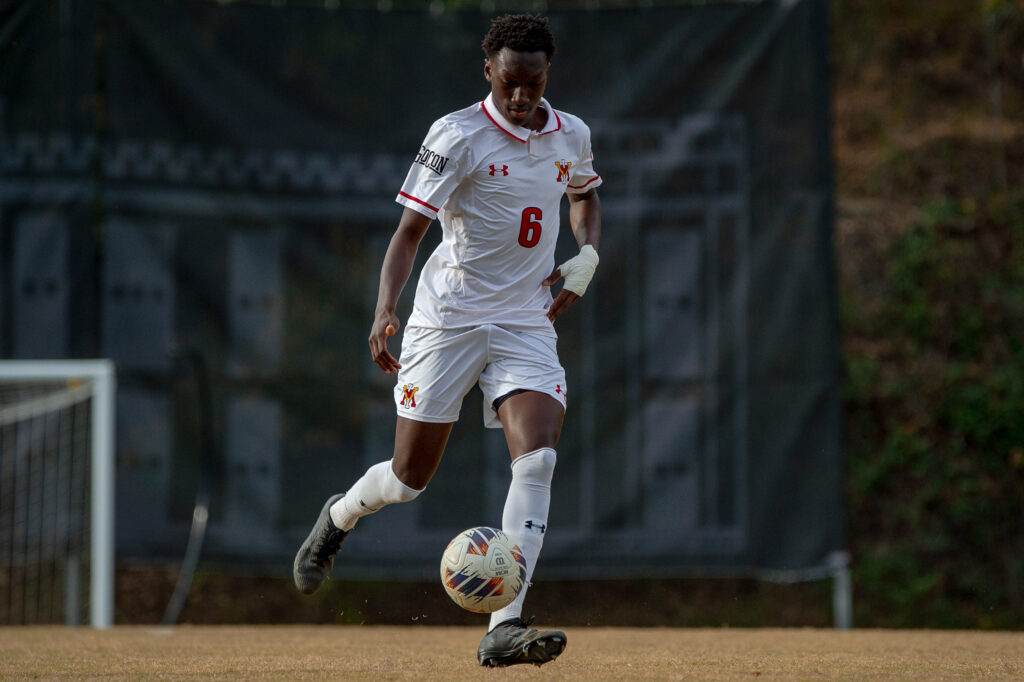
Amari Benjamin playing soccer for Virginia Military Institute.
VMI Men’s Soccer Action Shot vs. Queens

His days start early while he’s in season — around 6 a.m. for a team run or a quick session on the field before breakfast. Then it’s classes until the afternoon and straight to practice, which lasts until after 6:30 p.m. Then he’s back to studying and class assignments.  

“I like to get a lot of my work done out the way early. I don’t want to stay up late because I wake up in the morning feeling groggy,” he explained. “Usually throughout the day, from whenever we finish that first training until before practice, it’s only school. That way, at least at night, I can only focus on whether I have an exam the next day or I can focus on one thing and not have to over stretch myself.”

Benjamin has had to find a balance in structuring all his tasks. In the beginning, he found it tough to do so.  

“My first year playing Division I soccer, all of that was overwhelming. It wasn’t until my sophomore year that I really was able to crack down on it and build good habits and get into a routine,” he stated.  

He especially must plan with traveling for games, which they have a packed schedule of nearly 20 games during a season.  

“When I know I have an away game coming, I try to overly stress the fact that I need to finish all this, because I go into the game with just the game in mind, and not have to worry about an assignment due at 11:59 p.m.,” he explained. “Usually, I try to plan out my days well. I feel like every assignment I get or every reading I’m assigned, I always put in my notes, and I try to get it done that day, if possible. That way, later in the week, when the games do come around, it’s just straight soccer.” 

Benjamin said the skills he’s learned at VMI will translate into his life, no matter what he does. He says the ability to multitask and prioritize has helped him plan his days properly.  

“I feel like one piece of advice that my dyke [senior mentor] also told me was, at the end of the day, you’re going to go to bed, and the next morning you’re going to wake up,” he commented. “You’ve just got to get through the rest of the day, and nothing can really hinder you. At the end of the day, if you just do what you need to do and get through it, there’s a whole new day waiting for you.” 

From Law School Dreams to Army Leadership: Jeremiah Wilks ’25

This article is part of The Next Step series. While the four years at VMI are designed for cadets to push themselves academically, physically, and mentally to tackle the demands of life at a premiere military college, they also prepare cadets for life after graduation. Whether that life be one in the military or one in the private sector, VMI faculty and staff provide guidance to cadets along their journeys. One department specifically dedicated to that endeavor of post-Institute success is the Office of Career Services. In The Next Step series, we highlight cadets preparing to enter the workforce after graduation, as well as those still in the midst of their cadetship preparing for internships over the summer. 

Jeremiah Wilks ’25 never intended on commissioning when he came to Virginia Military Institute. 

“I had a misconception of what the military is like. I originally planned to attend law school following graduation from VMI,” he admitted.  

His time at VMI swayed his decision, though. 

The international studies major from Richmond, Virginia, will be commissioning into the U.S. Army as an infantry officer following when he graduates. He branched Signal Corps detail infantry, where he will be an infantry officer, from second lieutenant to captain, and will transition to Signal Corps as a captain.

“I chose to commission into the U.S. Army because I will gain experience as a platoon leader early in my career, ultimately developing me as a leader and learning how to influence individuals in an organization,” he explained. “This generation has a shortage of leaders, and this role will sharpen my leadership and project management skills. Additionally, the stable income and benefits that the U.S. Army offers is hard to turn down.” 

He said commissioning will also allow him the opportunity to attend law school later in his life with federal tuition assistance the Army provides, alongside health care, the GI Bill, and loans with exceptional interest rates. 

“This environment will make me more adaptable, increase my workload, and give me a good foundation for my career with real-world leadership experience and top-secret clearance,” he said.  

As an infantry officer, Wilks will be responsible for leading infantry soldiers at all levels of command and combined armed forces during missions on the ground. He will assess the situation and lead an attack, defense, and other operations. Other duties second lieutenants fulfill include platoon logistics, and training. 

In the next decade, Wilks hopes to be working for the government in Northern Virginia or Washington, D.C., preferably in the tech field or intelligence.  

He credits his dyke, 1st Lt. Johnnie Walker III ’22, as his inspiration for this career path.  

“VMI gave me a foundation of discipline and many opportunities to lead others,” he said. “I believe VMI on your resume is unmatched.” 

I Am VMI: Woongchan Oh ’25

What truly defines Virginia Military Institute are the people. Cadets, faculty, and staff, both past and present, are what make it “No Ordinary College.” I Am VMI will showcase the outstanding individuals who have accepted the challenges and embraced the spirit of VMI. Their perspectives provide authentic insights into life at the Institute and the value of this unique military college.

Major: Civil Engineering
Hometown: Seoul, South Korea | Harrisonburg, Virginia
Featured Activities: NCAA Division 1 Soccer | Tau Beta Pi Honors Society
Post-Graduation Plans: Commission, U.S. Army

Woongchan Oh ’25 had considered a military path during high school. But it was a soccer scholarship to Virginia Military Institute that solidified his decision.

“The opportunity to continue both my academic and athletic career ultimately led me to choose VMI,” he explained.

Oh wanted to pursue an engineering degree and among the three engineering programs at VMI, civil engineering offered the most hands-on experience and fieldwork, he said.

His experience at VMI has been crucial in his personal and professional growth. The demanding environment has helped him develop strong time management skills and perseverance.

Balancing academics, athletics, and military training has been a continual challenge for him and has encouraged him to step outside his comfort zone. VMI has shaped him into a more adaptable and confident individual, one who is ready to take on any future challenges with determination, he admitted.

“My experience at VMI has been unique compared to other cadets. I sought out every opportunity available to me, and I took full advantage of them,” he said. “I played NCAA soccer for all four years while balancing my engineering degree. In addition to my academic and athletic commitments, I enlisted in the Army as a combat engineer, studied abroad at Korea University, conducted summer research, and completed a summer internship with the Virginia Department of Transportation. None of this would have been possible without the support of my friends, faculty, and VMI alumni. I am always thankful for them and grateful for the opportunities I have had.”

Oh credits the one-of-a-kind environment of VMI to his successes — in the classroom, on the soccer field, in his personal life, and more.

“I enjoy hanging out with my roommates, who are also my teammates and classmates,” he said. “VMI is a unique place where you share every experience with your friends, strengthening your bond and creating lifelong friendships.”

Oh has also been equipped with discipline and resilience at VMI.

“The ability to manage time effectively, adapt to challenges, and perform under pressure will be invaluable in my future career,” he commented. “Whether in the military, engineering, or any other field, the leadership, teamwork, and problem-solving skills I developed at VMI will help me succeed. Additionally, the strong network of alumni, faculty, and friends who have supported me throughout my journey will continue to be a valuable resource as I move forward.”

He said he’s proud to be from VMI and revels in the fact that he has experienced the same school life as generations before him.

“In today’s world, fewer young people are willing to challenge themselves or embrace pressure and stressful situations. I am grateful that I chose a different path that pushed me beyond my comfort zone,” he said. “VMI, like any other place, does not guarantee success, but I can assure you that everyone in the VMI community wants you to succeed. They will guide and support you along the way. With an open mind and determination, you will find countless opportunities to grow and excel.”

I Am VMI: Kevin Garroway ’25

What truly defines Virginia Military Institute are the people. Cadets, faculty, and staff, both past and present, are what make it “No Ordinary College.” I Am VMI showcases the outstanding individuals who have accepted the challenges and embraced the spirit of VMI. Their perspectives provide authentic insights into life at the Institute and the value of this unique military college.

Role at VMI: 1st Class Cadet (Senior), VMI Class of 2025
Major:
 Civil Engineering
Hometown: Ellicott City, Maryland
Featured Activities: India Co. XO 2024-25 | VMI Army ROTC Ranger Challenge, including Cambrian Patrol Commander
Post-Graduation Plans: Commission, U.S. Army Infantry

Kevin Garroway ’25 wanted a challenge. All it took was one visit to Virginia Military Institute and he could see how different it was from other schools. He was sold.

“My experience has been great. It gives me the opportunity to struggle, but also gives me the resources to overcome,” he said.

The civil engineering major initially started out as a chemistry major. But after taking AP biochemistry in high school, he decided to shift, he explained.

He says he enjoys being in such close proximity to his friends. They work out together, eat together, and hang out.

“I’ve gotten to do some cool things at VMI, but I’m most proud of the Institute when I’m with my friends here,” he said.

He says he’s grown immensely since starting at VMI.

“I feel that, as a rat, I had a lot of people above me who I wanted to be like. When I first started, I recognized that I was at the bottom and would have to earn my place, but I saw where I wanted to be. I had a lot of people who helped me see what it took to get to the places where I wanted to be,” he admitted.

He said the skills he’s gained at the Institute will translate well when he enters the U.S. Army.

“I believe that VMI cadets typically have a different mentality than most,” he said. “We are used to a lot of bad things happening at one time and figuring out a way to overcome them. When bad things happen to peers at different schools, it seems to stop them or at least throw them down. We feel at home in the struggle.

“VMI is not going to magically turn you into the next five-star general, it takes effort,” he continued. “Some people come in and reap the rewards without sowing the seeds. You truly get in what you put out. The opportunities are here, it’s just a matter of if you are willing to go and grab them.”

Behind the Balance: Cameron Thomas ’27 — Keydet Men’s Track and Field

Virginia Military Institute’s cadet-athletes have to juggle cadet life, heavy academic course loads, and their NCAA Division I sport. Committed to both academic and athletic pursuits, balancing their rigorous schedule in both sports and school requires a certain level of commitment and discipline. Behind the Balance is a series that focuses on those cadet-athletes and how they handle the hurdles of the day-to-day. 

College was the last thing on Cameron Thomas’ ’27 radar in high school. Instead, he was looking to enlist in the military once he graduated. That was until he started track his junior year, specifically competing in pole vault. 

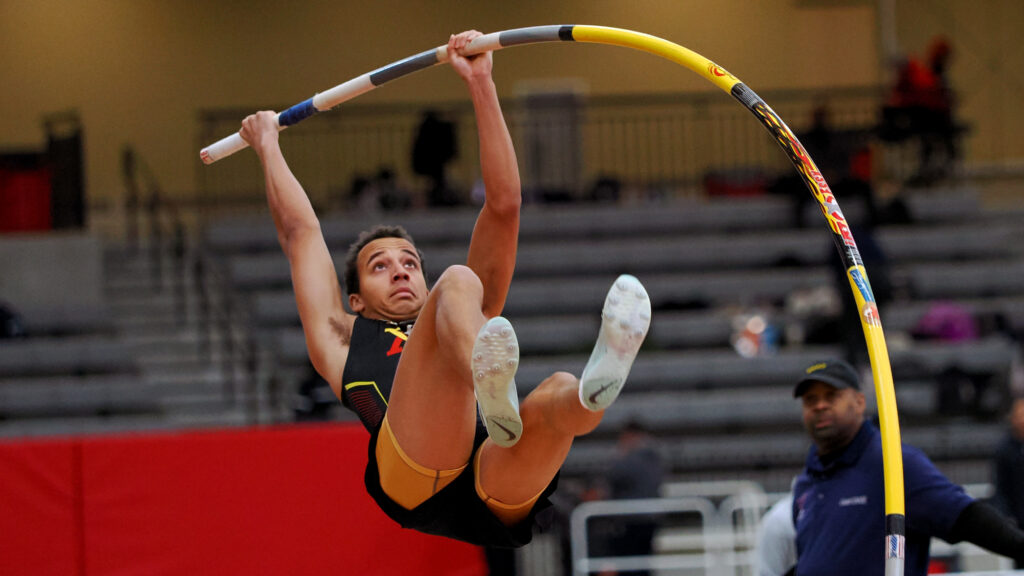
Thomas admits he used to fear heights, but now catapulting over the pole is no big deal. Instead it’s something he highly excels at. Recently, he broke a more than two decade old Virginia Military Institute record for pole vault for indoor track and broke the record last year for outdoor track. In 2024, he also won the pole vault individual title at the SoCon Championships for All-SoCon recognition. 

“Pole vaulting is a very mental sport so staying calm and focused is crucial to competing at this high of a level,” he explained. “Trusting the process on one day that you have practiced for the entire year can be very stressful, especially in front of a large audience.” 

To combat that, he’s come up with breathing techniques and nutrition plans for the days leading up to competition.  

“As long as you do as much as you can to prepare yourself, everything you do on that day during competition should feel easy and effortless,” he said. “My best days are ones where I’m not forcing anything. So, in a way pole vaulting on competition day should just feel like a run and jump; everything else is irrelevant.” 

Keeping stress down and staying organized are ways he stays in the zone.  

Cadet-athletes at VMI not only have their responsibilities with their selected sport but cadet duties on top of that. Cadets are also required to take physical fitness classes twice a week, participate in ROTC all four years, prepare for room and uniform inspections, practice for parade, guard duty, and more.

Taking 16 and a half credits as an economics and business major, Thomas says this is a lighter load than he had last year with over 18 credits. His days usually start at 6:30 a.m. when he gets up and heads to breakfast. This semester he has classes until noon, which allows him several hours to complete any class assignments.  

“The schedule I have right now is really nice because right after my classes, that’s what I’m the most focused,” he explained. “So, getting right into my homework, I can get pretty far ahead.” 

Sometimes, he can fit in a power nap before heading to practice at 4 p.m., which lasts until 7 p.m. He eats at 7:30 p.m. then studies until he’s ready for bed, which he has a pretty rough stop at 9:30 p.m. 

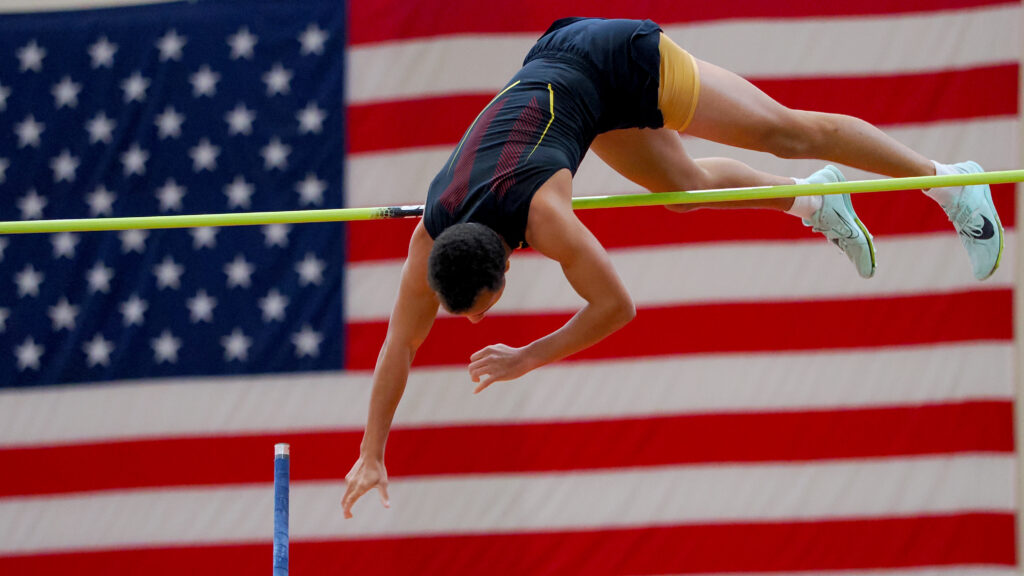
Cameron Thomas pole vaulting during a track and field meet for Virginia Military Institute.
VMI Team Challenge track and field meet at the Corps Physical Training Facility in Lexington, VA January 11, 2025. (Randall K. Wolf)

“I had a bad habit last year going to bed at like 10:30 p.m. because that’s when taps is, so it’s like the average bedtime. But I realize if I get way more sleep, I feel a lot happier,” he said.  

Originally, Thomas was a biology major. Enrolling in the Summer Transition Program prior to matriculating, he took a class with Col. Wade Bell, but instead of focusing on biology, Thomas was trading stocks.  

“He would always laugh at me because I’d be in the back of the class just yelling whenever I make money,” he said. “He really prompted me to go toward the economics and business major, because I didn’t even know that was the thing.” 

Thomas said he is interested in learning how the economy works, especially this year with his more major-centric classes that are focused on it. He said in high school he was stock trading.  

Cameron Thomas pole vaulting during a track and field meet for Virginia Military Institute.
VMI Team Challenge track and field meet at the Corps Physical Training Facility in Lexington, VA January 11, 2025. (Randall K. Wolf)

“I got really obsessed with stock trading and learning how numbers work. I’ve always been a math guy as well, way more than writing or reading,” he commented “I like making money or sometimes losing money. You know, it’s all process.” 

Coming to VMI was a process for him as well, especially learning how to adapt to a strict schedule. 

“I think I’m a lot more mature since I’ve been here. Before I was doing things like staying up late, and not really thinking about how my days coincide with each other on like a day-to-day basis,” he admitted. “I’d always wait to do my work until the last minute. Now I realize that getting it done early is going to be easier in the long run.” 

He’s also committed to his daily practices at track. 

“It was very difficult when I first got here during the Rat Line, because we also had the other stuff. Like last year, I kind of went down with my progression, because I was doing push-ups before the meets, I was marching in new boots and walking in low quarters. A lot of stuff to get used to.” 

He’s learned how to hold himself accountable. His growth in understanding responsibility will help him in the future, especially with dreams of joining the World Class Athlete program with the U.S. Army. Currently, he’s seeking to commission into the Army. The program enables athletes to train for the Olympics. If that doesn’t pan out, he’s looking to be part of the Finance Corps in the Army. 

Never Quit, Never Settle: 2nd Lt. Janine Colantonio’s Pursuit of Excellence in Ranger School

This story originally appeared on the U.S. Army website.

“I met God in the mountains.”

These were the words of 2nd Lt. Janine Colantonio, a 2023 graduate of Virginia Military Institute and newly tabbed infantry officer, as she reflected on her experience at one of the Army’s toughest schools—Ranger School.

Colantonio graduated from Ranger School on January 24, 2025. Her journey was more than just a test of physical endurance—it was a crucible of leadership, self-discipline, and perseverance.

A Legacy of Leadership: Inspired to Lead

For Colantonio, the pursuit of excellence wasn’t just a personal ambition—it was a legacy she was determined to continue.

Her grandfather, Ron Colan, a VMI Class of 1963 graduate, Vietnam War veteran, and engineer officer, played a pivotal role in shaping her decision to transfer to VMI and join Army ROTC.

As a child, she didn’t fully grasp the significance of his service. It wasn’t just his military background that inspired her—it was the leader he was and the character he embodied. Those same qualities became the foundation for her own pursuit of excellence as a leader.

When her father encouraged her to follow in his footsteps, she saw VMI and ROTC as the path to becoming the best leader she could be.

The Road to Ranger School: A Test of Grit & Competition

Before stepping into the grueling phases of Ranger School, Colantonio honed her skills and mental toughness through VMI’s Ranger Challenge Team. Competing in Army ROTC’s toughest event, she trained alongside like-minded cadets who thrived in an environment of high standards and voluntary hardship.

“I was drawn to Ranger Challenge because it was a group of individuals who wanted to put in the extra work and challenge themselves. It’s a volunteer competition, and I learned early on that if you want to be the best, you have to get used to being uncomfortable”

That intensity prepared her for the exhaustion, tactical proficiency, and accountability required at Ranger School. More importantly, the experience reinforced a core belief she carried into her military career—when you surround yourself with highly driven people, they will push you beyond your perceived limits.

A Test Beyond 62 Days

Ranger School’s “62 and through” mantra is well known. It signifies a Soldier’s ability to complete the course without being recycled—a straight path through the grueling 62-day challenge.

But for Colantonio, Ranger School wasn’t just about surviving the course—it was about self-improvement. Endurance, competition, and leadership development didn’t stop at earning the tab.

“You want to give yourself the best leadership experience. Ranger School is a place where you can get as close to real combat experience and the stressors that come with it without actually being in combat.”

Her mindset would soon be tested in ways she never expected.

Endurance: The Power of Pushing Forward

Ranger School is a brutal test of endurance—a relentless cycle of food deprivation, sleep deprivation, and nonstop movement through some of the toughest environments imaginable.

Yet, for Colantonio, the toughest challenge wasn’t physical—it was facing failure head-on.

After successfully completing Infantry Basic Officer Leader Course (IBOLC) and Ranger Assessment Phase (“RAP Week”), she entered phase 1 of Ranger School, but was unexpectedly dropped—a setback that forced her to ask herself:

“Do I really want this?”

Instead of giving up, she did what true leaders do—she self-reflected, sought honest feedback, and refined her approach.

“Most people in Ranger School are used to being one of the best. Pride gets to you. But this experience forced me to be honest with myself and recognize areas where I needed to improve.”

She reached out to her peers, asking them bluntly:

“What do I need to do better?”

Unlike those who complete Ranger School in 62 days, Colantonio’s journey required four attempts before earning her tab—totaling over 190 days in the course.

Her two grueling rotations through Mountain Phase pushed her to new levels of physical and mental endurance. By the time she reached Florida Phase for the second time, she was determined to finish what she started.

“It’s what’s expected of us, and I wanted to show up to my platoon as the best and most experienced leader that I can be.”

Camaraderie: The Ranger Brotherhood

While Ranger School is designed to push individual limits, no one succeeds alone. The experience forged some of the strongest bonds Colantonio has ever had.

“Ranger School teaches you to be selfless. You can go in thinking you’re a team player, but when you’re wet, starving, and exhausted, the only thing that matters is the mission and the people to your left and right. That’s when you truly learn what it means to put others before yourself.”

Through extreme adversity, Colantonio built deep trust with her Ranger buddies, knowing that in the hardest moments, they had her back—and she had theirs.

Hardship and Faith: Meeting God in the Mountains

The Mountain Phase of Ranger School is infamous for its harsh terrain and brutal conditions, and for Colantonio, it became more than just a physical challenge—it was a test of faith.

“One time, I turned to the guy in my squad and said, ‘This is horrible. This is not fun.’”

But in those moments of suffering, something kept her moving—the people around her.

“You have guys fighting for their ‘go’—a wife, kids, siblings back home—and they’re pushing themselves to make it through. You want to do the same when it’s your turn. You want other people to fight for you to get your ‘go’ just like you fight for them.”

It was this shared hardship, this mutual sacrifice, that defined Ranger School.

Lessons for Future Leaders: Never Quit, Never Settle

Colantonio’s journey through Ranger School is a testament to the power of competition, the necessity of endurance, and the strength of team camaraderie.

For future cadets who aspire to follow her example, she offers this advice:

“Network, seek out mentors, and don’t be afraid to push yourself into uncomfortable situations.”

The Road Ahead

With her Ranger tab earned and her next assignment to the 101st Airborne Division, Colantonio is more than just a graduate of one of the Army’s toughest schools—she is a leader forged through hardship, competition, and an unwavering refusal to quit.

Because true endurance doesn’t stop at ’62 and through’—it extends far beyond the tab, into the Soldiers she will lead and the challenges she will continue to overcome.

Virginia Military Institute Army ROTC proudly honors its alumni, who continue to set the standard for leadership and leadership in the U.S. Army.