
As the nation approaches its 250th anniversary, Virginia Military Institute’s Civil Discourse Initiative (CDI) embodies the idea that a healthy democracy necessitates dialogue, compromise, and trust. VMI’s Center for Leadership and Ethics (CLE) started holding debates in 2021, and then partnered with VMI’s Building BRIDGES club in 2022 to grow the opportunities and audiences for the debates. CDI, the name for the program since last year, now offers year-round programming.
The expanding initiative provides a variety of forums for engagement and discussion by using light parliamentary-style Braver Angels debates and A Braver Campus Dialogue (ABCD) workshops to foster a culture of civil discourse and constructive community conversations on important and sometimes controversial topics. These activities encourage listening and public speaking skills and give students more opportunities for rigorous examination of topics through open dialogue. All of these skills align with the mission of VMI to develop leaders and citizen-soldiers.
“Good leaders welcome a variety of viewpoints to help them with decision making,” noted Col. David Gray, executive director of the CLE. “These viewpoints help stress-test and strengthen decisions and strategies. Good leaders are also good listeners and engage effectively with their teams.”
Led by three faculty fellows, Col. Valentina Dimitrova-Grajzl, professor of economics, Col. Sara Whipple, professor of psychology, and Lt. Col. Kim Connolly, assistant director for programs and conferences at the CLE, CDI began the 2025-26 academic year with the support of the Jackson-Hope Fund via a five-year grant to advance VMI’s emphasis on citizenship and leadership through normalizing and internalizing civil discourse at VMI. Four cadet fellows, Katy Layman ’26, Zach Denton ’27, Josiah Farrell ’28, and Zach Richardson ’28, helped develop, organize, and promote the events to cadets and recruit opening speakers. In addition, four cadet ambassadors helped publicize events.
Activities this past year included the introduction of the solutions-based ABCD workshop to both local intercollegiate partners, Washington & Lee, Southern Virginia University (SVU), and Mountain Gateway Community College, and the local community. CDI hosted a workshop in September titled, “How Can We Improve Our Local Economy?” that drew 150 participants and introduced local business owners, economic development officials, and concerned citizens to this civil discourse tool. It also facilitated a meaningful intergenerational exchange of ideas and viewpoints.
In December, VMI hosted a public square debate, a collaborative effort between the VA250 Commission, the State Council of Higher Education for Virginia, the Virginia Department of Education, the College Debates and Discourse Alliance, the American Council of Trustees and Alumni, and Braver Angels. It was part of the commission’s Education Steering Committee’s programs for K-12 and college students to make history come alive, spark a civics renaissance, and celebrate democracy. Select students who participated in the debate will be invited to participate in a debate at the State Capitol in October.
A February debate at VMI focused on honor, integrity, and compliance. Additionally, throughout the academic year cadets traveled to related events at the University of Virginia and SVU.
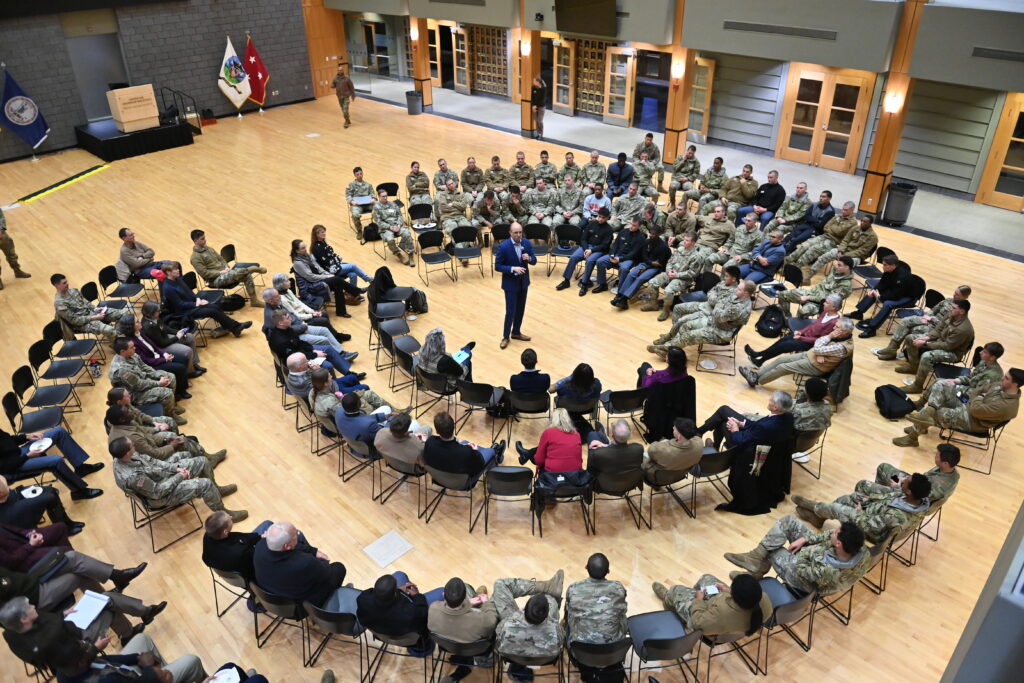
VMI Photo by Kelly Nye.
“This year has been great for CDI, as we have continued to expand the program and connect with even more people,” said Farrell. “The opportunity to engage with students from other colleges at the Democracy360 conference at University of Virginia in a civil discourse setting was a great way to expand my views on issues like voter ID and identity politics. Making connections and conversing with students from other backgrounds has allowed me to take a step back and evaluate my own opinions and ideals.”
The initiative’s efforts to fold civil discourse into the everyday culture of VMI took another step forward when VMI’s committee on academic technology collaborated with CDI to host an ABCD workshop on AI, creativity, and critical thinking. This was attended by a cross-disciplinary group of staff and faculty and included two cadet representatives from the Honor Court.
Smaller monthly “Food for Thought” conversations covered a variety of topics in an informal setting during the lunch period, allowing for more engagement between cadets, faculty, and staff. In addition, a half-day workshop titled, “Cultivating Curious Individuals, Teams, and Organizations,” was offered in March by Dr. Todd Kashdan, author and founder of the Well-Being Lab at George Mason University.
Looking at the next academic year, the initiative has expanded to formally include interdisciplinary faculty and staff partners who have supported and participated in programs over the years. They will receive training to become debate moderators and to incorporate debates and ABCD workshops into the curriculum and other programming.
Cadet ambassador Bianca Marlang ’27 reflected on the impact the program has had on her this past year. “I have learned to keep my bearing amidst hearing views that are the complete opposite from mine… I have since learned to listen for genuine understanding and not listen to respond. It seems small, but I’m very proud of it.”
A complete listing of all CDI activities from this past academic year can be found on the Center for Leadership and Ethics’ website.