
Post View Unavailable »
New Website Launched »

Working With the Embassy of Spain: Josh Kiggans ’25

This article is part of The Next Step series. While the four years at VMI are designed for cadets to push themselves academically, physically, and mentally to tackle the demands of life at a premiere military college, they also prepare cadets for life after graduation. Whether that life be one in the military or one in the private sector, VMI faculty and staff provide guidance to cadets along their journeys. One department specifically dedicated to that endeavor of post-Institute success is the Office of Career Services. In The Next Step series, we highlight cadets preparing to enter the workforce after graduation, as well as those still in the midst of their cadetship preparing for internships over the summer. 

Josh Kiggans ’25 has always wanted to help others. He came to Virginia Military Institute with the mindset to join the military. However, over the years, he realized another goal.  

“In high school, I told people that if I didn’t join the Navy, I would like to find a way to help people in a foreign country,” he said. “I realized that this previous goal was one that I really wanted to pursue and was motivated to follow.” 

Kiggans, a psychology major from Virginia Beach, Virginia, will be part of the North American Language and Culture Assistants Program (NALCAP) through the Embassy of Spain following his graduation from the Institute.  

“I applied to NALCAP because I wanted the opportunity to help others and teach, as well as travel the world and learn more about other languages and cultures. I had previously studied abroad through VMI’s summer study abroad programs to Spain,” he explained. “When the program ended, I knew that I had to find a way to get back to Spain.”

With the help from Dr. Sabrina Laroussi, associate professor of Spanish in the Department of Modern Languages and Cultures, he was able to find the right program that fit his needs. 

“In the NALCAP program, I will serve as a teaching assistant in a classroom helping teach English and coming up with activities about American culture,” he said. “I currently do not know which age group I will help teach, but the ages I can teach range from 1 to 18 years old.” 

Thanks to the Office of Career Services, Kiggans was able to land the job with the Embassy of Spain.  

“There was an Embassy of Spain table at a career fair where I was able to get in touch with someone who worked with the NALCAP program. I was able to keep in contact with their representative, and he was very helpful throughout the application process,” he stated. 

He credits Laroussi with helping him get through the process by answering any questions he had, while also developing his Spanish and connecting him with people to attain the job. 

“VMI prepared me for this next step in my life with the opportunities to study abroad and develop cultural experiences in areas most people don’t go to,” he commented. “I believe that having a VMI degree on my resume has given me a competitive edge in obtaining this job, because it tells an employer that you’re hardworking without directly telling them that you’re hardworking. And with all the opportunities VMI gives you to develop your professional career outside of the military, whether it be through the career services, network of alumni, opportunities to gain leadership experience, etcetera, my degree certainly sets me apart from the crowd.” 

He said another important person in his life who’s inspired him is his mother.  

“When she was my age, she did a similar program in Japan and has given me advice as well as been extremely supportive the entire time,” he said. “Both of my parents have given me the opportunity to further my education and have been supportive along the way. I would not have been able to get through a place like VMI without them.” 

He’s hoping in the next decade he’s able to have a career based around building a better community for people to live in. After his work with the embassy, he hopes to join the U.S. Navy and give back to the country that has given him so much. 
From Law School Dreams to Army Leadership: Jeremiah Wilks ’25

This article is part of The Next Step series. While the four years at VMI are designed for cadets to push themselves academically, physically, and mentally to tackle the demands of life at a premiere military college, they also prepare cadets for life after graduation. Whether that life be one in the military or one in the private sector, VMI faculty and staff provide guidance to cadets along their journeys. One department specifically dedicated to that endeavor of post-Institute success is the Office of Career Services. In The Next Step series, we highlight cadets preparing to enter the workforce after graduation, as well as those still in the midst of their cadetship preparing for internships over the summer. 

Jeremiah Wilks ’25 never intended on commissioning when he came to Virginia Military Institute. 

“I had a misconception of what the military is like. I originally planned to attend law school following graduation from VMI,” he admitted.  

His time at VMI swayed his decision, though. 

The international studies major from Richmond, Virginia, will be commissioning into the U.S. Army as an infantry officer following when he graduates. He branched Signal Corps detail infantry, where he will be an infantry officer, from second lieutenant to captain, and will transition to Signal Corps as a captain.

“I chose to commission into the U.S. Army because I will gain experience as a platoon leader early in my career, ultimately developing me as a leader and learning how to influence individuals in an organization,” he explained. “This generation has a shortage of leaders, and this role will sharpen my leadership and project management skills. Additionally, the stable income and benefits that the U.S. Army offers is hard to turn down.” 

He said commissioning will also allow him the opportunity to attend law school later in his life with federal tuition assistance the Army provides, alongside health care, the GI Bill, and loans with exceptional interest rates. 

“This environment will make me more adaptable, increase my workload, and give me a good foundation for my career with real-world leadership experience and top-secret clearance,” he said.  

As an infantry officer, Wilks will be responsible for leading infantry soldiers at all levels of command and combined armed forces during missions on the ground. He will assess the situation and lead an attack, defense, and other operations. Other duties second lieutenants fulfill include platoon logistics, and training. 

In the next decade, Wilks hopes to be working for the government in Northern Virginia or Washington, D.C., preferably in the tech field or intelligence.  

He credits his dyke, 1st Lt. Johnnie Walker III ’22, as his inspiration for this career path.  

“VMI gave me a foundation of discipline and many opportunities to lead others,” he said. “I believe VMI on your resume is unmatched.” 

Taking the Law in his Hands: Christian Walker ’25

This article is part of The Next Step series. While the four years at VMI are designed for cadets to push themselves academically, physically, and mentally to tackle the demands of life at a premiere military college, they also prepare cadets for life after graduation. Whether that life be one in the military or one in the private sector, VMI faculty and staff provide guidance to cadets along their journeys. One department specifically dedicated to that endeavor of post-Institute success is the Office of Career Services. In The Next Step series, we highlight cadets preparing to enter the workforce after graduation, as well as those still in the midst of their cadetship preparing for internships over the summer. 

LEXINGTON, Va. June 11, 2025 — It was never the intent of Christian Walker ’25 to go to law school. Initially, he had no desire to. He was also incredibly unsure about what his future would hold.  

“My 2nd Class year is when my interest in potentially attending law school was ignited as I would take several classes that involved different sectors of the law,” he explained. “Through taking these courses, I discovered a passion for law and hope that I would one day be able to pursue a career as a lawyer.”

The international studies major from North Chesterfield, Virginia, said he has long felt his purpose in life is to serve others.  

“I feel that law is one of the professions where you can consistently help people day after day,” he said. “This is something I was seeking when I was trying to figure out what to do after college, and it was something that I found in the law.” 

Walker is expecting law school to be a challenging experience, something he hopes will help with his goal of becoming a JAG officer.  

“From what I’ve heard talking to other individuals who are currently in law school, there is a new challenge every day that your professors expect you to not only think critically about but also expect you to apply relevant legal arguments to,” he commented. “However, law school creates an environment for individuals to work together … at the end of the day, everyone has the same goal, which is to be a lawyer.” 

He credits Maj. Tim Passmore, assistant professor of international studies, in helping him discover what law school could do for him.  

“He taught the very first law class that I took during my cadetship, and it set the foundation for my interest in the law,” he stated. “Through taking other classes taught by Major Passmore, and getting the opportunity to attend the Law of Armed Conflict Competition in Sanremo, Italy, he has helped foster my interest in the law and give me the knowledge required to succeed as a first year in law school.” 

Walker said VMI has instilled structure and drive in himself, which will allow him to succeed in all facets of life. From the early wakeups and tidy rooms, Walker knows that even the smallest details need to be thought about. 

The bonds he created while at VMI have shown him that there are always people who will go out of their way to help, if ever you should need it.  

“That’s something that I feel very few other colleges create while people attend. Without the environment that VMI creates and the challenges it puts you through every single day, I would not have had the tools to succeed and the drive to achieve greater things,” he said.  

He hopes in the next decade he will be able to provide legal support as a JAG officer, then potentially a federal prosecutor. Most importantly, he wants to make an impact on people in a positive way, especially if they are going through tough times where they may have nowhere else to turn.  

“I absolutely believe VMI gives me a competitive edge on my resume. The Institute has a reputation for helping create strong academic habits that will help cadets even after their time at VMI is over, and that is something that is taken into consideration when applying to schools after VMI,” he said. “The reputation that alumni of the Institute have helped create is strong and has spread to graduate institutions. It is through their hard work and dedication that allows my application to look stronger because ‘Virginia Military Institute’ is on it, and it is my hope that I can carry on this legacy.” 

I Am VMI: Woongchan Oh ’25

What truly defines Virginia Military Institute are the people. Cadets, faculty, and staff, both past and present, are what make it “No Ordinary College.” I Am VMI will showcase the outstanding individuals who have accepted the challenges and embraced the spirit of VMI. Their perspectives provide authentic insights into life at the Institute and the value of this unique military college.

Major: Civil Engineering
Hometown: Seoul, South Korea | Harrisonburg, Virginia
Featured Activities: NCAA Division 1 Soccer | Tau Beta Pi Honors Society
Post-Graduation Plans: Commission, U.S. Army

Woongchan Oh ’25 had considered a military path during high school. But it was a soccer scholarship to Virginia Military Institute that solidified his decision.

“The opportunity to continue both my academic and athletic career ultimately led me to choose VMI,” he explained.

Oh wanted to pursue an engineering degree and among the three engineering programs at VMI, civil engineering offered the most hands-on experience and fieldwork, he said.

His experience at VMI has been crucial in his personal and professional growth. The demanding environment has helped him develop strong time management skills and perseverance.

Balancing academics, athletics, and military training has been a continual challenge for him and has encouraged him to step outside his comfort zone. VMI has shaped him into a more adaptable and confident individual, one who is ready to take on any future challenges with determination, he admitted.

“My experience at VMI has been unique compared to other cadets. I sought out every opportunity available to me, and I took full advantage of them,” he said. “I played NCAA soccer for all four years while balancing my engineering degree. In addition to my academic and athletic commitments, I enlisted in the Army as a combat engineer, studied abroad at Korea University, conducted summer research, and completed a summer internship with the Virginia Department of Transportation. None of this would have been possible without the support of my friends, faculty, and VMI alumni. I am always thankful for them and grateful for the opportunities I have had.”

Oh credits the one-of-a-kind environment of VMI to his successes — in the classroom, on the soccer field, in his personal life, and more.

“I enjoy hanging out with my roommates, who are also my teammates and classmates,” he said. “VMI is a unique place where you share every experience with your friends, strengthening your bond and creating lifelong friendships.”

Oh has also been equipped with discipline and resilience at VMI.

“The ability to manage time effectively, adapt to challenges, and perform under pressure will be invaluable in my future career,” he commented. “Whether in the military, engineering, or any other field, the leadership, teamwork, and problem-solving skills I developed at VMI will help me succeed. Additionally, the strong network of alumni, faculty, and friends who have supported me throughout my journey will continue to be a valuable resource as I move forward.”

He said he’s proud to be from VMI and revels in the fact that he has experienced the same school life as generations before him.

“In today’s world, fewer young people are willing to challenge themselves or embrace pressure and stressful situations. I am grateful that I chose a different path that pushed me beyond my comfort zone,” he said. “VMI, like any other place, does not guarantee success, but I can assure you that everyone in the VMI community wants you to succeed. They will guide and support you along the way. With an open mind and determination, you will find countless opportunities to grow and excel.”

I Am VMI: Kevin Garroway ’25

What truly defines Virginia Military Institute are the people. Cadets, faculty, and staff, both past and present, are what make it “No Ordinary College.” I Am VMI showcases the outstanding individuals who have accepted the challenges and embraced the spirit of VMI. Their perspectives provide authentic insights into life at the Institute and the value of this unique military college.

Role at VMI: 1st Class Cadet (Senior), VMI Class of 2025
Major:
 Civil Engineering
Hometown: Ellicott City, Maryland
Featured Activities: India Co. XO 2024-25 | VMI Army ROTC Ranger Challenge, including Cambrian Patrol Commander
Post-Graduation Plans: Commission, U.S. Army Infantry

Kevin Garroway ’25 wanted a challenge. All it took was one visit to Virginia Military Institute and he could see how different it was from other schools. He was sold.

“My experience has been great. It gives me the opportunity to struggle, but also gives me the resources to overcome,” he said.

The civil engineering major initially started out as a chemistry major. But after taking AP biochemistry in high school, he decided to shift, he explained.

He says he enjoys being in such close proximity to his friends. They work out together, eat together, and hang out.

“I’ve gotten to do some cool things at VMI, but I’m most proud of the Institute when I’m with my friends here,” he said.

He says he’s grown immensely since starting at VMI.

“I feel that, as a rat, I had a lot of people above me who I wanted to be like. When I first started, I recognized that I was at the bottom and would have to earn my place, but I saw where I wanted to be. I had a lot of people who helped me see what it took to get to the places where I wanted to be,” he admitted.

He said the skills he’s gained at the Institute will translate well when he enters the U.S. Army.

“I believe that VMI cadets typically have a different mentality than most,” he said. “We are used to a lot of bad things happening at one time and figuring out a way to overcome them. When bad things happen to peers at different schools, it seems to stop them or at least throw them down. We feel at home in the struggle.

“VMI is not going to magically turn you into the next five-star general, it takes effort,” he continued. “Some people come in and reap the rewards without sowing the seeds. You truly get in what you put out. The opportunities are here, it’s just a matter of if you are willing to go and grab them.”

Institute Awards Highlight Achievements for the Academic Year

Each May, numerous awards recognizing the accomplishments of cadets, faculty, and staff across multiple fields and disciplines are presented at VMI’s Institute Awards ceremony. These awards are provided by the Institute, by civic groups, and by the Institute’s ROTC units.

Congratulations to the 2025 recipients:

AWARDRECIPIENT
Intercollegiate Sports AwardsJacob Owen Prince ’26
Intercollegiate Sports AwardsLuke Alexander Rusterucci ’25
Intercollegiate Sports AwardsCourtney Nicole Novotny ’25
Institute Writing Program Thesis Awards: Engineering & ScienceCourtney Nicole Novotny ’25
Institute Writing Program Thesis Awards: Engineering & ScienceMaj. Molly Kent
Institute Writing Program Thesis Awards: Arts, Humanities & Social Sciences                                               Gabriel Patrick Williams ’25
Institute Writing Program Thesis Awards: Arts, Humanities & Social Sciences                                               Maj. Megan Roosevelt
Lieutenant General Edward Mallory Almond 1915  AwardJoshua Jackson Evans ’25
General Withers A. Burress Marksmanship Awards (Men’s Rifle Team)Ryan Charles Harlow ’25
General Withers A. Burress Marksmanship Awards (Women’s Rifle Team)Darian Elizabeth Tweedell ’27
100th Infantry Division Lieutenant General Withers A. Burress Scholarship Fund Awards  (Rising 1st)                                                                Dylan Louis Apo ’26
100th Infantry Division Lieutenant General Withers A. Burress Scholarship Fund Awards (Rising 1st)James Oliver Aldinger ’26
100th Infantry Division Lieutenant General Withers A. Burress Scholarship Fund Awards (Rising 2nd)                                                 Victor Angel Austin McBride ’27
100th Infantry Division Lieutenant General Withers A. Burress Scholarship Fund Awards (Rising 2nd)Rafe Michael Clendenin ’27
Major General Stephen Sewell, Jr. 1960  AwardMeagan Marie Riding ’27
Colonel Thomas St. John Arnold AwardNathan Andrew Franchebois ’25
The Lieutenant John H. Lattin 1966 AwardJonah Michael Jurack ’25
International Studies Award                               Jonah Michael Jurack ’25
Lieutenant Mark R. Wilson, Sr. Midshipman AwardAnna Yemelianova ’25     
The Chief of Naval Operations Distinguished Midshipman Graduate AwardAnna Yemelianova ’25     
General Lemuel C. Shepherd Jr. Sixth Marine Division AwardsJack Chrisman Fletcher ’25
General Lemuel C. Shepherd Jr, Sixth Marine Division AwardsTrey Robert McGee ’25
Chesty Puller Award, First Marine DivisionTrey Robert McGee ’25
Chesty Puller Scholarship, First Marine DivisionAmiel George D. Diaz ’26
Chesty Puller Scholarship, First Marine DivisionSteven Charles Parkinson Jr. ’27
Naval Submarine League: Admiral Frederick B. Warder AwardLouis Brandt Wiltenmuth ’25
Superintendent William H. Milton, Jr. Class of 1920 AwardLouis Brandt Wiltenmuth ’25
Brigadier General Alonzo J. Walter 1949B AwardElana Cadhla Gutierrez ’25
General Douglas MacArthur Cadet AwardMelina Karise Bulger ’25
Earl L. Valentine Jr. AwardPatrick John Simmons ’25
Alan D’Andelot Belin Memorial PrizeAnthony Wayne Allen Jr. ’28
John Ryd Bush AwardTitus Mitchell Royl ’28
Commander Harry Millard Mason Military Proficiency AwardConnor Dawson Cherry ’25
Charles H. Dayhuff Jr. 1931 First Captain AwardDevin Christopher Auzenne ’26
Class of 1964 New Market Legacy AwardCameron Joseph Dabu ’25
Marshall Citizen-Soldier AwardJohn Edward Covert ’25
Faculty Scholarships for MeritAiden James Psczulkoski ’27
Faculty Scholarships for MeritAlyssa Madylaine Cacace ’26
Faculty Scholarships for MeritMacallister Jennings Clark ’26
Faculty Scholarships for MeritAlexander Joseph Riley ’27
Francis H.  Smith AwardSarah Elizabeth Woosley ’26
The New Market Scholar-in-Residence AwardJamie Angelina Rodriguez ’28
The Colonel Daniel T. Ingram 1921 – Castle Heights Military Academy AwardSuzanne Jeanne Peck Leaptrot ’25
Award for Excellence in PhysicsNathan Angelo Vanness ’25
Commodore Matthew Fontaine Maury Award                                                                     Kevin Joseph Dougherty ’25
Alfred H. Knowles AwardJames Andrew Boynewicz ’25
The Floyd D. Gottwald Jr 1943 Award in ChemistryCaleb Owen Staples ’25
Civil Engineering AwardKenna Jaye McAllister ’25
Brigadier General Jeffrey G. Smith Jr. 1979 Cyber MedalKephner Clinton Etienne ’25
Stewart W. Anderson 1908 Memorial Award           Cole S. Bowyer ’25
The John W. and Jane M. Roberts AwardTraylor Alexander Duval ’25
Lieutenant Randolph T. Townsend AwardZachary Thomas Poche’ ’25
Thomas S. Baur 1975 Award for Excellence in Exercise ScienceCaroline Marie Lassalle ’25
Bruce C. Gottwald Jr. 1981 AwardSimon Delano Roberts Moore III ’25
Adolpho Ponzanelli Award                                 Charles Lowell Downs III ’25
Adolpho Ponzanelli Award                                 Joshua Daniel Palmer ’25
Charles R. Martin 1955 AwardRachel Joy Roberson ’25
The Wilbur S. Hinman Jr., 1926 Research AwardLife SciencesRachel Joy Roberson ’25
The Wilbur S. Hinman Jr., 1926 Research AwardLife Sciences  Lt. Col. Jillian L. Stuart
The Wilbur S. Hinman Jr., 1926 Research Award Arts & HumanitiesJack Irish Conley ’25
The Wilbur S. Hinman Jr., 1926 Research AwardArts & Humanities  Maj. Christopher M. Blunda
The Wilbur S. Hinman Jr., 1926 Research Award Natural SciencesHai-Hsin Huang ’25
The Wilbur S. Hinman Jr., 1926 Research Award Natural Sciences Lt. Col. Meagan C. Herald
The Wilbur S. Hinman Jr., 1926 Research Award EngineeringCate Fay Dowden ’25
The Wilbur S. Hinman Jr., 1926 Research Award Engineering  Capt. Robert L. McMasters
Sir Moses Ezekiel AwardGretal Yvette Shank ’25
Colonel Herbert Nash Dillard 1934 AwardGretal Yvette Shank ’25
Asa S. Dearing AwardGretal Yvette Shank ’25
The Nathaniel W. Pendleton 1922 Distinguished Coaching Award          Gary S. Thacker Jr.
The VMI Distinguished Service AwardMary Laura Kludy
The VMI Distinguished Service AwardJay M. Shafer
The VMI Distinguished Service AwardCapt. Heather J. Williams
The Dr. D. Rae Carpenter AwardCol. Paul R. Moosman Jr.
The Thomas Jefferson Teaching AwardDr. Sherif E. Abdelhamid
The VMI Distinguished Teaching Award                                                                         Col. Timothy C. Dowling
The Jackson-Hope VMIRL Matthew Fontaine Maury Prize for Excellence in ResearchCol. R. Geoffrey Jensen
The Jackson-Hope Prize for Excellence in Published Scholarly Work, Humanities & Social SciencesCol. Spencer D. Bakich
The Jackson-Hope Prize for Excellence in Published Scholarly Work, Science & EngineeringMaj. Christopher N. Shingledecker
The Jackson-Hope Prize for Excellence in Academic Advancement                                                                                             Col. Kathleen D. Bulger-Barnett
Benjamin H. Powell Jr., 1936 Institute Professorship in EngineeringCol. Joseph R. Blandino
General Edwin Cox 1920 Institute Professorship in History and EconomicsCol. Jeffrey S. Smith
Charles S. Luck, Jr., 1920 Institute Professorship in EngineeringCol. Charles D. Newhouse
John C. Allen 1962 Distinguished Professorship in ChemistryCol. Stanton Q. Smith
Henry King Burgwyn Jr., Boy Colonel of the Confederacy, Chair of Military HistoryCol. Timothy C. Dowling
Colonel Beverly M. Read 1941 Institute Professorship in Arts and SciencesCol. Scott T. Frein
Jackson-Hope Distinguished Chair in Natural SciencesCol. John A. David


Explanations of each award are available in the May 2025 Institute Awards Program and photos are available on the VMI Flickr account.

Behind the Balance: Caden Plummer ’25 — Keydet Baseball

Virginia Military Institute’s cadet-athletes have to juggle cadet life, heavy academic course loads, and their NCAA Division I sport. Committed to both academic and athletic pursuits, balancing their rigorous schedule in both sports and school requires a certain level of commitment and discipline. Behind the Balance is a series that focuses on those cadet-athletes and how they handle the hurdles of the day-to-day. 

Time management is a common theme for many cadets, especially as a cadet-athlete. Caden Plummer ’25 is no stranger to figuring out his time and schedule. 

“You get dealt certain inconveniences that you just have to figure out how to deal with,” he said. “You can feel sorry for yourself in the moment, but that doesn’t do anything. You’re weighing yourself down more. Having the ability to be able to turn the page and be like, alright, I’m just going to deal with this, I’m going to figure out how to get it done and then you go in and just do it.”

Determination is what Plummer has in spades. His goal heading to college was to play baseball. Not only that, he wanted to play as a pitcher and a hitter, which can be difficult to be offered. Part of choosing Virginia Military Institute was that he was offered to do both. Now, just a pitcher, he’s glad he chose the Institute. He’s a civil engineering major — another draw to the school was its robust engineering program.  

What really sealed the deal was after an overnight from a VMI open house, he could feel the brotherhood and camaraderie that came with it.  

“That really drew me to it,” he admitted.  

Now in his final semester, he’s taking his lowest credit hours of 14 and a half, but previously he was tacking on 18-19 credits a semester. The lighter load has allowed him to head down to the baseball field early for some individual practice.  

Cadet-athletes at VMI not only have their responsibilities with their selected sport but cadet duties on top of that. Cadets are also required to take physical fitness classes twice a week, participate in ROTC all four years, prepare for room and uniform inspections, practice for parade, guard duty, and more. 

He’s down on the field around 1 or 2:30 p.m. for practice daily, while in season. 

“Pitchers, then hitters will hit in small groups. It’s more individualized work with the coaches,” he explained.  

Practice, while in season, runs until about 6 p.m., while out of season it can go as late as 8 p.m. Plummer said the practices are shorter while in season to conserve energy due to the number of games they’re playing.  

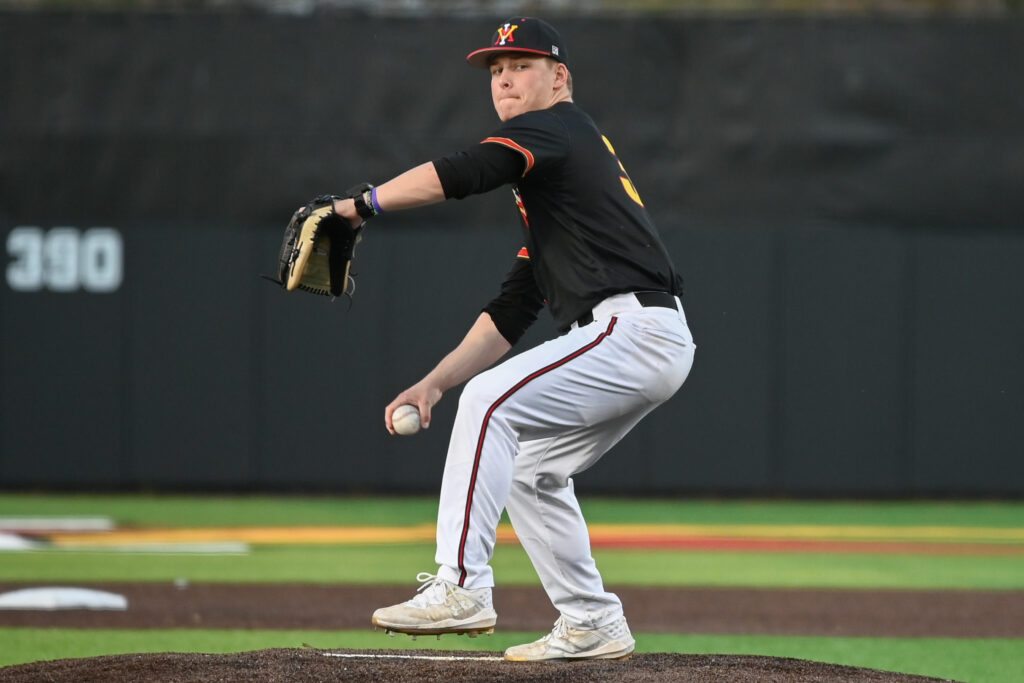
Caden Plummer throwing a baseball during a Virginia Military game.

“It’s to try and give us a little bit of rest.” 

His time at VMI has given him the fortitude to get things done efficiently. 

“People can get lazy and if you do that here, then there are a lot of consequences,” he said. “It’s important to stay on top of your stuff, if you can have the mental fortitude to do it.” 

Plummer said that type of attitude will help in the real world with project deadlines or work responsibilities. Considering he has already landed a job for post-graduation, he knows he can’t slack off. He has accepted a position with Kimley-Horn in Richmond as an engineer.  

He credits his faith in keeping him strong and pulling him out of tough times. Keeping a positive mindset has also created a strong foundation for himself. He also doesn’t take his experience at VMI for granted. 

“That’s a huge thing for me, my relationship with the Lord,” he commented. “I’m just lucky to be able to get to experience these things, because there’s plenty of people that would like to be in my spot or would like to go to college.”  

Honors Week: Exploring Global Rivalries and Climate Change

During VMI’s annual Honors Week, Earl Filgo ’25 presented research that bridges global strategic competition and climate change. 

Filgo, an international studies major with minors in national security and Arabic, plans to commission into the U.S. Army as a military intelligence officer after graduating this spring. His presentation, “Strategic Rivalry and its Implications for Climate Change Mitigation,” brings together his academic interests and his drive to confront complex global challenges. 

“I chose this topic because of my interest in international relations theory, its ties to national security, and my concern over climate change,” Filgo said. “Climate change deserves more scrutiny outside the scientific community, especially from those studying security and diplomacy.”

His thesis explores how rivalry between states affects their willingness to cooperate on global environmental initiatives. The research required a hybrid of qualitative and quantitative methods, evolving over time as Filgo engaged more deeply with data and theory.  

“Initially, I thought it would be mostly qualitative,” he said, “but as I progressed, I realized how powerful quantitative research could be for this topic.” 

Filgo found the thesis process to be intensive.  

“It takes time, loads of time,” he said. “You need to understand different theories and studies, then link them together into one cohesive project. It’s not enough to have a great research question. You need solid data to back it up.” 

Filgo’s advisor, Col. Patrick Rhamey, observed Filgo’s growth throughout the process.  

“Once he got started, he showed initiative and diligence,” Rhamey said. “He learned to work with limited and sometimes poorly coded data, using both statistical software and theoretical frameworks to produce a well-rounded study.” 

Rhamey highlighted the relevance of Filgo’s work for the VMI community. “His research connects global environmental priorities with military spending, a subject directly tied to the paths many of our cadets pursue.” 

“I gained credibility and confidence in my research skills, and a way to show my capabilities to future employers,” he said about how the experience expanded his academic and practical skill set. “It’s a burden, but also an exciting challenge not many cadets get to experience.” 

Honors Week: Cadet Completes Work on App

Parents of newborns often struggle to understand the needs of their baby. How often should they eat? How long should they sleep? How does one know if they are sick? So, it isn’t unusual for parents of babies with hearing impairments to be confused. Col. James Squire, professor in the Department of Electrical and Computer Engineering at Virginia Military Institute, was faced with that very issue 25 years ago when his oldest son was born and diagnosed with a hearing disorder.

Squire’s first thought as a new parent was, “What was the world like that he was experiencing?” Squire and his wife were given an audiogram, but they didn’t know what it meant. Thankfully, his son’s hearing disorder was a misdiagnosis, but it inspired Squire to begin research to help young parents of children with hearing loss. “I thought it would make a good honors project for cadets. I was wrong. It made a terrible single honors project, but it made three really good honors projects because there was so much background work with theoretical development, open-source work, working with audiologists, and figuring out how to get programs that could be used practically by the audiology community.”  

Work on the project has spanned over nine years and began with Will Flathers ’09, who primarily focused on filtering audio. Binh Tran ’23 continued with the project and created an open-source sampling frequency filter. Tran won an award for his contribution at the Institute of Electrical and Electronics Engineers (IEEE) Southeast Regional Conference two years ago.

Cole Bowyer ’25, who took up the mantle as the third honors student to work on the endeavor, placed the capstone on the project in his presentation, “Audiogram Emulator,” a free app available to parents that allows them to hear as their child hears.  

Bowyer explained that roughly 9,000 children are born each year in the United States with some type of hearing impairment, and only half of those children receive treatment.

“If a child does not receive any treatment before the age of 1, it’s shown to significantly hurt his ability to learn in the education system and keep up with his peers,” he said.  

Why do parents not seek treatment? Bowyer believes there are several reasons. “For one, parents do not want a label attached to their child. Second, often the child can hear sounds and react, so his parents think he is hearing properly, but he’s not. Since his hearing is impaired, he is not receiving a true understanding of what is being said. And third, parents may not understand hearing loss and its ramifications.”  

In his research, Bowyer consulted with many professionals in their respective field including Lindsey Richard, Au.D., CCC-A, educational audiologist at The Virginia School for the Deaf and the Blind in Staunton. “She provided helpful feedback on how to improve the app. Without her, I don’t think that we would have been able to make the best possible app.”   

Squire and the three cadets who developed the app have no intention of profiting from their work. “We want it easily assessable and free to parents so they will fully grasp how their child hears, and increase the chances of the child getting medical help,” stated Bowyer. The app can be downloaded from the Squire’s website.  

Bowyer will present the project at the IEEE Southeast Regional Conference in Charlotte, North Carolina. His hope in the future is that the app will be commonly used by audiologists and other medical professionals  

Bowyer is an electrical and computer engineering major from Daleville, Virginia, where he attended Lord Botetourt High School. He is the son of Tara Tice and Sheldon Bowyer. Following graduation, he will work for AECOM in Roanoke. 

Honors Week: Analyzing U.S. – China Conflict Asymmetries

John Kennedy ’25 used his Virginia Military Institute Honors Week presentation to tackle how asymmetries between the United States and China shape the potential for conflict in his thesis titled, “Asymmetries Between the U.S. and China in the Context of Conflict. 

Kennedy, an economics and business major, will marry after graduation and commissioning, before heading to Fort Moore for infantry officer training. 

“I started VMI the same week Abbey Gate was bombed during the Afghanistan withdrawal,” Kennedy said. “That moment made it clear to many of us that peace isn’t guaranteed. I wanted to examine what future conflict could actually look like, especially with China.”

Kennedy focused his research on China’s conventional military capabilities, strategic doctrine, and economic leverage.  

“Public rhetoric makes China seem like a looming military threat,” he said. “But my research suggests that their economic power may be the more serious concern.”  

“Cadet Kennedy has done a remarkable job of taking a very large topic and reducing it to its bare bones,” Col. Atin Basuchoudhary, Kennedy’s faculty advisor, said. “He has combined various elements of his learning experience to answer his thesis question.” 

The thesis process began during Kennedy’s 2nd Class year with topic selection and continued through a series of formal submissions. Most of his work was done this spring.  

“I spent about three hours a week on it, mostly reading and refining ideas,” he said. “The Rat Line made it tough to make real progress last fall.” 

Kennedy says he’s gained both insight and perspective through the process of his thesis.  

“This research helped me think critically about the reality behind the headlines,” he said. “It’s easy to be alarmed by military posturing, but understanding the economic side gives you a fuller picture.” 

Kennedy also acknowledged the importance of mentorship throughout the project.  

“I want to thank Colonel Basuchoudhary and Colonel [Spencer] Bakich for their guidance,” he said. “Their support helped make this project possible.”