Post View Unavailable »
New Website Launched »

The Vanguard — Gracie Harlow ’27

The Vanguard series highlights cadets of Virginia Military Institute who exemplify promise, perseverance, and the true spirit of leadership. While they may not be the top-ranking students or those in prestigious positions, these individuals’ dedication, resilience, and growth embody the essence of being a VMI cadet. By sharing their stories, including the challenges they’ve faced and overcome, we shine a spotlight on the diverse paths to success at the Institute, proving that leadership and excellence come in many forms.  

When Gracie Harlow ’27 started her collegiate career, she felt like she was going through the motions and not obtaining any growth. She started at Hollins University, an all-female college near Roanoke, but ended up transferring to Virginia Military Institute after two years. 

“There was no challenge. I was just living,” she admitted. “I wanted a challenge. My brother went to The Citadel and I come from a military family. I wanted something different. I knew I could get somewhere from here.” 

The transfer as a junior didn’t mean she’d end up a 2nd Class cadet. She went directly to the Rat Line and started over.  

“You can’t skip it,” she said of the Rat Line. She turned 21 right after Breakout. 

“It was kind of rough in the beginning. I struggled a lot. My dyke helped me a lot,” she stated. “It took a lot of getting used to, but I feel like everything I went through and I have been through so far has helped me grow in these couple years.” 

Harlow also knew she needed financial assistance for school. She received a scholarship for track and field, which she participated in her first two years as a cadet. All of her aid is covered by VMI scholarships, either from the school or alumni.  

“These have been crucial to me getting through school due to my financial situation at home,” she explained. “Having those opportunities that are free or I have an avenue to make it free means a lot.” 

She has her plate full. A history and English double major, she also has several writing and photography extracurricular activities. Originally, she started out as an international studies major, but felt uninspired and was looking for something she enjoyed more. She switched to history, but found she needed to fill more classes. 

“I had a lot of schedule to fill, so I picked up the double major in English. That has helped me branch out and meet people,” she commented.  

Maj. Madeleine Ramsey, assistant professor of history and Harlow’s academic advisor, has worked closely with Harlow for the past two years. Although she hasn’t taught her, she’s heard her colleagues speak about Harlow’s influence in the classroom. Ramsey noted Harlow’s academic diligence as even more impressive because she’s been able to achieve it while participating in a DI sport of track and field and the demanding regimental system. 

“She is always prepared, ready to engage with the material at hand, and willing to participate actively in classroom discussions. She is a committed student, as I have seen firsthand through the numerous visits to both my colleagues’ offices and mine, to ask questions and seek assistance with her papers,” Ramsey commented. “As she has done throughout her academic career, Ms. Harlow applies the same discipline and dedication to VMI’s Corps of Cadets. She excels both inside and outside the classroom and now holds rank as a corporal.” 

The dive into history and English allowed her the opportunity for an internship with the American Battle Monuments Commission where she was given the opportunity to research for them. She also traveled to France to present her research with the commission. 

Being involved has been a huge goal for Harlow.  
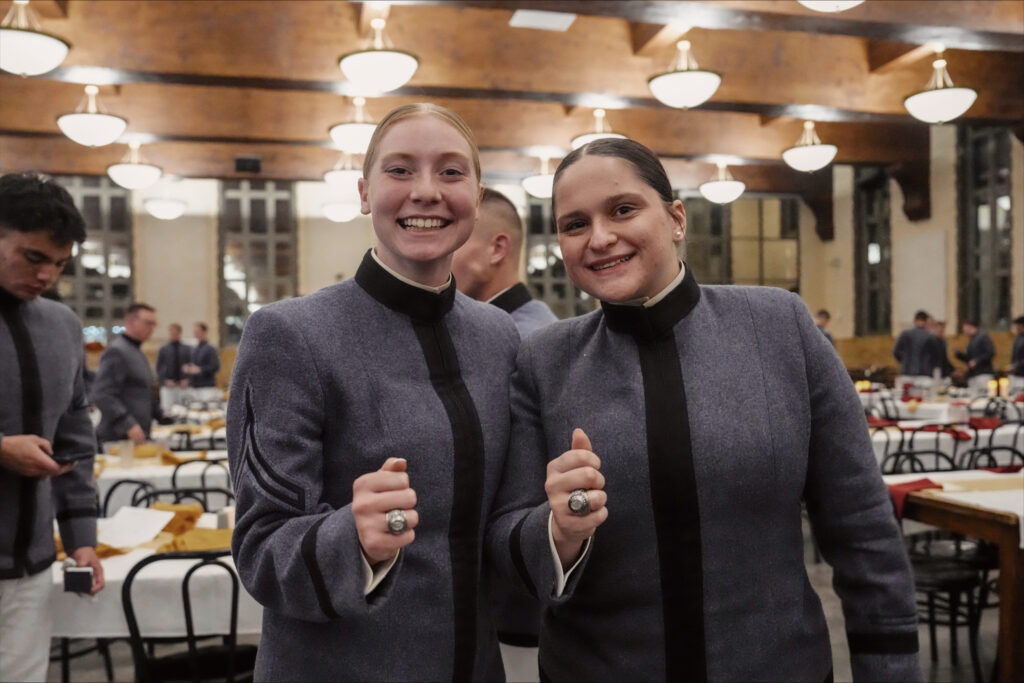
Gracie Harlow with her brother rat in the dining hall.

“I like trying new things, but I feel like VMI has given me more opportunities to do that,” she said. “Hard work is more recognized here than a lot of colleges. I know we have the uniforms that look the same, but you can always tell the difference.” 

She will be studying abroad this summer in Spain, spending four weeks at the University of Alcalá. She previously went to Poland in the summer of 2024 through the MirYam Institute’s program, I-SAP (Israel Strategy & Policy) tour, which is designed for U.S. military cadets to travel, learn about a country, its place among the nations, and its relationship with the United States. 

Despite any shortcomings Harlow has faced in her personal life, Ramsey said she’s been able to hold numerous part-time jobs and also received an internship from John A. Adams ’71 Center for Military History and Strategic Analysis to travel to Normandy. 

“Quite simply, Ms. Harlow is one of the hardest -working cadets I have encountered at VMI, a place where hard work is a part of everyday life,” Ramsey said. 

As a student, she’s improved with planning things out. She used to be more sporadic with things and the regiment of VMI has pushed her to become more solid in her foundation.  

“I feel like I literally have to plan out everything. I’m a big planner,” she stated.  

Ramsey said that Harlow is one of the most organized and disciplined students she’s ever met. 

“She arrives promptly for every meeting and is always prepared. She has faced a variety of challenging circumstances in her life that for many would have been reason to seek an easier path,” Ramsey stated. “Ms. Harlow sought out, and has excelled in, one of the most challenging systems in higher education, which speaks to her strength of character.” 

Her roommate calls her OCD because she’s very strict about her uniform and how tidy their room is. She prides herself on never having any demerits.  

“I hate being in trouble. I just do my best to avoid it.” 

She tends to be more quiet in the classroom but will always speak up if she needs help.  

“I try to do my hardest to work with my professors and get the help I need. I lean a lot on my roommate. My dyke helped me a lot my rat year. I still talk to her a lot. I met my boyfriend here,” Harlow said. “The whole support system is how I buckle down and deal with it. VMI teaches you to move forward no matter what’s in your way right now. You have to get past it. And having that support system to get past it helps.”
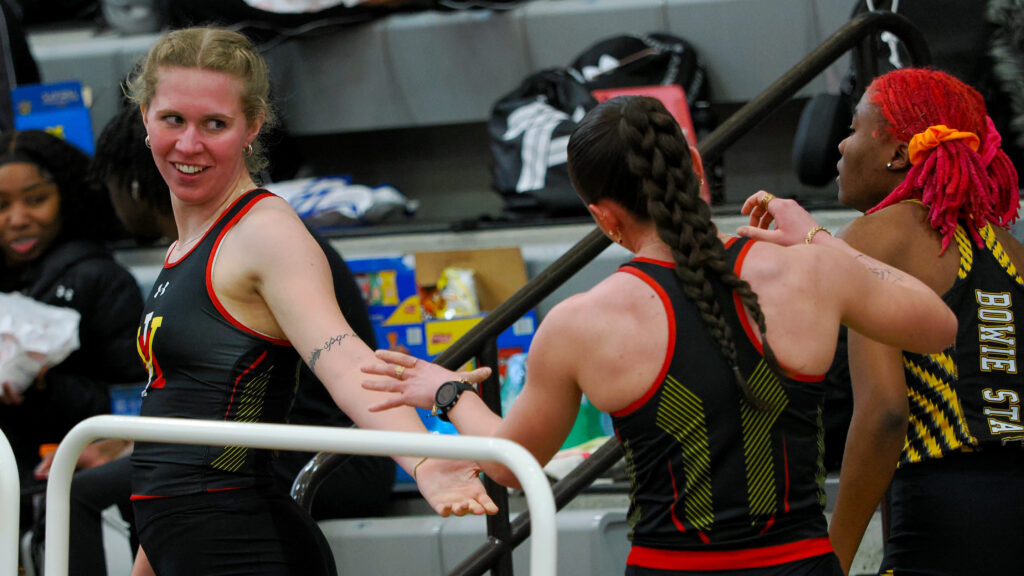
Behind the Balance: Evelyn Anderson ’27 — Keydet Track and Field

Virginia Military Institute’s cadet-athletes have to juggle cadet life, heavy academic course loads, and their NCAA Division I sport. Committed to both academic and athletic pursuits, balancing their rigorous schedule in both sports and school requires a certain level of commitment and discipline. Behind the Balance is a series that focuses on those cadet-athletes and how they handle the hurdles of the day-to-day. 

Evelyn Anderson ’27 thrives on structure. The international studies major has 17.5 credits this semester, while holding rank as regimental sergeant major for the Corps, and balancing a Division I sport. With a hefty academic load, she’s fitting schoolwork in whenever she can. Her regimental duties can range from cadet leadership meetings to Honor Court trials, which also take up a chunk of her time and effort. She is also planning on commissioning into the U.S. Marines Corps, so she has ROTC responsibilities. 

Originally, she wanted to relieve her parents of the burden of paying for college. Even though Anderson had never heard of Virginia Military Institute, she was recruited for track and field, resulting in a full ride. 

“I have three younger siblings, so I figured I’d take the load off a little bit, and I did a visit here, and I really enjoyed it,” she said. “I needed the structure, so that’s really what led my decision.” 

Anderson started out as a soccer player when she was younger, then joined cross country and track to stay active leading up to soccer season.  

“With track, you see the time, and it’s a reflection of you every single time,” she said. “There’s no denying that if you didn’t do well, it’s because of your own actions leading up to the meet. I think it has more accountability of whether or not you’re actually putting in the effort. I like seeing my gains and/or losses based off the effort that I put in.” 

Cadet-athletes at VMI not only have their responsibilities with their selected sport but cadet duties on top of that. Cadets are also required to take physical fitness classes twice a week, participate in ROTC all four years, prepare for room and uniform inspections, practice for parade, guard duty, and more. 

Evelyn Anderson, part of the VMI Team Challenge track and field meet at the Corps Physical Training Facility in Lexington, VA January 11, 2025.

She’ll go straight from class to practice some days, which results in some late nights finishing schoolwork.  

“I’m big on the Google calendar schedule. I have everything that I’m ever doing in Google calendar, so I try to plan it out ahead of time,” she explains.  

Even when it becomes overwhelming, Anderson reminds herself that there’s been so many before her that have been able to tackle the tasks that VMI puts forth.  

“This isn’t new. It’s just overwhelming for me because I haven’t been in that situation,” she admitted. “If other people can do it, you can as well. If you’re uncomfortable, everyone else is also uncomfortable. I’m not the only person with responsibilities. Everyone at VMI is pretty much invested in some aspects of the school. I just try to tell myself not to be dramatic.”Sometimes, you just have to call it a day. 

“My biggest life hack is knowing when to give up. And that sounds so bad, but I think that there comes a time where you realize going to bed is worth more and will do more for your mental health than trying to push out an assignment or complete last-minute things,” she explained. “You can’t operate on fumes.” 

The challenges are worth it, she said. Anderson credits VMI with improving her interpersonal skills. In high school, she moved and then went through COVID-19 where she wasn’t around people, and her life revolved around school, track, and being at home. 

“Coming to VMI, I feel uncomfortable kind of all the time, but it’s in a good way. I’m growing skills, learning how to interact with different people from different backgrounds,” she explained. “I come from a more rural area that has one high school. It’s a lot different for me, dealing with all different people, especially in stressful ways. I have to orchestrate and hit deadlines. I think that that’s really helping prepare me for the professional world.” 

VMI Class of 2027 Celebrates Ring Figure

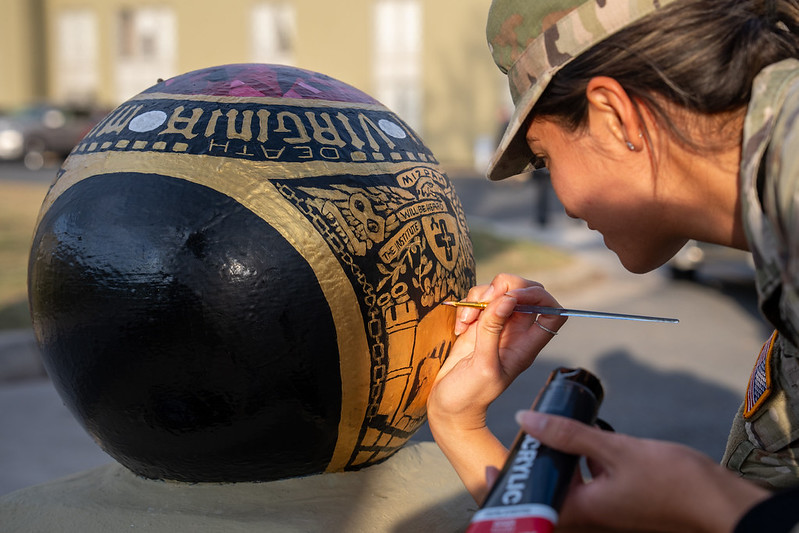
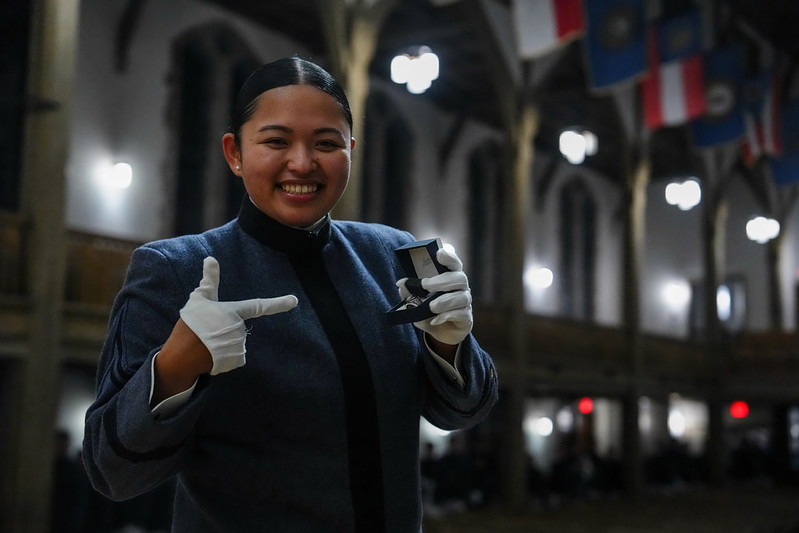
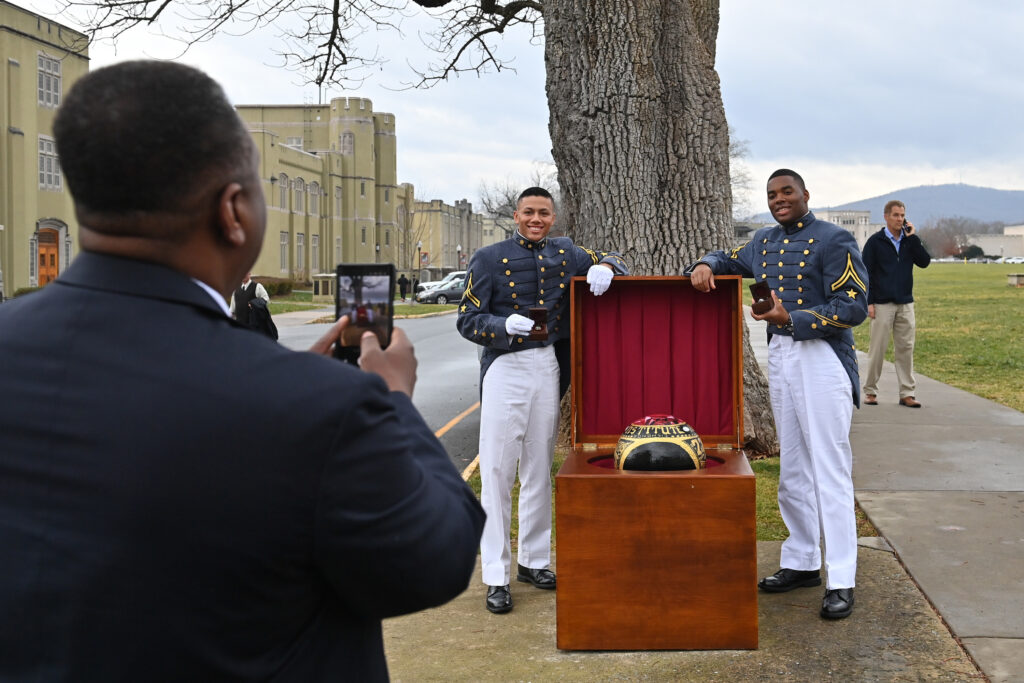
When the cannonball across Letcher Avenue from Memorial Hall transforms into a highly-detailed ring with a brilliant center gemstone, the observant passerby knows it’s time for Ring Figure, one of the many significant brother rat bonding experiences in the lives of Virginia Military Institute cadets. It was during the two-day celebration held Nov. 20 and 21 that 2nd Class cadets received their class rings. Though the weather was dreary in Lexington, to the members of the Class of 2027, the atmosphere on post was warm and radiant throughout the long-awaited events, including the presentation of combat rings and class supper Thursday evening, followed by a family brunch, class ring presentation, ring blessing, and Ring Figure ball on Friday.

The first ring was designed by members of the Class of 1848 and was presented to graduates during finals celebrations. The design was simple. The word “Mizpah” was cut in the stone and on the inside of the band was engraved, “1 of 24, July 1848.” Mizpah, from the Hebrew, is translated as “the Lord watch between me and thee, when we are absent one from another.” The term signified brotherhood, the enduring connection among the 24 graduates of the Class of 1848. Modern rings have become increasingly larger and more elaborate in design, but the tradition of the class designing their one-of-a-kind ring remains the same and the word “Mizpah” is often still found. The custom of 2nd Class cadets receiving the class ring was established in 1907, and the addition of the Ring Figure ball started in 1927 with the Class of 1928. 

The traditional presentation of the combat rings was held in Memorial Hall followed by the class supper in Crozet Hall Thursday evening, where the cadets dined while entertained by a jazz quartet led by Lt. Col. Matthew Halligan. Kimber Latsha ’77, a representative from the class who graduated 50 years before the honored class, offered congratulatory words to the cadets and gifted them a class guidon to carry at their future reunions. The Douglas Carter France III ’71 Memorial Award was presented by Warren J. “Buddy” Bryan ’71 to Gabriel DuPlessis ’27, who received the honor through an election by his peers. Established in 1969 by the Class of 1971 as a tribute to their brother rat who lost his life in an automobile accident, the award is presented each year to the 2nd Class cadet who best emulates the qualities of France: excellent character, selflessness, graciousness, and enthusiasm.

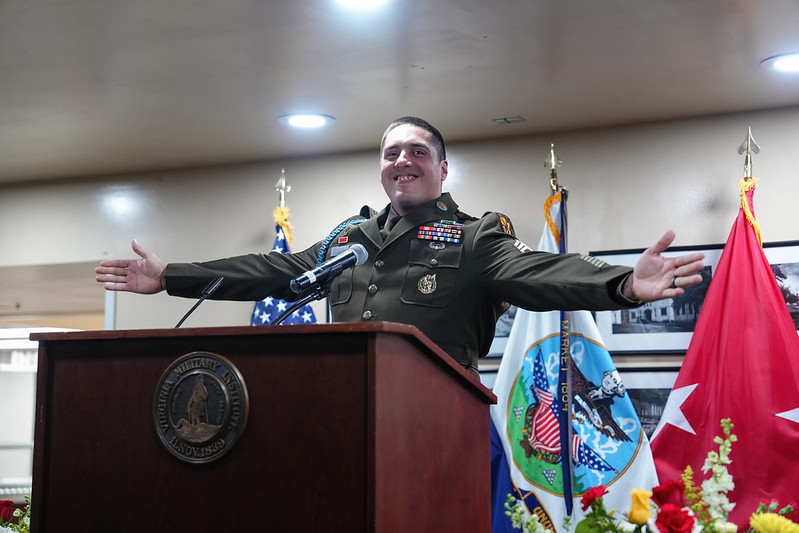
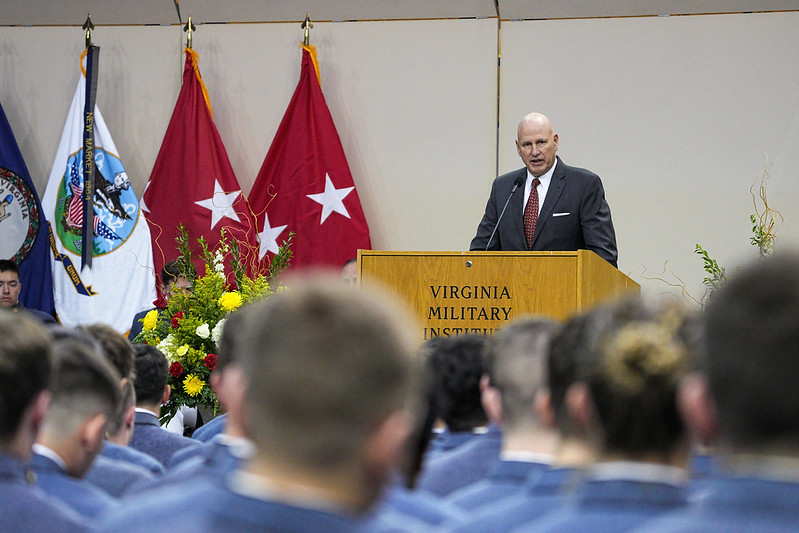
The class nominated Sgt. 1st Class Larry Aviles, Army ROTC military science instructor, to be their honorary brother rat for the evening. Mutual affection was displayed as the cadets welcomed Aviles to the podium with chants and applause, to which he responded with a lighthearted, “What up, weirdos?” Following the laughter, Aviles thanked the class for the tribute and earnestly challenged them to always remain disciplined, be a service to others, and to remember they chose the hard road. “That road will beat you up, break you down, and make you question why you ever set foot on it. However, it’s also the road that forges warriors, leaders, and people who can carry the weight when no one else can. You have already proven you can handle more than most ever will. You’re not just the Class of 2027, you are the next generation of warriors, and it’s time to own that.” Despite his plans of retiring in seven months, Aviles promised to return for the class’s graduation in 2027. 

Pierson Read ’27, vice president of the class, presented Aviles with a signet dinner ring and framed print of “Charge of the VMI Cadets at New Market,” by Benjamin West Clinedinst, VMI Class of 1880. A favorite of Aviles, the original 18-by-25 foot oil painting hangs in Memorial Hall. 

Aviles beams with pride at the podium, arms outstretched.
—VMI Photo by H. Lockwood McLaughlin

   
Originally from the Bronx, New York, Aviles enlisted in the Army in 2006. He was deployed multiple times to the Middle East including Operation Iraqi Surge, Operation Iraqi Sovereignty, New Dawn, and Operation Enduring Freedom. He was later assigned to The Lightning Academy—the military’s premier jungle training venue in located in Hawaii—where he served as a jungle survivor instructor. In that capacity, Aviles was deployed to train or teach in multiple countries around the world including the French Foreign Legion “Caome Foga” in Gabon, Africa; the Jungle Warfare School “Guerra na Selva,” in Manaus, Brazil; and the Marine Jungle Warfare Course in Okinawa, Japan. Aviles was then assigned to recruiting operations in Portland, Oregon, where he enlisted over 40 future soldiers and participated in countless high school instructions. After recruiting, he was assigned to the 1st Battalion, 327th Infantry Regiment, 1st Brigade, and 101st Airborne Division as a platoon sergeant where he trained soldiers through JRTC rotations and multiple live fire exercises. Aviles’ military education and certifications consist of tactical tracking operations, Army jungle survival, Marine jungle warfare, rappel master, air assault, Army basic instructor, medical casualty assistance, Army recruiting course, Equal Opportunity Leaders Course, Counter-Radio Controlled Improvised Explosive Device/Electronic Warfare course, Spider M7 Munitions course, Tactical Site Exploitation course, Class 1 UAS course, Field Sanitation course, Combat Lifesaver course, Combative level 1 course, Basic Leaders course, Advanced Leaders course, and Senior Leaders course. Aviles was also awarded the Expert Infantryman Badge and Combat Infantry Badge. 
 
Following Aviles’ speech, Matthew Assouad ’27, class president, invited his brother rats to put on their combat rings, which they did to boisterous cheers, and ensued in vigorously banging their rings on the chairs and tables, filling the dining hall with a metallic symphony.

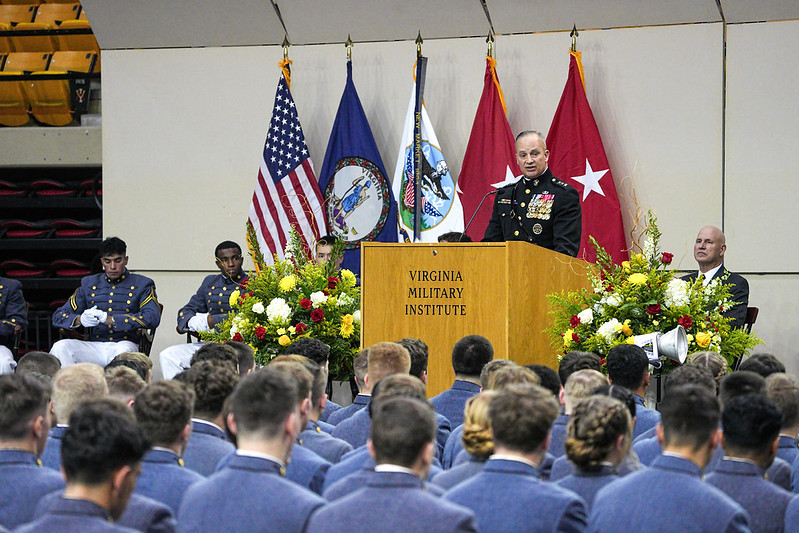
On Friday, a family brunch in Crozet Hall preceded the formal ring presentation ceremony where 2nd Class cadets received their individualized rings in Cameron Hall. Mohammad Zanganeh ’27, Ring Figure chairman, welcomed guests, offered opening remarks, and introduced the speakers, the first being Lt. Gen. David Furness ’87, superintendent. Furness shared with the cadets that he remembers being in their shoes 40 years earlier. “I recall being overwhelmed by the accomplishment and the anticipation of getting that ring on my finger. The VMI class ring is a unique symbol among our nation’s service academies and senior military colleges, for no two class rings are alike, which makes us different from every other institution. Symbolism is important. It helps connect us to the values and ideals we cherish, and reminds us of them long after our journey at VMI has ended. The acceptance of this ring brings a new journey of great responsibility and portends a life of selfless service ahead. Like your choice of attending VMI, service and sacrifice are truly the path less traveled, and this path is one full of purpose and rewarding life experiences.” 

Alumnus guest speaker, retired U.S. Marine Corps Maj. Gen. Paul Brier ’81, addressed the class after Furness. Brier described the VMI ring as a military totem of the United States, a bond and a heritage. “It is a lifelong reminder that you are never alone. This ring carries a silent but powerful message: that you are a leader, a person of character, and someone who can be trusted to do what is right.” He continued by imparting to them the difference between talent and trust. “Talent is important. The military thrives on it, and here at VMI, your talents have already carried you far. But talent alone is never enough. Talent is about the individual. Trust is about the team. When pressure builds—in combat, leadership, and in life—it is trust, not talent, that determines who people will follow. You build bonds forged not by talent, but by trust, and those bonds became the foundation of your class identity, the very strength you celebrate today as you put on that ring. Your ring symbolizes far more than individual achievement. It symbolizes your class. You wear it not just for yourself, but for every brother rat who walked the Rat Line with you, who sweated and suffered beside you, who now stands as part of a great, unbroken chain of trust stretching back generations.”
 
At the conclusion of his speech, the class presented Brier with a first edition of “One Hundred Years at VMI,” by William Couper, VMI Class of 1904.   

Brier received a Naval ROTC scholarship to attend VMI, where he earned a degree in civil engineering. He also holds a Master of Strategic Studies from the U.S. Army War College in Carlisle, Pennsylvania. He is a veteran of the Gulf, Iraq, and Afghanistan wars, and retired after 36 years of military service. During this service, he commanded the 3d Battalion, 14th Marines; 6th Civil Affairs Group in Iraq; Marine Forces Central Command Coordination Element, Afghanistan; U.S. Marine Forces Europe; U.S. Marine Forces Africa; and 4th Marine Division. He also served as deputy commander of Joint Force Maritime Component for Joint Task Force Odyssey Dawn, conducting contingency operations in Libya and the Mediterranean Sea; and as the assistant deputy commandant for plans, policies, and operations, Marine Corps Headquarters at the Pentagon. As a registered professional engineer civilian, Brier serves as the assistant circuit executive for the U.S. Courts of the Fourth Circuit leading the facilities program for the federal judiciary in Virginia, Maryland, West Virginia, North Carolina, and South Carolina. He is also an offshore skipper, coach, and mentor in the Commanding and Seamanship Training Squadron, a premier summer training program at the U.S. Naval Academy, where midshipmen receive training and experience in ocean sailing, seamanship, navigation, leadership, and teamwork aboard Navy 44 sloops. His awards include the Navy Distinguished Service Medal, Defense Superior Service Medal, and Bronze Star Medal with Combat “V” and gold star.

Cadets pose for a photo with their rings.

Later Friday afternoon, the ring blessing service was held in Memorial Hall. Col. John Casper ’04, Institute chaplain, shared his message, “The Prize is Worth the Price,” a phrase which he confessed helped get him through his cadetship. “It’s the idea that the prize of an end goal is worth the price you have to pay to get it. In academics, the prize of a good grade is worth the price of studying.   The prize of wearing a ring and saying you go to VMI comes with the price of hard work, suffering, and acknowledging your own weaknesses. The catch is you have to decide in your heart if it’s worth the price, and each of you have. You’ve chosen the road less traveled.” Casper encouraged the cadets to not lose sight of the actual prize they are after, their faith. He referenced the biblical passage, I Corinthians 9:24 “Do you know that in a race all the runners run, but only one receives the prize? So run that you may obtain it.” Casper’s talk was followed by five cadets who offered prayers, verses, or blessings from their respective faiths of Protestantism, Catholicism, Muslimism, Judaism, and Buddhism. Each faith group then held individual blessings in separate areas of the chapel.  

Cadets and their dates enjoy an evening on post during the Ring Figure.

The evening wrapped up with the Ring Figure ball in Cocke Hall with the traditional dress code of coatees, white ducks, or long white skirts for cadets, floor-length white gowns and elbow-length gloves for female civilian dates, and tuxedos with white bow tie for male civilian dates. Before entering Cocke Hall, couples proceeded through an arch of sabers held high by two opposing lines of cadets in Memorial Hall. They were also photographed as they posed in the larger-than-life replica ring.

The Vanguard — Aidan Carman ’27

The Vanguard series highlights cadets of Virginia Military Institute who exemplify promise, perseverance, and the true spirit of leadership. While they may not be the top-ranking students or those in prestigious positions, these individuals’ dedication, resilience, and growth embody the essence of being a VMI cadet. By sharing their stories, including the challenges they’ve faced and overcome, we shine a spotlight on the diverse paths to success at the Institute, proving that leadership and excellence come in many forms.  

Aidan Carman ’27 can be described as committed to whatever Virginia Military Institute can do for him. His professor, Col. John David, professor in the Department of Applied Mathematics and Jackson-Hope Distinguished Professor of Natural Science, said Carman is trying to get everything he can from his time at the Institute — utilizing his math degree track and plans of commissioning into the U.S. Navy.

“I feel like there’ s been a lot of good Naval officers come out of our department, and I think he’s going to be another one,” David said. “I think beyond his effort and hard work is the fact that he seems to fit in well with his [brother rats] and other math majors. He’s a great kid. My job would be easy if they were all like him.” 

Carman says he’s focused and confident in himself, but he’s still trying to improve himself. The math major said he’s academically sound.  

“I’m fortunate that I can grasp a lot of material. Not to say that I don’t have to put in any work, but it seems, for the most part, I pick up things pretty quickly, so that’s good. I’ve been able to keep good grades,” he admitted. 

There was a bit of a learning curve in his first year, especially when it came to time management.  

“That was a very big shock coming here, especially throughout the Rat Line, was learning how to manage my time,” he stated. “As a high school student, I didn’t have to put any effort at all into it. I never brought home homework. It was all done by the end of the day. I didn’t have labs. So, learning how to balance school with also getting sleep and managing all that time to do the little in between things. 

“The biggest thing I had to learn was not doing homework the night before it was due, but when it was assigned,” he said. “Procrastination is what really gets people. All the little things start to add up. Once I started just getting the smaller stuff out of the way, I had a lot more time for bigger projects and tests.” 

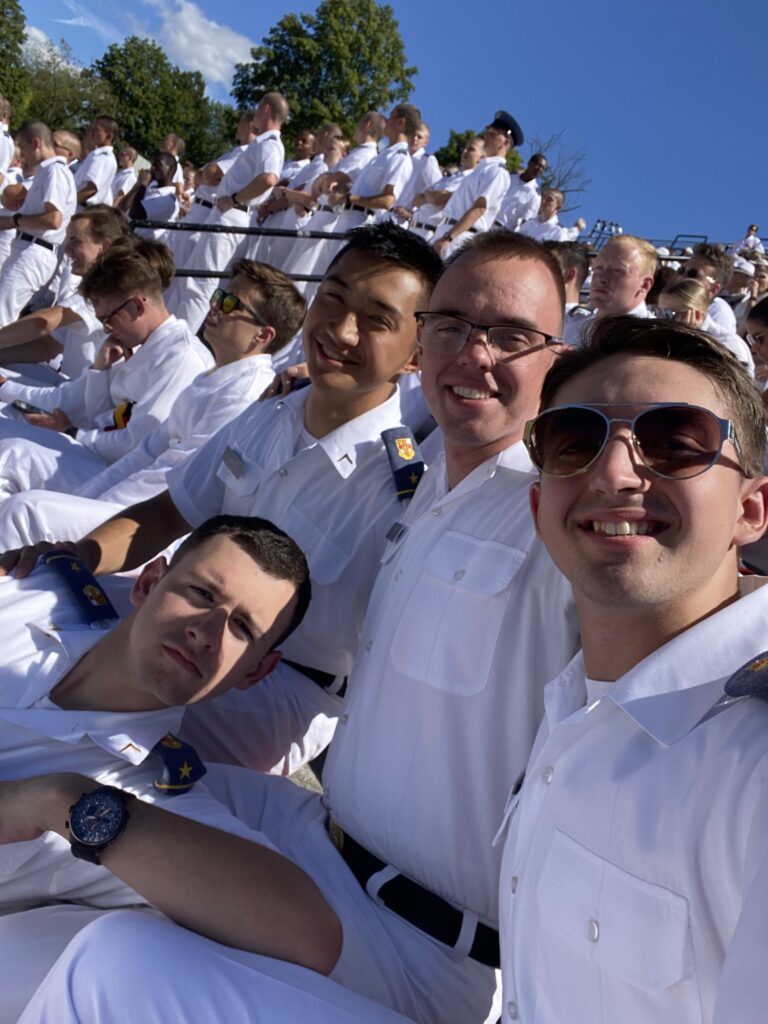
Aiden Carmen with his brother rats at a football game at Virginia Military Institute.

One of the biggest lessons Carman has learned is to be comfortable with being uncomfortable.  

“Throughout the Rat Line, just some of the mental challenge of not quitting when that’s the easy way out, and even if something’s harder to do, still doing it and just grit your teeth and do it,” he explained. “I feel like I was not that way before coming here. I was the, ‘take the easy way out,’ but that changed when I got here. I learned to just grit my teeth and do the hard way over the easy.”

As a platoon sergeant for the Old Corps, his day begins and ends with accountability.  

“Mostly it’s just being accountable at formations,” he explained. “For BRC [breakfast role call] and SRC [supper role call] every morning and evening, I stand out in front, get accountability, report it back, and then march down.” 

But even with a system in place, each year at VMI brought its own unique challenges.  

“As a rat, you just do what you’re told and go where you’re told — you’ve got your dyke (senior mentor) to support you,” he said. “By 2nd Class year, you know the people who will have your back, and you know the school a lot better. Third Class year, though, is tricky. You’re not completely alone, but it feels like it sometimes. You’re trying to figure out your support system, both personally and academically, and really learn what works for you and what doesn’t.”

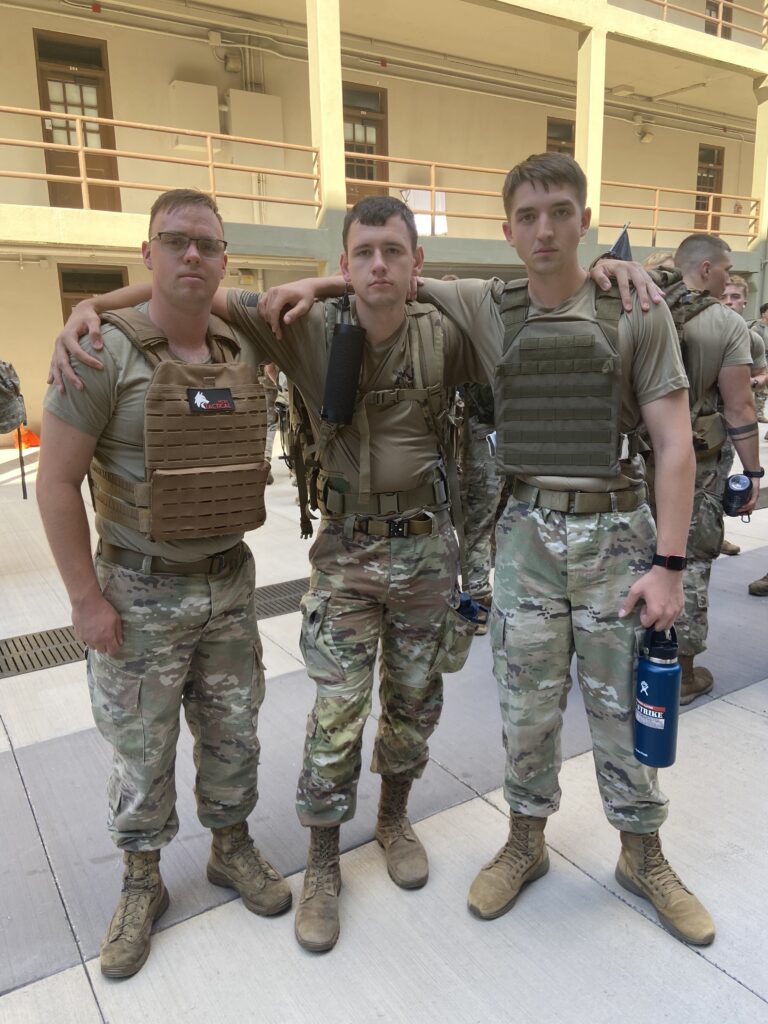
Aiden Carman with his brother rats in barracks at Virginia Military Institute.

One of the places he found direction was in the math department, where he got involved in research opportunities. Through the Summer Undergraduate Research Institute (SURI), there’s a program called AIM, or Applied Industry Mathematics. Carman explained that it’s focused on working with local businesses or even departments at VMI. He’s worked with VMI’s financial aid and administration office, but most recently he partnered with a company in Buena Vista.

Those experiences gave him something more than classroom learning — real-world work experience. 

“You get credits, a stipend, and, most importantly, the chance to apply what you’ve learned to actual problems. Sometimes in class you’re just solving for a number,” he explained. “I feel like I got a very wide breadth of experience from working with different entities in a professional line of work and applied the things I’ve learned in class and put them into practice to see how they can solve real world problems. That’s a valuable skill.” 

“He always does what he’s supposed to do,” David, director of the AIM program, said.  

Carman has enrolled in three of David’s classes and in 2024, did research to help VMI’s admissions and financial aid offices analyze what factors best predict whether cadets will stay at the Institute and ultimately graduate. 

“He just seems to be really committed to getting everything he can out of his time at VMI,” David commented. 

The Vanguard — Caleb Chandler ’27

The Vanguard series highlights cadets of Virginia Military Institute who exemplify promise, perseverance, and the true spirit of leadership. While they may not be the top-ranking students or those in prestigious positions, these individuals’ dedication, resilience, and growth embody the essence of being a VMI cadet. By sharing their stories, including the challenges they’ve faced and overcome, we shine a spotlight on the diverse paths to success at the Institute, proving that leadership and excellence come in many forms. 

Caleb Chandler ’27 wanted a challenge when it came to deciding what language to study at Virginia Military Institute.  

“When I saw the different language options, I didn’t want to take Chinese, I didn’t want to take Spanish or French, I kind of thought they were too basic,” the modern languages and cultures major admitted. “I wanted that challenge of Arabic, and I’m glad I did.”

He was inspired to explore Arabic after observing his father, an aviation mechanic in the U.S. Navy during the War on Terror. He said that area of the world had consumed his father’s life, so it was really all he knew growing up. 

Chandler originally set his sights on VMI because he was recruited for the wrestling team. Growing up in a military family, the Institute was appealing to him. But he left the team last year and decided the club rugby team was more up his alley.  

“Being a NCAA athlete is not for the weak,” he said.  

Instead, he’s taken on more roles for the Corps, like being elected the class historian, which means he’s in charge of housing for all the cadets. 

“If there’s ever room disputes or anything like that, usually I’m the primary mediator,” he explained. “Or if the room does need to be changed, I’ll change it and make sure all parties are on the same side, as well as the commandant staff. That’s my primary job.”  

By being part of the General Committee, if there are violations of the class system or the white book, he is part of the committee that prosecutes. 

Chandler’s passion for Arabic earned him a scholarship for the Project Global Officer (Project GO) program last year, which provides ROTC students with opportunities to study strategic languages and cultures abroad. The scholarship is funded by the Department of Defense and the experience lasts about two months, specifically for critical language speakers, Chandler said.  

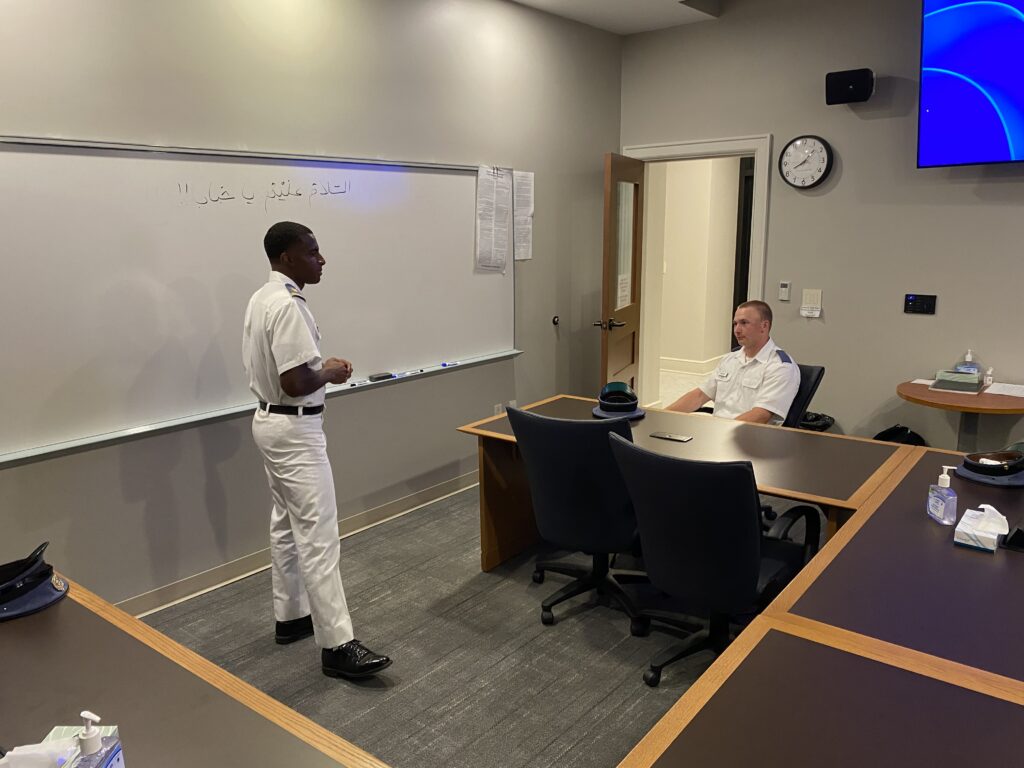
Cadets in a classroom at Virginia Military Institute.

“That could be anything from Arabic, Chinese, Swahili, Russian, those types of languages that the government deems necessary for young officers to speak,” he said. “You basically spend two months there in intensive learning.” 

He said that sometimes he’d be in the classroom for four hours or even up to eight hours — all Arabic instruction with culture lessons mixed in.  

While participating, Chandler said he visited eight cities in Morocco, rode a camel in the Sahara Desert, all while expanding his language capabilities.  

“I got used to hearing [Arabic] from native speakers, because there’s only so much you can do in the classroom,” he stated. “When you have hours that you can dive into it and you can see what your weaknesses are, you can become better. My speaking became better, my listening, my comprehension, everything.” 

His studies were centered at the American Language Center, which was close to his host family. His host mother didn’t speak any English, and he had to communicate entirely in Arabic at home, unless his host brothers were there to help.

“I was nervous initially. I had only completed the 100 level of the language by this point. I could do basic greetings and stuff like that,” he admitted. “I’d say about by the halfway point, I had kind of gotten a schedule down, and most things that my host mother would ask me, I would be able to understand.” 

Maj. Hicham Assaoui, assistant professor of Arabic in the Department of Modern Languages and Cultures, said studying and living in Morocco was a rigorous and immersive experience, one that Chandler not only met, but thrived in.  

“He quickly adapted to his host family, developed meaningful relationships, and served as what I can only consider as a cultural bridge between American and Moroccan communities,” Assaoui explained. “He is both mature and resilient. In terms of academic promise, his strong performance in the Moroccan history and culture course and his growth in Arabic proficiency signal a strong potential for future success.” 

His commitment to the study of Arabic continues on post. An active participant in the Group Study Session (GSS) tutor group, he holds group study sessions once a week for the 101 or 102 levels of Arabic. He’ll also attend lower-level Arabic classes to understand what each class is working on so he can tailor his study sessions to best fit those who need help.  

“I’ll write down notes to myself and what they need to work on in conjunction with the professor, and when we come in to the group study sessions, we’ll spend that entire hour, maybe on verb conjugation or reviewing vocabulary — it’s completely what they want,” he said. “I try and make it as close to possible to what helped me succeed.” 

Caleb Chandler on a camel in the desert.

According to Lt. Col. Jason Schroepfer, assistant professor in the Department of Modern Languages and Culture, the way Chandler approaches learning Arabic has stood out to him. He describes him as a leader to those wishing to learn Arabic, where his fellow cadets look to him for guidance.  

“In communication activities, he quietly takes stock of the task at hand by actively taking notes. He then applies the knowledge undeterred by the fear of making mistakes. He also takes feedback on some areas of improvement, if need be,” Schroepfer said. “In Arabic reading tasks, he’s also not afraid to take measured risks by making educated guesses on the meanings of words and structures that are just a little bit more advanced than his current level. These hallmarks of a motivated, independent student, more often than not, payoff for him. Most importantly, these are traits that are shared by highly successful people in general.”

Mohammed Shihab, Arabic professor in the Department of Modern Languages and Culture, said Chandler possesses a proactive drive to serve. Shihab has observed him during study and tutoring sessions with other cadets where Chandler doesn’t give them the answers, instead he guides them on how to study, breaking down difficult course material into understandable segments.  

“His initiative in seeking out those in need of help and his selfless dedication to their success is a rare and valuable trait that speaks directly to his character and potential as a leader of character,” Shihab said. “Cadet Chandler is the complete package: a brilliant and diligent student, a born leader, and a person of profound integrity. He is precisely the type of individual — one who leads with intelligence, compassion, and unwavering reliability.” 

Chandler said he’s grown more as a person while being at VMI. He started out as a shy individual, but with the roles he’s taken on and embrace, he’s become more confident. 

“I have to assert myself, and I’ve become so much more confident, and I can actually believe what I’m saying,” he stated. “I don’t get as nervous as much. Public speaking always killed me, but now it’s just something that’s required. I kind of just evolved.” 

He admits he enjoys every second of VMI, something he’s said others may find a little weird. 

“These are some of the best memories in the world,” he commented. “Like nights when you’re just staying up with the roommates, doing homework until maybe one or two in the morning. But you can just look back and it all makes it worth it. Just the bonds here.” 

He says he’s grown as a student. 

“I want to learn as much as possible, but I find it frustrating that there’s not enough class time for me to dive into it. I get so passionate about it,” he said. 

Chandler will be commissioning into the U.S. Army with the hopes to be a military intelligence officer, utilizing his love of Arabic. 

Assaoui has observed Chandler’s work in multiple contexts. Every week Chandler helps man the Arabic language table, he was also Assaoui’s student for study abroad in Morocco, and currently he’s enrolled in his upper-level Arabic 302 class.  

Assaoui said Chandler exemplifies the kind of cadet that VMI strives to cultivate.  

“He stands out for his initiative, adaptability, and genuine passion for learning,” he explained. “While many students are content to meet expectations, he consistently goes above and beyond to excel. His ability to build rapport with classmates, instructors, and host families reflects strong interpersonal skills and emotional intelligence.” 

Behind the Balance: Colin Crenshaw ’27 — Keydet Cross Country

Virginia Military Institute’s cadet-athletes have to juggle cadet life, heavy academic course loads, and their NCAA Division I sport. Committed to both academic and athletic pursuits, balancing their rigorous schedule in both sports and school requires a certain level of commitment and discipline. Behind the Balance is a series that focuses on those cadet-athletes and how they handle the hurdles of the day-to-day. 

Uncertainty after high school is normal and something Colin Crenshaw ’27 faced upon graduation. It’s one of the reasons he decided to attend Virginia Military Institute. 

“I didn’t really know what I wanted to do after high school, but I knew if I came here, there would be lots of doors that would be open,” he admitted.  

The chemistry major also had the opportunity to run cross country and track at VMI, something he fell in love with at a young age. 

“I started running cross country in middle school because my mom convinced me to, because she told me I’d get faster for basketball,” he said. “I ended up not being that good at basketball. I fell in love with running. I had a good coach when I first started, and he kind of helped me fall in love with the sport and just pushed me to see how good I could be.” 

He likes how cross country makes him more accountable. 

“I like that it’s all on me,” he commented. “I don’t have to rely on other people. If I do bad, it’s on me. I think it really tests what you’re made of when you’re out there by yourself.” 

The 2nd Class cadet has a heavy load this semester with 19.5 credit hours. 

“Especially here at VMI, there are not a lot of moments where you get to sit back and think,” Crenshaw commented. “I use running to do that.” 

Cadet-athletes at VMI not only have their responsibilities with their selected sport but cadet duties on top of that. Cadets are also required to take physical fitness classes twice a week, participate in ROTC all four years, prepare for room and uniform inspections, practice for parade, guard duty, and more. 

He’s up before 6 a.m. most days for morning runs. His weekly mileage is between 55 and 60 miles. He’s then in class from 8 a.m. until 3:30 p.m., then he’s off to a 4 p.m. practice.  

“I just take it one thing at a time and try not to get overwhelmed,” he said. “I know it’s just going to prepare me well for the future.” 

Crenshaw said he tries to fit in schoolwork between classes, so he’s not staying up late to finish assignments.  

The workload he has at VMI — with academics, athletics, and cadet responsibilities — will help him later in life. Something he is looking to pursue after graduating is attending medical school. Crenshaw is currently a cadet EMT.

“I think the biggest thing is time management. That’s something I really learned here that I didn’t have to focus on before,” he stated. “I also think VMI teaches you that you’ve got to be doing what you’re supposed to be doing. I think that just that discipline will help me in the future.” 

Colin Crenshaw running cross country for Virginia Military Institute.

He tries to take victories where he can and start with the small things.  

“One thing I like to do when I’m working is if I have something small or not that significant, that’s not going to take me very long, I like to do that thing first, so I can get one thing done,” he explained. “Rather than trying to do an overwhelming project first.” 

As a cadet EMT, Crenshaw is able to pick and choose what events he’s able to cover. It all has to fit into his sports and academic schedule.  

“I always knew that I wanted to do something where I actually made a difference and helped people,” he said. “I didn’t want to just sit behind a desk and click around in Excel files. That’s something I’ve always known about myself.” 

The busyness of life at VMI is something Crenshaw enjoys and thrives on.  

“That’s the one reason I thought I would do well here,” he said. “I don’t like sitting around being bored. That’s when I get myself into trouble. It’s not good for me to be bored.” 

Behind the Balance: Amari Benjamin ’27 — Keydet Men’s Soccer

Virginia Military Institute’s cadet-athletes have to juggle cadet life, heavy academic course loads, and their NCAA Division I sport. Committed to both academic and athletic pursuits, balancing their rigorous schedule in both sports and school requires a certain level of commitment and discipline. Behind the Balance is a series that focuses on those cadet-athletes and how they handle the hurdles of the day-to-day. 

A sense of discipline is what drew Amari Benjamin ’27 to Virginia Military Institute.  

“I knew that I wanted that in my life, and I knew that would set me up forever,” he said. “I also wanted the option to commission, because I was on the fence and I got the opportunity to play soccer here as well.”

Benjamin, an economics and business major, plans on commissioning into the U.S. Army. Having the option to play soccer at VMI was a big draw for Benjamin. After a soccer camp with the VMI soccer coach, Nick Regan, his interest was piqued.  

“I wasn’t originally interested in VMI. I didn’t really know what it was, either,” Benjamin admitted. “But then Coach Regan reached out to me saying, we’re interested. He gave me a little breakdown on the school and then did my own research. My dad was in the Navy, so I’ve always been in that military setting at home too … it wasn’t that big of an adjustment.” 

Cadet-athletes at VMI not only have their responsibilities with their selected sport but cadet duties on top of that. Cadets are also required to take physical fitness classes twice a week, participate in ROTC all four years, prepare for room and uniform inspections, practice for parade, guard duty, and more. 

Benjamin has a packed schedule with 17.5 credits as well as serving as an S9 Sergeant. With that comes a multitude of duties including preparing for pep rallies, company athletics activities, and creating permits and Concept of Operations (CONOPS) documents. S9 is primarily made up of athletes, so cadets involved must pick up where it’s needed when those on the staff are in season. 

“S9 is an amazing staff because we all know how much we put in on the field or court, so we are always quick to have each other backs and help when help is needed,” he said. “When it’s S9 time, it’s S9 time. Allowing me to segment my day with school, soccer, and rank allows me to stay on top of things and not get burnt out.” 

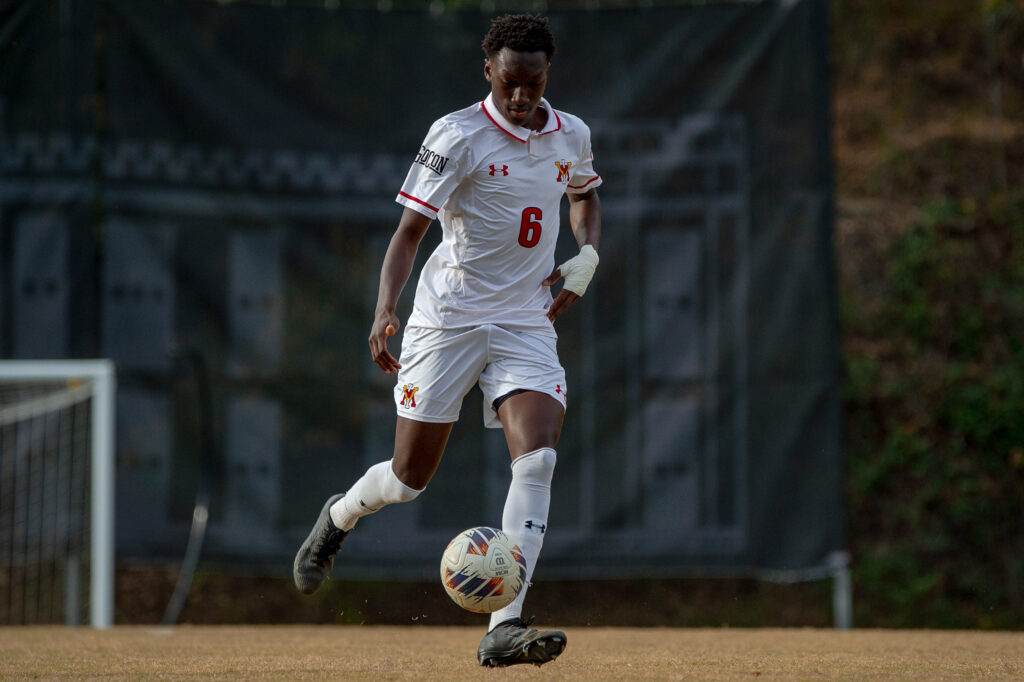
Amari Benjamin playing soccer for Virginia Military Institute.
VMI Men’s Soccer Action Shot vs. Queens

His days start early while he’s in season — around 6 a.m. for a team run or a quick session on the field before breakfast. Then it’s classes until the afternoon and straight to practice, which lasts until after 6:30 p.m. Then he’s back to studying and class assignments.  

“I like to get a lot of my work done out the way early. I don’t want to stay up late because I wake up in the morning feeling groggy,” he explained. “Usually throughout the day, from whenever we finish that first training until before practice, it’s only school. That way, at least at night, I can only focus on whether I have an exam the next day or I can focus on one thing and not have to over stretch myself.”

Benjamin has had to find a balance in structuring all his tasks. In the beginning, he found it tough to do so.  

“My first year playing Division I soccer, all of that was overwhelming. It wasn’t until my sophomore year that I really was able to crack down on it and build good habits and get into a routine,” he stated.  

He especially must plan with traveling for games, which they have a packed schedule of nearly 20 games during a season.  

“When I know I have an away game coming, I try to overly stress the fact that I need to finish all this, because I go into the game with just the game in mind, and not have to worry about an assignment due at 11:59 p.m.,” he explained. “Usually, I try to plan out my days well. I feel like every assignment I get or every reading I’m assigned, I always put in my notes, and I try to get it done that day, if possible. That way, later in the week, when the games do come around, it’s just straight soccer.” 

Benjamin said the skills he’s learned at VMI will translate into his life, no matter what he does. He says the ability to multitask and prioritize has helped him plan his days properly.  

“I feel like one piece of advice that my dyke [senior mentor] also told me was, at the end of the day, you’re going to go to bed, and the next morning you’re going to wake up,” he commented. “You’ve just got to get through the rest of the day, and nothing can really hinder you. At the end of the day, if you just do what you need to do and get through it, there’s a whole new day waiting for you.” 

Behind the Balance: Barrett Callejo ’27 — Keydet Women’s Soccer

Virginia Military Institute’s cadet-athletes have to juggle cadet life, heavy academic course loads, and their NCAA Division I sport. Committed to both academic and athletic pursuits, balancing their rigorous schedule in both sports and school requires a certain level of commitment and discipline. Behind the Balance is a series that focuses on those cadet-athletes and how they handle the hurdles of the day-to-day. 

When Barrett Callejo ’27 arrived for her brother’s matriculation at Virginia Military Institute several years ago, she was still in high school. But the cadets asked her upon arrival if she had a dyke, or senior mentor. Callejo said she was taken aback, and explained it wasn’t her that was matriculating, but instead her brother.  

That moment stuck with her, along with how welcoming and excited the cadets were. “There were these strong, independent women. They were coming up to me and super excited that another female was trying to come to VMI. To me, that was cool seeing that in person,” she explained. 

She was then inspired when she was recruited for soccer to come to VMI to be that example. 

“Being on the soccer team and meeting everybody, it has pushed me to emulate what those other strong, independent women have done as well,” she said.  

Callejo knew she wanted to attend a military college, but it wasn’t until she had a visit with the soccer team that it solidified her decision. 

“The thing that really stuck out the most about VMI, overall, that led me to coming to this team, was their culture on the team,” she admitted. “When I was a recruit and I came in, I remember the team being so incredibly welcoming to me. Even though I wasn’t part of the team yet, they still treated me like I was one of them already, and that was really special to me. I already felt like I was a part of that family.” 

As her time continues at VMI, so does her growth in duties. Shouldering more responsibility, Callejo said it’s been rewarding. She currently serves as part of cadre, specifically a guide sergeant with Foxtrot Company, where she serves as a mentor to those in her company. 

“Being an upperclassman, you take on a lot more responsibilities,” she said. “You look up to all those upperclassmen and all those independent women, but now you are one of them. You’re going to be that person that the freshmen can look up to, whether it be on the team or even up on the hill, because I’m a part of the cadre team. I have a couple girls in my company, and I’m hoping to be a role model for them as well.” 

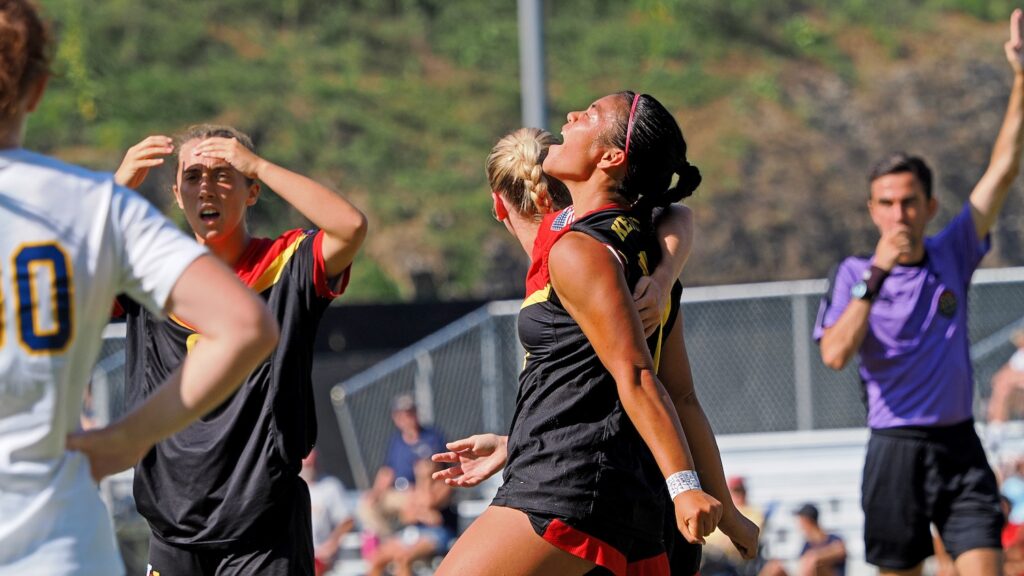
Barrett Callejo rejoicing on the soccer field while playing for Virginia Military Institute.
VMI’s women’s soccer team hosts Emory & Henry University at Patchin Field in Lexington, VA August 24, 2024. First half, VMI up 1-0. (Randall K. Wolf/VMI)

Cadet-athletes at VMI not only have their responsibilities with their selected sport but cadet duties on top of that. Cadets are also required to take physical fitness classes twice a week, participate in ROTC all four years, prepare for room and uniform inspections, practice for parade, guard duty, and more. 

Last year, Callejo served as a corporal on cadre. Serving as a corporal, she found she had a lot of influence on those below her, allowing her to lead while she was being led. She found another female guide sergeant while she was serving as a corporal, who was a big influence on her to continue being on cadre.  

“When you’re a corporal as a 3rd Class cadet, you have a lot of influence upon the rats just because you’re with them so much as a corporal,” she said. 

Having a packed day, Callejo, a biology major, has had to prioritize a couple things this year. With her role on cadre, being on the soccer team, keeping up with athletics, and more, it caused her to drop a class from 19 credit hours to 16 credit hours — primarily because she will be studying for the MCAT (Medical College Admission Test) this semester.  

“I just kept putting a lot of things onto my plate, plus being in season and the traveling,” she explained.  

The way she handles it is by writing everything down at the beginning of the week. Her Sundays consist of coming up with a game plan for her week and how she will tackle it. Whenever she gets overwhelmed, she goes for a run or hangs out with her teammates or friends.  

“Everybody on the team is one of my closest friends,” she commented. “I never thought I would make friends this tight. I’m closer with all of these girls I’ve known for three years now than I have other people that I’ve known for my entire life. But it’s not only just a team. I have some friends that I’ve met just being a cadet here, and they’re my closest friends.” 

She’s not only created bonds with her peers, but also with her professors.  

“Having professors on your side and having good relationships with professors has really helped me and has given me a lot of cool opportunities and positions at school as well,” she said.  

“I’ve had some good bonds with a lot of the professors in the chemistry and biology departments, and they’ve asked me for the past two years to help tutor for their classes. That not only helps the underclassmen who I tutor, but also, it’s helped me personally to go over all the basic stuff.” 

Those opportunities include being part of Tri Beta, a biology honor society and working on Summer Undergraduate Research Institute projects with the potential of being published. 

Her piece of advice: don’t study in barracks, there’s too much distraction. 

“I think studying is the best way to escape from all of the hectic stuff that happens up on the hill,” she said. 

Behind the Balance: Conner Reid ’27 — Keydet Men’s Soccer

Virginia Military Institute’s cadet-athletes have to juggle cadet life, heavy academic course loads, and their NCAA Division I sport. Committed to both academic and athletic pursuits, balancing their rigorous schedule in both sports and school requires a certain level of commitment and discipline. Behind the Balance is a series that focuses on those cadet-athletes and how they handle the hurdles of the day-to-day. 

A different college experience was what Conner Reid ’27 was searching for. He said that Virginia Military Institute offered that and it’s what attracted him.  

He was looking at the University of Virginia, but he didn’t make it into the soccer program there. So, he broadened his search. 

“I started looking at other schools, and VMI really stood out to me,” he said. “It’s not the typical college experience.” 

But when he started reaching out, he found that the alumni network was exuberant.  

“I’m from Richmond, so the second I brought up VMI, people started coming from everywhere,” he admitted. “I think that really stuck it to me.” 

The economics and business major said VMI has helped shape him for the future.  

I think VMI sets you up best for life compared to other colleges,” he explained. “Regardless of when your classes start, you’re waking up at 6 a.m. and you’re getting your day started just like you would in the real world. Here you have to do a lot of things that you don’t necessarily want to do, but that’s kind of how life is. I’d say mastering discipline and doing things I don’t want to do along with time management here, especially while playing a sport, is a skill I’ve almost perfected. Those are the skills that I’ve really gained from VMI that have prepared me for life.” 

Cadet-athletes at VMI not only have their responsibilities with their selected sport but cadet duties on top of that. Cadets are also required to take physical fitness classes twice a week, participate in ROTC all four years, prepare for room and uniform inspections, practice for parade, guard duty, and more. 

He was used to balancing multiple things in high school by playing two sports — basketball and soccer — while keeping up with his studies.  

“Here I’ve really been able to put it on full display, adding the military aspect on top it,” he said. “I’ve never really traveled for sports, but here you’re on the road half the week during the soccer season, so I’ve honed that in and perfected that here. It’s something I plan to continue to carry on.” 

With an 18-credit hour semester and early mornings and practices bookending his school time, he likes to tackle things the minute he gets them.  

“If I can just knock out assignments as soon as possible, that’s best. I don’t typically do work on the bus just because I get motion sickness really badly. So, whether it’s in the hotel or on weekends, when I can finally catch up or get ahead, that’s where I knock out most of my work. I’ve been able to find a good rhythm,” Reid said. “I just roll with it and take it as it comes. Unless I know I have a test coming up, I’ll try to get ahead so I can just study that week and not have to worry about assignments. Most of the week, I just roll with the punches.” 

Reid also holds rank as an S2 sergeant, which is a front facing person for academics in the Corps. 

“So anytime rats need reminding of what their academic standards are or pairing them up with a tutor, we do a lot of that,” he explained.  

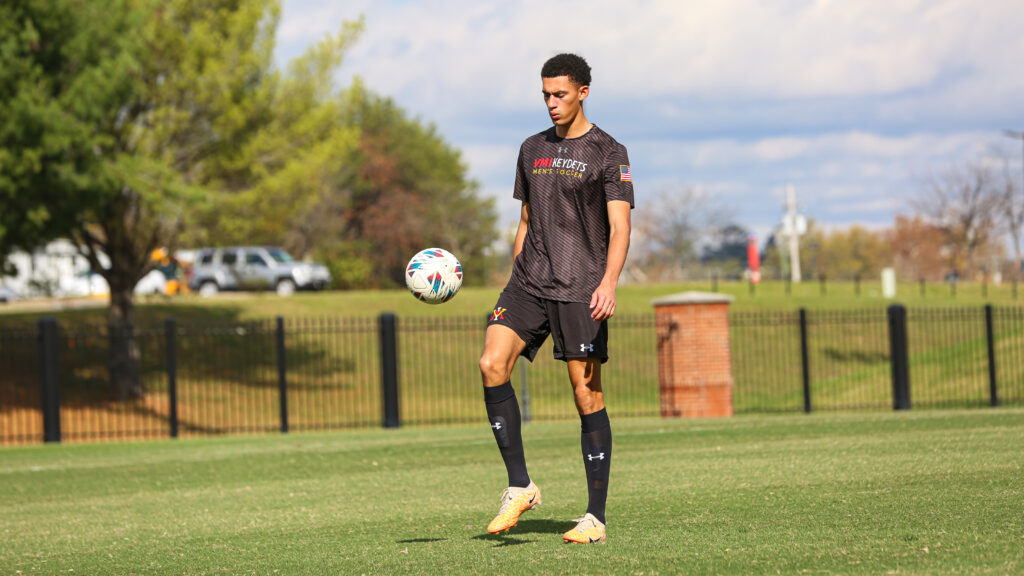
Conner Reid on the soccer field with a ball, playing for Virginia Military Institute.
VMI Men’s Soccer vs. Wofford at SoCon Championship

They also have Miller Academic Center Saturdays, where they meet up with rats and teach them study habits and how to do better in college, to help with the transition from high school. 

“I feel like academics is a strong suit for me, and I want to do my best to help other people succeed in college,” Reid commented. “I know it can be very different moving from high school to college. The workload and the difficulty of the work pick up. I’m trying to help people succeed.”

He’s a part of the Cadet Investment Group, which helps manage part of the school’s endowment. He says as a group of select individuals, they are able to manage real money and pitch stocks to the group and invest.  

“It’s pretty cool getting to actively manage real money and make investment decisions.” 

He jokes that he got a free group of friends when he started at VMI, especially with his teammates.  

“College can be a very daunting place; you meet new people and start all over. But the soccer team coming in from day one, we have these three weeks to a month of pre-season. You just get to meet people and then spend so much time with them during the Rat Line,” he said. “I’ve grown really close with my class. It’s a brotherhood. You’re closest with everybody on your team more than you are probably anybody else in the Corps.” 

His advice coming in? School should be the focus.  

“I know a lot of people here they’ll focus on the Rat Line, or they’ll spend their free time playing video games or something like that. To me, soccer is going to end one day. School is the most important,” he stated. “Prioritize getting your assignments done. Put in as much effort as you would on the soccer field in the classroom.” 

Behind the Balance: Jillian Sisk ’27 — Keydet Women’s Track and Field

Virginia Military Institute’s cadet-athletes have to juggle cadet life, heavy academic course loads, and their NCAA Division I sport. Committed to both academic and athletic pursuits, balancing their rigorous schedule in both sports and school requires a certain level of commitment and discipline. Behind the Balance is a series that focuses on those cadet-athletes and how they handle the hurdles of the day-to-day. 

Her love of math and science propelled Jillian Sisk ’27 to pursue a STEM major. At first, she thought veterinary school would be the right path, but found it wasn’t the right fit for her. Instead, she discovered engineering, which pointed her to Virginia Military Institute.  

“I started out as a mechanical engineering major my first semester and realized that was not for me, and I switched to civil and I loved it,” she explained. “I love the teachers. They are so nice and they’re always making sure that you’ll succeed. They know your name. They know your face. And civil engineering is just so interesting because it’s you’re directly working with people.” 

She said choosing civil engineering as her major allowed her to see the direct effect her work could have on the community. She’d be working with the infrastructure of the state, for example. 

“I’m doing things for people — the water, the bridges, the roadways,” she said. “It’s a serious job, because if you build something and it breaks, that would be bad.” 

Sisk was recruited to VMI for track and field as a long-distance runner. She hadn’t heard of the Institute until then.  

“Everyone was welcoming and kind, and they answered all my questions,” she said about her first visit. “I met so many people that seemed like they’d be the type to uplift you if you’re having a hard day or a bad day. And I just felt like it was a family.”

She’s also found that family within her teammates, who offer her support on and off the track. Sisk, who runs the 3K, 5K, the mile, and the steeplechase race, got into track and field in middle school when she was looking for a sport to play. She said the minimal equipment was an incentive, especially for a new sport to try out. Turns out, she was a natural. 

“I just loved it. I love the competition. I love the discipline it requires to get out there and do it every day,” she admitted. “I love the process of training.” 

She’s dedicated to training, which takes up a good portion of her day.  

Cadet-athletes at VMI not only have their responsibilities with their selected sport but cadet duties on top of that. Cadets are also required to take physical fitness classes twice a week, participate in ROTC all four years, prepare for room and uniform inspections, practice for parade, guard duty, and more. 

She’s up just after 6 a.m. when she grabs breakfast to-go and heads back to her room.  

“I’ll check to see what type of homework I have for that day, and I’ll make myself a list of things I want to get done,” she said.  

Jillian Sisk runs track during a meet for Virginia Military Institute.
VMI’s Jillian Sisk during the 3000 meter run. The VMI Invitational indoor track and field meet at the Corps Physical Training Facility in Lexington VA January 27, 2024. (Randall K. Wolf / VMI)

With class until just after noon, she has time to tidy up her quarters, check-in with teachers, and catch up on work before she heads to practice at 3:30 p.m. By 7:30 p.m. it’s dinner time and the more studying. Her days usually wrap up around 10 or 11 p.m. 

With 18 and a half credits, it can get overwhelming at times. During her rat year, Sisk admitted she struggled to stay on top of her studies and saw her grades slip.  

“School always came really easy for me in high school, I never really studied or anything, but you have to study here,” she stated. 

Talking with her mom, her roommates, classmates, and teammates offers good stress relief for Sisk. She said if there’s any time she feels overwhelmed or needs to talk, they’re there. Running offers solace for Sisk.  

“If I’m ever having a really bad day, usually going out for a run helps that a lot. I love running. It makes me feel happy that at the end of the day, no matter what, I have running,” she said. “I can run and that’s one of my strengths and it makes me feel good about myself. I can go out there and just run eight miles and it feels like nothing.” 

She has the mental fortitude thanks to enduring long distances, which can be applicable to her life at VMI and after. 

“I think that they are really preparing me for the future, with the busyness and the strict deadlines,” Sisk explained. “I’m way better at planning things.” 

From last year alone, she’s seen a difference within herself in how she is able to use time wisely. 

“It’s made me have to be more of a self-advocate,” she stated. “If I’m struggling with something in class, I have to be brave enough to ask for help or go to office hours. You have to be able to stand up for yourself. Because at the end of the day, it’s your education … you’ve got to be able to do that for yourself.”