Post View Unavailable »
New Website Launched »

VMI Pipe Band Takes Honors in Savannah

The Virginia Military Institute Pipe Band won first place at the 48th annual Savannah Scottish Games and Celtic Festival, a celebration of Scottish heritage in Savannah, Georgia, May 2.

Chuck Bohannon, director of piping & drumming at the Savannah Scottish Games, reported two pipe bands competed against VMI. Charleston Pipe Band from Charleston, South Carolina, won second place; and the Savannah Pipes and Drums took third place. 

In addition, there were individual competitions in which VMI cadets were victorious. For solo piping grade 5 march A competition, Ben Bowen ’26 won first place; Byron Rivey ’26, second place; David Cooper ’28, third place; and Roy Fullmer ’29, fourth place. For solo piping grade 5 march B competition, Alden Rhodes ’26 won first place; Xinwen Mai ’29, second place; Thor Alewine ’26, third place; and Julia Ward ’26, fourth place. For solo piping grade 4, William Bolay ’26 received fourth place. For solo snare drumming grade 5 competition, Khang Lai ’29 won first place; Thomas Sasso ’27, second place; and Harrison Sloane ’27, fourth place. For solo snare drumming grade 4, Connor Wolfe ’26 won first place. For solo tenor drumming grade 5 competition, Kira Brenaman ’26 won first place; and Sloan Roberts ’29, second place. For solo bass drum grade 5, Brenaman won first place; Erick Rymer ’28, third place; and Stephen Underwood ’29, fourth place.

Maj. Brian Donaldson, director of the VMI Pipe Band, was justifiably pleased with the band’s performance. “There is an appropriate Gaelic word to use when describing the Pipe Band’s accomplishments in Savannah. It’s ‘ceannas,’ which means to dominate. The band played extremely well, and all cadets performed their best, both in the band competition and in the solos. They all flew the flag high for VMI and proudly recited the Old Yell when the results of the competitions were announced,” he shared.

Brenaman, a 1st Class cadet, came to VMI with no musical experience and is grateful to have had the opportunity to be a member of the Pipe Band. “I learned to play the bass drum and the Scottish tenor drum, as the Pipe Band had not had a tenor drummer in over five years. We now have a growing tenor group and have had numerous opportunities to compete and perform across the East Coast. The pipe band community is truly like no other.” 

Lai, a 4th Class cadet, has been drumming for nearly 10 years, and has played in a marching band and jazz band, but this is the first year he has played in a pipe band. “As a 4th Class cadet, winning 1st place in the competition is a great feeling. Everyone in the Pipe Band has a great work ethic. Maj. Donaldson makes a great effort to push us beyond our limits and is very inspiring,” he said.
VMI Community Theatre Presents “1776”

The VMI Community Theatre presents the Tony Award-winning musical, “1776,” Friday, April 17 and Saturday, April 18 at 7:30 p.m., and Sunday, April 19 at 2:00 p.m. in Gillis Theater.

“1776” follows John Adams of Massachusetts, Benjamin Franklin of Pennsylvania, and Thomas Jefferson of Virginia, as they attempt to convince the members of the Second Continental Congress to vote for independence from the shackles of the British monarchy by signing the Declaration of Independence. It features music and lyrics by Sherman Edwards, including the iconic songs, “For God’s Sake, John, Sit Down,” “But, Mr. Adams,” and “The Egg.” The script was written by Peter Stone.

Included in the cast are VMI cadets Ethan Aldridge ’26 as Thomas Jefferson, John Gorman ’26 as Charles Thomson, Nicole Samella ’26 as a painter, Michael Colin ’27 as Roger Sherman, Carla Feaster ’27 as John Hancock, Thomas Sasso ’27 as John Dickinson, George Sullivan ’27 as John Adams, Hayden Talbott ’27 as Martha Jefferson, Sophia Heinlein ’28 as Abigail Adams, Aadil Pattada ’28 as George Read, Keye Warren ’28 as James Wilson, Nicolas Colletti ’29 as Josiah Bartlett, Iagan Andrew Kiddie ’29 as Col. Thomas McKean, Jamie Pacheco ’29 as Jonathan Witherspoon, and William Shable ’29 as Lyman Hall. Community cast members include Mark Anderson as Robert Livingston and Joseph Hewes, Emilie Davis as Lewis Morris, Micah Fishbein as Caesar Rodney and a leather apron, James Heilpern as Richard Henry Lee, Jaxon Johnson as a courier, Woody Johnson as Samuel Chase, Dallin Lewis as Andrew McNair, Peter Lipsett as Edward Rutledge, Rob Mish as Benjamin Franklin, and Tom Oxendine as Stephen Hopkins.

The play is directed by Tim Price, assisted by Andrew Hartless. Stage crew includes Fabiana Sofia Pajaro ’26, Laura Canaday ’27, Dusand Barrow ’28, Tamara Jimenez ’29, An Nguyen ’29, and William Shable ’29. The light and sound booth is run by Timothy Persons ’27. Rechnna Sok ’26 serves as tech director.

Admission is $10 for adults and $5 for students and senior citizens ages 65 and over, payable by cash or check at the door. Cadets and children ages six and under are free. Reservations are not required. Gillis Theater is located in Marshall Hall on VMI post. For additional information, email Tim Price at pricetr@vmi.edu.   

The Extra Mile: Rock Climbing Club

All it took was the promise of extra credit for Owen Clarke ’25 to start climbing. He had to hit a certain route to gain 10 extra points on his final exam, according to Department of History assistant professor Maj. Christopher Blunda. Blunda also happens to be the assistant coach for Virginia Military Institute’s Rock Climbing Club.  

Clarke is the cadet in charge for the club. He always had some interest in climbing, but didn’t start taking it seriously until last January.  

“I had kind of dabbled in it,” he admitted. 

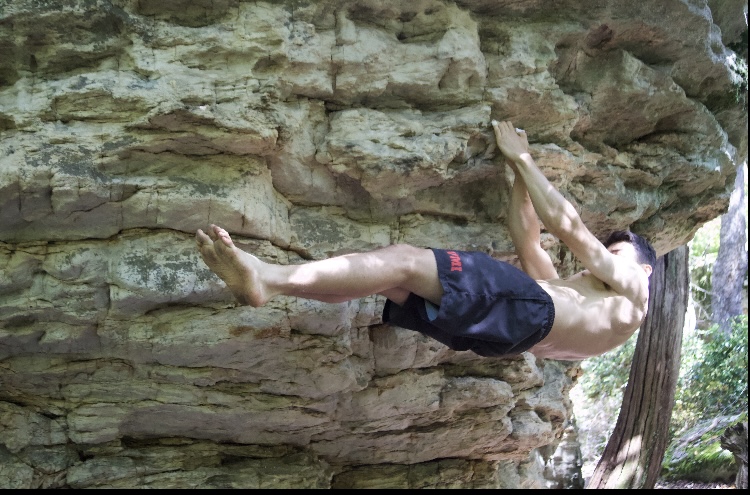
The club, which has about 15 cadets on the roster, practices three times a week. They also make excursions to cliffs and bouldering opportunities in the surrounding areas on the weekends. Most recently, the club took a trip to McAfee Knob outside of Roanoke to boulder.  

Zeb Barrett ’26 joined the club because he’d always enjoyed climbing things as a kid. With the giant rock wall at VMI’s Corps Physical Training Facility, he saw an opportunity to grow his skills.  

“I never really had the time to dedicate myself to rock climbing,” he explained. “Since I came to VMI, there’s a rock wall right there. I was like, I might get into this and see what’s up. And I really enjoyed it.” 

For Connor Bott ’26, he had gone to a summer camp in high school where he discovered a passion for rock climbing. 

“I didn’t really have a chance to do it since then, until I got to VMI, just because I live on the Eastern Shore. The nearest cliff is here. Once I got here, though, I started in the club, and that was a lot of fun,” he said. 

They have about seven competitive climbers on the roster, the rest are in varying skill levels — but it’s all about the confidence you have in your body and strength. 

“Rock climbing, when you begin, is not really an intuitive movement. You don’t move in a way that you’re used to moving,” Clarke stated. “You kind of have to learn over time how to move up routes and change your body in ways you’d normally not think about.” 

The club isn’t just specifically rock climbing (or top rope), they also do bouldering is done at lower heights and doesn’t require ropes or harnesses. Both Clarke and Bott prefer bouldering to rock climbing.  

“I think it’s more technique based,” Clarke said. “Bouldering is more interesting to me. It’s more of a puzzle.”

The club competes in what are called red point competitions, which consist of each climber getting a certain number of routes in varying difficulty and two hours to complete the route in one go. Scores are based on how many times you are able to complete the route in one go, which is called a flash.  

A guy grappling on rocks as a part of the rock climbing club at VMI.
Screenshot

“Top rope changes in length, so it’s a lot longer and more endurance based,” Barrett said. “Since it’s so long, you can’t have intense movements along the whole route, so it’s a lot easier on strength movements. Bouldering is a lot shorter, so it’s more intensive for a short amount of time. I prefer bouldering because I have more strength than endurance.” 

Bott is the opposite; he enjoys top rope to bouldering. He says it acts as a good way to break away from his academic schedule and have a release, which is something Clarke echoed. 

“My favorite thing about the club is it’s an escape for me. When I’m climbing, I just have to worry about the problem in front of me,” Clarke continued. “I’ve got to think about the way in which I’m going to try to go up the wall. I don’t have to worry about a million other things happening here [at VMI].” 

It also requires a lot of strength you wouldn’t even consider, according to Clarke. 

“It’s a lot of weird joint stability, putting your joints in a position that they’re not used to being in,” he said. “Rock climbing is more like calisthenics, where you’re putting the joints in your body in unstable positions and forcing them to adapt.” 

Although they do compete, it’s more of a community-based sport. Everyone wants each other to succeed, Clarke said. 

“Everyone loves watching someone get better in their climbs,” Bott said.  

“It’s not a team sport, but there is definitely a community, and people cheer each other on,” Barrett added. “If I see a person struggling, I ask if they need help, then help them as much as possible.” 

For Barrett, the club serves as a place for fun and enjoying something he’s passionate about. 

“Everybody has a passion … it’s my passion. I just love it. That’s why I think it’s important. Everybody has to love something. This is something I love,” Barrett said.  

The Extra Mile: Racquet Sports Club

Jude Roberts ’25 was inspired to start a new club sport at Virginia Military Institute after joining a badminton team while studying abroad.  

“I missed tennis and racquetball, and I remembered all the people I had talked to at VMI regarding their interest in these sports. A few of them even considered starting a tennis club before me, so I knew there was interest,” he explained. 

He and others joined together to start the Racquet Sports Club, where Roberts is the cadet in charge.  

There are currently 33 cadets on the roster for the club, but Roberts said about half of them are active, consistent tennis players. Others appear sporadically for more niche sports.

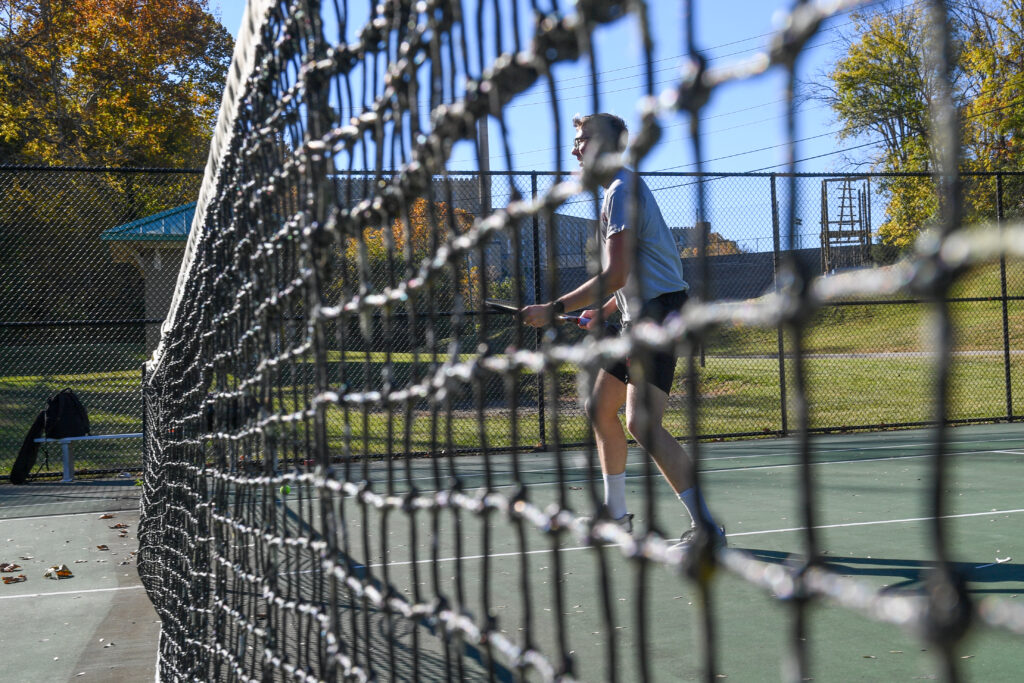
“We mostly play tennis and pickleball,” Roberts said. “We just recently acquired the equipment to play racquetball and badminton as well, so we are coordinating the schedules for those.” 

Roberts has always played a form of racquet sport since he was young, starting with racquetball. It was something his uncle taught him to do for fun, learning the basics.  

“I was just looking for something to do during my senior year of high school, so I joined the tennis team and learned a lot while having a great time with my friends and coaches,” he said. “From there, it was easy to try pickleball at my local gym and eventually badminton in England. These sports have been a tremendous source of joy and camaraderie for me, so I hope we can offer cadets some similar experiences.” 

The club has some larger events planned for the spring, but for now, they’re just playing for fun. The hope is to play with the Rockbridge Tennis Association every Saturday.  

Raj Singh ’25, a member of the club, started playing tennis when he was in elementary school, and has loved the sport ever since. He played all through high school but stopped once he came to VMI because there wasn’t a team or club dedicated to it.  

“I really enjoyed the movement, high pace, and the intensity the games can give throughout a match,” he stated. “I enjoy the club, it is a great way to relieve some stress, get a nice workout but also it allows me to keep my skills as a tennis player as it can diminish when you don’t play for a while.” 

Although the club is still in its infancy, Singh said he hopes it grows bigger and becomes an opportunity to begin outreach to other schools for more opportunities.  

“Clubs like ours are important as they give cadets an opportunity to get into sports which may not be offered in regular classes or in NCAA,” he explained. “Giving us more options can help in health, coordination, and involvement with other cadets.” 

A cadet behind a net on the tennis court.

Roberts said clubs like his offer an opportunity for cadets to take a break from the stresses of VMI responsibilities. 

“I enjoy the club because it provides me with a fun way to stay fit and a break from the typical VMI monotony. It has been very fulfilling to watch it grow and see other cadets enjoying it.” 

He also said the club has offered him profound leadership experience.  

“I have learned a lot about the considerations that go into everything we do here at VMI. I have a much deeper appreciation for the level of care and effort that goes into cadet life, and I am grateful for everything that has been done for us to come out and play some racquet sports,” he said. 

The Extra Mile: Pistol Club

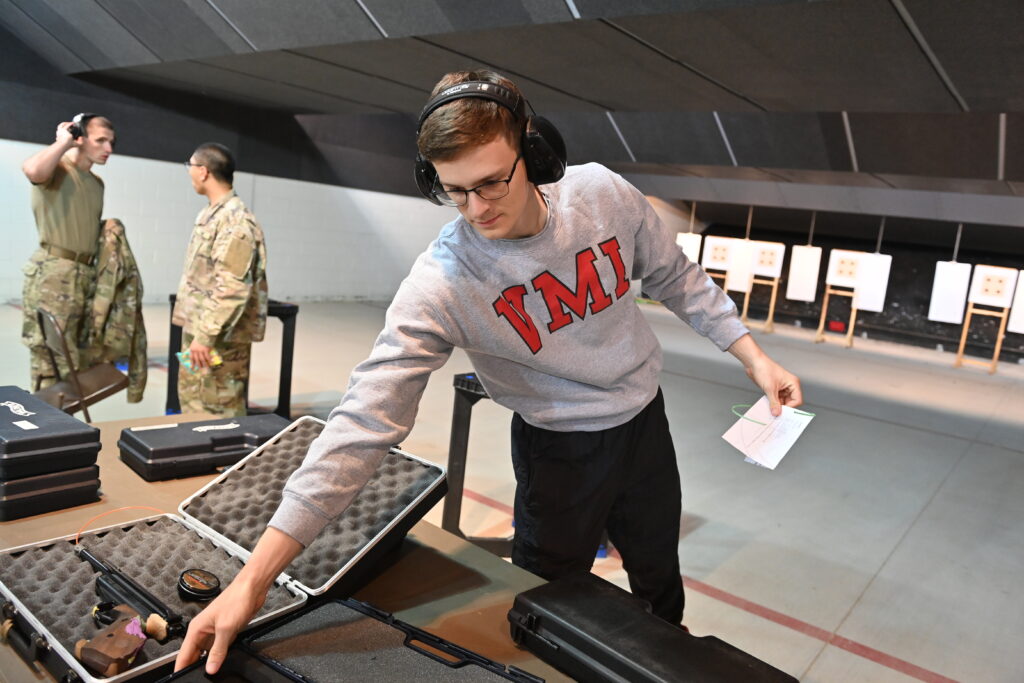
The firing range is cold and dim, except for the lit-up lanes where you fire. Half a dozen cadets are gathering their equipment and setting up their targets. During a practice, they’re shooting air pistols at the range on North Post. 

The Pistol Club at Virginia Military Institute shoots Olympic style, which can consist of three disciplines: rifle, pistol, and shotgun. The club uses air pistol and .22 pistol in a shooting range, where participants aim at targets. They utilize three different shooting methods: air pistol, sport pistol, and standard pistol. Every Tuesday and Thursday, the club, made up of about a dozen cadets both male and female, will meet up at the range either at North Post or Kilbourne Hall. 

Everyone unlocks their guns and ammunition, and targets are assembled. During practice, they use a large sheet of paper with four small targets on it. It’s stapled onto a wood panel and set up at the end of the range.   

“We’ll start with slow fire, so it’s about five minutes for 10 shots and we just try and focus on groupings and getting kind of into a rhythm at the beginning of the night,” said Chris Olsen ’25, the cadet in charge for the club.  

The club is not a sanctioned NCAA sport, but they do compete nationally. The competitions consist of 60 shots fired in three different shooting disciplines: air pistol, sport pistol, and standard pistol, for a total of 180 shots fired. 

Earlier this year, the club competed in the National Collegiate Pistol Championship held at Fort Moore (formerly Fort Benning) Army post near Columbus, Georgia, in late March. The VMI contingent consisted of a team of four shooters: Olsen, Parker Hall ’24, Jacob Cook ’26, and Kate Patrick ’27, with Jamie Palacio ’27 competing as an individual. The club held a national rank of 11th place going into the competition. With 15 schools at the championship, VMI came in 10th place for air pistol, 8th place for sport pistol, and 10th place for standard pistol. The team finished the competition in 10th place, improving their national ranking. 

This was on the heels of the club’s attendance of the Scholastic Action Shooting Program Intercollegiate Pistols Nationals — the first time in club’s history — in 2023. 

They try to do six to eight matches a year, with stops at the Naval Academy and The Citadel. 

The club is run by cadets, specifically with Olsen in charge with an assistant cadet in charge, usually a 2nd Class cadet. This year, it’s Cook. The club also has a set of coaches — head coach Reese McCormick, assistant coach Norman Claytor, Master Seargeant Robert Coleman, and Jan Downs — that help guide the cadets. 

Olsen said you can join the club without any experience. They’ll teach you how to properly shoot. He said the club atmosphere allows for a more relaxed environment. 

“It’s a competitive but relaxed environment because I’m not directly competing against anybody else in a way. I’m competing against myself every time, because I’m just trying to get that one extra point that I didn’t get last time. It creates a healthy kind of competition,” he said. 

A cadet in the shooting range placing guns back in cases.

Olsen had always been interested in precision shooting. 

“I grew up in a little bit of a rural area, and my buddy had a farm,” he said. “It was just one of those things where after school for fun, you just take a bunch of shotguns or a couple rifles out and just go shoot at random things.”

The club has been on and off since the 1970s. Olsen joined as a rat and said clubs at VMI serve as a break in cadet life. 

“I think they’re extremely important because it acts as an outlet for the regular cadet, who might not be involved in other things,” he said. “Clubs are the last area where cadets can be involved and have a leadership experience at a leadership school, but also build their own little community and find their own little group.” 

Stealing a Moe-ment With VMI’s Mascot

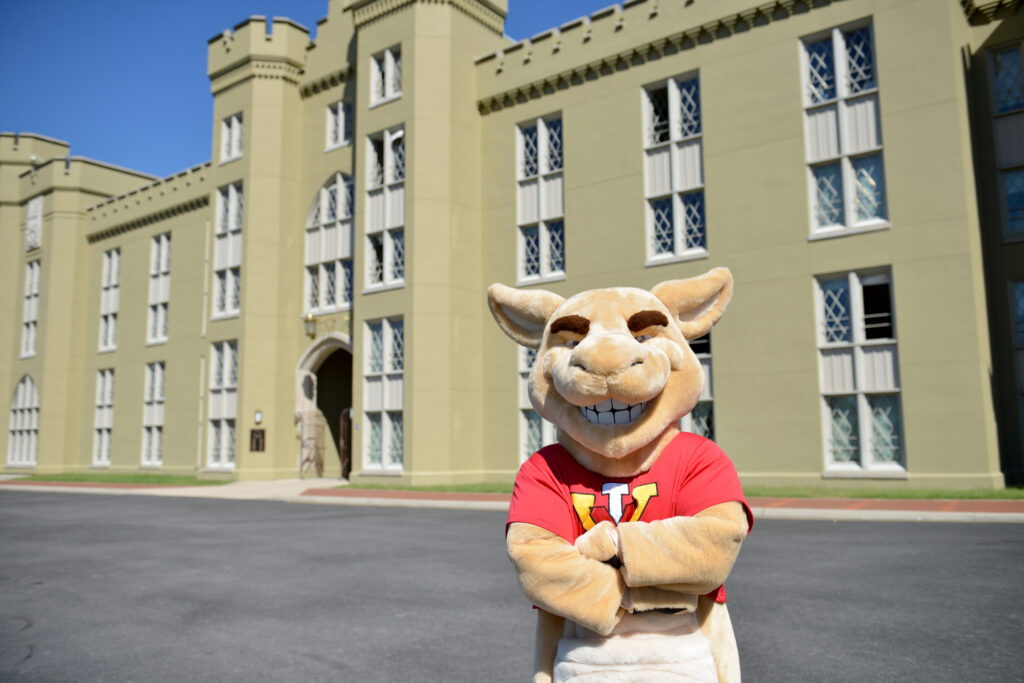
Atop the kangaroo head, there’s a small vent and a fan. Bowlman “Tee” Bowles IV ’26 says it gets hot under there. The fan helps, but it’s often sweltering inside the faux kangaroo costume.  

He also needs a handler walking him around — he can barely see.  

Bowles is one of two cadets who serve as the mascot, Moe, during functions at Virginia Military Institute. The history major, who will be commissioning into the U.S. Army following his time at VMI, joined the Corps of Cadets S9 regimental staff his 3rd Class year. S9 staff are responsible for all issues related to NCAA athletics and club sport events. 

He chose S9 because he had similar duties in high school — working with the sports team, commentating on games, doing social media, and so on. A big draw was the opportunity to become Moe.  

“Every time I watched basketball games, I saw mascots doing stupid things and fooling around with other teams and stuff. I got inspired by seeing those mascots on TV, which gave me interest to do the Moe costume,” he said.  

Moe is a staple around post. He’s present for home football games, pep rally, and other home sporting events. The mascot is around for pictures and overall, a boost in morale.  

“We’re there for the rats,” Bowles said.  

Moe is a key part of the Keydets, specifically with family, friends, alumni, and other guests in attendance at events, Bowles said. That means a lot of pictures being taken — aided specifically by Moe’s handler — and overall hyping of the crowd. This year features a new costume for the mascot. Bowles said the previous suit was falling apart and needed to be replaced. He came in this year and a new suit was there. 

“In the Moe costume, you have to look down when taking pictures. The eyes are looking up. Whenever I’m taking pictures, I’m literally looking at the ground,” explained Bowles, hence the need for the handler.  

Bowles says the handler will tap him on the shoulder when people ask for photos and help him maneuver around the crowd, especially at Foster Stadium.  

“The steps are really steep and hard to get up in those big feet,” he said. 

Moe, VMI's mascot, outside of barracks.

Bowles shares the responsibility with Carter Rees ’27. Rees just started as Moe at the start of the 2024-25 academic year.  

“I love feeling the energy of a crowd, so the opportunity to be at the center of creating that energy was an easy decision for me,” Rees said. “My favorite part of being Moe is making people happy. Whether that’s getting the Corps hyped up or taking pictures with people, I love seeing smiles on people’s faces.” 

Bowles said he tries to break some of the tension during the games, especially any stresses that the rats are facing.  

“It’s super easy to interact with the rats,” he said. “I love going up there and messing with them. Like I’d sit down next to rats and take their drinks and stuff, act like I’m drinking it.” 

He’s also trying to bridge the divide that can sometimes be seen between the Corps and athletics. 

“There’s this stigma that the Corps is detached from athletics, that athlete, non-athlete divide,” he said. “I think Moe can definitely help unlock that by interacting with them as rats, because I can help them unlock interest in athletics.” 

The history behind Moe 

The history behind Moe and the Keydets is a little complicated.  

Keydets have been the term to describe VMI’s athletic teams, although where it originated isn’t clear. While a Keydet is not a kangaroo, the animal was chosen as the mascot in 1947, when two VMI cheerleaders saw a picture of a kangaroo on the front of a magazine and realized how uncommon the animal was as a mascot. Originally named TD Bound, the mascot was renamed Moe later, to appeal to all VMI athletics, not just football. 

It’s said that the term Keydet could have come from the United States Military Academy’s term used to denote the gray of the standard uniform of a cadet. Another definition, one that hasn’t been factually substantiated, due to the Southern drawl of some members of the Corps, the pronunciation of cadet morphed into Keydet.  

VMI has been associated with several nicknames, one of the longest was the Flying Squadron, which referred to the football team. The Flying Squadron nickname started in 1917 at a football game between VMI and North Carolina and it stuck, becoming most popular during the 1920 season. It wasn’t until the 1930s that the term Keydet became associated with VMI athletic teams.  

Learn more here.

The Extra Mile: Pre-Law Society

Jon Krueger ’24 wasn’t sure what path he was going to take once arriving at Virginia Military Institute.  

“I’ve always been interested in the military and I’ve always felt like I’ve done well with the structure as far as academic skills,” he said.  

A family friend recommended VMI, so Krueger decided an overnight trip for an open house was a good plan. He enjoyed it.  

But finding the Pre-Law Society, a club option offered at VMI, was totally by chance his 3rd Class year.  

“It was an in passing conversation with my academic advisor. He asked me if I’d thought about grad school and I had no real game plan,” he said. “I kind of started getting interested in law school. There’s still a lot that I don’t know about, but being an English major working with documents and a lot of writing … law interests me in general. So that’s what piqued my interest.” 

Krueger is the project manager of the club, which means he’s in charge of organizing events while working with other leadership within the club. In the past, the club has sat in on University of Virginia’s law students’ mock trials as jurors, along with tours of UVA Law School.  

He said the Pre-Law Society is a good way to dip your toes into discovering what law and law school are about. 

“We just try to get an experience for newer members or people that aren’t quite sure how law school works,” he said. “I think it’s to get everybody introduced to it, see if it’s even for you. It’s not necessarily with joining the Pre-Law Society, anybody expects you to be a lawyer. It’s more to get people interested, see if this is something that they enjoy.” 

The club is well-received, having almost 50 members.  

Most of the events of the society does include VMI alumni visits. Former professors, judges, and lawyers have all stepped onto post to talk. 

“We’ve been able to talk to people who do a lot of different aspects of the law, like military and civilian. We’ve also had different judges and trial lawyers from the JAG Corps. There’s also a member of the Law School Admission Council that comes once a year to talk about the LSAT, the standardized test to get into law school, and a lot of people found that helpful for their own LSAT.” 

The club also takes trips, apart from UVA, to Richmond and Washington, D.C. to speak with lawyers and other law professionals.  

Once Krueger graduates in the spring, his plan is to go to Officer Candidate School for the Navy, then go to law school, so this club has been imperative for his future.  

Patrick Kiernan ’25, a history major, said he started becoming interested in law after several junior and high school classes he took.  

“I had interest from taking those classes, wanting to look more into practicing law,” he said.  

Kiernan said a great aspect of the club is the advisor Maj. Tim Passmore, assistant professor of international studies, who can recommend a certain number of cadets and alumni that want to attend certain law schools through a memorandum of understanding.   

“They basically guarantee an interview because the idea is with the time constraints you have at VMI, your GPA and LSAT scores aren’t necessarily the best reflection of what you can do,” he said. 

The two said the amount of knowledge they’ve received through participating in the club is insurmountable.  

“Being around people that can tell you more about law, life, and the resources available to you … not to mention, I don’t think it ever looks bad on a resume to say that you’re part of the Pre-Law Society,” Krueger said.

The Extra Mile: Triathlon

Discipline. It’s something that Virginia Military Institute instills in its cadets. Luke Rose ’24 said it’s integral in being part of the triathlon club.  

Rose, the cadet in charge (CIC) of the club, said the members focus on training for triathlons — which encompasses cycling, swimming and running.  

The team, which is made up of eight people, practices twice a week, either focusing on swimming or biking. Rose, an international studies major, said running is mainly done individually, on each cadet’s own time.  

“Most people are proficient in two of the subjects and then work on the third,” Peyton Reingruber ’23, a civil and environmental engineering major. said. “So, more common than not, people are usually getting into cycling. It’s not a very common sport.” 

Rose said cycling is a demanding sport and credits their coach, Brian Frazier, in training them, especially with cycling. A lot of the athletes on the team are training up to 15 hours a week.  

“He’s done a great job with helping us progress in our cycling and that’s kind of where his expertise is,” Rose said. “Most people who show up here have ran before or used to run.” 

Part of the USA Triathlon Collegiate Club, the VMI Triathlon Club participates in several competitions throughout the year. They focus on two types of triathlons — sprint and Olympic. Sprint is a half mile swim, 12.4 mile bike, and 3.1 mile run. Olympic is a .93 mile swim, 24.8 mile bike, and 6.2 mile run.  

“Being a military school, it’s pretty difficult,” Rose said about competing. “The season is more of a spring and summer season and then into early fall. So, we miss the kind of big conference events, which are in early September. Our main events that we really train up for are in the spring.” 

The main goal: go to the national championship. Last year, the event was held in Georgia, and Rose said everyone finished and it got competitive. This spring, the championship will be held in California.  

‘It’s a sweat-fest’ 

They utilize VMI’s Aquatic Center for swimming practice, while they take to the streets around Lexington atop a bicycle. Most of the team have their own bike, but there are team bikes available for use. 

But what happens when the weather turns cold? That’s when they sweat it out in Cocke Hall on stationary bikes for about an hour and a half. 

“It’s a sweat fest,” Rose said. “It’s a room with no windows or anything. Just put on some music and work really hard.” 

Andrew Wright ’25, an economics and business major, joined the club last spring. He said he grew up watching his father do long distance events in running and cycling. When he found out VMI had a triathlon club, he was on board.

“I think my favorite part is just learning just learning how to do it better,” he said. “I’m pretty new to cycling. Coach Brian has been great and helped me figure out how to become more efficient and become a better cyclist. I grew up swimming a good bit but didn’t really have the technique or anything like that or had never done a lot of endurance or long swims. So I’m learning new things, and just becoming better at this fun sport.” 

Reingruber said his mother did triathlons while he was growing up, but he never participated in them until after Breakout. He was an avid swimmer in high school. 

“I’d say my favorite part is people’s dedication to go that extra mile and do more than what they already are doing,” he said. “Most of the team or at least half is planning on commissioning on top of academics and everything. So, to spend four hours a week just on practices, roughly, that’s a big time commitment. To see some people come out and have a good attitude and work hard is really uplifting, especially if someone’s having like a hard day.”

Rose said physical activity, especially in this club, acts as a cleanser. 

“Not only is it productive to your overall health, but I think it also benefits the mind greatly,” he said. “Instead of just going and playing some video games to blow off steam, you’re going to do something physical and work on yourself. It kind of gives you that mental reset, so by the time you’re done, you go shower, you’re ready to go again to go work on academics. I think that’s very beneficial to cadets, especially.” 

His favorite part — club members showing up and working hard. 

“Practices aren’t necessarily always a fun, jolly time,” he said. “We go out there and we work really hard, and I think it builds a lot of camaraderie and builds us as a team, you kind of get to know each other a little more when you’re really suffering through some of the tougher workouts. It’s pretty awesome to see the team come together and support each other.” 

The Extra Mile: Arnold Air Society

With dreams of attending the U.S. Air Force Academy, Nathan “Skye” Van Ness ’25 had to shift gears when he wasn’t accepted. But it didn’t deter him. Rather, if he could go back in time, he wouldn’t have even applied. Instead, Virginia Military Institute has provided an overwhelmingly beneficial college and military experience for the cadet.  

Overall, he’s much happier in his decision.  

“VMI teaches a level of humility and appreciation for the enlisted side. And not only that, but also for the non-commissioning cadets as well,” the physics major said. “It affords all sorts of other unique and distinct opportunities to interact with other kids in different branches and really get a full picture of everything while building yourself in a way that I haven’t really seen anywhere else.”

Van Ness said by attending VMI, his skills in athletics, academics, and leadership have improved significantly, which in turn has prepared him to be an effective leader. By joining VMI’s Air Force ROTC Det 880 Arnold Air Society John P. Jumper Squadron, his leadership skills have increased tenfold.  

The Arnold Air Society (AAS) is a service organization through the Air Force ROTC (AFROTC) that centers on professionalism, honor, and community service. Squadrons are formed by AFROTC in collegiate settings focusing on cadets who are dedicated to their community and to becoming an Air Force officer. 

Van Ness is the commander for the squadron. The club was recently rebooted. It was reinstated in 2021 after a pause, but the club has ties at VMI stemming back to the 1970s.  

What drew Van Ness to the club was its values, but also there’s the possibility of national scholarships upwards to $10,000.  

“I saw that sort of excellence as something I want to be a part of and really live up to,” he said.  

He decided to join, which requires a list of things before being initiated, that includes: 

  • Have at least a 2.5 GPA 
  • Score at least an 80 on the United States Air Force Physical Fitness Assessment and meet physical standards 
  • Be active in the cadet corps and have necessary leadership qualities 
  • Receive an invitation from AAS and complete the post-training program 
  • Pass the AAS national test 

The two big things that VMI’s chapter does is have the candidacy class come up with a service project. This year it was collecting funds for the Rockbridge SPCA. The other initiation task is getting signatures from all the current members, which is around 10. 

Normally, that wouldn’t sound hard, but to get the signatures, the candidate would need to do a task. Last year, Van Ness required a candidate to clean his shoes in order to get his signature.  

“I took one shoe, and I shined it because I’m good at shining shoes. I love doing it. I made one shoe as shiny as I possibly could get it. I was like, if you can get this other shoe just as shiny, I’ll give you my signature,” he said. 

The more Van Ness participated, the more leadership opportunities he craved. He began working towards squadron commander. 

“I would say that the Arnold Air Society has single-handedly improved my leadership and leadership philosophy as a whole,” he said. 

By attending the National Conclave, or NATCON, last year, Van Ness said he felt like he grew up an entire year within just a few days due to the impact of the conference.  

“It felt like I matured so much just from being able to be there,” he said.  

Last semester, Donald “Alex” Dieffenbach ’26, a computer science major, was the candidate training officer for the club. His role in the squadron was member onboarding, and initiation. Each potential new member participates in a candidacy before they are initiated.  

Candidacy is a several months long process which goes over the basic knowledge about AAS, history, structure, and administration.  

“A lot of it is like the tradition, the heritage, the values, just kind of teaching the candidates what kind of person best fits into this society,” Dieffenbach said.  

The club is also not strictly for VMI cadets, as they’ve had Washington & Lee and Mary Baldwin students also participate.  

“We intend on completing a lot more service projects, a lot more morale events, and really engaging with the region and as a squadron,” Van Ness said. 

“That’s the nice part about Lexington, it’s a small community,” Dieffenbach said. “We’re really blessed to be in this place because community outreach is significantly easier than say, like Richmond or Charlottesville. You can build those connections.” 

The Extra Mile: Trap and Skeet Club

The long gravel road winds around to the back of McKethan Park. From the first turn, you may see a large flagpole with a red flag flying. It signals that there’s shooting in progress at the outdoor range. 

Lucas Wood ’24 grew up hunting and target shooting, but it wasn’t until he became friends with Virginia Military Institute’s Trap and Skeet Club cadet in charge that he shot a clay. 

“I grew up shooting but never like this,” he said. “I tried it out and I just really enjoyed it and figured it out.” 

He’s now the cadet in charge (CIC) for the club, which practices twice a week at McKethan Park in Lexington. He said the club is a good chance for cadets to step out of the confines of who they know in their class and create bonds with the rest of the Corps involved.  

“VMI is very separated by class. You’re friends with the people who are in your class. But the clubs give an opportunity for all the classes to come together and get to know each other,” he said. “When you’re spending five hours a week out on the range with somebody that’s a year younger than you or two years older than you, whatever it might be, it’s really good to know a large variety of people.” 

Most of those in the club either grew up shooting or have experience with a gun. Bryant Falk ’25 also grew up shooting.  

“You all kind of have a certain similarity,” Falk said. “Some people will go and hunt together with people in the club or we’ll go shoot together with people in the club.” 

But not everyone needs to be an experienced shooter to join the club. Wood said there are a number of members who have never shot before.  

“It’s really interesting to see them as they progress … start to figure out the basics of it,  and then really become some good shooters,” he said. 

It’s the comradery of the team that keeps them engaged in the club. During practice is the time when they can shine individually, though.  

“We get competitive because when we go out somewhere to compete, it’s as a team,” Wood said. “But then when we’re out there practicing is more individual, like what your individual scores are. So I like the competitiveness within the team. We kind of like egg each other on, so it’s always a good time just to be out there.” 

Practice is also a time to hone your skills and aim for perfection. The perfect score in skeet is 25, and Wood has shot that once while at practice.  

“A tradition within the skeet shooting community is that when you shoot your first 25, everybody that you’re shooting with shoots the hat that you’re wearing,” he said. “You take your hat and throw it over and everybody that you’re shooting with, shoots your hat in the air.” 

Wood, although ecstatic he shot that perfect score, was a little bummed to have one of his favorite hats ruined.  

“I got it at one of the competitions we did,” he said. “So you’ve got to be mindful of what hats you’re wearing.” 

The difficulty of the sport is what draws Wood in, he said.  

“We’ll shoot multiple rounds or multiple matches while we’re out there at practice. And in one round, you can shoot a 23 out of 25 and the next round you only hit 16 of the 25. It’s literally hit or miss,” he said. “It gets aggravating. That’s what keeps us coming back.” 

Falk said he enjoys the excitement of knowing twice a week he’ll be out there shooting.  

“You get excited to go out and shoot because you get away from this place for a little bit. And you’re not doing like military or anything like that,” he said. “It’s a fun thing to do. But it’s also difficult at the same time. It’s challenging, because you want to shoot as good as possible.” 

Falk said when he started, he could barely shoot an eight.  

“Over time, as we kept going, we kept shooting more and more and more. And we just keep going back because we want to shoot better and better and better.” 

How trap and skeet works 

It’s easier to see and experience than it is to explain, Wood warns.  

Trap and skeet are two different type of shooting sports. With skeet, you rotate through for a total of 25 targets from eight different stations. Skeet is shot in squads of up to five shooters, who move from station to station around the half-moon, ending up in the center, at the end of the round. 

“The target is farther away from you and it’s moving,” Wood said. “When the wind starts flying. it’ll push targets either super-fast or slow or the wind can push them way up.”

In trap shooting, you stand in stations on a crescent shape behind the trap house, which is in front of the posts. Each trap house is equipped with a mechanical trap that throws clay targets into the air.  

One of the main differences between these shooting sports is skeet is a rotation of shots that you have to get to each station, despite any timing of when the clays are thrown. In trap, the shooter yells, “pull,” for the clay to be released.  

In trap, each shooter takes turns until everyone has fired five rounds at their post, then they rotate to the next post to do the same. They do this rotation until each shooter has hit the five different stations, shooting five shots at each station.  

 The club is open to everyone but rats, who can join once they’re 4th Class cadets.