Post View Unavailable »
New Website Launched »

The Extra Mile: Yearbook Club

The ability to flip through pages and be transported into the past is sort of magical.  

James Burns ’23 and his team spend the academic year scouring post for memories. They come in the form of pictures, words, moments, and more. From the Rat Challenge, Breakout to Ring Figure and graduation, the Virginia Military Institute yearbook, “The Bomb,” takes a snapshot in time that can be memorialized forever. 

“I think of ‘The Bomb’ as a way to remember what happened during the year when you look back in the book 25 years from now. It is truly putting together the collection of moments and people that make VMI special,” he said. 

The yearbook not only records events and cadets, but academics, clubs, sports, and shoutouts to the graduating class.  

For Burns, it’s the job of the editor of the yearbook to make sure those college moments are captured and put into print. It’s also a job he kind of just fell into. His fellow brother rat Sibi Bagavathy ’23 recruited him to help. 

“I showed up to a meeting and I got put directly to work. That was all she wrote,” the cadet-in-charge said. 

Now, he’s in charge. He works closely with Command Sgt. Maj. Suzanne D. Rubenstein with putting the actual yearbook together.  

“At the end of the day what happens to the yearbook is my decision, but I like to take a lot of input from my team in terms of cover, different spreads, themes, colors, etcetera,” he said.   

This year’s theme is “Shadows,” which will feature a series of shadowed photos around post.  

The yearbook was first published in 1885. After a nine year hiatus, it has been published continuously since 1895, with the exception of 1945 and 1946. VMI also digitized the yearbook collection from 1885 to 2010. 

“It is one of the oldest publications,” Rubenstein said. “It’s a year of history captured in the moment. You’re not going to get that back. You’ve got to publish this book and see faces and names.” 

The team spends the year ticking off boxes, hitting up all the clubs, activities, and more on post. It also allows participants to set their own schedule and work at their own pace — as long as deadlines are met. It’s an ongoing process, Anna Yemelianova ’25 said. Although things are wrapping up in mid-to-late April in terms of finalizing the yearbook, there are still things they have to document.  

“We still have so much of the year to get through and there are so many pictures and events that we could get into the yearbook,” Yemelianova said.  

The yearbook staff reiterated that Rubenstein tells them this is a cadet yearbook — not a staff yearbook — so the focus should be on those attending VMI.  

“She’s fantastic in that she allows us to have creative direction,” Bagavathy said. “Like what color it is going to be, or the overall theme of the yearbook. At the same time she’s basically kind of pushing us along where we need to be pushed along.” 

Bagavathy said the club is what you make of it, all depending on what your interests are.  

“For me photography, and I guess the creative direction of the yearbook design itself,” he said.  
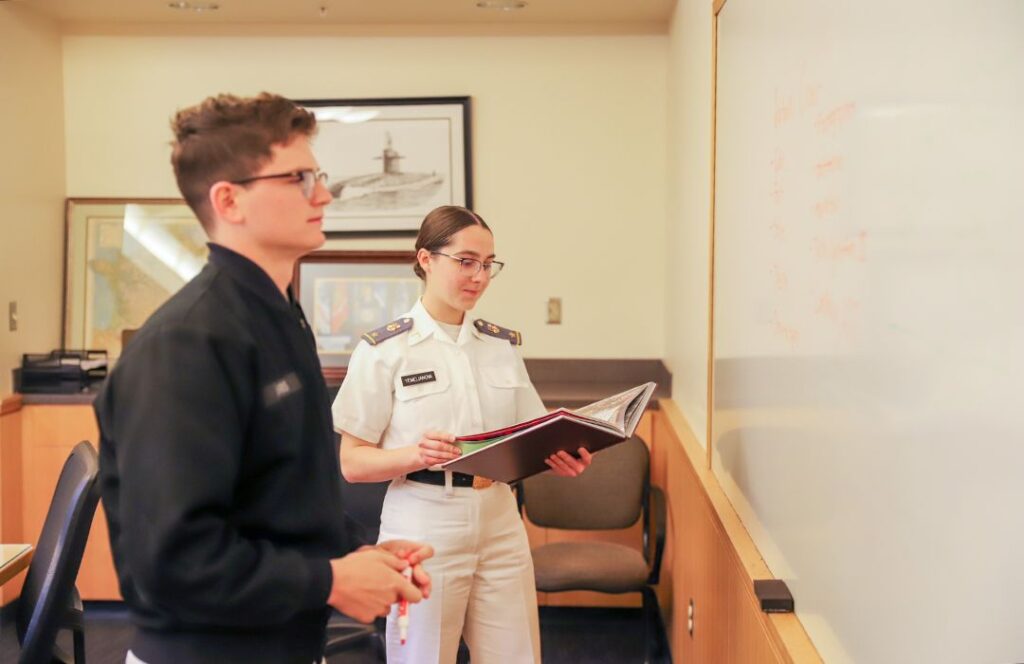
Two students plan out portions of the VMI yearbook, "The Bomb."

Bagavathy was involved with the yearbook while in high school. Overall, he enjoys the creativity of it.  

“Getting together and working in a team group environment … I was really excited to hear that there was something here at VMI just like that,” he said. 

The yearbooks, which are funded by the advertisements sold and placed in the back of them and by the purchases in previous years, are extremely popular.  

“My favorite thing about the yearbook is taking photos during the different events here. Especially when people don’t know the photos are being taken and they are living in the moment,” Burns said. “I think it’s awesome to be able to look at how far you and your class have come in just four short years here.” 

Bagavathy said VMI’s smaller size is a benefit.  

“I think VMI, given its size, is actually able to do a good job of capturing what cadet life is like, in addition to having biographies for each person laid out well. These bigger schools, you can’t really do that,” he said. “I think we do a good job of capturing all the different elements, rather than just making a glorified brochure.” 

It’s more personable, Yemelianova confirmed. 

“You can pick up a yearbook and just flip through it and be like, ‘Oh, I know so many of these people,’” she said. 

“It’s kind of nice having a platform to essentially make those memories into concrete, tangible objects that you can look at,” Bagavathy added. 
The Extra Mile: Drone Club

At 8 years old, Charles Malé ’25 had his eyes set on flight. “I’ve always loved drones, helicopters, and anything that moves,” he said.  

He spent years playing with toy cars as a child but eventually got bored with them. Moving onto toy helicopters, he finally landed on his true passion: drones. 

Malé, assistant cadet in charge of the VMI Drone Club, is a computer science major with a minor in cybersecurity, from Arlington, Virginia. Malé came to VMI with an associate’s degree in computer science and he plans to graduate early in 2024.  

“I’ve done a lot of work with drones over the years,” he said. “But they were quite expensive.” The cost of flying drones and professional gear can reach upwards of $1,000. Due to the expense of drones, Malé decided to take a break from his hobby.  

Luckily for Malé and other cadets at Virginia Military Institute, Dr. Sherif Abdelhamid had other plans for the Drone Club at VMI.  

Abdelhamid, assistant professor in the Department of Computer and Information Sciences, received a grant from the Commonwealth Cyber Initiative. Abdelhamid leads VMI’s Drone Club and has a fellowship from CCI that he uses to sponsor research and cadet development.   

More importantly, he has used the grant to sponsor all the Drone Club’s activities. “Using the grant, we have bought around ten drones of different types, sizes, and purposes, as well as other IoT devices and sensors,” he said.    

While attending a cybersecurity event, Abdelhamid became interested in drones and the role that they play in surveillance and protection. “The drones are no longer just flying toys,” he said. When asked if he would support the Drone Club, Abdelhamid thought it would be a great way to apply his personal and research interests to a cadet involvement opportunity.  

Last year, Malé was approached by Abdelhamid. “He knew I was into drones… we were talking about it in class one day,” Malé said. “He was like, ‘Oh you seem to be into drones.’”  

Malé had no idea that a Drone Club even existed at VMI. With little hesitancy, Malé joined forces with Abdelhamid and the two cadets –in charge, Kolby Quigg ’24 and Stone Summers ’24, to reignite the club.   

The club has a membership total of three to five cadets. Most members of the club are computer science majors. This common trait presents difficulties when cadets have overlapping group study sessions and cannot make it to the club meeting time.  

To accommodate the club’s demographic, and attract cadets from other departments, the club rearranged its schedule to host meetings on Mondays. “We’ve noticed a bigger turnout since then,” Malé said. “Next semester, we’re expecting to see at least five people consistently.” 

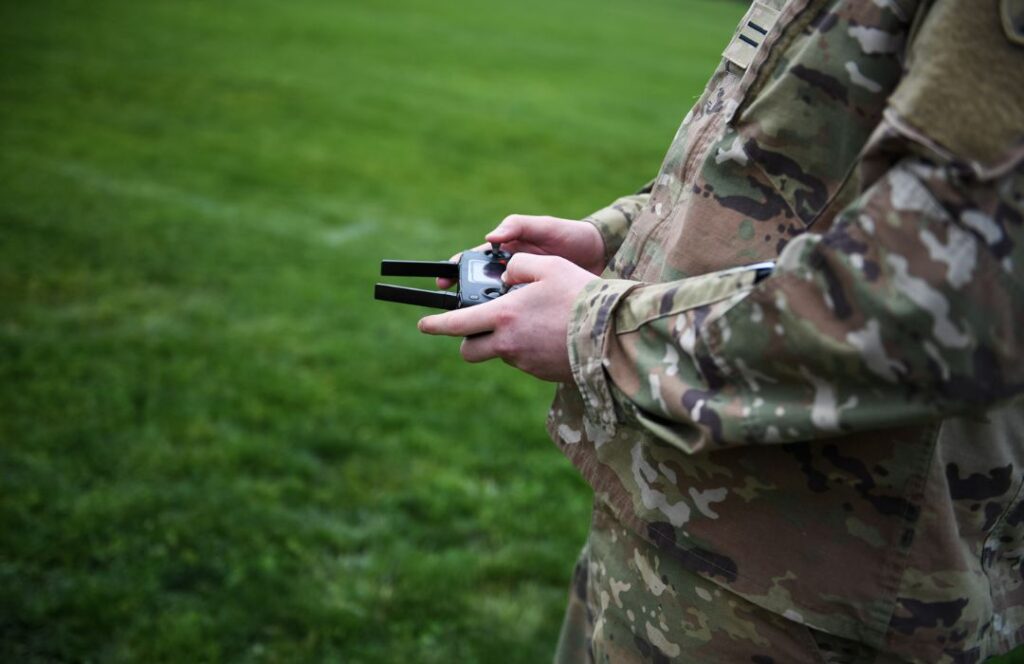
A cadet holds the controls to a drone in their hands.

Simulating flight  

Since the Drone Club had previously existed, the first step for the group was inventory – “We went on a treasure hunt for leftover drone parts,” said Malé.    

“We had to see what kind of drones were left behind and we found this really old brand called 3DR Solo,” said Malé. The club spent its first semester trying to update the software and firmware on these old-school drones.  

The software updates did not make a major difference, and the club moved on to purchasing DJI Phantom 3’s. Through this time, the club realized they were using a lot of large drones and ones that many cadets may be unfamiliar with. When the club came to this realization, Malé had an idea that would transform the club.  

“I introduced the idea of having people come in [to the club] and use my drone simulator,” he said. The Drone Club meets later in the day, around 8 p.m., and has had issues with flying at night.  

“So, we switched to simulators for the meantime, while we figured out the big drone situation,” said Malé.  

In addition to the drone simulator, the club has recently tapped into educational drones. Malé explained that the club is using educational software through a program known as “DroneBlocks.” The software uses visual programming concepts to help students learn to program drones, irrespective of their programming experience level. 

“We’ve been relying on their [educational] drones as a big resource for the first semester, as well as second semester,” said Malé. 

When looking to buy a drone, there are many classes to consider. Malé shared that there are educational-sized drones, racing-sized drones, indoor drones, and outdoor drones.  

Drone credentials and certifications 

To be considered “street-legal,” it is required to register drones that are over one pound. To register a drone and legally fly it, an individual must obtain a license from the Federal Aviation Administration (FAA). In addition to licenses and registrations, cadets in the drone club must work with post-police to make sure that they are following all airspace guidelines.  

This summer, the club hopes to increase its membership and will do so by sponsoring cadets to obtain their FAA licenses.  

“We’re going to sponsor cadets and faculty to apply for the FAA certificate,” said Abdelhamid. The club sent an email to all cadets informing them about this opportunity and has since received six applications.  

“We are planning to sponsor up to 10 cadets,” he said. Abdelhamid plans to use his grant to cover the test fees, study materials, and travel expenses for all interested cadets and faculty members.  

Aside from certification, the club has hopes of attending a drone competition soon. Next fall, the club plans to attend a gated drone competition, with teams competing from several different departments on post.  

Before then, the club received an invitation to participate in community cyber day May 13 in Natural Bridge.  

“On this day, we plan to showcase the work we are doing, the activities, and the drones we have,” said Abdelhamid.  

The Extra Mile: Theatre Club

Tori Wright ’24 was looking for anything to escape COVID-19 on post as a rat. The catch — there were not a lot of activities for rats to join due to the amount of work that was required of them in the Rat Line. Nevertheless, Virginia Military Institute’s Cadet Theatre was one she could.  

“My experiences with the theater were just always amazing. It was like this little safe place away from barracks,” she said. “It was honestly like a second home, so I kind of just stayed year after year.” 

With about four performances a year, the club is a little different than others offered on post. It’s technically two entities — the VMI Theatre and the VMI Community Theatre. Both involve cadets, but the community program wrangles in local participants when it’s tough to fill out a production. Cadet-in-charge Matthew Frazier ’23 said that usually happens for the holiday and summer productions, mainly because cadets have left to go home.  

Wright has been a key player in leading the summer sessions of theater for the past few years, something she says is a little bit more relaxed than when school is in session. She prefaces that it’s still very much a military school activity, but it’s different because they’re all in civilian clothes and can interact with the community on a personal level.  

“It’s a lot more relaxed. There’s a lot more time,” she said. 

Frazier said overall, VMI Theatre is a good escape for cadets — a point that Wright agreed with.  

“Because we’re here at VMI, it’s such a militaristic environment,” Wright said. “Even in classes, in other clubs, things like that, t’s very rigidly structured. There’s a set time, a set place, a set way of doing everything. But theater is so much more flexible.” 

The flexibility is in the creative freedom you get with performing or changing up a few props.  

“The general environment is so much more relaxed,” she said. “It’s a good way — especially during the Rat Line — of escaping to a much friendlier place.” 

Byron Rivey ’26 has been involved with theater since a young age. The first show he can remember being in was in sixth grade doing a rendition of “Beauty and the Beast.” 

“Ever since I can remember I was hooked,” he said.  

With the pandemic, he drifted from theater.  

“A distance grew between my fellow castmates,” he said. “This distance forced me to quit theater in high school. However, this year was the first time on stage for a while. My biggest supporter was my dyke, Ted Harris ’23, who is also in theater.” 

Both Frazier and Harris recently completed their last performance with VMI Theatre, performing “The Odd Couple.” A bittersweet exit, the two both said the club provided a place of refuge for them — something Rivey said as well.  

“Clubs like theater allow cadets and rats to escape from the daily stresses and portray a different person,” Rivey said. “Daily stresses include academic or Rat Line stresses. It also allows you to meet cadets from different companies.” 

VMI Theatre is in its 53rd consecutive year, according to director Joellen Bland. She’s been the director since 1982.  

“I have hundreds of treasured memories … but the thrill of seeing cadets blossom and grow on a stage before a live audience, and seeing the flush of pride on their faces when applause surrounds them, and their high-fives when they unwind after a performance is worth every moment of doing theater at VMI,” she said.  

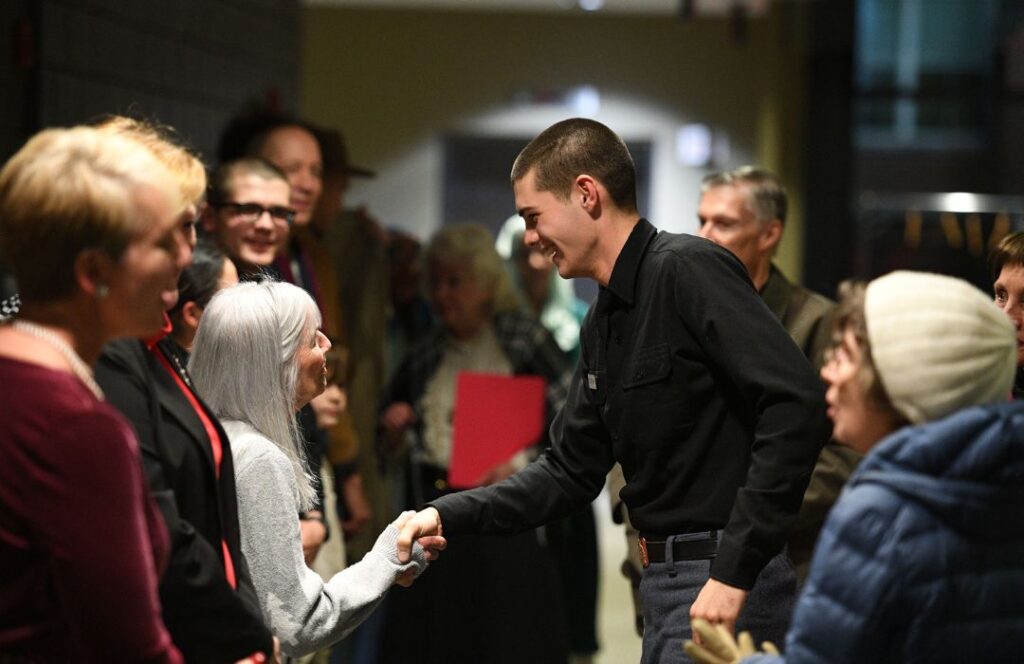
A cadet talks with audience members after a theater performance.

Bland said she doesn’t view VMI Theatre as a club but as more than that.  

“Even though we have never had a venue to truly call our own, and even though there is no theater course or major at VMI, and even though cadets do theater by choice and not by academic requirement, we are alive and continuing to struggle to stay alive at VMI today,” she said. 

Working with cadets is an adventure, she said, considering how many different directions they’re pulled in on a daily basis.  

“Doing theater is not like anything else they might tackle,” she said. “Auditions, rehearsals, learning lines-cues-entrances-and-exits for performances, set-building, prop-gathering, costume assembling, publicity selecting, etcetera, etcetera, are all part of getting a show together and performing it for the public. And guess what? All of this has absolutely nothing to do with handling a ball of any kind.” 

Colin J.M. Nicassio ’26 started acting on a whim with a production during his senior year of high school. After enrolling at VMI, he started getting emails about different activities and saw there was a summer theater — something that would be perfect for him while enrolled in VMI’s Summer Transition Program.  

“Being in theater at VMI is a very unique experience in the fact that few know about the program, and even fewer participate,” he said. “It is a small crew of 10 or so familiar faces that show up when their schedules allow them to and memorize their lines the day before opening night. It’s a challenge to be in the shows, but as Joellen always says, ‘Somehow, some way, we will do it because we’ve done it before.’” 

Nicassio said that VMI Theatre is crucial for the image of the Institute and also for breaking up the monotony of cadet life. 

“Perceptions are hard to change and improve, even when they should be. To the common person, activities like this or any of the things that go on around post are hard to portray to someone who is not in the system because of the overshadowing of those giant tan walls that encompass all of cadet life as many people think,” he said. “There should be a strong emphasis on these extracurricular activities at VMI because they’re much more than a time commitment, they’re a haven from the day-to-day monotony of life. It’s these cracks and holes in the image of the Institute that really help cadets stay engaged and strong at the Institute.” 

He said that activities like theater need to be emphasized at VMI.  

“Not only is this a military institute, but it is for developing leaders to grow and develop as characters themselves. That is what theater is all about. It’s about making friends backstage and working together to achieve a common goal that many others can enjoy. 

There is no point in making a show if there is nobody to watch it,” he said. 

The Extra Mile: Scuba Club

In 2018, Laura Fenske ’25, assistant cadet in charge of the Virginia Military Institute Scuba Club, was introduced to scuba diving by her parents, who had been diving for many years. Fenske’s parents discovered their love for scuba diving on their honeymoon and have since adapted the skill to fit their lifestyle.  

Fenske’s first diving experience was far from impressive.  

“It was a cold pool, and I did it up in Northern Virginia,” she said. “I went to a quarry, so it was dull freshwater, and it wasn’t that great of an experience.” 

The Fenske family decided that the cold water wasn’t ideal for their diving adventures, but they still wanted to dive year-round. They explored different options and finally landed on warm-water-only diving.  

“We went down to Florida and did some diving in the [Florida] Keys, and then went up to Pompano Beach,” she said. During that trip, Fenske’s family embarked on wreck dives and drift dives, which led to her newfound hobby. “That’s where I fell in love with diving.”  

Two years into scuba diving, Fenske wanted to take her diving experience to the next level. To improve her skills and increase credibility, Fenske sought out professional certifications through the Professional Association of Diving Instructors (PADI).  

With several certifications, including PADI Divemaster and Scuba Schools International (SSI) Instructor, she knew that she could turn diving into a career. All along, Fenske knew that she wanted to use these certifications to encourage her friends to share her love for scuba diving.  

“Of course, I could make a career out of it,” she said. “It’s a fun hobby… and I really just use the professional certifications to be able to teach people how to do it and recruit all my friends.”  

Scuba diving scenarios  

When thinking of a military college in Southwest Virginia, the VMI Scuba Club is probably not on anyone’s radar.  

Surprisingly, cadets have applied this fun club to real-life experiences and necessary job training.  

“Cadets join the Scuba Club if they have a trip coming up, and they want to get certified, or it might pertain to their career,” said Akhil Thadur ’24, cadet in charge of the Scuba Club.  

Thadur is a PADI Advanced Diver (Nitrox) and is currently working towards certification as a rescue diver.  

“The course teaches me how to manage a life-or-death situation,” he said. “If something bad happens to someone, how do I organize their evacuation? How do I contact authorities? How do I manage a rescue team?”  

By joining the Scuba Club, cadets have access to resources, including many of these certification courses.  

“If they want to be a diver in the U.S. Navy, a commercial diver, or if they want to go into special operations … this club can be a good steppingstone for them, and their skills,” said Thadur. 

If cadets are interested in pursuing certifications, most of the legwork is completed on their own time. Once a cadet has prepared for the written portion of their certification, they move on to complete the in-person diving tests.  

“You do the bookwork, and then you go to the instructor for your dives, and you take several tests,” said Thadur. After completing the certification, cadets can use their credentials in real-time with the Scuba Club.  

“We take a weekend, and travel to a place called Lake Phoenix, which is a quarry,” he said. “It’s one of the best dive sites on the East Coast.”  

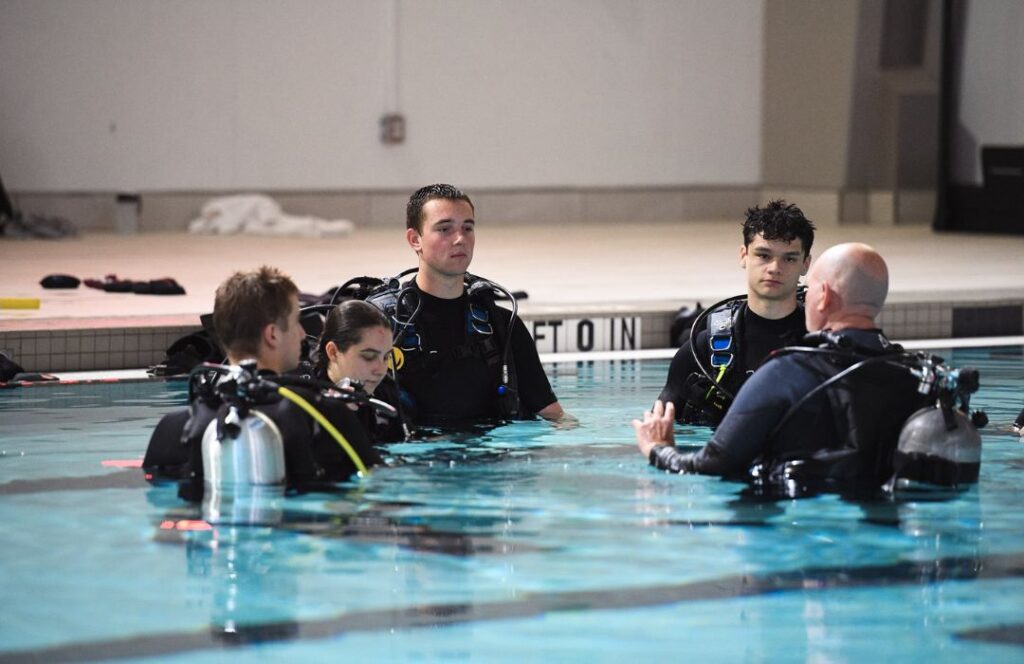
Cadets await instruction with scuba gear in the pool.

How to immerse yourself in the club 

Cadets have the option of taking their first dive with the Scuba Club, or if they have diving experience, they can expand their skills.  

“The purpose of the Scuba Club is to introduce cadets to scuba diving,” said Thadur. “For those that are already certified, we want to provide them with advanced training and minimize some of the costs that are associated with diving.”  

During the ratline, Fenske joined the Scuba Club as an escape from her day-to-day activities. She was asked to assist the club due to her professional certifications and deep knowledge of diving. 

“It broke up part of the ratline for me,” she said. “On Sundays, I got to help teach diving at the scuba club … and it was a lifesaver.”   

Fenske shared that her diving skills prepared her for a cadetship at VMI, and more importantly – these skills have prepared her for life. From learning to breathe through a regulator to staying calm underwater – Fenske has trained herself to find tranquility in the chaos.  

“It teaches you to stay calm,” she said. “Either way, I have air coming in … I don’t want to shoot to the surface, or I could get injured.”  

During the school year, Fenske shared that life on post can be hectic. Those busy times have allowed Fenske to apply her underwater skills in scenarios on land.   

“I just have to stop and take a breath,” she said. “I tell myself, ‘Remember, you have air,’ and it’s all fine.”  

Each year during the spring semester, the club travels to a quarry and completes one to two dive trips. All cadets are welcome to join, and no diving experience or equipment is necessary.  

The Extra Mile: Hockey Club

A group of nearly two dozen cadets pack into vans and travel over an hour to hit the ice in Lynchburg. Equipment is loaded into two vehicles as cadets pour in and head to face-off for practice.  

Practice starts at 7 p.m. on Wednesdays or Thursdays and most of the time, they do not return to post until after midnight.  

Liberty University is the closest place the Virginia Military Institute’s Hockey Club team can get ice time, according to VMI Hockey captain Rory Groat ’23. Arriving on post in the wee hours only to get up again at 6 a.m. can take a toll on cadets with their Corps responsibilities. But, for Groat and his team, it’s just another week for them — and hockey is life.

The club team, which has been around since the early 2000s, brought up its roster number this year, Groat said, mainly made up of 4th Class cadets. Although numbers were up, the number of players completing the Rat Line this year proved to be difficult in filling spots for games. Low roster numbers shouldn’t be a problem heading into the next year’s season. 

Since it’s a club sport, anyone can play — even with little-to-no experience. In order to play a game though, you have to try out for the line. Only 22 can be put on the roster. The tryouts will be a new addition for next year, incoming captain Patrick Cavanaugh ’24 explained. 

“Everyone is welcome,” Cavanaugh said. “You can come practice. I don’t care if you don’t even have skates. We’ll find you ways to get skates and get you on the ice.” 

The number of people who have come onto the team who haven’t skated before is relatively high — and everyone works together to get their skill levels up. Don’t have gear? The team will help outfit you with whatever leftover equipment they have. Hockey is an expensive sport, with the bare basics costing in the upwards of $500. Skates alone can cost that much.  

Bonding of a brotherhood 

Despite that cap on players per game, the club has a camaraderie that really resonates with each of the cadets.  

“Hockey is kind of like a brotherhood … kind of like the Corps.You’re going to battle with all your friends on the ice and it’s like it’s a big family,” Cavanaugh said. 

He said that connection with each of his teammates ties into what VMI stands for.  

“You’re with your brother rats, they’re like family. And then you have the upperclassmen you look to for leadership, just like you would look to a captain on a hockey team. Then, underclassmen, you learn how to mentor them. You learn how to guide them, make them better, develop their skills,” Cavanaugh said. 

Much of the team started playing hockey young. Groat said he’s been skating since he was 3 and has been playing on travel hockey teams since he was a child. Cavanaugh has been playing since the fifth grade and the other incoming co-captain Jake Clift ’24 has been playing since he was 8. 

The three team members all grew up in different parts of the country — Groat and Clift in Virginia and Cavanaugh in New York — so their experiences with building in the sport were slightly opposite. For Groat and Clift, their time was spent playing on travel teams, while Cavanaugh worked his way up to play for a AAA team, the New Jersey Avalanche.  

The VMI Hockey Team is part of the Atlantic Coast Collegiate Hockey League, which is a non-NCAA collegiate ice hockey league in the Mid-Atlantic and southeast regions of the United States. This year they played teams from Old Dominion University, William & Mary, Citadel, Mary Baldwin University, Christopher Newport University, and more.  

A hockey player on the ice mid-play.

Creating chemistry and building a team 

Their record this year was not stellar. They won one game out of 16. A contributing factor to the low number of wins was the availability of players. With the majority of their playing line being rats, they couldn’t come out to every game due to Rat Line activities.  

This was Coach David Turner’s first year, and he has no previous hockey experience. 

“There are some games where we only had nine people and there’s five on the ice at a time,” Turner ’22 said. “Usually you have upwards of 20 and you’re able to switch out for lines, but we didn’t even have two [lines].”  

Although it was a learning curve for Turner, he said it was easy to build respect and chemistry with the team.  

“Even though I wasn’t as skilled as them, it was instant respect and instant chemistry. I was able to relate to them really easily,” he said.  

The hockey team also provides a sense of normalcy — something needed in a military school setting, Cavanaugh said. 

“It builds on the values VMI establishes in your cadetship, but the biggest thing for me is not having to act like a cadet … you get this sense of normalcy and being like a normal college kid, you know when you’re out in Lynchburg for practice or wherever the games are. So that’s my favorite part about it,” Cavanaugh said. 

There’s also a different sense of camaraderie with parallels to VMI life, Clift said. 

“We take this group of individuals who come in or who have already been here, and we’re making a whole new team just like the way VMI does during the Rat Line,” Clift said. “We’re taking all these different guys and we’re building the chemistry. We’re getting that sense of camaraderie. I don’t know how to explain it but what makes hockey different from other sports is the sense of camaraderie and just the brotherhood of it.” 

For team manager Sean Daffron ’24, even though he doesn’t play on the team, he joined so he could hang out with his friends.  

“I play rugby for the school, and we have our group for sure, but hockey is probably the closest with the guys that I’ve personally experienced,” he said. “You come out to practice and then everybody knows each other. It’s pretty instant. It’s impressive.” 

That connection can be seen on and off the ice. During a game, if a teammate is chasing the puck, you know someone will back you up.  

“Hockey is a very gritty, all-out sport where if I’m going to go into a corner chasing a puck I know for example, Jake is going to have my back if I just get completely laid out,” Cavanaugh said. 

The Extra Mile: Rugby

When Kenny Howerton ’23 entered high school, he discovered that his school had one of the only high school rugby teams in Virginia. This was a perfect match for someone who had been playing the sport since age 10. Howerton joined his high school’s team and the rest, as they say, is history.  

“From men’s clubs to high school, and now at VMI. I have immersed myself in rugby, and I love it,” he said. 

Howerton leads VMI Rugby as team captain. He was introduced to the sport through his uncle, who played at the collegiate level.   

Howerton shared that the team is one of the most diverse teams on post. “From former NCAA athletes to cadre members and privates, we all come together with a common goal: to play rugby.”   

Playing the game  

In the game of rugby, each number on a jersey corresponds to a specific job and role on the team. Passing, catching, and tackling are the basic skills required of each player on the VMI Rugby team. Players wearing the numbers one through eight typically have a large build, an aggressive style of play, and consistently fast-paced movements. These players, known as the “forward pack,” are tasked with carrying the ball into tight pockets of space.  

Players nine through 15 are traditionally the speedier players, referred to as “backs.” These players have the job of working the ball towards the outside of the field and scoring for their team.  

The sport of rugby is very popular across the globe, but for many Americans, it falls under the general category of sports and does not draw the same crowds as football, basketball, or baseball. Nate Mayfield ’24, co-captain of VMI’s Rugby team, shares that the sport has carried him through very challenging times.  

In his first year at VMI, Mayfield had serious doubts about the length of his cadetship. With the help of his coaches, Mayfield was able to persevere, and has found his place at VMI on the rugby field.   

“My coaches had a really big impact on me and gave me something to work for that was bigger than myself, and bigger than the things going on around me,” he said.  

Both cadets shared that the sport has taught them lessons that will last beyond their four years on the team. Two of the bigger lessons are sacrifice and leadership 

“You’re out there with 14 of your best friends. You can’t win a game without all 15 people working together and you learn to sacrifice,” he said. “You use a lot of pain and fatigue to help fight alongside the other 14 guys and protect them. You all push each other towards the same common goal.”  

When it comes to leading a team, Mayfield shared that there is an unseen side to leadership. “Being a rugby captain is not very glamorous,” he said. “It means you are the first one down to the pitch for training. You’re going to be the one sweeping out the sheds or cleaning out the buses after a tournament.”  

Mayfield explained that he is no stranger to sacrifice, and in many ways, VMI prepared him to lead a team.  

“I’m better prepared to sacrifice for my teammates who I know, when it comes down to it, they are going to be willing to sacrifice themselves for me during a game.”  

Creating a community with camaraderie  

When Howerton speaks about rugby, one word that rings true is community. 

“The biggest thing that I love about rugby is the camaraderie that I’ve built with every single team that I’ve played with, especially at VMI,” he said. “From passing each other in the hallway, going to class, walking in barracks, or eating down in Crozet, anytime I see one of the guys on the team, my face lights up. I know that guy has my back, and I can always count on them.” 

When asked about the meaning of the sport, Howerton shared that the brotherhood within rugby is long-lasting and deeply supportive.  

“You have fifteen other guys on the field that are willing to help you and be there for you every step of the way, to make sure that you get to where you need to be,” he said.  

Once the final whistle is blown, the aggressive game comes to an end and players join to create friendships.  

“There’s a brotherhood that is built in between the tackles and the tries. At the end of my four years on VMI’s Rugby team, I can honestly say that it is the best decision I have made,” Howerton said. 

The rugby revival  

Last year, VMI Rugby ended its season at the national championship in New Orleans. From injuries to attitudes, the team did not perform at the high level that they had planned for. Through this difficult season, the team found hope and began to prepare for its current season.  

“In all of our eyes, we saw the level of competition. We saw where we were, versus where we wanted to be. From that moment on, we kind of had a different attitude,” Howerton said.  

To build the team from the ground up, Howerton said they all had to become students of the game. “We saw our goals and what they needed to be, and we knew that it was going to take a lot of work to get back to where we were and to achieve even greater than we had.”  

Mayfield further explained this concept: “Our biggest goal for this year would definitely be building our game knowledge from where we were last semester and making sure that all seven guys on the field are working as one unit and really playing fundamental rugby.”  

This year, the team is hopeful for an invitation to the national tournament, held in Washington, D.C., and an even better outcome. Mayfield explained that there is a large population of VMI alumni in D.C.  

“We expect a lot more support this year,” he said. “We’d really like to have some home crowds there to come watch us and really be able to put on a big show.”  

The rugby team has one final opportunity to qualify for the national tournament.  VMI Rugby will travel to East Carolina University April 15. If they succeed, they will appear at the national tournament from April 28-30.  

The Extra Mile: Cyber Club

Cadet John Barker ’23 wasn’t big on socializing in middle and high school. He found that interacting with computers was what made him comfortable. You’d never guess that now. Barker is well spoken, engaging and Virginia Military Institute’s Cyber Club cadet in charge, among other things.  

“Computers are a lot easier to interact with,” he said. “I did that for a little while and then I guess I became more comfortable with people, and the more comfortable with people I got, the more interested I became, in not just the being technical part, but being in an organization and trying to develop an organization that does more technical things for other people.” 

VMI’s Cyber Club boasts 104 members, making it one of the largest club organizations on post. And it hasn’t been around for long — it started in 2017. 

According to Barker, this year the Cyber Club has gone through a more specific change. The club has partnered with a number of companies and organizations in order to provide different opportunities for its members. That includes professional networking, certification training, off-post activities like capture the flag competitions, paid opportunities, and expanded leadership opportunities.

“I believe that Cyber Club is really just what the people make it,” said Joey Flynn ’25. He said the leaders and the cadets in charge really get people involved. “You fall in love with it. It’s what really pushes it to grow and develop.” 

The big activity they do as a club is capture the flag (CTF) competitions. The club doesn’t capture a physical flag. Instead, it’s a hacking competition between the club and other schools. At these competitions, the schools are given a data set and you are equipped with tools made by other people that you use to capture the theoretical flag.  

VMI’s Cyber Club spearheads about three of these competitions a year — the big one coming up in April, which is the NSA Cyber Exercise. To prepare, it depends on a variety of factors, Barker said. 

“It depends on what the CTF is, how big it is, and then what people like to do,” he said. “It’s a whole wide variety of things. Whether that’s looking at the website and breaking it or whether it’s looking at a database and trying to break it.” 

Those in the club can use their experience outside of VMI. The club allows for them to get certifications and training — many of which are free to the club or at a discounted price due to the club’s involvement with different organizations. One of those is TestOut Corporation, which provides professional grade certifications, which gives the club 50% off certifications. To offset the other costs, VMI’s Cyber Defense Lab has agreed to pay for any club member to get a certification for free, if the cadet gets three free mini certifications from the Cisco Networking Academy. It’s important to get some of these like certifications because it’ll help club members in the job market in the future. 

Barker, a computer science major, said he hopes club members are building valuable networks. 

Many just found themselves in the club. For Flynn, he got involved as a 4th Class cadet in 2021.  

“I never touched a computer, anything that in any way that mattered besides (Microsoft) Word until I got to college and I decided to be a computer science major,” Flynn said. “I just wanted to be the best in my field that I could, and the Cyber Club is just like giving me the opportunity to do that.” 

Flynn said he’s using the club to his advantage by establishing as many connections as possible through the club events.  

“I just want to expand my knowledge, my base knowledge,” he said. “You need to be able to adapt. That type of knowledge is what we learn in Cyber Club, and I think that helps a lot in the future.” 

The club isn’t heavily funded, which in turn creates some blocks in certain opportunities, Barker said. The club has to travel to places for several days, so it’s a challenge to get off post and find transportation.  

“CTF next year, for example, it’s hosted at the NSA, or it’s hosted at Virginia Tech, or it’s hosted in Langley, Virginia. These fantastic places that are impossible to get off post,” Barker said. “It’s a two-day event and you have one day for travel and one day to come back. You’re looking at a four-day permit. And anybody that looks at that balks at it very quickly. So you lose that networking opportunity.” 

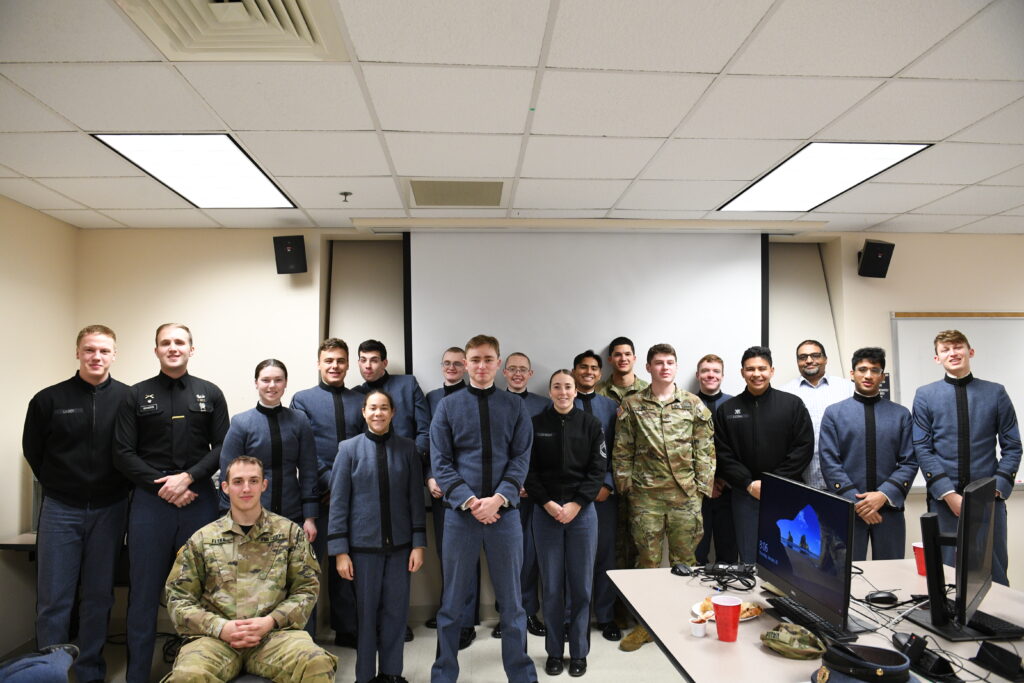
The cyber club at VMI inside a classroom.

Amish Parikh, IT specialist and systems engineer in VMI’s Cyber Defense Lab, is the CTF coach for the Cyber Club and a mentor and instructor to the Cyber Captains within Cyber Club. He said he loves working with cadets because of their professionality and their desire to learn and enact educational experiences into their lives.  

“The cadets are always looking for opportunities to gain further knowledge at VMI and after VMI in the direction that they will be heading into whether it be for government or private sectors,” he said.  

Parikh said the club is important especially due to the need for cybersecurity. The club presents real world cyber situations and develops a strong contingent of confident cyber members to society.  

Cyber Club is taking our citizen soldiers to becoming cyber citizen soldiers with the knowledge and know-how to protect and defend our personal data into the future,” he said. “Cyber is a growing space with that in mind the Cyber Defense Laboratory is training cyber captains and Cyber Club members to expand their horizons into AI machine learning, robotics, autonomous technologies, cyber teams, and application/web development where we can provide cadets of all calibers both in STEM and non-STEM programs to learn about cybersecurity in a multitude of directions.” 

Cyber Club meets on Thursdays at 8 p.m. in Mallory Hall. 

The Extra Mile: Brazilian Jiu-Jitsu Club

Cadet Audrianna Kelly ’25 had never heard of jiu-jitsu prior to coming to Virginia Military Institute. Previously doing martial arts, kung fu, karate, and wrestling, she was looking for a way to stay active while on post.  

That’s when she found VMI’s Brazilian Jiu-Jitsu (BJJ) Club as a rat. She aspired to get physically stronger and find more ways to defend herself to help aid her in her future military career.  

“As soon as I got the list of clubs that were available, and I saw Brazilian jiu-jitsu I was immediately intrigued,” she said. 

Jiu-jitsu is a grappling-based martial art and combative sport, which uses skill and control to resist opponents. It also serves as a form of self-defense. 

Kelly is one of the few females in the club. Out of the nearly 50 people in the club, only five are female. 

“I think that being one of the few females in the club is cool because it goes along with the saying, ‘Women can do anything a man can do, but in heels,’” she said. 

Sparring with guys doesn’t bother her, because they’re all there to learn martial arts and to become strong. But she’s noticed some guys don’t want to spar with the girls.  

“I guess because most of them are either physically bigger than us or more skilled, and they don’t want to hurt us. I don’t like that thought process because, while it is sometimes true, it leads to a clear line that separates the guys and girls of the club that is ultimately putting a damper on our training,” she said. “When guys don’t want to spar with girls, it leaves us girls to spar with each other and there is no variety, no change. Overall, I don’t mind when I spar with guys or girls.” 

Coach Col. Paul R. Moosman, Jr. started BJJ because of his wife, Deanne, who happens to be the assistant coach for the club.  

“I got into jiu-jitsu because I needed to learn how to protect myself against my wife who was also learning,” he said. “And I think we both got into coaching because we got connected with the club early on.” 

“Paul felt like he couldn’t just let me do jiu-jitsu and beat him up, so he started to take jiu-jitsu classes with me,” Deanne joked. 

The club started in 2009 with Capt. Jim Whitten as the coach. The Moosmans got involved around 2015, then officially became coach and assistant coach two years ago. Both are purple belts — the third level, with belt ranks going white, blue, purple, brown, and black.  

Deanne said she got involved with jiu-jitsu after taking boxing classes and Muay Thai. She was familiar with jiu-jitsu because there are combative (classes) in the Department of Human Performance & Wellness, where she works.  

She loved the physical and mental components of the sport. Jiu-jitsu is like a game of chess on the mats where you have to anticipate your opponent’s moves.  

“When you’re rolling with someone, you can bait someone to set something up like you can in chess,” she said. “You can think like two, three, or four moves ahead and set things up.” 

Deanne said by the time participating cadets graduate, they should be able to think two moves ahead.   

“There’s an aspect of you getting comfortable being uncomfortable,” she said. “So you’re in a difficult position or situation and you really have to maintain your composure and think through that situation strategically.” 

It also doesn’t matter your size or weight — if you have your techniques down, you can go up against anyone, Deanne said.  

“You can go up against someone who’s like 50 pounds heavier, a lot heavier than you, stronger than you and you can use the technique to out-technique them.” 

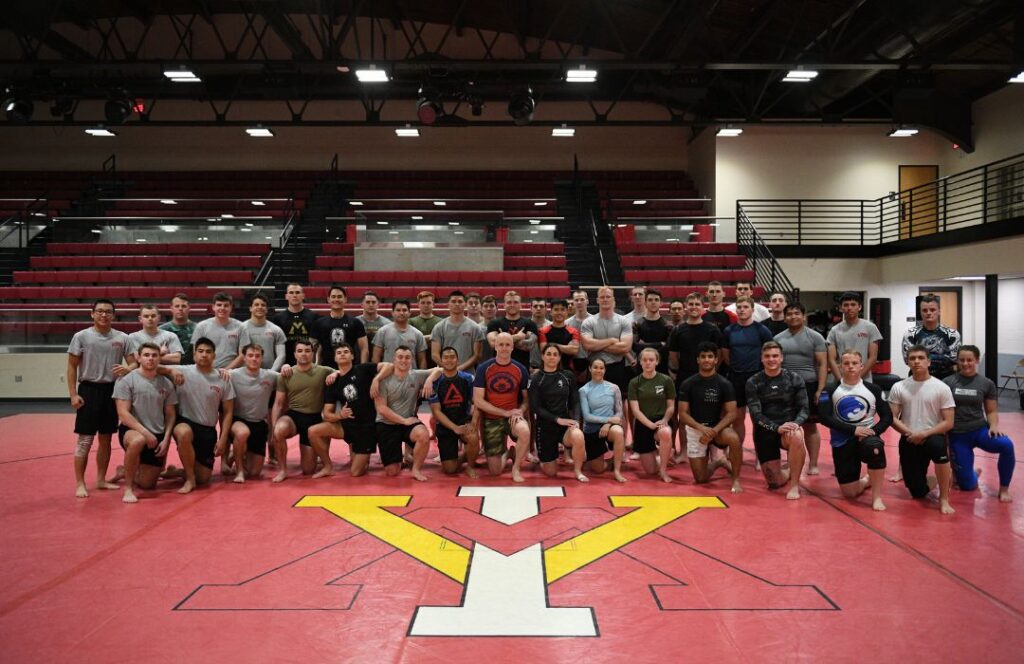
The Brazilian Jiu-Jitsu Club at VMI pose for a picture on the mat.

Practice and dedication 

Club members practice two to three times a week, totaling about five hours a week.  

Cadet Walker Powell ’23, cadet in charge of the club, signed on as a rat, along with his roommate David Amos ’23, the assistant cadet in charge. Both are blue belts.  

The club also competes in several competitions throughout the year. Both Powell and Amos participate in those, along with about a dozen more.  

“I just wanted to be good at something unique. Then I started doing it; I just fell in love with it,” Powell said.  

It takes persistence and dedication. Powell said it can take up to 20 years to accomplish a black belt — a longer timeline than most martial arts. Powell and Amos say at their respective home gyms they may dedicate about 15 to 20 hours a week to practice. 

Powell echoed the notion that jiu-jitsu is like chess.  

“You can’t get good at a strategy or position unless you work it as often as possible,” he said. “You can’t really work these things out like chess where you can play by yourself. You have to have that other person with you. So, it may not seem like a team effort, but it really is a team effort to do the sport.” 

For some, it’s not about competition, it’s more about the workout and release. 

“It’s like a workout in that afterward you feel exhausted but good, confident about yourself. Or when you’re sad or mad about your day, this is a great way to let it out,” Kelly said. 

Cadet Holly Hein ’23 is preparing to commission into the Marine Corps. After leaving the VMI swim team to focus on ROTC, she was able to join a club she wanted to. It also didn’t hurt that she’s had martial arts experience — she’s a black belt in Taekwondo.   

“I like the skills that I’m learning. It’s a lot of self-defense skills, but it’s also useful,” she said. “I’m going to the Marine Corps and we have a Marine Corps martial arts program that uses a lot of jiu-jitsu and Judo techniques. So, I’m getting some background experience in that. And it’s also a really great de-stressor. Mondays and Wednesdays, I know that I’m going to go there and I’m going to get all of my frustration from the day out.” 

Paul said he loves seeing the cadets grow with the club.  

“It’s great to have your students outside the classroom,” he said. “It definitely makes it good for us because we can really connect with them. We’re not always seeing them in the classroom and you just kind of get to interact with them in a different way and you get to know them better. 

“As a cadet, you come in and you know nothing so we practice two days a week, at the most maybe three days a week. It just takes a long time to sort of pick up the basic skills,” he added. “It’s really impressive to us when cadets are able to graduate from white belt to blue belt, which is a major milestone.” 

Most recently, the club took five cadets to Charleston, South Carolina for the Annual WVGO Gi and No Gi Spring Championship bringing home several awards. 

“This week we’ll be addressing weaknesses I saw in all of their games,” Paul said. “This is one of the reasons we encourage cadets to compete — it provides invaluable feedback on one’s technical abilities. By addressing the issues that reveal themselves in the high stress environment of a tournament, you can become a much better BJJ practitioner.”

The Extra Mile: Marathon Club

Sweat, asphalt, and shin splints are only a few of the fine details that define 26.2 miles. Traveled by foot, these long-distance races are frequented by many seasoned athletes across the United States.  

At VMI, cadets that join the Marathon Club dedicate many hours of their lives to training for a single race. For most people, checking out after a long day would allow for time to relax and rest. The Marathon Club members find relaxation in lacing up their running shoes.   

“I say that we’re the fun run club,” said Zach Wallace ’24. “It’s not about your personal times… it’s about your enjoyment of running and doing what I have found it does for me and trying to help other people.”  

Wallace, assistant cadet in charge of the Marathon Club, comes from a military family that has a long lineage of runners. From 1960 to 1970, Wallace’s grandfather ran 50-milers and was featured in several running magazines. Growing up, Wallace spent many weekends running on trails with his father, who was in the Marine Corps.  

Later, Wallace was inspired by his mom to try long-distance running.  

“My mom started running marathons when I was in elementary school,” he said. “When my mom was training for the Marine Corps Marathon, I decided that I would run the Marine Corps 10k,” he said.  

Wallace initially joined the Marathon Club to improve his three-mile score for the Marine Corps fitness test. The Marathon Club at VMI has been around since the mid-1990s and came to fruition as a way for cadets to improve their running scores for the performance fitness test.  

Ryan O’Connor ’24, cadet in charge of the Marathon Club, had always enjoyed running but was interested in taking his hobby to the next level. He has since fallen in love with the sport and shared that it provides an escape from his daily life.  

“I like how you can sink into your own mental state,” he said.   

Similarly, Wallace shared that he finds an escape in the many miles he spends with his own thoughts. “Running is a form of therapy for me,” he said. “I don’t listen to music, typically, but whatever thoughts come to mind, I know that they are important.”  

Training for the club is done on an individual basis but shared in a group atmosphere. If one cadet is training for intervals, other cadets are invited to join in on this training. Wallace does most of the planning for the club, and even coordinates which races the cadets compete in.  

“It’s the bones of the Marathon Club,” he said. “The planning, the permits, communicating with coaches, rides, paperwork, funding, and registering club members for races.”  

Coming into the club, O’Connor had experience with 5ks and 10ks but had never tested his limits with distance running. Currently, he is training for a half marathon, and next year, he plans to complete a full marathon.   

For Wallace, the distance of choice is still undetermined.  

“The short-term goal I have is the Promise Land 50k that is coming up at the end of April,” he said. “Long term, I will be running the Hellgate 100k.”  

Wallace plans to keep seeking long-distance runs, and with each race, he sets the bar even higher. “It’s about chasing down the next mileage,” he said. “If I like running the 100k, then I’ll go to 100 miles. If I don’t like it, I can say that I have run 66 miles.”  

The Marathon Club meets twice a week to provide information about upcoming races and training programs. The club is open to all interested cadets, and members are only required to complete one race per semester.   

The Extra Mile: Cadet Emergency Medical Technicians

Donnie McBrayer came to Lexington to retire, but it seems to be the furthest thing from what he’s done. As the assistant advisor for Virginia Military Institute’s cadet emergency medical technicians (EMTs), he’s tasked with taking cadets and turning them into certified EMTs.  

When he first came to Lexington, he volunteered for the City of Lexington, worked some VMI football games, and wound up teaching EMT classes. By 2014, he started volunteering with the fire department. In 2016, he was asked to help set up the EMT organization at VMI.  

The unofficial program stems back to the 1990s, with a group of about five to six cadets. In the spring of 2016, it became certified by the state as a non-transport emergency medical service (EMS) agency. Every two years, they need to get recertified as an organization. With that certification, VMI’s cadet EMTs can handle 911 calls on post instead of relying on the Lexington Fire Department’s EMTs to arrive.   

Lexington only gets called if the patient in question needs transportation to a hospital, thanks to the program.  

It started out as a club organization, then morphed into being integrated into the regimental system. In the 2014-15 academic year, the club had 24 cadets. That grew to 73 at one point. Currently, they have 68 cadets.

Cadet EMT Chief Ryan Carpino ‘23, a biology major from Worcester, Massachusetts, has been part of the program for nearly three years. He also volunteers with the Lexington Fire Department. 

He said he’s always been drawn to public service. His grandfather and mother have both served as first responders. 

“I always had that kind of public service thing. I guess you could say in my blood, so to speak,” he said.  

He was also drawn to the military, thus making VMI a perfect fit for him.  

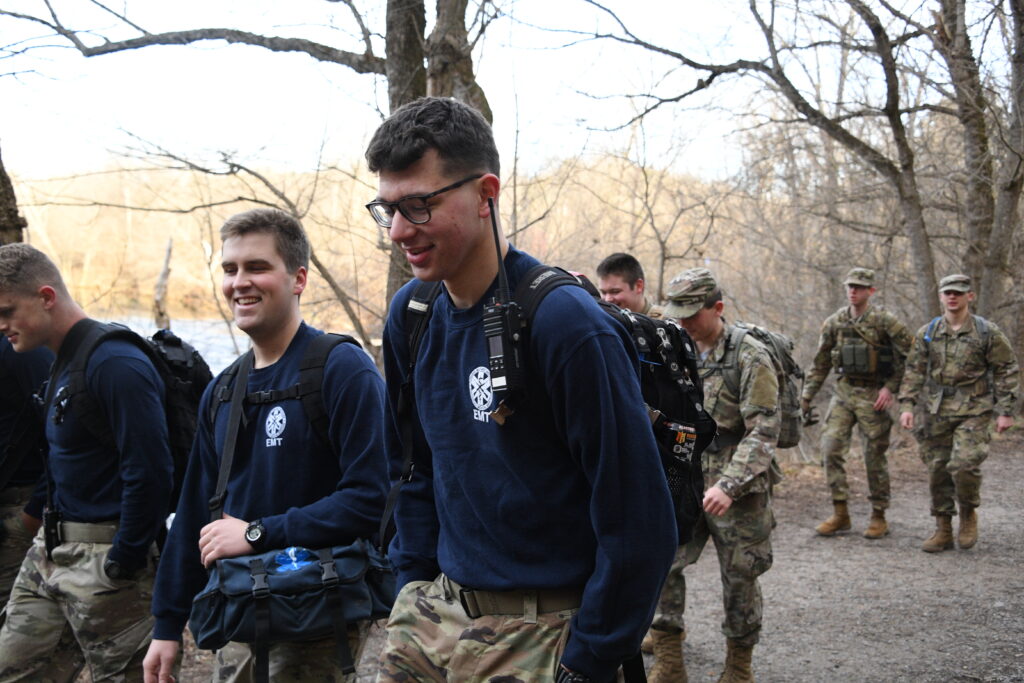
Cadet EMTs during the 20 mile march at VMI.

How the program works 

Training happens on post, but some come in with certifications they obtained while in high school, Carpino explained. In the spring, there’s usually an interest meeting that leads into the interview process. Then the list is made.  

During the first summer session, if accepted, they attend the certification classes. Those participating stay on post with free room and board and their meals paid for during the summer. In turn, cadets also receive three credit hours. The catch is, cadets then owe the program four semesters. 

“There’s quite a bit of money … getting that all done,” McBrayer said. “So we have people that we are able to depend on for those two years.” 

They have 24 slots open currently.  

“We try not to close the door on anybody,” Carpino said. “But at some point, you kind of have to. We always say that if you don’t get a chance to do it through us, there are plenty of other options they can do.” 

Not everyone who participates in the program are commissioning. Some graduate and end up working as emergency room doctors, some become police officers, others are firefighters/EMTs. 

“What we try to do is make sure they have a career when they leave here … that they are marketable,” McBrayer said.  

Where you’d see them 

The VMI cadet EMTs are at every VMI event.  

“During a football game, we have a whole EMS operation — besides the city ambulance — we have our cadet EMTs on that,” McBrayer said. “We have them throughout the stadium. If there’s a civilian that has an injury problem, or medical problem, we can be there for them, too. That’s a big thing of what we also do at every football game, every basketball game, we have one to two EMTs there, things like that.” 

Some EMTs are NCAA athletes. Others are part of cadet leadership during events, there has to be some juggling to make sure events are covered.  

There’s a rank system and an operation to be able to spread their resources around.  

“We have that chain of developing people that allows us to help and each company has entities attached to them,” Carpino said. “So anytime they do any event, they’re always there.”

The deputy chief makes the plan, the operations lieutenant is in charge of staffing. According to Carpino, it works as whoever is free signs up and they will staff certain things. 

“We also have people on guard 24/7, so it’s more like a standby thing,” he said. “There’s always the senior EMT that has the experience and we have the younger EMT there so they can learn and grow.” 

McBrayer said it’s a rewarding experience working with the cadet EMTs, especially knowing that the cadets will be leaving to do greater things in life.  

“That’s the most rewarding part … to see them find their career path and to be able to succeed,” he said. 

Carpino likes that you can see instant change in the work they’re doing.  

“The most rewarding calls are the ones when you get to make an immediate direct change in your brother rat’s darkest time, whether that be relieving pain or just being there emotionally for them,” he said.