Post View Unavailable:
Post View is currently unavailable due to technical difficulties. More information.Last Updated: 01-08-2026 09:42 AM»
Notice:
VMI.edu has recently been updated and upgraded. Please note that some URLs may have changed. Visitors are encouraged to use the new, expanded site menu and site search to navigate through these changes.
New Website Launched»
The Virginia Military Institute team won first place recently at the 2026 Seerist Intellithon in Reston, Virginia.
The prestigious competition hosted by Seerist — a company whose mission is to shape the future of risk intelligence by enabling organizations to proactively anticipate, manage, and respond to global cyber threats — brought together top talent from five senior military colleges including The Citadel, Norwich University, the University of North Georgia, Virginia Tech, as well as VMI, to solve real-world open-source intelligence and security challenges.
The cadet team, sponsored by Department of Computer and Information Sciences (CIS) and Cyber Defense Laboratory (CyDef), included Michael Kelley ’27, Caroline Marini ’26, River Smith ’27, and John Stotler ’27. Col. Imran Ghani, professor in CIS and director of operations for CyDef, was their coach.
Stotler shared it was an amazing experience. “We utilized tools and skills to collect intelligence and brief highly significant persons on real world activities that were frequently being updated.”
Ghani stated the VMI victory was built on preparation and discipline.
“To prepare for the competition, the cadets conducted multiple rounds of targeted practice using a preemptive, scenario-based approach, which ultimately aligned with the competition. Their commitment, ability to follow structured mentorship, and continuous skill refinement were key factors that led to this success.”
Virginia Military Institute hosted the 9th annual Commonwealth Cyber Fusion and Virginia Cyber Cup (VCC) Competition, a state-wide collegiate cyber security competition, February 20 and 21. The invitation-only event is for colleges that are National Security Agency (NSA) / Department of Homeland Security (DHS)-designated National Centers of Academic Excellence in Cyber Defense. It was organized by VMI’s Center for Leadership and Ethics (CLE) as part of its strategic engagement initiatives; and co-hosted by the Virginia Cyber Range, an initiative with a mission to enhance cybersecurity education for students in the commonwealth’s public high schools, colleges, and universities; and the Commonwealth Cyber Initiative (CCI), Virginia’s main access point for cybersecurity research, innovation, workforce development, and news.
VMI founded this cybersecurity event in 2017 at the suggestion of Bryce Bucklin ’17, a computer science major, who suggested the Commonwealth of Virginia create a statewide cybersecurity competition. United States Sen. Mark Warner served as honorary chairman.
Participating were 150 students with nearly 30 of their faculty advisors representing 19 colleges in Virginia: Danville Community College, ECPI University, George Mason University, Germanna Community College, James Madison University, Laurel Ridge Community College, Liberty University, Marymount University, Northern Virginia Community College, Old Dominion University, Radford University, Regent University, Tidewater Community College, University of Virginia, Virginia Commonwealth University, Virginia State University, Virginia Tech, VMI, and making their inaugural appearance, William & Mary.
Activities included a job fair, free professional headshots, a Tech Duels team debate competition, and a faculty/industry round table discussion hosted by representatives from CCI.
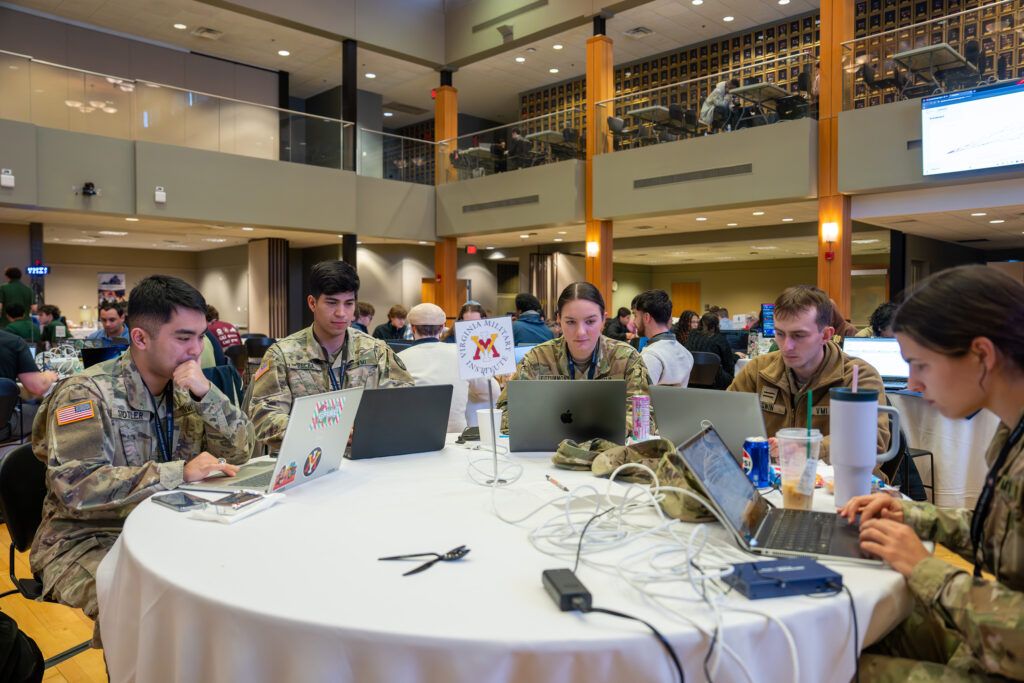
VMI cadets work together to decipher problems across a range of categories during the capture-the-flag competition in the Hall of Valor. –VMI Photo by H. Lockwood McLaughlin.
Col. David Gray, executive director of the CLE, served as master of ceremonies for the event. Brig. Gen. Robert W. Moreschi, dean of the faculty and deputy superintendent for academics, welcomed the participants to VMI. “You are here by invitation, which indicates that you are elite students in cybersecurity. Your career starts here with networking and honing your skills. The country needs you, the commonwealth needs you, and businesses need you. Make friends and enjoy your time here.” He then introduced the keynote speaker, Patrick McShea, executive director for cyber mission operations for CACI International Inc.Patrick McShea imparts the importance of soft skills during his keynote speech in Gillis Theater
McShea spoke on the importance of soft skills, such as teamwork, leadership, adaptability, problem-solving, communication, and creativity.
“Why do soft skills matter in a technical world? Employers want well-rounded people. I would take someone with a great attitude and the aptitude to grow into a role, over the smartest person in the room if I feel that the smartest person in the room is going to be a problem. Technical skills are a foundation, but they aren’t the only thing.”
McShea also stressed the importance of a well written and succinct resumé, and being true to oneself in discovering life’s calling. He ended by reminding the students that “Lifelong learning is not an option.”
Patrick McShea imparts the importance of soft skills during his keynote speech in Gillis Theater.—VMI Photo by H. Lockwood McLaughlin.
A highlight of the two days for the student participants was the VCC capture-the-flag competition, in which teams tackled problems in scenarios designed to model real-world computer security challenges across a range of categories including cryptography, network traffic analysis, and reverse engineering. George Mason University was the high scorer in the four-year college division. The University of Virginia finished second, and William & Mary came in third. For the community college division: Germanna Community College was the winner, followed by Danville Community College in second, and Tidewater Community College in third. VMI cadet competitors were Caroline Marini ’26, Sarah Fitzsimmons ’27, Isaac Gwin ’27, Santiago Rocha ’27, and John Stotler ’27. Their coach was Jacob Klein, software engineer in the Cyber Defense Laboratory. Klein stated the cadets did very well despite most of them being new to the competition.
“It was intimidating and nerve-racking, however they buckled down and put up a respectable score. They look forward to future opportunities to compete.”
Lt. Col. Kim Connolly, assistant director of programs and conference for the CLE, stated the collaborative event develops Virginia’s cybersecurity workforce. “Its unique design provides a well-rounded experience for the students, helping them develop both their technical and soft skills before they enter the workforce.”
Virginia Military Institute has developed an experiential learning project called, “Students-Led Cyber Defense: Creating a Safer Digital Landscape for Local Businesses and Nonprofits in Rockbridge County,” in which VMI cadets serve as instructors, mentors, trainers, and support to nonprofits and small local organizations in Rockbridge County which have no information technology or cybersecurity team.
The initiative is designed to equip cadets with practical cybersecurity skills, bridging the gap between traditional classroom learning and real-world application, and positioning them for successful careers after graduation. The project is funded by a grant from the Commonwealth Cyber Initiative.
According to Dr. Sherif Abdelhamid, assistant professor in the Department of Computer and Information Sciences, team member of the Cyber Defense Lab at VMI, and project principal investigator, the project began in January 2025.
“We spent last spring preparing the training material and learning modules, and an additional four months developing ‘Aegora,’ a web platform that hosts the material and service tools. Our first instructional class was with the Virginia Innovation Accelerator (VIA) in Buena Vista. Cadets conducted comprehensive cybersecurity threat assessments, advised on securing network systems, delivered cybersecurity training, and provided advisory support for integrating artificial intelligence to enhance daily workflows, marketing strategies, and data analysis while maintaining data integrity.”
Nickie Hawkins, director of VIA, attended the cadet-run class and found it invaluable. She was able to use what she learned the following week, when one of her workplace accounts had a password breach. “I was able to recognize the issue, communicate with my team, and apply the necessary interventions to protect our data and accounts. Having the confidence to move forward quickly reduced the potential impact of the breach and reduced the time spent on securing data,” said Hawkins.
One cadet on the team, James Bangura ’26, a computer science major with a track in cybersecurity, said the program has been one of the most meaningful hands-on experiences of his academic career.
“I have been involved in assessing digital vulnerabilities and helping develop practical security recommendations for local businesses and nonprofits in Rockbridge County. This project has been incredibly rewarding because it allows us to apply classroom knowledge to real-world challenges that directly impact our community. Working on this initiative has strengthened my technical skills, improved my ability to communicate complex security concepts to non-technical audiences, and reinforced my commitment to serving others through cybersecurity.”
In addition to Bangura, there are currently seven other cadets on the team including Benjamin Davis ’26, James Jeffers ’26, Gunnar Romsland ’26, Shahryar Shah ’26, Lucienne Ashmore ’27, Ian Coker ’27, and Katelyn Redlinger ’27. Abdelhamid stated there are plans to provide training to additional local businesses, and to apply for additional grants to extend the program.
This article is part of The Next Step series. While the four years at VMI are designed for cadets to push themselves academically, physically, and mentally to tackle the demands of life at a premiere military college, they also prepare cadets for life after graduation. Whether that life be one in the military or one in the private sector, VMI faculty and staff provide guidance to cadets along their journeys. One department specifically dedicated to that endeavor of post-Institute success is the Office of Career Services. In The Next Step series, we highlight cadets preparing to enter the workforce after graduation, as well as those still in the midst of their cadetship preparing for internships over the summer.
Business and computer science were two industries that Warner Collier ’24 saw opportunity in. Coming to Virginia Military Institute, he wanted to cast as wide of a net as possible, which brought him to major in economics and business, with concentrations in decision analytics and financial analysis, along with computer science and cybersecurity minors.
“As I progressed through rat year, I knew I wanted to work in finance after joining the Cadet Investment Group,” he said. “I did more research on careers in finance and gravitated towards private equity.”
Hailing from Midlothian, Virginia, recent graduate Collier is now set to work for Civitas Growth Partners as an analyst.
“I will be involved in all aspects of the deal sourcing process,” he said. “This will include identifying and reaching out to potential investment opportunities. Also, I will analyze company financials, KPIs, build out financial models, and communicate key insights. Lastly, I will sit in on portfolio company board meetings and monitor the financial and operating performance of the portfolio companies.”
Coincidentally, Collier said this was the first job he applied for.
”I wanted to work for an organization which aligns with my moral values. For the same reason I chose VMI, I wanted to be a part of a firm which believes in doing things the right way,” he said.
Working for a small company like Civitas was what was most attractive to Collier. He said it would allow him to have more learning opportunities and contributions.
“I was drawn to private equity as I enjoy analyzing companies, figuring out what makes them work, and implementing strategies which yield real results,” he said.
He believes that having VMI on his resume aided him in landing this job.
“The number one reason Civitas hired me is because they know they can trust me. The foundation of VMI, honor, is the competitive edge I have over others,” he said.
VMI has taught him to be comfortable in the uncomfortable.
“VMI puts you in high stress situations which give you valuable tools that translate to the workplace. I’m confident in my abilities and work ethic due to VMI,” he said.