
Post View Unavailable »
New Website Launched »

ECE Cadets Aid Disabled Veteran with Capstone Project

Eight 1st Class cadets majoring in electrical and computer engineering (ECE) at Virginia Military Institute recently presented their capstone project after working on it throughout the academic year. According to Col. David Feinauer, professor in the Department of ECE, the engineering capstone experience is an important milestone and prepares the cadets for their future careers.

“Our cadets applied engineering design to meet real human needs,” Feinauer said as he described the project. “They worked in two teams and developed both custom hardware as well as software to transform an over-the-bed workstation platform into a smart home-integrated, more accessible, user-centered assistive technology that enhances independence and everyday comfort. Their effort on this project provided a meaningful example of the service embedded in a VMI education and the power of engineering with purpose.”

Their effort on this project provided a meaningful example of the service embedded in a VMI education and the power of engineering with purpose.

Col. David Feinauer, professor in the Department of ECE

The cadets’ work was for the benefit of Jeremy Davis, a disabled and bedridden Army veteran living in Maine. He sustained damage to his nervous system and internal organs during a service-related injury. Rehabilitation engineers at the Department of Veterans Affairs Medical Center in Richmond, Virginia, provided Davis with a motorized over-the-bed workstation allowing him to use a computer from bed. The cadets worked to make the workstation more accessible by allowing him to control the position of the monitor and keyboard directly from his computer or phone.

Davis was connected to VMI through Project S.E.R.V.E. (PS), a national nonprofit founded to engineer personalized solutions for veterans and emergency responders, enhancing their quality of life. Steve McMillan, project manager with PS, explained the process.

“Our staff reviews hundreds of project requests we receive from veterans and emergency responders to identify those that align with our mission of working with student engineers. We also speak with capstone professors like Col. Feinauer to gauge the types of projects they are seeking. We then reach out to the requestors to discuss and assess possibilities. We currently have 27 partner universities across the country and strive to align pairing regionally. As a 501(c)(3), we are limited to a certain number of projects each year, since we depend on donations and grants to fund the projects.”

According to Nicholas Ligday ’26, project manager for the hardware team, this process was rewarding. “This wasn’t just an academic project, but one someone will use on a daily basis, and definitely a crowning achievement of my cadetship. We were able to help someone in a way that will leave a lasting impression. Despite the challenges and all our other obligations at VMI, we stayed focused on helping someone else. I think it really says something about the kind of people VMI produces.”

Davis was pleased with the final results. “The cadets’ conduct and commitment gave me a great deal of confidence in the future leadership of our military. They represent the very best of what you hope to see: competent, thoughtful, and mission-focused individuals who genuinely care about the people they serve. Their ability to translate real-world user needs into practical engineering solutions speaks volumes about their training and character,” he shared.
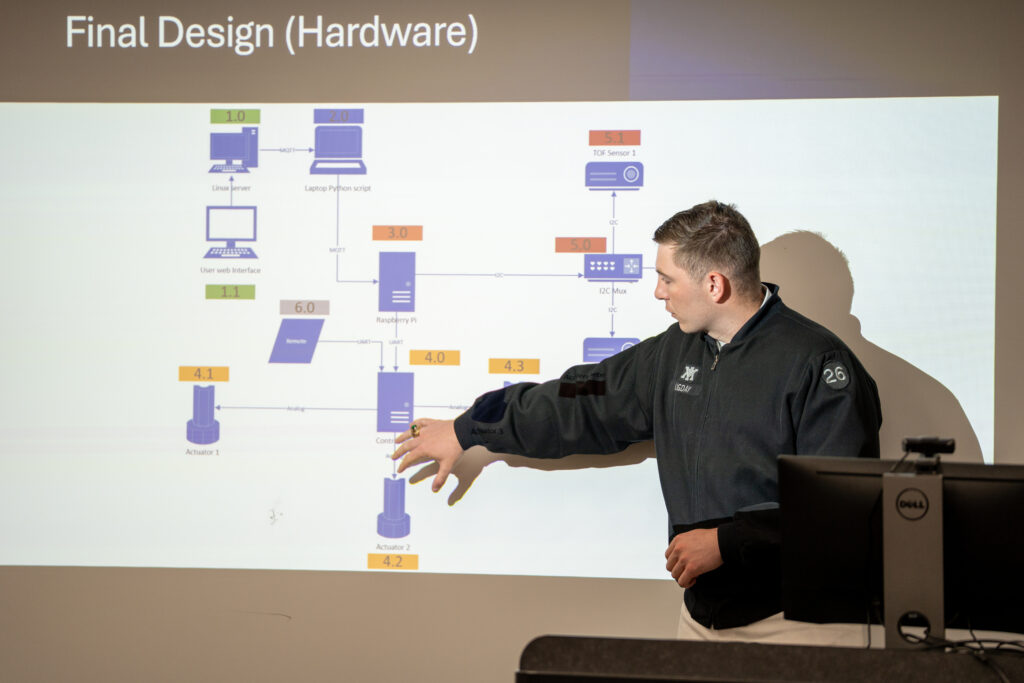
Cadets points to a slide explaining circuit boards.
Nicholas Ligday ’26 discusses the custom hardware design his team worked on for their capstone project. –VMI Photo by Lexie West.

Barr Breaks Own Record

Two years after he set multiple powerlifting records, Col. Dan Barr ’74, professor emeritus of electrical and computer engineering at Virginia Military Institute, has once again achieved new heights.

Since 2023, Barr has received training and competition advice from Rebecca Owen, assistant coach with VMI’s powerlifting club. In February 2024, he competed in his age bracket at the United States Powerlifting Coalition (USPC) meet held in Cocke Hall. It was there that he set both state and national records in squat with 249.1 pounds, bench press with 238 pounds, and deadlift with 319.6 pounds, for a total of 806.7 pounds.

During the recent 2026 USPC meet Barr, who is now 73 years old, broke his own record in squat with 275.5 pounds, bench press with 253.5 pounds, and deadlift with 365.9 pounds, for a total of 894.9 pounds, improving his overall total by 88 pounds.

According to Barr, the USPC does not normally issue a certificate for each attempt that breaks a record. “So, I set three records in 2024, then this year on my first attempts, set three more, and on second attempts, broke those, and received the four national records certificate,” he shared proudly.

Additionally, last summer Barr was inducted into the hall of fame at his alma mater, Cabrillo High School in Lompoc, California, for being an athlete, warrior, patriot, educator, and inspirational leader. Barr joins his sister, Sharon Spalding, an athlete in her own right and already in the school’s hall of fame, making them the sole brother-sister pair holding the honor.

I Am VMI: Julia Ward ’26 

What truly defines Virginia Military Institute are the people. Cadets, faculty, and staff, both past and present, are what make it “No Ordinary College.” I AM VMI will showcase the outstanding individuals who have accepted the challenges and embraced the spirit of VMI. Their perspectives provide authentic insights into life at the Institute and the value of this unique military college. 

I Am VMI: Julia Ward ’26 

  • VMI Class: 2026  
  • Major: Electrical & Computer Engineering  
  • Hometown: Frankfort, Illinois 
  • NCAA Sport: Water Polo  
  • Commissioning Plans: U.S. Navy – Hoping to service select Subs  
  • Other Clubs/Societies/Activities: VMI Pipes & Drums, Honor Court, Society Women’s Engineers (SWE) 

Julia Ward ’26 came to Virginia Military Institute uncertain of herself and her leadership abilities.  

“I wanted to challenge myself,” she said. “I knew I wanted to put myself in a better position as a newly commissioned officer. I figured there was no other place to take opportunities and learn to flourish. I liked the family aspect of VMI and the alumni connections that come from time spent at VMI.” 

Ward said there’s always something to do at VMI and she enjoys the busy pace. 

“Whether it is a sporting event, a debate, a dinner, a speaker, or simply just class work, it keeps you busy. I like to be active and VMI is the place for that,” she explained. “It isn’t always military either; there are plenty of clubs or activities to get engaged in the Corps.” 

She had the opportunities for engagement to help build her and others into a family, noting there’s always a group of supporters for each cadet— either with the staff, faculty, or other cadets.  

“Everyone wants you to succeed. This year strengthened that bond with a lot of people at school. I had a death of two very close people to me at the beginning of the semester that made me almost not come back for the semester. Having the support system I have here let me come back, get back on my feet, and keep leading for a deeper purpose,” she said. “I had a lot of responsibilities before leaving and I knew if I didn’t return, I would be letting a lot of people down, but I would also not be living for the two that I lost. I would not have come back if it was not for the support system of the commandant staff, my professors, and the people around me who lift me up every day.” 

VMI is rigorous, but rewarding, Ward explained. Each day brings a new set of challenges she can work through.  

“I think it has forced me to come out of my shell a lot. I have honestly fully transformed from the person I was three years ago sitting in a high school seat ready to graduate,” she said. “It is a surreal feeling to watch your dreams unfold in front of you. I have wanted to serve in the military for a while and having that dream come to life in the next year is still unreal to me, not to mention all of the experiences I have been able to have to travel, to lead, to put myself out there, and get hands on instruction is something I would not have had if I chose to go anywhere else. It’s very rare that you go to any other college and NCAA is just another thing you do because there are so many other opportunities like holding rank and cadet government that can bring experience to your time at a school.” 

“I think it has forced me to come out of my shell a lot. I have honestly fully transformed from the person I was three years ago sitting in a high school seat ready to graduate. It is a surreal feeling to watch your dreams unfold in front of you.”

The electrical and computer engineering major originally wanted to pursue mechanical engineering. When she first came to VMI, she was interested in a career in biomedical engineering after commissioning into the U.S. Navy. She saw that the electrical engineering department had more to offer in that background, so, she made a last-minute switch.  

“I have no further regrets, and I do not question my future success using a technical degree in the Navy or in industry based on the instruction I have been able to receive in the classroom,” she said. 

Julia Ward during Virginia Military Institute's 1st Class rank announcements.

Ward admits that VMI has made her a more confident person.  

“It puts you in positions that force you to make hard decisions in a low-risk situation so the time that it really matters we will know how to react or step up to the plate to lead because that’s just our nature now,” she commented. 

VMI has also prepared her for her future in the Navy. She’s been able to see that during summer training for Naval ROTC, but credits the confidence boost the Institute instills to be a big factor in her future successes.  

“I think it really is the confidence we exude from our decision-making abilities and the way we interact with teams of all different backgrounds. We already know what it feels like to get beat down and build ourselves back up again,” she said. “There is a lot of resilience that comes from going here and it allows graduates to bring creative solutions to the table and to work harder than everyone in the room because the thought of failure doesn’t scare us, we just pick ourselves back up and keep going.” 

Ward said it’s been easy to fit in at VMI — no matter what, you find your people. Overall, the pride she has gained being a VMI cadet has been the best experience.  

“How hard the average person works here is tenfold above every other school,” she described. “How eager to help and get involved people are here is something that doesn’t get spoken about enough at our school, how close we are to everyone.” 

Honors Week: Cadet Completes Work on App

Parents of newborns often struggle to understand the needs of their baby. How often should they eat? How long should they sleep? How does one know if they are sick? So, it isn’t unusual for parents of babies with hearing impairments to be confused. Col. James Squire, professor in the Department of Electrical and Computer Engineering at Virginia Military Institute, was faced with that very issue 25 years ago when his oldest son was born and diagnosed with a hearing disorder.

Squire’s first thought as a new parent was, “What was the world like that he was experiencing?” Squire and his wife were given an audiogram, but they didn’t know what it meant. Thankfully, his son’s hearing disorder was a misdiagnosis, but it inspired Squire to begin research to help young parents of children with hearing loss. “I thought it would make a good honors project for cadets. I was wrong. It made a terrible single honors project, but it made three really good honors projects because there was so much background work with theoretical development, open-source work, working with audiologists, and figuring out how to get programs that could be used practically by the audiology community.”  

Work on the project has spanned over nine years and began with Will Flathers ’09, who primarily focused on filtering audio. Binh Tran ’23 continued with the project and created an open-source sampling frequency filter. Tran won an award for his contribution at the Institute of Electrical and Electronics Engineers (IEEE) Southeast Regional Conference two years ago.

Cole Bowyer ’25, who took up the mantle as the third honors student to work on the endeavor, placed the capstone on the project in his presentation, “Audiogram Emulator,” a free app available to parents that allows them to hear as their child hears.  

Bowyer explained that roughly 9,000 children are born each year in the United States with some type of hearing impairment, and only half of those children receive treatment.

“If a child does not receive any treatment before the age of 1, it’s shown to significantly hurt his ability to learn in the education system and keep up with his peers,” he said.  

Why do parents not seek treatment? Bowyer believes there are several reasons. “For one, parents do not want a label attached to their child. Second, often the child can hear sounds and react, so his parents think he is hearing properly, but he’s not. Since his hearing is impaired, he is not receiving a true understanding of what is being said. And third, parents may not understand hearing loss and its ramifications.”  

In his research, Bowyer consulted with many professionals in their respective field including Lindsey Richard, Au.D., CCC-A, educational audiologist at The Virginia School for the Deaf and the Blind in Staunton. “She provided helpful feedback on how to improve the app. Without her, I don’t think that we would have been able to make the best possible app.”   

Squire and the three cadets who developed the app have no intention of profiting from their work. “We want it easily assessable and free to parents so they will fully grasp how their child hears, and increase the chances of the child getting medical help,” stated Bowyer. The app can be downloaded from the Squire’s website.  

Bowyer will present the project at the IEEE Southeast Regional Conference in Charlotte, North Carolina. His hope in the future is that the app will be commonly used by audiologists and other medical professionals  

Bowyer is an electrical and computer engineering major from Daleville, Virginia, where he attended Lord Botetourt High School. He is the son of Tara Tice and Sheldon Bowyer. Following graduation, he will work for AECOM in Roanoke. 

Honors Week: Tavenner Performs Stellar Research

Cassiopeia is a constellation in the northern sky named after a Greek mythological queen. Its distinctive “W” shape formed by its five brightest stars, makes the constellation easily recognizable. In the center of the “W” is the star, Gamma Cassiopeia, which Brian Tavenner ’25 researched for his honors thesis, “Polarization and Interstellar Extinction in the Vicinity of the Star Gamma Cassiopeia.”  

Polarization of starlight, first observed in 1949, is when the star’s energy travels through space in just one direction instead of random patterns. Interstellar extinction refers to the dimming of starlight, making the distant objects appear fainter and redder. Both polarization and extinction are due to dust and gas particles.    

Tavenner’s work at the VMI Observatory at McKethan Park was enjoyable but limited due to the telescope needing repairs. Using other tools and computer programing, he was able to deduce that the region of space he analyzed is most likely filled with emission line stars, that is stars with material around it that can influence its measured polarization. He recommends that more cadets continue his research to discover the reason for his conclusions.  

According to Tavenner’s advisor, Col. Gregory Topasna, professor in the Department of Physics and Astronomy, the project had several moving parts.

“Brian worked diligently to see everything to completion. Obtaining the images was a little more complicated than usual since the telescope needed repairing, but he was able to image a region that has stars with interesting characteristics. The fact that there is a concentration of emission stars northwest of Gamma Cassiopeia is very interesting and worth following up on. Before graduation, I’m hoping Brian can rustle up a cadet who wants to extend his work. He also knew LaTeX, a typesetting routine that is heavily used by astronomers when writing papers,” he said. 

Tavenner submitted his research to the European Astronomical Society in hopes that it will be presented in poster form at the annual general meeting in June at University College Cork in Ireland.  

Tavenner is an electrical and computer engineering major from North Prince George, Virginia. He is a graduate of Midlothian High School, and the son of Andrea and James Tavenner. Following graduation, he plans to work with an engineering firm in Richmond.  

From VMI to Pioneering Defense Technologies at DEVCOM: Jonathan Tumwikirize ’24

This article is part of The Next Step series. While the four years at VMI are designed for cadets to push themselves academically, physically, and mentally to tackle the demands of life at a premiere military college, they also prepare cadets for life after graduation. Whether that life be one in the military or one in the private sector, VMI faculty and staff provide guidance to cadets along their journeys. One department specifically dedicated to that endeavor of post-Institute success is the Office of Career Services. In The Next Step series, we highlight cadets preparing to enter the workforce after graduation, as well as those still in the midst of their cadetship preparing for internships over the summer. 

Jonathan Tumwikirize ’24 wanted to gain firsthand experience in a military environment, while also getting his degree. It’s what drew him to Virginia Military Institute and allowed him to explore federal-civilian positions to pursue upon graduation.  

The recent graduate from Ashburn, Virginia, majored in electrical and computer engineering and minored in mathematics, and he has accepted a position at the U.S. Army Combat Capabilities Development Command (DEVCOM) Command, Control, Communications, Computers, Cyber, Intelligence, Surveillance, and Reconnaissance (C5ISR) Center. DEVCOM is an information technologies and integrated systems center that develops technologies for the U.S. Army to use on platforms: from soldier to ground vehicle, and from air to space. 

“DEVCOM’s reputable contributions to advancing defense capabilities aligned perfectly with my career aspirations,” he said. “Their cutting-edge technology was frequently a talking -point in my electrical and computer engineering classes.” 

Tumwikirize said he applied to a handful of engineering positions but found that DEVCOM’s eagerness to find potential leaders was the most attractive thing about the position and work environment.

“They offered a dynamic and forward-thinking environment where employees can collaborate with top talents, take on complex challenges, and have a tangible impact on national security,” he said. “Besides their unmatched employee benefits and great location, they provide a similar environment to VMI: they are committed to nurturing the growth of their engineers.” 

At DEVCOM, he will be an electrical engineer specializing in embedded software, where he will be contributing to the company’s countermine division by deriving technologies and strategies that contribute to directly saving lives and enhancing mission effectiveness. 

He plans on pursuing a master’s in electrical and computer engineering at Virginia Tech. 

“As technology continues to grow in complexity, the need for individuals with refined skills also expands; complex solutions require subject matter experts,” he said. “A master’s degree allows me the opportunity to gain specialized knowledge, demonstrate leadership potential, and cultivate my overall ability to support the nation’s critical technological objectives.”  

VMI providing a strong path for success 

Tumwikirize said that with VMI Career Services, there were several opportunities to engage with various employers on post. He said he had met with an operations specialist from DEVCOM through a career fair held at VMI, who then assisted him in his job searching, making the process seamless.  

“I also wrote my first resume through career services, often sitting down and refining each statement to articulate my skillsets and potential,” he said. 

The foundation he received by attending VMI has allowed him to prosper. Shortly after joining the Rat Line, his leadership journey began with the responsibilities of a corporal.  

“Through various leadership positions, I have been able to experiment and develop leadership methodologies that are optimal for a variety of scenarios,” he said. “VMI has given me the opportunity to develop integrity, adaptability, resilience, empathy, and effective communication through their leadership course and positions in cadet government.” 

The inspiration for his path stems from his parents, who contributed to the United States Agency for International Development expatriate work. From that, Tumwikirize was exposed to a plethora of international affairs and the need for innovation within the defense community.  

“Exposed to the harsh reality of instability of five different countries, I often witnessed disastrous events commonly catalyzed by unsettling and armed extremists,” he said. “The unique exposure sparked my interest in contributing to global solutions within the defense community.” 

It also played into why he chose the electrical and computer engineering track. When he was younger, he had an interest in computers, but found that tinkering with various operating systems was what he found to be challenging. 

With the achievement of graduating from VMI, he said it exemplifies one’s resolute commitment to serve. It also served as an aid to him finding exemplary employment.  

“Only individuals who have experienced a cadetship at VMI know the tenacity in everything required to graduate,” he said. “This immediate recognition from alumni was a drastic competitive advantage in my job search. Alumni are familiar with the characteristics required to be successful within such a rigorous environment, and they desire the same type of people within their network.” 

His hope for the next decade is to become a seasoned engineer and leader. 

“I aspire to guide teams that foster groundbreaking solutions and lead individuals that have an unyielding commitment to advancing defense solutions,” he said. “I aspire to achieve collective goals in my career such as navigating complex engineering challenges, completing my master’s degree, and a decade of resilient service to the nation.”