Post View Unavailable »
New Website Launched »

The Vanguard — Owen Johns ’28

The Vanguard series highlights cadets of Virginia Military Institute who exemplify promise, perseverance, and the true spirit of leadership. While they may not be the top-ranking students or those in prestigious positions, these individuals’ dedication, resilience, and growth embody the essence of being a VMI cadet. By sharing their stories, including the challenges they’ve faced and overcome, we shine a spotlight on the diverse paths to success at the Institute, proving that leadership and excellence come in many forms.  

Owen Johns ’28 has always been interested in how the world works, which is what drew him to an international studies major at Virginia Military Institute.  

“I like to see how things in the past affect current outcomes,” he explained. 

Johns knew he wanted to commission in the U.S. Army, so VMI was the best choice for him. Once he got to VMI and chose his direction, he discovered a whole new world of opportunities. He is a VMI emergency medical technician (EMT), a volunteer firefighter with the City of Lexington, and an S1 corporal. 

Maj. Mattie Webb, assistant professor in the Department of History, said Johns is highly respected amongst his peers.  

“I could always count on him to ask difficult but well-reasoned questions, something that showed me he was genuinely curious and eager to connect course material to larger themes and debates,” Webb explained.  

From taking on leadership roles in the classroom to always engaging in discussion, Johns has impressed Webb since he was in her U.S. Constitutional History course. That course is challenging and requires cadets to learn the material and also communicate it effectively to each other. 

“Johns consistently demonstrated a commitment to uplifting those around him, especially during group activities. He was eager to improve and regularly took advantage of opportunities outside the classroom, including attending guest speaker events,” she said. “This attitude reflected his enthusiasm to learn, openness to feedback, and genuine enthusiasm for U.S. constitutional history.” 

Johns admits being a cadet at VMI is difficult, but he’s been able to be proactive with time management to keep things in order.  

“I was not really that organized before I came here,” he said. “It was a bit of a gut check of needing to learn how to prioritize.” 

One word can easily describe Johns — busy. Not only is he balancing a course load of 16 credits and his S1 duties, which includes responsibilities for personnel and administrative actions for the Corps of Cadets, plus various EMT duties throughout the week, he’s also spending his weekend running calls with Lexington Fire Department or with VMI EMS.  

“I try to keep my time full between academics, extracurriculars, and EMT,” he said. 

When he saw his uncle dyke (his upper-class mentor’s roommate) was an EMT, he was inspired to check it out. Johns attended an interest meeting, then ended up interviewing for the course, which only accepts around 25 cadets for a summer session. The course is completed in four weeks, teaching EMT skills in the classroom, then running calls with local stations in the area — anywhere between Rockbridge and Alleghany counties. The minimum number of runs needed to complete the course is 10. Johns completed around 18 in his time.  

“It was fun, but it was stressful, too. It’s one of those things where you learn the subject quickly and you have to go out the next day and see it in person,” he admitted. 
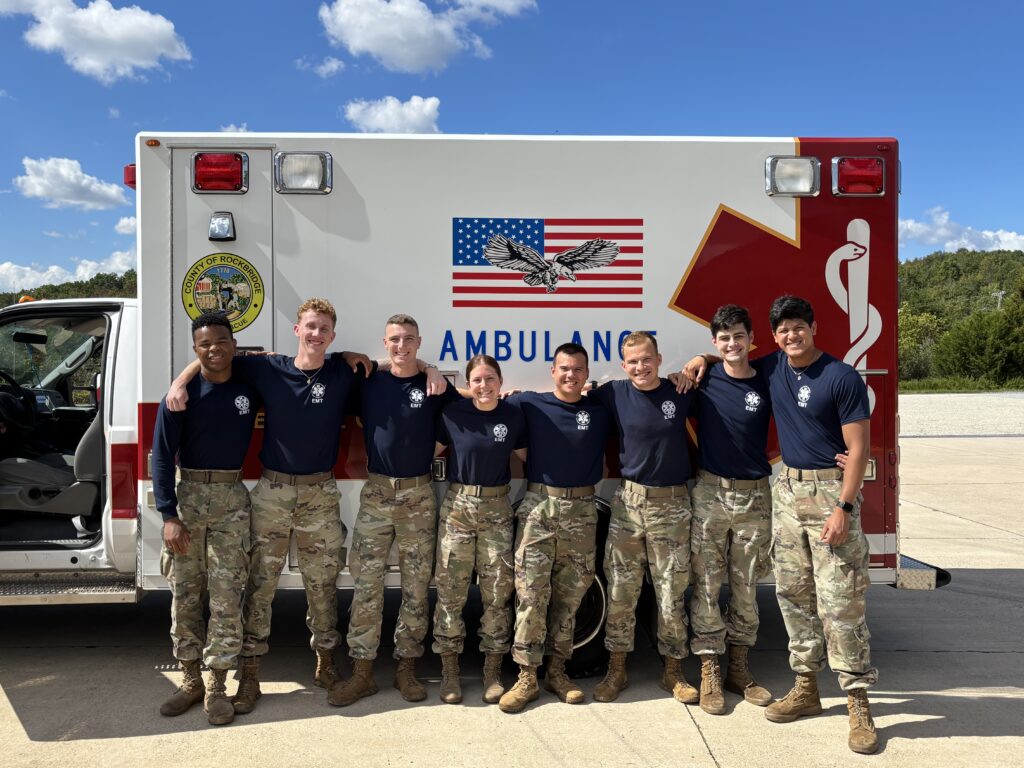
Cadet EMTs at Virginia Military Institute in front of an ambulance.

Since receiving his certification last summer, Johns has been working as an EMT at VMI. During that time, another EMT got him interested in running calls with the fire department in Lexington. Around five cadets toggle between VMI EMT work and the Lexington Fire Department on a regular basis.  

“I’m running calls almost every or every other weekend — either on the ambulance or fire,” he said.  

Donnie McBrayer, VMI EMS advisor, said although Johns is a newer EMT, he’s gained a lot of experience in that short time. He said he’s committed to learning. 

“Johns has shown a willingness to learn and assist in teaching other new cadet EMTs as related to patient interaction,” McBrayer said. “Like with any new EMT, initially Johns was not confident in his skills. Over the past year, he has become more confident with handling medical emergencies. He has a very good future in fire and EMS.”

Johns is currently working on his Firefighter 1 certification, which requires two nights a week with the department and some skill days. That will allow him to be an entry-level firefighter where he can go into the interiors of buildings during calls.  

“I found as an EMT, I still was getting the experience, still giving back, but I just want to take it one step further,” he commented. “I might be working on the ambulance, but I want to jump and help with the other aspects too.” 

By taking leadership roles and working as an EMT and with the fire department, Johns said he’s gained knowledge on how to take an active approach to leadership.  

“I’m able to know what needs to be done, and help coordinate other people I’m working with, like junior members, and help teach and get the job done at the same time,” he said. 

He’s found the most challenging part to be the balance of it all.  

“You really have to prioritize your time, always keeping a planner and notes in your phone for when I have a meeting, when I have training, when I have to go anywhere,” he stated. “Sometimes it gets a little rough and overlapping, but keeping on top of a schedule is probably the best way I found to manage that balance.” 

Webb noted Johns’ involvement outside the classroom showcases his ability to balance EMT responsibilities with academic work.  

“What stood out to me most was his maturity and sense of responsibility, approaching both his academic coursework and his service commitments with a high degree of professionalism,” she stated. 
VMI Alums Return for Medical Rotation

Two Virginia Military Institute alumni, Allen Xu ’21 and Thaddeus Wegrzyn ’22, returned to the Institute in late March for two weeks as part of their medical education with a family medicine rotation at the VMI Infirmary.

Xu and Wegrzyn, who are fourth-year medical students at the Edward Via College of Osteopathic Medicine (VCOM) in Blacksburg, chose to serve one of their medical rotations alongside Institute physician, Dr. Melissa S. Krawiec ’01 and family nurse practitioner, Jenny Crance, DNP, FNP-C.

Medical rotations, also known as clinicals, are required hands-on patient care experiences for medical students, and consist of two years of back-to-back four-week durations of training under the supervision of a medical professional in various specialties at many medical facilities. Xu and Wegrzyn have completed about 20 clinicals, with VMI being the last for Xu. Wegrzyn has an additional obligation of two weeks of physical medicine and rehabilitation to complete for Carilion Clinic in Radford.

According to Krawiec, this is the first time alumni have returned to VMI for their clinicals.

“We were delighted to have Allen and Thad with us for two weeks. They were able to closely relate to the cadets and understand the pressures they are under, because they have been cadets themselves. They have come full circle. I trust it was a rewarding experience for them, and I hope they learned some valuable clinical ‘pearls’ in our unique environment. We saw some interesting cases over their time with us,” she said.

Though they arrived to VMI with no set of expectations on what medical conditions they would see during their visit, Xu and Wegrzyn treated a variety of family practice conditions for the cadets including colds, allergies, rashes, burns, dental pain, soft tissue wounds, and orthopedic injuries. They assessed patients and discussed treatment plans with Krawiec and Crance. They also met with cadets who are considering going to medical school. Wegrzyn stated that cadet outreach is important to them. “There is no formal pre-med program at VMI, but there are many cadets who are interested in going into health care. We had many conversations with them and advised them on their options of making that dream a reality.”Xu, a biology major from Ringoes, New Jersey, began his love for healing as a high school student when he became an emergency medical technician (EMT), a skill he continued at VMI. As EMT chief, he would often deliver cadet patients to the infirmary, but was never able to observe their treatment there.

“It’s gratifying to see what happens on this side of the infirmary door,” he observed.

Xu’s chosen medical field of study is psychiatry. Initially entering medical school, he wanted to go into emergency medicine, but changed his mind after witnessing family members facing emotional trials. He noted that returning to VMI at this stage of his training has given him a different perspective on the environment that helped shape him.

“VMI and the military are built on a culture that values discipline, resilience, and composure under pressure. Those are qualities I continue to respect and carry with me. At the same time, my training has reinforced that the reality of life and leadership includes navigating stress, loss, and uncertainty. What I have come to appreciate is that supporting behavioral health does not take away from those core values. If anything, it strengthens them. The ability to reflect, seek support when needed, and maintain personal well-being allows individuals to sustain performance and lead more effectively over time.

Returning in this role has been especially meaningful, and I hope conversations like these continue to evolve in a way that supports both excellence and well-being.” He eventually wants to work with veterans with post-traumatic stress disorder and trauma.

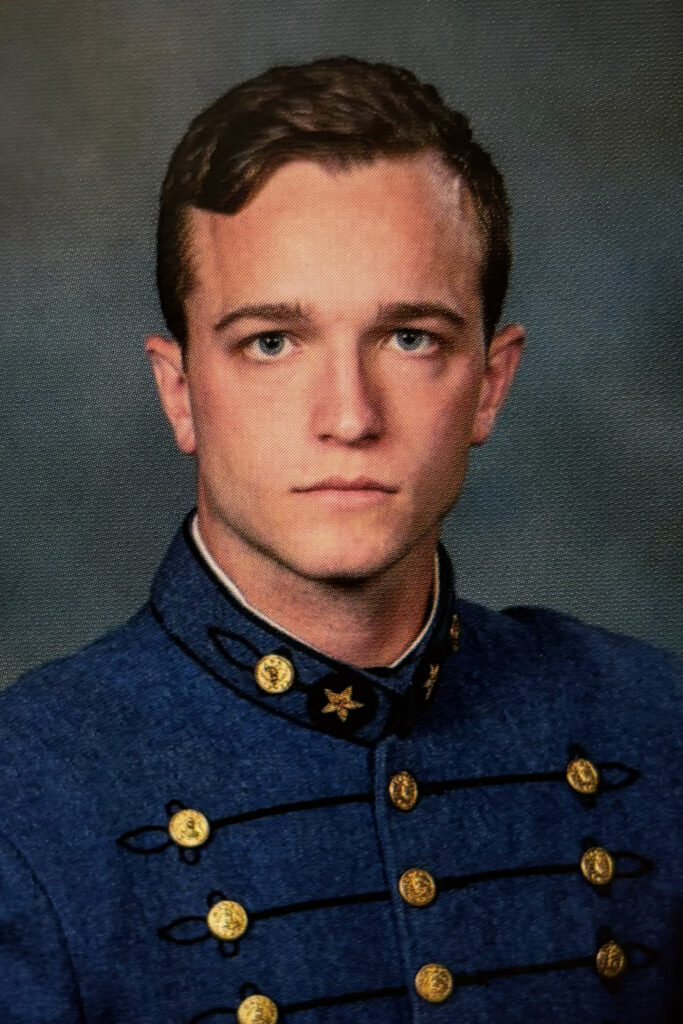
Allen Xu cadet portrait
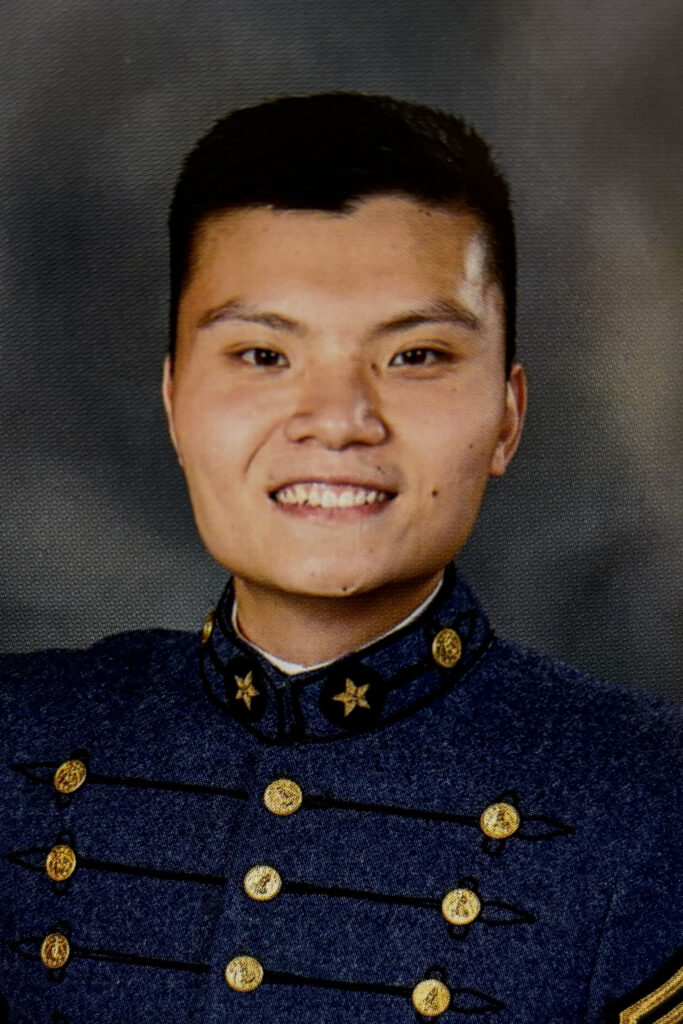
Thaddeus Wegrzyn portrait

Wegrzyn, a biology major with an exercise science minor from Lincoln, Nebraska, served as a cadre member as a cadet. He originally wanted to go into combat in the military. He changed his mind though when he started to enjoy his academic studies at VMI.

“It all started to click with me. My advisor was great, and my interest in going into medicine bloomed. I chose primary care medicine as a specialty, so I’d be in a position to teach patients a better understanding of taking care of their bodies. I feel a strong obligation to educate and mentor patients, so they take control of their health and prevent illnesses and accidents.”

The two originally met in a public speaking class when Wegrzyn was a rat. Since both were biology majors, they shared several more classes, and served on the Honor Court together.

Xu confessed VMI prepared them well for medical school.

“The resiliency we learned at VMI has paid dividends. Cadets are taught how to find out what needs done and to create a plan. They learn good time management skills. And believe it or not, we get more sleep at VCOM than we ever got at VMI,” he laughed.  

Wegrzyn agreed and shared that VMI graduates are highly thought of at VCOM.

“VCOM’s mission is to prepare globally-minded, community-focused physicians, which is similar to that of VMI’s mission of producing citizen-soldiers with a high sense of public service. In fact, there are currently five VMI alumni who are in their first year at VCOM. There is a strong pipeline from VMI to VCOM.”

He added there is a chapter of the Student Association of Military Osteopathic Physicians & Surgeons at VCOM in which he served as president and Xu served as vice president last year. This year, the reins of the two leadership positions are held by two other VMI graduates.

Following graduation from medical school in May, Xu and Wegrzyn will begin their residencies. Xu will serve his for four years in psychiatry at Camp Lejuene, North Carolina, and Wegrzyn, who has commissioned into the Army, will serve his for three years in family medicine at Fort Bragg, North Carolina.

The Vanguard — Bianca Marlang ’27

The Vanguard series highlights cadets of Virginia Military Institute who exemplify promise, perseverance, and the true spirit of leadership. While they may not be the top-ranking students or those in prestigious positions, these individuals’ dedication, resilience, and growth embody the essence of being a VMI cadet. By sharing their stories, including the challenges they’ve faced and overcome, we shine a spotlight on the diverse paths to success at the Institute, proving that leadership and excellence come in many forms.  

From staying on friends’ couches to graduating early from Virginia Military Institute, Bianca Marlang’s ’27 path has never been a straight line. She faced adversity within her family, but persevered. 

“Coming from a Filipino background, as a firstborn daughter, too, I felt trapped and not listened to. I had to make a way for myself,” she explained. “It’s a lot of pressure but in that, I pulled myself up.” 

Graduating high school during COVID-19, she wasn’t on good terms with her parents. She spent much of that time bouncing back and forth to friends’ houses and exploring college options.  

“I was practically homeless … I was living with whoever would take me in, friends at the time,” she admitted. “I didn’t have contact with my family for about two or three years.” 

She got to VMI thanks to her uncle’s help. But she hit a wall with financial aid. Sitting outside the alumni building on the benches with her uncle, she thought there would be no way she could attend the Institute. She said with a lot of annoyance from her side, she attained enough information and assistance to figure it out.  

“I wanted to come here because of the honor system and the most important point: I like the fact that the Rat Line evens everybody out. I can come from the background that I came from, and I meet people with completely opposite backgrounds,” she stated. “It’s really interesting that we’re all going through the same thing, and we’re all leveled out by this one adversity.” 

Col. Sara Whipple, professor in the Department of Psychology, said she met Marlang as a prospective cadet and remembers being impressed by her even then.  

“I have now had the opportunity to get to know her across multiple contexts — in class, as an advisee, and as an ambassador to the VMI Civil Discourse Initiative. Bianca takes her academic work seriously and devotes herself to a number of extracurriculars. At the same time though, she is humble and has a great sense of humor,” Whipple explained. 

Coming to VMI as a 21-year-old was intimidating. She didn’t want to be known as the old cadet. Her other college experiences prior to attending the Institute included going to Old Dominion University and community college. That ended up in her favor, having several prerequisites already completed.  

“It’s been ingrained in me that education is the one thing that people can’t take away from you, even at the grave. That comes with you,” she stated. 

Those extra credits also have allowed her to graduate in the spring, a year ahead of schedule. From there she plans on attending Austin Peay University in Tennessee to complete her prerequisites for a Doctor of Physical Therapy (DTP) program. She hopes she can commission into the armed forces through that program.

“Bianca is the kind of student every professor hopes to see on the roster the first day of class — cheerful, curious, and unafraid to ask tough questions,” Col. Glenn Sullivan, professor in the Department of Psychology, said. 

The psychology major has already taken steps towards her medical career by being a cadet emergency medical technician (EMT). She was inspired by her mother, who is a nurse, and her uncle, who is a doctor.  

“I think seeing the Rat Line from behind the scenes and seeing everything from a third point of view is interesting,” she said. “As cadre, you’re too in it, because people are yelling at you; you’re yelling at people. And as a rat, it’s the same thing. But as an EMT, I kind of took a step back.” 

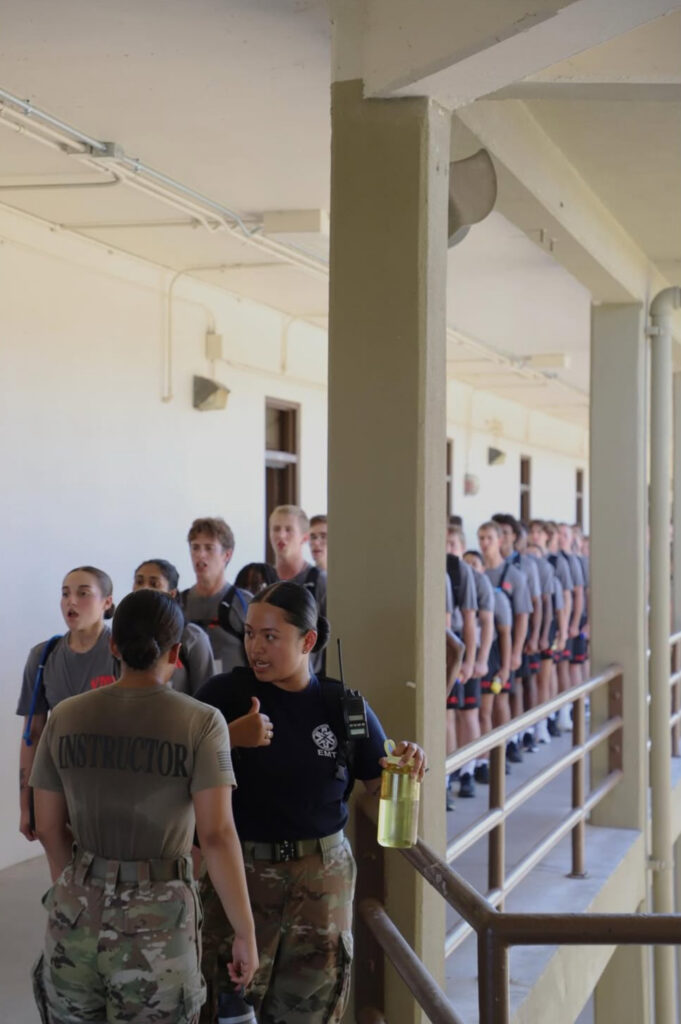
Bianca Marlang works as a cadet EMT during a Corps exercise in barracks at Virginia Military Institute.

Marlang also serves as an ambassador for Braver Angels and the VMI Civil Discourse Initiative (CDI), which holds debates teaching civil discourse. 

“We try to get people to engage in these debates. I feel like people don’t want to talk or even listen, which is what we need right now,” she explained.

As a rat, Marlang said that she began as more closed off, but her time at VMI has broadened that. 

“I think I’ve become more open minded because I’ve heard other people’s points of view. It’s made me stronger in my beliefs, but at the same time, it’s made me more tolerable and respectful of other people’s point of view,” she said. 

Whipple could see that right away. She was particularly impressed with Marlang as a rat when she spoke at one of the CDI debates.  

“Her speech was not prepared in advance but rather came out of her own interest in, and reaction to, others’ thoughts,” Whipple said. “Bianca is willing to speak her mind, but she also makes a concerted effort to listen and understand others. As such, she has been an incredible leader within the VMI CDI.” 

Marlang feels the VMI system has prepared her for the future. She has noticed the changes that the Institute has instilled in her.  

“It makes you fail on purpose,” she commented. “I realized that a lot of me has changed when I went home. Normally, whenever I would get criticized or yelled at, I’d have a visceral reaction. But I kind of got used to it. I think the recovery part from failures is what VMI has helped me with a lot.” 

Describing her as highly inquisitive, not only academically, but on a personal level, Whipple said that Marlang is genuinely interested in others and knowing their stories.  

“Whenever she drops by my office, it’s a welcome visit because I know that in one sitting, we can go from academic discussions to the completely inane,” Whipple continued. “She has had personal challenges during her time at VMI, but manages to keep her goals central during these times. I think that type of focus and commitment are major contributors to her perseverance. Last year she made up her mind that she wanted to graduate a year early, and she is doing it.” 

VMI Cadet Rescues Citadel Administrator: Renders Aid to Rival Fan

When it comes to school rivalries, the one between Virginia Military Institute and The Citadel is among the most historic and intense. The Military Classic of the South, the annual football game between the two senior military colleges, is their biggest competition, with the winner taking home the coveted Silver Shako trophy. This academic year, the game was held in early November in Charleston, and it was there that Dusand Barrow ’28, a VMI emergency medical technician (EMT), set aside his team partiality to aid a Citadel fan in distress.

For all away NCAA events, VMI Emergency Medical Services (EMS) sends a small contingent of cadet EMTs to provide emergency response services for cadet spectators in need. Originally, Barrow was not intending to attend the football game at The Citadel, but it was the birthday of the cadet who had been assigned to go who wanted to spend the weekend with his family. So, Barrow volunteered to fill in, and, along with three other VMI EMTs and EMS advisor, Donnie McBrayer, found himself on the bus to Charleston on game day.

Upon arriving to Johnson Hagood Stadium at The Citadel, Barrow prepared to march in with the other corporals, but was alerted that McBrayer needed his help with a patient. He sprinted to McBrayer who was aiding an older gentleman who had fallen and was bleeding.

“We treated him, cleaned him up, and sent him to the hospital in an ambulance. After that, I went under the stand area to buy a snack. A group of people high up in the stands saw me, ran down the stairs, and asked if I was an EMT. One of their friends had passed out and needed care. I climbed the stairs with them to their friend, who was fully unconscious. I treated her for about five minutes until the EMTs The Citadel had hired for the game arrived. By that time, the patient was awake but still a bit groggy. I grabbed their equipment and monitored her vital signs. The other EMTs talked to her, and got more information. She had a history of high blood pressure and became overheated in the South Carolina sun. She declined to go to the hospital, so I gave her some water and told her, ‘If anything else happens, please feel free to grab me or somebody who’s in a blue shirt like me, or call one of the other EMTs.’”

It was then the patient and her friends realized that Barrow was a VMI cadet, and were impressed he had come to the home team side of the stadium willingly and without any reservation to render aid.

“I told them this is my job, it is how I was trained, and what’s expected of me. They told me if I ever think of switching from VMI to The Citadel, they can help. I told them, ‘No, no, I’m very happy at VMI,’” laughed Barrow.

The group asked Barrow for his name so they could send a recommendation to VMI’s commandant of cadets, Col. Ley Havird ’90. Though Barrow did not expect to receive anything for what he considered a normal service call, a couple days later he received an email from the group of Citadel friends.

“It turns out they are all faculty members at The Citadel. So that entire group sent an email to our advisor, and to our commandant, who awarded me an optional — an authorized excuse from supper roll call. Then I got another email saying our superintendent wanted to meet with me in his office.”

It was there that Lt. Gen. David Furness ’87 presented Barrow with two challenge coins: One from himself and one from the president of The Citadel. Furness also presented Barrow with a letter of commendation.

According to McBrayer, VMI EMS is a Virginia department of EMS non-transport agency that runs 911 emergency services on VMI property.

“It provides coverage for any cadet-related function that needs EMS support, such as rat activities, parades, NCAA events, and ROTC exercises. VMI has 58 EMTs. Barrow is very competent when working with medical patients. He is constantly striving to learn more when it comes to training as an EMT.”

Barrow is originally from the South American country of Guyana, but now calls Norfolk, Virginia, home. He is majoring in biology and is the cadet in charge of VMI’s firefighting club. He volunteers as a fire fighter for the Lexington Fire Department. Being a first responder is extremely important to Barrow, and because of the EMT and firefighting training and practical opportunities offered at VMI, it is one of the reasons he chose to become a cadet. He is also involved with the climbing team, VMI Theatre, Officers’ Christian Fellowship, and works at the Corps Physical Training Facility. Following graduation, he plans to enlist in the Army Reserves and become a professional EMT or fire fighter.

Cadet EMTs Train for Mass Casualty Incident

Virginia Military Institute cadets preparing to be post emergency medical technicians (EMTs) underwent mass casualty incident (MCI) training recently. Donnie McBrayer, assistant EMT advisor at VMI, was assisted by instructors from Mountain Gateway Community College and volunteers from Lexington Fire Department to create a real-life simulation of a gas line explosion in which the cadets had to quickly assess the victims—both human and mannequin—to determine the seriousness of their injuries, transfer them to a staging area, then reassess them to decide if they should be transported to the hospital.

McBrayer stated that when the rats arrive in August, mini MCIs may occur. “The reason why we train the cadet EMTs this way is that when 400 rats go out on hikes on hot August days, 15 may become light-headed, faint, or sustain an injury. The EMTs who accompany them will have to assess the condition of each rat is in distress, and determine their next course of treatment,” he said.

Cadets completing the MCI training will receive certification from the state.