Post View Unavailable »
New Website Launched »

Behind the Balance: Evelyn Anderson ’27 — Keydet Track and Field

Virginia Military Institute’s cadet-athletes have to juggle cadet life, heavy academic course loads, and their NCAA Division I sport. Committed to both academic and athletic pursuits, balancing their rigorous schedule in both sports and school requires a certain level of commitment and discipline. Behind the Balance is a series that focuses on those cadet-athletes and how they handle the hurdles of the day-to-day. 

Evelyn Anderson ’27 thrives on structure. The international studies major has 17.5 credits this semester, while holding rank as regimental sergeant major for the Corps, and balancing a Division I sport. With a hefty academic load, she’s fitting schoolwork in whenever she can. Her regimental duties can range from cadet leadership meetings to Honor Court trials, which also take up a chunk of her time and effort. She is also planning on commissioning into the U.S. Marines Corps, so she has ROTC responsibilities. 

Originally, she wanted to relieve her parents of the burden of paying for college. Even though Anderson had never heard of Virginia Military Institute, she was recruited for track and field, resulting in a full ride. 

“I have three younger siblings, so I figured I’d take the load off a little bit, and I did a visit here, and I really enjoyed it,” she said. “I needed the structure, so that’s really what led my decision.” 

Anderson started out as a soccer player when she was younger, then joined cross country and track to stay active leading up to soccer season.  

“With track, you see the time, and it’s a reflection of you every single time,” she said. “There’s no denying that if you didn’t do well, it’s because of your own actions leading up to the meet. I think it has more accountability of whether or not you’re actually putting in the effort. I like seeing my gains and/or losses based off the effort that I put in.” 

Cadet-athletes at VMI not only have their responsibilities with their selected sport but cadet duties on top of that. Cadets are also required to take physical fitness classes twice a week, participate in ROTC all four years, prepare for room and uniform inspections, practice for parade, guard duty, and more. 
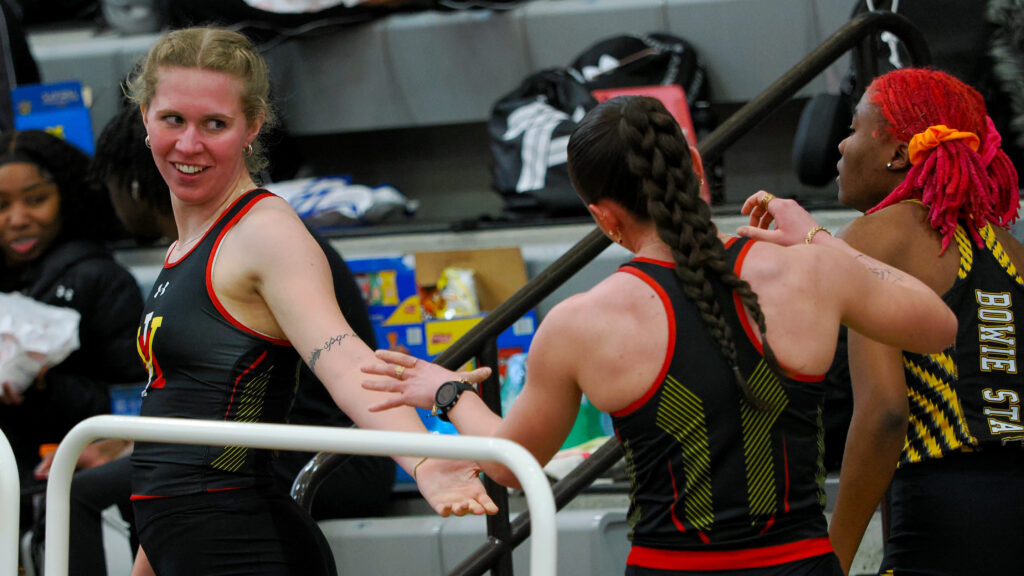
Evelyn Anderson, part of the VMI Team Challenge track and field meet at the Corps Physical Training Facility in Lexington, VA January 11, 2025.

She’ll go straight from class to practice some days, which results in some late nights finishing schoolwork.  

“I’m big on the Google calendar schedule. I have everything that I’m ever doing in Google calendar, so I try to plan it out ahead of time,” she explains.  

Even when it becomes overwhelming, Anderson reminds herself that there’s been so many before her that have been able to tackle the tasks that VMI puts forth.  

“This isn’t new. It’s just overwhelming for me because I haven’t been in that situation,” she admitted. “If other people can do it, you can as well. If you’re uncomfortable, everyone else is also uncomfortable. I’m not the only person with responsibilities. Everyone at VMI is pretty much invested in some aspects of the school. I just try to tell myself not to be dramatic.”Sometimes, you just have to call it a day. 

“My biggest life hack is knowing when to give up. And that sounds so bad, but I think that there comes a time where you realize going to bed is worth more and will do more for your mental health than trying to push out an assignment or complete last-minute things,” she explained. “You can’t operate on fumes.” 

The challenges are worth it, she said. Anderson credits VMI with improving her interpersonal skills. In high school, she moved and then went through COVID-19 where she wasn’t around people, and her life revolved around school, track, and being at home. 

“Coming to VMI, I feel uncomfortable kind of all the time, but it’s in a good way. I’m growing skills, learning how to interact with different people from different backgrounds,” she explained. “I come from a more rural area that has one high school. It’s a lot different for me, dealing with all different people, especially in stressful ways. I have to orchestrate and hit deadlines. I think that that’s really helping prepare me for the professional world.” 
The Vanguard — Ryan Halverson ’26

The Vanguard series highlights cadets of Virginia Military Institute who exemplify promise, perseverance, and the true spirit of leadership. While they may not be the top-ranking students or those in prestigious positions, these individuals’ dedication, resilience, and growth embody the essence of being a VMI cadet. By sharing their stories, including the challenges they’ve faced and overcome, we shine a spotlight on the diverse paths to success at the Institute, proving that leadership and excellence come in many forms. 

Lessons learned outside the classroom at Virginia Military Institute are what push Ryan Halverson ’26 to do better. He’s never been one to really enjoy school, but once he was able to apply what’s he’s learning in class to the outside world, his drive grew.  

“I’ve learned a lot more lessons in VMI classrooms just about myself,” he said.

One class he took on civic discourse presented him with a project on how to portray an argument and how to move an audience. He said that being at VMI, he knows it serves the greater good. 

“I think that’s really important for not only business, but in the military as well. Understanding that from that perspective, and not just a school perspective, is important,” he explained. 

Halverson, an English major, originally came to VMI as a civil engineering major. 

“I instantly knew it was a mistake.” 

Lt. Col. Pennie Ticen, associate professor in the Department of English, Rhetoric, and Humanistic Studies described Halverson as a conscientious student, ever since the beginning of his cadetship. She had him as a rat. 

“He came to class having done any assigned reading and/or writing, regularly contributed to class discussion — partly by listening carefully to his peers’ comments and then adding a synthesizing comment or a question designed to further discussion,” she explained. Halverson had approached her when he wanted to switch majors. “Demonstrating the care he brings to all his decision-making, he asked me for materials about the major, made an appointment to meet with me so he could ask questions, and then decided to submit his request to change departments.”

He switched to English because he saw it could really lend itself to what he wants to pursue after college, which is commissioning into the Marine Corps.  

“It was best for me in terms of communication and in leadership,” he said.  

Ticen, who is also Halverson’s advisor, said he is always the first cadet to get in touch with any questions or concerns about scheduling. 

“[He’s] making sure he is making steady progress on his degree, taking his major courses in the order in which we suggest so that he can build up his skills in our challenging humanities curriculum covering — art history and visual culture, literature, philosophy, and rhetoric & writing, etcetera,” she said. “In his cadetship, Halverson has consistently demonstrated his desire to get the most out of his VMI experience.” 

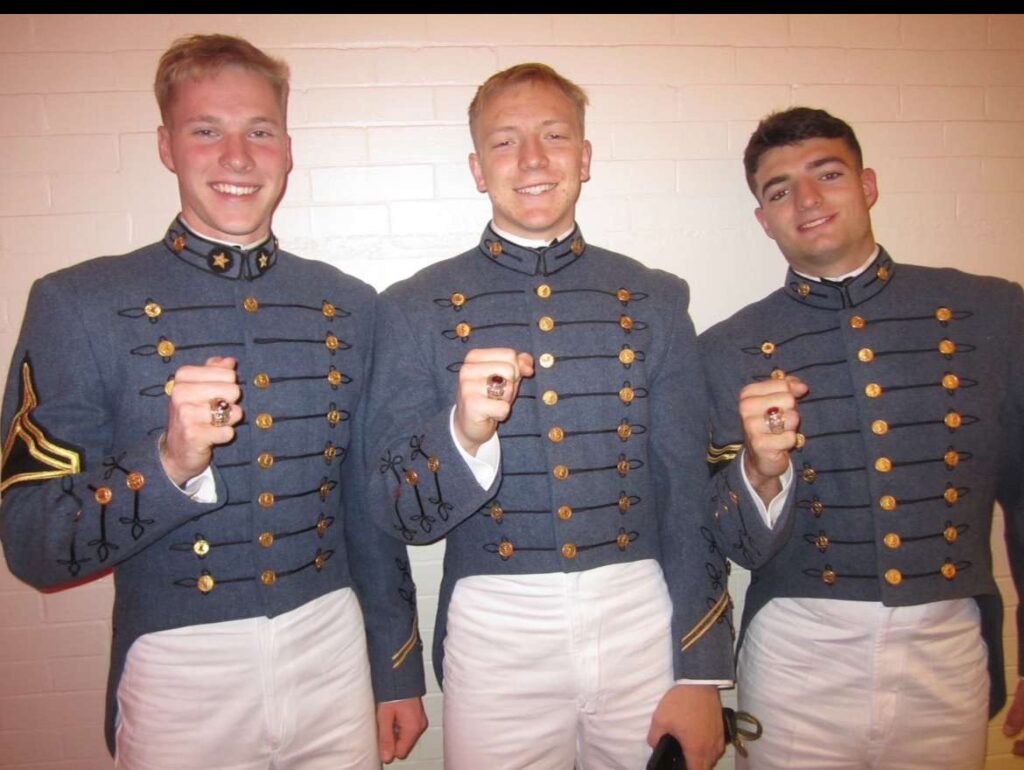
Ryan Halverson showing off his Virginia Military Institute ring with his brother rats.

By serving on the Rat Disciplinary Committee (RDC) and on cadre this year, he will move into the role of RDC president next year.  

“I would just say I’m someone who likes to push those around me. I like to make people better and really show people what they can do,” he commented. “One of my favorite quotes is, as a leader, you don’t show people your superpowers, you show them theirs. I think that’s what I try to do at VMI.” 

It’s a shift for him, he said. When he was in high school, he always wanted to help others but didn’t apply himself much to leadership positions. His time at VMI has helped that. He said the sense of camaraderie and the push to make everyone better was a turning point.  

Although the daily grind at VMI can be challenging, Halverson said his roommates and friends help him keep going.  

“There’s not one challenge here that you can’t overcome, but it’s being able to do that every single day is what’s hard,” he said. 

Col. Michelle Iten, associate professor in the Department of English, Rhetoric, and Humanistic Studies and the one who taught his civic discourse class, said Halverson is an insightful thinker who is strong at critical thinking. She said he also has a strong work ethic and puts in the time needed without cutting corners. 

“From the work he did for my class and our conversations, it’s clear to me that Halverson sees college as a place to expand his knowledge — he wants to learn deeply,” she stated. “He puts in all the careful thought and hard work needed to truly learn. This sets him apart from many cadets who are in class because they have to be and are in college just to get a degree. 

“He also stands out for his critical thinking skills,” she continued. “Ryan often impressed me with his comments in class — he’s insightful beyond his years in seeing cause and effect and in understanding what motivates people.” 

Halverson said being honest with yourself on what you need to improve on is important, especially when you are a rat. 

“It shows you where you’re lacking so that when it’s over, you can develop yourself through the next three years. Know your weaknesses, and I strive every day to become better in those areas,” he said. “You get put in so many stressful and uncomfortable situations that you get through. Doing that over and over just builds confidence.” 

The Cadet Collective: Benjamin Fong ’27

Virginia Military Institute requires structure and dedication. It also becomes a place where bonds are created that can last a lifetime. Maybe it’s a professor, a coach, or a fellow cadet. No one makes it through VMI alone. The Cadet Collective tells the stories of those relationships that help pave the way for success.  

Everything started to fall into place the week before Matriculation, Benjamin Fong ’27 said. He had traveled across the country from California and was staying with his uncle in Maryland, unsure of how he’d get down to Virginia Military Institute.  

His cross-country trip wasn’t straight from the West Coast to the East Coast. As part of his ROTC scholarship, he had to do a New Student Indoctrination (NSI) for the Naval ROTC, which was held in Chicago. He knew that he would be at VMI come August, but due to his financial restraints, he couldn’t make the move from California to Virginia.  

The Navy flew him from California to Chicago. Step one was down. He just needed to figure out how to get closer to Virginia after NSI.  

That brought him to Maryland with his uncle, who said he could drive him down to Lexington. But the VMI Parents Council had another solution.  

“The Parents Council had actually been considering finding me a way to get down here, which I didn’t know at that time,” he said. 

That’s where Robert and Dana Ruble came in. The Rubles were the 2023-24 co-presidents of the VMI Parents Council, which provides a link between parents, cadets, and staff at VMI. They offered to get him to Lexington and even went as far as to inform him their son, Sebastian Ruble ’24, was interested in being his dyke (1st Class mentor).  

“All this kindness seemed foreign to me,” he said. “The Rubles throughout the year have been very kind to me, have always been there to talk when the Rat Line got tough, connected me with alumni and school resources when needed, and regularly checked in and made sure that I was thriving. Many times, I came to them in a tricky situation, whether financially or with family issues and they gave their full support and guidance.” 

The Rubles assured Fong that there would be a family to help him walk through Matriculation Day. That’s how he met Kellett and Adrea Thomas.  

The Thomases became his host family. Before Matriculation he stayed at their home, had dinner, and prepared for what was next. During the Matriculation Fair, the Thomas’ showed Fong which church they attend and invited him to join them on Sundays. 

“On Matriculation Day, they introduced me to so many people who would later be revealed as important individuals. They answered all my questions and got me answers from those who knew them,” he said. 

A host family generally “adopts” a rat and takes care of them through the Rat Line. That includes offering care packages, putting them in touch with alumni or other resources, being a sounding board during hard times, and more.  

“I was shocked that such a family was willing to actively help out matriculants that they had never met,” he said. “As they hosted me for the night and acted as a surrogate family, I couldn’t help but feel indebted to them. Whenever I thanked them, they told me that they were glad to help and loved doing so, which I know they genuinely enjoyed.” 

The Thomases helped him acquire books. When they found out he didn’t have a pillow the first week, they got him one. They explained the process of what it was like to go through the Rat Line and what to expect, since they’d seen it firsthand with their own children who’ve attended.  

These relationships have proved to be an important factor in Fong’s time at VMI. 

“If you had no resources coming here, it’d be hard to justify staying, especially from out of state. You’re in a foreign place, a unique place. You’re facing all this adversity,” he said. “Having these recurrent relationships kind of makes it seem like it’s a reward in the sense that you go through these things, but at the same time, you’ve been taken care of. No matter how hard it is, there will always be somewhere, someone to take care of you. That kind of relationship, whether it’s a host family, your dyke’s family, or even the Parents Council is very important.” 

In addition to the Thomases, his dyke has been a major influence in his first year at VMI. 

“Sebastian Ruble is the best dyke anyone could ask for. He mentors, answers questions, and jokes around with me,” he said. “I always like to brag about him because, to me, he stands on a pedestal. I greatly appreciate him and how much he has done for me.” 

Finding VMI and all it offers was by chance. While looking at options for college, Fong sought out an ROTC scholarship. That meant selecting schools with ROTC options. He clicked Virginia Military Institute but had never heard of it.  

“I picked Virginia as a state because I knew that it had a little bit of military ties to it. Then I saw the word military and Virginia Military Institute. And I didn’t even really look into the school. I just checked it off,” he said. “So, when I applied to VMI, I found out more about it. And I decided this was a happy coincidence. I’m glad I stumbled upon the school.” 

It’s been a transformative year for Fong. Last year, he was struggling as to where he would end up after high school. He was living with friends, lacked the funds to do much, and was receiving a lot of denials. He knew he wanted to go into the military. The psychology major plans on commissioning into the U.S. Marine Corps after graduating.  

Now, he’s more regimented. He wants to be a leader, mentor others, and pay forward what he’s been given. He’s also become humbled by the generosity he’s received.  

“It’s made me appreciate reaching out. It was hard for me at first. For me, it’s very hard to receive help, because I have always been in the mindset of, I need to help myself. No one’s going to do it for me,” he said. “But here I am. People go out of their way to help me. I’ve been more comfortable with asking for help. I’ve learned to just appreciate their generosity, but also in the future when I’m able to give back or pass it forward, I will.” 

Midshipmen Moments: Addison Hagan ’24

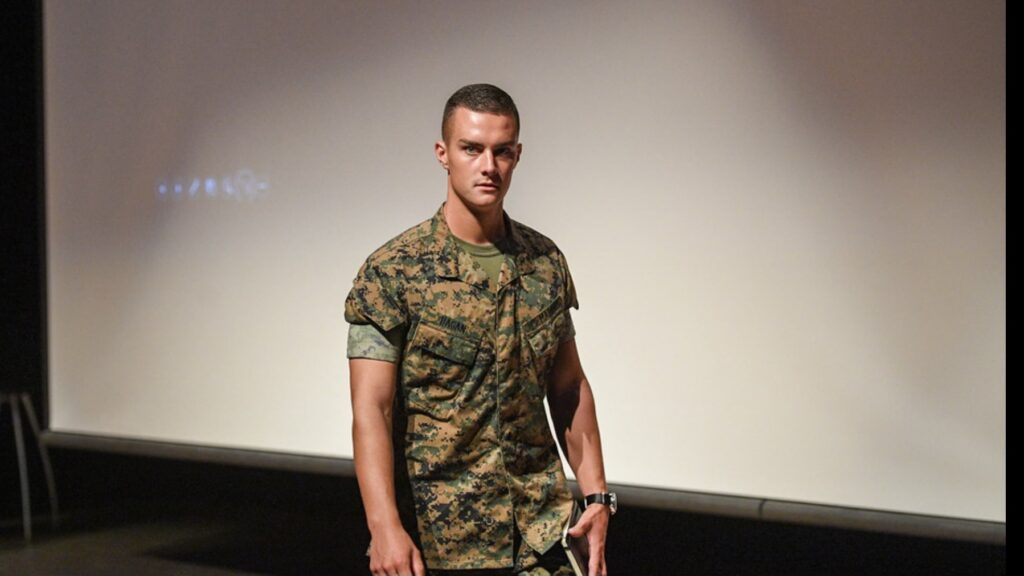
Joseph Addison Hagan V ’24 always admired the men in his family who attended Virginia Military Institute. It was a part of his family history he wanted to claim.  

“VMI is the hardest small military college and there is no better school to prepare me for service in the United States Marine Corps,” he said.

The civil engineering major applied for a four-year Marine Option Naval ROTC scholarship when he was a senior in high school. Those selected applicants for the NROTC scholarship program are awarded scholarships through a highly competitive national selection process. If awarded, they receive full tuition, a book stipend, educational fees, and other financial benefits. Once they graduate, the midshipmen are commissioned as officers in the U.S. Navy or U.S. Marine Corps. 

Hagan was lucky enough to be awarded the scholarship, which allowed him to contract to be a Marine Corps officer upon his graduation from VMI.  

The Naval ROTC program provides two programs in which cadets can enroll in — U.S. Navy or U.S. Marine Corps. 

The mission is to develop midshipmen mentally, morally, and physically, and to instill the highest ideals of duty, honor, and loyalty to commission them as Navy or Marine officers. The NROTC program fosters high-level responsibilities of command, citizenship, and government.  

Hagan has participated in a few summer assignments. His first was Marine Month West at Camp Pendleton, California, staying at Camp Talega. His next summer assignment was Marine Month East at Camp Lejeune in Jacksonville, North Carolina. Both assignments focused on training like land navigation, endurance courses, obstacle courses, hikes, physical fitness, academics, and small unit leadership. 

“Both of these experiences were filled with really great training and a lot of fun times,” he said. 

This past summer, he attended Officer Candidates School (OSC) at Marine Corps Base in Quantico. OSC is to educate and train officer candidates in Marine Corps knowledge and skills within a controlled and challenging environment. The school evaluates and screens individuals for the leadership, moral, mental, and physical qualities required for commissioning as a Marine Corps officer. 

Some trainings and activities included: combat conditioning, obstacle course, close order drill, academic classes and discussions, fire team assault course, leadership reaction course, stamina and endurance course, small unit leadership evaluation, and daily platoon staff evaluation.

Joseph Addison Hagan V, Class of 2024
Screenshot

“OCS was the toughest thing I’ve done so far, and it was an extremely rewarding experience,” he said. 

Currently, he is the midshipmen company commander for the Marine Company. This means, he ensures that every cadet who is a Marine option midshipman has what they need to prepare for their future as a second lieutenant in the U.S. Marine Corps.  

“I get to help decide what we do for our training, and I have the opportunity to work closely with the NROTC Staff,” he said. “I would say that I get to lead others and give back to an organization that prepared me well for OCS. I am now in a position where I can put the principles and information I have learned over the past three years to work training the next few classes of midshipmen.”