Post View Unavailable »
New Website Launched »

Bott Designs Retractable Boat Anchor

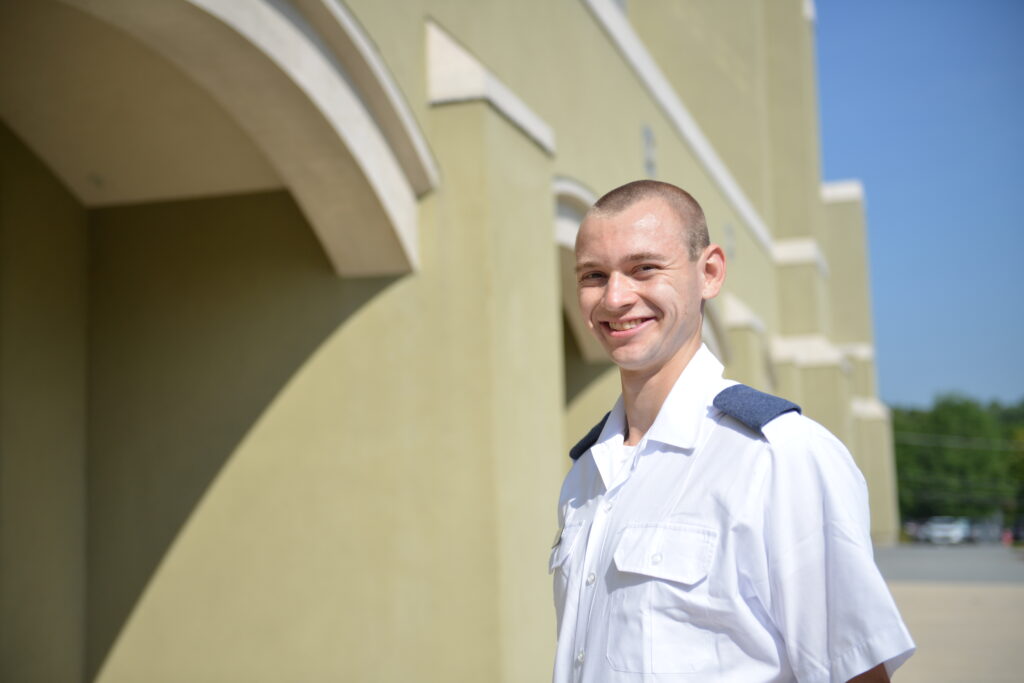
Connor Bott ’26, a mechanical engineering major at Virginia Military Institute, has designed a modern adaptation for an ancient devise with his honors senior thesis project, “Design and Analysis of an Electromechanical Marine Wreck Anchor.”

From the Eastern Shore town of Exmore, Virginia, Bott’s hobbies include fishing, boating, and scuba diving. Through these interests, he observed that small boat anchors, crucial for positioning the boat as well as for safety, often get stuck and have to be cut loose and abandoned, which inspired him to research better anchor designs.

He began his presentation with explaining how anchors work.

“There is a misconception that an anchor is just a big weight that you drop off the side of the boat and then the weight alone holds the boat in place. That’s not how they work. To properly operate them, you let out enough anchor line, then pull, allowing the anchor arms to burrow into the ground.” He added an important thing to consider when choosing an anchor, is the makeup of the seabed. “On the bottom could be sand, mud, rock, grass, clay, or a combination. If the boat is over a wreck, a reef, rocks, or trees, you might use a grappling hook style anchor, because instead of burrowing, it’s designed to hook onto something underwater.”

Bott explained challenges with grappling hook anchors.

“Anchor arms might hook under a rock, a log, or a hard piece of wreckage and get stuck. Unless you have someone who can put on scuba gear and dive down to wedge it free, you will have to cut your anchor line and leave the anchor. That is not a pleasing prospect, since some anchors can cost hundreds of dollars.”

To prevent loss of equipment and money, Bott wanted to construct an electromechanical anchor to drop over shipwrecks for divers who enjoy exploring wrecks like he does. He designed his anchor to be compact, have the look and feel like a regular grappling hook anchor, be intuitive to operate, use a physical and electrical tether, and realistically manufacturable. He envisioned a seatbelt-style release mechanism, so with a press of a button the anchor arms unfold, and the user can easily pull up the anchor.

After a lot of design and redesign work, much calculation regarding forces, friction, and water pressure, Bott’s design was ready to be tested. He engaged the expertise of engineering department lab technician Michael Cullen, and machinist Marco Floyd, who were instrumental in bringing the anchor to life.

“Building this thing was a fun process, because I would take my design down to our machinist, and he would look at it and say, ‘You’re crazy. We can’t make this on our equipment.’ So, we would sit down together, and he would come up with ideas on how we can break up this complex geometry to a bunch of little pieces, so that one piece became five different pieces that fit together like a little jigsaw puzzle.”

Bott concluded by sharing the next steps for his project are putting the electronics into the housing of the anchor, performing a leak test, and a final load test underwater. “I’m very happy with how far we’ve gotten, and I’m very excited to get this thing in the water and make sure it actually works like we hope.”

Col. Gerald “Jay” Sullivan, professor and head of the Department of Mechanical Engineering, served as Bott’s advisor on the project. Sullivan stated that given Bott’s hobbies—especially wreck diving—and all the mechanical maintenance that goes along with them, he wasn’t too surprised that he came up with this project.

“Connor is very good with his hands and highly analytical. He was able to bring together all these really great analytical skills that he has in mechanical engineering, with superior manufacturing skills, and intense creativity, to bring this project to fruition.”

Bott is the son of Charles Bott ’96. He is an alumnus of Norfolk Academy, and plans to pursue a graduate degree in marine or subsea engineering following graduation.
Gilman Scholarship Available for Studies Abroad

Col. Jeff Kendrick, director of the Office of Global Education at Virginia Military Institute, announced the U.S. Department of State’s Benjamin A. Gilman International Scholarship is currently accepting applications. The Gilman and Gilman-McCain Scholarships are merit-based awards for American undergraduate students with high financial need who want to study or intern abroad for academic credit.

Josiah Farrell ’28 and Anderson Robles Rodriguez ’28 both benefited from the scholarships when they participated in the Taiwan Huayu BEST Program to study Mandarin Chinese at the National Chengchi University in Taipei last summer.

Farrell, who is double majoring in international studies and modern languages and cultures, shared studying abroad was a lifelong dream come true. “The funding provided by Gilman kept my parents and myself from worrying about how my summer studies would be funded, and allowed me to focus on learning Mandarin. Additionally, with the funds I had left over, I was able to completely fund my follow-on service project to hold a Chinese Moon Festival last October.” 

Robles Rodriguez, a mechanical engineering major, said his summer studying Mandarin in Taiwan was one of the most meaningful experiences of his life. “Through daily immersion, I gained confidence using Mandarin in night markets, on public transportation, and while traveling independently throughout the country. Without the Gilman Scholarship, studying abroad in Taiwan would not have been an option for me, and its support allowed me to fully enjoy the experience without financial stress. I was incredibly happy during my time abroad, and it reinforced how powerful and life-changing studying in a foreign country can be.”

Gracie Harlow ’27, who is double majoring in history and English with a concentration in literature, has been awarded a Gilman Scholarship to study Spanish at Universidad de Alcalá in Madrid, Spain, this summer for four weeks.

“As a Pell Grant student, I already come from a low-income background, so I never believed that studying abroad at another university would be in the cards for me. But this scholarship is covering half of the program costs, which relieved a lot of financial stress. VMI has made this amazing opportunity possible for me, and I couldn’t be more thankful.”

Kendrick reported VMI has enjoyed a 100% success rate in applications submitted and funded over the last year, and credits it to the hard work cadets put into drafting, editing, and refining their applications.

“Having served on the national review panels for both awards, I can testify that the competition is stiff. These cadets must tell a compelling story and thoughtfully connect their study abroad plans to future career goals. Over 17,000 applications were submitted nationwide last year in the March cycle, and of those, roughly only one-fourth were funded. Last year’s October cycle had 7,700 applications and only 20% were selected. This speaks to the high quality of our outstanding cadets. Furthermore, our two cadet awardees from 2026 maxed out the award at $5,000 each, and were awarded an additional $3,000 for the study of a critical language. This is a significant contribution and makes studying abroad a reality for cadets who might not otherwise have the opportunity.”

Cadets interested in studying abroad should visit the Office of Global Education on post to learn the requirements of the Gilman and Gilman-McCain Scholarships or other available awards, or email GlobalEd@vmi.edu for more information and to start on their application.

Behind the Balance: Matthew Picard ’27 — Keydet Men’s Swim and Dive

Virginia Military Institute’s cadet-athletes have to juggle cadet life, heavy academic course loads, and their NCAA Division I sport. Committed to both academic and athletic pursuits, balancing their rigorous schedule in both sports and school requires a certain level of commitment and discipline. Behind the Balance is a series that focuses on those cadet-athletes and how they handle the hurdles of the day-to-day. 

Matthew Picard ’27 vowed he would never attend a military college. One of his teammates in high school ended up going to Virginia Military Institute and he was encouraged to investigate it.

“He went to high school with me, and we both swam on the high school team. I asked where he was going to college, because he was the captain and a good role model. And he said, VMI,” Picard explained. “I was like, what is that military school? He then said I should look into it. I’m like, no, I’m never going to go. There is no reason for me to go into the military.” 

A conversation with his father got some gears turning for him. That’s when he started researching VMI.  

Picard was intrigued to see that a new aquatic center was being built at VMI and there was also a new swim coach. After a conversation with Coach Scott Thacker, Picard was more on board. Then he discovered the engineering program at the Institute, and he was sold.  

“It came down to the decision, and my dad told me, ‘If you’re going to pick four years of your life to put everything into and just get it done, it’s now,” he said. 

The mechanical engineering major is enrolled in 19 credits this semester, as well as being part of the swim and dive team.  

Cadet-athletes at VMI not only have their responsibilities with their selected sport but cadet duties on top of that. Cadets are also required to take physical fitness classes twice a week, participate in ROTC all four years, prepare for room and uniform inspections, practice for parade, guard duty, and more. 

Managing his time has been the hardest thing to get down. 

“I benefit from practicing and then eating,” He explained. “I find that I can lock in and get work done after that.” 

His days start early — 6 a.m. four times a week for morning practice. He’s in class starting at 8 or 9 a.m. then practice again at 4 p.m. until after 7 p.m. After grabbing a bite to eat, then he dedicates the rest of the night to studying and schoolwork.  

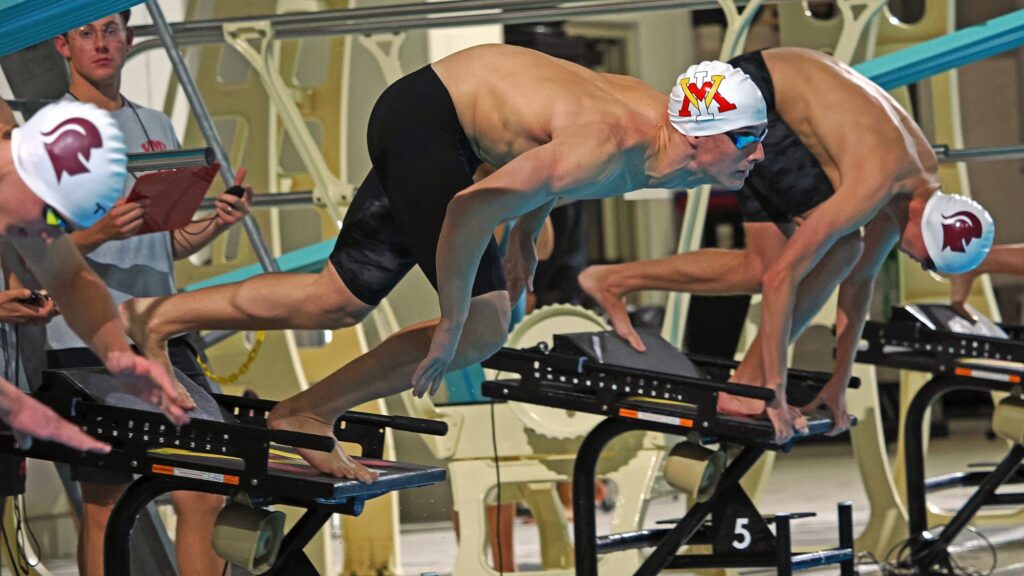
Swimming, although a demanding practice schedule, allows him to switch focus. He swims the 50-meter, 100-meter, and 200-meter relays, all freestyle.  

Matthew Picard diving into the pool during a Virginia Military Institute swim meet.

“I think it’s very power focused. I love moving quick, trying to get to the wall as fast as you can,” he stated. “I think it’s very competitive. I feel like with sprints, you’re a lot closer with other people, so it kind of pushes you to get that much faster.” 

He’s proven to be fast. Last year, he and others on the team broke several VMI records. He set a rat and team record in the 50-yard freestyle, a rat and team record in the 100-yard freestyle, a rat and team record in the 200-freestyle, as well as several other relay records. 

Picard has been interested in how things work since a young age. He likes taking things apart and putting them back together. 

“I used to take apart pens, radios, just all sorts of stuff. And my parents hated it, because I would just break things,” he joked. “I like to know why does that work the way it does. That’s the biggest thing: designing and then building, and then problem solving and going through the whole process to make things.” 

He feels like VMI prepared him to handle heavy course loads and his swim team responsibilities, as well as preparing him for whatever is next after he graduates.  

“I think I’ve definitely felt more qualified than some of my buddies that have come back from other places with the same major. I think it’s definitely taught some life skills, a lot of maturity. We grow up fast here.” 

Summer Transition Program Helps Matriculants Ease In

They say nothing can prepare you for the Rat Line, but there are ways to ease into the rigors of Virginia Military Institute. One option is for incoming rats to participate in the Summer Transition Program (STP). You’re able to get a class under your belt while familiarizing yourself with post. 

Held the summer before rats matriculate, STP gives the opportunities to get a head start on academics and physical fitness. The four-week voluntary program allows participants to earn credits for one academic class and become familiar with VMI — living in barracks, physical training, eating in Crozet Hall, and taking classes.  

Zachary Richardson ’28 wanted to knock out a biology class. He was drawn to VMI for its Army ROTC program, plus the size of the school was a huge deciding factor for him. 

“I was blown away by everything offered here, the small class sizes, the integrity, and the Honor Code was really admiring,” the history major said. 

Once he was accepted, he figured STP would be a good first step.  

“Those four weeks were good for me mentally, adjusting and getting ready for what was coming in August,” he said. “Meeting a lot of my brother rats in the summer was really cool, because on Matriculation Day, I recognized so many people. It was a big advantage and a big motivator. Like, I can make it through this, I’ve got already friends here.”

Cadet Zachary Richardson, Class of 2028
Zachary Richardson ’28

He said getting a class out of the way over the summer will help with his academic load this semester. Also being on post for those weeks allowed him to gain some overall knowledge about the Institute and free access to places before facing more restrictions as a rat. He knows where his classes are, he’s familiar with faculty and staff on post, plus he even met some cadre. He was also able to meet with the regimental band commander and join band company.  

“I basically joined band company and knew what company was going to be in before Matriculation Day,” he said. “That was a cool thing to learn and figure out.”

The physical aspect of STP was unmatchable of what he endured during Matriculation Week. But, participating in STP and getting used to working out daily helped introduce him to that routine. The intensity was elevated once he joined the Rat Line. It was a bit of a shock to Richardson.  

“I was here in STP walking around like I owned the place, and now I’m the lowest form, not even in existence. I’m a rat, right?” he said. “I think I was motivated to come here. I had prepared, so physically I didn’t feel too challenged by Matriculation Week. It was more the lack of sleep and just the big shift in lifestyle. It was a big shock to be woken up by a big loudspeaker and your cadre coming in and banging on the door … the stress level was something I was not used to. I was kind of just like taking it one meal at a time.”

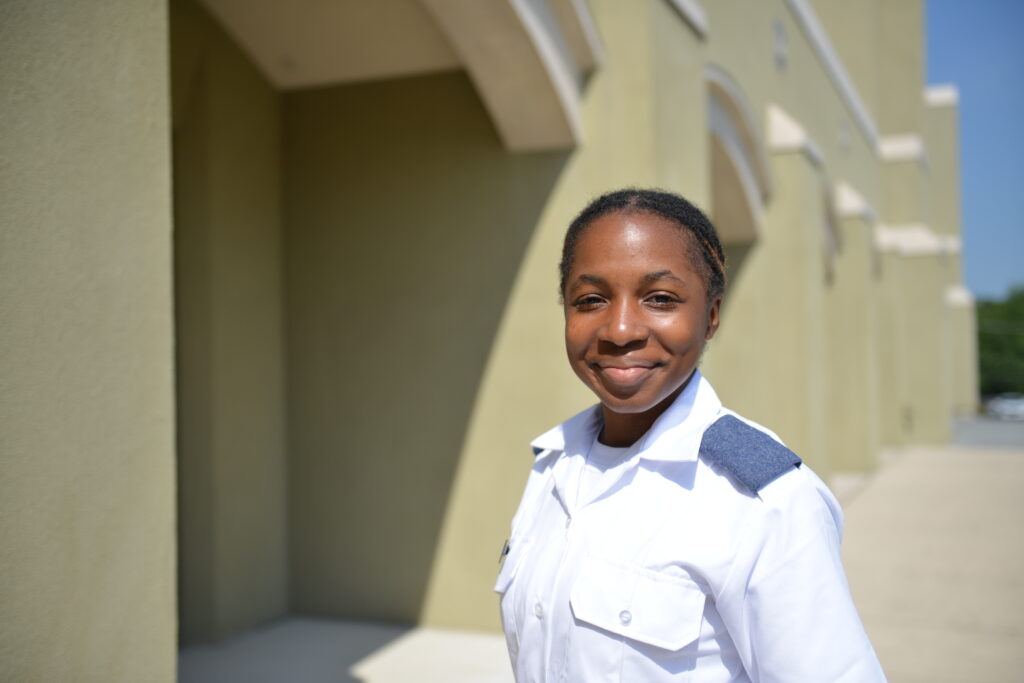
Cadet Denasia Owens, Class of 2028
Denasia Owens ’28

Denasia Owens ’28 took precalculus during STP. VMI appealed to her because it was a more structured learning environment that incorporated the military aspect. Owens, a mechanical engineering major, felt like STP helped with the physical aspect, especially walking around post up and down hills. But it didn’t prepare her mentally as much. STP was a little less formal, she said. 

“One part that is excluded is the yelling, having someone in your face,” she said.

Owens said that the staff from STP can now serve as a safe place for her since she’s familiar with them. 

“There are still some people that I can be like, ‘Hey, I know you,’ even though you’re an upperclassman, I can still come talk to you, because we already know each other outside of Matriculation Day,” she said. 

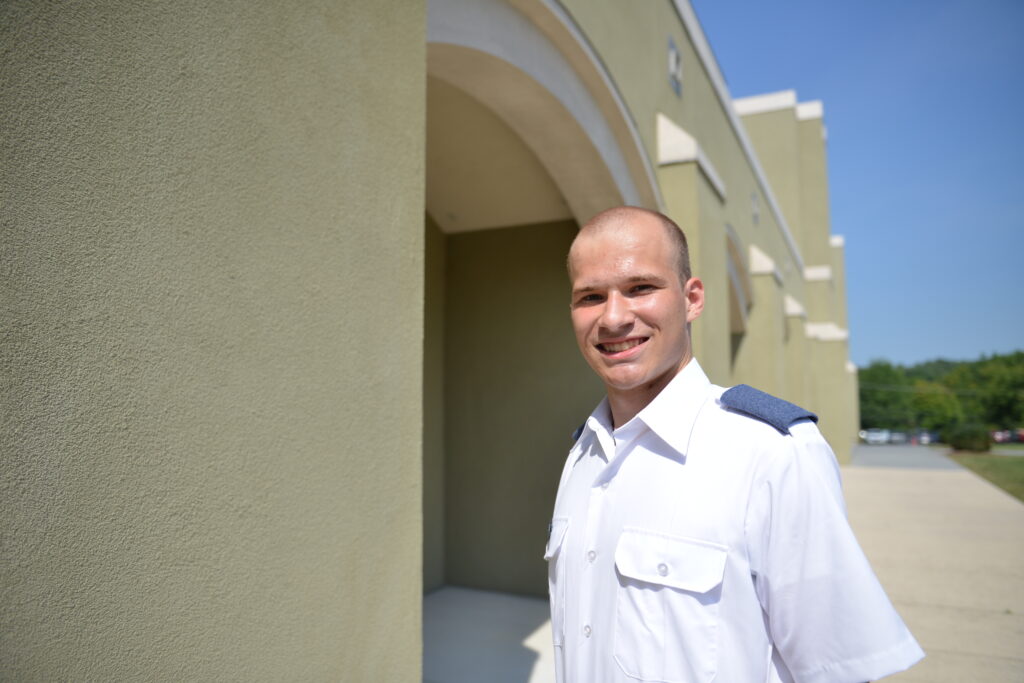
Cadet Owen Johns, Class of 2028
Owen Johns’ ’28

It was Owen Johns’ ’28 father’s idea to do STP. The international studies major said he wanted to get more conditioning over the summer and take a math class. 

“The course really helped, because it took one course off my schedule, so it gives me more time to focus on other classes that I have,” he said. “Along with that, the fitness, even though it was very relaxed, it still helped, like getting used to the VMI Fitness Test and all the other components that we have to do as rats.”

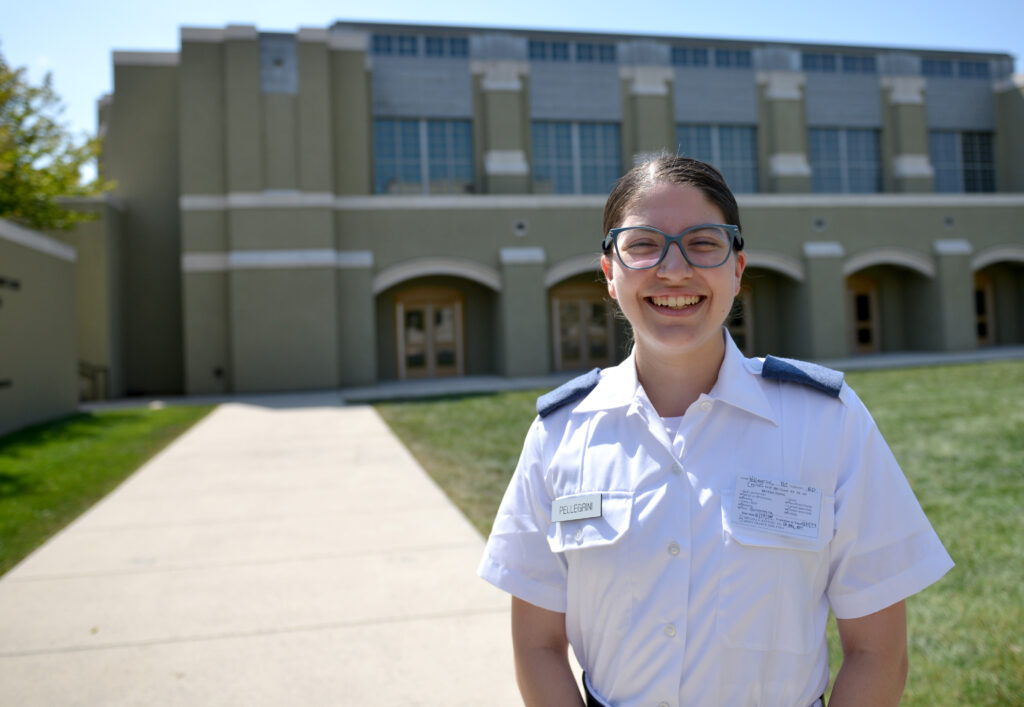
Modern languages major Bailey Pellegrini ’28 liked VMI’s commitment to having a focused program. She didn’t attend an open house prior to being accepted into the Institute, so she thought STP would be the proper way to get an introduction. She said it allowed her to get to know people coming in. Pellegrini did echo what other rats said in terms of the physical demands; STP doesn’t dive full force into the physicality of what Matriculation Week will be like. 

“I’m not an athlete, and I’m not here for the physical aspect of it. I know that I’m going to shine in my academics,” she said. “I feel like it was a lot more challenging because I’m not used to the repetitive things.”

Maj. Katie Baur, associate professor for the Department of Human Performance and Wellness, said the STP program is distinctly positive and focuses on personal growth. 

“While nothing can truly prepare incoming rats for the VMI experience, I do believe that our STP-ers come into matriculation with a bit more confidence and familiarity with their surroundings. I look forward to being involved with this program each summer,” she said. 

Cadet Bailey Pellegrini, Class of 2028
Bailey Pellegrini ’28

With STP and Matriculation Week under their belts, these rats feel like they’re moving forward. 

“The days feel long, but the weeks go by fast. It wasn’t too bad, if I am 100% honest,” Richardson said. “It’s definitely an experience I’ll never forget.” 

Cadets Experience Nuclear Technology Applications

VMI’s mechanical engineering degree program offers a nuclear engineering concentration, which includes specialized courses in nuclear technology. Cadets planning to enter the US Navy’s nuclear power program and cadets considering a career in nuclear technology find this concentration valuable.

In addition to course work, the concentration includes two field trips — a fall trip to Dominion Energy’s North Anna nuclear power station in Louisa County, Virginia, and a spring trip to Framatome, a nuclear industry supplier in Lynchburg, Virginia. Both trips provide enhanced perspective to cadets on the scale, equipment, and operations in the nuclear industry. Further, both Dominion and Framatome maintain strong relationships with VMI, and employ a considerable number of VMI alumni.

The recent trip to Framatome was led by mechanical engineering faculty member Paul Damerell and Maj. Jack Wilkins ‘16. Damerell, a 40-year nuclear industry veteran and retiring VMI Wachtmeister chair, has taught VMI’s Introduction to Nuclear Engineering course for six years. Wilkins will be covering the course going forward.

At the Lynchburg facility, Framatome develops equipment used for specialized maintenance of nuclear power plants, and supports the design of new reactors. Its factory floor includes mock-ups of several nuclear plant components used to test maintenance equipment designs, and train workers. During the recent field trip, cadets first heard a few brief presentations, and then had a walking tour of the shop floor, led by Curtis Van Cleve ’02.

“The size and scope of the facilities is impressive,” Shane Wise ’24 said.

Cadets were fully engaged as they saw the equipment, and asked numerous questions. Further, the tour included a stop at Framatome’s virtual reality (VR) lab, where cadets saw — and tried out — VR tools used to train workers.

“For someone going into the Nuclear Navy and planning on working in the nuclear industry after I get out, it was really interesting to hear about the industry,” Dillon Tidwell ’24 said.

Cadets departed the trip with a fresh perspective.

“The visit to Framatome was eye-opening and gave me confidence that I have chosen a field with longevity and many opportunities,” Justin Chow ’24 said.

Behind the Balance: Drew Menges ’25 — Keydet Soccer

Virginia Military Institute’s cadet-athletes have to juggle cadet life, heavy academic course loads, and their NCAA Division I sport. Committed to both academic and athletic pursuits, balancing their rigorous schedule in both sports and school requires a certain level of commitment and discipline. Behind the Balance is a series that focuses on those cadet-athletes and how they handle the hurdles of the day-to-day. 

Drew Menges ’25 had dreamed of attending the United States Merchant Marine Academy, but those dreams were halted when he was not admitted due to colorblindness. That didn’t slash his desire to go to military college, though.  

“I always wanted to go to a military school … So at the last minute we were looking at other options,” he said.

Menges has a strong desire to serve his country because of  his own family’s service. Both his grandfathers served, one in the Navy and one in the Air Force.  

“When I found out about military schools, I didn’t really know what they did,” he said. “I thought it’s pretty cool that you could come here to get a degree and commission.” 

When he found Virginia Military Institute, it was nearly kismet. By attending VMI, he’d also be able to play soccer for the school.  

“Everything worked out with the coach and then I just applied here and got in,” he said.  

When Menges talks about soccer his entire face lights up. You can tell it’s one of his passions. But, he’s serious about it. Starting at the age of 3, he took the field. By the time he entered middle school, he was playing on a club soccer team. There came a time when he had to choose between two sports, though. He was playing both soccer and lacrosse, but they were both during the same season. 

Ultimately, soccer scored higher for him.  

“I decided to stick with soccer because I liked it more. I think I was a little bit better at it too,” he said.  

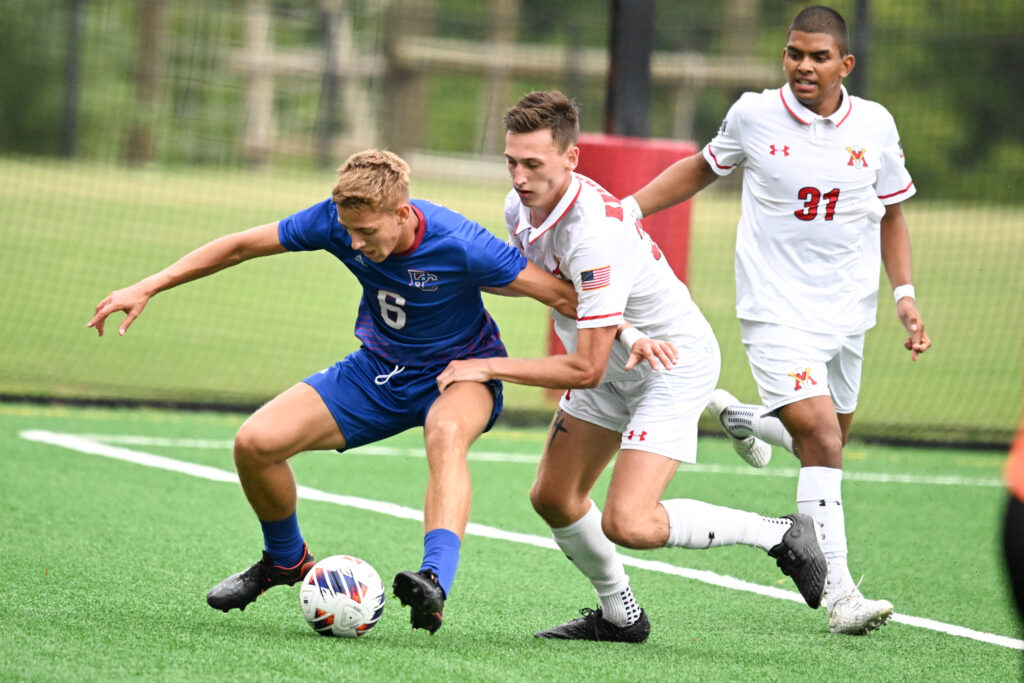
Drew Menges on the soccer field playing for Virginia Military Institute's men's soccer team.

Scoring goals on and off the field 

The mechanical engineering major has a full course load of 18 credits this semester. He’ll also be commissioning into the Army upon graduation. So, his days are tightly packed. 

Getting up at 6:30 a.m. daily, he heads to morning training with the soccer team. Morning practices consist of mostly running or stretching. Then, he’s off to formation at 7 a.m. By 7:05 a.m. he’s back to his room to put his hay up, do a little bit of school work, then he attempts to go to Crozet for breakfast before his first class at 9 a.m. 

On his long days, he has classes from 9 a.m. to 4 p.m. On good days, he’s out of class by 1 p.m. Practice is at 4:30 p.m. so after class, he’s either rushing to practices or doing work or sleeping.  

After practice, he hits up the mess hall, then it’s back to work for the remainder of the night. Sometimes he’s working on class work until midnight. On especially hard nights, he could be up until the wee hours of 4 a.m. completing assignments.  

“It’s pretty difficult. I’m not going to lie,” he said. “And this year it’s definitely ramped up because the mechanical engineering classes have got a lot harder and there’s a lot more work. I just try to knock one thing out at a time.” 

He suggests doing as much as you can with the time you’re given.  

Cadet-athletes at VMI not only have their responsibilities with their selected sport but cadet duties on top of that. There are specific times they can eat, go to class, study, and sleep. They are also required to take physical fitness classes twice a week, participate in ROTC all four years, be prepared for room and uniform inspections, parade preparation, guard duty, and more.  

“Before I came here I was not very good with time management. And everything kind of came easy to me, especially with school,” he said. “So coming here, I’ve definitely learned a lot about what I need to do every day to get stuff done, especially when it’s a heavy workload.”

He also discovered what he’s capable of.  

“You’re able to find out a lot about what you actually can do,” he said. “Like a regular college or if you didn’t come here, you probably would have never found that out by yourselves.” 

One tip he does have is to find time for yourself, even if it’s something small. He says he likes to spend some weekends with friends, just hanging out. 

“I’m also a very big believer in when I’m doing an assignment and it’s not clicking, just taking a break and stepping away from it,” he said. “It really, really helps me. And that’s why on the weekends, I always try to find time to do something for myself, instead of just worrying about school and stuff.”