Post View Unavailable:
Post View is currently unavailable due to technical difficulties. More information.Last Updated: 01-08-2026 09:42 AM»
Notice:
VMI.edu has recently been updated and upgraded. Please note that some URLs may have changed. Visitors are encouraged to use the new, expanded site menu and site search to navigate through these changes.
New Website Launched»
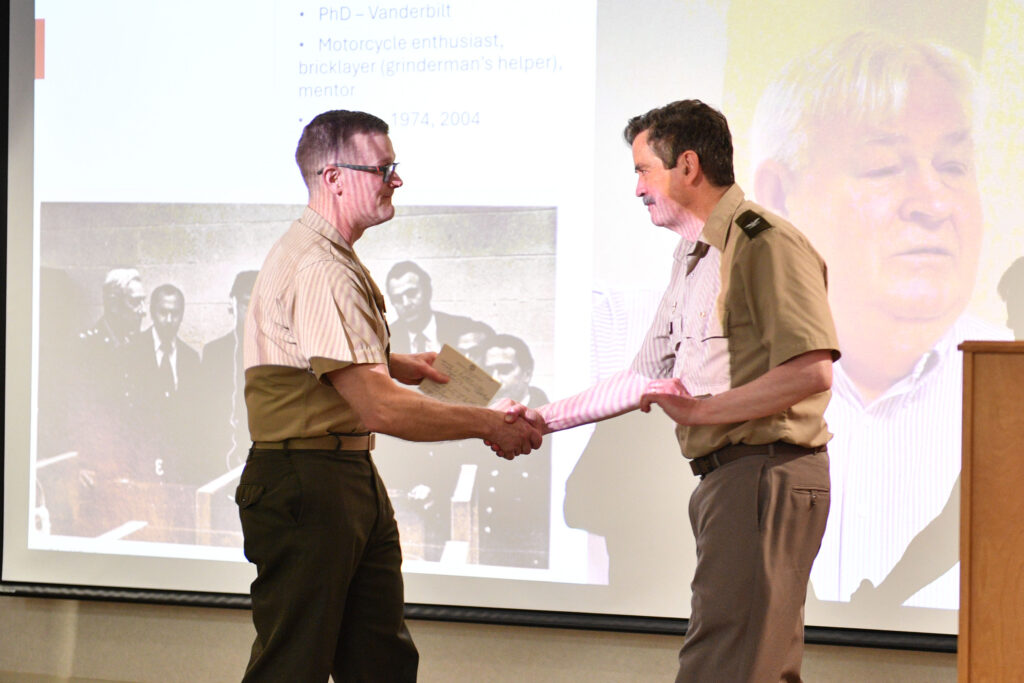
The Department of Modern Language and Cultures (DoMC) at Virginia Military Institute announced the suspension of the German program with the retirement of Col. Donald Sunnen, professor of German. A gathering of department members, both past and present, was held recently to observe the ending of the program and reminisce about the professors who taught German at the Institute since J.T.L. Preston in 1839. Though there was a hiatus of more than 30 years, German returned to the curriculum in 1873 and has been taught nearly continuously since.
At the event, memories were shared by Col. Travis Homiak ’95, VMI’s chief of staff, who, as a cadet, double majored in German and international studies; Maj. Charles Range ’10, who double majored in German and history; Patricia Hardin, former adjunct professor; Dr. Martin Nassua of Helmut-Schmidt-Universität in Hamburg; and Sunnen, who taught at VMI for 36 years. “I have always tried to make language real. Language opens doors and it has been my task as a teacher to encourage my students even when they make mistakes,” Sunnen shared.
Col. Abbey Carrico, professor and head of DoMC, stated, “While we do not know the future of German at VMI, we have taken time to remember its past. Through this retrospective we have shared stories and memories about the faculty and cadets who made this program what it was. We honored Col. Sunnen’s impact and influence at VMI and thanked him for his service to the department and German program.”
Homiak enjoyed seeing how many alumni were touched by the German program. “We all had an affinity for the language and the culture that initially brought us to the program, but the most impactful thing for me was seeing the connection between students across the years who shared professors like Col. Sunnen and the late Col. Siegfried Weing, who taught me and pushed me to excel and expand my horizons. When I think about the professors who made a difference for me at VMI, I think of him most of all. Aside from commissioning as a Marine officer, the German program was the high point of my education at VMI.”
Colin Nicassio ’26 will essentially be the last cadet to graduate with a minor in German when he receives his diploma. “Col. Sunnen was a fantastic professor, and there is a close-knit group of German speakers at VMI. The curriculum may not be here next year, but I know that German will always be spoken on post,” he said.
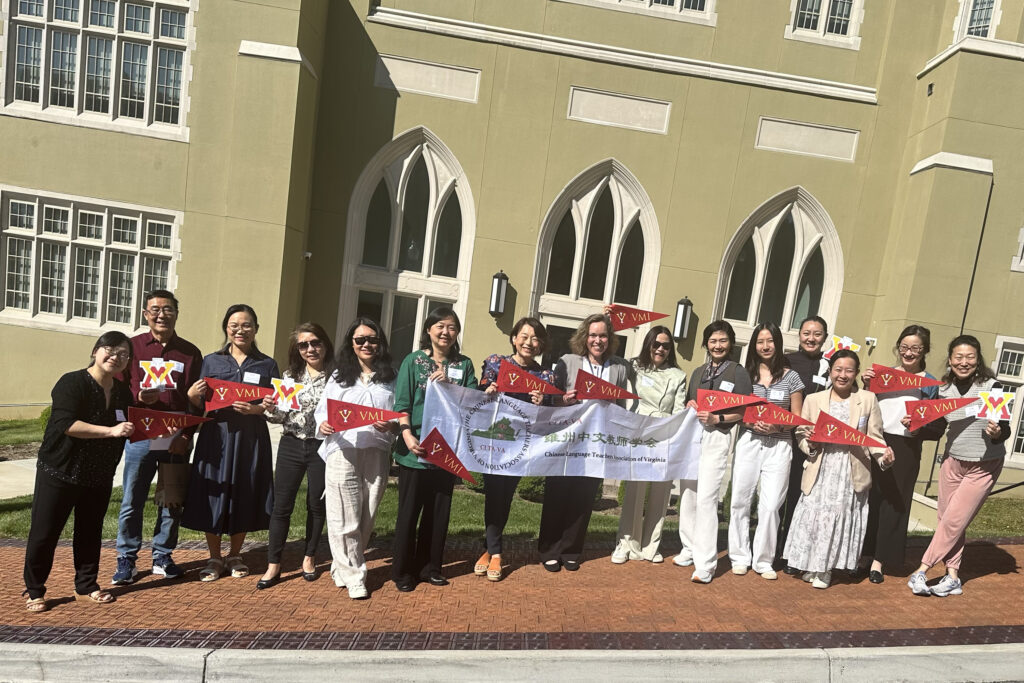
Virginia Military Institute hosted the spring 2026 Workshop of the Chinese Language Teachers Association of Virginia (CLTA-VA) April 11.
CLTA-VA is one of 22 regional affiliates of the national CLTA, dedicated to advancing the teaching of Chinese language and culture. Its mission is to promote quality teaching and learning at all levels, to support the professional growth and career development of Chinese language teachers, and to encourage collaboration and exchange among educators. Each year, the organization holds two workshops that bring together teachers who instruct kindergarten through a four-year bachelor’s degree (K-16).
Dr. Laura Xie, associate professor of Chinese in the Department of Modern Languages and Cultures (DoMC) and organizer of the workshop hosted at VMI, said, “We welcomed 18 K-16 Chinese language teachers from across Virginia and Washington, D.C. We had instructors from the University of Virginia, Washington and Lee University, the International Center for Language Studies, and several college preparatory and high schools. Three speakers led sessions on topics such as artificial intelligence in language teaching, digital tools for interactive learning, communicative language pedagogy, and innovative curriculum design. In addition to the sessions and workshops, our cadets played a big role in making the day run smoothly. They helped with logistics, greeted guests, and represented VMI well. We also had the chance to take our visitors on a tour of the post. Many of them found the tour especially memorable.”
Col. Abbey Carrico, professor and head of DoMC, stated the department was happy to host the conference for the first time at VMI.
“This group of Chinese educators shared teaching strategies and built connections across schools. Dr. Xie did a fabulous job coordinating this event and showcasing VMI’s dedication to language and cultural development in cadets.”
VMI offers both a major and minor in Chinese through DoMC. Currently there are 10 cadets majoring and eight minoring in the language.
Participants of the CLTA-VA workshop show their support for VMI in front of Scott Shipp Hall. –Photo courtesy of Dr. Laura Xie.
Col. Jeff Kendrick, director of the Office of Global Education at Virginia Military Institute, announced the U.S. Department of State’s Benjamin A. Gilman International Scholarship is currently accepting applications. The Gilman and Gilman-McCain Scholarships are merit-based awards for American undergraduate students with high financial need who want to study or intern abroad for academic credit.
Josiah Farrell ’28 and Anderson Robles Rodriguez ’28 both benefited from the scholarships when they participated in the Taiwan Huayu BEST Program to study Mandarin Chinese at the National Chengchi University in Taipei last summer.
Farrell, who is double majoring in international studies and modern languages and cultures, shared studying abroad was a lifelong dream come true. “The funding provided by Gilman kept my parents and myself from worrying about how my summer studies would be funded, and allowed me to focus on learning Mandarin. Additionally, with the funds I had left over, I was able to completely fund my follow-on service project to hold a Chinese Moon Festival last October.”
Robles Rodriguez, a mechanical engineering major, said his summer studying Mandarin in Taiwan was one of the most meaningful experiences of his life. “Through daily immersion, I gained confidence using Mandarin in night markets, on public transportation, and while traveling independently throughout the country. Without the Gilman Scholarship, studying abroad in Taiwan would not have been an option for me, and its support allowed me to fully enjoy the experience without financial stress. I was incredibly happy during my time abroad, and it reinforced how powerful and life-changing studying in a foreign country can be.”
Gracie Harlow ’27, who is double majoring in history and English with a concentration in literature, has been awarded a Gilman Scholarship to study Spanish at Universidad de Alcalá in Madrid, Spain, this summer for four weeks.
“As a Pell Grant student, I already come from a low-income background, so I never believed that studying abroad at another university would be in the cards for me. But this scholarship is covering half of the program costs, which relieved a lot of financial stress. VMI has made this amazing opportunity possible for me, and I couldn’t be more thankful.”
Kendrick reported VMI has enjoyed a 100% success rate in applications submitted and funded over the last year, and credits it to the hard work cadets put into drafting, editing, and refining their applications.
“Having served on the national review panels for both awards, I can testify that the competition is stiff. These cadets must tell a compelling story and thoughtfully connect their study abroad plans to future career goals. Over 17,000 applications were submitted nationwide last year in the March cycle, and of those, roughly only one-fourth were funded. Last year’s October cycle had 7,700 applications and only 20% were selected. This speaks to the high quality of our outstanding cadets. Furthermore, our two cadet awardees from 2026 maxed out the award at $5,000 each, and were awarded an additional $3,000 for the study of a critical language. This is a significant contribution and makes studying abroad a reality for cadets who might not otherwise have the opportunity.”
Cadets interested in studying abroad should visit the Office of Global Education on post to learn the requirements of the Gilman and Gilman-McCain Scholarships or other available awards, or email GlobalEd@vmi.edu for more information and to start on their application.
The Vanguard series highlights cadets of Virginia Military Institute who exemplify promise, perseverance, and the true spirit of leadership. While they may not be the top-ranking students or those in prestigious positions, these individuals’ dedication, resilience, and growth embody the essence of being a VMI cadet. By sharing their stories, including the challenges they’ve faced and overcome, we shine a spotlight on the diverse paths to success at the Institute, proving that leadership and excellence come in many forms.
Caleb Chandler ’27 wanted a challenge when it came to deciding what language to study at Virginia Military Institute.
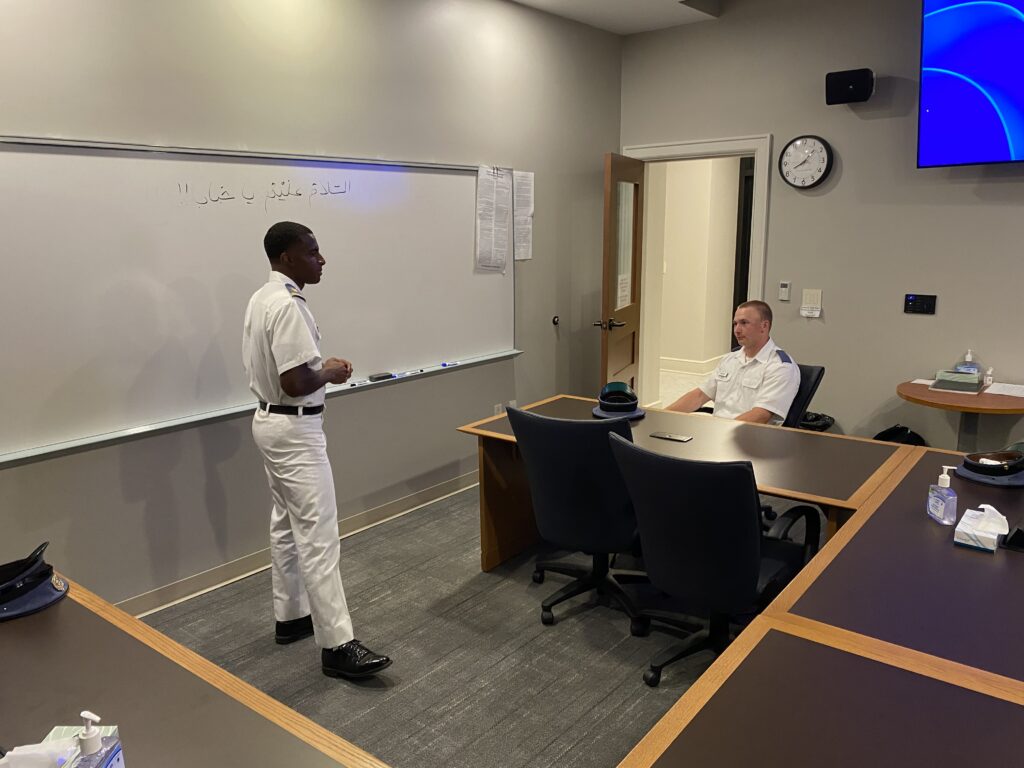
“When I saw the different language options, I didn’t want to take Chinese, I didn’t want to take Spanish or French, I kind of thought they were too basic,” the modern languages and cultures major admitted. “I wanted that challenge of Arabic, and I’m glad I did.”
He was inspired to explore Arabic after observing his father, an aviation mechanic in the U.S. Navy during the War on Terror. He said that area of the world had consumed his father’s life, so it was really all he knew growing up.
Chandler originally set his sights on VMI because he was recruited for the wrestling team. Growing up in a military family, the Institute was appealing to him. But he left the team last year and decided the club rugby team was more up his alley.
“Being a NCAA athlete is not for the weak,” he said.
Instead, he’s taken on more roles for the Corps, like being elected the class historian, which means he’s in charge of housing for all the cadets.
“If there’s ever room disputes or anything like that, usually I’m the primary mediator,” he explained. “Or if the room does need to be changed, I’ll change it and make sure all parties are on the same side, as well as the commandant staff. That’s my primary job.”
By being part of the General Committee, if there are violations of the class system or the white book, he is part of the committee that prosecutes.
Chandler’s passion for Arabic earned him a scholarship for the Project Global Officer (Project GO) program last year, which provides ROTC students with opportunities to study strategic languages and cultures abroad. The scholarship is funded by the Department of Defense and the experience lasts about two months, specifically for critical language speakers, Chandler said.
“That could be anything from Arabic, Chinese, Swahili, Russian, those types of languages that the government deems necessary for young officers to speak,” he said. “You basically spend two months there in intensive learning.”
He said that sometimes he’d be in the classroom for four hours or even up to eight hours — all Arabic instruction with culture lessons mixed in.
While participating, Chandler said he visited eight cities in Morocco, rode a camel in the Sahara Desert, all while expanding his language capabilities.
“I got used to hearing [Arabic] from native speakers, because there’s only so much you can do in the classroom,” he stated. “When you have hours that you can dive into it and you can see what your weaknesses are, you can become better. My speaking became better, my listening, my comprehension, everything.”
His studies were centered at the American Language Center, which was close to his host family. His host mother didn’t speak any English, and he had to communicate entirely in Arabic at home, unless his host brothers were there to help.
“I was nervous initially. I had only completed the 100 level of the language by this point. I could do basic greetings and stuff like that,” he admitted. “I’d say about by the halfway point, I had kind of gotten a schedule down, and most things that my host mother would ask me, I would be able to understand.”
Maj. Hicham Assaoui, assistant professor of Arabic in the Department of Modern Languages and Cultures, said studying and living in Morocco was a rigorous and immersive experience, one that Chandler not only met, but thrived in.
“He quickly adapted to his host family, developed meaningful relationships, and served as what I can only consider as a cultural bridge between American and Moroccan communities,” Assaoui explained. “He is both mature and resilient. In terms of academic promise, his strong performance in the Moroccan history and culture course and his growth in Arabic proficiency signal a strong potential for future success.”
His commitment to the study of Arabic continues on post. An active participant in the Group Study Session (GSS) tutor group, he holds group study sessions once a week for the 101 or 102 levels of Arabic. He’ll also attend lower-level Arabic classes to understand what each class is working on so he can tailor his study sessions to best fit those who need help.
“I’ll write down notes to myself and what they need to work on in conjunction with the professor, and when we come in to the group study sessions, we’ll spend that entire hour, maybe on verb conjugation or reviewing vocabulary — it’s completely what they want,” he said. “I try and make it as close to possible to what helped me succeed.”
According to Lt. Col. Jason Schroepfer, assistant professor in the Department of Modern Languages and Culture, the way Chandler approaches learning Arabic has stood out to him. He describes him as a leader to those wishing to learn Arabic, where his fellow cadets look to him for guidance.
“In communication activities, he quietly takes stock of the task at hand by actively taking notes. He then applies the knowledge undeterred by the fear of making mistakes. He also takes feedback on some areas of improvement, if need be,” Schroepfer said. “In Arabic reading tasks, he’s also not afraid to take measured risks by making educated guesses on the meanings of words and structures that are just a little bit more advanced than his current level. These hallmarks of a motivated, independent student, more often than not, payoff for him. Most importantly, these are traits that are shared by highly successful people in general.”
Mohammed Shihab, Arabic professor in the Department of Modern Languages and Culture, said Chandler possesses a proactive drive to serve. Shihab has observed him during study and tutoring sessions with other cadets where Chandler doesn’t give them the answers, instead he guides them on how to study, breaking down difficult course material into understandable segments.
“His initiative in seeking out those in need of help and his selfless dedication to their success is a rare and valuable trait that speaks directly to his character and potential as a leader of character,” Shihab said. “Cadet Chandler is the complete package: a brilliant and diligent student, a born leader, and a person of profound integrity. He is precisely the type of individual — one who leads with intelligence, compassion, and unwavering reliability.”
Chandler said he’s grown more as a person while being at VMI. He started out as a shy individual, but with the roles he’s taken on and embrace, he’s become more confident.
“I have to assert myself, and I’ve become so much more confident, and I can actually believe what I’m saying,” he stated. “I don’t get as nervous as much. Public speaking always killed me, but now it’s just something that’s required. I kind of just evolved.”
He admits he enjoys every second of VMI, something he’s said others may find a little weird.
“These are some of the best memories in the world,” he commented. “Like nights when you’re just staying up with the roommates, doing homework until maybe one or two in the morning. But you can just look back and it all makes it worth it. Just the bonds here.”
He says he’s grown as a student.
“I want to learn as much as possible, but I find it frustrating that there’s not enough class time for me to dive into it. I get so passionate about it,” he said.
Chandler will be commissioning into the U.S. Army with the hopes to be a military intelligence officer, utilizing his love of Arabic.
Assaoui has observed Chandler’s work in multiple contexts. Every week Chandler helps man the Arabic language table, he was also Assaoui’s student for study abroad in Morocco, and currently he’s enrolled in his upper-level Arabic 302 class.
Assaoui said Chandler exemplifies the kind of cadet that VMI strives to cultivate.
“He stands out for his initiative, adaptability, and genuine passion for learning,” he explained. “While many students are content to meet expectations, he consistently goes above and beyond to excel. His ability to build rapport with classmates, instructors, and host families reflects strong interpersonal skills and emotional intelligence.”
Last week, the Phi Sigma Iota International Foreign Language Honor Society hosted Global Festivities, an event celebrating the cultural diversity of New Year traditions around the world.
Cadets engaged in hands-on activities, including creating paper lanterns, folding origami, crafting vibrant Brazilian carnival masks, and testing their knowledge in a Jeopardy-style cultural trivia game. Through these interactive experiences, they explored diverse traditions and gained insight into how different communities welcome the new year. They also enjoyed delicious refreshments inspired by cuisines from around the world.
This event was initiated by Phi Sigma Iota president Anna Yemelianova ’25, who worked closely with the Department of Modern Languages and Cultures, and in collaboration with the Office of Diversity, Opportunity, and Inclusion, to make it a success.
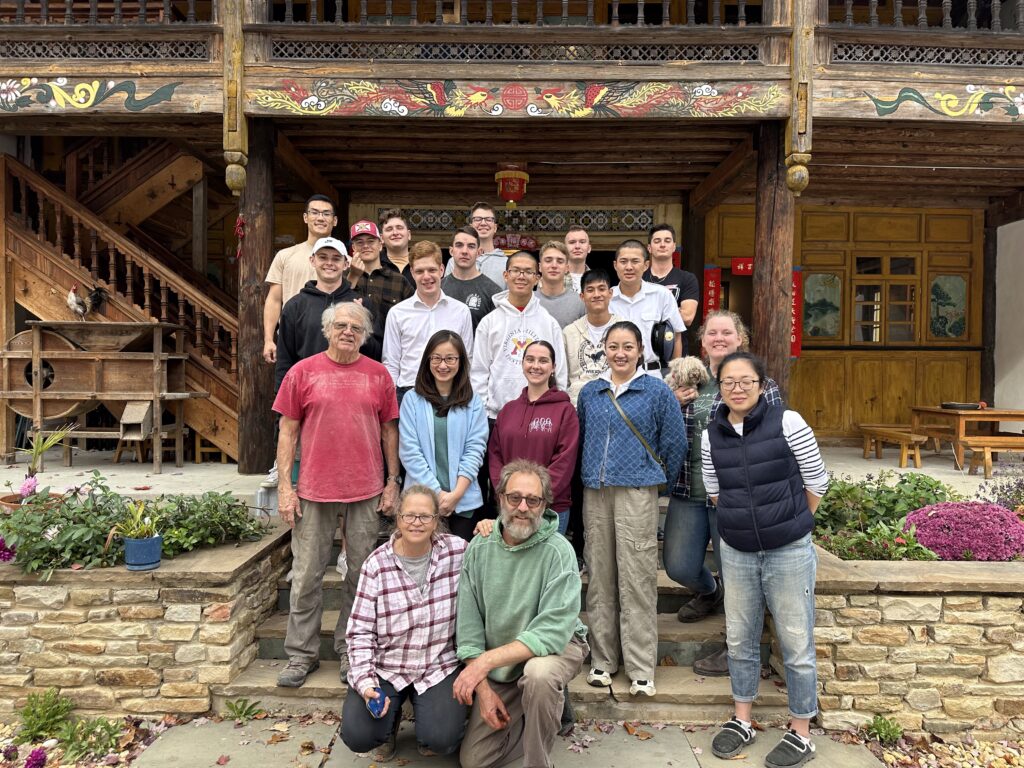
The house of a Tibetan Catholic family was built near Cizhong, China in 1989. With a blend of Tibetan, Naxi, Bai, and Han Chinese ethnic styles, the home follows traditional layout, materials, methods, and ornamentation of houses in the region going back centuries.
In 2017, the house had to be relocated due to the construction of the Wunonglong dam. Now calling Harpers Ferry, West Virginia, home, the China Folk House is along the Appalachian Trail connecting to the Shenandoah River, echoing its previous landscape of the Himalayas and Mekong River in China. What started out as a simple teatime at the home in China, turned into having the house disassembled and shipped over to the United States.
Sitting on a 1,600-acre nature conservatory as part of the Friends Wilderness Center, the home is a cultural and educational center dedicated to environmental stewardship, cultural exchange, community engagement, and experiential education, according to its website.
The China Folk House was the perfect place for 15 Virginia Military Institute cadets from Chinese Civilization, Introduction to Advanced Chinese, and Cultural History of Chinese Martial Arts classes to visit.
The trip was planned and organized by the Phi Sigma Iota Honor Society, the National Collegiate Chinese Honor Society, VMI’s Department of Modern Languages and Cultures, and Department of History.
Three faculty members oversaw the visit: Dr. Laura Xie, associate professor of Chinese and faculty advisor for Phi Sigma Iota Honor Society; Dr. Lu Lu, assistant professor of Chinese and faculty advisor for the National Collegiate Chinese Honor Society, and Dr. Qiong Liu, assistant professor in the history department.
The group of professors had learned about the home from colleagues at other universities who had visited it, and the founder of the China Folk House presented it at a Chinese pedagogy workshop they had attended.
Xie said it was an enriching and one-of-a-kind experience for the cadets, allowing them to engage directly with artifacts, architecture, and lifestyles that embody the history and culture of traditional Chinese society. She said during the visit, one of the founders explained the China Folk House was reconstructed to reflect the spirit of old rural China.
“She explained that the Folk House was built in the style of traditional farming villages, where neighbors worked together, supported one another, and tackled projects as a community,” Xie explained. “This gives our students a sense of how community bonds and shared responsibilities shaped traditional Chinese lifestyles.”
Xie and others said the excursion allowed cadets to explore the Chinese culture that can’t be covered in a typical classroom setting.
“To be honest, cadets don’t often have opportunities to experience Asian cultures locally in Lexington,” Lu said. “Excursions like these allow them to immerse themselves in foreign cultures and languages, even if only briefly.”
The visit provided hands-on examples of certain themes covered in class, from traditional construction techniques to symbolism.
“The highlight of the trip was the cadets’ active involvement in the house construction process itself, and I was especially impressed by their teamwork and camaraderie, a true reflection of VMI’s spirit,” Lu said. “I believe this trip bridged the gap between classroom knowledge and real-world application and offered our cadets invaluable memories.”
Liu’s class, The Cultural History of Chinese Martial Arts, covers not only the techniques of Chinese martial arts, but also the cultural meanings within the practice.
“For example, Daoism — a philosophy deeply intertwined with Chinese martial arts — emphasizes harmony between humans and nature,” she stated. “The China Folk House beautifully embodies this principle in its design and integration with the natural surroundings. Traditional Chinese architecture, often influenced by feng shui, reflects Daoist cosmology, aligning spaces for balance and positive energy.”
By exploring the layout and architecture of the Folk House, it allowed cadets to experience the principles like harmony, balance, and simplicity, Liu explained.
“This experiential learning deepened their understanding of concepts they may have only encountered in texts, revealing how abstract ideas like yin-yang and feng shui come to life in physical spaces,” Liu commented. “The visit offered a tangible link between philosophical concepts, such as naturalness, and everyday practices, illustrating that philosophy isn’t just theoretical; it shapes practical aspects of life, from martial arts to architecture. Observing these principles in action helped the cadets appreciate how cultural philosophies influence daily experiences and lifestyle choices.”
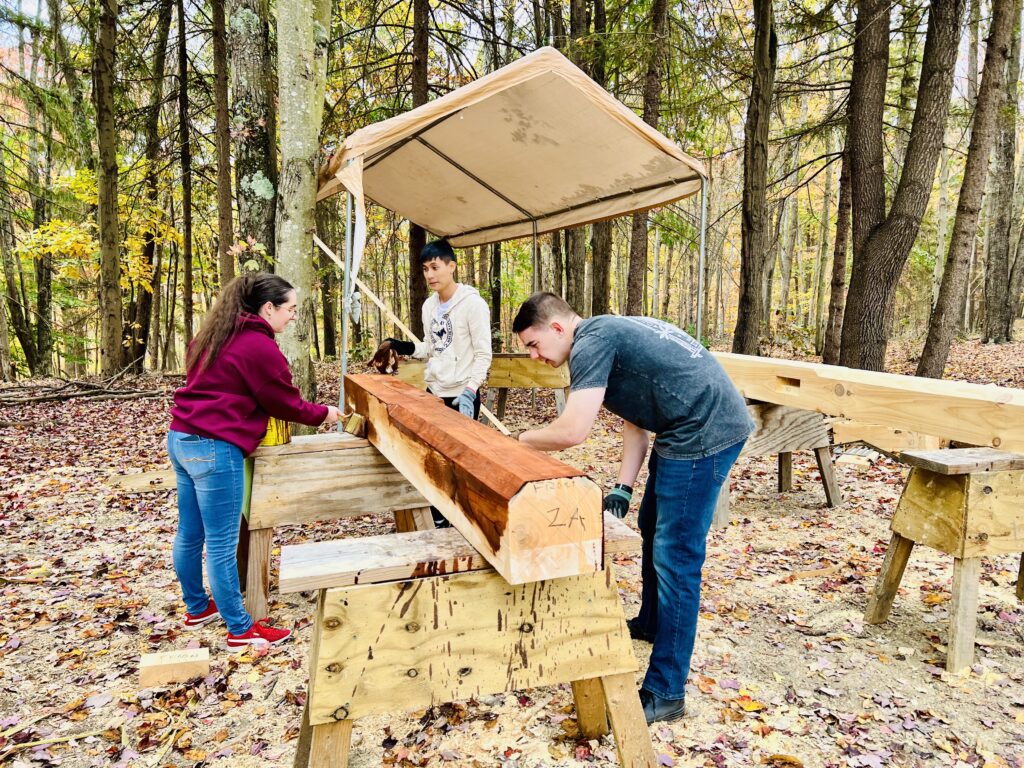
Anna Yemelianova ’25, the president of Phi Sigma Iota, found the experience meaningful because she and others were able to contribute to work at the home like staining wood, mixing concrete, and tending to gardens. It also provided a window into rural life and the transformation throughout China’s reform periods.
“Each space within the home told its own story — from the traditional kitchen that witnessed countless family gatherings to storage areas that reflected changing agricultural practices across generations,” she said. “As urbanization and modernization spread globally, preserving spaces like this becomes increasingly vital for maintaining connections to local knowledge and cultural traditions.”
The Folk House serves as a museum piece and a living bridge between past and present allowing visitors to see how rural families adapted to social and political changes, according to Yemelianova.
“Through both learning and volunteering, our group of VMI cadets became part of this ongoing story of cultural preservation, helping ensure these invaluable traditions and knowledge continue to be shared with future generations.”
They say nothing can prepare you for the Rat Line, but there are ways to ease into the rigors of Virginia Military Institute. One option is for incoming rats to participate in the Summer Transition Program (STP). You’re able to get a class under your belt while familiarizing yourself with post.
Held the summer before rats matriculate, STP gives the opportunities to get a head start on academics and physical fitness. The four-week voluntary program allows participants to earn credits for one academic class and become familiar with VMI — living in barracks, physical training, eating in Crozet Hall, and taking classes.
Zachary Richardson ’28 wanted to knock out a biology class. He was drawn to VMI for its Army ROTC program, plus the size of the school was a huge deciding factor for him.
“I was blown away by everything offered here, the small class sizes, the integrity, and the Honor Code was really admiring,” the history major said.
Once he was accepted, he figured STP would be a good first step.
“Those four weeks were good for me mentally, adjusting and getting ready for what was coming in August,” he said. “Meeting a lot of my brother rats in the summer was really cool, because on Matriculation Day, I recognized so many people. It was a big advantage and a big motivator. Like, I can make it through this, I’ve got already friends here.”
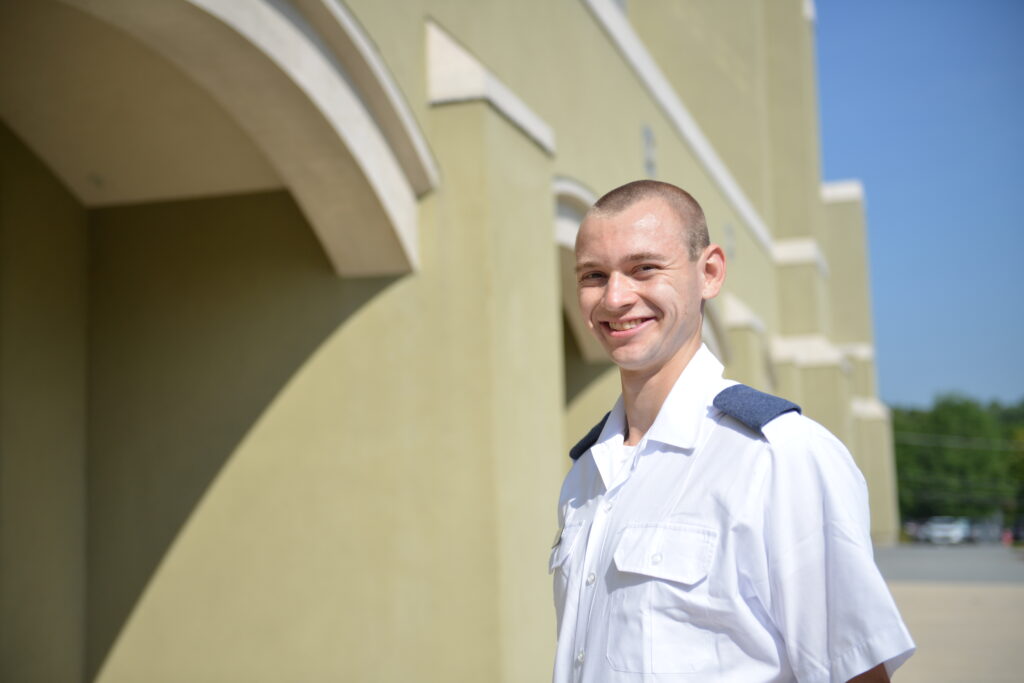
Zachary Richardson ’28
He said getting a class out of the way over the summer will help with his academic load this semester. Also being on post for those weeks allowed him to gain some overall knowledge about the Institute and free access to places before facing more restrictions as a rat. He knows where his classes are, he’s familiar with faculty and staff on post, plus he even met some cadre. He was also able to meet with the regimental band commander and join band company.
“I basically joined band company and knew what company was going to be in before Matriculation Day,” he said. “That was a cool thing to learn and figure out.”
The physical aspect of STP was unmatchable of what he endured during Matriculation Week. But, participating in STP and getting used to working out daily helped introduce him to that routine. The intensity was elevated once he joined the Rat Line. It was a bit of a shock to Richardson.
“I was here in STP walking around like I owned the place, and now I’m the lowest form, not even in existence. I’m a rat, right?” he said. “I think I was motivated to come here. I had prepared, so physically I didn’t feel too challenged by Matriculation Week. It was more the lack of sleep and just the big shift in lifestyle. It was a big shock to be woken up by a big loudspeaker and your cadre coming in and banging on the door … the stress level was something I was not used to. I was kind of just like taking it one meal at a time.”
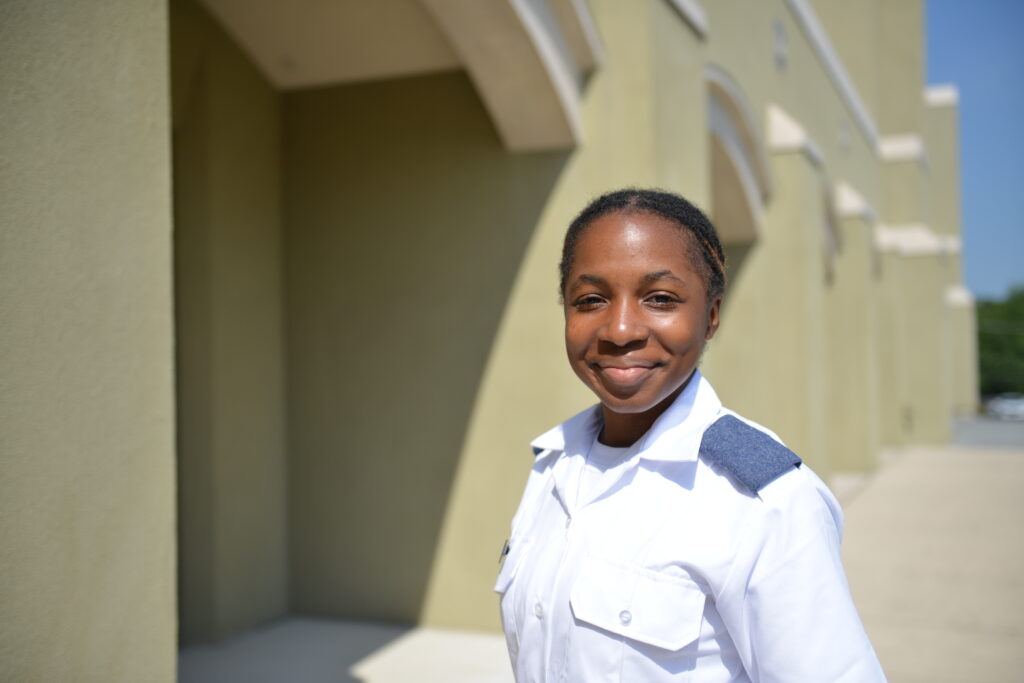
Denasia Owens ’28
Denasia Owens ’28 took precalculus during STP. VMI appealed to her because it was a more structured learning environment that incorporated the military aspect. Owens, a mechanical engineering major, felt like STP helped with the physical aspect, especially walking around post up and down hills. But it didn’t prepare her mentally as much. STP was a little less formal, she said.
“One part that is excluded is the yelling, having someone in your face,” she said.
Owens said that the staff from STP can now serve as a safe place for her since she’s familiar with them.
“There are still some people that I can be like, ‘Hey, I know you,’ even though you’re an upperclassman, I can still come talk to you, because we already know each other outside of Matriculation Day,” she said.
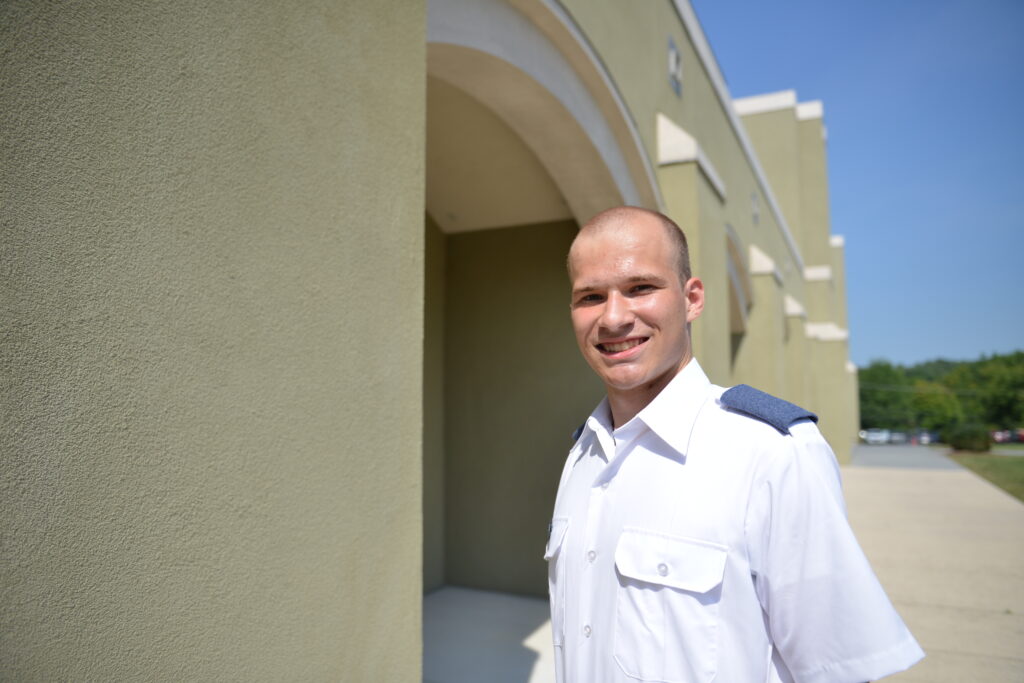
Owen Johns’ ’28
It was Owen Johns’ ’28 father’s idea to do STP. The international studies major said he wanted to get more conditioning over the summer and take a math class.
“The course really helped, because it took one course off my schedule, so it gives me more time to focus on other classes that I have,” he said. “Along with that, the fitness, even though it was very relaxed, it still helped, like getting used to the VMI Fitness Test and all the other components that we have to do as rats.”
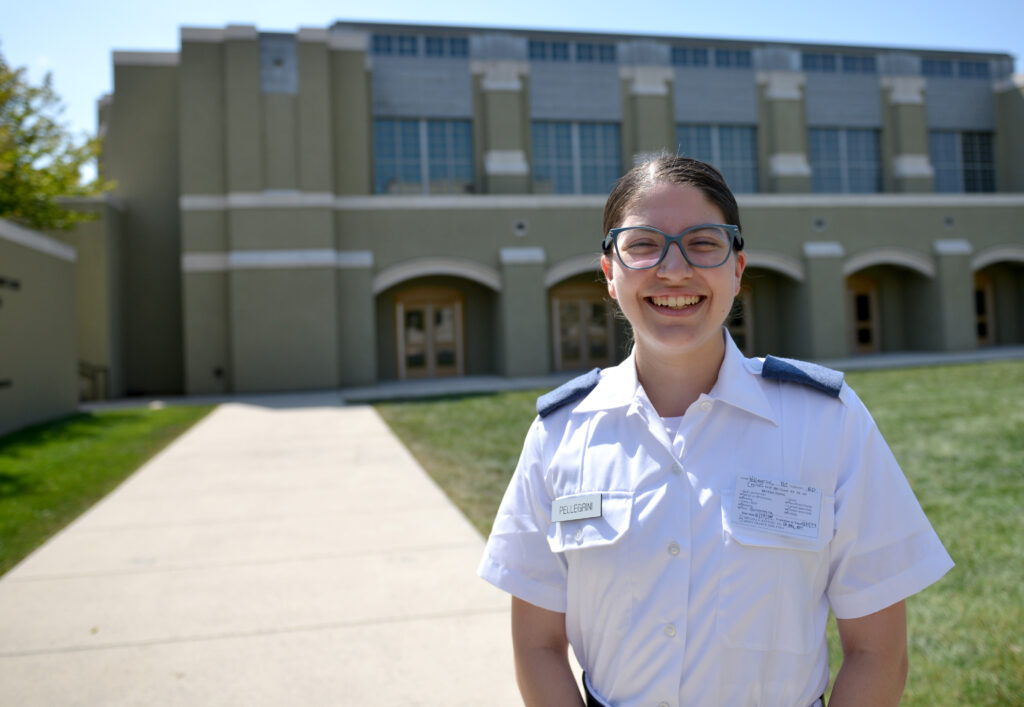
Modern languages major Bailey Pellegrini ’28 liked VMI’s commitment to having a focused program. She didn’t attend an open house prior to being accepted into the Institute, so she thought STP would be the proper way to get an introduction. She said it allowed her to get to know people coming in. Pellegrini did echo what other rats said in terms of the physical demands; STP doesn’t dive full force into the physicality of what Matriculation Week will be like.
“I’m not an athlete, and I’m not here for the physical aspect of it. I know that I’m going to shine in my academics,” she said. “I feel like it was a lot more challenging because I’m not used to the repetitive things.”
Maj. Katie Baur, associate professor for the Department of Human Performance and Wellness, said the STP program is distinctly positive and focuses on personal growth.
“While nothing can truly prepare incoming rats for the VMI experience, I do believe that our STP-ers come into matriculation with a bit more confidence and familiarity with their surroundings. I look forward to being involved with this program each summer,” she said.
Bailey Pellegrini ’28
With STP and Matriculation Week under their belts, these rats feel like they’re moving forward.
“The days feel long, but the weeks go by fast. It wasn’t too bad, if I am 100% honest,” Richardson said. “It’s definitely an experience I’ll never forget.”
Trips to Barcelona, Granada, Madrid, and more were just the perks for a group of Virginia Military Institute cadets this summer.
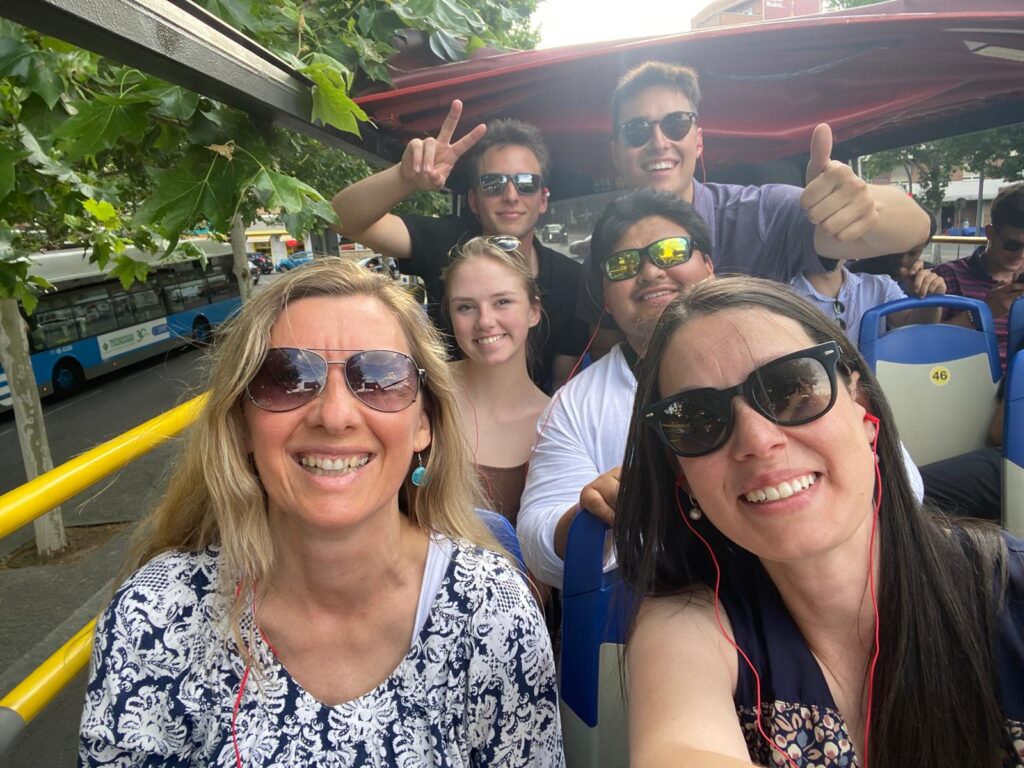
Nearly two dozen traveled to Spain this summer for a study abroad program, with varying majors and minors represented, from economics and business, modern languages, history, computer science, engineering, and more.
The five-week program allowed cadets to take three classes at the Universidad de Alcalá in Alcalá de Henares near Madrid. They were enrolled in two Spanish classes taught by the university professors and an economics elective class, which was taught by VMI’s Col. Valentina Dimitrova-Grajzl, professor of economics and business.
“Study abroad programs are important because they humanize the rest of the world and introduce the students to new ideas and different ways of living, working, and interacting,” she said. “In a world of so much polarization, such programs can be a bridge for better understanding and cooperation.”
Dimitrova-Grajzl said cadets are able to develop an open-mindedness about the world by participating in study abroad programs like this one. She said it was rewarding to see how each cadet’s knowledge and worldviews were expanding and changing organically.
“Students experienced how the definition of economic and social well-being can differ across countries and cultures, how the architecture and design of cities can incentivize people to be active and socially integrated, and how the structure of a workday varies based on geography and climate,” she said.
The program was put together by Dr. Sabrina Laroussi, associate professor of Spanish in the Department of Modern Languages and Cultures, who has led the program for the past six sessions. Laroussi said she gets immense satisfaction seeing her students’ Spanish language skills progress.
“Every student has his or her own strategies to overcome language barriers as they go from being shy to order food in a restaurant or a coffee shop, or purchase something in a store, to making every effort to speak some of the local language to get around, connect with locals, and make friends,” she said. “Even if it is through using plain language or basic Spanish phrases such as ‘Hola’ (hello), ‘Gracias’ (thank you), ‘Un café con hielo, por favor’ (iced coffee, please).”
Firsthand experience and gaining credits
Connor Franklin ’26 decided to sign up for the Spain study abroad program because he and a friend both needed six more credit hours of Spanish language, plus it was his first time traveling to Europe for school. The economics and business major said the classes were very laid back but interactive. He was able to meander between classes, check out cafes, and enjoy the culture.
“The experience was awesome; it was the most fun I have had. I learned so much about the culture of Spain and a lot about the European Union,” he said. “It was very interesting to see how people operated throughout their day and also to see how different their priorities were from people from the U.S.”
Franklin said surrounding himself in the Spanish culture gave him a different way to learn the language.
“You are surrounded by the language, so you are forced to learn it. To me it is one of the best ways to learn a language,” he said.
This program allowed Cadlee Jarvis ’26, a history major, to travel abroad for the first time. Taking classes in a foreign country did take some adjusting, he said, especially compared to the structure that VMI has.
“I think this program is important to have at VMI because it gives cadets the opportunity to travel abroad and learn new information about different cultures,” he said. “It also helps cadets gain new experiences and memories that will last a lifetime.”
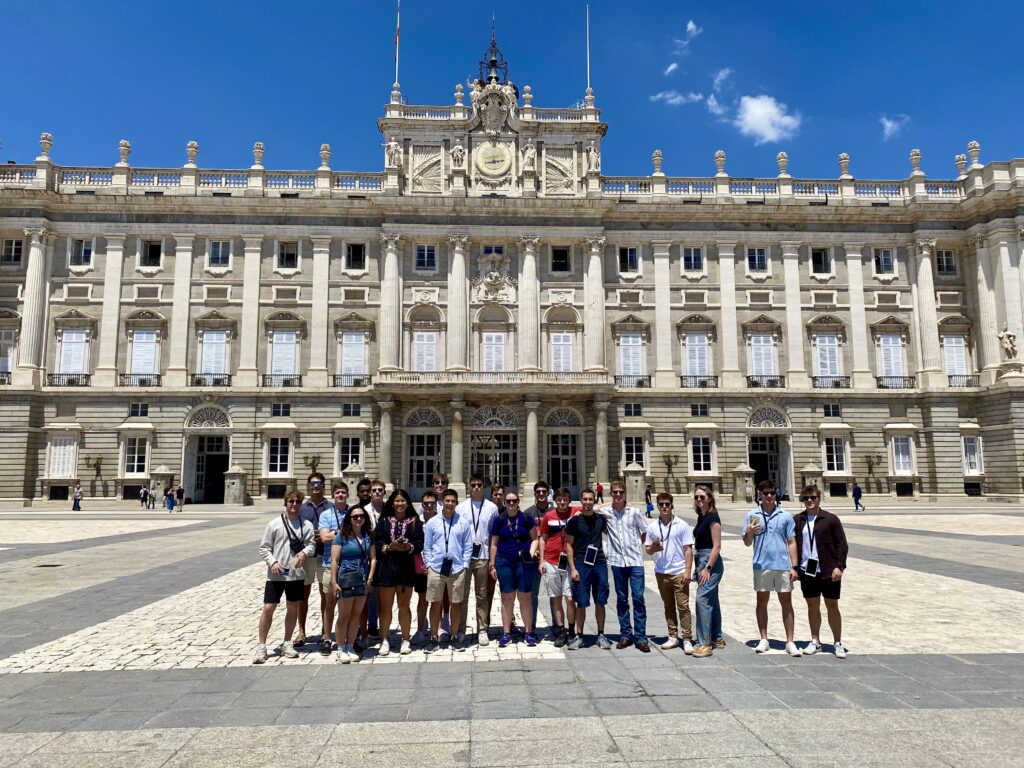
In addition to class time, cadets took trips to Southern Spain (Granada and Sevilla), to Northern Spain (Barcelona), and several day or half-day trips to Madrid to the U.S. Embassy, the Royal Palace, the Prado Museum, and several tours of the city.
Laroussi said she enjoyed seeing everyone embrace new experiences and step out of their culinary comfort zones.
“When we visit very touristy cities such as Seville, Barcelona, or Toledo, I always emphasize to students to avoid tourist traps: restaurants on big, popular squares or near major tourist attractions, or restaurants with a menu featuring multiple languages,” she said. “So, at the end of the day, when they tell me that they went to a restaurant where there were only locals, the waiters did not speak English, the menu was entirely in Spanish, and they ordered a local specialty… that is my greatest satisfaction.”
The students lived in a dorm at the Universidad de Alcalá along with Spanish students and other international students who were taking summer classes in Alcalá. They got to practice their Spanish language regularly since it is a town that is less touristy and provides a very authentic experience of living in a Spanish town.
Suzanne J.P. Leaptrot ’25, an English major, decided on the study abroad program so she could lighten her course load in her final year at VMI. This is her second study abroad opportunity. In the spring of 2023, she did a semester at Oxford. Spending a month in Spain, taking three classes was also the most cost-effective opportunity, she and others said. For nine credits, she only spent $5,400 on the classes, plus the flight to get to Spain.
“Part of what makes this trip so valuable is the weekend trips we took. One thing I kicked myself for when I was in England was not traveling more and seeing the major England things. This trip took all the planning and energy out of my hands and took me to the major Spanish sites, and I’m so glad it did,” she said. “Alone, I never would have gone to the Picasso Museum in Barcelona, which was my favorite of all the places we visited.”
Thanks to taking an immersive language class, Leaptrot was forced to figure out ways to describe things when the vocabulary in the other language is limited.
“For example, toward the end of my trip, I was looking for Post-it notes at a grocery store and I did not know the word, so I asked a worker if they had sticky papers to take notes in books, the worker understood and told me where to go to find them. Three hours a week in a classroom just does not compare to an immersion class,” she said.
Colton Jones ’26, an international studies and political science major with a minor in national security, was intrigued by the program after seeing posters about it around post. A driving factor in going was so he could knock out his Spanish requirements, while being able to apply what he’s learning in real-time situations.
“It gives cadets a chance to really focus on their Spanish studies in a way that are unable to when they are at VMI,” he said. “They also get to experience a different culture and it may open their eyes to new experiences and new things that they otherwise never would have seen.”