
Post View Unavailable »
New Website Launched »

VMI Commissions Military Officers

Virginia Military Institute commissioned nearly 140 cadets into the armed services at the annual Reserve Officers’ Training Corps (ROTC) joint commissioning ceremony May 15 in Cameron Hall. The ceremony was livestreamed for family and friends who could not attend the event in person.

Gen. Christopher J. Mahoney, 13th vice chairman of the Joint Chiefs of Staff, the nation’s second highest-ranking military officer, who arrived to post by helicopter, offered the commissioning officer remarks and administered the oath of office to the cadets beginning their journey of military service as second lieutenants in the U.S. Air Force, Army, and Marine Corps, and as ensigns in the Coast Guard and Navy.

Lt. Gen. David Furness ’87, who just completed his first academic year as the Institute’s 16th superintendent, welcomed the nation’s newest military officers, their friends and families, faculty and staff, and members of the Corps of Cadets to the ceremony. He thanked the ROTC officers, cadre, and staff who were instrumental in teaching and mentoring the young officers, and acknowledged all the veterans and current military members in the audience. “We appreciate the sacrifices you have made and the leadership you have shown. These cadets are following in your footsteps because of the examples you have set,” he said.

Furness reminded the commissioning cadets that VMI has prepared them to face any challenge or adversary, and how honor, courage, and commitment have been instilled in them. “These fundamentals will serve you well for the rest of your life. The time has come for you to take the next step in your careers and serve our great nation.”

He shared three habits he was advised to adhere to when he was a young officer. “First, embrace lifelong learning. You must continually increase your knowledge through practice and self-study. Second, stay physically fit. You will find that when stress arrives, you will be better disciplined to persevere when you are fit, and always remember that a strong mind never grows in a weak body. Last, but most importantly, you must take care of those you lead. Whether in the military, the civilian sector, or your family, people will depend on you to be an ethical and reliable source of strength, to teach, coach, and mentor those you are responsible for.” He congratulated the cadets on attaining a commission, voiced his pride of them, thanked them for making the decision to serve in the military, and wished them Godspeed.  

Furness then introduced Mahoney as a great friend and noted their paths crossed many times throughout their careers. Mahoney graduated from the College of the Holy Cross in Worcester, Massachusetts, with a bachelor’s degree in economics, and commissioned into the Marine Corps. He has served as a pilot with the Marine All-Weather Fighter Attack Squadron known as the “Bengals,” as well as the fighter squadrons known as the “Werewolves,” the “Crusaders,” and the “Bats.” He has held command at the squadron, group, and wing levels. He is a graduate of the Weapons and Tactics Instructor Course, the Marine Division Tactics Course, and the Navy Fighter Weapons School commonly known as TOPGUN. He holds two master’s degrees. One from the University of Canberra in Australia, and one from Air University at Maxwell Air Force Base in Alabama, both with the highest academic distinction.

Mahoney shared he was honored and humbled to speak at VMI, which he described as hallowed ground. To the commissionees, he stated that the era of America’s uncontested dominance is over. “The adversaries you face are capable. They are hungry, and they’re watching you. You’re about to be handed the greatest responsibility the nation can bestow.” He told them they will be tested. “The enemy will jam your communications. Your screens will go black. You will not be able to call higher headquarters for permission. You will not be able to call in a medical evacuation. Will you freeze? Will you wait for perfect information? What will you do? Answering that question will require everything you have. It will require the lessons of this great institution that is built on unrivaled tradition, and these traditions over time have become legend.” Mahoney then cited legendary VMI alumni like Lt. Gen. Chesty Puller, VMI Class of 1921; Lt. Gen. Charles Kilbourne, VMI Class of 1894; Maj. Gen. William Upshur, VMI Class of 1902; and Gen. Lemuel Shepherd, VMI Class of 1917; who all faced dire situations in battle, but instead of hesitating or panicking, they relied on the steel VMI put in their spines. “They did not shrink from violence. They stepped into the breach.” He warned the new officers that because these VMI legendary ghosts set such a high standard, the military has high expectations of VMI graduates. “When a commander sees a VMI ring on a finger, they don’t see a recent college graduate, they see the ghosts of VMI. They expect you to be unbreakable, they expect you to lead from the front, and they expect you to navigate chaos without losing your bearing. Virginia Military Institute has given you the discipline and uncompromised standard. The rest is up to you. The ghosts of VMI are watching you. Our adversaries are preparing for you. What will you do?”    

He then asked the commissioning cadets to stand as he administered the oath of office. Afterward, the brother rats gave each other congratulatory hugs as the audience applauded and cheered.  

Following the ceremony, the separate military branches conducted individual pin-on ceremonies at various locations on post. It was there that the newly commissioned officers followed a tradition of presenting a silver dollar to the active service member or veteran from whom they received their first salute.

According to Capt. Megan Taylor, assistant professor of military science for the Army ROTC George C. Marshall Battalion—formerly known as the Blue Ridge Battalion—at VMI. Many were exemplary, but two were prominent: James Aldinger, an international studies major from Arlington, Virginia; and Matthew Kleinschuster, an applied mathematics major from Richmond, Virginia. “Aldinger served as the Ranger Challenge platoon leader responsible for the training and preparation of the Ranger Challenge team. Under his leadership, the team successfully competed at Exercise Cambrian Patrol in Wales in the United Kingdom; at the 4th Brigade Ranger Challenge at Fort Pickett, Virginia; and at the Sandhurst Military Skills Competition at the U.S. Military Academy at West Point. His ability to coordinate training, planning, and logistics for local, national, and international competitions far exceeded the traditional cadet experience. He ranked within the top 1% of cadets nationwide and is branching in the infantry. Kleinschuster served as battalion commander and was responsible for the oversight, accountability, and training of four companies and more than 1,000 VMI cadets. He had the single greatest impact on the Army ROTC mission and overall success of the battalion over the past year. Through his leadership, work ethic, and very impressive GPA, Kleinschuster earned the distinction of being ranked the No. 8 cadet in the nation and was selected to branch in explosive ordnance disposal,” Taylor said.

Lt. Cmdr. Tom Campbell, naval science instructor for Naval ROTC, designated two cadets who commissioned into the Navy and two who commissioned into the Marine Corps as truly outstanding. Macallister Clark, a mechanical engineering major from Saint Michael, Minnesota, was a four-year national scholarship recipient, and retained a 4.0 four-year GPA. He was selected to be commissioned as a Naval reactors engineer (NRE), an elite technical officer who manages the lifecycle of Navy nuclear propulsion plants. The last year a VMI cadet commissioned as NRE was 2017.

Nicole Samella, an electrical and computer engineering major from Virginia Beach, Virginia, was a four-year national scholarship recipient, maintained a superior GPA and high physical fitness scores, and served as the NROTC battalion commander. As the top ranked surface warfare officer in the nation, she was handpicked to transfer into the Navy Engineering Duty Officer program. 

Kern Aughinbaugh, a biology major from San Marcos, California, served as the Marine Company commanding officer and advisor for the NROTC Bulldog Program, helping prepare candidates for the physical requirements of the Marine Officer Candidate School. Moreover, he served the Corps as Golf Company commander in the regiment. Devin Auzenne, a history major from Opelousas, Louisiana, was a four-year national scholarship recipient. In addition to serving the Corps as regimental commanding officer, he also was an advisor for the NROTC Bulldog Program. Both Aughinbaugh and Auzenne will go to The Basic School in Quantico, Virginia.

Col. Eric Steele, commander of Air Force ROTC, cited two cadets as exceptional. Reese Lassiter, a mechanical engineering and physics double major from Louisa, Virginia, has earned the coveted Distinguished Graduate (DG) award—established to recognize the top 10% of commissioning cadets—from AFROTC. “He’s been a standout cadet his entire time in our program, winning national awards and earning recognition through several highly competitive military training courses. He will be attending undergraduate pilot training at Columbus Air Force Base in Mississippi after commissioning,” said Steele.  

Hannah Buttner, an international studies major from Williamsburg, Virginia, successfully completed a leadership tour as Cadet Wing commander last fall. “Competing through a highly rigorous process at the national level, she was also selected to attend Green Flag-West at Nellis Air Force Base in Las Vegas, Nevada, and at Fort Irwin, California, where she gained broad exposure to Air Force and Army joint air-to-ground operations in a real-world training environment. She is this year’s recipient of the Captain John W. Kennedy ’69 Award for sustained excellence throughout her time as a cadet. She will attend intelligence officer training at Goodfellow Air Force Base in San Angelo, Texas,” Steele explained.    

According to Command Sgt. Maj. Suzanne Rubenstein, director of cadet activities and VMI liaison for the Coast Guard Auxiliary University Program, one cadet who commissioned in the Coast Guard. Shane McKenna, an international studies major from Salt Point, New York, served as commander for the AUP and was Foxtrot Company executive officer.  

Memorial Parade

Earlier in the day the Memorial Parade was held, commemorating the bravery and sacrifice of all alumni who died on the field of honor including the Mexican-American War, the American Civil War, the Spanish-American War, World War I, World War II, the Korean Conflict, the Vietnam War, the Marine Barracks in Lebanon, the Persian Gulf War, and the Global War on Terrorism. The large garrison flags were flown at half-staff, by order of Gov. Abigail Spanberger, in memory and respect of Peace Officers’ Memorial Day, a fitting backdrop as all 591 alumni names were somberly read by Stone Gardner ’28, Sophia Lurey ’28, Garrett Maye ’28, and Jamie Rodriguez ’28. A wreath was laid at the foot of the monument, “Virginia Mourning Her Dead,” as well as at the three barracks arches. A prayer led by Col. John P. Casper ’04, Institute chaplain, was followed by the firing of a three-volley salute. A stirring echo rendition of “Taps” was played by Louis Marangoni ’27 and resonated by Khaidan Piedmonte ’28, followed by the Pipe Band leading the Regimental Band in an emotional delivery of “Amazing Grace.” Col. Lawrence “Ley” Havird ’90, commandant, was joined by Furness in taking review of the parade as the Corps marched from the Parade Ground down Letcher Avenue and ending in barracks.
I Am VMI: Julia Ward ’26 

What truly defines Virginia Military Institute are the people. Cadets, faculty, and staff, both past and present, are what make it “No Ordinary College.” I AM VMI will showcase the outstanding individuals who have accepted the challenges and embraced the spirit of VMI. Their perspectives provide authentic insights into life at the Institute and the value of this unique military college. 

I Am VMI: Julia Ward ’26 

  • VMI Class: 2026  
  • Major: Electrical & Computer Engineering  
  • Hometown: Frankfort, Illinois 
  • NCAA Sport: Water Polo  
  • Commissioning Plans: U.S. Navy – Hoping to service select Subs  
  • Other Clubs/Societies/Activities: VMI Pipes & Drums, Honor Court, Society Women’s Engineers (SWE) 

Julia Ward ’26 came to Virginia Military Institute uncertain of herself and her leadership abilities.  

“I wanted to challenge myself,” she said. “I knew I wanted to put myself in a better position as a newly commissioned officer. I figured there was no other place to take opportunities and learn to flourish. I liked the family aspect of VMI and the alumni connections that come from time spent at VMI.” 

Ward said there’s always something to do at VMI and she enjoys the busy pace. 

“Whether it is a sporting event, a debate, a dinner, a speaker, or simply just class work, it keeps you busy. I like to be active and VMI is the place for that,” she explained. “It isn’t always military either; there are plenty of clubs or activities to get engaged in the Corps.” 

She had the opportunities for engagement to help build her and others into a family, noting there’s always a group of supporters for each cadet— either with the staff, faculty, or other cadets.  

“Everyone wants you to succeed. This year strengthened that bond with a lot of people at school. I had a death of two very close people to me at the beginning of the semester that made me almost not come back for the semester. Having the support system I have here let me come back, get back on my feet, and keep leading for a deeper purpose,” she said. “I had a lot of responsibilities before leaving and I knew if I didn’t return, I would be letting a lot of people down, but I would also not be living for the two that I lost. I would not have come back if it was not for the support system of the commandant staff, my professors, and the people around me who lift me up every day.” 

VMI is rigorous, but rewarding, Ward explained. Each day brings a new set of challenges she can work through.  

“I think it has forced me to come out of my shell a lot. I have honestly fully transformed from the person I was three years ago sitting in a high school seat ready to graduate,” she said. “It is a surreal feeling to watch your dreams unfold in front of you. I have wanted to serve in the military for a while and having that dream come to life in the next year is still unreal to me, not to mention all of the experiences I have been able to have to travel, to lead, to put myself out there, and get hands on instruction is something I would not have had if I chose to go anywhere else. It’s very rare that you go to any other college and NCAA is just another thing you do because there are so many other opportunities like holding rank and cadet government that can bring experience to your time at a school.” 

“I think it has forced me to come out of my shell a lot. I have honestly fully transformed from the person I was three years ago sitting in a high school seat ready to graduate. It is a surreal feeling to watch your dreams unfold in front of you.”

The electrical and computer engineering major originally wanted to pursue mechanical engineering. When she first came to VMI, she was interested in a career in biomedical engineering after commissioning into the U.S. Navy. She saw that the electrical engineering department had more to offer in that background, so, she made a last-minute switch.  

“I have no further regrets, and I do not question my future success using a technical degree in the Navy or in industry based on the instruction I have been able to receive in the classroom,” she said. 

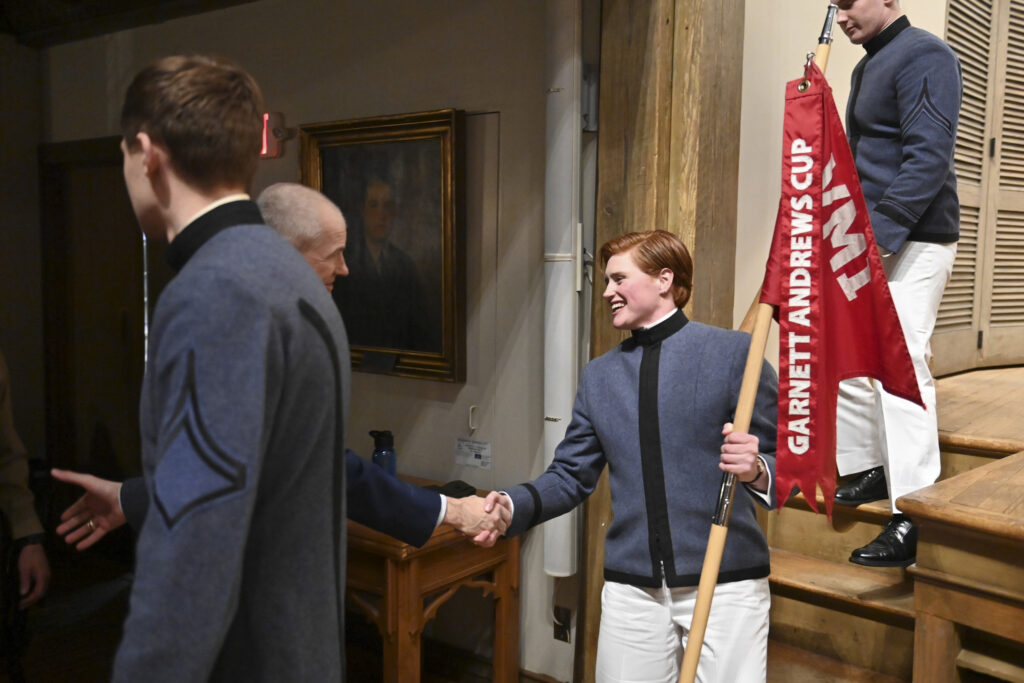
Julia Ward during Virginia Military Institute's 1st Class rank announcements.

Ward admits that VMI has made her a more confident person.  

“It puts you in positions that force you to make hard decisions in a low-risk situation so the time that it really matters we will know how to react or step up to the plate to lead because that’s just our nature now,” she commented. 

VMI has also prepared her for her future in the Navy. She’s been able to see that during summer training for Naval ROTC, but credits the confidence boost the Institute instills to be a big factor in her future successes.  

“I think it really is the confidence we exude from our decision-making abilities and the way we interact with teams of all different backgrounds. We already know what it feels like to get beat down and build ourselves back up again,” she said. “There is a lot of resilience that comes from going here and it allows graduates to bring creative solutions to the table and to work harder than everyone in the room because the thought of failure doesn’t scare us, we just pick ourselves back up and keep going.” 

Ward said it’s been easy to fit in at VMI — no matter what, you find your people. Overall, the pride she has gained being a VMI cadet has been the best experience.  

“How hard the average person works here is tenfold above every other school,” she described. “How eager to help and get involved people are here is something that doesn’t get spoken about enough at our school, how close we are to everyone.” 

From VMI to Government Defense: Kevin Dougherty ’25

This article is part of The Next Step series. While the four years at VMI are designed for cadets to push themselves academically, physically, and mentally to tackle the demands of life at a premiere military college, they also prepare cadets for life after graduation. Whether that life be one in the military or one in the private sector, VMI faculty and staff provide guidance to cadets along their journeys. One department specifically dedicated to that endeavor of post-Institute success is the Office of Career Services. In The Next Step series, we highlight cadets preparing to enter the workforce after graduation, as well as those still in the midst of their cadetship preparing for internships over the summer. 

Dreams of commissioning may have been eliminated over a year ago for Kevin Dougherty ’25, but his call to duty did not diminish.  

The applied mathematics major from Virginia Beach, Virginia, had an original plan to commission in the U.S. Navy as an explosive ordnance disposal officer, but he was medically removed from the Naval ROTC unit over a year ago. Instead, he has accepted a job with Lockheed Martin. 

“I still wanted to contribute to defense capabilities in as much of a capacity as I could and I thought of no better way to move forward in my life than work for the top defense contracting organization in the United States,” he explained.  

He will be a guidance, navigation, and control modeling and simulation engineer in which he will be working within the missiles and fire control sector of the company. He will help develop, analyze, and test algorithms that govern the aspects of missile systems and other defense platforms. 

“I think the skills I have learned here at VMI, both technical and nontechnical, have prepared me for a job in an industry like defense contracting,” he said. “Going through classes with both a military basis and a non-military basis, I believe that I have a step up from individuals who go to a ‘normal’ college and want to get into defense contracting. I also believe that the alumni pipeline is huge with defense contracting and understood that with using the alumni network I would have a shot at getting into such a massive organization like Lockheed Martin.” 

He credits the help of friends, family, and some alumni in getting the opportunity to work for Lockheed Martin.  

“I think having VMI on my resume doesn’t necessarily give an advantage, but I think if that same resume crosses the right person’s desk at the right time, it can lead to something big for sure,” he admitted. “I believe VMI has had an impact on much of my non-technical skills. It teaches you so many soft skills that make someone successful like time management, public speaking, self-discipline, and my personal favorite, resilience. Life is difficult, but I think these skills can take you very far in both the military world and the civilian world because at the end of the day they all develop you as a leader in today’s society.” 

Dougherty said he’s not sure what the future holds, but he’s focused on the today — knowing if he can focus on that, success will come on its own.  

“I think what really inspired me to embark on this career path is the possibilities of where it will take me and where it will lead in the future.” he commented. “I am super excited to move somewhere I have never lived and work with new individuals in a new environment.” 

Midshipmen Moments: Rukshana Sarkari ’24

Few people can say they spent their summer aboard a warship in the Pacific Ocean, but Rukshana Sarkari ’24 can.  

Sarkari spent the summer with the USS Ronald Reagan nuclear-powered aircraft carrier battle group. Her journey started near the end July in Darwin, Australia and ended mid-August in Manila, Philippines.  

Sarkari wanted to gain experience in both the surface warfare and nuclear power fields, and this summer training assignment offered an amazing and unique opportunity to do so. She experienced one week of conventional surface warfare exposure on a destroyer and a week of nuclear propulsion exposure on an aircraft carrier. While onboard with five other midshipmen from across the country, they collectively spent time on every deck and level of the ship.

“We gained experience in various departments onboard and the operations of how everything and everyone is intertwined onboard,” she said. 

This was Sarkari’s first year participating in a summer assignment. The 1st Class cadet, a Virginia Military Institute Naval ROTC midshipman, will be commissioning into the Navy after graduation.  

“The most valuable thing I gained from this experience was to understand the emotional aspect of what it means to be an officer,” she said. “In the sense that as an officer you do need to keep that professional relationship with your Sailors, but to also remember that your Sailors have a life outside of their duty station. That it is possible to be both compassionate and stern with your Sailors together. In doing so, you can also build credibility with Sailors.” 

Her summer assignment will help her after she graduates in spring, 2024. She’s set to commission as a surface warfare officer on the path to becoming an engineering duty officer. Of all the Navy communities, she said that surface warfare has a very mentorship and leadership focus.  

“This skill and many others can translate to any part of my life even beyond the military,” she said.  

A lifelong dream 

Since the age of 9, Sarkari knew she wanted to join the military.  

“To know that the moment I get to raise my right hand and pledge my life to this country is so close, I can hardly wait to see what I can do in my future,” she said. “Serving your country is the foundation of America, and to know that not only am I surrounded by people who support my decision, but to be going into a profession that is built on servitude to others, I could not ask for more.” 

She said growing up, she saw the loss of patriotism in her peers. She’s also seen a sense of pride and welfare for the country dwindle. If serving her country can revive that patriotism, then she’s more than willing to do that.  

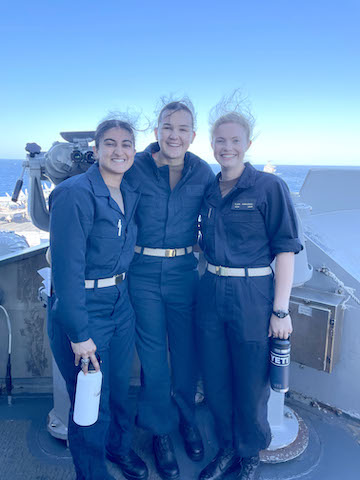
Rukshana Sarkari aboard a naval vessel.

“As a child of immigrant parents, I would not be where I am today if they did not have to option to come to America and study and fulfill what is the American dream,” she said. “I want nothing more than to protect that dream for generations to come. I want to be able to look back and tell my kids that this country can make anyone’s dreams come true. We are a country of opportunities, and if I don’t take my own opportunities then how am I supposed to lead and help others to do the same?”

Gaining experience in the outside world, Sarkari said it gave her major insight as to what her life will look like after VMI.  

“Coming from a senior military school, the day in and day out of life can sometimes make you forget what the outside world is like … to go out and experience what the real Navy is like and not the trial version at school,” she said.  

Highlights on deck 

Her favorite part of the assignment was being on the flight deck or up on the bridge of the ship. She said that the Navy isn’t all about being at sea and watching other ships. 

“To an extent it is, but to see the operations behind how the ship is maintained and maneuvered through the water was possibly the greatest thing,” she said.  

Come May, she said she will be beyond proud to swear in and take on the duty the country asks of her. She said her path in life is to lead and make a difference.  

“I am a part of the future generation of this country. I have always wanted to make a difference with my life, and even if it’s only for a small department on a ship in the middle of the ocean, those actions carry on and I’ll at least be able to help someone else make a bigger difference,” she said. “I just want to be able to bring back what Americans fought and stood for and be a member of a country that fights for their people, a country that lends a helping hand to those in need and stands up for those who cannot do it themselves.”