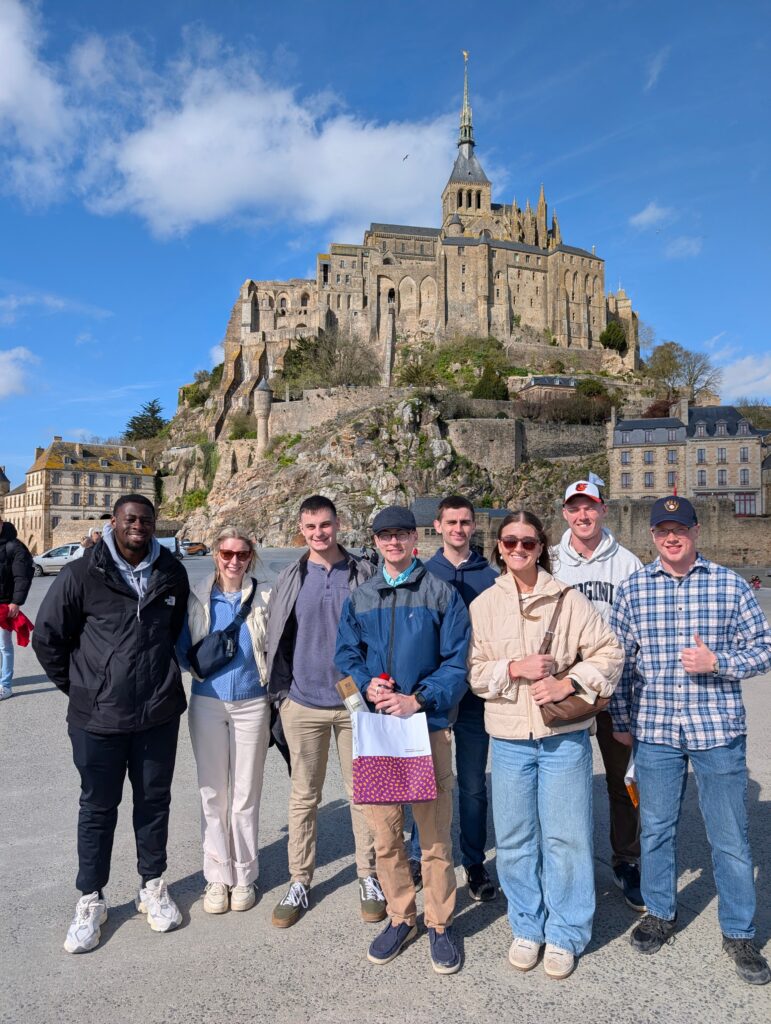
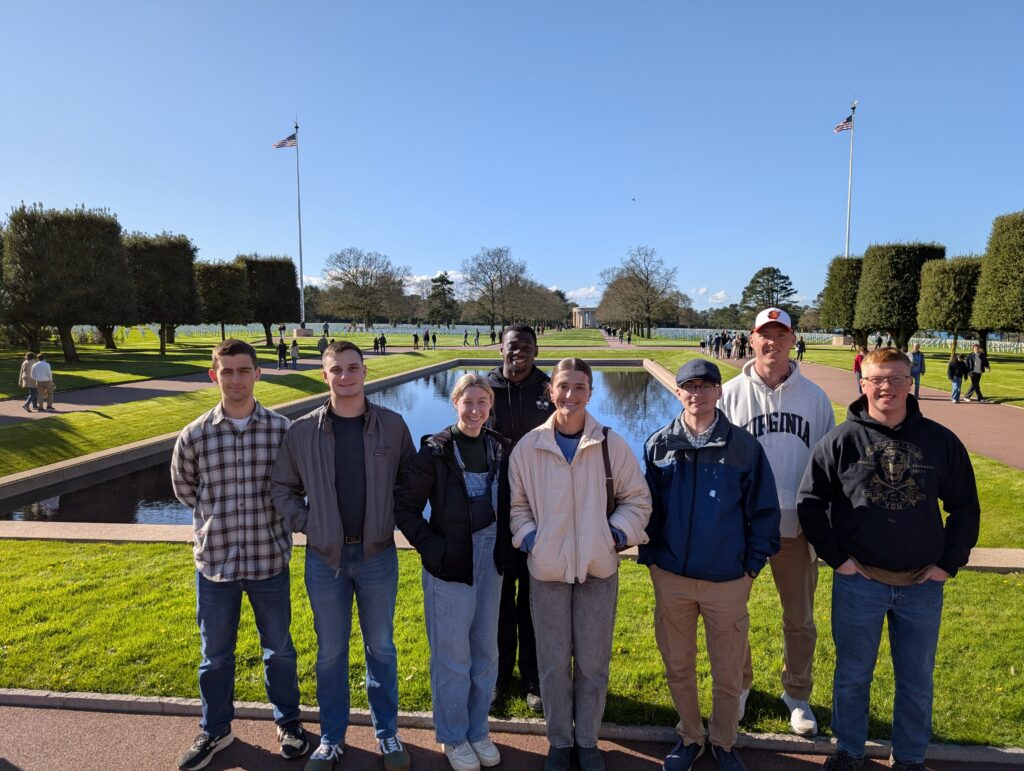
The Battle of Normandy, the Allied operation that launched the successful liberation of German-occupied Western Europe during World War II, began on D-Day, June 6, 1944. United States, British, and Canadian forces landed on five French beaches, marking history’s largest amphibious assault. Many U.S. servicemen were killed during the assault, including Virginia Military Institute alumni.
Eight 1st Class commissioning VMI cadets, along with their faculty leadership team, recently traveled to France through the Olmsted Foundation’s Undergraduate Program (OFUP). In preparation for the trip, one of the many assignments the cadets were given was to work in pairs and research the personal story of an alumnus who had died during the battle, and is buried at the Normandy American Cemetery in Colleville-sur-Mer, an itinerary stop planned for the group. Upon arriving to the cemetery, the cadets were to find the gravesite of the alumnus, and share that person’s story with the group.
Capt. Sydney A. Vincent Jr. ’40
James Bangura ’26 and Matthew Nordyk ’26 worked together researching Capt. Sydney A. Vincent Jr. ’40, born May 3, 1919, in Portland, Oregon, the eldest of three siblings. He graduated with a degree in civil engineering. His classmates described him as playfully argumentative and full of common sense, drive, originality, and the personality of a leader.
He served in the Army as a cavalry officer in the 803rd Tank Destroyer Battalion and operated a M10 Wolverine tank destroyer. He married Lt. Jane Margaret Byer, a Navy nurse, in 1943. On D-Day, Vincent’s unit was attached to the 29th Infantry Division and fought further inland. On the fateful day of July 18, 1944, Vincent fought alongside another VMI graduate, Maj. Glover S. Johns Jr. ’31, who would eventually retire as a colonel. A German observation post proved to be trouble for the Americans approaching Saint-Lô. Vincent was given permission to “take care of it,” and moved his M10 into position and fired upon the German emplacement. Tragically, enemy mortar landed on the thin-skinned, open-top M10 and fatally wounded Vincent. He was posthumously awarded the Silver Star Medal for his gallant actions. The citation reads: “On July 18, 1944, Captain Vincent led a detachment of his mechanized unit into the city in the face of devastating small arms fire and artillery fire. Throughout the attack, he remained at the head of his unit, encouraging and inspiring his men to close with the enemy.”
Bangura noted, “Vincent showed selfless service against enemies. He showed bravery and died wearing his VMI ring.”
The cadets were unable to access Vincent’s headstone due to wet conditions at the cemetery, but were able to get the full intended experience walking the cemetery’s paths, as well as spending time in a garden dedicated to the peace for which the Americans fought. Nordyk said walking alongside the graves was humbling and reminded him of the sacrifices made. “It is not a place of remorse, but remembrance. The headstones shine a brilliant and pure white, reflecting the honorable character found in those who fought and died for liberty.”
Capt. Harold Sheffey ’37
Jack Ericsson ’26 and Macallister Clark ’26 delved into the life of Capt. Harold Sheffey ’37 from Marion, Virginia, who studied liberal arts at VMI. He was nicknamed “Red” for his flaming red hair, was popular with his friends, and was somewhat of a ladies’ man. In the Army, he served as commander of Company K, 3rd Battalion, 330th Infantry Regiment, 83rd Infantry Division. He took command after landing on the beaches at Normandy, July 8. Eight days later, he was killed leading his men to liberate the town of Remilly-sur-Lozon. Ericsson acknowledged, “Seeing his gravestone was a humbling experience and I think it is important to keep the memories of those men alive.” Ericsson added Sheffey’s sister still lived in Marion until her death within the last decade.
Lt. Benjamin Rives Kearfott ’43
Nolan Savard ’26 and Liam Smith ’26 studied about Lt. Benjamin Rives Kearfott ’43. Born November 7, 1919, and a native of Martinsville, Virginia, Kearfott played football and basketball in high school. At age 17 he enlisted in the Virginia National Guard. In 1942, he married Mary Jennings of Lynchburg.
On D-Day, he was an infantry platoon leader in the 3rd Platoon, Company A, 116th Infantry Regiment, 29th Infantry Division—the unit famously known as the Bedford Boys—tasked with landing on the westernmost sector of Omaha Beach. He was aboard Landing Craft Assault 1015 with Capt. Taylor Fellers and 30 other soldiers from Company A. While not originally from Bedford, Kearfott was reassigned to the unit due to a chance illness of another officer. Upon landing on Omaha Beach, all men aboard the landing craft were killed instantly by machine gun fire. Their bodies were scattered along the beach. Kearfott was awarded the Purple Heart, which is currently kept at the VMI Museum, along with his casket flag and emblem of the 29th Infantry Division.
Capt. Dan Joseph Morton ’41
Anna Grace Adams ’26 and Samantha Waters ’26 researched Capt. Dan Joseph Morton ’41
from Columbus, Georgia, who became an Army cavalry officer and married Bette Wright. As a second lieutenant, Morton participated in Operation Torch, the Allied invasion of French North Africa in November 1942, and Operation Husky, the Allied invasion of Sicily in July 1943. Adams recounted, “By June 1944, the time of the Normandy campaign, he had been promoted to captain and was an experienced and decorated armor officer. He was on the intelligence staff for Combat Command A of the 2nd Armored Division.”
Waters described the circumstances of Morton’s death. “During Operation Cobra, an offensive which began seven weeks after D-Day, Morton’s unit was leading an advance near the village of Villebaudon. They were ambushed by four German tanks. Being on the intelligence staff, he was not required to take the lead in a counterattack, but Morton stepped up and took the initiative to save his unit. His tank was fired upon, and shrapnel hit him in the chest, killing him instantly on July 28.” Morton was temporarily buried at Sainte-Mère-Église. By 1948, Bette had remarried, and his father had died, so his mother made the decision to have his remains transferred to the Normandy American Cemetery. He was awarded the Silver Star Medal posthumously.
Two members of the faculty leadership team who traveled with the cadets, Lt. Col. Jochen Arndt, associate professor of history, deputy director of the John A. Adams ’71 Center for Military History and Strategic Analysis, and OFUP director; and Col. Houston Johnson V, professor and head of the Department of History, explained the importance of the cadets researching the fallen alumni. “The Battle of Normandy involved hundreds of thousands of troops and casualties. Researching and retelling the stories of VMI alumni who served and died in Normandy allowed our cadets to gain a deeper understanding of the heroism and tragedy of D-Day and WWII, and the VMI connection to those events,” said Arndt.
Johnson agreed. “It was extremely gratifying to see the Olmsted cadet participants embrace their research into these alumni who perished during the Normandy campaign. The cadets were able to gain new insights into both VMI’s history and that of the D-Day landings and subsequent Normandy campaign; to be able to reflect on these men’s sacrifices at the Normandy American Cemetery made that reflection particularly meaningful.”