Post View Unavailable:
Post View is currently unavailable due to technical difficulties. More information.Last Updated: 01-08-2026 09:42 AM»
Notice:
VMI.edu has recently been updated and upgraded. Please note that some URLs may have changed. Visitors are encouraged to use the new, expanded site menu and site search to navigate through these changes.
New Website Launched»
Three of the nine members of the VMI High-Powered Rocket Club recently launched medium-powered rockets at the Valley Aerospace Team (VAST) launch site near Monterey, Virginia.
Michael Trigger ’26, a computer science major; Quinlan Johnson ’28, a physics major; Yushen Zhu ’28, an electrical and computer engineering major; along with Maj. Durig Lewis, instructor in the Department of Physics and Astronomy and club officer in charge, traveled to the site to shoot the rockets built by cadets last academic year.
Trigger reported VAST has an excellent launch site with plenty of open land.
“I wish it was a little closer to VMI, but it’s hard to find a place with that much undeveloped land and is clear of trees. It was fun watching the rockets take off and realizing the builders’ craftmanship is what keeps them intact as they undergo all the forces needed to fly.”
According to Lewis, several members of the club are currently working on their National Association of Rocketry level one certifications.
“Certification permits people to purchase and use rocket motors whose physical constraints and performance exceed traditional model rocket boundaries. There must always be someone in the group who is certified to launch one of these rockets.”
Club members are also building rockets scheduled to launch next semester.
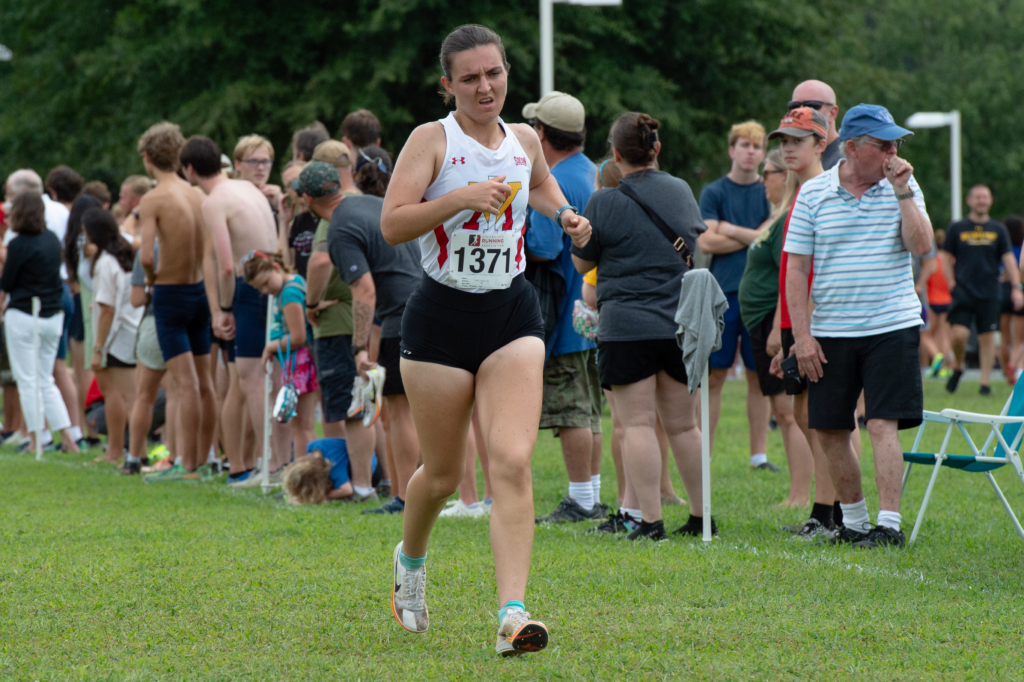
Virginia Military Institute’s cadet-athletes have to juggle cadet life, heavy academic course loads, and their NCAA Division I sport. Committed to both academic and athletic pursuits, balancing their rigorous schedule in both sports and school requires a certain level of commitment and discipline. Behind the Balance is a series that focuses on those cadet-athletes and how they handle the hurdles of the day-to-day.
It wasn’t love at first run for Abby Fiorillo ’25. She said her father made her do cross country when she was in high school, but the longer she ran, her love for the sport grew.
It brought her community, and it was something that she was excited to continue to do while at Virginia Military Institute.
“I love the competition,” she said. “It’s challenging, and I like the community around it.”
The physics major chose VMI for the ROTC aspect; she will be commissioning into the U.S. Army after graduation next year.
“I chose VMI for a lot of reasons,” she said. “My brother came here, so it was familiar. And then I really wanted the community that VMI has to offer.”
That community can be found in the Corps and within the cross country team. She said when she’s training during the week, she’s often running with a friend or finding time to reflect on her own. Her daily runs average between seven and eight miles, while she’s doing between 40 and 45 miles weekly.
“My favorite part about cross country is practicing. I love working out, and I don’t have to plan when my workouts are going to be. I already know I have a specified time,” she said. “It’s consistent. When I’m not studying or when I’m stressed, cross country gives me that outlet and that mental focus.”
She’s chatting it up when she runs with friends. Other days, she opts to listen to music on her phone.
“Some of the time, it’s like meditation,” she said. “And sometimes I don’t even think about anything. I’m just running.”
It’s become sort of routine for her, she said.
“I really don’t pay attention to it anymore because I’m so used to running it,” she said. “Now I just want to just go into my little mental state and clear my mind, or think about what happened that day, or something that’s on my mind, or what I want to do in the future.”
It can also serve as a planning period for her. Cadet-athletes at VMI not only have their responsibilities with their selected sport but cadet duties on top of that. Cadets are also required to take physical fitness classes twice a week, participate in ROTC all four years, prepare for room and uniform inspections, practice for parade, guard duty, and more.
Her regimented days begin at 6:45 a.m. and don’t end until after 8 p.m. She does set a hard stop at 10:30 p.m.
“I try to get as much sleep as I can, just because it’s taxing on your body and I enjoy it,” she said about her sport.
She said having a plan and system is important, especially knowing your priorities.
“I love my sport, but I’m here for academics. I’m really getting a degree out of this. It’s having priorities and knowing how to schedule it all, staying on top of homework, practicing every day and doing everything you can, just to fit it all in,” she said. “I think I was pretty good at routine in high school, but VMI made me realize that I can fit so much more into my routine than I thought.”
Fiorillo said the constant go of VMI will help her become a great leader. With her desire to commission into the Army, the ability of coming up with a plan and procedure will lend itself to her leading a platoon, she said.
“Knowing that there are going to be early days, late days … every day is going to be different. But making sure that you have your priorities straight is going to help with that,” she said. “I think VMI fosters that shared suffering of everyone doing the same thing. No one wants to wake up at 7 a.m. every day. But it shows that we’re a little bit more responsible, and it instills those characteristics.”
VMI cadet Hai-Hsin Huang ’25, an applied mathematics major with a minor in physics, is evaluating cost-efficient exercise programs for the elderly as part of the Summer Undergraduate Research Institute (SURI) at the Virginia Military Institute.
Huang has a keen interest in mathematical modeling and its applications across scientific fields and has previously undertaken independent studies and research projects in biological mathematical modeling and operations research.
This summer, he is combining his mathematical expertise with a meta-analysis of existing studies to determine which types of exercises. These include aerobic, strength training, or balance exercises that offer the best health outcomes for the elderly while remaining economically viable.
“SURI is a great opportunity that allows me to focus on my research without distractions,” said Huang. “The environment here at VMI is conducive to academic exploration and provides the resources necessary for thorough research.”
Huang’s research, supervised by Col. Mike Krackow, professor of human performance and wellness, aims to generate recommendations for healthcare providers and policymakers. These recommendations will help optimize aging and reduce healthcare costs.
Krackow, whose background includes healthcare and strength conditioning focusing on fall prevention for the elderly, has guided Huang through the research process.
“My role is to advise him on the process, provide resources, and ensure he produces a high-quality paper that could potentially be published or presented at a conference,” said Krackow.
Huang is optimistic about the potential impact of his work.
“Eventually, I hope this research can inform healthcare providers and policymakers about which exercise programs are most beneficial for the elderly while being cost-effective,” Huang explained.
Both Huang and Krackow agree on the importance of the SURI program for cadets, noting the development of critical thinking and problem-solving skills that are invaluable for future academic and professional endeavors.
“SURI helps cadets gain research experience that is beneficial for graduate school and professional fields,” Krackow said. “It allows them to disseminate relevant information and develop expertise in their specific areas of interest.”
Huang encourages future cadets to participate in SURI, advising them to take full advantage of available resources, seek guidance, stay organized, and choose research topics they are passionate about.
“SURI is a fantastic program that offers a unique opportunity to engage in academic research beyond regular coursework,” Huang said. “I highly recommend it to anyone interested in expanding their academic horizons.”