
Post View Unavailable »
New Website Launched »

VMI Army Cadets Win Bronze in Wales

For the second year in a row, the Virginia Military Institute Army ROTC Ranger Challenge team won the bronze medal at Exercise Cambrian Patrol (ECP), the British Army’s premier patrolling event held Oct. 3-12 in the Brecon Beacons, a mountain range in Wales in the United Kingdom (UK). Last year was the team’s first year to compete, and the first ROTC unit from the United States to participate.

Ranger Challenge is the “varsity sport” of the Army ROTC program, and is made up of eight cadets who tried out for the team last spring. Members include team captain James Aldinger ’26, Owen Brunk ’26, Gavin Hudson ’26, Jackson Karam ’26, Colin Russell ’26, Bradford Seery ’26, Raymond Moffett ’27, and David Townsend ’27. The team was coached by Sgt. 1st Class Robert Bain, military science instructor; Capt. Tyler Brians, assistant professor of military science; Capt. Pauline Johnson, assistant professor of military science and officer in charge of Ranger Challenge; and Capt. Christopher Lopez, military science instructor.

ECP is a continuous, 48-hour long-range international military patrol exercise across rough terrain. It originated in 1959 when a group of Welsh Territorial Army (now Army Reserve) soldiers designed a weekend training event which included long distance marching and a shooting competition.

ECP is both mentally and physically demanding, and considered to be one of the most difficult and esteemed of military competitions. Participants carry 80-pound rucks, get limited sleep, and have minimal food. It is open to regular military, reserve military, and ROTC units. Units outside the U.K. must first qualify by winning a similar competition in their home country. This year, over 125 teams from more than 30 countries competed at ECP.

VMI faculty member, Maj. Alex Paul, assistant professor in the Department of History, knows first-hand the challenging conditions in Brecon from his time serving in the British Army. As a young infantry soldier, he spent several weeks training there. Prior to the VMI team leaving for Wales, Paul met with them to help prepare them for what they could expect. He emphasized how quickly conditions in the area could turn dangerous.

“The rain doesn’t just fall, it comes sideways. The cold, the wet, and the wind together are unforgiving. You have to look after yourself and your kit, but more importantly, you have to look after each other.” Paul’s message to the cadets was clear, “Preparation and vigilance matter, but resilience and camaraderie are what see soldiers through the toughest conditions. Hot drinks, dry socks, and humor will get you through more than you realize.” Learning of the teams’ success at ECP, Paul shared he is very proud of them.

According to Brians, Cambrian Patrol is an extremely challenging training event that even active duty Army teams would be hard-pressed to perform well.

“Many of the tactics and skills that teams are assessed on during the event require specialized training. For VMI’s team to arrive at the exercise with only one month of training and earn bronze is truly exceptional. As a coach, I’m extremely proud of the team and respect their grit to remain focused on the mission even during adverse conditions. Most countries only send their best soldiers, and our ROTC team outperformed many of them.”

Hudson, a psychology major from Locust, North Carolina, stated the event was grueling, but he was thankful for the opportunity to participate.

“I couldn’t ask for a better group of guys to compete with. I have nothing but respect for this team. We all had to lean on each other and use our different skill sets to get the job done. Completing the Cambrian Patrol is an accomplishment in itself, and to be able to earn a medal with these guys is something special.”

Seery, an international studies major from Chesapeake, Virginia, also competed in Wales last year. He agreed with Hudson that their accomplishment was very much a team effort.

“Each of the eight members of the team did their part and pulled their own weight to help make this year another success. Without the help from all our coaches, and the support from the administration, our success would not have happened.”

Tryouts for next year’s Ranger Challenge team will be held in the spring.
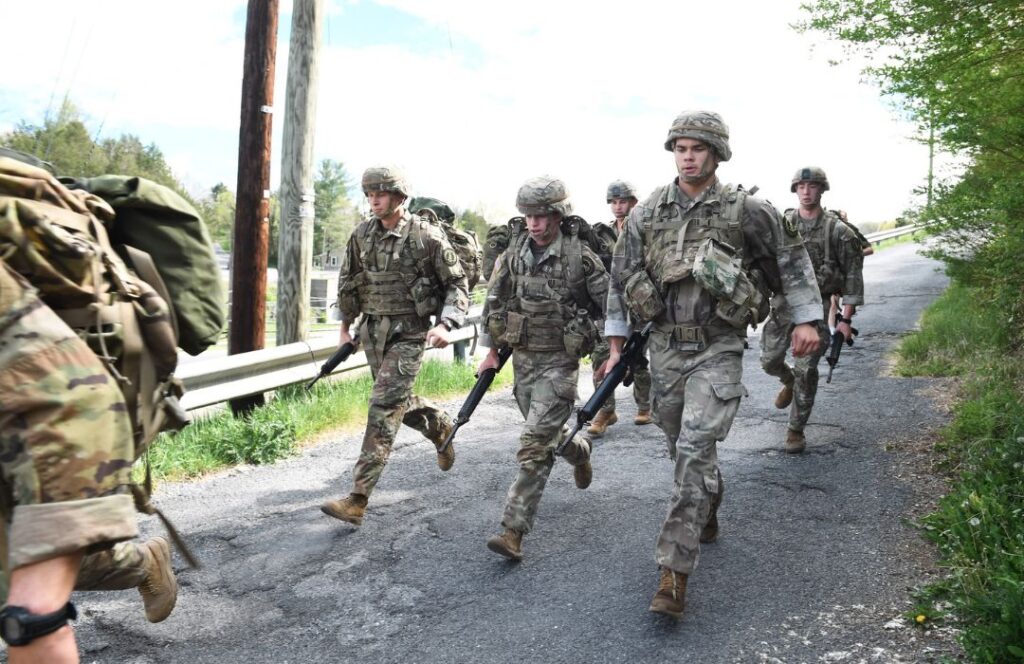
The Extra Mile: Ranger Challenge

Have you ever wondered what a mix of Army ROTC and a varsity sport would be? You’d get the Army ROTC Ranger Challenge team, which is a club at Virginia Military Institute.  

A cadet has two chances to make it into the Ranger Challenge team at VMI — once in the spring and another in the fall each year. The week-long tryout results in only 50% of those attempting landing a spot. 

What do tryouts entail? Two words — grueling effort. 

The club tests several skills, from written land navigation tests and day orienteering, to basic rifle marksmanship and a grenade assault course. There’s also the M-16 assembly/disassembly test, a mystery challenge that changes every year, and night orienteering. 

According to the Army, the Ranger Challenge team is described as an Army ROTC varsity sport, where teams form early in the semester and train nearly every morning of the week all the way up until the Sandhurst Military Skills Competition at the U.S. Military Academy (USMA) at West Point in mid-spring. 

But that’s not all, the club is also required to complete the Army Physical Fitness Test, which consists of two minutes of push-ups, two minutes of sit-ups, and a two-mile run — all to be completed when participating cadets are operating on less than six hours of sleep. 

Fun, right?  

It is for those who participate. More so, the experience helps prepare them for their future military careers.  

“You’re training for, essentially, what your job is going to be,” Collin Fitzpatrick ’23 said. “It’s a really good stepping stone.” 

The club is associated with Army ROTC, so those who are lucky enough to make the ranks are participating in activities that they will most likely be doing in their careers after VMI. Think of it as the best of the best. The cadets on the Ranger Challenge team often rank the highest in Cadet Summer Training (CST) and VMI’s Army ROTC.  

“It’s definitely a leg up for training for the standard Army ROTC,” Fitzpatrick said.  

The club is more rigorous than other clubs at the Institute. They practice as if they were an NCAA team. They complete physical training each morning that lasts for an hour beginning at 5:45 a.m. Then, every afternoon, they have skills practice for two hours.  

“We don’t have NCAA status, but I think the training time is similar to NCAA teams,” Fitzpatrick said. “We’re definitely one of the more active clubs. The thing is, it’s not really seen as a club because it’s associated with Army ROTC. We do fall in club status, but it’s kind of like limbo.” 

The majority of the team’s career goals are to be entry-level officers in the military.  

“It’s just a group of individuals that all are going toward the same goal. At the end of the day, we’re training for our jobs in the military,” Fitzpatrick said. 

Janine “J.J.” Colantonio ’23 said Ranger Challenge allows her to surround herself with others who are looking to better and challenge themselves.  

“It sounds kind of selfish, but we are preparing ourselves for careers at the end of the day,” she said.

Training for the Ranger Challenge team extends well beyond the academic year. The 2nd Class cadets on the Ranger Challenge team also participate in CST at Fort Knox, which involves platoon-level tactics and 10-level tasks, like individual soldier tests. Others throughout the summer maintain a regime with specified workouts to keep them in shape for the following year’s tryouts. 

The majority of cadets who participate in the Ranger Challenge either continue in schools like the Sapper Leader Course with the Army or Cadet Troop Leader Training (CTLT). 

VMI cadets participate in Ranger Challenge, an elite Army ROTC program.

“It’s basically just like the military version of an internship,” Colantonio said. “You’re going to shadow like a [platoon leader] in a certain unit … so a certain job type or description that appeals to you that you’d be interested in. And you’re just seeing what the unit does, what you would do in the future in that specific job.” 

Most recently, the team placed fifth, winning a Sandhurst Medallion for the top five overall teams out of 48 teams in the annual Sandhurst Military Skills Competition April 28 and 29.   

VMI competed against teams from USMA, the Air Force Academy, and the Coast Guard Academy, as well as Army ROTC units across the United States including Texas A&M, Notre Dame University, North Carolina State University, Liberty University, and the University of Central Florida. In addition, 14 international teams competed including the Royal Military Academy Sandhurst (RMAS) in Great Britain, as well as teams from Brazil, Canada, Chile, Denmark, Germany, Korea, Japan, Latvia, Mexico, Poland, Thailand, and Sweden. 

Those competing spent two days running a myriad of obstacles including weapons disassembly/assembly, grenade assault, gas mask function, rifle and pistol shooting, programming a radio, carrying a casualty, land navigation, and lugging their minimum 35-pound rucks for approximately 30 miles. The winner of the competition is chosen based on performance at each of the obstacles as well as the speed with which they complete them.    

The takeaway, despite the arduous efforts in this club, is the relationships made with those who are part of it. 

“It’s people,” Thomas Marlow ’23 said. “The caliber of people that we wake up every single morning with is pretty substantial. That reflects in so many different aspects here at VMI, not just Army.” 

“I’d say a big thing even from the relationships that I formed as a freshman, even the seniors on the team at the time, they’ll reach out to me, or I’ll reach out to them and  that mentorship continues,” Fitzpatrick said. “And as they move forward in life, I kind of move in their footsteps.”