Post View Unavailable »
New Website Launched »

21st Chaplain of the Marine Corps to Speak at Baccalaureate

Each May during graduation week at Virginia Military Institute, graduating cadets, family, and friends gather for a non-denominational Baccalaureate service. This annual event, hosted by the Chaplain’s Office, celebrates the collective faith, fellowship, and service among 1st Class cadets at VMI.  

Several special recognitions and awards are given to graduating cadets who have demonstrated exceptional service and character within their respective faith communities on post. The service also includes congregational songs, special music, and a guest speaker. For the past several years, the guest speakers have been chief of chaplains for the various military branches.  

For this year’s event, May 16 at 6 p.m. in Memorial Hall, VMI is honored to welcome Chaplain (Rear Adm.) Carey H. Cash,  the 21st chaplain of the Marine Corps and soon-to-be acting chief of chaplains. 

A native of Memphis, Tennessee, Cash graduated from The Citadel in 1992 with a bachelor’s degree in political science and was named First-Team All American for Division I-AA Football. Answering the call to ministry, he attended Southwestern Baptist Theological Seminary and earned his Master of Divinity in 1998. He completed a Master of Theology with a concentration in ethics from Boston University in 2008 and a Doctor of Ministry from The Catholic University of America in 2017.  

His operational tours include battalion chaplain to the 1st Battalion, 5th Marine Regiment where he provided ministry to infantry Marines during the opening months of Operation Iraqi Freedom. He then served as chaplain to the 2nd Battalion, 4th Marine Regiment after which he was chosen by the Navy’s chief of chaplains to receive the Military Chaplains Distinguished Service Award for Ministry to Marines. He also served as command chaplain aboard USS San Jacinto (CG 56), deploying to the Arabian Gulf in support of Operation Iraqi Freedom carrier operations and oil-platform defense; officer in charge of the Mobile Support Team for U.S. Naval Forces Central Command Forward – Afghanistan; command chaplain aboard USS John C. Stennis (CVN 74) and for Carrier Strike Group 3, deploying in support of U.S. 7th Fleet operations; and force and fleet chaplain for United States Naval Forces Central Command/ U.S. 5th Fleet in Bahrain, where he coordinated religious ministry for all Navy chaplains afloat and ashore serving in the U.S. Central Command’s area of responsibility.  

Cash’s shore assignments include deputy director, Chaplains Religious Enrichment Development Operation (CREDO) Europe; command chaplain to Naval Support Facility Thurmont, Camp David, Maryland; deputy command chaplain at the U.S. Naval Academy, and most recently, commanding officer, Naval Chaplaincy School, in Newport, Rhode Island. Cash assumed his current duties as the 21st chaplain of the Marine Corps and deputy chief of chaplains in May 2022.  

His awards include the Legion of Merit (two awards), Meritorious Service Medal (three awards), Navy and Marine Corps Commendation Medal (three awards), Navy and Marine Corps Achievement Medal (three awards), Combat Action Ribbon, and Presidential Unit Citation. 

Cadet Uses Disability to Motivate

Lou Ferrigno, bodybuilder and actor known best for his role in “The Incredible Hulk,” has been profoundly deaf most of his life. He once remarked, “I think my hearing loss helped create a determination within me to be all I can be, and gave me a certain strength of character too.”

Determined and strong of character are two descriptors of a successful cadet at Virginia Military Institute, so when Andrew Kiddie ’29, who was diagnosed with deafness just before his second birthday, chose to come to arguably the hardest senior military college in the country, he, like Ferrigno, used his disability as a motivator.

Kiddie has worn a cochlear implant (CI) for most of his life. It is a small, complex electronic device that helps people who are profoundly deaf perceive sound. The implant consists of an external portion that sits behind the ear and a second portion that is surgically placed under the skin. CI technology has improved since Kiddie was first fitted for one when he was a toddler. The CI he currently wears is sweat proof — crucial for a cadet — and uses Bluetooth technology, which Kiddie controls via an app on his phone.

“They are always finding ways to make the design better. With Bluetooth, I can have private phone calls and listen to music on my phone without anyone else hearing it,” he laughed.

Kiddie also knows American Sign Language (ASL) and can masterfully read lips.

When Kiddie began the application process to VMI, the Office of Admissions was cautious.

“Before they met me, they were hesitant. They didn’t know if I could handle the Rat Line with all the physical challenges constantly thrown at me.” When Kiddie finally met with members of the admissions office at an open house, they had him talk with the Institute physician, Dr. Melissa S. Krawiec ’01. She learned he successfully participated in JROTC and cross country during high school. She also had a phone conversation with the surgeon who implanted his CI, got a clear medical understanding of his condition, and discussed any reasonable accommodations he might need in order to participate safely and fully in the VMI experience. 

“With that information,” explained Krawiec, “I was able to have meaningful discussion with Col. Lawrence Havird ’90, commandant, and Col. Jack Johnson Jr., head of the Department of Human Performance and Wellness (HPW), both members of the fitness review panel that makes recommendations to the superintendent, and felt confident recommending him for admission.”

Kiddie’s father, Norman Kiddie, remembers when his son was accepted to VMI. “Andrew has worked incredibly hard for everything he has achieved. His dream was to attend VMI, and I will never forget the look on his face when he found out he had been accepted as the first cadet with a cochlear implant.”

Kiddie attended the Summer Transition Program, a curriculum designed to enhance the academic and physical fitness of incoming cadets, then officially matriculated last August. He confessed the most challenging part of VMI life was the Rat Line, not the physicality of it, but determining from which person the commanding voices were originating.

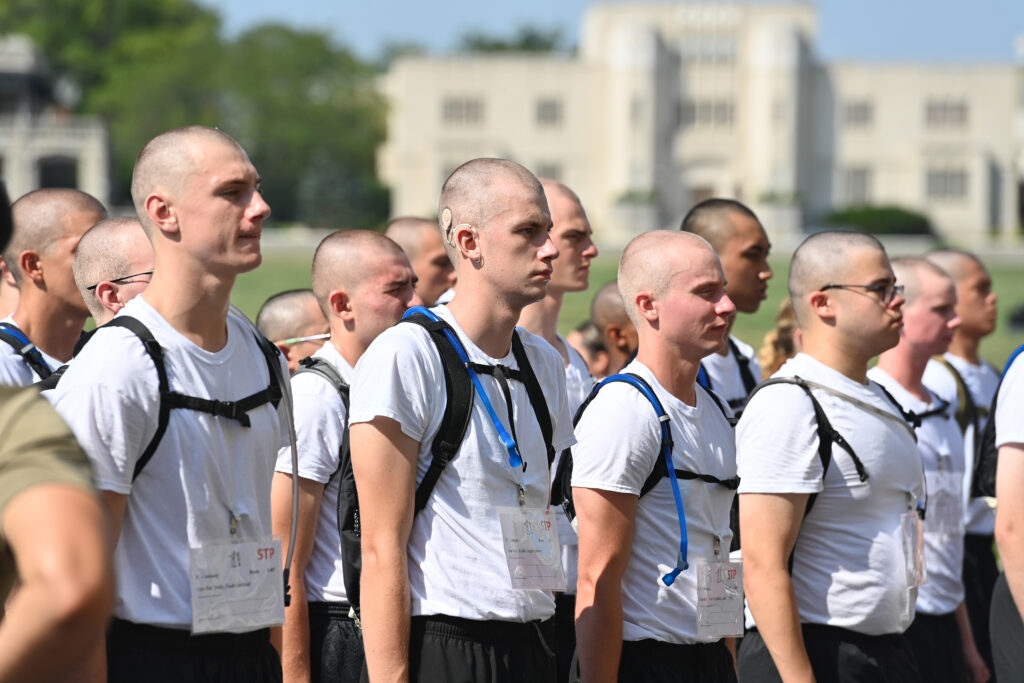
Andrew Kiddie ’29 and his brother rats wait outside the armory during Matriculation Week. –VMI File Photo by H. Lockwood McLaughlin.

“It was hard to figure out who was shouting at me when they were behind my ears. I couldn’t tell if it was the first sergeant, or master sergeant, or who else it might have been, so when I responded, I would usually get it wrong.”

Kiddie is majoring in biology. His academic advisor, Lt. Col. Mary Beth Manjerovic, associate professor of biology, reported he is an excellent student who has never let his deafness define him. “He is a great example of the VMI spirit because he holds himself to the same standards as his brother rats, meeting every expectation with focus and determination.”

His boxing class coach, Capt. Jim Whitten, instructor in HPW, agrees with Manjerovic. “Andrew’s hearing impairment is not an issue. He gives great effort and is constantly trying to improve.” 

Extracurricular activities Kiddie engages in at VMI include the Glee Club, VMI Theatre, and the mixed martial arts club.

Kiddie’s mother, Anzelle Kiddie, shared raising a child who is deaf has been a learning curve filled with tears, laughter, blessings, and grace. “It was very hard in the beginning, but we received assistance from wonderful people — speech therapists, special education teachers, and ASL interpreters—who all helped him become who he is today. We all had to believe, pray, and put in the work.”

A native of Chesterfield, Virginia, Kiddie is an alumnus of Manchester High School in Midlothian. He aspires to be the first deaf cadet to graduate from VMI and to be an inspiration to others with hearing loss. He hopes to commission into the Air Force. If he does not commission, he plans to attend medical school or veterinary school.

Cadets Present Research at NCUR

Eighteen Virginia Military Institute cadets joined approximately 5,000 participants at the National Conference on Undergraduate Research (NCUR) held at the Greater Richmond Convention Center in Richmond April 13-15.

NCUR is an organization dedicated to promoting undergraduate research, scholarship, and creative activity in all fields of study. It offers a unique environment for the celebration and promotion of undergraduate student achievement, as well as student career readiness development. The location for the conference changes each year, in various places across the country. In 2005, it was held at VMI and Washington and Lee University. 

Lt. Col. Molly Kent, director of the VMI Center for Undergraduate Research (VCUR) and associate professor in the Department of Biology, also attended the conference. She said this year’s group of cadets who applied and were accepted to present their work at NCUR was the largest since she assumed the role of VCUR director in 2024.

“We were pleased that the close proximity of this year’s conference allowed so many cadets to attend, and VCUR was able to fully fund the trip. Our cadets showcased the full breadth of the Institute’s academic excellence — from the arts and humanities to cutting‑edge engineering — through research conducted by cadets, alongside dedicated faculty mentors.”

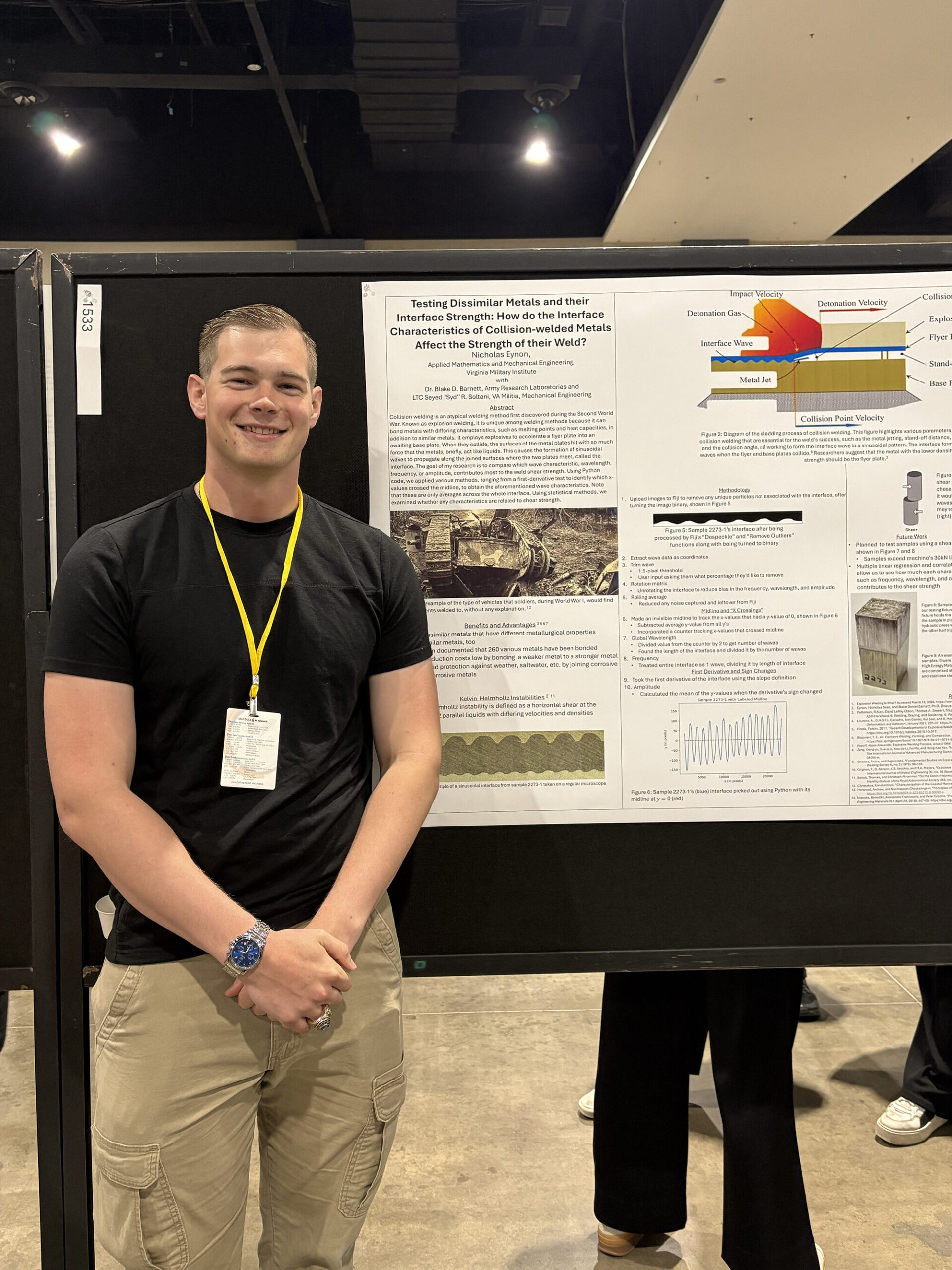
Nicholas Eynon ’26, an applied mathematics major minoring in philosophy, presented a poster based on his honors thesis, “Testing Dissimilar Metals and their Interface Strength: How do the Interface Characteristics of Collision-welded Metals Affect the Shear Strength of their Weld?”

Nicholas Eynon ’26 presents his poster at NCUR in Richmond. –Photo courtesy of Lt. Col. Molly Kent.

His research focused on collision welding, specifically its relationship between its shear strength and its interface characteristics. Eynon admitted he had fun at NCUR. “It was very enjoyable to present my work, not only as a reward, but to share the name and vision of VMI to other college students, show them the hard work I put into my research, and show them the same respect. It was interesting to hear about other students’ research, and in some instances, we discussed how our topics overlapped and could be used in tandem. Overall, I am very grateful for my time with NCUR.” Following graduation in May, Eynon will commission into the U.S. Army.

Nickole Chávez ’26, an English major minoring in Spanish, presented her project, “Bridging the Confidence Gap: ELL Mentorships and Narrative Exploration of the Mexican- American Student Experience.”

Her research involved an independent study working with an English Language Learner (ELL) student in Lexington, which led her to write a narrative of her own education using reflexive thematic analysis. “I used my experience of working in the school and my memories of growing up in a failing education system to corroborate articles I read about the lack of resources in schools for bilingual and immigrant students,” Chávez explained. She presented her findings in a crowded room, which she admitted was a little nerve wracking. “NCUR was an amazing experience. I was able to share a personal project that I worked on for two semesters. Sharing my story and experiences with a room full of students and professors from other schools was something I never thought I would do.” Chávez hopes to work for the Department of Homeland Security after graduating.

Basuchoudhary Edits Book

Col. Atin Basuchoudhary, the John and Jane Roberts Institute Professor in Free Enterprise Business in the Department of Economics and Business at Virginia Military Institute, recently co-edited, “The Cambridge Handbook on the Economics of Terrorism.”

Since the turn of the century, few issues have shaped political debate and policymaking more than terrorism. As a result, there has been a huge increase in the amount of academic research devoted to investigating the causes and consequences of terrorism. “The Cambridge Handbook on the Economics of Terrorism” is the first to present a state-of-the art survey of the economics of terrorism. It adopts a rational-choice perspective according to which terrorists are viewed as rational economic actors and presents a framework for analyzing the causes and consequences of terrorism. It explores the causes and consequences of terrorism and shines a light on practical counterterrorism policies and their trade-offs. With contributions from many leading figures in this fast-growing and important field, this book offers an accessible yet comprehensive collection of the economic analysis of terror.

Additional information on the book and purchasing details may be found on the Cambridge University Press website.

Shingledecker Featured on ‘With Good Reason’

Maj. Chris Shingledecker, assistant professor in the Department of Chemistry at Virginia Military Institute, is featured on “Eye in the Sky,” an episode of the public radio program, “With Good Reason,” that first airs April 25.

The show airs on 136 radio stations in 36 states. On the show, Shingledecker talks about his studies of ice layers that freeze in clouds of stardust using the James Webb Space Telescope. He shares that cosmic ice is a key ingredient in the formation of the universe.

Others on the show, including Dan Runfola from William & Mary and Scott Doney from the University of Virginia, highlight their work observing satellite images from space and how these images can teach us about the evolution of the human footprint and health of the oceans. “With Good Reason” is sponsored by the Virginia Foundation for the Humanities. Local broadcast times, as well as audio files of full programs and companion news features, are on the “With Good Reason” website.

Cadets Honor Fallen Alumni at Normandy

The Battle of Normandy, the Allied operation that launched the successful liberation of German-occupied Western Europe during World War II, began on D-Day, June 6, 1944. United States, British, and Canadian forces landed on five French beaches, marking history’s largest amphibious assault. Many U.S. servicemen were killed during the assault, including Virginia Military Institute alumni.

Eight 1st Class commissioning VMI cadets, along with their faculty leadership team, recently traveled to France through the Olmsted Foundation’s Undergraduate Program (OFUP). In preparation for the trip, one of the many assignments the cadets were given was to work in pairs and research the personal story of an alumnus who had died during the battle, and is buried at the Normandy American Cemetery in Colleville-sur-Mer, an itinerary stop planned for the group. Upon arriving to the cemetery, the cadets were to find the gravesite of the alumnus, and share that person’s story with the group.

Capt. Sydney A. Vincent Jr. ’40

James Bangura ’26 and Matthew Nordyk ’26 worked together researching Capt. Sydney A. Vincent Jr. ’40, born May 3, 1919, in Portland, Oregon, the eldest of three siblings. He graduated with a degree in civil engineering. His classmates described him as playfully argumentative and full of common sense, drive, originality, and the personality of a leader.

He served in the Army as a cavalry officer in the 803rd Tank Destroyer Battalion and operated a M10 Wolverine tank destroyer. He married Lt. Jane Margaret Byer, a Navy nurse, in 1943. On D-Day, Vincent’s unit was attached to the 29th Infantry Division and fought further inland. On the fateful day of July 18, 1944, Vincent fought alongside another VMI graduate, Maj. Glover S. Johns Jr. ’31, who would eventually retire as a colonel. A German observation post proved to be trouble for the Americans approaching Saint-Lô. Vincent was given permission to “take care of it,” and moved his M10 into position and fired upon the German emplacement. Tragically, enemy mortar landed on the thin-skinned, open-top M10 and fatally wounded Vincent. He was posthumously awarded the Silver Star Medal for his gallant actions. The citation reads: “On July 18, 1944, Captain Vincent led a detachment of his mechanized unit into the city in the face of devastating small arms fire and artillery fire. Throughout the attack, he remained at the head of his unit, encouraging and inspiring his men to close with the enemy.”

Bangura noted, “Vincent showed selfless service against enemies. He showed bravery and died wearing his VMI ring.”

The cadets were unable to access Vincent’s headstone due to wet conditions at the cemetery, but were able to get the full intended experience walking the cemetery’s paths, as well as spending time in a garden dedicated to the peace for which the Americans fought. Nordyk said walking alongside the graves was humbling and reminded him of the sacrifices made. “It is not a place of remorse, but remembrance. The headstones shine a brilliant and pure white, reflecting the honorable character found in those who fought and died for liberty.”

Capt. Harold Sheffey ’37

Jack Ericsson ’26 and Macallister Clark ’26 delved into the life of Capt. Harold Sheffey ’37 from Marion, Virginia, who studied liberal arts at VMI. He was nicknamed “Red” for his flaming red hair, was popular with his friends, and was somewhat of a ladies’ man. In the Army, he served as commander of Company K, 3rd Battalion, 330th Infantry Regiment, 83rd Infantry Division. He took command after landing on the beaches at Normandy, July 8. Eight days later, he was killed leading his men to liberate the town of Remilly-sur-Lozon. Ericsson acknowledged, “Seeing his gravestone was a humbling experience and I think it is important to keep the memories of those men alive.” Ericsson added Sheffey’s sister still lived in Marion until her death within the last decade.

Lt. Benjamin Rives Kearfott ’43

Nolan Savard ’26 and Liam Smith ’26 studied about Lt. Benjamin Rives Kearfott ’43. Born November 7, 1919, and a native of Martinsville, Virginia, Kearfott played football and basketball in high school. At age 17 he enlisted in the Virginia National Guard. In 1942, he married Mary Jennings of Lynchburg.

On D-Day, he was an infantry platoon leader in the 3rd Platoon, Company A, 116th Infantry Regiment, 29th Infantry Division—the unit famously known as the Bedford Boys—tasked with landing on the westernmost sector of Omaha Beach. He was aboard Landing Craft Assault 1015 with Capt. Taylor Fellers and 30 other soldiers from Company A. While not originally from Bedford, Kearfott was reassigned to the unit due to a chance illness of another officer. Upon landing on Omaha Beach, all men aboard the landing craft were killed instantly by machine gun fire. Their bodies were scattered along the beach. Kearfott was awarded the Purple Heart, which is currently kept at the VMI Museum, along with his casket flag and emblem of the 29th Infantry Division. 

Capt. Dan Joseph Morton ’41

Anna Grace Adams ’26 and Samantha Waters ’26 researched Capt. Dan Joseph Morton ’41

from Columbus, Georgia, who became an Army cavalry officer and married Bette Wright. As a second lieutenant, Morton participated in Operation Torch, the Allied invasion of French North Africa in November 1942, and Operation Husky, the Allied invasion of Sicily in July 1943. Adams recounted, “By June 1944, the time of the Normandy campaign, he had been promoted to captain and was an experienced and decorated armor officer. He was on the intelligence staff for Combat Command A of the 2nd Armored Division.”

Waters described the circumstances of Morton’s death. “During Operation Cobra, an offensive which began seven weeks after D-Day, Morton’s unit was leading an advance near the village of Villebaudon. They were ambushed by four German tanks. Being on the intelligence staff, he was not required to take the lead in a counterattack, but Morton stepped up and took the initiative to save his unit. His tank was fired upon, and shrapnel hit him in the chest, killing him instantly on July 28.” Morton was temporarily buried at Sainte-Mère-Église. By 1948, Bette had remarried, and his father had died, so his mother made the decision to have his remains transferred to the Normandy American Cemetery. He was awarded the Silver Star Medal posthumously.

Two members of the faculty leadership team who traveled with the cadets, Lt. Col. Jochen Arndt, associate professor of history, deputy director of the John A. Adams ’71 Center for Military History and Strategic Analysis, and OFUP director; and Col. Houston Johnson V, professor and head of the Department of History, explained the importance of the cadets researching the fallen alumni. “The Battle of Normandy involved hundreds of thousands of troops and casualties. Researching and retelling the stories of VMI alumni who served and died in Normandy allowed our cadets to gain a deeper understanding of the heroism and tragedy of D-Day and WWII, and the VMI connection to those events,” said Arndt.

Johnson agreed. “It was extremely gratifying to see the Olmsted cadet participants embrace their research into these alumni who perished during the Normandy campaign. The cadets were able to gain new insights into both VMI’s history and that of the D-Day landings and subsequent Normandy campaign; to be able to reflect on these men’s sacrifices at the Normandy American Cemetery made that reflection particularly meaningful.” 

Holston Featured on ‘With Good Reason’

Col. Ryan Holston, professor in the Department of International Studies and Political Science and the Jonathan M. Daniels ’61 Chair for Academic Excellence at Virginia Military Institute, will discuss the book he co-edited with Justin Garrison, “The Historical Mind: Humanistic Renewal in a Post-Constitutional Age,” on an episode of the public radio program, “With Good Reason,” that will first air April 18. The show airs on 136 radio stations in 36 states.
 
In the book, published in 2020, Holston argues that the biggest political problems can be traced to a “thinning” of the human character, and that without self-restraint even the best constitution becomes useless.

“With Good Reason” is sponsored by the Virginia Foundation for the Humanities. Local broadcast times, as well as audio files of full programs and companion news features, are on the “With Good Reason” website.

VMI Wins First Place at Cybersecurity Competition

The Virginia Military Institute team won first place recently at the 2026 Seerist Intellithon in Reston, Virginia.

The prestigious competition hosted by Seerist — a company whose mission is to shape the future of risk intelligence by enabling organizations to proactively anticipate, manage, and respond to global cyber threats — brought together top talent from five senior military colleges including The Citadel, Norwich University, the University of North Georgia, Virginia Tech, as well as VMI, to solve real-world open-source intelligence and security challenges.

The cadet team, sponsored by Department of Computer and Information Sciences (CIS) and Cyber Defense Laboratory (CyDef), included Michael Kelley ’27, Caroline Marini ’26, River Smith ’27, and John Stotler ’27. Col. Imran Ghani, professor in CIS and director of operations for CyDef, was their coach.   

Stotler shared it was an amazing experience. “We utilized tools and skills to collect intelligence and brief highly significant persons on real world activities that were frequently being updated.”

Ghani stated the VMI victory was built on preparation and discipline.

“To prepare for the competition, the cadets conducted multiple rounds of targeted practice using a preemptive, scenario-based approach, which ultimately aligned with the competition. Their commitment, ability to follow structured mentorship, and continuous skill refinement were key factors that led to this success.”

Bott Designs Retractable Boat Anchor

Connor Bott ’26, a mechanical engineering major at Virginia Military Institute, has designed a modern adaptation for an ancient devise with his honors senior thesis project, “Design and Analysis of an Electromechanical Marine Wreck Anchor.”

From the Eastern Shore town of Exmore, Virginia, Bott’s hobbies include fishing, boating, and scuba diving. Through these interests, he observed that small boat anchors, crucial for positioning the boat as well as for safety, often get stuck and have to be cut loose and abandoned, which inspired him to research better anchor designs.

He began his presentation with explaining how anchors work.

“There is a misconception that an anchor is just a big weight that you drop off the side of the boat and then the weight alone holds the boat in place. That’s not how they work. To properly operate them, you let out enough anchor line, then pull, allowing the anchor arms to burrow into the ground.” He added an important thing to consider when choosing an anchor, is the makeup of the seabed. “On the bottom could be sand, mud, rock, grass, clay, or a combination. If the boat is over a wreck, a reef, rocks, or trees, you might use a grappling hook style anchor, because instead of burrowing, it’s designed to hook onto something underwater.”

Bott explained challenges with grappling hook anchors.

“Anchor arms might hook under a rock, a log, or a hard piece of wreckage and get stuck. Unless you have someone who can put on scuba gear and dive down to wedge it free, you will have to cut your anchor line and leave the anchor. That is not a pleasing prospect, since some anchors can cost hundreds of dollars.”

To prevent loss of equipment and money, Bott wanted to construct an electromechanical anchor to drop over shipwrecks for divers who enjoy exploring wrecks like he does. He designed his anchor to be compact, have the look and feel like a regular grappling hook anchor, be intuitive to operate, use a physical and electrical tether, and realistically manufacturable. He envisioned a seatbelt-style release mechanism, so with a press of a button the anchor arms unfold, and the user can easily pull up the anchor.

After a lot of design and redesign work, much calculation regarding forces, friction, and water pressure, Bott’s design was ready to be tested. He engaged the expertise of engineering department lab technician Michael Cullen, and machinist Marco Floyd, who were instrumental in bringing the anchor to life.

“Building this thing was a fun process, because I would take my design down to our machinist, and he would look at it and say, ‘You’re crazy. We can’t make this on our equipment.’ So, we would sit down together, and he would come up with ideas on how we can break up this complex geometry to a bunch of little pieces, so that one piece became five different pieces that fit together like a little jigsaw puzzle.”

Bott concluded by sharing the next steps for his project are putting the electronics into the housing of the anchor, performing a leak test, and a final load test underwater. “I’m very happy with how far we’ve gotten, and I’m very excited to get this thing in the water and make sure it actually works like we hope.”

Col. Gerald “Jay” Sullivan, professor and head of the Department of Mechanical Engineering, served as Bott’s advisor on the project. Sullivan stated that given Bott’s hobbies—especially wreck diving—and all the mechanical maintenance that goes along with them, he wasn’t too surprised that he came up with this project.

“Connor is very good with his hands and highly analytical. He was able to bring together all these really great analytical skills that he has in mechanical engineering, with superior manufacturing skills, and intense creativity, to bring this project to fruition.”

Bott is the son of Charles Bott ’96. He is an alumnus of Norfolk Academy, and plans to pursue a graduate degree in marine or subsea engineering following graduation.

Commissioning Cadets Explore la France

 A contingent from Virginia Military Institute toured France during spring furlough thanks to the Olmsted Foundation’s Undergraduate Program (OFUP). Eight 1st Class commissioning cadets along with their faculty leadership team, Col. Houston Johnson V, professor and head of the Department of History (DOH); Lt. Col. Jochen Arndt, associate professor of history, deputy director of the John A. Adams ’71 Center for Military History and Strategic Analysis (Adams Center) and OFUP director; and Col. David Gray, executive director of VMI’s Center for Leadership and Ethics (CLE), toured regions throughout the country. The fully funded trip was co-sponsored by VMI’s DOH, the Adams Center, and the CLE. Assistance was provided by the Office of Global Education (OGE). Cadets were chosen through a rigorous application process based on their GPA, ROTC ranking, a written essay, and personal interview.

The OFUP offers overseas travel and cultural immersion opportunities to service academy cadets, midshipmen, and ROTC students attending or associated with selected Title 10 senior military colleges. These trips are conducted in non-English speaking countries with exposure to national perspectives and a focus on the role of U.S. policy in those regions.

Arndt reported that to prepare for the trip, cadets hosted a reception for a French military delegation and French exchange students on post; developed their travel itinerary; participated in a reading seminar focused on the French culture, the American Revolution, WWI, WWII, the Cold War, and the period since; researched personal stories of VMI alumni who died during the Battle of Normandy; and attended safety briefings. “Upon arriving in France, our first base of operation was the town of Bayeux in Normandy where the cadets learned the history of the Battle of Normandy by visiting the iconic church in Sainte-Mère-Église, one of the first towns liberated on D-Day, June 6, 1944, and Pointe du Hoc, where U.S. Army Rangers heroically scaled 100-foot cliffs under enemy fire,” he shared.

For Gray, who teaches courses on U.S. military history, a key event for the group was visiting the Normandy American Cemetery in Colleville-sur-Mer, overlooking Omaha Beach.

“We spent several hours, allowing for cadets to find the graves of the fallen VMI alumni they had earlier researched, and report their acts of heroism,” said Gray.

The second base of operation was the city of Paris where cadets participated in a wide range of activities. Johnson related highlights of their time in the capital city.

“We took a gastronomic walking tour of the neighborhood of Saint-Germain-des-Prés where cadets learned about the production and cultural importance of food for France. We saw major sites like Notre-Dame, the Eiffel Tower, and the Champs-Élysées. We also visited Mont Saint-Michel and the Palace of Versailles and its gardens.”

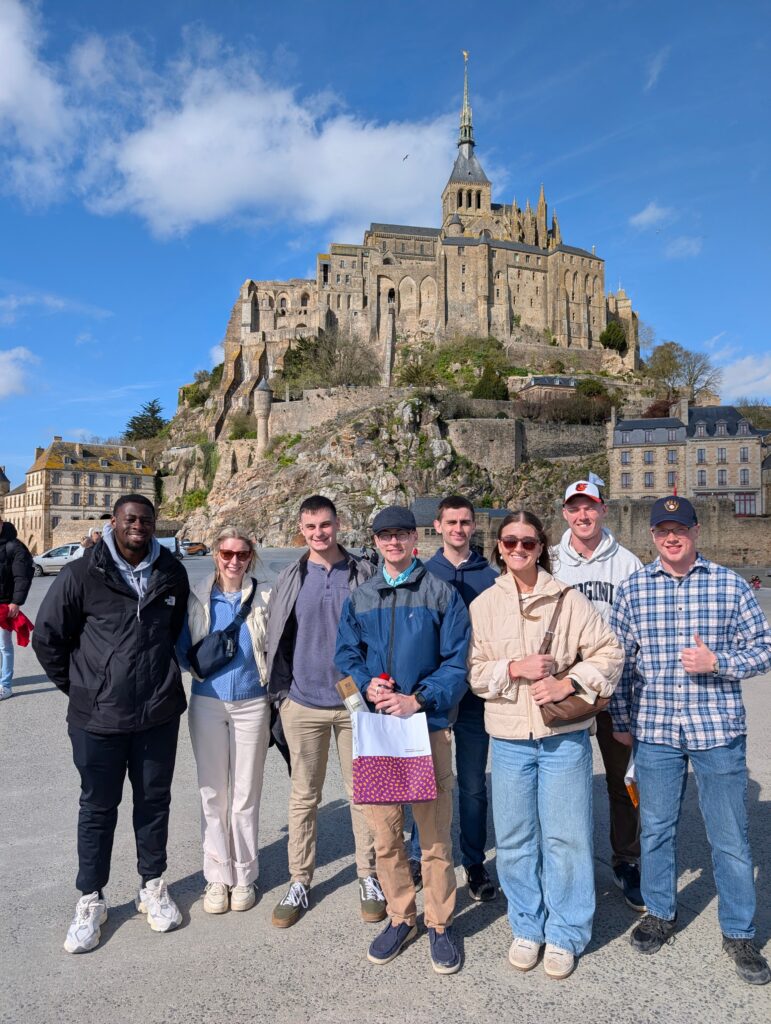
Mont Saint-Michel towers over VMI cadets in Normandy, France. –Photo courtesy of Col. Houston Johnson V.

Particularly informative for the cadets was dining with Olmsted Scholar, U.S. Navy Lt. Cmdr. Sean Margot, who is currently studying at Sorbonne University, as well as U.S. Marine Corps Maj. Skye Martin and U.S. Army Maj. Calista Stoop, both of whom are currently studying at the French War College, École de Guerre in Paris. While conversing over dinner, cadets learned about the Olmsted Scholar Program, and were inspired by the opportunities available to them as they embark on their military careers in May.

For Samantha Waters ’26, a history major who will commission into the Navy, the trip is one she will never forget. She was amazed by how the people of France remember and respect the German WWII soldiers buried at La Cambe German War Cemetery in Normandy.

“They were the enemy, but the French recognize that the average age of those soldiers was 20. They had mothers and fathers who waited for them to return. I think this prepared me more for the military. I’ll be faced with making difficult decisions, and risking human life should never be taken lightly.”

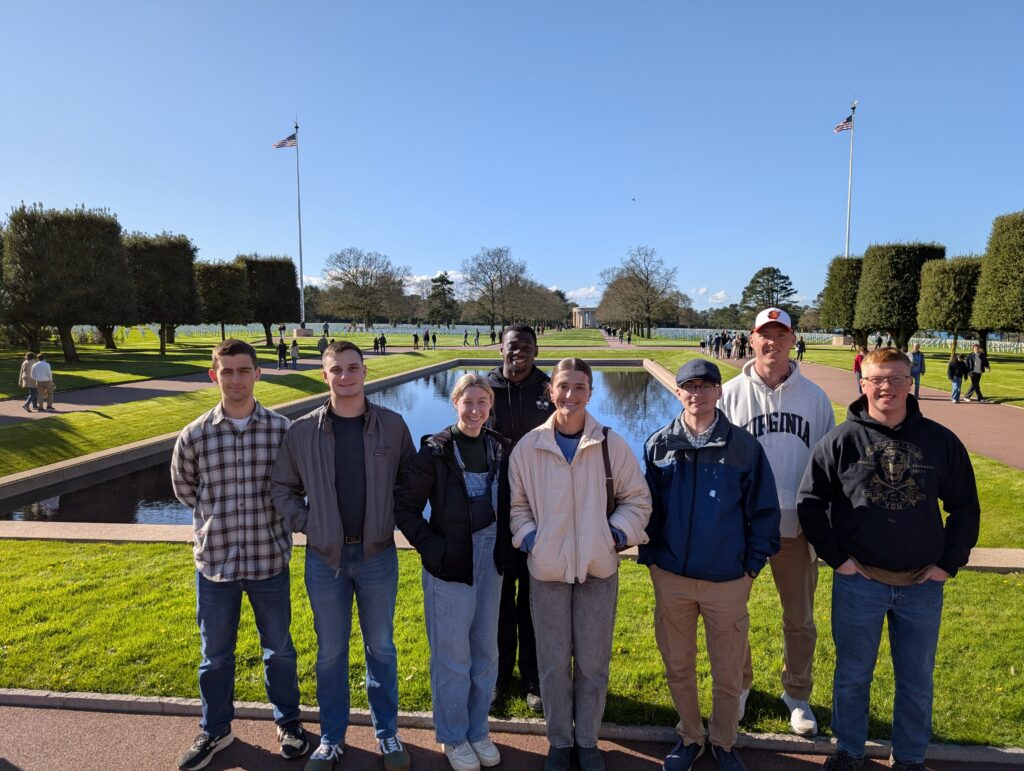
Cadets pay their respects at the Normandy American Cemetery in Colleville-sur-Mer. –Photo courtesy of Col. Houston Johnson V.

James Bangura ’26, who is majoring in computer science and will commission into the Army, had the unique opportunity of celebrating Eid al-Fitr, an Islamic observance kept worldwide, at the Grand Mosque of Paris.

“As a Muslim cadet, this was a significant moment for me. It allowed me to practice my faith while abroad and experience how Islam is observed in a different cultural setting, further reinforcing the importance of religious and cultural understanding.”

Both cadets agreed the trip directly contributes to their preparation for military service by reinforcing what they have already learned about American and world history, the importance of working with partner forces; understanding different cultures, social norms and communication styles; and navigating throughout a foreign country.

VMI Superintendent Lt. Gen. David Furness ’87 recently signed a memorandum of understanding (MOU) with the Olmsted Foundation, establishing the nation’s first Olmsted Intern Program for cadet overseas travel. According to Col. Jeff Kendrick, director of OGE, the MOU expanded and rebranded the undergraduate program that VMI has been running for several years.

“VMI is honored to continue the tradition of exposing future military leaders to national perspectives and the role of U.S. policy in those regions that are visited each year. The highly selective program is reserved for top performing cadets, and selection is solely merit-based. Six to eight cadets will be chosen to participate in the program each year, and will receive full funding for one to three weeks of travel. While the new program shares many of the same objectives as the previous one, there is now more of an emphasis on cadet leadership and preparation for possible participation in the Olmsted Scholar Program for junior officers,” he said.