Post View Unavailable:
Post View is currently unavailable due to technical difficulties. More information.Last Updated: 01-08-2026 09:42 AM»
Notice:
VMI.edu has recently been updated and upgraded. Please note that some URLs may have changed. Visitors are encouraged to use the new, expanded site menu and site search to navigate through these changes.
New Website Launched»
VMI basketball guard TJ Johnson has been selected as one of just three student-athletes nationwide to serve on the NCAA Division I Board of Directors.
The board is the highest-ranking governing body for the division, with oversight of the Division I budget, select litigation matters and infractions processes.
As a student-athlete on the committee, Johnson will be tasked with giving an athlete’s perspective of everything happening in the current collegiate sports landscape such as NIL, the transfer portal and many other areas.
“The Board of Directors are in charge of making a lot of the rules and everything going on behind the scenes,” Johnson said. “The three of us will give feedback on what our experience has been like, what we view as things we can change, make better, explain what’s working and what is not, etc. We’re there to give a broader perspective of what it’s like from our side of the spectrum.”
For the past few months, Johnson has served as the SoCon representative for the NCAA Student-Athlete Engagement Group and heard about the opportunity to serve on the NCAA Board of Directors through that association.
“We had our first Student-Athlete Engagement Group meeting a couple months ago and they spoke of a few different leadership positions that had opened,” Johnson said. “One was to serve as a student-athlete representative for the NCAA Board of Directors. They sent the reps from all the other conferences an application, so I went through the application process and found out last week that I had been selected.”
An economics and business major, Johnson is set to begin his responsibilities with the committee in January.
“It’s a good opportunity for me to learn how the NCAA functions and how they make decisions,” Johnson said. “I hope to be able to make it better in some way, shape, or form. I’ve got two younger brothers – one playing basketball at another university and one in high school – so I have the mindset going in that hopefully I can help make it better. I’m looking forward to a great experience and to learn from it.”
“This is a tremendous honor for TJ from the NCAA to be selected as one of three student-athletes from around the country. He is a leader on and off the court and impacts people in so many ways. We are very proud of him and look forward to seeing the impact he has on this committee.”
One of the many things Virginia Military Institute cadets are renowned for are their selfless acts of service, even when it is not convenient. That was made evident during the most stressful and demanding time of fall semester, exam week.
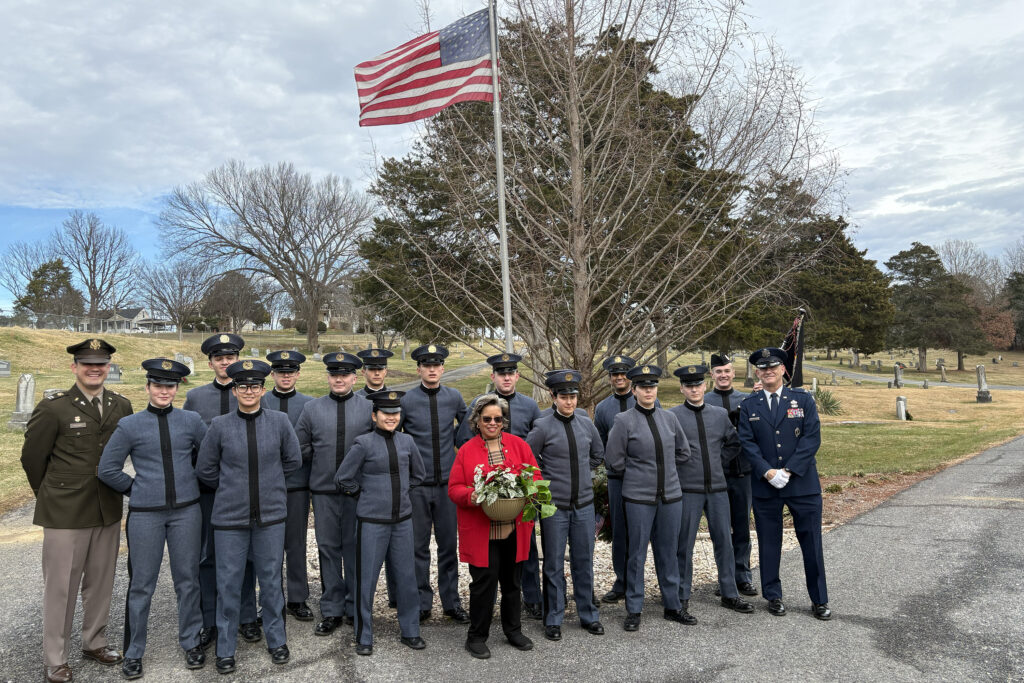
The Building BRIDGES Club at VMI supported the local nonprofit, Remembering Rockbridge Veterans, in participating in National Wreaths Across America Day, Dec. 13.
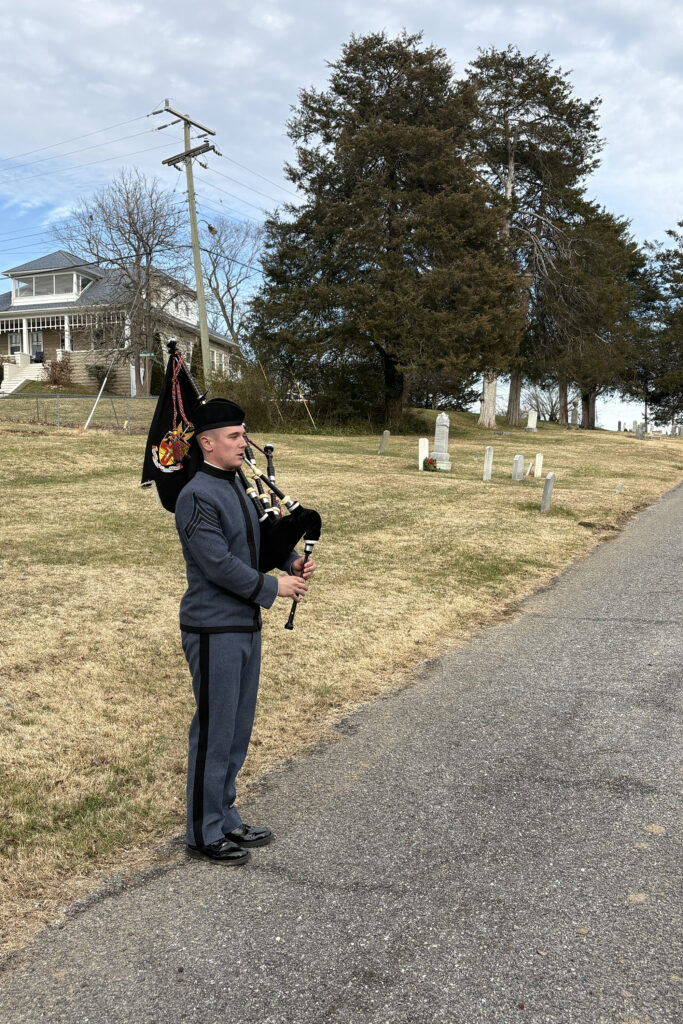
Fourteen cadets laid wreaths on veterans’ headstones at Evergreen Cemetery. During the solemn ceremony, Capt. Eli Facemire ’19, associate chaplain to the Corps of Cadets, delivered the invocation; Col. Ley Havird ’90, commandant, provided remarks; and Ben Bowen ’26 Pipe Band major, offered a rendition of “Amazing Grace” on bagpipe.
Col. Valentina Dimitrova-Grajzl, faculty co-advisor for Building BRIDGES, also in attendance, was moved the cadets chose to participate on their last Saturday before winter furlough.
“I am glad cadets could take part in this event to honor and remember our veterans, and to reflect on the sacrifices they made to defend our freedoms.”
Nationally, the Wreaths Across America activity incorporated two million volunteers at more than 5,200 locations in all 50 states, remembering the fallen, honoring those who serve, and teaching the next generation the value of freedom.
The evening before, the Building BRIDGES Club; Preston Library; the Office of Diversity, Opportunity, and Inclusion; and the cadet art group sponsored a holiday card-making event at the post exchange. A large crowd of cadets gathered for hot apple cider, s’mores, and to create and personalize greeting cards for veterans, senior community residents, and others in need of some extra seasonal cheer.
Sean Daffron ’26, along with his roommates, attended to share in the holiday merriment. He revealed his own grandparents recently moved into an assisted living center.
“I know how hard it is to be away from family, especially during the holidays. I’m hoping these cards can make the recipients’ days more cheerful, even if it’s just a little.”
A webpage dedicated to national postgraduate scholarships and pre-professional programs in law and health professions available to Virginia Military Institute cadets, regardless of their commissioning status, was recently unveiled to 1st and 2nd Class Institute Honors cadets.
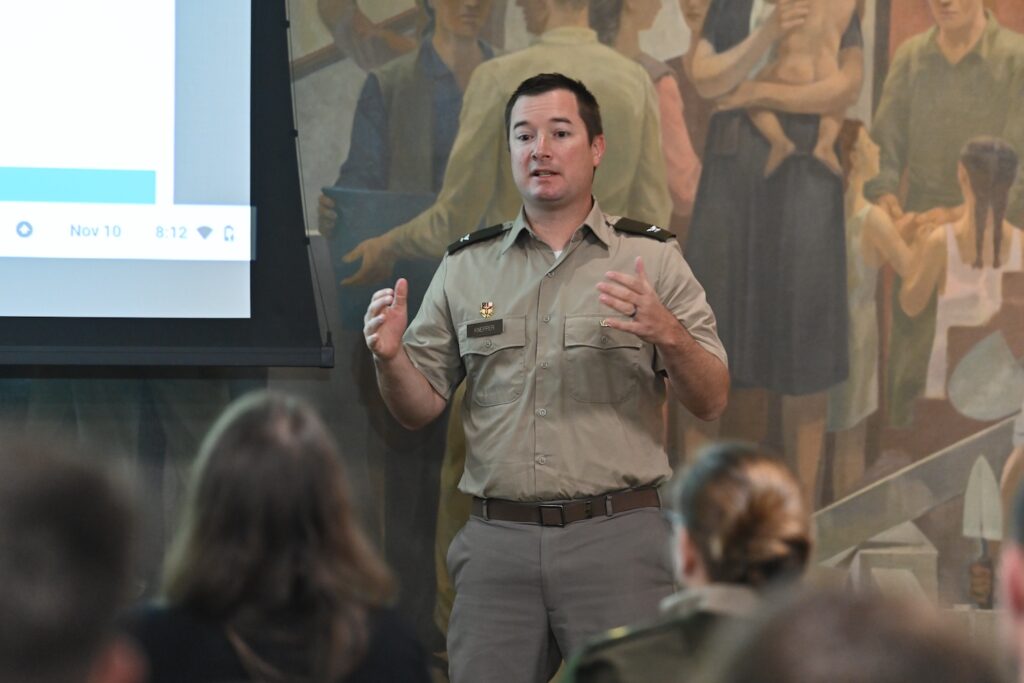
Col. Robert McDonald, associate dean for academic affairs and director of the Honors Program, welcomed the cadets to the informational session in Pogue Auditorium, and introduced a group of faculty advisors who have developed expertise for a specific scholarship or program. For over 18 months, the advisors have been collaborating on ways to increase awareness of the scholarships and programs, along with respective requirements and application procedures.
Scholarships include the Marshall Scholarship, which funds students seeking a master’s degree in the UK, advised by Lt. Col. Patrick Eichholz, associate professor in the Department of English, Rhetoric, and Humanistic Studies (ERHS); the Rhodes Scholarship, which funds a graduate degree at Oxford University, advised by Col. Steven Knepper, professor in ERHS; the Gates Cambridge Scholarship, which funds a graduate degree at the University of Cambridge, advised by Maj. Christopher Blunda, assistant professor in the Department of History; the Fulbright Scholarship, a program for students pursuing graduate study, research, or teaching English abroad, advised by Col. Jeff Kendrick, director of the Office of Global Education; the Truman Scholarship, for students wanting to study in the U.S. and pursue careers in public service, advised by Dr. Vera Heuer, professor in the Department of International Studies and Political Science (IS); and the Barry M. Goldwater Scholarship, which provides money for rising college juniors and seniors in the natural sciences, mathematics, and engineering who are interested in pursuing careers in research, advised by Col. David Feinauer, professor in the Department of Electrical and Computer Engineering.
Maj. Alison Burke, assistant professor in the Department of Biology is the advisor for the Pre-Professional Program for cadets aspiring to go into a health profession; and Lt. Col. Tim Passmore, associate professor in IS, is the advisor for the Pre-Professional Program for cadets who wish to attend law school. VMI has admissions agreements with leading law and medicine programs, and very recently supported eight cadets applying to law schools at the University of Virginia, William & Mary, Washington and Lee University, and the University of Richmond.
Col. Steven Knepper discusses the requirements and application procedure for the Rhodes Scholarship.—VMI Photo by Kelly Nye.
McDonald advised the cadets that the programs are highly competitive, and they should start their application process early.
“You all have good grades, but grades aren’t enough. If you are interested in any of these programs, contact the expert advisor. If your resume seems aligned, we will do everything possible to help you shape a viable candidacy for any award you want to pursue. VMI has produced 11 Rhodes Scholars, four Fulbright Fellows, two Fulbright Scholars, two Gates Cambridge Scholars, one Barry M. Goldwater Scholar, one Marshall Scholar, and many other recipients of nationally prestigious awards. For a school our size, those are remarkable statistics, and I believe some of you sitting in this room have the ability to add to that impressive record.”
The presentation will be repeated in February for 3rd Class Institute Honors cadets, then annually thereafter.
For more information on VMI’s postgraduate scholarships and pre-professional programs, go here.
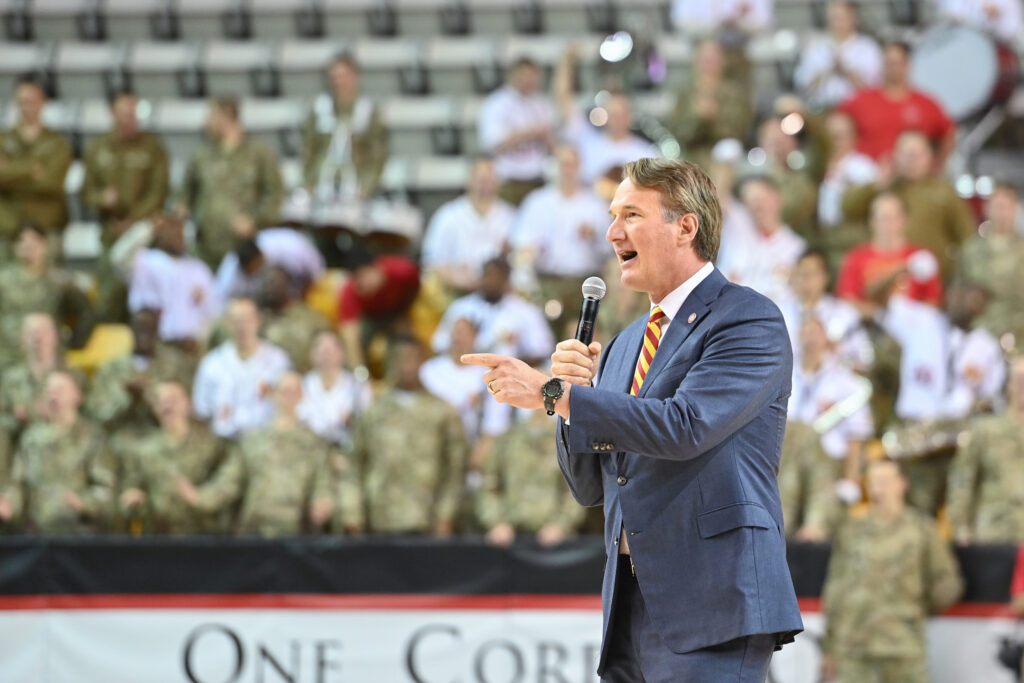
VMI welcomed a special guest to the last home basketball game before winter furlough. Gov. Glenn Youngkin was warmly welcomed by the Corps of Cadets in Cameron Hall Dec. 9, as the Keydets took on the Loyola University Greyhounds.
Youngkin, who celebrated his birthday in Lexington that evening, sat in the stands alongside his wife, Suzanne, VMI Superintendent Lt. Gen. David Furness ’87, and his wife, Lynda.
At halftime, Youngkin walked out onto the court and was serenaded with “Happy Birthday” by the Corps, whom he thanked and went on to address.
“Every time I am here, I am overwhelmed with pride. I love this place. One of the greatest honors I have had during my time as governor is to speak at graduation two years ago.” Acknowledging the approaching end of the semester, he pivoted his narrative. “Some of you might be carrying some burdens. There has only been one perfect person in the history of this planet, and it is none of us.”Gov. Glenn Youngkin addresses the Corps of Cadets during halftime in Cameron Hall Dec. 9.
The Corps, anticipating what was coming next, erupted into ecstatic cheers.
“By the power vested in me, as governor of the Commonwealth of Virginia and commander and chief of the Corps of Cadets, I do hereby grant amnesty to those cadets who have unserved duties and commitments.”
The raucous ovation, jumps of joy, and brother rat hugs continued for several minutes as the governor was gifted a red VMI cap which he immediately donned. As he exited the court to return to his seat, he was impeded by rats imploring him to autograph their Rat Bibles, which he did graciously.
Following the Keydets victory over the Greyhounds 86-70, Youngkin joined the team on the floor as the entire Corps stood at attention and sang “The VMI Doxology.”
Col. Steve Knepper, professor in the Department of English, Rhetoric, and Humanistic Studies at Virginia Military Institute, is featured on ” The Weight of a Whale”, a poetry episode of the public radio program, “With Good Reason,” that first aired Dec. 5. The show airs on 136 radio stations in 36 states.
Knepper is a poet and writer who founded an online poetry journal called New Verse Review: A Journal of Lyric and Narrative Poetry. He grew up on a small dairy farm in Pennsylvania and came to poetry relatively late in his career. His poem, “Breech,” is his memory of his father’s struggle to help a distressed cow give birth to her calf. On the show, he talks about his own poetry and some of the poets featured in the online journal.
“With Good Reason” is sponsored by the Virginia Foundation for the Humanities. Local broadcast times, as well as audio files of full programs and companion news features, are on the “With Good Reason” website.
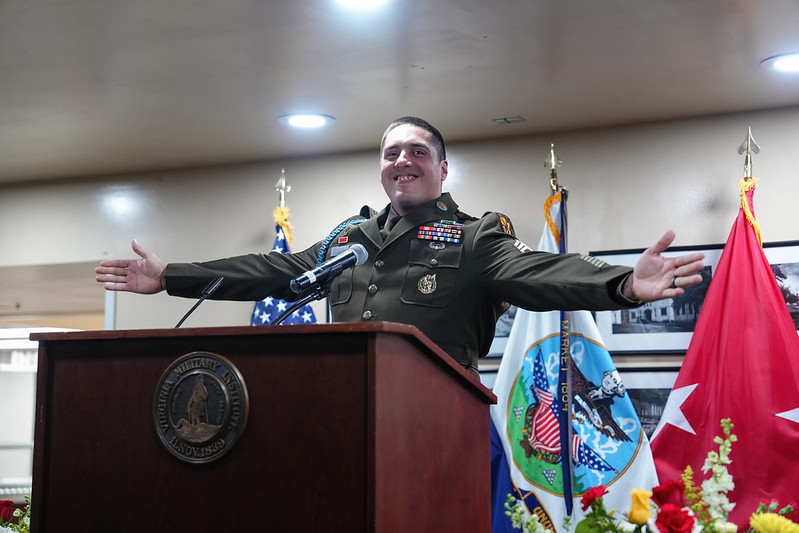
Virginia Military Institute will hold its December ROTC joint commissioning ceremony, in which approximately 20 new officers take their commissioning oaths, Wednesday, Dec. 17 at 5 p.m., and commencement ceremony, Thursday, Dec. 18 at 11 a.m. About 25 cadets are expected to receive the diplomas. The public is invited to attend both ceremonies, which will take place in Memorial Hall on post.
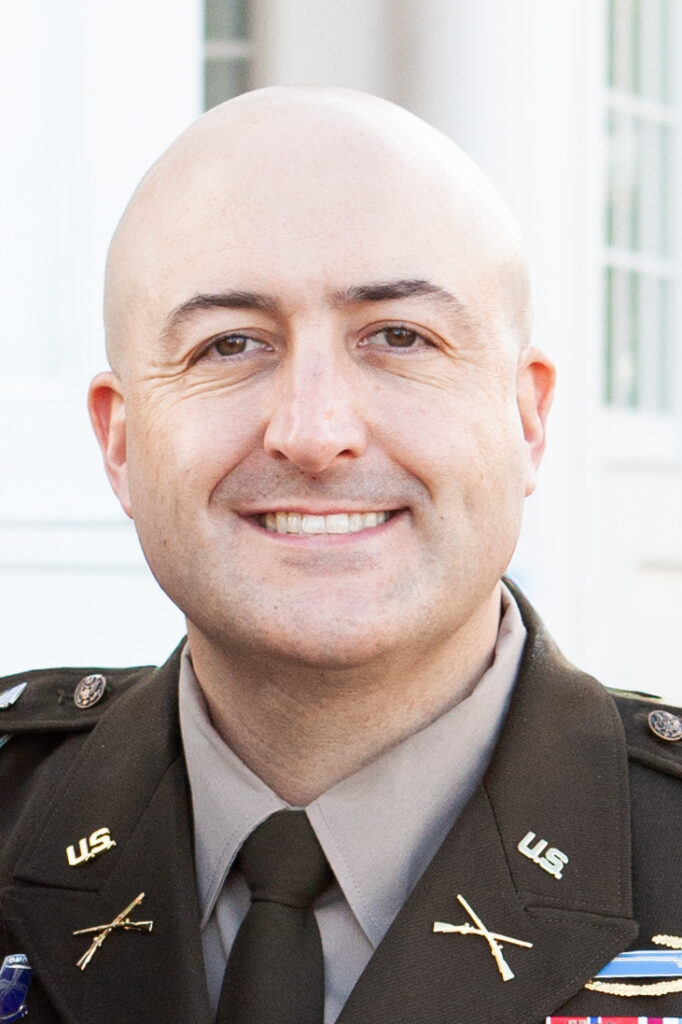
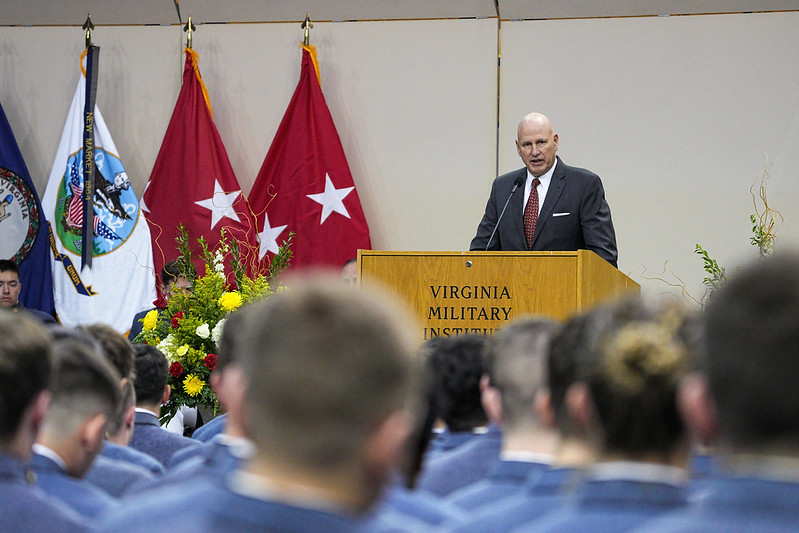
The speaker for the commissioning ceremony will be Col. Timothy Price ’04, who graduated from VMI with a degree in international studies and immediately commissioned into the Army.
His service includes multiple combat deployments across the Middle East in support of both conventional and special operations, as well as operational deployments to South Korea, Israel, Poland, the Baltic states, and the Southern Caucasus region. His military education includes the Infantry Officer Basic Course, Maneuver Captain’s Career Course, Ranger School, and Command and General Staff College. He also earned a master’s degree in public policy management from Georgetown University as part of the Joint Chiefs of Staff Internship Program.
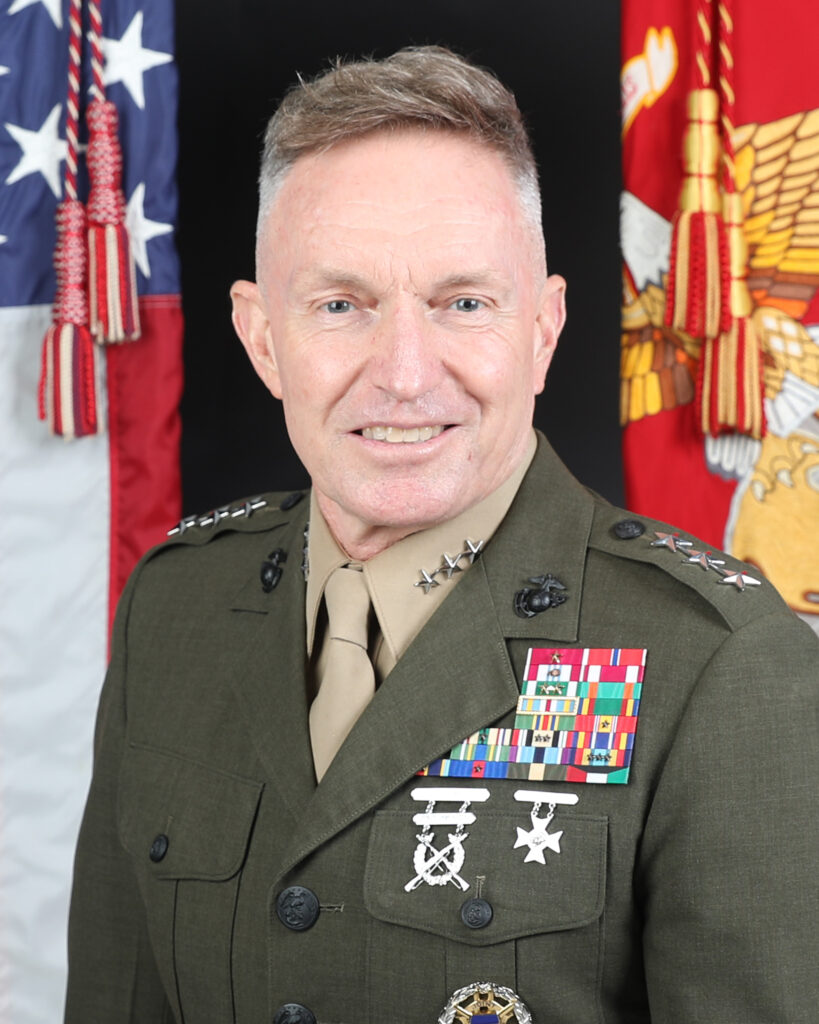
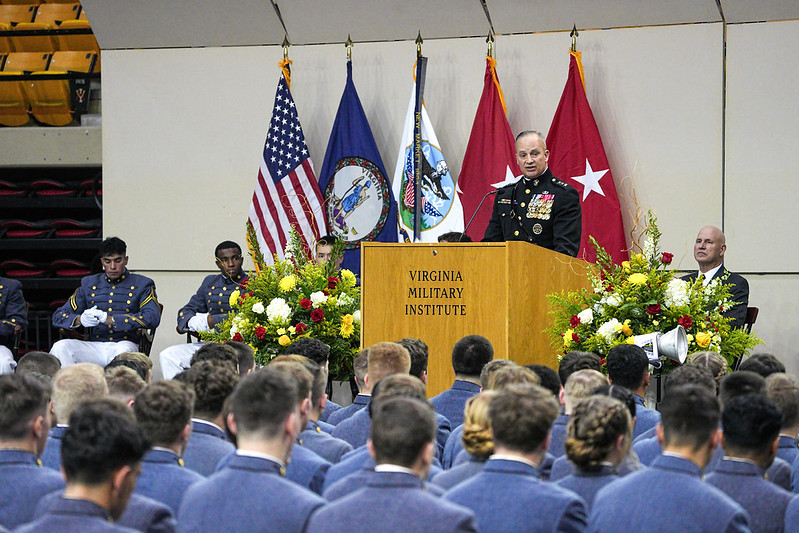
The speaker for commencement will be Lt. Gen. William J. Bowers ’90, deputy commandant for Manpower and Reserve Affairs. Bowers commissioned into the Marine Corps after graduating with distinction from VMI with a degree in history. While at VMI, he was a member of the boxing club, the Semper Fi society, the Ring Figure honor guard, and was Echo Company commander.
Throughout his military career, he has served in every Marine Expeditionary Force, in every element of the Marine Air Ground Task Force, and in most parts of the supporting establishment. Bowers’ personal decorations include the Legion of Merit (with gold star), the Bronze Star, the Defense Meritorious Service Medal (with oak leaf cluster), the Meritorious Service Medal, the Navy and Marine Corps Commendation Medal (with two gold stars), the Navy and Marine Corps Achievement Medal. He was the “Combat Engineer Officer of the Year” in 1998.
Mattie Quesenberry Smith, Ph.D., instructor in the Department of English, Rhetoric, and Humanistic Studies at Virginia Military Institute, and Virginia’s poet laureate, has been chosen by Virginia Business (VB) for their list of “100 People to Meet in 2026” in the Educators category.
For the seventh year, VB, a publication dedicated to covering economic activity in every sector and region of Virginia, highlighted a group of fascinating people in the commonwealth. A lifelong resident of Virginia, Smith grew up in Appalachia in humble surroundings. The first of her family to go to college, she received her undergraduate degree from Hollins University where she double majored in biology and English literature. She continued her studies at Hollins, earning a master’s degree in English literature and creative writing. She earned her doctorate from Virginia Tech in 2024.
Smith’s poetry has appeared in many periodicals. She has written screenplays with her husband and VMI peer, Douglas N. Smith. Their documentary film, “Between Two Fires” garnered a CINE Eagle and Best Documentary of the Show in the New York International Independent Film and Video Festival. The Academy of Motion Picture Arts and Sciences awarded the film an Oscar for excellence in graduate student filmmaking.
Using funds she received from an Academy of American Poets Laureate fellowship, Smith launched “Perseverance and Resilience: Supporting Veterans through Poetry,” a project that supports veterans’ health and well-being. The project involves regional workshops throughout Virginia, facilitated by creative writing instructors and contemporary veteran poets. Through the workshops, veterans explore ways they have persevered and found resilience in challenging times.
Smith confessed she was taken by surprise when VB initially contacted her to tell her she had been chosen. “Virginia Business is a fantastic resource for Virginians. Useful information and professional insights fill its pages. I am thankful for the support this endorsement provides for my veterans poetry project.”
Smith is currently working on a book of poetry titled, “Optics and Doubt.”
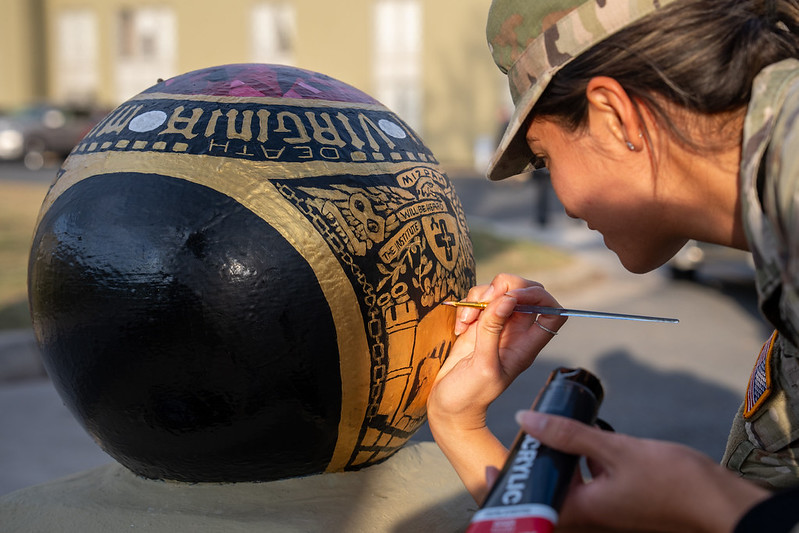
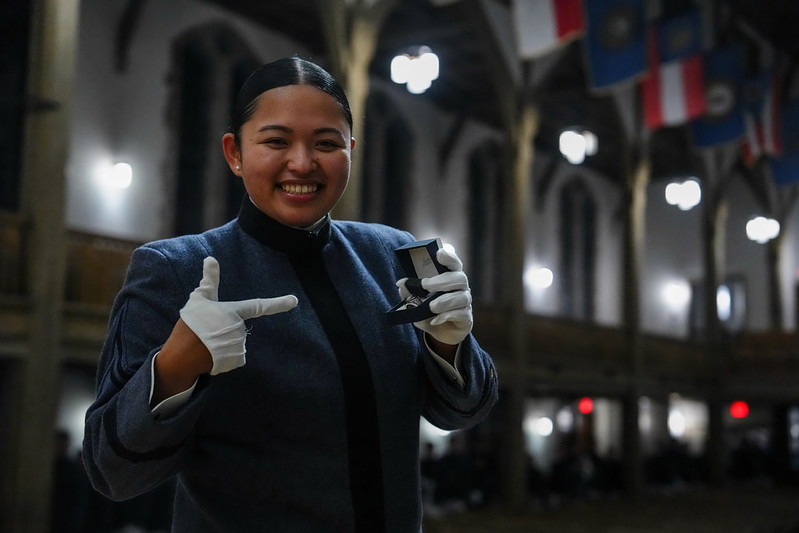
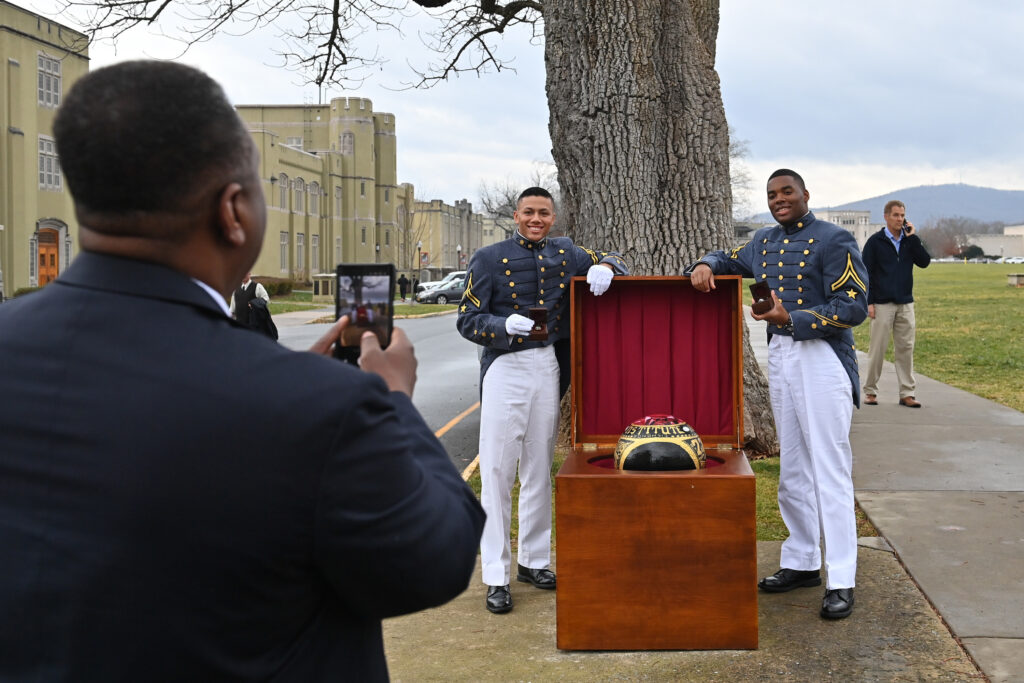
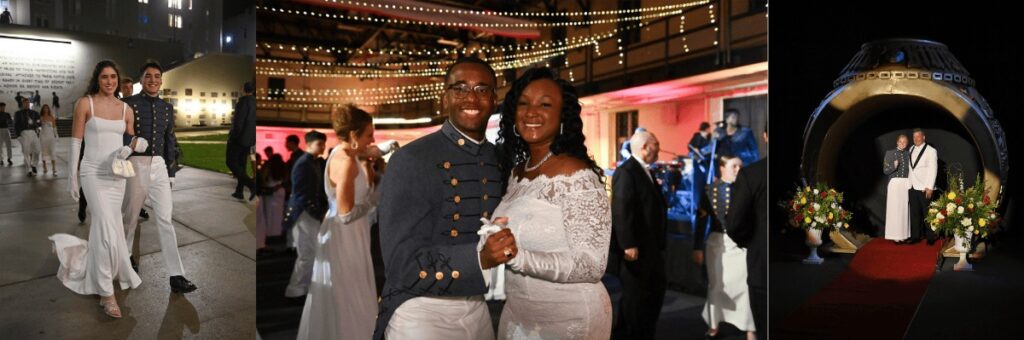
When the cannonball across Letcher Avenue from Memorial Hall transforms into a highly-detailed ring with a brilliant center gemstone, the observant passerby knows it’s time for Ring Figure, one of the many significant brother rat bonding experiences in the lives of Virginia Military Institute cadets. It was during the two-day celebration held Nov. 20 and 21 that 2nd Class cadets received their class rings. Though the weather was dreary in Lexington, to the members of the Class of 2027, the atmosphere on post was warm and radiant throughout the long-awaited events, including the presentation of combat rings and class supper Thursday evening, followed by a family brunch, class ring presentation, ring blessing, and Ring Figure ball on Friday.
The first ring was designed by members of the Class of 1848 and was presented to graduates during finals celebrations. The design was simple. The word “Mizpah” was cut in the stone and on the inside of the band was engraved, “1 of 24, July 1848.” Mizpah, from the Hebrew, is translated as “the Lord watch between me and thee, when we are absent one from another.” The term signified brotherhood, the enduring connection among the 24 graduates of the Class of 1848. Modern rings have become increasingly larger and more elaborate in design, but the tradition of the class designing their one-of-a-kind ring remains the same and the word “Mizpah” is often still found. The custom of 2nd Class cadets receiving the class ring was established in 1907, and the addition of the Ring Figure ball started in 1927 with the Class of 1928.
The traditional presentation of the combat rings was held in Memorial Hall followed by the class supper in Crozet Hall Thursday evening, where the cadets dined while entertained by a jazz quartet led by Lt. Col. Matthew Halligan. Kimber Latsha ’77, a representative from the class who graduated 50 years before the honored class, offered congratulatory words to the cadets and gifted them a class guidon to carry at their future reunions. The Douglas Carter France III ’71 Memorial Award was presented by Warren J. “Buddy” Bryan ’71 to Gabriel DuPlessis ’27, who received the honor through an election by his peers. Established in 1969 by the Class of 1971 as a tribute to their brother rat who lost his life in an automobile accident, the award is presented each year to the 2nd Class cadet who best emulates the qualities of France: excellent character, selflessness, graciousness, and enthusiasm.
The class nominated Sgt. 1st Class Larry Aviles, Army ROTC military science instructor, to be their honorary brother rat for the evening. Mutual affection was displayed as the cadets welcomed Aviles to the podium with chants and applause, to which he responded with a lighthearted, “What up, weirdos?” Following the laughter, Aviles thanked the class for the tribute and earnestly challenged them to always remain disciplined, be a service to others, and to remember they chose the hard road. “That road will beat you up, break you down, and make you question why you ever set foot on it. However, it’s also the road that forges warriors, leaders, and people who can carry the weight when no one else can. You have already proven you can handle more than most ever will. You’re not just the Class of 2027, you are the next generation of warriors, and it’s time to own that.” Despite his plans of retiring in seven months, Aviles promised to return for the class’s graduation in 2027.
Pierson Read ’27, vice president of the class, presented Aviles with a signet dinner ring and framed print of “Charge of the VMI Cadets at New Market,” by Benjamin West Clinedinst, VMI Class of 1880. A favorite of Aviles, the original 18-by-25 foot oil painting hangs in Memorial Hall.
—VMI Photo by H. Lockwood McLaughlin
Originally from the Bronx, New York, Aviles enlisted in the Army in 2006. He was deployed multiple times to the Middle East including Operation Iraqi Surge, Operation Iraqi Sovereignty, New Dawn, and Operation Enduring Freedom. He was later assigned to The Lightning Academy—the military’s premier jungle training venue in located in Hawaii—where he served as a jungle survivor instructor. In that capacity, Aviles was deployed to train or teach in multiple countries around the world including the French Foreign Legion “Caome Foga” in Gabon, Africa; the Jungle Warfare School “Guerra na Selva,” in Manaus, Brazil; and the Marine Jungle Warfare Course in Okinawa, Japan. Aviles was then assigned to recruiting operations in Portland, Oregon, where he enlisted over 40 future soldiers and participated in countless high school instructions. After recruiting, he was assigned to the 1st Battalion, 327th Infantry Regiment, 1st Brigade, and 101st Airborne Division as a platoon sergeant where he trained soldiers through JRTC rotations and multiple live fire exercises. Aviles’ military education and certifications consist of tactical tracking operations, Army jungle survival, Marine jungle warfare, rappel master, air assault, Army basic instructor, medical casualty assistance, Army recruiting course, Equal Opportunity Leaders Course, Counter-Radio Controlled Improvised Explosive Device/Electronic Warfare course, Spider M7 Munitions course, Tactical Site Exploitation course, Class 1 UAS course, Field Sanitation course, Combat Lifesaver course, Combative level 1 course, Basic Leaders course, Advanced Leaders course, and Senior Leaders course. Aviles was also awarded the Expert Infantryman Badge and Combat Infantry Badge.
Following Aviles’ speech, Matthew Assouad ’27, class president, invited his brother rats to put on their combat rings, which they did to boisterous cheers, and ensued in vigorously banging their rings on the chairs and tables, filling the dining hall with a metallic symphony.
On Friday, a family brunch in Crozet Hall preceded the formal ring presentation ceremony where 2nd Class cadets received their individualized rings in Cameron Hall. Mohammad Zanganeh ’27, Ring Figure chairman, welcomed guests, offered opening remarks, and introduced the speakers, the first being Lt. Gen. David Furness ’87, superintendent. Furness shared with the cadets that he remembers being in their shoes 40 years earlier. “I recall being overwhelmed by the accomplishment and the anticipation of getting that ring on my finger. The VMI class ring is a unique symbol among our nation’s service academies and senior military colleges, for no two class rings are alike, which makes us different from every other institution. Symbolism is important. It helps connect us to the values and ideals we cherish, and reminds us of them long after our journey at VMI has ended. The acceptance of this ring brings a new journey of great responsibility and portends a life of selfless service ahead. Like your choice of attending VMI, service and sacrifice are truly the path less traveled, and this path is one full of purpose and rewarding life experiences.”
Alumnus guest speaker, retired U.S. Marine Corps Maj. Gen. Paul Brier ’81, addressed the class after Furness. Brier described the VMI ring as a military totem of the United States, a bond and a heritage. “It is a lifelong reminder that you are never alone. This ring carries a silent but powerful message: that you are a leader, a person of character, and someone who can be trusted to do what is right.” He continued by imparting to them the difference between talent and trust. “Talent is important. The military thrives on it, and here at VMI, your talents have already carried you far. But talent alone is never enough. Talent is about the individual. Trust is about the team. When pressure builds—in combat, leadership, and in life—it is trust, not talent, that determines who people will follow. You build bonds forged not by talent, but by trust, and those bonds became the foundation of your class identity, the very strength you celebrate today as you put on that ring. Your ring symbolizes far more than individual achievement. It symbolizes your class. You wear it not just for yourself, but for every brother rat who walked the Rat Line with you, who sweated and suffered beside you, who now stands as part of a great, unbroken chain of trust stretching back generations.”
At the conclusion of his speech, the class presented Brier with a first edition of “One Hundred Years at VMI,” by William Couper, VMI Class of 1904.
Brier received a Naval ROTC scholarship to attend VMI, where he earned a degree in civil engineering. He also holds a Master of Strategic Studies from the U.S. Army War College in Carlisle, Pennsylvania. He is a veteran of the Gulf, Iraq, and Afghanistan wars, and retired after 36 years of military service. During this service, he commanded the 3d Battalion, 14th Marines; 6th Civil Affairs Group in Iraq; Marine Forces Central Command Coordination Element, Afghanistan; U.S. Marine Forces Europe; U.S. Marine Forces Africa; and 4th Marine Division. He also served as deputy commander of Joint Force Maritime Component for Joint Task Force Odyssey Dawn, conducting contingency operations in Libya and the Mediterranean Sea; and as the assistant deputy commandant for plans, policies, and operations, Marine Corps Headquarters at the Pentagon. As a registered professional engineer civilian, Brier serves as the assistant circuit executive for the U.S. Courts of the Fourth Circuit leading the facilities program for the federal judiciary in Virginia, Maryland, West Virginia, North Carolina, and South Carolina. He is also an offshore skipper, coach, and mentor in the Commanding and Seamanship Training Squadron, a premier summer training program at the U.S. Naval Academy, where midshipmen receive training and experience in ocean sailing, seamanship, navigation, leadership, and teamwork aboard Navy 44 sloops. His awards include the Navy Distinguished Service Medal, Defense Superior Service Medal, and Bronze Star Medal with Combat “V” and gold star.
Later Friday afternoon, the ring blessing service was held in Memorial Hall. Col. John Casper ’04, Institute chaplain, shared his message, “The Prize is Worth the Price,” a phrase which he confessed helped get him through his cadetship. “It’s the idea that the prize of an end goal is worth the price you have to pay to get it. In academics, the prize of a good grade is worth the price of studying. The prize of wearing a ring and saying you go to VMI comes with the price of hard work, suffering, and acknowledging your own weaknesses. The catch is you have to decide in your heart if it’s worth the price, and each of you have. You’ve chosen the road less traveled.” Casper encouraged the cadets to not lose sight of the actual prize they are after, their faith. He referenced the biblical passage, I Corinthians 9:24 “Do you know that in a race all the runners run, but only one receives the prize? So run that you may obtain it.” Casper’s talk was followed by five cadets who offered prayers, verses, or blessings from their respective faiths of Protestantism, Catholicism, Muslimism, Judaism, and Buddhism. Each faith group then held individual blessings in separate areas of the chapel.
The evening wrapped up with the Ring Figure ball in Cocke Hall with the traditional dress code of coatees, white ducks, or long white skirts for cadets, floor-length white gowns and elbow-length gloves for female civilian dates, and tuxedos with white bow tie for male civilian dates. Before entering Cocke Hall, couples proceeded through an arch of sabers held high by two opposing lines of cadets in Memorial Hall. They were also photographed as they posed in the larger-than-life replica ring.
For the second year in a row, the Virginia Military Institute Army ROTC Ranger Challenge team won the bronze medal at Exercise Cambrian Patrol (ECP), the British Army’s premier patrolling event held Oct. 3-12 in the Brecon Beacons, a mountain range in Wales in the United Kingdom (UK). Last year was the team’s first year to compete, and the first ROTC unit from the United States to participate.
Ranger Challenge is the “varsity sport” of the Army ROTC program, and is made up of eight cadets who tried out for the team last spring. Members include team captain James Aldinger ’26, Owen Brunk ’26, Gavin Hudson ’26, Jackson Karam ’26, Colin Russell ’26, Bradford Seery ’26, Raymond Moffett ’27, and David Townsend ’27. The team was coached by Sgt. 1st Class Robert Bain, military science instructor; Capt. Tyler Brians, assistant professor of military science; Capt. Pauline Johnson, assistant professor of military science and officer in charge of Ranger Challenge; and Capt. Christopher Lopez, military science instructor.
ECP is a continuous, 48-hour long-range international military patrol exercise across rough terrain. It originated in 1959 when a group of Welsh Territorial Army (now Army Reserve) soldiers designed a weekend training event which included long distance marching and a shooting competition.
ECP is both mentally and physically demanding, and considered to be one of the most difficult and esteemed of military competitions. Participants carry 80-pound rucks, get limited sleep, and have minimal food. It is open to regular military, reserve military, and ROTC units. Units outside the U.K. must first qualify by winning a similar competition in their home country. This year, over 125 teams from more than 30 countries competed at ECP.
VMI faculty member, Maj. Alex Paul, assistant professor in the Department of History, knows first-hand the challenging conditions in Brecon from his time serving in the British Army. As a young infantry soldier, he spent several weeks training there. Prior to the VMI team leaving for Wales, Paul met with them to help prepare them for what they could expect. He emphasized how quickly conditions in the area could turn dangerous.
“The rain doesn’t just fall, it comes sideways. The cold, the wet, and the wind together are unforgiving. You have to look after yourself and your kit, but more importantly, you have to look after each other.” Paul’s message to the cadets was clear, “Preparation and vigilance matter, but resilience and camaraderie are what see soldiers through the toughest conditions. Hot drinks, dry socks, and humor will get you through more than you realize.” Learning of the teams’ success at ECP, Paul shared he is very proud of them.
According to Brians, Cambrian Patrol is an extremely challenging training event that even active duty Army teams would be hard-pressed to perform well.
“Many of the tactics and skills that teams are assessed on during the event require specialized training. For VMI’s team to arrive at the exercise with only one month of training and earn bronze is truly exceptional. As a coach, I’m extremely proud of the team and respect their grit to remain focused on the mission even during adverse conditions. Most countries only send their best soldiers, and our ROTC team outperformed many of them.”
Hudson, a psychology major from Locust, North Carolina, stated the event was grueling, but he was thankful for the opportunity to participate.
“I couldn’t ask for a better group of guys to compete with. I have nothing but respect for this team. We all had to lean on each other and use our different skill sets to get the job done. Completing the Cambrian Patrol is an accomplishment in itself, and to be able to earn a medal with these guys is something special.”
Seery, an international studies major from Chesapeake, Virginia, also competed in Wales last year. He agreed with Hudson that their accomplishment was very much a team effort.
“Each of the eight members of the team did their part and pulled their own weight to help make this year another success. Without the help from all our coaches, and the support from the administration, our success would not have happened.”
Tryouts for next year’s Ranger Challenge team will be held in the spring.
Three of the nine members of the VMI High-Powered Rocket Club recently launched medium-powered rockets at the Valley Aerospace Team (VAST) launch site near Monterey, Virginia.
Michael Trigger ’26, a computer science major; Quinlan Johnson ’28, a physics major; Yushen Zhu ’28, an electrical and computer engineering major; along with Maj. Durig Lewis, instructor in the Department of Physics and Astronomy and club officer in charge, traveled to the site to shoot the rockets built by cadets last academic year.
Trigger reported VAST has an excellent launch site with plenty of open land.
“I wish it was a little closer to VMI, but it’s hard to find a place with that much undeveloped land and is clear of trees. It was fun watching the rockets take off and realizing the builders’ craftmanship is what keeps them intact as they undergo all the forces needed to fly.”
According to Lewis, several members of the club are currently working on their National Association of Rocketry level one certifications.
“Certification permits people to purchase and use rocket motors whose physical constraints and performance exceed traditional model rocket boundaries. There must always be someone in the group who is certified to launch one of these rockets.”
Club members are also building rockets scheduled to launch next semester.