Post View Unavailable:
Post View is currently unavailable due to technical difficulties. More information.Last Updated: 01-08-2026 09:42 AM»
Notice:
VMI.edu has recently been updated and upgraded. Please note that some URLs may have changed. Visitors are encouraged to use the new, expanded site menu and site search to navigate through these changes.
New Website Launched»
Virginia Military Institute’s Civil Discourse Initiative and its local college partners; Washington and Lee University, Southern Virginia University, and Mountain Gateway Community College, invites the greater Lexington, Buena Vista, and Rockbridge County community, as well as area high schools, to participate in a public square debate on the resolution: “The American Dream is Alive and Well.”
This free, public event to be held Tuesday, Dec. 2, at 7 p.m. in VMI’s Marshall Hall, offers a thought-provoking evening of respectful dialogue and civic engagement.
As a commemorative partner in VA250, VMI honors the nation’s founding principles of free speech, public civil debate, and civic participation.
Established by the General Assembly in 2020, VA250 commemorates the 250th anniversary of the American Revolution, the Revolutionary War, and the Independence of the United States in the Commonwealth of Virginia. It is a multi-year movement of celebration, education, and community rooted in Virginia’s revolutionary spirit.
Public square debates are a collaborative effort between the VA250 commission, the State Council of Higher Education for Virginia, the Virginia Department of Education, the College Debates and Discourse Alliance, the American Council of Trustees and Alumni, and Braver Angels. The Commission’s Education Steering Committee is planning programs for K-12 and college students over the coming year to make history come alive, spark a civics renaissance, and celebrate democracy.>
Since 2021, VMI has hosted college-wide and classroom debates using the Braver Angels format, a non-competitive, non-performative community conversation. The debates are led by a trained chairperson, following a light parliamentary style. The debate rules ensure conversations stay constructive and allow many viewpoints to be heard and examined. Unlike traditional Braver Angels debates, public square events bring together four key groups: high school students; two-year college students; four-year college students; and local community members in one forum. Each two-hour debate explores enduring themes of creating a more perfect union where everyone can exercise their inalienable rights to life, liberty, and the pursuit of happiness.
Select students who participate will be invited to a culminating statewide debate at the State Capitol next October.
VMI’s Civil Discourse Initiative is a partnership between the Center for Leadership and Ethics (CLE) and the cadet Building BRIDGES program, funded by the Jackson-Hope grant.
As the holiday season approaches, festivities are being planned not only on the VMI post, but also at the New Market Battlefield State Historical Park and the Jackson House Museum.
Spirit Night
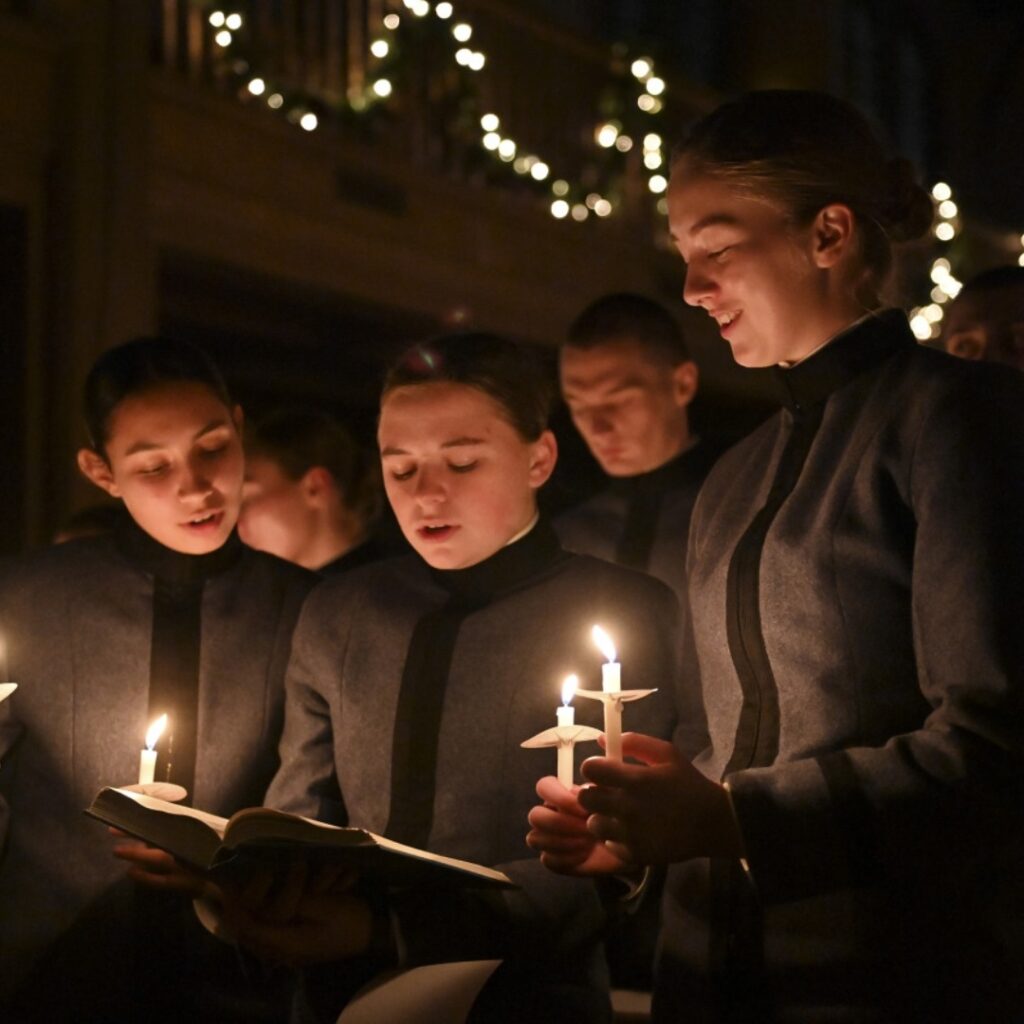
VMI will welcome visitors to “Carols in the Courtyard” Thursday, Dec. 11, at 7:30 p.m. Members of the community will gather with cadets in the courtyard of barracks to hear carols performed by VMI musicians. The VMI Chaplain’s Office will host a candlelight service in Memorial Hall at 8 p.m. following the conclusion of “Carols in the Courtyard.”
Parades
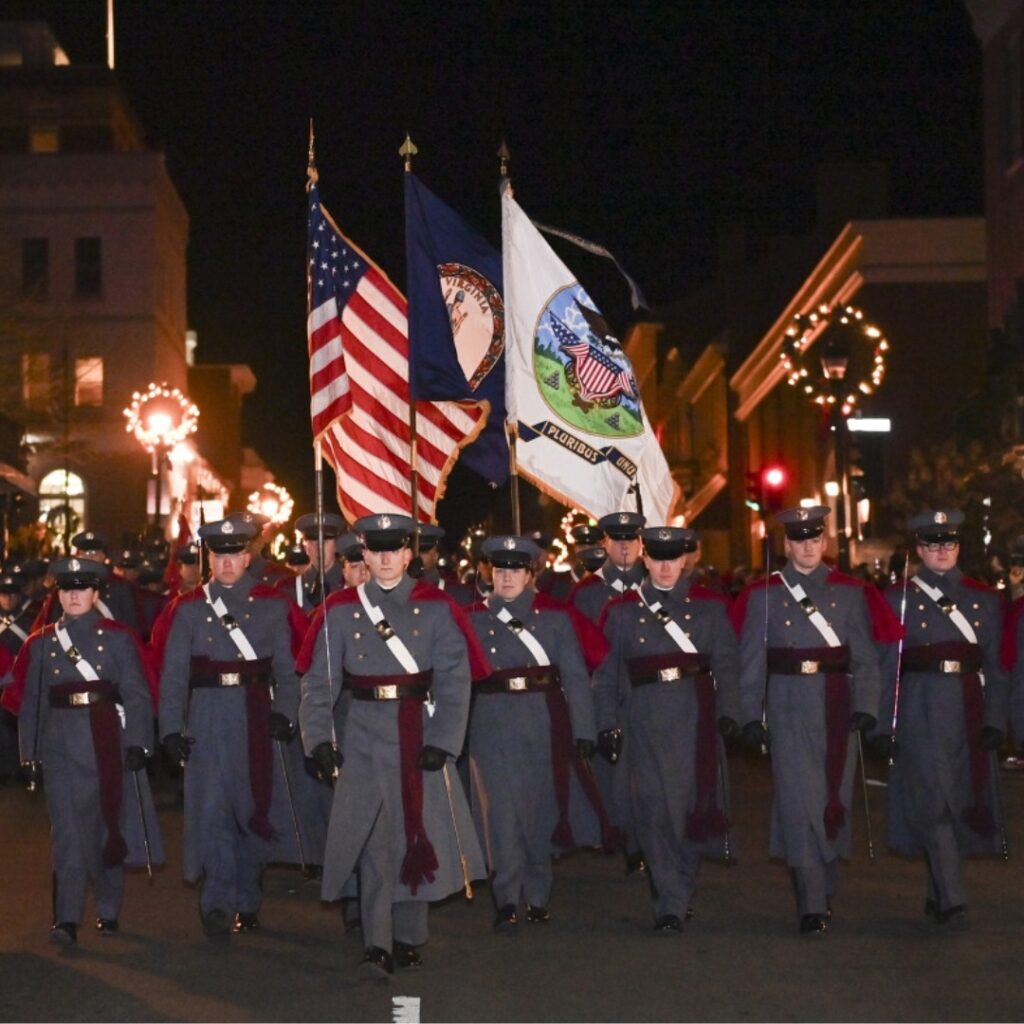
VMI rats, or first-year cadets, will march in the Lexington Christmas parade, to be held Friday, Dec. 5, at 6 p.m. on Main Street in downtown Lexington. The VMI Regimental Band, and Pipe Band will appear in the Dominion Energy Richmond Christmas parade for the 31st time since 1989. That parade will be Saturday, Dec. 6, at 10:15 a.m. on Broad Street.
VMI Museum Holiday Open House
The VMI Museum, located in Memorial Hall, will hold its annual holiday open house Friday, Dec. 12. Door prize drawings, special discounts and offers on many items in the store will run throughout the day from 9 a.m. to 5 p.m. Holiday refreshments will be served from 11 a.m. to 4 p.m.
Jackson House Museum
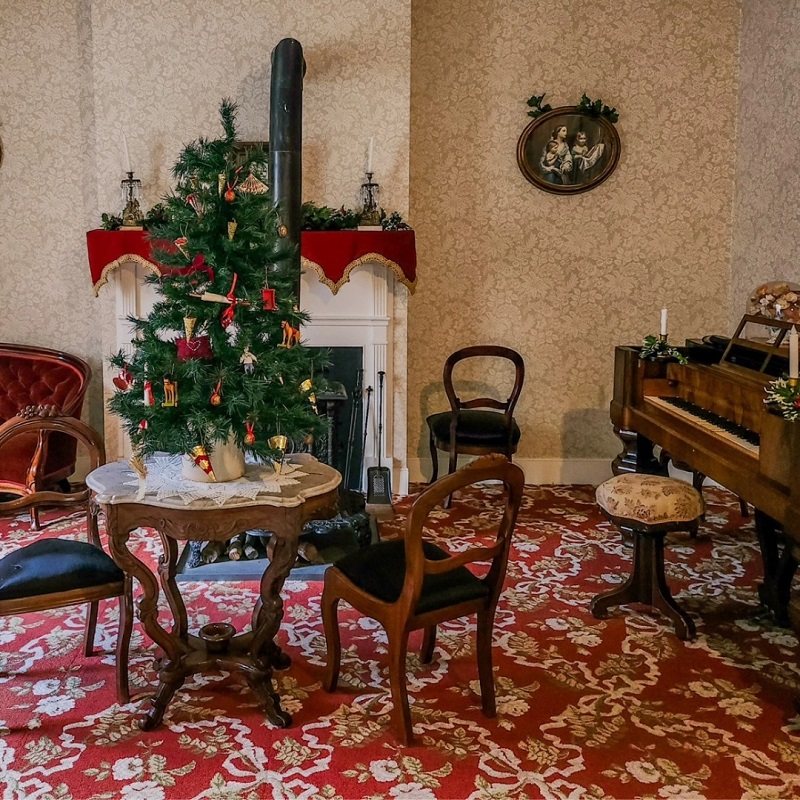
The Jackson House Museum will host “Christmas at the Jacksons’,” Friday, Dec. 12 from 6 to 8 p.m. Visitors will step back in time and experience Christmas in 1859 while interacting with costumed interpreters. Those attending will sing carols, churn butter in the kitchen, and help guests from 1859 choose the proper outfit for dinner. The last tour will be at 7:40 p.m. Admission for the event is canned food for humans and/or pets to benefit the Rockbridge Area Relief Association food pantry. For more information on “Christmas at the Jacksons’,” call 540-464-7704 or visit the museum’s events page.
Christmas on the Farm
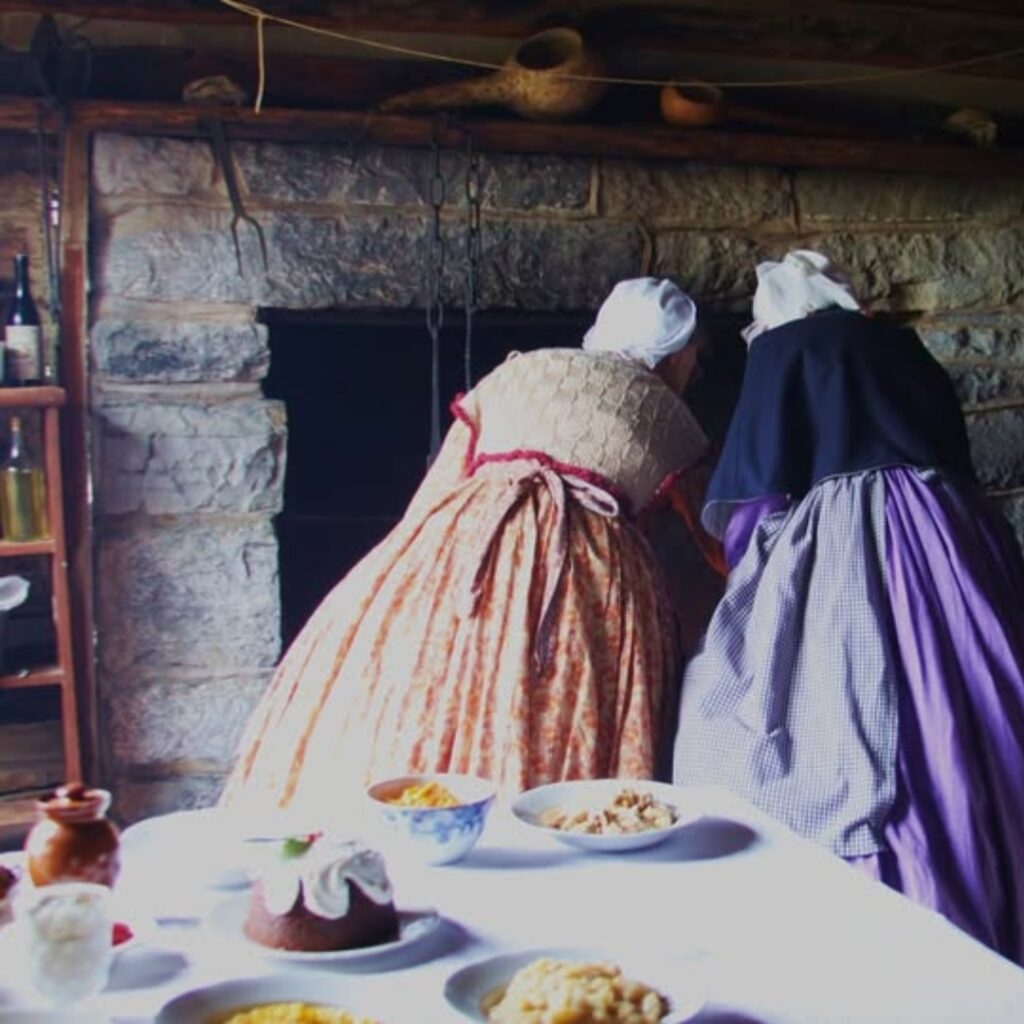
The New Market Battlefield State Historical Park will be the site for “Christmas on the Farm,” to be held Saturday, Dec. 6, from 10 a.m. to 3 p.m. at the Virginia Museum of the Civil War, located in New Market. Visitors will be able to explore the museum, make crafts, enjoy festive treats, and see a special Christmas film. They will take a step back to 1859 and visit the Bushong family as they cook, sing, and tell stories in anticipation of a special Christmas visitor. Event tickets go on sale at 10 a.m. Dec. 6 and can be purchased at the Virginia Museum of the Civil War. Event prices are $10 per adult (ages 13 and older), $6 per youth (ages 6-12), children 5 and under are free. Receive one free admission with the donation of four non-perishable food items. Donations will benefit the local food pantry. For more information call 540-740-3101 or visit the museum’s website.
Five Virginia Military Institute cadets, with Dr. Sherif Abdelhamid, assistant professor in the Department of Computer and Information Sciences and outreach liaison officer for VMI’s Cyber Defense Laboratory, traveled to Spartanburg, South Carolina, to present research projects at the SoCon Undergraduate Research Forum (SURF), at Wofford College Oct. 24-25.
SURF brings together students from across the Southern Conference league’s member institutions to showcase their academic excellence.
Cadets who attended include Benjamin Davis ’26, who is double majoring in applied mathematics and computer science; Jackson Pelt ’26, a mechanical engineering major; Shahryar Shah ’26, a computer science major; Gracie Harlow ’27, who is double majoring in history and English; and Jeremiah Woods ’27, a history major.
Woods said SURF was a great opportunity to share his first research experience. His project titled, “African Americans at VMI: 1851-1865,” explores the contributions of the enslaved and free Black men and women who lived and worked in connection with the Institute during the years leading up to and throughout the Civil War.
“It highlights their lives, labor, and legacies, while reflecting on how their presence shaped the foundation of VMI and how their stories can be more fully recognized today,” he explained.
In her project titled, “Commemorating Service: Preserving Memory Through Archival Research at the American Battle Monuments Commission,” Harlow focuses on U.S. military personnel who died during the Normandy campaign in World War II, and the importance of preserving their stories. Last summer, she presented her research at the Normandy American Cemetery in France.
“I am extremely thankful to have had the opportunity to also present my research at SURF. The feedback from graders who evaluated the presentations, allowed me to move forward and broaden my views,” she said.
According to Abdelhamid, attending SURF was an invaluable experience for the cadets. “They not only showcased their research with confidence and professionalism, but also engaged deeply with peers and faculty from across the Southern Conference. SURF provided them with a meaningful platform to exchange ideas, receive constructive feedback, and see firsthand how their academic work connects to larger conversations in their disciplines.”
Virginia Military Institute contributed significantly honoring veterans at the City of Lexington Veterans Day parade and ceremony on an exceptionally cold Nov. 11. Led by Regimental Commander Devin Auzenne ’26, a contingent of the Corps of Cadets, including members of the Pipe Band, marched from Oak Grove Cemetery, down Main Street past hundreds of spectators to the Old Courthouse to commemorate the 25th anniversary of the Veterans Memorial in Courthouse Square.
In addition to the cadets, school marching bands, members of the Lexington Police Department, Lexington Fire and Rescue, Rockbridge County Sheriff’s Office, antique Jeeps, various floats, and veterans and their families joined the parade.
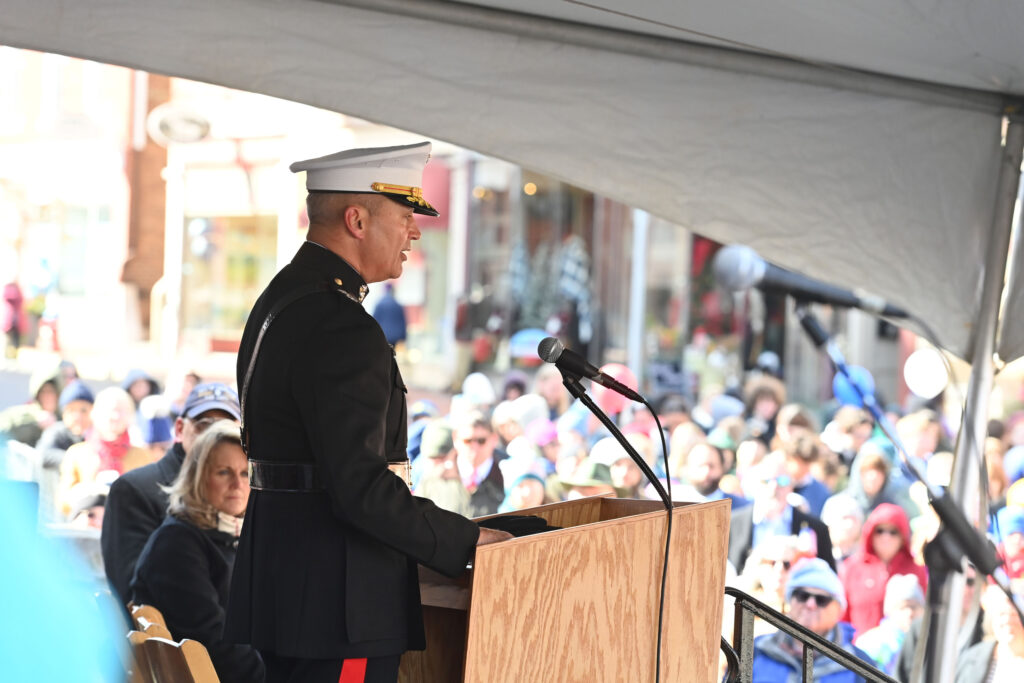
VMI Superintendent Lt. Gen. David Furness ’87 was the keynote speaker at the ceremony in front of the Old Courthouse. Furness, a veteran of the U.S. Marine Corps, gave a brief history of Veterans Day, originally called Armistice Day by President Woodrow Wilson at the conclusion of WWI in 1919. The idea was to commemorate those who served in the Great War which ended on the 11th hour of the 11th day of the 11th month. Armistice Day was renamed Veterans Day by Congress in 1954 to honor all American veterans. Furness also challenged his listeners to contemplate the freedoms Americans enjoy. “Opportunities to gather, debate, write, and worship at any time in our great nation. We have these freedoms because men and women valued our Republic so much that they stood against tyranny to defend it. Let us take a moment to pause and reflect on the lives of those Americans who throughout our history, answered our nation’s call, and in doing so, took great personal risk with little promise of reward. Let us also thank God that we live in a country that still produces men and women willing to risk everything to keep our nation free.”
Furness added that to fully honor veterans, remembering just one day a year is not enough. “Commit to becoming a better citizen every day. Exercise your constitutionally protected right to vote. Volunteer with compassion, zeal, and purpose to make your local community a better place to live and work. However we choose to serve, we honor veterans by making America that ‘Shining City on the Hill’ once again.”
Lt. Gen. David Furness ’87 addresses the crowd gathered in front of the Old Courthouse on Veterans Day. –VMI Photo by Kelly Nye.
Two professors at Virginia Military Institute are featured in “Into the Sun”, the Veterans Day episode of the public radio program, “With Good Reason,” Nov. 8 through 15.
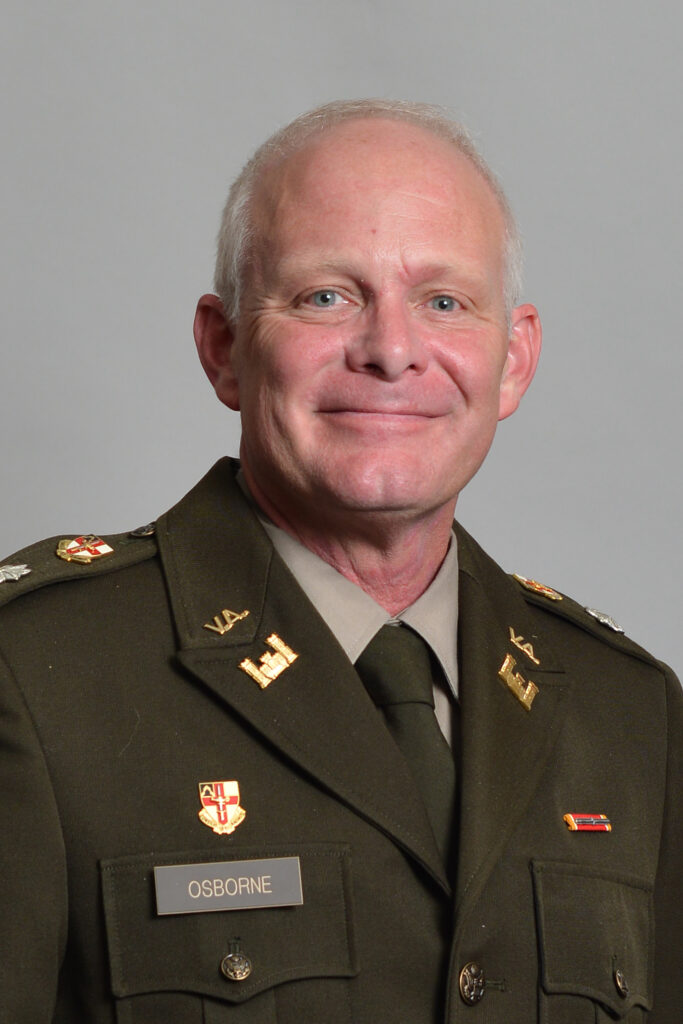
The show airs on 136 radio stations in 36 states. Lt. Col. Eric Osborne, associate professor in the Department of History, discusses the 1918 Battle of Megiddo, which was the world’s last great cavalry charge and a decisive British victory. He says the victory led to the collapse of the Ottoman Empire and paved the way for the future state of Israel in Palestinian territories. Osborne is the author of “The Battle of Megiddo: Palestine 1918.”
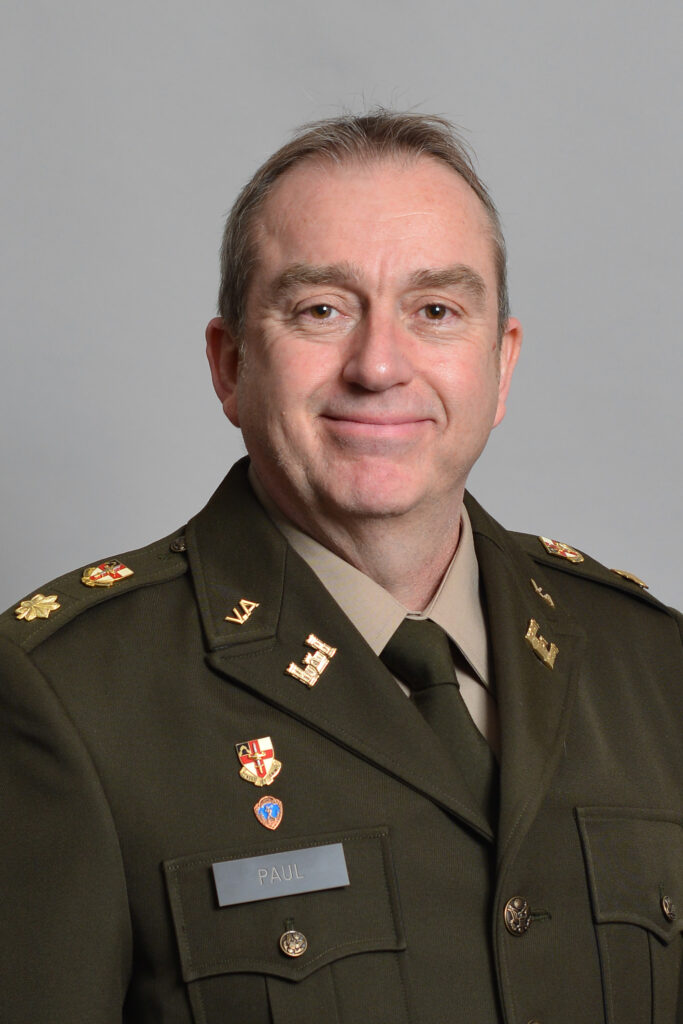
Maj. Alex Paul, assistant professor in the Department of History, shares how his forthcoming book, “Unwilling Doughboys: The U.S. Army’s Foreign-Born Conscripts in World War I,” shatters the myth that during WWI, most immigrants in the United States submissively complied with the conscription practices of many local draft boards. “With Good Reason” is sponsored by the Virginia Foundation for the Humanities. Local broadcast times, as well as audio files of full programs and companion news features, are on the “With Good Reason” website.
Virginia Military Institute was established Nov. 11, 1839, when 23 young Virginians were mustered into the service of the state and, in falling snow, the first cadet sentry — John B. Strange of Scottsville — took his post. This year VMI, the oldest state-supported military college in the country, celebrated the 186th anniversary of its founding Friday, Nov. 7.
The morning began with Rat Olympics, the spirited culmination of Rat Challenge, the 10-week physical fitness program, held primarily in the Corps Physical Training Facility, with challenges also held on North Post obstacles. Events at Rat Olympics included relays, dodge ball, rope race, rock climbing, and culminated with a tug-of-war bracketed championship. The company that is named victor of Rat Olympics is the one that scores the most points. Additionally, the company that works the hardest and displays the best attitude is awarded the Stockwell Cup, named for the late Col. Bill Stockwell, and the cadet who has demonstrated the spirit, enthusiasm, and vision of Rat Challenge throughout the 10 weeks is presented the Col. James Coale award.
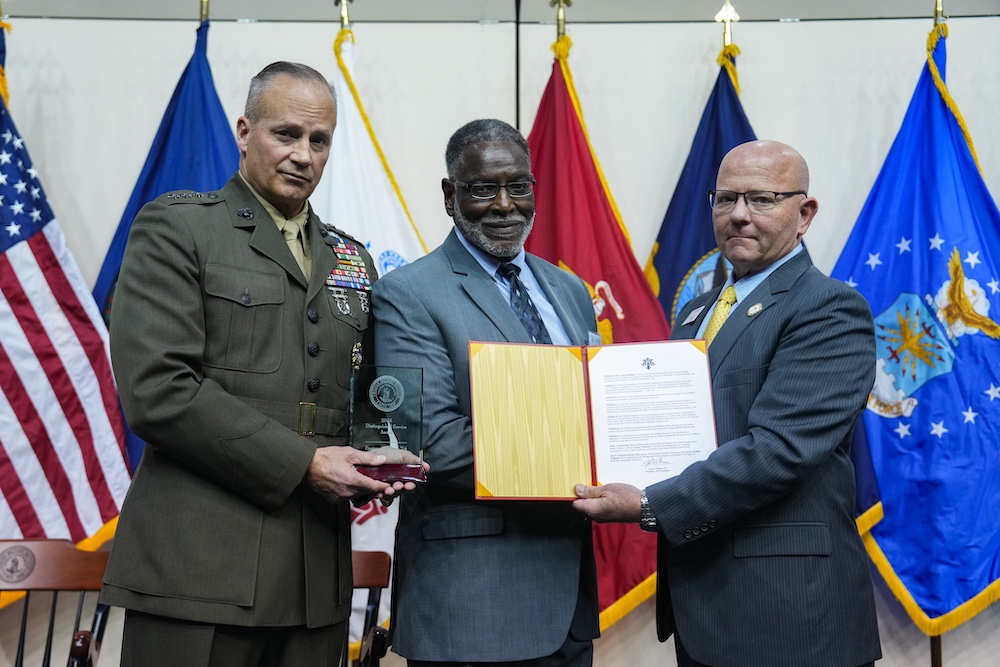
In the afternoon, the Corps of Cadets, along with faculty, staff, alumni, and special guests, convened in Cameron Hall to honor Eugene “Gene” Williams ’74, recipient of the Distinguished Service Award, VMI Foundation’s highest honor. First presented in 1969, the Distinguished Service Award recognizes alumni and friends whose service to the Institute, dedication to the Foundation’s mission, and career achievements and distinctions are truly exceptional. Gene is the 77th recipient of the award.
Lt. Gen. David Furness ’87 exhibits the Distinguished Service Award while John Williams ’88 presents the citation recognizing the achievements of Gene Williams ’74 (center).—VMI Photo by H. Lockwood McLaughlin.
Lt. Gen. David Furness ’87, superintendent, welcomed those gathered and stated VMI’s founders set out to create a school deeply entrenched in a strong sense of civic duty and honor. “One of the greatest testaments to the effectiveness of our educational model is our graduates. We have alumni who accomplished great feats in all walks of life. They live influential lives in their communities and have a service mindset. However, they do not do this for recognition, but because it is the right thing to do. Today, we are privileged to bestow one of VMI’s highest service honors, the Distinguished Service Award, on one of our graduates.” Furness then introduced the president of the VMI Foundation, John Williams ’88, who read the citation recognizing the achievements of Gene and his commitment to service, presented him with the award, and invited him to the lectern to address the audience who saluted him with a standing ovation.
Gene thanked family, friends, and his brother rats who traveled from Florida, Georgia, the Carolinas, Texas, Pennsylvania, Maryland, and all corners of Virginia to pay homage to their BR. He shared his adoration for VMI.
“I love my school in many ways. I’m actually defined by my school. VMI molded my life into something of value.” He cited its principles, ideals, and its contributions to the country and the world. “However, our beloved school is not without blemish. VMI was very late tearing down barriers to racial justice as it was the last public college in Virginia to integrate, and I regret that. I have older relatives who would have benefited greatly from the rigor, the structure, and the character and leadership development that is fundamental to the VMI system. They would have also brought dignity and quality to this place, as I have tried to do during my cadetship and afterward. That opportunity was simply not permitted here between 1839 and 1968.” He added his words may sound hard, but they are the truth, and the truth must be told. “I am extremely proud that when our school eventually acted, it implemented the integration of the Corps with dignity, fairness, and determination that failure was not an option. No other school in the state of Virginia integrated more smoothly, fairly, and successfully than VMI. It repeated that performance in 1997 with the admission of women. Neither of these transformational events were flawless, and we are still work in progress, but we did demonstrate that we could do very well whatever we resolved to do.”
Gene implored the cadets to be truth seekers and oppose what is not honorable and not true, and to help make the world truly great.
“I know you cadets have the intellect, the backbone, and the strength of character to do this. It will take tremendous courage and foresight on your part, and the support of the leaders here at VMI.”
He continued by affirming he celebrates Founders Day with sincerity and with the acknowledgement of the high ideals of honor, discipline, and courage. “The foundational principles in 1839 that are still still true today. I celebrate this with the full knowledge that if I were alive in 1839, the best that I could have envisioned was being an enslaved worker here at VMI. I would have not been treated as a man created in the image of God, but as chattel. It would have been a living hell, because I would have longed to be free. I would have fought and died to be free. This is why this recognition today is so meaningful to me. This is also why I remain so hopeful and encouraged about the future.”
He further noted that efforts to sanitize history are wrong, dangerous, and unfair. “Truth has to be acknowledged, and it has to be reconciled. I have great faith that the majority of VMI people will be agents of what is right, just, and honorable. If that is the case, we’re going to be all right.”
He closed by stating despite whatever else has been going on in the affairs of VMI, including many issues that have caused him distress, he has always had confidence that the leaders of VMI were committed to developing healthy and honorable young leaders and having fidelity to the principles of the Institute. “I have faith that this will continue to be the case, and I pledge my support to Gen. Furness and his administration to be an advocate and supporter of VMI.”
Gene is founder and executive director of the College Orientation Workshop, Inc. (COW), a four-week challenging educational enrichment program, held each summer at VMI. Next year marks its 40th year of transforming the lives of promising, male, minority and at-risk high school students.
He was in the third class of African American cadets at VMI. He received an athletic scholarship to play football and was dubbed “Mean” Gene on the gridiron. He played multiple positions including defensive safety, tight end, fullback, halfback, quarterback, and linebacker. He received All State, All Southern Conference, and All-American recognition, and was named an Outstanding College Athlete of America. He was selected to play in the All-American Bowl game in 1974 in Tampa, Florida, and sustained a serious injury in that game which ended his football career. That same year he received the Henry Fairfax Ayres Most Valuable Player Award and was inducted into Kappa Alpha Order. Within the Corps of Cadets, he attained the rank of lieutenant in Echo Company.
In 1978, Gene became the first African American and youngest appointee to the VMI Board of Visitors (BOV). He remained on the BOV for 10 years. He is a past member of the Keydet Club Board of Governors and the VMI Foundation Board of Trustees. He was inducted into the VMI Sports Hall of Fame in 1985, was keynote speaker for the 2001Virginia Commonwealth Games, and was the commencement speaker at VMI’s December graduation ceremony in 2017.
Following his speech, the Founders Day parade was held in which Gene took review of the parade alongside Furness. The Cadet Battery fired a 15-gun salute from the howitzers. Friday evening, the Institute Society Dinner was held in Marshall Hall where Gene was an honored guest, and Furness was keynote speaker.
The superintendent regrets to inform the VMI community of the death of retired Sgt. 1st Class Thomas E. Atkinson, who passed away peacefully Nov. 3, 2025, at the age of 71.
Atkinson enlisted in the U.S. Army at the age of 18 and served for 21 years. His last active-duty assignment was chief of administration in VMI’s Army ROTC from 1990 to 1993. Upon retirement from active duty, he continued to serve VMI Army ROTC for more than three decades before retiring in 2023 as the recruiting operations officer (ROO). During his time at VMI, he directly supported and helped more than 1,900 cadets earn their commissions as second lieutenants.
Retired Col. Douglas Vincent ’93, former professor of military science, shared Atkinson was “an absolute pillar of the VMI community and one of the finest NCOs I’ve ever worked with, from my time as a young cadet all the way up through being the PMS at VMI. Sgt. 1st Class Atkinson taught generations of VMI cadets what ‘right looked like’ and was the embodiment of professionalism and selfless service. He is irreplaceable. RIP my friend. You will be missed.”
Kathy Ruffin, administrative assistant for Army ROTC and long-time coworker of Atkinson, said, “He took care of the cadets. He was so organized and put many cadets into the Army. He was simply amazing, always putting others before himself.”
Not all contests in Charleston happened on the football field Nov. 1. While the Keydets and the Bulldogs contended for the Silver Shako, members of the VMI Pipe Band competed at the 54th Annual Scottish Games and Highland Gathering at Riverfront Park in North Charleston.
Six cadets traveled to the gathering, where five of them participated and triumphed in their individual contests. For grade 5 solo piping, Caleb Swanson ’27 received first place. For grade 5 solo snare drumming, Connor Wolfe ’26 placed first with an above grade level recommendation; Thomas Sasso ’27 placed third; and Harrison Sloane ’27 placed fourth. Kira Brenaman ’26 placed second in bass drumming and third in tenor drumming. Joseph Reynolds ’27, a new member of the pipe band, accompanied the competitors to learn and encourage.
Maj. Brian Donaldson, director of the Pipe Band, who usually accompanies the pipers and drummers at competitions, was not present at the event. “They attended the games and performed under their own steam, which is admirable and made me feel very proud indeed,” said Donaldson.
According to Wolfe, the cadets had opportunities to network with their counterparts from The Citadel. “We traded advice on performance technique and the future of our respective pipe programs.”
The VMI Community Theatre presents, “Dirk Gently’s Holistic Detective Agency,” Friday, Nov. 14 and Saturday, Nov. 15 at 7:30 p.m. and Sunday, Nov. 16 at 2 p.m. in Gillis Theater.
The three-act play was written by Douglas Adams, author of “The Hitchhiker’s Guide to the Galaxy.” Gently, the main character of the play, is a detective who finds himself on the trail of a gruesome murder, involved with the works of Coleridge, quantum physics, and the enigmatic study of the Cambridge Professor of Chronology. Ultimately, the stakes of the case are far greater than a single murder, including the fate of life on Earth. Confused? Don’t be—everything is connected.
Included in the cast are VMI cadets Colin Nicassio ’26 as Sergeant Gilks, Nicole Samella ’26 as Susan Way, Adam Brinkley ’27 as Don 2 & Answerphone, Carla Feaster ’27 as Dirk Gently, John Stotler ’27 as Richard MacDuff, Hayden Talbott ’27 as “Reg,” Prof. Urban Chronotis, Jesse Vaughn ’27 as Watkin & Perkins, Sophia Heinlein ’28 as Janice Pearce, Aadil Pattada ’28 as Gordon Way, Keye Warren ’28 as Michael Wenton-Weakes, and Arthur Marlow ’29 as Don 1 & Voiceover. Community members include Liz Clarke as Waitress & Housekeeper, Alice Ingersoll and Nora Ingersoll as Sarah Androyd, David Lusk as Marvin Androyd, and Kristen Pace as understudy for Nicole Samella ’26.
The play is directed by Tim Price, assisted by Andrew Hartless. Stage crew includes Fabiana Sofia Pajaro ’26, Laura Canaday ’27, Dusand Barrow ’28, Hayden Crawford ’28, and Tamara Jimenez ’29. The light and sound booth is run by Timothy Persons ’27 and Kaleb Gonzalez ’29. Rechnna Sok ’26 serves as costume designer.
Admission is $10 for adults and $5 for students and senior citizens ages 65 and over, payable by cash or check at the door. Cadets and children ages six and under are free. Reservations are not required. Gillis Theater is located in Marshall Hall on VMI post. For additional information, email Tim Price at pricetr@vmi.edu.
Virginia Military Institute’s 16th annual Leadership and Ethics Conference hosted by the Center for Leadership and Ethics (CLE) was held Oct. 26-28 on post. This year’s theme was “Leading With Integrity,” an extension of the CLE’s academic year theme of “American Values.”
The. Conference hosted nearly 190 participants, made up of students and staff members from many colleges, universities, and military academies from across the nation including, Christopher Newport University, East Tennessee State University, Hampden-Sydney College, Norwich University, Texas A&M University, The Citadel, U.S. Air Force Academy, U.S. Military Academy at West Point, the University of Virginia, Virginia Tech, as well as VMI. Additionally, the Ludovika University of Public Service in Hungary, the Military University of Land Forces in Poland, and the Philippine Military Academy in the Philippines sent delegations.
The conference opened in Marshall Hall with pageantry as the VMI color guard marched in carrying the flags as the Herald Trumpets played “The Star-Spangled Banner” in four-part harmony. Col. Dave Gray, executive director of the CLE, welcomed the assembly and affirmed that leading with integrity is quintessential to the American experience, which began from the time of the Revolution with George Washington. “In the 18th century, integrity was linked to sacred, personal honor. That means being very trustworthy, candid with your peers, and of sound moral principle. Throughout his life, despite setbacks that he may have had, Washington gained that reputation both here in Virginia and among the other colonies, and so he was appointed as the commanding general of the Continental Army.” A second example Gray offered as someone who led with integrity is VMI’s most famous graduate, Gen. George C. Marshall, VMI Class of 1901. “Because Marshall was a selfless man, a man of integrity, a man of duty, and had served his country well, Franklin Delano Roosevelt appointed him as Chief of Staff of the Army during World War II.”
Central to the conference’s programming were small group discussions, interactive activities, and speakers focusing on personal ethics, honor, integrity, principled leadership, as well as the cultivation of moral courage. One activity involved role-playing a fictional scenario—but one the participants may truly face one day while serving in the military, state department, or FBI—of a hostage crisis set in the Democratic Republic of the Congo. Divided into groups, the students heard from four expert panelists who gave points to consider from their own perspectives. The groups had to make a recommendation to resolve the crisis using morally justifiable solutions while considering the short- and long-term effects.
The first guest speaker of the conference was retired U.S. Air Force Maj. Gen.Charles Dunlap Jr., executive director of the Duke University Center on Law, Ethics, and National Security; and author of the award-winning essay, “The Origins of the Military Coup of 2012,” published in 1992. During his talk titled, “Becoming a Leader with Integrity: Lessons We Keep Learning,” Dunlap shared that the nature of the nation’s adversaries is now quite different than other times in history. “They don’t share our values and they don’t believe the law applies to them.” As examples he cited Hamas and drug smugglers. “We have to worry about nation states as well. China and Russia have been replete with activities that challenge the idea of integrity in leadership and honor in war. How can we address that in practical terms?” To answer his question, Dunlap offered several ideas to the future military leaders. “Actions must be thoroughly thought through from different perspectives. Think strategically. Control your emotions and those of your troops. Words matter. Be innovative. Have working knowledge of technology. Demonstrate commitment and resolve. Hold yourself accountable. Aim to be respected, if not popular. Learn from your experiences. Find a mentor or mentors. Embrace feedback. Don’t expect vindication for doing the right thing. Have moral courage. And be a lifelong learner.”
That afternoon, conference attendees heard the powerful story of a victim of an actual hostage crisis. Moran Stella Yanai, an Israeli jewelry designer, was held hostage in Gaza by Hamas terrorists for 54 days after she was kidnapped from the Nova music festival on Saturday, Oct. 7, 2023. The moderated interview was led by Gray who posed questions to Yanai, who answered them with courage and candor, emphasizing her personal experiences, not her political viewpoints. Yanai began by confessing she struggled in a life without meaning until she was 36 years old. “But one morning, a voice in my head told me there must be a different way, and from that point, I went on a journey to discover who I am as a person. Right before October 7, I finally became my best friend. I wanted to help people. I was the most inspired, and at the best point physically and mentally.” Yanai was scheduled to sell her jewelry at the Nova festival, but that morning had second thoughts about leaving her home. Being a religious person, she didn’t usually work on Fridays and Saturdays. “Now I can say it was God’s plan. I was supposed to be there, but I was very stressed. I kept thinking of ways to go back home, but was obligated to stay till the end.” But at 6 a.m. when she saw the beautiful sunrise, Yanai was grateful she stayed the entire night. “Everybody was happy.” By 6:29, the happiness ended when rockets started flying.
“I served in the army and I know how to recognize all the sounds. I heard rocket-propelled grenades and automatic weapons. I had severe panic attacks one after another, and couldn’t really act.” Her friend insisted they run to the car and drive as fast as possible, but driving proved impossible among all the people screaming and being massacred. Abandoning the car, they ran for hours, struggling to survive. Finally, Yanai hid in a tree, where she was found by terrorists who pulled her down. “A terrorist dragged me from that tree, then realized I was wearing a lot of jewelry. He ripped it all off, and almost cut off my fingers. He inadvertently carved the first letter of God’s name on my left hand.” Her scar still remains.
She was crammed into a car with 10 terrorists, convinced they planned to drive her to a makeshift gallows to hang her, but was spared from death that day. “I was counting the miracles that happened to me that day, because I was saved so many times from death. I kept thinking there must be a reason I was surviving.”
Eventually Yanai was taken to a house where she was held with another hostage, an 18-year-old girl. She gave thanks to God for the young woman, because it gave her a purpose. “Since I had to protect her, I also had to protect myself.” Later, the terrorist brought in the girl’s mother, which added one more person for Yanai to care for. Her faith in God and her commitment to the other women is what sustained her. “That was the first time in my life that I was proud of myself, that I knew I was doing everything I could to survive.”
On the 49th day of captivity, Yanai was told she would be released along with her two companions. Though the mother and daughter were released, Yanai was brought back to the house. It wasn’t until she actually saw the Red Cross Jeep on the 54th day, that she knew she had been rescued.
Yanai emphasized that she does not harbor ill will, but seeks peace and reconciliation. The audience who had remained silent throughout her heart-wrenching narrative, erupted into an enthusiastic standing ovation when she concluded.
The second day of the conference opened with M. Alejandra Parra-Orlandoni, the Caroline Dawn Wortham ’12 Leadership Speaker. Parra-Orlandoni is the chief operating officer of Pasteur Labs, a simulation intelligence startup, and founder of Spirare Tech. She is a senior fellow at Harvard Kennedy School’s Mossavar-Rahmani Center for Business and Government, where her work focuses on artificial intelligence (AI) policy. She holds degrees from the U.S. Naval Academy, Massachusetts Institute of Technology (MIT), and Harvard Law School. She shared with the audience about the ethical responsibilities of developing and working with AI. She first discussed the difference between adaptation and innovation. “When I think of adaptation, I think of stepping into a different situation, and figuring out how you can still succeed. It might require changing one thing here, one thing there. When I think about innovation, I think of a situation where you step into the unknown. There is no charted territory. An example she offered of innovation was when she worked for Facebook. “A lot of the technologies that we were building hadn’t existed for general use. We were sometimes unsure if the new technology was ready to be released. We would agonize over a new product. We’d look at it from all angles.” She stressed that integrity is crucial when assessing new technology.
Another concept Parra-Orlandoni examined in her talk, was friction. “Most digital technology is built with this notion of reducing friction, to make everything as easy as possible for the user. Maybe though, sometimes having friction is important.” As illustration, she shared that she injured her back years ago and had to undergo hours of physical therapy and discomfort at the gym to restore her strength. “Because of doing that hard, uncomfortable work, today if my dog pulls me and I fall, instead of reinjuring my back, I’m okay. That kind of friction in our lives, those difficult things are what forge who we are.” She also cited incidents of people using AI chatbots—software applications designed to have textual or spoken conversations—that resulted in suicide or attempted suicide. “The chatbots, because they are always trying to make the user feel good and remove all friction, just kept encouraging these poor people who were crying out for help. But instead of a product that pushed back and said, ‘Hey, maybe it’s time to stop using me and reach out for help from a human,’ they just kept encouraging these users to keep going down this path of self-harm.”
Parra-Orlandoni concluded by sharing a recent study performed at MIT recently regarding brain activity when using ChatGPT, an AI chatbot. “The experiment was set up such that people had to write a report. One group didn’t use ChatGPT at all. A second group used ChatGPT entirely, and a third group started without ChatGPT, but used it at the end to check their work or improve it. What the study found that the group that didn’t use ChatGPT at all had a lot of brain activity. The group who used ChatGPT entirely, didn’t really learn anything about what they were asked to study, and their brain activity was low. And the third group, who started without ChatGPT then added it at the end, had the highest amount of brain activity. AI is a good tool to use, but we still need to learn the old fashioned way, analog style.”
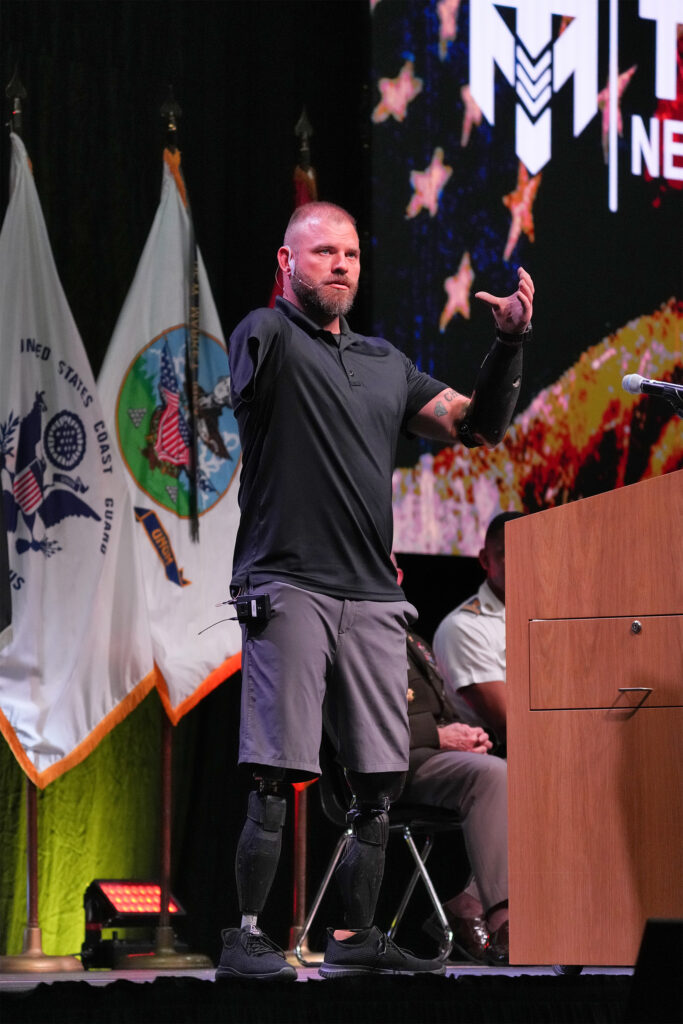
The keynote and concluding speaker of the conference was the H.B. Johnson Jr., 1926 Distinguished Lecture Speaker, retired U.S. Army Staff Sgt. Travis Mills of the 82nd Airborne Division, who spoke in Cameron Hall to the entire Corps of Cadets, guests of the conference, and members of the community. Mills was critically injured by an improvised explosive device while on patrol in Afghanistan during on his third tour of duty in 2012, losing portions of both legs and both arms. He is one of only five servicemen from the wars in Iraq and Afghanistan to survive quadruple amputee injuries.
Retired U.S. Army Staff Sgt. Travis Mills speaks in Cameron Hall Oct. 28. –VMI Photo by H. Lockwood McLaughlin.
Mills opened his talk with self-deprecating humor to put his audience at ease. “I think jokes really do help to disarm the situation. Knee-slap if you got them. I don’t, but if you do, by all means, feel free.” After the laughter subsided, Mills’ tone turned serious, though still sprinkled with good-natured humor, as he shared his story of being critically injured and his long road to recovery. “On April 10, we strapped our gear on like normal, and we went out on patrol. We had a minesweeper out front who swept the ground, not once, but twice. He told us it was clear. I took my backpack off and put it on the ground. When it hit the ground, it landed on top of a bomb. When that bomb went off, it tore my right arm and right leg off instantly. My right side was completely gone and never found. My left leg was broken at the bone, and muscle and tendon held it on. My left arm was blown off at the wrist, but I could still use my thumb, index, and middle finger. Within seconds, my medic, Dan Bateson, was on my right arm, putting tourniquets on as fast as he could. I looked at Dan and said, ‘Hey, you’re not going to save me. There are two other guys calling for a medic. Go save my guys.’ It wasn’t that I wanted to die, but I’ve seen guys die from less injury. I thought there was no way they would be able to save me. Dan just ignored me and kept working on me.”
When the doctor finally reached Mills, he had to drive a sternum IV in his chest. Mills refused to scream out in pain or show any fear. He didn’t want that to be the last memory his men had of him.
Within 10 minutes they had him on a helicopter and flew him to the Kandahar Airfield hospital where nine doctors and seven nurses worked on him for 14 hours. Two nurses took turns pumping air into his lungs for nine hours. They ran out of blood in the blood bank, so they had to do an emergency call over the entire airfield for A positive and universal blood while the doctors and nurses who were compatible were taking blood from their own veins as they operated. When surgery was over, Mills was a triple amputee. Two days later, the doctors realized Mills’ remaining arm had necrotized, and had to cut it off as well.
Later he was flown to a hospital in Germany, where he came out of medical sedation for the first time. The first person he saw was his brother-in-law, Josh, an Army medic. After being assured that his other soldiers were okay, Mills ask Josh if he was paralyzed. Josh told him no. “I said, ‘don’t lie to me, I can’t feel my fingers and toes.’ Josh said, ‘you’re not paralyzed, Travis. You don’t have them anymore, they’re gone.’”
Mills struggled with his new reality. Questions swirled through his mind like, “Does God hate me?” “What did I do wrong like to deserve this?” “Can I still be a husband and a father?”
Josh insisted Mills call his wife and parents. Not ready for the hard conversations, he kept his calls brief. Before hanging up with his mother, she said, “Hey Travis, happy birthday.” It was his 25th birthday.
He arrived at Walter Reed National Military Medical Center in Bethesda, Maryland, April 17. It was there where he was able to see his wife, Kelsey, and baby daughter, Chloe. After the initial affectionate greetings, Mills broke down and said to Kelsey, “You don’t have to do this. This is not what you signed up for. Take whatever we have, it’s yours.” Without hesitation, Kelsey told him, “No, we’re going to get through this together.”
Having Kelsey by his side gave Mills motivation to overcome his obstacles and to keep a positive attitude. Mills worked hard with his physical and occupational therapy, and learned to use his new prosthetic legs and arm in record time. He amazed all his medical providers at the speed of his recovery, his optimism, and his encouragement to other patients going through similar challenges.
Mills is author of two books: “Tough as They Come,” a New York Times bestseller; and “Bounce Back: 12 Warrior Principles to Reclaim and Recalibrate Your Life.” Mills is also featured in the award-winning documentary, “Travis: A Soldier’s Story.” He and Kelsey founded the Travis Mills Foundation, a nonprofit formed to benefit and assist post-9/11 veterans who have been injured in active duty or as a result of their military service. He owns several businesses including the White Duck Pub in Winthrop, Maine. He travels the nation and shares his inspirational message to “Never give up. Never quit.”
Maximus Ankrah ’26, a VMI cadet who attended the conference, stated the collaboration of all the senior military colleges and academies is what he enjoyed most. “Meeting dedicated young leaders from all parts of our nation motivates me to serve this country.”
Kristopher Ruth ’26, also from VMI, agreed, “The experience provided a unique opportunity to exchange ideas, learn from diverse perspectives, and deepen my understanding of what leading with integrity truly means.”
Next year’s Leadership Conference will be held Oct. 26-27, 2026, with an announcement of the theme and title coming in the spring. To stay informed, visit the conference website and join the mailing list.