Post View Unavailable:
Post View is currently unavailable due to technical difficulties. More information.Last Updated: 01-08-2026 09:42 AM»
Notice:
VMI.edu has recently been updated and upgraded. Please note that some URLs may have changed. Visitors are encouraged to use the new, expanded site menu and site search to navigate through these changes.
New Website Launched»
From matriculation through the walk across the stage at graduation, a VMI class works together to support and guide each other, unifying cadets from all backgrounds, ways of life, and diverse locations into one cohesive group with a shared commitment to excellence and leadership.
After breaking out of the Rat Line, the Class of 2027 has taken their next step at the Institute, electing their class president, vice president, and historian. Earlier this month, 10 candidates for these positions stood in front of their brother rats in Memorial Hall to present their case to earn the right to lead VMI’s newest class. Following a vote by the 4th Class cadets, these important positions have been filled.
Matthew D. Assouad of Fredericksburg, Virginia — class president
Pierson M. Read of Duluth, Georgia — class vice president
The path through Virginia Military Institute is made possible by the connections made throughout a cadet’s four years.
Several 1st Class cadets express their deepest appreciation to the faculty and staff who have profoundly influenced their journey.
“Voices of Gratitude” is a touching tribute featuring a few graduating cadets surprising their mentors with letters of gratitude, sharing the impact of guidance, support, and inspiration received during their cadetship.
From the tables in Crozet to the desks in the classroom, every word of appreciation echoes the legacy of dedication our esteemed faculty and staff have built.
Virginia Military Institute requires structure and dedication. It also becomes a place where bonds are created that can last a lifetime. Maybe it’s a professor, a coach, or a fellow cadet. No one makes it through VMI alone. The Cadet Collective tells the stories of those relationships that help pave the way for success.
Matthew Kleinschuster ’26 tagged along to college tours with his brother Jacob “Jake” Kleinschuster ’24, so he got an inside look at whatever places his brother was interested in. Virginia Military Institute wasn’t the immediate choice for Jake, but his senior year of high school he was decided.
They kept it in the family. Their grandfather, also Jacob, Class of 1964, attended VMI.
“Seeing him have his buddies over all the time, telling the Rat Line stories … I’ve always wanted something like that with a group of guys I can live life with,” Jake said.
Jake didn’t pressure Matthew in picking VMI, but he was really gunning for him to.
“When he did decide, I was very excited that he came here,” Jake said. “I enjoyed being the older brother for the Rat Line because I knew what was coming up for him. Also, I could have some of my other friends go pay Matthew a visit, which was great. Being able to see Matthew go through that, knowing what the weeks and days to come for him would be and get to kind of mess around with him here was really enjoyable for me, but just solidifying our relationship.”
It wasn’t even a question when Matthew had decided where to attend.
“Having my brother here was definitely a perk,” Matthew said. “It was nice to know where I’m going to go, I already have a guaranteed friend. We were best friends growing up.”
The two have always been close — sharing a room growing up, starting a landscaping business during the first year of the COVID-19 pandemic, where they’d work together every afternoon. Their relationship grew as they spent more one-on-one time together as young adults.
“Fast forward to college. Once I got to the Rat Line, he was always shooting glances here and there kind of encouraging me. Then after the Rat Line, we did Ranger Challenge, which was a lot of fun,” Matthew said.
He said they wake up and work out together, attend classes, and more.
“It really solidified that friendship. And that’s what I think kind of encapsulates our relationship,” Matthew said.
Jake said his friends have become Matthew’s friends and vice versa, making a larger family unit for them both on post.
“We’re like the glue that links everybody together, because we’re brothers and I’m hanging out with his buddies now,” Jake said. “Having a brother here has been really special because I get to see those friendships I’ve made with my brother rats, but also at the end of day I get to share everything with Matthew.”
Matthew was intimidated to come to VMI, especially after his brother. He said that Jake had made a name for himself here.
“Jake definitely excelled here. He made a big name for himself,” Matthew said. “Coming in, I was nervous. It’s hard to hide the last name Kleinschuster. I felt like I had targeted my back. But after a while, I realized at the end of the day, VMI wants you to become your own man.”
Matthew said having his brother here served as a form of encouragement.
“I have big shoes to fill, but someone behind me who’s going to support me, whatever I do,” Matthew said. “That was probably the biggest motivation of having a brother here. Not the nerve-wracking and being nervous of not living up to his title, but just knowing no matter what happened, I had someone in my corner.”
The brothers say after their time at VMI, their relationships will continue to strengthen after having shared the camaraderie of going through the same experience. They even have corresponding majors. Jake, an economics and business major with a math minor, and Matthew, a math major with a business minor. The two plan on entering the U.S. Army after graduating — another shared bond that will continue.
“We’ll continue to make connections there. Then when I go to the Army, I’m excited to do the same thing,” Matthew said. “We get different furloughs off, come back and hang. The more and more we experienced separately, the more we get to share together, which I’m excited about.”
Jake said that having Matthew at VMI made him appreciate the small things and not take any day for granted.
“Knowing that in a few months I’ll be gone for a handful years and just taking these days, slowly enjoying the time to spend with Matthew,” Jake said. “Being here studying, being able to go to the gym with Matthews is a blessing.”
For Matthew, it’s served as a motivation.
“It’s fun to know that whatever happens, my brother’s going to support me,” Matthew said. “I push myself every day to be better than Jake, which is pretty difficult, but it’s fun to try and strive for. And he encourages me in all aspects. He’s always behind me, motivating me and then vice versa. We’re kind of pushing off each other.”
Jake said they’ve created a bond that many admire.
“When our friends see our relationship, it’s a fun special relationship that I think they look up to,” Jake said. “Being able to just create that big group of guys, everyone just getting along and hanging out regardless of where they came from. It’s been fun.”
After Jake graduates in the spring, Matthew said he’s not looking forward to finding a new routine without his brother on post.
“I’m going to continue making a name for myself and lead,” Matthew said. “I’m excited to see what that looks like when he’s gone, when I don’t have that guy in my corner. I’m not too worried knowing that I’ve got other guys in my corner just for me, but I’ll miss him. I’ll need to find another gym partner, another study partner. But, I’m excited for him and I’m excited to see where I go and do my thing.”
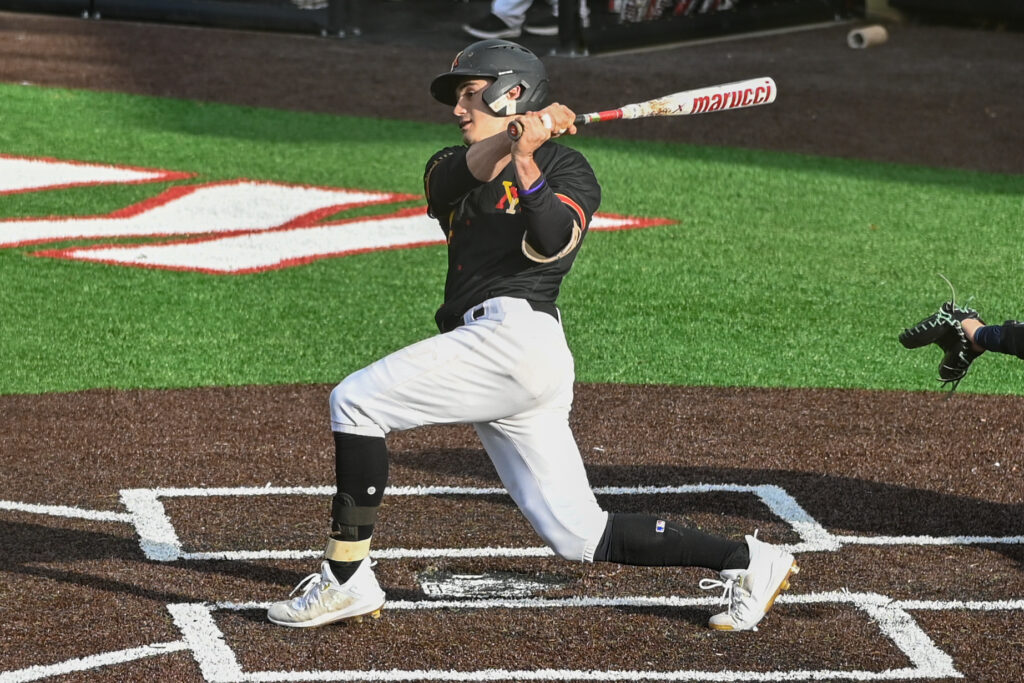
Ty Swaim ’24 didn’t want a lot of debt coming out of college and he knew one way for him to attain a good education was through a baseball scholarship. Virginia Military Institute wasn’t even a place he was thinking of until he was recruited to play for the Keydets.
He said ultimately, he based his decision on attending VMI for the opportunity to play baseball, the trust he had with the coaching staff, and the expectations they had for him. But also, it was based on the financial opportunity it presented.
Coming from a lower income household, he knew he had to get some sort of financial help, which he was able to with a combination of a baseball scholarship and financial aid.
“Coming in here, it was the closest thing to a full scholarship that I could have gotten, especially for baseball, which is extremely tough to get,” he said.
He also knew choosing to pursue VMI’s economic and business degree would work greatly for him.
“The degree has a huge weight and significance,” he said.
Being able to continue his love of baseball was a plus. His grandfather played professional baseball and his parents were heavily involved in athletics.
“I feel like I always had a T-ball bat or a plastic bat in my hands,” he said.
Playing sports has always been in his inventory.
“It just so happened that baseball was the only one I was half decent at,” he joked. “If I wanted to go to college, it was the only one that I was good enough to play Division I, so that’s kind of how that worked. I love baseball more than anything.”
Swaim was drawn to baseball because of its competitiveness, combining both a team sport aspect and individual skill – competing as an individual on a team basis.
“You’re working with your teammates, but a lot of it boils down to individual things where you have the bat on your shoulders,” he said. “You have the ball in your hand where you can get the job done. I know from a hitter’s perspective, when you’re in the box, you’re kind of in a war with the pitcher. It’s just you guys. When you’re on defense, when the ball’s hit, it’s a team sport. You can go help out your pitcher, you can go make a play.”
Cadet-athletes at VMI not only have their responsibilities with their selected sport but cadet duties on top of that. Cadets are also required to take physical fitness classes twice a week, participate in ROTC all four years, prepare for room and uniform inspections, practice for parade, guard duty, and more.
Days start early for Swaim, especially when he’s in season. He’s up most days at 5:15 a.m. to lift weights from 6 to 7:15 a.m. Then he rushes to grab breakfast to-go, so he can head back to his room, shower, change, put his hay up, and get ready for class.
His schedule varies for certain days — Tuesdays and Thursdays he has class at 8 a.m. Wednesdays and Fridays, he doesn’t have class until 12:35 p.m. He uses his time wisely, though. On his free mornings, he spends them completing homework to get ahead, because he’s usually down on the field for more practice by 2:30 p.m. daily.
This last semester is a bit different than years past. His previous years had been back-to-back classes then straight to practice. Now, as a 1st Class cadet, he’s given more of a break.
His goal is to finish his homework during the week, so he can travel on the weekends or play at home for baseball.
“I try to set up all my schoolwork to be done within that week because I know on the weekends, I just want to focus on baseball,” he said. “I know my brain is not going to be in the classroom, so I do all my schoolwork during the day.”
His top priority right now is finishing strong for baseball. He feels that VMI has prepared him to come out on top in his sport, but also has prepared him for whatever life throws at him after graduation in May.
“The busier I am, oddly enough, the better I am. This school doesn’t really let up,” he said. “The schoolwork in the past has been extremely tough … when you have three tests a day, it gets crazy. When I was super busy with really hard classes and heavy course loads, I ended up getting better grades because there was absolutely zero time for free time. Sometimes I think I work well in that just because when I do get free time, I tend to slack off.”
He doesn’t take those slivers of days off for granted. His time at VMI has taught him to savor the downtime and treat it as a reward for working hard, and to acknowledge stress not necessarily being a bad thing.
“Having stress isn’t bad, just being able to understand the stress and use it,” he said. “I think stress gets a bad rap, which obviously when you are stressed it’s terrible. Everything brings you stress. But it gives you things to do, keeps your mind busy and things for you to work on. If there was no stress at all, I don’t know that would be a very fun world to live in. No challenges to get over, there’s nothing to focus on, there’s no goals to meet.”
Swaim admits he still has room to grow and isn’t quite sure of his next steps following graduation. But, VMI has created a great path for him.
“I think I’ve matured a lot since I’ve been here. Of course, I think there’s still so much more I can learn,” he said.
His priorities for the spring — baseball and living in the moment. This is his last chance to play on a large scale.
“I really want to focus on baseball and just ending on a good note. I have spent so much time in my life on it,” he said.
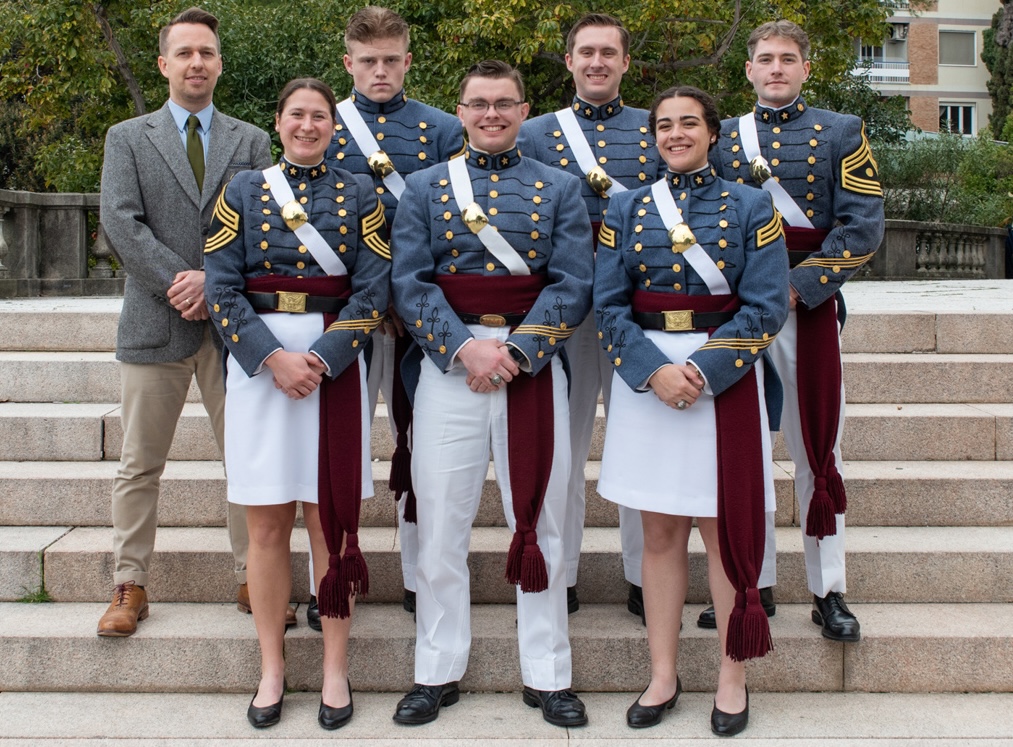
Virginia Military Institute was one of 25 military academies from around the world who participated in the annual Competition on the Law of Armed Conflict in Sanremo, Italy. The event was hosted by the International Institute of Humanitarian Law.
Six VMI cadets out of more than 100 participants spent a week diving into war simulations where they had to advise on the legality of decisions given by their commanders. Each participated in mixed teams alongside two cadets from another academy.
This year, VMI walked away with five awards, which was the most received by any academy at the competition. Hannah White ’24 won a silver award in the individual category, and four cadets won awards in the team category (Devin Thomas ’24 – gold; Michael Menton ’24 – silver; Gabriele Woodward ’24 – bronze; White – bronze).
Cadets are chosen for the competition after completing a course on the Law of Armed Conflict with Maj. Tim Passmore, assistant professor of international studies, and then receive additional training and preparation as a team before the competition. In 2012, VMI started participating in the competition under Col. Robert James’ direction, who now serves as a judge.
The competition consists of cadets serving as legal advisers to a commander in a fictional war scenario simulation, according to Passmore. Cadets are divided into mixed teams of three, where they work with cadets from other academies. Each team is given a scenario, which develops over the week as new information is revealed. The teams must advise the commander on the legality of the various actions their military can take, Passmore said.
“The body of law they are advising on is called international humanitarian law, or the law of armed conflict, and consists of various international treaties and other legal principles,” Passmore said. “Some of the main treaties are the Geneva Conventions, Hague Conventions, and UN Charter.”
White, an international studies major who will be commissioning into the Coast Guard, said the competition was hands-down one of the best experiences of her cadetship.
“Having the opportunity to meet people from all over the world for the common interest of Law of Armed Conflict is truly a unique experience,” she said. “Getting to work in a team with people I’ve never met before who are in militaries from other countries teaches you how to communicate effectively and how to work as a team player. It also allowed my teammates and I to develop friendships with people who we may get the chance to work with again in our military careers.”
She said that with Passmore’s guidance, she became proficient in international treaties and conventions, along with homing in and developing her public speaking skills, attention to detail, and her confidence. She urges other cadets to apply for the opportunity to participate.
“These are all skills that are important to master as a future military officer, and I can easily say that through him and this experience, I am more prepared to be a leader in the Coast Guard,” she said.
Passmore said this experience allows his students to participate in a real-world exercise of military decision making.
“Even though it’s a lot of hard work, the cadets find it really enjoyable and engaging,” he said. “Beyond this, it gives them an experience they will carry into their careers. Most of these cadets will go on to serve in the military, and this is an invaluable experience where they get to see how decisions are made and approach war fighting through a legal context.”
Participating cadets also get to put into practice all the work that went into preparing for the competition for the past year. In addition to taking a class on the law of armed conflict, Passmore said the six cadets met as a team weekly in the spring semester to conduct practice exercises.
“The cadets worked incredibly hard in their free time, and it paid off at the competition,” Passmore said. “The competition gave them an opportunity to meet and interact with cadets from other military academies all over the world. It’s a great way to forge relationships with people at a similar stage in life, and the cadets always love the interactions they have.”
Menton said Passmore’s class just clicked and it started him down a path towards international law and organizations.
“The competition was a fast-paced learning experience that challenged my ability to think critically about complex issues and work well with my teammates who were from European service academies,” he said. “The experiences I had with my teammates and other members of the European armed forces were beyond beneficial. I was able to immerse myself in their cultures for a brief time and exchange experiences with them from our home countries.”
Passmore said the competition allows VMI to showcase its cadets to a large international audience.
“Their especially strong performance this year sends a clear signal of the discipline, hard work, and academic rigor of VMI, and particularly of the international studies program,” he said. “It is also wonderful that VMI provides this opportunity to a select group of cadets each year, as it tends to be one of, if not the most valuable experiences cadets have during their cadetship.”
Virginia Military Institute employees are finding ways to grow in their careers and within themselves thanks to a program called Emerging Leaders through the Center for Leadership and Ethics (CLE).
The lecture and seminar series serves as an opportunity for faculty and staff to participate in monthly professional development training.
Col. David Gray, director of the CLE, said the program is aimed at helping people better understand themselves and relate with one another, especially with improving communications with fellow staff and cadets.
“We want to develop a bench of folks who over the years progressively will take over leadership positions within committees, within the departments, and perhaps within the Institute itself,” Gray said.
The program’s inception was in 2017. Under General Order 87, VMI has a tiered progressive professional development program for staff, faculty, and classified employees, which consists of three parts: an Institute-dictated core program, departmental and directorate directed opportunities, and individual self-study.
The Emerging Leaders course covers the following constructs and objectives:
Understanding My Strengths
Communication within the VMI Culture
Meeting Management
Conflict Management
Coaching Techniques
Decision-Making Skills
Finance and Budgeting
Gray said the Institute runs on three pillars — military, academics, and athletics — that don’t always communicate with one another.
“This professional development is oriented on threading those together,” he said.
The seminar series averages about eight to 12 people each session. Those who participate are selected by their department heads, specifically those who could be seen leading in the future, Gray said.
“What they’re looking at is back to the bench. “Who do I see leading in the future in some capacity? Then try and funnel them.”
Each year the seminar series is a bit different. Gray said there’s research done on how to improve the program with feedback they receive from participants, making it as interactive as possible.
“I believe we’ve captured the fundamental skills and behaviors that you need to be an effective leader,” Gray said. “This course is really looking to help people in the middle. They’re not brand new, they’ve got some experience, but you need a little bit more to work with your colleagues across the Institute. Hopefully, we give them enough so that they can be more effective in leading.”
The benefit of this experience is creating leaders the Institute can be proud of through a personalized program.
“We’re all about developing exceptional leaders. The staff and faculty here are the role models for cadets. This is about education and practice,” Gray said.
Serving as cadet operations sergeant for Band Company her 2nd Class year, Annie Townsend ’24 was able to set up a cadet guard team, which would perform the security for barracks at Virginia Military Institute. The team would oversee locking gates, coordination during emergency situations, enforcing uniform or disciplinary standards within the Corps, and posting members of the guard team for the security of the Corps of Cadets.
As her experience grew in that capacity, it piqued her interest in the security of barracks. Specifically, the interaction of infrastructure with the implementation of security.
“In conjunction with my interest in architecture — and particularly historic architecture — I developed my research to include aspects of security engineering, structural engineering, architecture, and the historical development of security at VMI,” she said.
Townsend, a civil and environmental engineering major, started her honors thesis midway through her 2nd Class year.
“I started by brainstorming, speaking with professors and finding faculty advisors, and writing a prospectus (research proposal),” she said.
Col. Chuck Newhouse, head of the Department of Civil and Environmental Engineering, served as Townsend’s advisor. He said when she approached him with the idea of combining her interests in engineering with the role of VMI’s guard team to take a critical look at the security at VMI, he was a little hesitant.
“Initially, I was reluctant to recommend that she pursue this because it is a controversial topic,” he said. “It is controversial because not everyone agrees on the best ways to provide security. Also, VMI doesn’t fall into one clearly defined category. It is, on the one hand a public college, and on the other hand an institution with a strong military presence. Should security follow requirements provided for colleges, or for military bases? It is not an easy question.”
She presented her thesis “A Security Analysis of the Virginia Military Institute’s Barracks through the Lens of Infrastructure” during VMI’s Honors Week.
Initially, her research had gone through several phases. She said she hoped to study the blast resistance of barracks based on the structural design, in the context of security and antiterrorism security.
“After realizing that I’d like to pursue architecture after graduation, I wanted to mold my topic to account for the architectural aspects of barracks as well,” she said. “I ultimately ended up blending architecture and structural/security engineering together to develop my final topic, a security analysis of barracks through the lens of infrastructure.”
Her research aimed to identify whether modern-day security that governs cadet life in barracks is sufficient.
The focus of the research was on four topics:
Military influences on VMI’s security
9/11 and its impacts on institutions of higher learning
How historical developments connect to security upgrades
How the research relates to barracks infrastructure, architecture, and structural engineering
“VMI’s barracks is the center of cadet life — it’s where we train, sleep, assemble for formations and parade, and get to know the brother rats that will be there for us throughout the rest of our lives,” Townsend said. “It’s where our cadetships begin on Matriculation Day, the center of our cadet organizations and activities throughout our four years, and where our cadetships end on graduation day.
“Ultimately, it houses VMI’s most valuable asset — the Corps of Cadets,” Townsend continued. “My research analyzes how the structure of barracks itself, and supporting human elements, reinforce and affect the security of the Corps of Cadets.”
A survey was conducted as part of Townsend’s research. The goal of the survey was to identify the Corps’ opinion on existing security infrastructure and the relevance of the guard team in security of barracks. The survey was voluntarily completed by 177 cadets, or 10.4% of the Corps, her research said.
The research showed that VMI’s approach to security is currently acceptable, but there’s significant room for improvement. Townsend says about 76% of the Corps felt entirely safe living in barracks, while about 14% said they feel neither safe nor unsafe living in barracks. But, nearly 10% of the Corp — 35% of that section were female cadets — did not feel entirely safe.
There are plans in place to ensure more security measures are met. According to the VMI Post Facilities Master Plan, roads, foot paths, parking areas, lighting, emergency lights and phones, along with signage are to be considered to enhance security. New security technologies are to be adopted with the attention to historical facilities, the plan said.
“As time progresses, change will remain the only constant in VMI’s approach to security — just as it has been in the past,” Townsend said in her thesis. “It is important to approach the security of VMI in the broader context; considering that it is neither a traditional college campus or a military installation, the approach to security is, and will always be, complex.”
Townsend said her research allowed her to develop insight into VMI’s unique history of security development, along with the culture of the Corps of Cadets that facilitates the security of barracks.
Her hope after graduation in May is to pursue a master’s degree in architecture, and study historic architecture and adaptive reuse. She’s also interested in the impact of architecture on the security of facilities and structures.
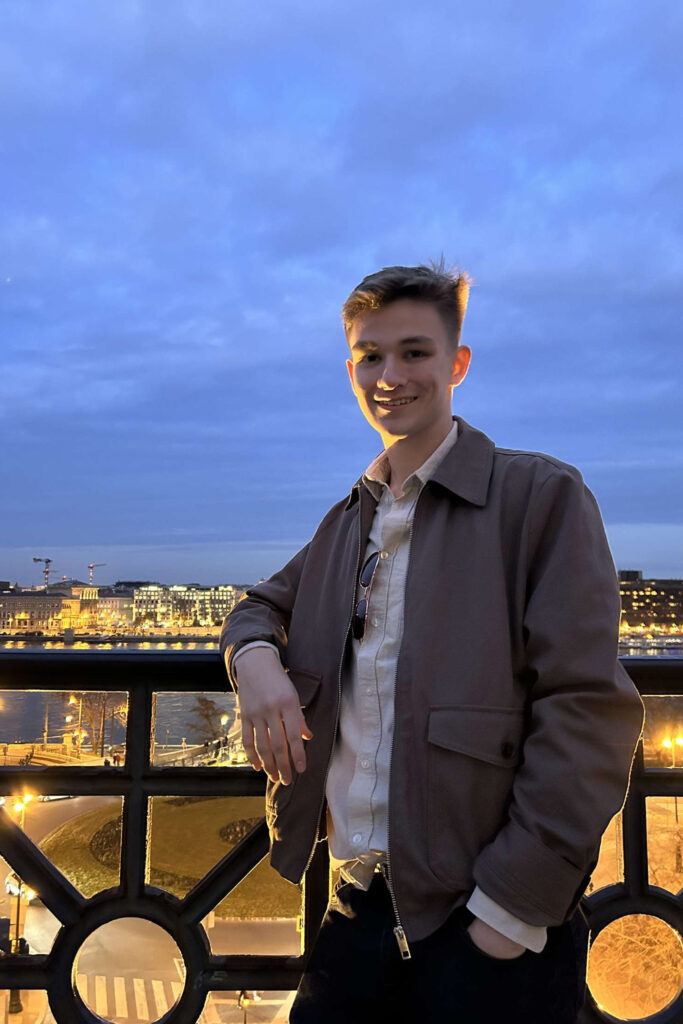
Virginia Military Institute cadet Kaiden Minter ’26, an international studies major, is spending spring semester studying with the Faculty of Political Science at the University of Belgrade in Serbia.
Minter awarded the Gilman Scholarship, a program of the U.S. Department of State’s Bureau of Educational and Cultural Affairs, which fosters mutual understanding between the people of the U.S. and the people of other countries to promote friendly, sympathetic, and peaceful relations.
Minter has been interested in the Balkan region for a long time. “The peninsula has a history of several different cultures living on it, causing a past marred with conflict as these cultures interact. When you look at other regions of similar sizes in Europe, like the Iberian Peninsula or the British Isles, you don’t see this type of conflict, so I’ve always been curious to study it physically,” stated Minter.
The courses in which Minter is currently enrolled in Serbia are U.S. Foreign Policy; European Politics; An Analysis on Conflict in the Balkans; International Political Economy; and Serbian Language, Culture and History. Each class compliments the others, and all of them are applicable to his major and classes he will be taking when he returns to Lexington. Minter shared that choosing to study in Serbia was a smart decision. “From the low cost of living to its similarity in geography to Southwest Virginia—with rolling soft mountains and deciduous forests—this is a wonderful place for me to study. The thing I love most though is the city of Belgrade itself. It’s a unique blend of Mediterranean and Eastern architecture mixed with the block structures of a communist state. The main fortress complex of Belgrade called, Kalemegdan, which has been used since the times of the Romans, is a short walk from my apartment.”
According to Todd Lee Goen, director of the Office of Global Education and senior international officer at VMI, the Gilman Scholarship was awarded last fall to approximately 1,700 American undergraduate students from all 50 states, the District of Columbia, and Puerto Rico. “The global education team is proud of Kaiden’s success in obtaining a Gilman Award, which is a testament to his desire to advance his global competencies through study abroad. His experiences in Serbia will expand his worldview and make him more competitive throughout his career,” said Goen.
Minter’s academic advisor, Col. Patrick Rhamey, professor in the Department of International Studies and Political Science recalled that Minter developed a clear passion engaging the world in his introduction to international politics course. “What makes that academic experience all the more exciting is this chance for Kaiden to study abroad provided by the Gilman Scholarship. These opportunities provide a firm foundation for future successful careers beyond America’s borders.”
Minter recommends Serbia as a place for other VMI cadets to study because of all the military history surrounding the region.
Minter is the grandson of Mark and Millie Minter of Roanoke. He is a graduate of Northside High School. He plans to join the Peace Corps and pursue a career in diplomacy after graduating from VMI.
Jon Krueger ’24 wasn’t sure what path he was going to take once arriving at Virginia Military Institute.
“I’ve always been interested in the military and I’ve always felt like I’ve done well with the structure as far as academic skills,” he said.
A family friend recommended VMI, so Krueger decided an overnight trip for an open house was a good plan. He enjoyed it.
But finding the Pre-Law Society, a club option offered at VMI, was totally by chance his 3rd Class year.
“It was an in passing conversation with my academic advisor. He asked me if I’d thought about grad school and I had no real game plan,” he said. “I kind of started getting interested in law school. There’s still a lot that I don’t know about, but being an English major working with documents and a lot of writing … law interests me in general. So that’s what piqued my interest.”
Krueger is the project manager of the club, which means he’s in charge of organizing events while working with other leadership within the club. In the past, the club has sat in on University of Virginia’s law students’ mock trials as jurors, along with tours of UVA Law School.
He said the Pre-Law Society is a good way to dip your toes into discovering what law and law school are about.
“We just try to get an experience for newer members or people that aren’t quite sure how law school works,” he said. “I think it’s to get everybody introduced to it, see if it’s even for you. It’s not necessarily with joining the Pre-Law Society, anybody expects you to be a lawyer. It’s more to get people interested, see if this is something that they enjoy.”
The club is well-received, having almost 50 members.
Most of the events of the society does include VMI alumni visits. Former professors, judges, and lawyers have all stepped onto post to talk.
“We’ve been able to talk to people who do a lot of different aspects of the law, like military and civilian. We’ve also had different judges and trial lawyers from the JAG Corps. There’s also a member of the Law School Admission Council that comes once a year to talk about the LSAT, the standardized test to get into law school, and a lot of people found that helpful for their own LSAT.”
The club also takes trips, apart from UVA, to Richmond and Washington, D.C. to speak with lawyers and other law professionals.
Once Krueger graduates in the spring, his plan is to go to Officer Candidate School for the Navy, then go to law school, so this club has been imperative for his future.
Patrick Kiernan ’25, a history major, said he started becoming interested in law after several junior and high school classes he took.
“I had interest from taking those classes, wanting to look more into practicing law,” he said.
Kiernan said a great aspect of the club is the advisor Maj. Tim Passmore, assistant professor of international studies, who can recommend a certain number of cadets and alumni that want to attend certain law schools through a memorandum of understanding.
“They basically guarantee an interview because the idea is with the time constraints you have at VMI, your GPA and LSAT scores aren’t necessarily the best reflection of what you can do,” he said.
The two said the amount of knowledge they’ve received through participating in the club is insurmountable.
“Being around people that can tell you more about law, life, and the resources available to you … not to mention, I don’t think it ever looks bad on a resume to say that you’re part of the Pre-Law Society,” Krueger said.
Virginia Military Institute’s cadet-athletes have to juggle cadet life, heavy academic course loads, and their NCAA Division I sport. Committed to both academic and athletic pursuits, balancing their rigorous schedule in both sports and school requires a certain level of commitment and discipline. Behind the Balance is a series that focuses on those cadet-athletes and how they handle the hurdles of the day-to-day.
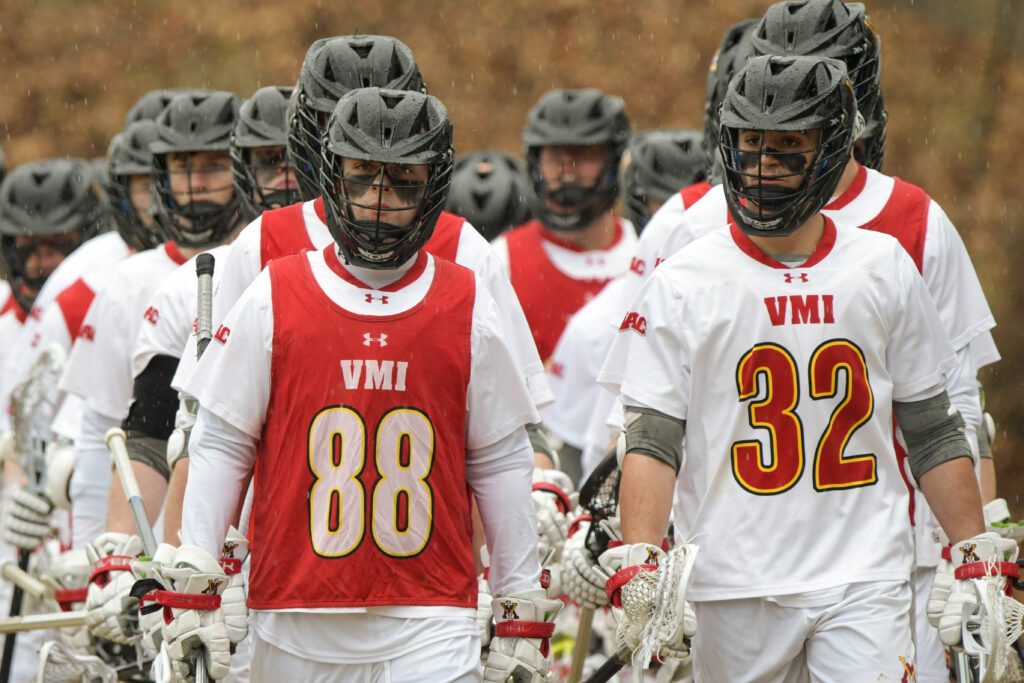
Leadership and regiment have been ingrained into Kyle Webster ’24 since beginning his time at Virginia Military Institute. Choosing a military college wasn’t his first choice, but with an offer to play lacrosse and a best friend from home also attending, those were big incentives.
He’s been playing lacrosse since he was 7 years old.
“I fell in love with it,” he said. “It’s a fast pace. People say it’s the fastest game on a field. The physicality and the thrill of scoring a goal or picking up a big ground ball is just awesome.”
Going to high school in Alexandria, Virginia, he played in one of the top three high school conferences in the country. The sport was incredibly popular in his area, but he was the first in his family to play it.
For his 1st Class year at VMI, Webster was voted as one of the team captains, alongside A.J. Stamos ’24 and Diego Markie ’25.
“I’m anywhere from motivation of the team to just checking in on guys,” he said about his role as captain. “I try to make sure that I have a great relationship and a friendship with every single person on the team. I can be that guy that anyone can come to for their problems or just want to talk. I’m trying to lead on the field, by example, and play the right way.”
Webster and Stamos grew up and have played lacrosse together since they were kids. Webster said it’s been a big motivation, having a friend like that on the team.
“It was kind of cool to have that full circle moment, since we’ve both played lacrosse together since we were seven. Then we come to college and we’re both captains,” he said.
In his last semester, he perfected the balance of academics and athletics. Although, he admits it was challenging.
Cadet-athletes at VMI not only have their responsibilities with their selected sport but cadet duties on top of that. Cadets are also required to take physical fitness classes twice a week, participate in ROTC all four years, prepare for room and uniform inspections, practice for parade, guard duty, and more.
For him, time management is what helps him. He’s also doing schoolwork between classes, which helps.
“I just make time for the important things,” he said. “This is a school, most importantly, so you must find time to do academics. When I was younger, I was taking more credits. I struggled at times.”
Now that he’s about to graduate, managing his time has become easier. Plus, he’s not taking a heavy load — he’s currently enrolled in 15 credits, compared to his average of 18 credits.
Days are regimented, as to be expected. He gets up at 6:45 a.m., eats, and heads to one morning class Mondays, Wednesdays, and Fridays. After class and until lunch, he’ll do schoolwork. Then after lunch he has three classes back-to-back, which brings him right to practice at 3:30 p.m. Practice is over at 6 p.m., so he’s off to dinner then back to his room for studying and then bed. He aims to go to bed at 10:30 p.m. every night.
“Sleep is very important,” he said.
Tuesdays and Thursdays he has one class in the morning and the rest of the day is spent working out, doing schoolwork, or hanging out before he needs to head to practice. Practice is six days a week, he said.
The economics and business major doesn’t plan on commissioning after graduation. Instead, he recently accepted a job with a government contracting firm out of the D.C. area called SteerBridge Strategies where he will be a project analyst.
He said his time at VMI has been a humbling experience, especially coming in thinking you’re the best. He says the first day, you find out you’re not, but instead you experience unity between your brother rats.
“I think that one of the best aspects of VMI is that everyone gets humbled, and you’re part of something bigger than yourself,” he said. “I feel like I’ve grown in that aspect, to see that it’s bigger than what the eye sees.”
Webster also found that accountability is a big factor, along with structure.
“Having a routine and structure in your life is very important. I feel like this place gets you ready for the real world … you have to be productive and efficient. That’s the main thing that you learn here at VMI,” he said.