Post View Unavailable »
New Website Launched »

The Extra Mile: Triathlon

Discipline. It’s something that Virginia Military Institute instills in its cadets. Luke Rose ’24 said it’s integral in being part of the triathlon club.  

Rose, the cadet in charge (CIC) of the club, said the members focus on training for triathlons — which encompasses cycling, swimming and running.  

The team, which is made up of eight people, practices twice a week, either focusing on swimming or biking. Rose, an international studies major, said running is mainly done individually, on each cadet’s own time.  

“Most people are proficient in two of the subjects and then work on the third,” Peyton Reingruber ’23, a civil and environmental engineering major. said. “So, more common than not, people are usually getting into cycling. It’s not a very common sport.” 

Rose said cycling is a demanding sport and credits their coach, Brian Frazier, in training them, especially with cycling. A lot of the athletes on the team are training up to 15 hours a week.  

“He’s done a great job with helping us progress in our cycling and that’s kind of where his expertise is,” Rose said. “Most people who show up here have ran before or used to run.” 

Part of the USA Triathlon Collegiate Club, the VMI Triathlon Club participates in several competitions throughout the year. They focus on two types of triathlons — sprint and Olympic. Sprint is a half mile swim, 12.4 mile bike, and 3.1 mile run. Olympic is a .93 mile swim, 24.8 mile bike, and 6.2 mile run.  

“Being a military school, it’s pretty difficult,” Rose said about competing. “The season is more of a spring and summer season and then into early fall. So, we miss the kind of big conference events, which are in early September. Our main events that we really train up for are in the spring.” 

The main goal: go to the national championship. Last year, the event was held in Georgia, and Rose said everyone finished and it got competitive. This spring, the championship will be held in California.  

‘It’s a sweat-fest’ 

They utilize VMI’s Aquatic Center for swimming practice, while they take to the streets around Lexington atop a bicycle. Most of the team have their own bike, but there are team bikes available for use. 

But what happens when the weather turns cold? That’s when they sweat it out in Cocke Hall on stationary bikes for about an hour and a half. 

“It’s a sweat fest,” Rose said. “It’s a room with no windows or anything. Just put on some music and work really hard.” 

Andrew Wright ’25, an economics and business major, joined the club last spring. He said he grew up watching his father do long distance events in running and cycling. When he found out VMI had a triathlon club, he was on board.

“I think my favorite part is just learning just learning how to do it better,” he said. “I’m pretty new to cycling. Coach Brian has been great and helped me figure out how to become more efficient and become a better cyclist. I grew up swimming a good bit but didn’t really have the technique or anything like that or had never done a lot of endurance or long swims. So I’m learning new things, and just becoming better at this fun sport.” 

Reingruber said his mother did triathlons while he was growing up, but he never participated in them until after Breakout. He was an avid swimmer in high school. 

“I’d say my favorite part is people’s dedication to go that extra mile and do more than what they already are doing,” he said. “Most of the team or at least half is planning on commissioning on top of academics and everything. So, to spend four hours a week just on practices, roughly, that’s a big time commitment. To see some people come out and have a good attitude and work hard is really uplifting, especially if someone’s having like a hard day.”

Rose said physical activity, especially in this club, acts as a cleanser. 

“Not only is it productive to your overall health, but I think it also benefits the mind greatly,” he said. “Instead of just going and playing some video games to blow off steam, you’re going to do something physical and work on yourself. It kind of gives you that mental reset, so by the time you’re done, you go shower, you’re ready to go again to go work on academics. I think that’s very beneficial to cadets, especially.” 

His favorite part — club members showing up and working hard. 

“Practices aren’t necessarily always a fun, jolly time,” he said. “We go out there and we work really hard, and I think it builds a lot of camaraderie and builds us as a team, you kind of get to know each other a little more when you’re really suffering through some of the tougher workouts. It’s pretty awesome to see the team come together and support each other.” 

Behind the Balance: Devin Butler ’24 — Keydet Basketball

Virginia Military Institute’s cadet-athletes have to juggle cadet life, heavy academic course loads, and their NCAA Division I sport. Committed to both academic and athletic pursuits, balancing their rigorous schedule in both sports and school requires a certain level of commitment and discipline. Behind the Balance is a series that focuses on those cadet-athletes and how they handle the hurdles of the day-to-day.  

Devin Butler ’24 doesn’t remember a time when there wasn’t a basketball in his hands. He may not have been able to dribble it as a baby, but it was there.  

“Ever since I can remember, I’ve always had a basketball,” the English major said. 

His father was a basketball player, then his brother grew up loving it. Once Butler was born, he said his brother was determined to make him a teammate. So, by the time he could walk, he could dribble a ball.  

While attending The Phelps School outside Philadelphia for high school, Butler wasn’t too interested in attending a military college like Virginia Military Institute. Coaches from VMI had been reaching out to his high school coaches, but he didn’t bite.  

“After the visit I could see how connected the people were here, especially the team,” he said. “It was totally different from any other visit I did. I had no question about it, I chose VMI.” 

This semester — his final one — he’s at 12 credits. Although it’s a lighter load than other semesters, he still has booked days throughout the week.  

Cadet-athletes at VMI not only have their responsibilities with their selected sport but cadet duties on top of that.  Cadets are also required to take physical fitness classes twice a week, participate in ROTC all four years, prepare for room and uniform inspections, practice for parade, guard duty, and more. 

“It does get tough here because of the military aspect of the school, along with academics and basketball,” he said. “I try to find time to pray and center myself religiously, and then to meditate to really be in tune with myself and appreciate all the madness that comes along. Because school is being paid for; I’m totally blessed. I couldn’t have it any better. So sometimes I need to just take time to stop and appreciate that and live in the moment really.” 

Getting up at 6 a.m. daily to hit the weight room by 6:20 a.m. is the norm for Butler. From there, it’s breakfast and onto classes. By noon, he’s got a break where he can grab lunch to-go from Crozet, take a quick nap, then back to classes until about 2 p.m. From there, he’ll head back to the weight room for an hour, then do some skill work for almost an hour before practice starts at 4 p.m. Then it’s on to dinner and back to barracks. He’s usually doing schoolwork a bit at night but has been keeping up with studies during his regular day.  

Devin Butler about to shoot a basketball during a Virginia Military Institute men's basketball game.

He said being on the basketball team really helps with any stress the day brings. 

But now, he’s more nostalgic. Finishing up his last semester, he feels like he can look back and appreciate the trials and tribulations he endured at VMI because it allowed him to become the leader he is now. 

“Now that I’m a 1st Class cadet, I can sit back and appreciate what the school has done for me, how much it has allowed and helped me to grow,” he said. “I’ve become a better leader. This team, this environment has kind of just sprang me into the leader I want to be when I leave here.” 

VMI has helped Butler’s confidence tremendously, he said. From starting as a rat, breaking out and becoming a 4th Class cadet, to receiving rings, and heading for matriculation. 

“All the things that you have to go through here … you have to find when everybody in the world tells you that you’re nothing, you have to find within yourself to say no, I am something,” he said. “So that was kind of my thing throughout the Ratline. I was like, it’s not going to break me. I know I’m worth something. Then as the years have gone by, I’ve seen that resiliency grow. And no matter the issue, no matter the challenge that VMI has thrown me, I’ve been able to kind of take it on.” 

That dedication and resiliency is something he can take with him outside of VMI. After graduating, he plans on attending graduate school.  

“That battle helped me to spring past my peers, because I’ll be able to take the adversity that life throws at you and know how to handle it,” he said.  

Behind the Balance: Courtney Novotny ’25 — Keydet Women’s Water Polo

irginia Military Institute’s cadet-athletes have to juggle cadet life, heavy academic course loads, and their NCAA Division I sport. Committed to both academic and athletic pursuits, balancing their rigorous schedule in both sports and school requires a certain level of commitment and discipline. Behind the Balance is a series that focuses on those cadet-athletes and how they handle the hurdles of the day-to-day.   

Courtney Novotny ’25 starts out each week with a plan. Every Sunday she goes over what needs to be done for the coming week. It’s the only way she can stay organized and on target for all her goals, especially since she’s one of the co-captains of the water polo team, handling her classes along with cadet responsibilities. 

“It just comes down to having good time management skills and organization skills,” she said. “I’m planning out what I have to do every single week, so I know what practices I have to be at and what military obligations that I might have. You always want to be two steps ahead when it comes to school because if you’re not two steps ahead, you’re going to get behind. For me, the balancing of all three of those things is just planning and knowing what you need to do for school.” 

Virginia Military Institute was a place where all her interests could intersect.  

“When I came on my visit to VMI, just the structure of the school and knowing that I can do ROTC, water polo, and major in biology at the same time was just exactly what I wanted. Because at another school, it would be a lot harder to balance all three of those things at the same time,” she said. 

Organization and balance are some things that have been instilled in Novotny’s life since high school, while she took classes outside of her high school and participated in athletics.  

“I was always very organized and always ahead on my schoolwork because I had sports and stuff like that,” she said. “I didn’t have as much free time after school as some other kids did. So, staying on top of those things was crucial and I was able to transfer those skills to VMI.” 

The biology major from Reading, Pennsylvania has been playing water polo since the fourth grade, which is not entirely common on the East Coast. But Novotny said that Pennsylvania has a large water polo community. Growing up in a swim-centric family lent itself to her finding water polo.  

“I just fell in love with it right away. I was just naturally pretty good at it,” she said.  

She loves the team aspect, especially with the small team at VMI. It allows the players to be close with one another. Having that camaraderie is key in a difficult sport like water polo. She said she’s gotten a lot of friendships out of it.  

“It’s a really hard sport because not only do you have to know how to swim but also you have to know how to tread water,” she said. “It’s a unique sport a lot of people don’t really know that much about. It’s a very rewarding sport.” 

She also enjoys getting into the pool every day for a good workout. It allows her to take her mind off all her other responsibilities.  

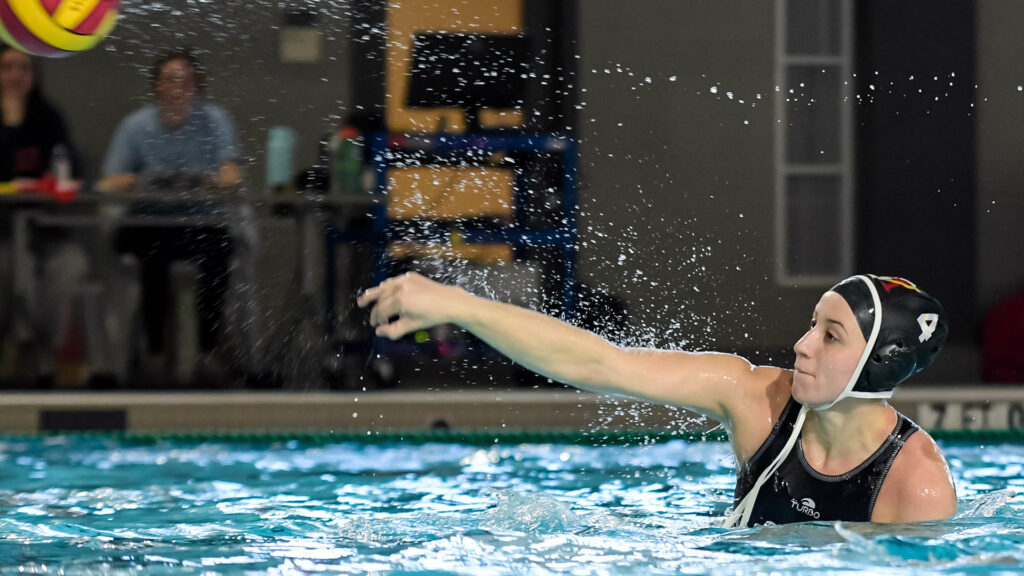
Courtney Novotny in the pool taking a shot for Virginia Military Institute's women's water polo team.

Cadet-athletes at VMI not only have their responsibilities with their selected sport but cadet duties on top of that.  Cadets are also required to take physical fitness classes twice a week, participate in ROTC all four years, prepare for room and uniform inspections, practice for parade, guard duty, and more. 

Her days can vary, depending on her schedule for classes and practice. Some days require an earlier wake-up, like when she does early morning lifting, she gets up at 5:15 a.m. 

Novotny isn’t sure if she will commission after graduating in 2025, but she is part of the Coast Guard auxiliary university program, which entails a lot of outside work and responsibilities. She said to stay on top of things, she takes the days she doesn’t have as many classes to get caught up on schoolwork. She lacks free time in the evenings because of practice.  

“I always try to tell myself even if I am having a bad day or if I do bad on an assignment that’s OK because that happens and I always make it through and overcome,” she said. “Usually, a lot of times, if I’m having a bad day, going to practice helps because it gets my mind off of it. I’ll go to practice, and I’ll be with my teammates. I forget about everything. Then I’m laughing and smiling. That’s the nice thing about playing a sport here is that you kind of get a break from academics.” 

Despite the busy schedule, Novotny said she likes the grind at VMI. Even though some days she wants to ditch practice and take a nap or do homework, she wouldn’t change it.  

“Being so involved at VMI is preparing me for the future,” she said. “When I’m older and I’m working, you’re always going to have a lot of responsibilities. So even though it is hard sometimes and I wish I didn’t always have to go to practice after classes, when I really think about it, it’s good to have this responsibility. Because it’s preparing me for what else is in the future.” 

Keydets Swim and Dive Break Multitude of Records

Keydets Swim and Dive lapped the competition during the America East Conference Championship. The championship was hosted at Virginia Military Institute’s Aquatic Center Feb. 14 through Feb. 17. 

Coach Scott Thacker said it was an incredible week hosting, which marks the first conference swim and dive championship event hosted at the Aquatic Center, which opened in early 2023.  

“The Goodall Pool was packed full of spectators and the energy was electric. It was an honor to host the conference meet and I am grateful for the efforts and dedication from our VMI staff to put on a top-notch championship environment,” he said. 

The VMI Swim and Dive athletes broke 26 program — team, rat, and personal — records during the championship, closing out the 2023-24 season. 

“I am beyond impressed and proud of our team for their accomplishments during the meet,” Thacker said. “Our team broke records a total of 26 times during the meet, totaling 21 new team records set during the championship. Having such a strong showing on post, and our 1sts closing out their athletic careers in our home pool makes it all the more special.” 

The breakdown of records

The first day of the conference meet brought several program records. 

Walden Wilder ’27 clocked a 2:02.45 in the 800-freestyle relay, which is a personal best and top 10 time in program history. 

Three-Legged Stool winner Kate Taylor ’24 became the first female in VMI history to swim a sub-24 second 50-freestyle relay split (23.91), as she anchored the 200-medley relay, according VMI Athletics.  

Two men’s relay teams also set records on the first day of the championship.  

Tinn Nguyen ’27, Chase Lane ’24, Tyler Blackwell ’24, and Matthew Picard ’27 broke the VMI record in the 200-medley relay with a time of 1:30.88. 

Picard, Sam Castle ’27, Elijah Fields ’27, and Dalton Cosner ’24 set a new program mark in the 800-freestyle relay, with a time of 6:47.05. 

Picard also set both a rat and team record in the 200-freestyle (1:41.00). 

The trend of slashing records continued into the second day of the meet, according to VMI Athletics.  

Cadets Chino Vera ’24 and Cosner bookended the 200-yard freestyle relay, as Max Brunner ’27 and Castle helped the Keydets post a new record time of 1:23.51. 

Taylor and Jillian Maher ’24 led off their 200-yard freestyle relay, with Walden Wilder and Noelle Tong for a women’s program record of 1:38.46. 

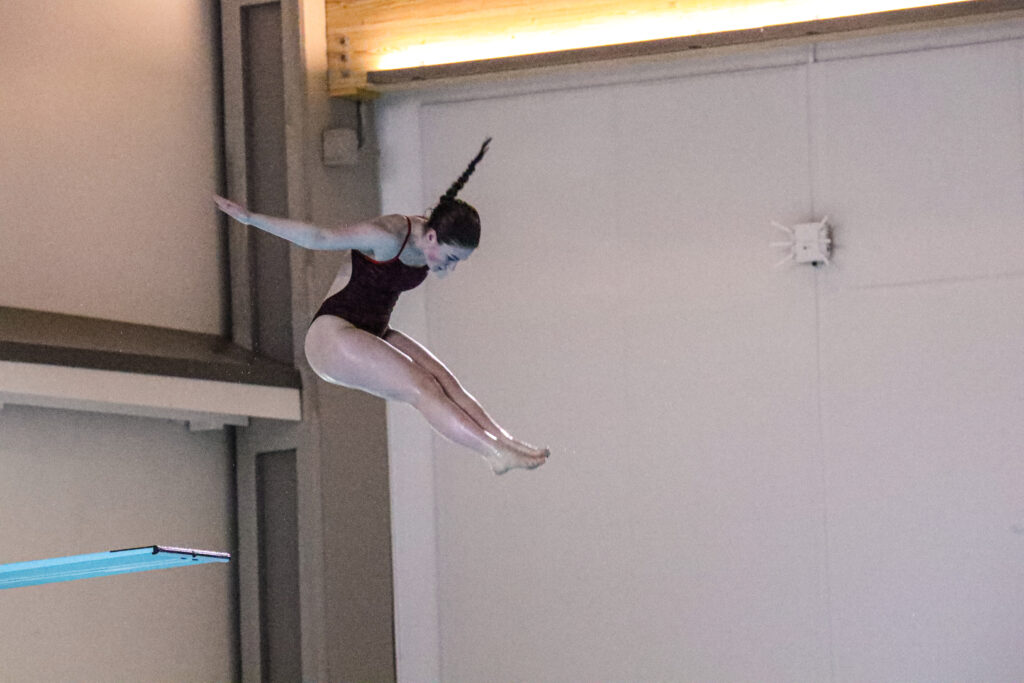
A diver mid-dive off the diving board.

Picard set another rat and team record in the 50-yard freestyle at 20.64 seconds. 

By Friday, the team cannonballed through 11 more records, according to VMI Athletics

  • Ethan Griffith ’25 earned the silver medal in 400 individual medley for a program record time of 3:58.62.
  • Blackwell set the VMI team record with a prelims time of 49.82 in the men’s 100 butterfly.
  • Leading off the 400 medley relay, Castle swam a team and rat record in the 100 backstroke.
  • After the prelims, Brunner would set a new rat record in the 100-yard butterfly
  • In the 100-yard breaststroke, Anne Bowles ’24 set a new team record with a time of 105.76 in the finals.
  • In the prelims of the 400-yard individual medley, Sarah Liebenow ’24 recorded a new women’s team record of 4:49.74.
  • In the 400-yard medley relay, Noelle Tong ’26, Bowles, Maher and Taylor swam a 4:02.37, setting a new women’s record in the process.
  • Castle, Lane, Blackwell, and Picard set the new men’s record in the 400 medley at 3:20.39. 

VMI Athletics said the last day of the meet resulted in five more records being broken. 

  • Picard set a rat and team record of 45.49 seconds in the 100-yard freestyle. 
  • Castle set a new team and rat record in the 200 backstroke at 1:50.28. 
  • Picard, Castle, Vera, and Castle combined for a new program record in the 400-freestyle relay with a 3:02.17 in that event. 

Behind the Balance: Tyler Mousaw ’24 — Keydet Wrestling

Virginia Military Institute’s cadet-athletes have to juggle cadet life, heavy academic course loads, and their NCAA Division I sport. Committed to both academic and athletic pursuits, balancing their rigorous schedule in both sports and school requires a certain level of commitment and discipline. Behind the Balance is a series that focuses on those cadet-athletes and how they handle the hurdles of the day-to-day.  

In first grade, Tyler Mousaw ’24 came home from school with a letter offering a chance to choose between two sports — basketball and wrestling. Mousaw said wrestling seemed like the more enjoyable option, and the rest is history. 

“It’s not like any other sport,” he said. “It’s a team sport and an individual sport. When you’re out there, it’s kind of just you and just something about it that’s fun.” 

The economics and business major plans on working in the private sector after graduating in the spring. He chose Virginia Military Institute because he needed to attend somewhere he could grow. He said he wasn’t a stellar student in high school, so he wanted a place that could push him to be the best he could be. 

“I just needed discipline,” he said. “I knew I needed to go somewhere where I would grow up kind of fast. VMI’s done that for me.” 

The cadet regimen has worked out for Mousaw. Plus, being a D1 athlete on VMI’s wrestling team has enabled him to find ways to balance everything. 

Cadet-athletes at VMI not only have their responsibilities with their selected sport but cadet duties on top of that. Cadets are also required to take physical fitness classes twice a week, participate in ROTC all four years, prepare for room and uniform inspections, practice for parade, guard duty, and more. 

He said he’s good at compartmentalizing. 

“I make the most of my time. When it’s wrestling time, it’s wrestling time. I don’t really think about academics or anything. When I’m not wrestling, I try to get my schoolwork done as quickly as possible so I can relax and do other things.” 

His days usually start with waking up at 5:45 a.m. and getting to Cormack Hall for early practice, which is usually weightlifting. If he still has schoolwork to complete, he’ll return to his room and finish that before heading to breakfast, then onto class. Around noon, he’ll have a break for lunch, but he’s back to classes until about 2 or 3:45 p.m. depending on the day. Following that, it’s back to Cormack for more practice until about 6 p.m. 

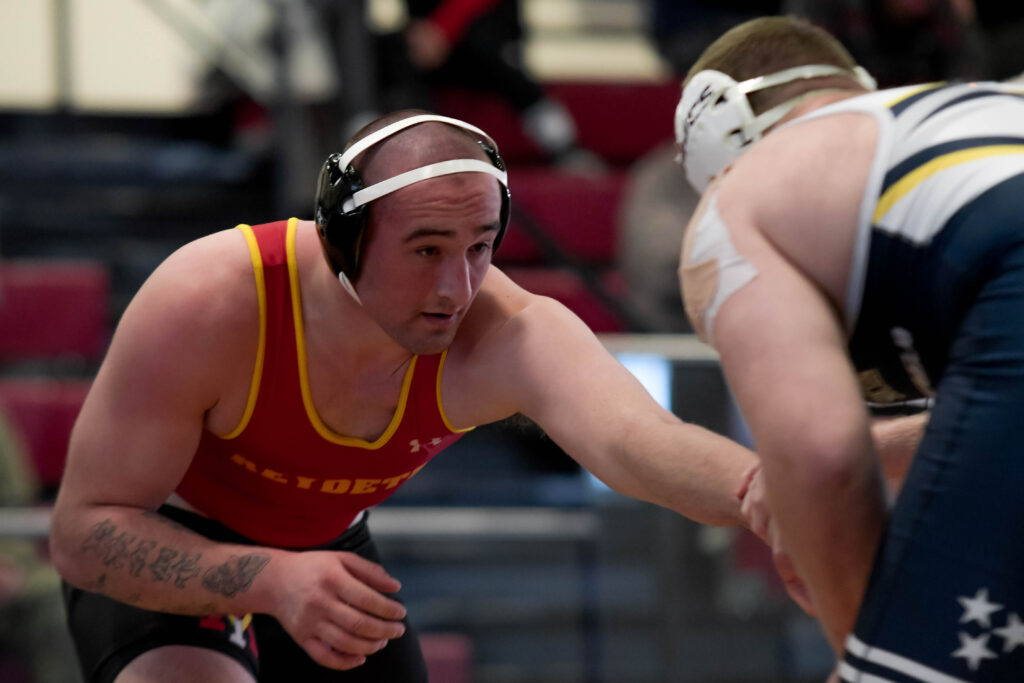
Tyler Mousaw wrestling for Virginia Military Institute.

Mousaw usually gets a break after practice before formation at 7:30 p.m. and then onto supper, so he opts to have some downtime. But after supper, it’s back to the books.   

Wrestling starts immediately upon arriving to post in the fall.

“Pretty much as soon as we get back to school in the beginning of the year, we start preseason [training]. It’s a lot of running and working out getting back in shape,” he said. 

He said the team stayed in Lexington over winter furlough to have two-a-day practices. His season starts in November and goes until about March. Although that may seem rigorous, his favorite part about attending VMI is that he gets to be a part of the wrestling team.  

“It’s just the bonds with the teammates … it’s a pretty tight bond,” he said. “Everybody’s going out there and putting it on the line in front of everybody and it’s a battle. You develop a respect for everybody.” 

But VMI has instilled something bigger in him — honor. 

“The biggest thing is the Honor Code. It’s just something good to live by,” he said. “Don’t lie, cheat, or steal. You’re setting yourself up pretty good right off the bat. My maturity before I came here, I was just like a normal high school kid. You know, a little bit rebellious. Then I came here and it forced me to grow up quickly. I think I’m more attuned to dealing with different situations. I’m more adaptable, and just ready to be done and get into the workforce.” 

The Extra Mile: Arnold Air Society

With dreams of attending the U.S. Air Force Academy, Nathan “Skye” Van Ness ’25 had to shift gears when he wasn’t accepted. But it didn’t deter him. Rather, if he could go back in time, he wouldn’t have even applied. Instead, Virginia Military Institute has provided an overwhelmingly beneficial college and military experience for the cadet.  

Overall, he’s much happier in his decision.  

“VMI teaches a level of humility and appreciation for the enlisted side. And not only that, but also for the non-commissioning cadets as well,” the physics major said. “It affords all sorts of other unique and distinct opportunities to interact with other kids in different branches and really get a full picture of everything while building yourself in a way that I haven’t really seen anywhere else.”

Van Ness said by attending VMI, his skills in athletics, academics, and leadership have improved significantly, which in turn has prepared him to be an effective leader. By joining VMI’s Air Force ROTC Det 880 Arnold Air Society John P. Jumper Squadron, his leadership skills have increased tenfold.  

The Arnold Air Society (AAS) is a service organization through the Air Force ROTC (AFROTC) that centers on professionalism, honor, and community service. Squadrons are formed by AFROTC in collegiate settings focusing on cadets who are dedicated to their community and to becoming an Air Force officer. 

Van Ness is the commander for the squadron. The club was recently rebooted. It was reinstated in 2021 after a pause, but the club has ties at VMI stemming back to the 1970s.  

What drew Van Ness to the club was its values, but also there’s the possibility of national scholarships upwards to $10,000.  

“I saw that sort of excellence as something I want to be a part of and really live up to,” he said.  

He decided to join, which requires a list of things before being initiated, that includes: 

  • Have at least a 2.5 GPA 
  • Score at least an 80 on the United States Air Force Physical Fitness Assessment and meet physical standards 
  • Be active in the cadet corps and have necessary leadership qualities 
  • Receive an invitation from AAS and complete the post-training program 
  • Pass the AAS national test 

The two big things that VMI’s chapter does is have the candidacy class come up with a service project. This year it was collecting funds for the Rockbridge SPCA. The other initiation task is getting signatures from all the current members, which is around 10. 

Normally, that wouldn’t sound hard, but to get the signatures, the candidate would need to do a task. Last year, Van Ness required a candidate to clean his shoes in order to get his signature.  

“I took one shoe, and I shined it because I’m good at shining shoes. I love doing it. I made one shoe as shiny as I possibly could get it. I was like, if you can get this other shoe just as shiny, I’ll give you my signature,” he said. 

The more Van Ness participated, the more leadership opportunities he craved. He began working towards squadron commander. 

“I would say that the Arnold Air Society has single-handedly improved my leadership and leadership philosophy as a whole,” he said. 

By attending the National Conclave, or NATCON, last year, Van Ness said he felt like he grew up an entire year within just a few days due to the impact of the conference.  

“It felt like I matured so much just from being able to be there,” he said.  

Last semester, Donald “Alex” Dieffenbach ’26, a computer science major, was the candidate training officer for the club. His role in the squadron was member onboarding, and initiation. Each potential new member participates in a candidacy before they are initiated.  

Candidacy is a several months long process which goes over the basic knowledge about AAS, history, structure, and administration.  

“A lot of it is like the tradition, the heritage, the values, just kind of teaching the candidates what kind of person best fits into this society,” Dieffenbach said.  

The club is also not strictly for VMI cadets, as they’ve had Washington & Lee and Mary Baldwin students also participate.  

“We intend on completing a lot more service projects, a lot more morale events, and really engaging with the region and as a squadron,” Van Ness said. 

“That’s the nice part about Lexington, it’s a small community,” Dieffenbach said. “We’re really blessed to be in this place because community outreach is significantly easier than say, like Richmond or Charlottesville. You can build those connections.” 

The Extra Mile: Trap and Skeet Club

The long gravel road winds around to the back of McKethan Park. From the first turn, you may see a large flagpole with a red flag flying. It signals that there’s shooting in progress at the outdoor range. 

Lucas Wood ’24 grew up hunting and target shooting, but it wasn’t until he became friends with Virginia Military Institute’s Trap and Skeet Club cadet in charge that he shot a clay. 

“I grew up shooting but never like this,” he said. “I tried it out and I just really enjoyed it and figured it out.” 

He’s now the cadet in charge (CIC) for the club, which practices twice a week at McKethan Park in Lexington. He said the club is a good chance for cadets to step out of the confines of who they know in their class and create bonds with the rest of the Corps involved.  

“VMI is very separated by class. You’re friends with the people who are in your class. But the clubs give an opportunity for all the classes to come together and get to know each other,” he said. “When you’re spending five hours a week out on the range with somebody that’s a year younger than you or two years older than you, whatever it might be, it’s really good to know a large variety of people.” 

Most of those in the club either grew up shooting or have experience with a gun. Bryant Falk ’25 also grew up shooting.  

“You all kind of have a certain similarity,” Falk said. “Some people will go and hunt together with people in the club or we’ll go shoot together with people in the club.” 

But not everyone needs to be an experienced shooter to join the club. Wood said there are a number of members who have never shot before.  

“It’s really interesting to see them as they progress … start to figure out the basics of it,  and then really become some good shooters,” he said. 

It’s the comradery of the team that keeps them engaged in the club. During practice is the time when they can shine individually, though.  

“We get competitive because when we go out somewhere to compete, it’s as a team,” Wood said. “But then when we’re out there practicing is more individual, like what your individual scores are. So I like the competitiveness within the team. We kind of like egg each other on, so it’s always a good time just to be out there.” 

Practice is also a time to hone your skills and aim for perfection. The perfect score in skeet is 25, and Wood has shot that once while at practice.  

“A tradition within the skeet shooting community is that when you shoot your first 25, everybody that you’re shooting with shoots the hat that you’re wearing,” he said. “You take your hat and throw it over and everybody that you’re shooting with, shoots your hat in the air.” 

Wood, although ecstatic he shot that perfect score, was a little bummed to have one of his favorite hats ruined.  

“I got it at one of the competitions we did,” he said. “So you’ve got to be mindful of what hats you’re wearing.” 

The difficulty of the sport is what draws Wood in, he said.  

“We’ll shoot multiple rounds or multiple matches while we’re out there at practice. And in one round, you can shoot a 23 out of 25 and the next round you only hit 16 of the 25. It’s literally hit or miss,” he said. “It gets aggravating. That’s what keeps us coming back.” 

Falk said he enjoys the excitement of knowing twice a week he’ll be out there shooting.  

“You get excited to go out and shoot because you get away from this place for a little bit. And you’re not doing like military or anything like that,” he said. “It’s a fun thing to do. But it’s also difficult at the same time. It’s challenging, because you want to shoot as good as possible.” 

Falk said when he started, he could barely shoot an eight.  

“Over time, as we kept going, we kept shooting more and more and more. And we just keep going back because we want to shoot better and better and better.” 

How trap and skeet works 

It’s easier to see and experience than it is to explain, Wood warns.  

Trap and skeet are two different type of shooting sports. With skeet, you rotate through for a total of 25 targets from eight different stations. Skeet is shot in squads of up to five shooters, who move from station to station around the half-moon, ending up in the center, at the end of the round. 

“The target is farther away from you and it’s moving,” Wood said. “When the wind starts flying. it’ll push targets either super-fast or slow or the wind can push them way up.”

In trap shooting, you stand in stations on a crescent shape behind the trap house, which is in front of the posts. Each trap house is equipped with a mechanical trap that throws clay targets into the air.  

One of the main differences between these shooting sports is skeet is a rotation of shots that you have to get to each station, despite any timing of when the clays are thrown. In trap, the shooter yells, “pull,” for the clay to be released.  

In trap, each shooter takes turns until everyone has fired five rounds at their post, then they rotate to the next post to do the same. They do this rotation until each shooter has hit the five different stations, shooting five shots at each station.  

 The club is open to everyone but rats, who can join once they’re 4th Class cadets.

Behind the Balance: Katie Grochalski ’24 — Keydet Rifle

Virginia Military Institute’s cadet-athletes have to juggle cadet life, heavy academic course loads, and their NCAA Division I sport. Committed to both academic and athletic pursuits, balancing their rigorous schedule in both sports and school requires a certain level of commitment and discipline. Behind the Balance is a series that focuses on those cadet-athletes and how they handle the hurdles of the day-to-day.  

Katie Grochalski ’24 was taught to shoot a simple action revolver at the age of 8 by her father. She grew up on a farm in Pennsylvania and by the age of 12, she was taught to shoot a .22. By 14, she was allowed to handle any gun that was in the house, if she were to lock it back up and demonstrate proper gun safety. 

“I grew up shooting groundhogs on my property and raccoons because we had chickens,” she said.  

She always wanted to hunt with her father, but she’s not a morning person. Instead, she started diving into other activities. Her initial aspiration was to be a fashion designer — it’s something she had said since kindergarten. She loved creating, sewing, and drawing. She also loved to dance. So, when she announced she wanted to be a Navy SEAL, it was a shock to her parents.  

“My parents were completely blindsided because I never told them I wanted to be a SEAL,” she said. 

The career change was prompted by a teacher when she was in the third grade who would bring in the newspaper every Wednesday. On one Wednesday, the headline regarded SEAL Team Six taking down Osama Bin Laden.  

The self-proclaimed lazy swimmer veered off the path of wanting to be a SEAL and settled on the Marine Corps by the time she reached the seventh grade. Grochalski, a psychology major, will be commissioning into the Marines after graduation.  

“All my friends from public school were Navy, Air Force, Army, so, I just rounded it out as a Marine,” she said. “And ever since seventh grade, this is all I ever wanted to do.” 

She said her family tried to persuade her to do something else, but her mind was set.  

“My response to them was whenever I turn 18, I’m going to do it anyway, so either you love me and you’re with me or you don’t talk to me,” she said. “I’ve been on this journey ever since. I taught myself how to run and taught myself how to do pull ups. I was a dancer growing up, so learning from elegance and grace into being a warfighter was completely different.” 

Joining Junior ROTC in high school, she first started with drill, but was drawn to the sport of rifle.  

“I was a year behind most people on the team because I joined as a sophomore, instead of as a freshman. But man, I loved it,” she said. “Doing rifle gave me a sense of stability, taught me how to really be a person and look at myself. I had an inferiority complex, and rifle taught me how to calm myself down and think through things properly.” 

Junior and senior year of high school, Grochalski transferred to Massanutten Military Academy, which is modeled after Virginia Military Institute. It seemed like the proper track — after high school to attend VMI.  

She found that rifle served as her own personal time, something that she could devote only to herself. Any big decisions or thoughts occurred at the range, she said. The solid black powder, the popping of rifles, it had a calming effect on her, so much so that she could even fall asleep at the range.  

“I think the discipline is fantastic. It does a lot with your mentality and mindfulness. It teaches you how to calm yourself to the point where I can tell my heart rate. I can sit here and physically feel my body shake because my heart rate,” she said.  

Her time at a military high school also instilled discipline, along with her training on the range.  

“I had to eat the same thing every single day. I had to have three meals a day. I had to make sure I worked out the same way every single day. How to be a level head, because I was not. Every Marine is a rifleman, so why not start early?” 

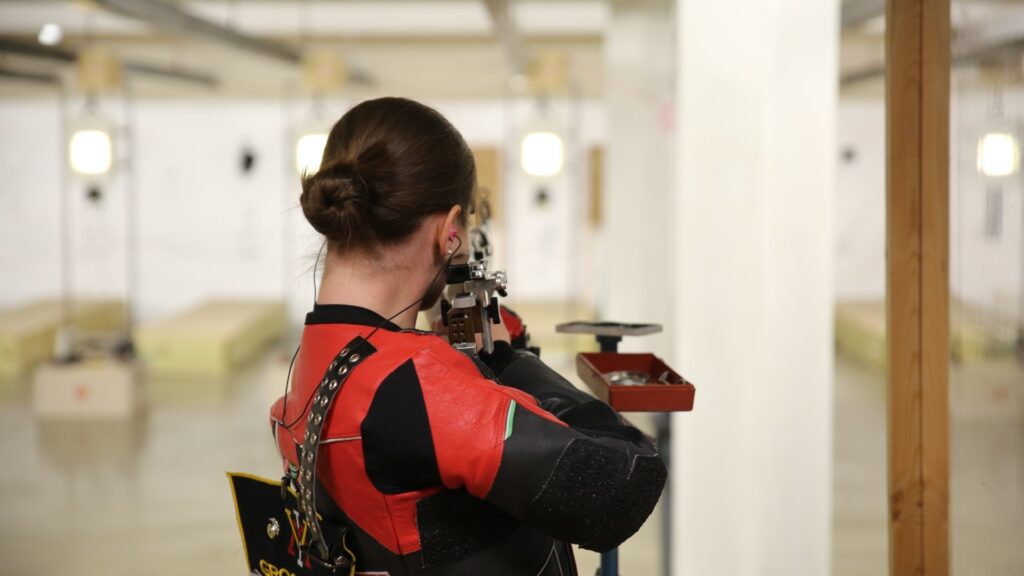
Katie Grochalski shooting a rifle as part of the Virginia Military Institute's rifle team.

On the team, in the classroom, and beyond 

She got involved with VMI’s rifle team by coming to a rifle match at VMI while she was a senior in high school. She toured the school a bit and was introduced to the rifle coach Lt. Col. Bill Bither. Her trip was cut short due to an impending snowstorm, but when she returned to VMI as a rat, she met with Bither and was on the team. 

Cadet-athletes at VMI not only have their responsibilities with their selected sport but cadet duties on top of that.  Cadets are also required to take physical fitness classes twice a week, participate in ROTC all four years, prepare for room and uniform inspections, practice for parade, guard duty, and more.

Grochalski has a stacked schedule, which includes waking up daily at 6:30 a.m. for formation at 7 a.m. On Tuesdays and Thursdays, she’s the drummer for formation, so she has to head to the band room prior to formation. After that, she heads back to her room, and if there’s time before her 10 a.m. class she’ll nap. She has three or four classes a day, depending on the day, but wraps up around 3 p.m. She has an hour after classes before practice for rifle begins at 4 p.m. 

“I’ll have an hour of me time to get things done; do any miscellaneous things,” she said.  

On Tuesdays and Thursdays, she lifts after she shoots at the range. By 9:30 p.m., she’s onto rifle formation.  

Wednesdays and Fridays, she teaches ballroom dance in the evening for the Ballroom Dance Club.  

“I love dancing,” she said. “It’s one thing that really ties me to home. It helps me handle my homesickness.” 

To balance it all, she said it’s best to come to the understanding that you can’t control everything.  

“Understand that you can’t control it all,” she said. “But with all my stuff, I’ve learned how to manage bit-by-bit over the years from first going to regular high school, then to military high school, onto here. Having that stress inoculation helps. It really helps.” 

Midshipmen Moments: Sebastain Ramirez ’24

Sebastian Ramirez ’24 became fond of the challenging lifestyle that came with attending Virginia Military Institute after attending an open house. He said the high standards that cadets endured on a daily basis was something he wanted. 

“I wanted to go through the system myself and experience a transformation from such an intense and demanding environment,” he said. 

The applied mathematics major was originally enrolled in the Air Force ROTC for the first two years of his cadetship. Towards the end of his 3rd Class year, he had a change in heart and decided that he wanted to try to become a Marine.  

“I admired the leadership philosophies of the Marine Corps and the unrelentingly high standard that is expected of all Marines,” he said.  

He said the standard of the Naval services, especially the Marine Corps, is one of the highest of all the branches, which made it something he was drawn to. He also saw similarities in VMI’s culture and that of the Marine Corps — intimate and sacred. 

“The mission of the Marine Corps is unique; we are called upon at a moment’s notice with the expectation of fighting and winning in any clime or place,” he said. “The thing that makes me most proud to be a Marine is the legacy. To have the privilege of carrying on the legacy of the Marine Corps is indescribable. I look forward to serving and supporting Marines and feel privileged to be given the opportunity to lead.” 

He’s currently contracted as a student naval aviator with hopes of flying the F/A-18 or F-35. 

The Naval ROTC program provides two programs in which cadets can enroll in — U.S. Navy or U.S. Marine Corps. 

The mission is to develop midshipmen mentally, morally, and physically, and to instill the highest ideals of duty, honor, and loyalty to commission them as Navy or Marine officers. The NROTC program fosters high-level responsibilities of command, citizenship, and government. 

This past summer, Ramirez attended Officer Candidate School (OCS) at Marine Corps Base in Quantico. OCS is to educate and train officer candidates in Marine Corps knowledge and skills within a controlled and challenging environment. The school evaluates and screens individuals for the leadership, moral, mental, and physical qualities required for commissioning as a Marine Corps officer. 

Some trainings and activities included: combat conditioning, obstacle courses, close order drill, academic classes and discussions, fire team assault course, leadership reaction course, stamina and endurance course, small unit leadership evaluation, and daily platoon staff evaluation. 

The 10-week training was focused on small unit leadership in a stressful and fatigue-inducing environment, Ramirez said.  

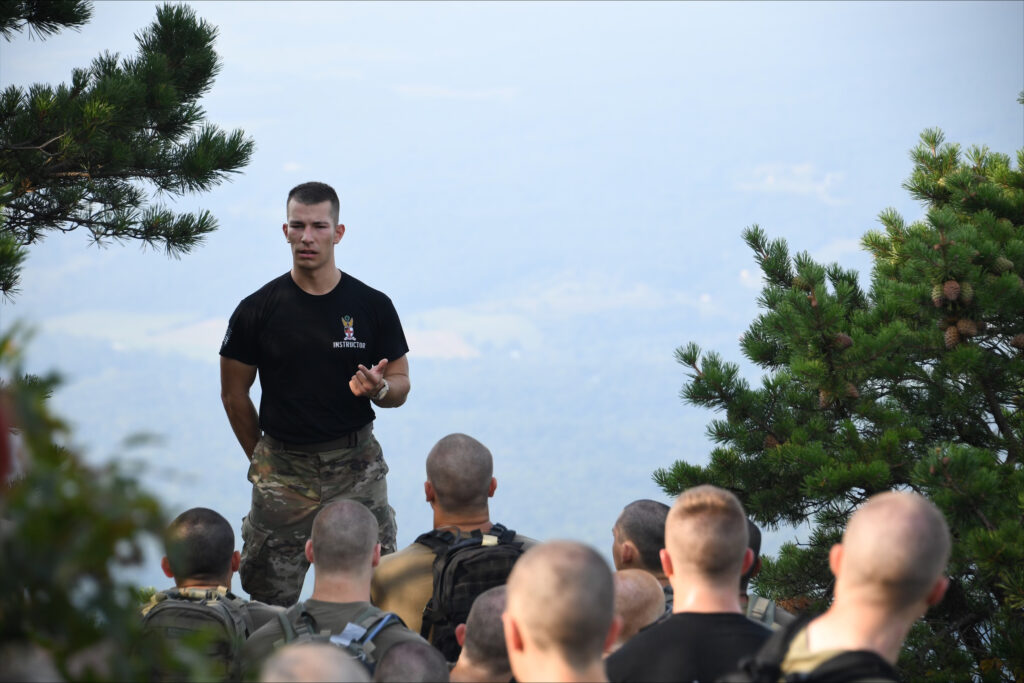
Sebastian Ramirez addresses the Corps of Cadets atop a mountain.

“There’s also a significant amount of physical training events varying from long-distance runs to courses designed to simulate the physical rigors of a combat environment,” he said. 

He is currently in the Marine Company as the midshipman company gunnery sergeant and physical training instructor.  

“My responsibilities include planning, overseeing all physical training events, and managing gear distribution and maintenance,” he said.

He’s had the privilege of leading the company in physical training and ensuring their success in physical fitness tests and combat fitness tests, but all aspects of life where one’s physical fitness is put to the test. 

“We’re trying to build someone who is balanced in strength, endurance, and adaptability,” he said. 

Ramirez said that a benefit of VMI is the open doors it provides.  

“My decision to join NROTC came very late in my cadetship, relatively speaking. Fortunately, I was willing to put in the work and as a result, I’ve been given amazing opportunities despite having joined the program so late,” he said. “Finally, nothing makes the journey more meaningful than being able to take on every challenge with your best friends. Make friends wherever you go, and you will enjoy the work.” 

Behind the Balance: Andrew Granger ’24 — Keydet Track and Field

Virginia Military Institute’s cadet-athletes have to juggle cadet life, heavy academic course loads, and their NCAA Division I sport. Committed to both academic and athletic pursuits, balancing their rigorous schedule in both sports and school requires a certain level of commitment and discipline. Behind the Balance is a series that focuses on those cadet-athletes and how they handle the hurdles of the day-to-day.  

If anyone knows balance, it’s Andrew Granger ’24. Not just with academics and cadet life, but within his event for track and field.  

Granger is a thrower, which requires a steady technique — something he’s perfected throughout the years. He started throwing in high school. 

“When you’re throwing, if you get off balance a little bit in any direction, then you can totally mess up the throw. It doesn’t matter where you are in the stages of the throw,” he said. 

Every move is calculated: the trajectory you must throw it, or the certain angle for the best distance, down to the speed at which you’re rotating. Granger is thinking about all of this just seconds before he throws.  

“You have good body awareness, and you define ‘what did I do wrong?’ That usually tells you what you need to improve and if you can do it. It directly translates to throwing farther and getting better.” 

The English major, who will be attending Naval Officer Candidate School after graduation, decided on Virginia Military Institute after a visit with Coach Zach Scott.  

“I got to see what life was like at VMI. I was really interested in the military aspect,” he said. Granger also figured attending VMI would give him the chance to see if serving in the military was the right choice for him — something he was on the fence about.  

“I didn’t know whether or not I wanted to do it yet. So, I figured it would be a good chance for me to kind of push myself into that sort of life and see,” he said. “Also, I wanted to improve myself and have a good foundation for the rest of my life.” 

He participates in the discus, shot put, and hammer throw events for both indoor and outdoor track. His season, which starts in October, goes on until May, making it one of the longest seasons for athletics at VMI.  

Staying up to date in his 18 credits, while still participating in a Division I sport, can be difficult.  

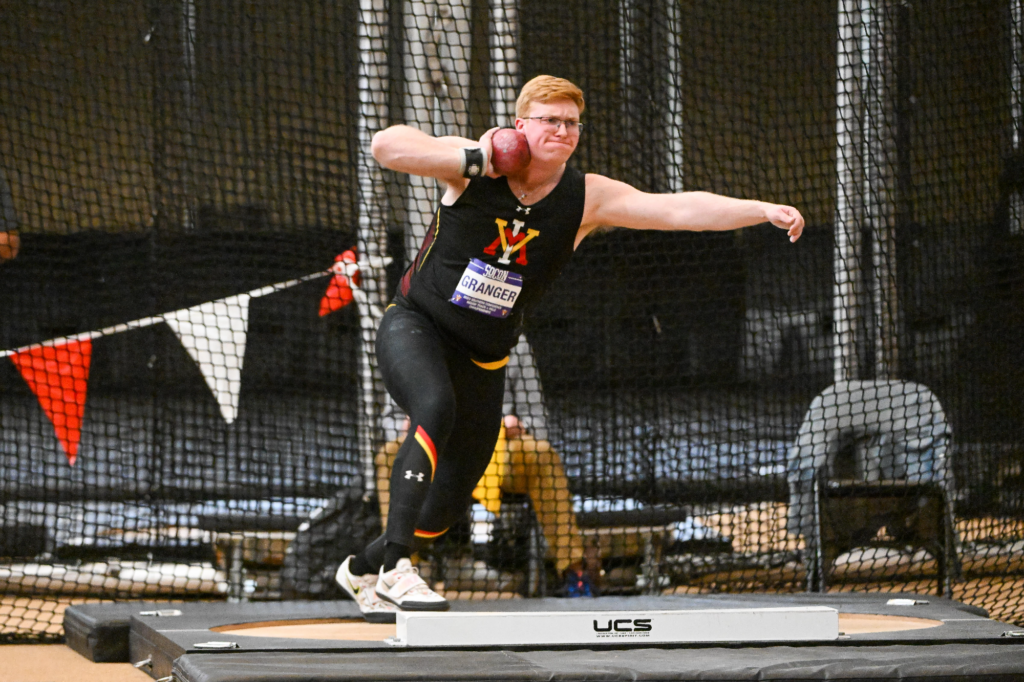
Andrew Granger preparing to throw the shot put during a track and field event for Virginia Military Institute.

Communication is key 

Cadet-athletes at VMI not only have their responsibilities with their selected sport but cadet duties on top of that. Cadets are also required to take physical fitness classes twice a week, participate in ROTC all four years, prepare for room and uniform inspections, practice for parade, guard duty, and more.

With days starting at 6:45 a.m., classes until 4 p.m., and practice until after 7 p.m., then studying and homework until nearly midnight, Granger said it’s a full day. 

“I think the phrase I hear a lot is VMI teaches you to fit a 30-hour workload into like a 24-hour day or something. I guess that it definitely teaches you to manage your time and it taught me to be respectful to everyone.” he said. 

“It’s a lot of work. It’s a balance between the academic and the athletic workload. I kind of have to stay on top of my homework and studying, while also just being ready for practice and working as hard as I can when I’m practicing,” he said. “It’s just about managing the time outside of practice to get your work done.” 

The biggest thing is communication, which is something VMI has instilled in him.  

“I’ve learned to definitely stay in contact with my teachers, especially if I’m missing classes,” he said.  

Emailing or talking in person with his professors is how he makes sure he’s making up what he’s missing out on in classes if he’s traveling for meets.  

“Whenever I have time, which is usually during the travel time when we’re on the bus, I’m getting the work done,” he said.  

Even though his sport is more individual, he said the whole team likes to back each other up. He said they all like to watch each other compete, cheer each other on, and be overall supportive of each other. Granger said they also guide each other and act as a second set of eyes looking at each athlete’s technique.