Post View Unavailable »
New Website Launched »

Midshipmen Moments: Addison Hagan ’24

Joseph Addison Hagan V ’24 always admired the men in his family who attended Virginia Military Institute. It was a part of his family history he wanted to claim.  

“VMI is the hardest small military college and there is no better school to prepare me for service in the United States Marine Corps,” he said.

The civil engineering major applied for a four-year Marine Option Naval ROTC scholarship when he was a senior in high school. Those selected applicants for the NROTC scholarship program are awarded scholarships through a highly competitive national selection process. If awarded, they receive full tuition, a book stipend, educational fees, and other financial benefits. Once they graduate, the midshipmen are commissioned as officers in the U.S. Navy or U.S. Marine Corps. 

Hagan was lucky enough to be awarded the scholarship, which allowed him to contract to be a Marine Corps officer upon his graduation from VMI.  

The Naval ROTC program provides two programs in which cadets can enroll in — U.S. Navy or U.S. Marine Corps. 

The mission is to develop midshipmen mentally, morally, and physically, and to instill the highest ideals of duty, honor, and loyalty to commission them as Navy or Marine officers. The NROTC program fosters high-level responsibilities of command, citizenship, and government.  

Hagan has participated in a few summer assignments. His first was Marine Month West at Camp Pendleton, California, staying at Camp Talega. His next summer assignment was Marine Month East at Camp Lejeune in Jacksonville, North Carolina. Both assignments focused on training like land navigation, endurance courses, obstacle courses, hikes, physical fitness, academics, and small unit leadership. 

“Both of these experiences were filled with really great training and a lot of fun times,” he said. 

This past summer, he attended Officer Candidates School (OSC) at Marine Corps Base in Quantico. OSC is to educate and train officer candidates in Marine Corps knowledge and skills within a controlled and challenging environment. The school evaluates and screens individuals for the leadership, moral, mental, and physical qualities required for commissioning as a Marine Corps officer. 

Some trainings and activities included: combat conditioning, obstacle course, close order drill, academic classes and discussions, fire team assault course, leadership reaction course, stamina and endurance course, small unit leadership evaluation, and daily platoon staff evaluation.
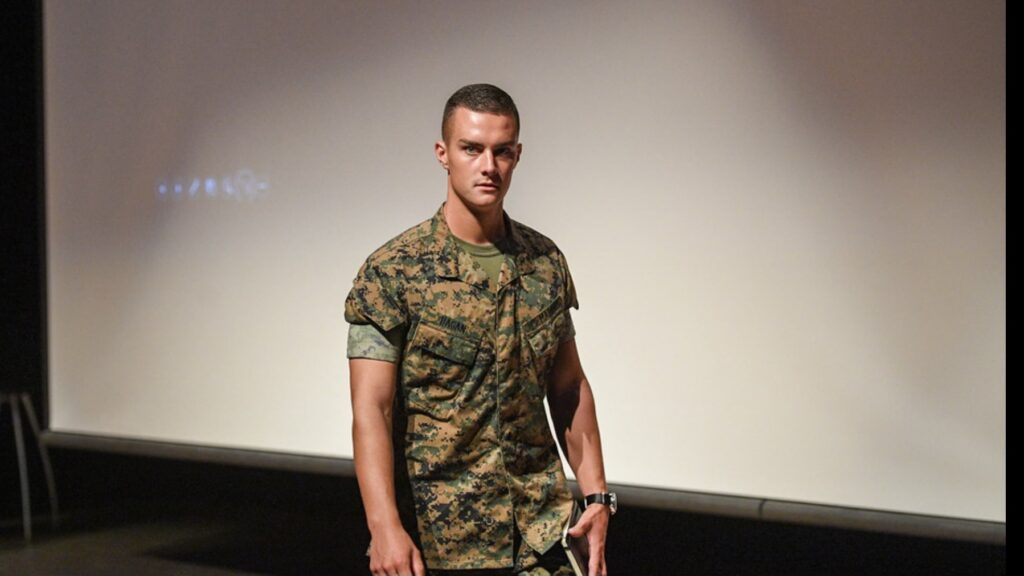
Joseph Addison Hagan V, Class of 2024
Screenshot

“OCS was the toughest thing I’ve done so far, and it was an extremely rewarding experience,” he said. 

Currently, he is the midshipmen company commander for the Marine Company. This means, he ensures that every cadet who is a Marine option midshipman has what they need to prepare for their future as a second lieutenant in the U.S. Marine Corps.  

“I get to help decide what we do for our training, and I have the opportunity to work closely with the NROTC Staff,” he said. “I would say that I get to lead others and give back to an organization that prepared me well for OCS. I am now in a position where I can put the principles and information I have learned over the past three years to work training the next few classes of midshipmen.” 
Behind the Balance: Christopher Hicks ’24 — Keydet Rifle

Virginia Military Institute’s cadet-athletes have to juggle cadet life, heavy academic course loads, and their NCAA Division I sport. Committed to both academic and athletic pursuits, balancing their rigorous schedule in both sports and school requires a certain level of commitment and discipline. Behind the Balance is a series that focuses on those cadet-athletes and how they handle the hurdles of the day-to-day. 

Christopher Hicks ’24 takes a deep breath, sets up his sight, braces his weapon, and fires. For Hicks, the sport of rifle is 90% mental. It’s also long and arduous.  

“If I’m having a rough last couple shots, I like to just put the gun down and then take a step back and try to regroup myself instead of letting the anger get to me,” he said.  

If he lets his anger and frustration get to him, he’ll just end up rolling the same set of bad shots.  

“I like to try to start over, reset my position,” he said. “This is a new shot. Forget about the old shots.” 

How the sport of rifle works 

He has two separate kinds of shots — one set of 60 shots with a .22 rifle and another set of 60 shots with an air rifle.  

He said it’s about a shot a minute. There is a time limit for both sections of shots, a total of an hour and a half.  

“It’s not rapid fire. You want to be one shot per minute,” he said. “Regroup yourself, go through the same routine, every shot. Make it the best shot you can.” 

It’s more than just shooting a gun. It’s about position and accuracy.  

When shooting the .22, you have three positions — prone, which is laying down; kneeling, with one knee down; and standing. Each position you get 20 shots, totaling 60 shots with the possibility of 600 points, 10 points per shot.  

For the air rifle, all 60 shots are from the standing position, with the same possibility of points. In this round, the athlete generally scores higher.  

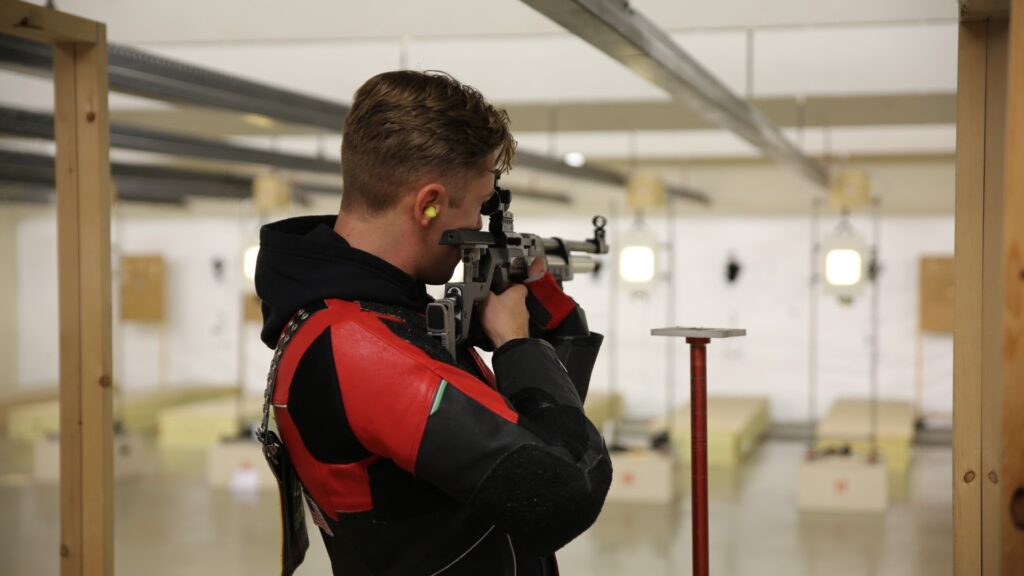
Christopher Hicks shooting a rifle for Virginia Military Institute's rifle tea\m.

Handling studies and sport

Rifle is one of the sports at Virginia Military Institute with one of the longest seasons. Starting in September until early-March. Hicks said the team practices daily from 4 to 5:30 p.m. 

Cadet-athletes at VMI not only have their responsibilities with their selected sport but cadet duties on top of that. Cadets are also required to take physical fitness classes twice a week, participate in ROTC all four years, prepare for room and uniform inspections, practice for parade, guard duty, and more.   

“I would say time management is the biggest thing,” he said. “Being able to know your schedule and then know when you have time and then fitting everything in. That’s what’s helped me the most because I know when I practice and when I have free time, and so I can fit in time for studying.” 

Hicks grew up hunting and knew his way around a gun, but he really got into it when he was part of Marine Corps Junior ROTC. The program has an extracurricular activity of rifle. 

The civil engineering major was originally going to commission, now he’s looking to use his degree in the civil sector. 

He wasn’t looking at schools specifically for rifle. He was selected for the team and entered a trial period. He said now, the team is making more recruiting efforts, but when he started, they were looking for people with prior experience in rifle.

Hicks said he’s a mix between a natural shot and a practiced one. He’s honed his skills on the range with practice — both mentally and in skill. The highest he’s scored is 591 in practice and 589 in competition.  

Drills like removing the monitor where you can gauge your shot also helps in feeling and seeing where you’re shooting, he said.

“Rather than just putting lead downrange and seeing where it goes, it helps you understand where you’re putting the shot and what’s affecting the shot, like trigger pull or anything like that,” he said. 

The Extra Mile: Building BRIDGES

Emma Funkhouser ’24 grew up in Rockbridge County, often attending events at Virginia Military Institute. She knew she wanted to make an impact, somehow, while attending college and into the future. 

“I got to see the character of people who came out of here and see the success that people were set up for here,” she said.  

That was one of the main reasons she chose to attend VMI.

Giving back and being part of the community is in her blood. Her father is a police officer, and she grew up participating in Girl Scouts.  

“I grew up with that aspect of giving back to the community, it is one of the best things you can do,” she said. 

She’s the cadet in charge (CIC) for VMI’s Building BRIDGES Club, which bridges the gap between VMI cadets, faculty, and staff and the community. Bijon Bose ’24, the other CIC for the club said he was drawn to serve his community, and helping out the community is just part of being a cadet.  

“This club is important to VMI because all cadets should be willing to serve in a capacity greater than themselves or serve others,” said Bose, a computer science major. “Every cadet at least should want to serve others. You don’t come to VMI with selfish intentions. We have our code of cadet; we have rules for how cadets should act. I think Building BRIDGES provides cadets a way to engage with the community where they wouldn’t have been able to do so by themselves.” 

Some goals of the club include facilitating learning outside the classroom, while providing space to have discussions concerning societal issues. The club helps develop the citizen -soldier mindset, while expanding critical thinking skills, promoting the ideas of selflessness, and creating compassionate engagement in the community.  

From guest speaker events, the Braver Angels debates, building with the area’s Habitat for Humanity, helping the Rockbridge SPCA, to making holiday postcards for local assisted living facilities, mentoring school children from kindergarten through grade 12, the club touches all aspects of the community. 

Funkhouser and Bose are both cadet EMTs, so they have a pulse on what sort of things need to be addressed in the community — both on and off post. One of the foundational aspects of VMI is creating citizen-soldiers, said Funkhouser, a chemistry major, who is pre-med. Building BRIDGES emphasizes the citizen aspect of that. She said that VMI focuses a lot on the soldier aspect, so this club helps cadets interact and connect with the community.  

Bose, Funkhouser, along with Madelyn Kennedy ’25, assistant CIC, hold a meeting at the beginning and end of the year. Throughout the two semesters, though, the club acts as a call-to-action group. There are several service projects or activities the club participates in — anytime there’s an event or activity, there’s a bulletin sent out asking for volunteers.  

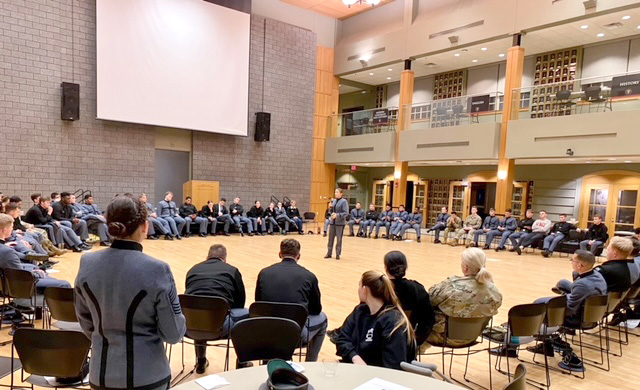
Cadets holding a discussion in Marshall Hall.

The club is made up of about 40 members and holds dozens of different activities throughout the year. Bose said there’s no set schedule on what they do. It’s even open for rats to join.  

Most of the club’s events on post are open to the full VMI community, so a lot of cadets who are not in the club participate. Hundreds of cadets have participated in the club’s fall debate, the Social Business Standards event, the fall Life, Culture and Society film event, and the Native American Heritage event. 

“The nature of the things that we do is very dynamic. We’ll have people from the community reach out to us on a few day’s’ notice,” he said. “Some weeks ago, a few of us went to the public library and we helped out with moving shelves there and that was on short notice.” 

Col. Valentina Dimitrova-Grajzl, along with Lt. Col. Sara Whipple and Dr. Sabrina Laroussi, are faculty co-advisors for the club. Dimitrova-Grajzl said the club aims to build relationships and connections between people. 

“That is very meaningful, especially when technology facilitates living in our echo chambers and augments divisions,” she said. “Our club leaders have the opportunity to be creative, to communicate with multiple stakeholders, and to learn how to organize events. All of our club members have the opportunity to develop new skills, gain a sense of efficacy, and develop an appreciation for community engagement and service. We are very proud of the work of our club leaders and members. Cadets always do exceptional work, which is why the community reaches out to us with volunteer opportunities on a regular basis.”

Bose said he can see that they are fostering good relationships between VMI and the community. 

“I think it shows the community that cadets are always there to help. People from the community reach out to our club all the time because they know that we’re kind of the liaison between cadets and the community,” he said. 

Funkhouser said the club serves as a reminder for the Corps of the type of standards they are held to. 

“I think the Corps really appreciates the fact that we do set up events for everything and have that kind of in with our community,” she said. “If you need help, absolutely let us know. Anybody would be willing to do anything for you.” 

Behind the Balance: Drew Menges ’25 — Keydet Soccer

Virginia Military Institute’s cadet-athletes have to juggle cadet life, heavy academic course loads, and their NCAA Division I sport. Committed to both academic and athletic pursuits, balancing their rigorous schedule in both sports and school requires a certain level of commitment and discipline. Behind the Balance is a series that focuses on those cadet-athletes and how they handle the hurdles of the day-to-day. 

Drew Menges ’25 had dreamed of attending the United States Merchant Marine Academy, but those dreams were halted when he was not admitted due to colorblindness. That didn’t slash his desire to go to military college, though.  

“I always wanted to go to a military school … So at the last minute we were looking at other options,” he said.

Menges has a strong desire to serve his country because of  his own family’s service. Both his grandfathers served, one in the Navy and one in the Air Force.  

“When I found out about military schools, I didn’t really know what they did,” he said. “I thought it’s pretty cool that you could come here to get a degree and commission.” 

When he found Virginia Military Institute, it was nearly kismet. By attending VMI, he’d also be able to play soccer for the school.  

“Everything worked out with the coach and then I just applied here and got in,” he said.  

When Menges talks about soccer his entire face lights up. You can tell it’s one of his passions. But, he’s serious about it. Starting at the age of 3, he took the field. By the time he entered middle school, he was playing on a club soccer team. There came a time when he had to choose between two sports, though. He was playing both soccer and lacrosse, but they were both during the same season. 

Ultimately, soccer scored higher for him.  

“I decided to stick with soccer because I liked it more. I think I was a little bit better at it too,” he said.  

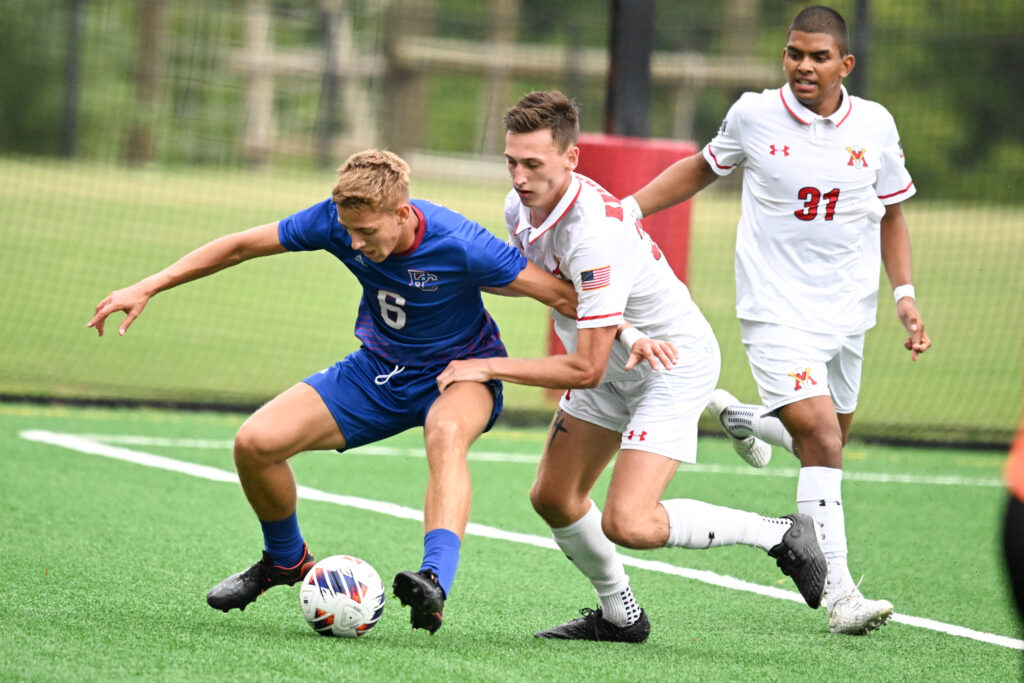
Drew Menges on the soccer field playing for Virginia Military Institute's men's soccer team.

Scoring goals on and off the field 

The mechanical engineering major has a full course load of 18 credits this semester. He’ll also be commissioning into the Army upon graduation. So, his days are tightly packed. 

Getting up at 6:30 a.m. daily, he heads to morning training with the soccer team. Morning practices consist of mostly running or stretching. Then, he’s off to formation at 7 a.m. By 7:05 a.m. he’s back to his room to put his hay up, do a little bit of school work, then he attempts to go to Crozet for breakfast before his first class at 9 a.m. 

On his long days, he has classes from 9 a.m. to 4 p.m. On good days, he’s out of class by 1 p.m. Practice is at 4:30 p.m. so after class, he’s either rushing to practices or doing work or sleeping.  

After practice, he hits up the mess hall, then it’s back to work for the remainder of the night. Sometimes he’s working on class work until midnight. On especially hard nights, he could be up until the wee hours of 4 a.m. completing assignments.  

“It’s pretty difficult. I’m not going to lie,” he said. “And this year it’s definitely ramped up because the mechanical engineering classes have got a lot harder and there’s a lot more work. I just try to knock one thing out at a time.” 

He suggests doing as much as you can with the time you’re given.  

Cadet-athletes at VMI not only have their responsibilities with their selected sport but cadet duties on top of that. There are specific times they can eat, go to class, study, and sleep. They are also required to take physical fitness classes twice a week, participate in ROTC all four years, be prepared for room and uniform inspections, parade preparation, guard duty, and more.  

“Before I came here I was not very good with time management. And everything kind of came easy to me, especially with school,” he said. “So coming here, I’ve definitely learned a lot about what I need to do every day to get stuff done, especially when it’s a heavy workload.”

He also discovered what he’s capable of.  

“You’re able to find out a lot about what you actually can do,” he said. “Like a regular college or if you didn’t come here, you probably would have never found that out by yourselves.” 

One tip he does have is to find time for yourself, even if it’s something small. He says he likes to spend some weekends with friends, just hanging out. 

“I’m also a very big believer in when I’m doing an assignment and it’s not clicking, just taking a break and stepping away from it,” he said. “It really, really helps me. And that’s why on the weekends, I always try to find time to do something for myself, instead of just worrying about school and stuff.” 

Midshipmen Moments: Rukshana Sarkari ’24

Few people can say they spent their summer aboard a warship in the Pacific Ocean, but Rukshana Sarkari ’24 can.  

Sarkari spent the summer with the USS Ronald Reagan nuclear-powered aircraft carrier battle group. Her journey started near the end July in Darwin, Australia and ended mid-August in Manila, Philippines.  

Sarkari wanted to gain experience in both the surface warfare and nuclear power fields, and this summer training assignment offered an amazing and unique opportunity to do so. She experienced one week of conventional surface warfare exposure on a destroyer and a week of nuclear propulsion exposure on an aircraft carrier. While onboard with five other midshipmen from across the country, they collectively spent time on every deck and level of the ship.

“We gained experience in various departments onboard and the operations of how everything and everyone is intertwined onboard,” she said. 

This was Sarkari’s first year participating in a summer assignment. The 1st Class cadet, a Virginia Military Institute Naval ROTC midshipman, will be commissioning into the Navy after graduation.  

“The most valuable thing I gained from this experience was to understand the emotional aspect of what it means to be an officer,” she said. “In the sense that as an officer you do need to keep that professional relationship with your Sailors, but to also remember that your Sailors have a life outside of their duty station. That it is possible to be both compassionate and stern with your Sailors together. In doing so, you can also build credibility with Sailors.” 

Her summer assignment will help her after she graduates in spring, 2024. She’s set to commission as a surface warfare officer on the path to becoming an engineering duty officer. Of all the Navy communities, she said that surface warfare has a very mentorship and leadership focus.  

“This skill and many others can translate to any part of my life even beyond the military,” she said.  

A lifelong dream 

Since the age of 9, Sarkari knew she wanted to join the military.  

“To know that the moment I get to raise my right hand and pledge my life to this country is so close, I can hardly wait to see what I can do in my future,” she said. “Serving your country is the foundation of America, and to know that not only am I surrounded by people who support my decision, but to be going into a profession that is built on servitude to others, I could not ask for more.” 

She said growing up, she saw the loss of patriotism in her peers. She’s also seen a sense of pride and welfare for the country dwindle. If serving her country can revive that patriotism, then she’s more than willing to do that.  

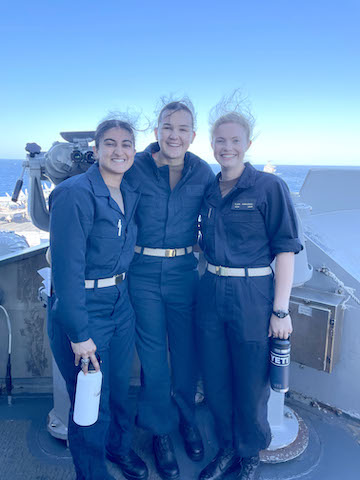
Rukshana Sarkari aboard a naval vessel.

“As a child of immigrant parents, I would not be where I am today if they did not have to option to come to America and study and fulfill what is the American dream,” she said. “I want nothing more than to protect that dream for generations to come. I want to be able to look back and tell my kids that this country can make anyone’s dreams come true. We are a country of opportunities, and if I don’t take my own opportunities then how am I supposed to lead and help others to do the same?”

Gaining experience in the outside world, Sarkari said it gave her major insight as to what her life will look like after VMI.  

“Coming from a senior military school, the day in and day out of life can sometimes make you forget what the outside world is like … to go out and experience what the real Navy is like and not the trial version at school,” she said.  

Highlights on deck 

Her favorite part of the assignment was being on the flight deck or up on the bridge of the ship. She said that the Navy isn’t all about being at sea and watching other ships. 

“To an extent it is, but to see the operations behind how the ship is maintained and maneuvered through the water was possibly the greatest thing,” she said.  

Come May, she said she will be beyond proud to swear in and take on the duty the country asks of her. She said her path in life is to lead and make a difference.  

“I am a part of the future generation of this country. I have always wanted to make a difference with my life, and even if it’s only for a small department on a ship in the middle of the ocean, those actions carry on and I’ll at least be able to help someone else make a bigger difference,” she said. “I just want to be able to bring back what Americans fought and stood for and be a member of a country that fights for their people, a country that lends a helping hand to those in need and stands up for those who cannot do it themselves.” 

The Extra Mile: Aviation Club

When Carter Wasser ’25 got in a plane to fly it for the first time, she was scared for her life. Climbing up in the sky, they reached the desired altitude, and her instructor took his hands off the controls. She grabbed on, let her fears settle, and ended up falling in love with flight.  

“I found my passion of aviation at that moment,” she said. “It was insane to be so high up. I was just around my hometown so I could see it from a different perspective. That’s one of the things I love about aviation is you can go up and see the world from a different perspective and kind of just breathe for a little bit.”

Wasser is part of Virginia Military Institute’s Aviation Club. It’s selective — only eight people can join at a time, because VMI foots the bill for participating cadets to get five hours of flight time towards their private pilot’s license. The contract is through Blue Ridge Aviation, based out of Shenandoah Valley Regional Airport.  

The club is open to 1st Class cadets, with the exception of some 2nd Class cadets. Wasser and Brayden Jones ’24 were some of those exceptions — both joining as 2nd Class cadets. The enrollment process for the club is first-come, first-serve, with higher classmen getting first dibs.  

Those who participate in the club have to give a good deal of their time up for it. It requires travel to the airport in Weyers Cave, then hours up in the sky. Jones said you have to have your own transportation to make the trips to clock your flight hours.  

“People who are in a lot of different clubs or NCAA stuff, we kind of stay away from because we want to make sure people are getting the most hours as they can so that we can keep the club up and running since there’s not a lot of people,” said Jones, who is the cadet in charge of the club. 

The club is also geared towards those who plan on commissioning and entering the aviation field. Wasser said the club is a good opportunity to test it out — aviation in the military is selective, so the club gives a good option to try it out.  

To get your private pilot’s license, you need a total of 140 flight hours. The club will provide five of them each year per cadet. Members have already racked up hours, though, ranging from 15 to 40 hours.  

Club activities include understanding the basic flight controls of a Cessna 172, understanding flight pictures, also studying and working toward the written test portion of the private pilot’s license, which consists of a random selection of 60 total questions from a pool of 1,000.  

“It’s all learning about the flight controls of the Cessna 172 and how that correlates to flying in the Shenandoah area because flying the mountains is not the easiest thing in the world,” Wasser said.  

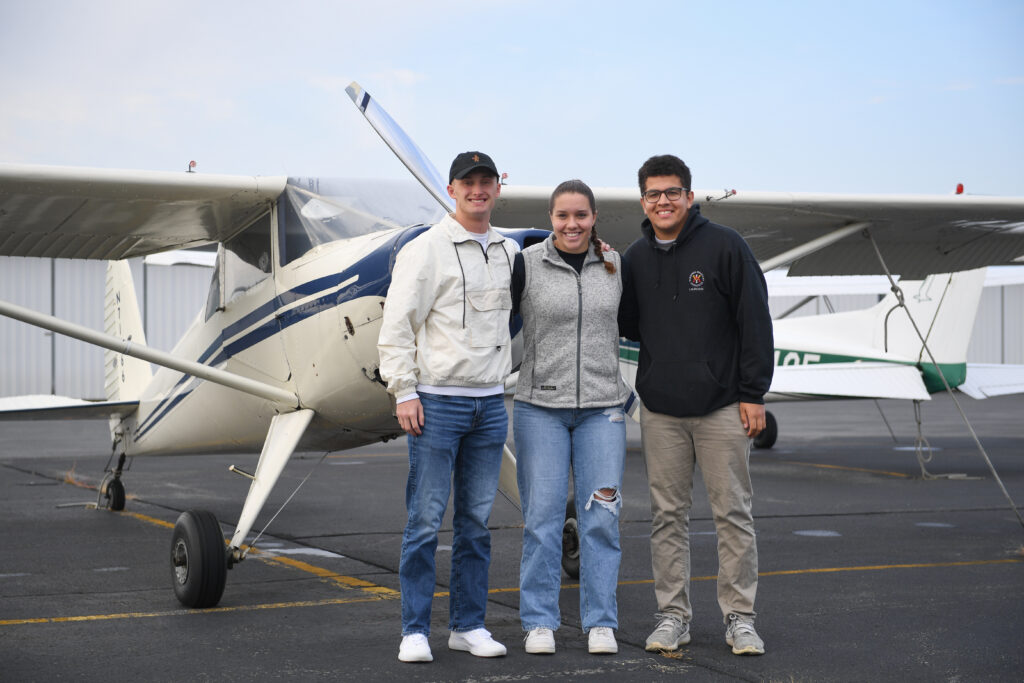
Three VMI Cadets stand in front of a plane on the tar mat, as part of the school's aviation club.

Experience in the air 

Wasser may have more flight time and plane experience than most members. She’s been flying back home in King George, Virginia. Graduating high school during COVID-19, her parents gifted her flight lessons.  

“I ended up falling in love with it. So, after my few flight lessons, I convinced my parents that I should continue, so I’ve been working on it for about two years now,” she said. “Every summer I go home I take flying lessons and work towards that.” 

But Jones went up in a plane to fly it for the first time last year. He said the instructor was surprised by how Jones kept his cool.  

“A lot of people kind of freak out when they get on the controls for the first time,” he said, but his instructor pointed out that, despite the plan doing weird things, Jones was able to remain calm and under control. “Then I got down on the ground and I was like, ‘OK, this is awesome. I’ve got to keep doing this.’ And I knocked out my hours for the first semester in like two or three weeks.”

Both are commissioning after graduation — Jones into the Navy and Wasser into the Army, both with aviation paths. For Jones, after graduation, he must teach for two years while waiting to go to flight school in the Navy.  

“I’m going to work towards getting my private pilot’s license and then fly in the Navy. Whatever they give me., I’m just happy flying,” he said.  

His plan after the military is flying privately for either the Department of Defense or other companies that have private pilots flying smaller planes. 

Wasser said she hopes after her time in the military she could come back to her hometown area near the Chesapeake Bay to work on conservation work. She wants to use her civil engineering degree and private pilot’s license to work with farmers and apply it to pesticide runoff reduction into the Chesapeake Bay. 

“Growing up on a farm I’d seen so many species die from runoff, pesticides, and herbicides,” she said. “I could take the flying aspect and the being outside aspect and kind of go out to farmers, get their soil, take it back to my lab tested and then take my own airplane and apply it and know that I was doing the right thing for the Chesapeake Bay, because that’s my home.” 

Behind the Balance: Grant Swinehart ’24 — Keydet Football

Virginia Military Institute’s cadet-athletes have to juggle cadet life, heavy academic course loads, and their NCAA Division I sport. Committed to both academic and athletic pursuits, balancing their rigorous schedule in both sports and school requires a certain level of commitment and discipline. Behind the Balance is a series that focuses on those cadet-athletes and how they handle the hurdles of the day-to-day. 

Grant Swinehart ’24 didn’t know a lot about Virginia Military Institute until one day the former head football coach Scott Wachenheim came to him with an offer. He had no military intentions. No connection to the military. And he had no clue what a military institute could offer him.  

“It was my only offer for football. So it’s obviously something that I strongly considered,” the running back said. 

He talked to a high school friend who played basketball at VMI to explore the option of becoming a cadet-athlete.  

“He told me a lot about school and that’s when I made my decision to commit here and kind of just ended up just picking in and rolling with it,” Swinehart said. 

Swinehart started playing football at the age of six. It was something his father introduced him to since he played when he was younger and through high school. His father was even his coach for a while. Swinehart was drawn to the physical competitiveness of the sport.  

“It was just different from the other sports that I’ve played,” he said. “It’s a big team sport, but it allows you to be competitive and physical. So that’s why I fell in love with it.” 

Now, as a Keydet Football player, he loves the rush when he takes the field.  

“Waiting for the first kickoff of the game, there’s a lot of anxiety and butterflies, just excited for it to start,” he said. “Just like probably any other sport, but football it’s a big build-up to the first moment and a lot of guys on my team will probably agree that those butterflies don’t really go away until the first play or until the first set and sometimes a couple plays after that. You kind of got to get it out of your system. But it’s a feeling like no other. Just hearing the fans cheer you on and being able to be out there with the guys you’ve been working so hard with. You can’t describe it.”  

Weightlifting, class, practice, studies 

Swinehart is getting up in the early hours to do weightlifting, which starts at 6 a.m. Then it’s team meetings. It’s on to breakfast at 7 a.m. Classes are from 8 a.m. until 3 p.m. Then it’s onto pre-practice meetings and full practice from 5 to 7 p.m.  

After practice, he’s studying during a dedicated study hall period. Finally, it’s dinner time at 8 p.m. More studying. By 10 p.m., it’s free time. 

With a load of 14 and a half credits, he says he tries to get ahead on schoolwork. Cadet-athletes at VMI not only have their responsibilities with their selected sport but cadet duties on top of that. There are specific times when they can eat, go to class, study, and sleep. Cadets are also required to take physical fitness classes twice a week, participate in ROTC all four years, require room and uniform inspections, parade preparation, guard duty, and more.  

“It’s definitely a challenge, but we have great resources with the athletic department to kind of stay on top of those types of things,” he said. “You really just got to be focused and dedicated in any of the free time that you do have to be getting your homework done, reaching out to the teachers, just kind of staying on top of things.” 

He says that if you start to fall behind, it’s going to be almost impossible to catch up.   

“That’s something that VMI kind of taught me, is to not get behind and try to stay on top of things in the first place. Reach out to professors in advance about traveling and what things you might miss,” he said.   

With his travel schedule, which is normally every other weekend, he has letters to give to his professors to alert them he will be missing class and therefore gets the assignments he’ll miss. He’s not doing work on the bus rides, instead, he aims to finish everything before he leaves for away games.  

Grant Swinehart with a football in hand while running down the field.
NCAA Football Championship Subdivision: Keydets rally to defeat Wildcats, 12-7

“There are some days that kind of can hit you, especially when a lot of tests or big assignments fall on the same day. Or you got a big practice ahead of you,” he said. 

He said the small class size at VMI is helpful in these cases because it allows him to have a more personal relationship with not only his classmates but also his professors. 

“It’s really easy to have that close relationship with your professor and meet with them when need be to make up anything you might have missed,” he said.  

Swinehart knows a lot about dedication and it’s something that VMI head football coach Danny Rocco recognized. Prior to the season, Swinehart was awarded the number 0 which is a new tradition started by Rocco. Each year, number zero will be given to the captain of the special teams — someone who embodies what it means to be a cadet-athlete: hard work, dedication, sacrifice, and selflessness. 

The future 

Swinehart is set to graduate in the spring and hopes to put his name in the transfer portal to see if he can play football while getting his master’s somewhere. He has two years of eligibility due to the COVID-19 season and for tearing his ACL in his second year.  

If not, he hopes to pursue something with his psychology degree. He feels his time at VMI has prepared him for the real world.  

“What I kind of say to myself is that it’s very rewarding knowing that you’ve been through all that stuff and you were able to handle multiple different things all at once,” he said. “It’s kind of preparing you for later in life, like with a job and a family and kids and all the other things that are going to come with that. I chose to come to a school like this and to play a sport like this, which I love a lot. It’s all just part of the process, but I wouldn’t trade it for anything in the world ever. I really love it and I know that at the end of the day, it’s helping me become a better person.” 

The Extra Mile: Golf Club

Zac Somers ’24 wasn’t hitting his shots the Sunday at a golf tournament. His swings weren’t looking good. The day just felt off. He needed some support to continue on the course.  

“I couldn’t hit a shot to save my life,” he said. “I called my mom like, ‘Hey, Mom, I don’t know if I want to quit, or I don’t know if I want to go.’” 

He went to his car and took a moment to set his mind straight.

“I sat there and had a long conversation with God. He told me to play. Did I do good? No. But I did better than Saturday,” Somers said.  

As the cadet in charge (CIC) for Virginia Military Institute’s Golf Club, he said often times the sport is a mental game.  

“With golf, it’s an individual sport. It’s all in their head. You basically have to be mentally strong. And that’s something that I’ve struggled with in the past, just that mentality,” he said. 

Somers got involved with the game of golf thanks to his grandfather. He credits him as his biggest inspiration when it comes to the sport. At a young age, he’d hit the links with his grandfather, then he started playing in middle and high school.  

When he got to VMI, his dyke (upperclass mentor) was part of the golf club. He decided to join his 3rd Class year, played a few tournaments and then by his 2nd Class year he was named assistant cadet in charge. Now, serving as CIC for the club, he’s been instrumental in forming a new tournament with the club, which began last year. 

Made up of 32 members, the club this year is all male cadets, but it is open to females. Part of the National Collegiate Club Golf Association, the club participates in various tournaments within that association. For each tournament only eight members can attend. Somers said it’s dependent on score and skill and varies for each event.  

“We’re starting to compete in everything, we want the best of the best in barracks, however, really, the club is just for those who like to play golf,” he said.  

Ian Struzzieri ’24, a history major, said he got involved with golf club after his roommate was the CIC two years ago. He’s been playing golf for about three years and thinks the club is important at VMI because there’s a good golfer population on post.  

“The team provides practice for the guys to go out and play or hit the range. It also brings that competitive atmosphere of a regular sport into the club realm,” he said.  

He uses his time in the club as a departure from cadet life. 

“The grind of golf lets all of life’s stressors go away,” he said. 

Allen Stewart ’24, a civil engineering major, joined during his 3rd Class year. He’s been playing golf for most of his life, starting with his father. He said that the key to golf is the willingness to play and have fun while not taking it too seriously. It’s a chance to go out and have fun with your brother rats, he said.  

Their home turf is Lexington Golf and Country Club and, even if they stay local to practice, it allows cadets to get off post and relax their minds.  

“To have the ability to just get off post in my opinion is the best thing,” Somers said. “There are  some club sports that don’t even leave post. Luckily for us, we have to leave post in order to practice.” 

But Somers has some rules — respect the course.  

“At the beginning of each semester [I explain] expectations on and off the course. Play fair, play right. Respect the course,” he said. 

Practicing in Lexington allows for participating cadets to also connect with those on the course, which tend to be a lot of alumni, Somers said. The civil engineering major said he’s able to talk to alumni and make connections that could help him upon graduation.  

“It’s a good way to network with the alumni while playing golf,” he said. “It’s the fact of networking and being able to get off post and meet new people. Get a taste of the civilian life, basically.” 

Behind the Balance: Audrey Davis ’25 — Keydet Soccer

Virginia Military Institute’s cadet-athletes have to juggle cadet life, heavy academic course loads, and their NCAA Division I sport. Committed to both academic and athletic pursuits, balancing their rigorous schedule in both sports and school requires a certain level of commitment and discipline. Behind the Balance is a series that focuses on those cadet-athletes and how they handle the hurdles of the day-to-day. 

It’s 5:45 a.m. on a Tuesday. Audrey Davis ’25 is up before the sun to get a workout in. It’s required — she plays center back for the Virginia Military Institute Women’s Soccer Team. They have some sort of workout or practice daily when they are in season, plus games on Sundays and Thursdays.  

Her days don’t always start before the crack of dawn. Certain ones call for lifting, rehabilitation, reviewing film, or drills. 

On a normal day, while in season, she’s up at 6:45 a.m. so she can be at formation at 7 a.m. where they stand outside and salute the flag. Then it’s breakfast and onto class from 8 a.m. until 2 p.m. After classes, she tries to come down to Paulette Hall to get some rehab work in before practice. Then it’s practice for around two hours.  

Then it’s onto dinner. 

From there she’s studying for up to four hours and her day just repeats.  

“It’s a pretty busy day,” she said.  

It varies on the intensity of what practices look like. Mondays are rest days — no practice whatsoever. Tuesday requires hardcore training. Then Wednesday is to build up for Thursday’s game. They do recovery training on Friday, ramp-up workouts on Saturday, and then play Sunday.  

“We want to have a full week schedule and then during the offseason, we’ll train pretty much every day, just some days might be a lighter load,” the international studies major said.  

Finding her way to VMI 

Davis wasn’t sure what life after college would look like.  

“I had no plan for after college and I just started thinking about what I wanted to do with my life. And I’m the type of person that does need that discipline in that structure,” she said.  

She initially was thinking of another school and being a biology major. Then she did a soccer camp at Virginia Military Institute with head coach Chris Haught-Thompson.  

“He liked me and he said that if I wanted to come here, the spot was mine,” she said.  

She wasn’t even going to commission and at first, was looking at the Marines. Once she was at VMI, she received an Army scholarship and everything started to switch into place.  

“It was just one of those things where I came here and I realized that I really liked this lifestyle and it’s really good for me,” she said.  

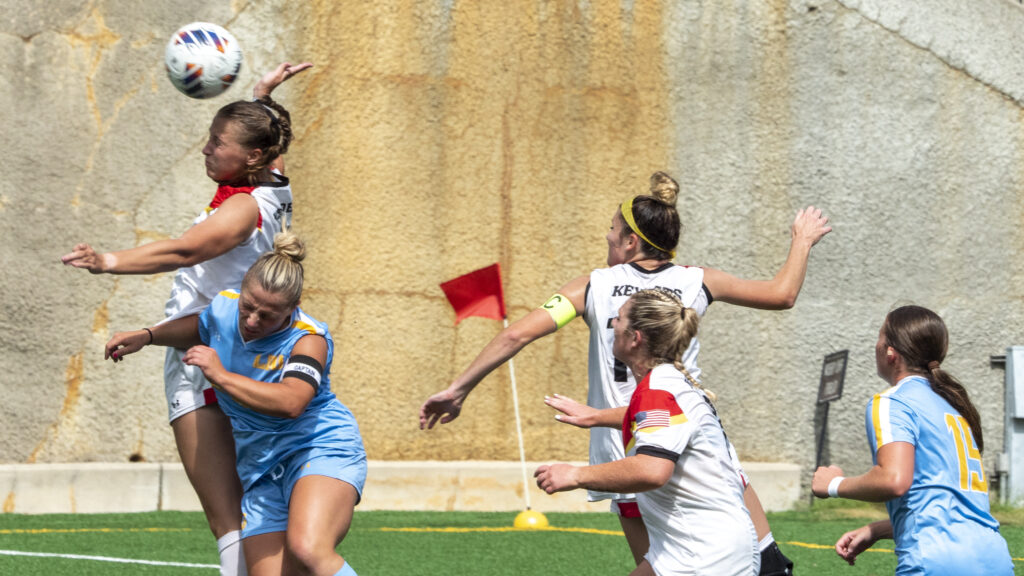
Audrey Davis hits the soccer ball on the field.
VMI’s #19 Audrey Davis. VMI vs Long Island Unv. women’s soccer game and senior day celebration September 10, 2023 at Drill Field #2 in Lexington. LIU won 2-1. (Randall K. Wolf / VMI )

Balancing studies and sports 

Cadet-athletes at VMI not only have their responsibilities with their selected sport but cadet duties on top of that. There are specific times of when they can eat, go to class, study, and sleep. Cadets are also required to take physical fitness classes twice a week, participate in ROTC all four years, require room and uniform inspections, parade preparation, guard duty, and more.  

It’s crucial to stay regimented with each activity.  

“I’ve become really productive in class, like staying on task so I don’t fall behind or so I don’t have to make up anything from class,” Davis said. “A lot of it is just really grinding it out like late at night like we’re done with dinner around 8 p.m., so normally I’d stay out from like 8 p.m. to midnight so I get like a good four hours of homework and then I try to get right to bed after that.” 

After graduation, she has committed to the U.S. Army for eight years. Her focus, which is undecided at the moment, is wavering between military intelligence and aviation. 

Her commitments to the Army while at VMI include control time weekly at school, Advanced Camp this summer, plus the commitment of eight years after graduation. 

When the days are long and tiring — both exhausting mentally and physically — Davis said she can’t give up.  

“You don’t really have a choice here, you really have to learn that line between giving up and seeing it as adversity and using it to push you,” she said.  

She’s seen firsthand overcoming a large obstacle with recently having ankle surgery.   

“One of the trainers here told me that if you push through even on your worst days … the next day is going to be better regardless. And I think that applies,” she said. “I started using that for not only soccer, but on the hill. So you really don’t have a choice. Because if you mess up one day here you fall behind and you can spend the whole semester trying to recover.” 

The Extra Mile: Powerlifting Club

Calin Green ’24 was looking to escape from the rush hour of cadets at Virginia Military Institute’s regular gym. Every Tuesday, Wednesday, and Thursday around 4 p.m. he’d run into an influx of other cadets trying to get a workout in.  

With a background in wrestling, he was looking for options in strength training. Plus, he wanted to stay in shape in preparation for commissioning into the Marines, while also participating in ROTC. 

“Powerlifting was really right up my alley, and I fell in love with it really quickly,” the psychology major said.  

As the cadet in charge of the VMI Powerlifting Club, he said even though the club is a team, the sport itself is a competition with yourself.  

“You’re trying to better yourself,” he said. “This is such an individually-focused sport. You can really focus on what you did right and what you did wrong. There’s no other confounding factor, like an opponent you’re going against.” 

You can be your greatest competition, Green continued.  

“IIt’s just you and that bar and whether you get it up or not,” he said. “Usually you can see or feel what exactly went wrong. Whether there was a missed groove in your form or if you just chose too heavy of a weight for your next lift.  It’s also something that you can constantly improve at and you can track your improvement very easily.” 

Although it’s an individual sport, the club is very team-oriented. When someone is going for a personal record (PR), the rest of the club is there to back them up and cheer them on. The powerlifting gym, which is in the basement of Cocke Hall on post, is completely outfitted for heavy lifting — plus it has an amazing sound system that allows for music to be blasted while members work out.  

“I like the type of people that it attracts, and the environment of the gym, especially,” Green said. “Everyone’s very supportive of each other and their lifts and their goals. I think it’s good to have people that support you and I think it’s good to support other people and their goals. I just think it fosters growth better than anything else.” 

Powerlifting club also provides a good mental break.  

“I think being able to give your maximum effort in something and just say that I trained the hardest that I possibly could today, that it makes you feel like you’re worth something, makes you feel like you can do something and it makes you better off,” Green said. 

Owen Clifford ’24, a civil engineering major, got into the club post-Breakout after he started hitting the gym more. He was looking for a club sport to participate in and he had heard from several friends that powerlifting was a good option.  

The assistant cadet in charge for the club said his favorite part about the club is the separate space and equipment allotted for the club. But also, being surrounded by people who are working towards the same goals.  

“That creates a very encouraging environment and people to kind of compete with internally,” he said. “Having the guidance from the coaches to make sure that I’m doing the best I can so I’m reaching a much higher goal, much higher lifts than I would just on my own in the normal gym.”

Both Green and Clifford said having the powerlifting club is a good departure from the demands of being a VMI cadet.  

“Having a little outlet — the hour and a half, where you’re not really worried about anything else, you don’t even worry about how long you have to be there because that’s your time to be there,” Clifford said. “So it makes it super easy to just focus on that. Go as hard as you want to, have the music pretty much as loud as the speakers will handle, and just work on yourself before finishing up the day.” 

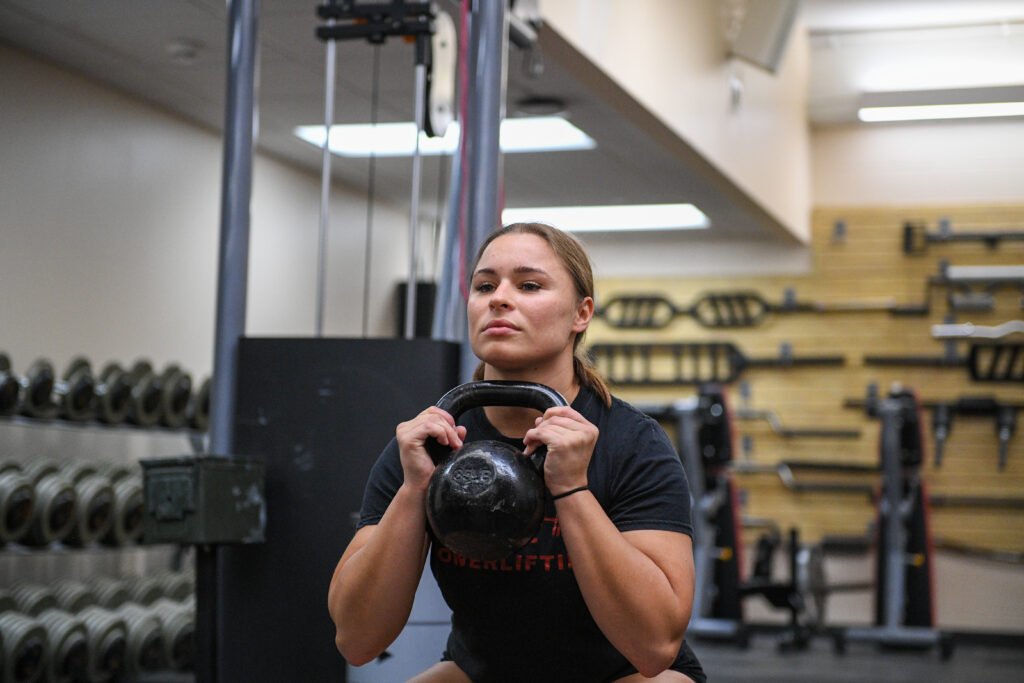
A woman does a goblet squat with a kettlebell.

The club centers on three main lifts: deadlift, back squat, and bench. The club, which has about 40 members, participates in various competitions throughout the year, where members are broken up into different weight classes. On average, about 20 cadets participate in the club practices regularly.  

Coach David Henson, police captain for VMI Police, and Coach Rebecca Owen enjoy interacting with the cadets and boosting their physical power. Henson has been coaching the team since 2013 and became head coach in 2016. The two work with cadets on their form, technique, programming, and preparation for competitions or meets.  

“Working with the cadets doing something they are very passionate about not only helps them but helps us as well,” Henson said. “Powerlifting is tough not only physically, but mentally. It’s a maximal strength sport and you have to have an appreciation for strength to enjoy lifting heavy weights a majority of the time.” 

The sport, he says, is beneficial in increasing overall strength and requires “sacrifice, discipline, discomfort, and determination.” 

“What makes it worth it is when you lift a weight that you previously thought was impossible,” he said.  

This is Owen’s ninth year coaching the team.  

“As coaches, we are trained to pick apart the power lifts (squat, bench, deadlift). We are pretty good at picking out weaknesses due to technique or muscle imbalances,” she said. “The strength aspect definitely helps with physical fitness tests, but one of the biggest benefits is being a part of the powerlifting family. We tend to develop strong relationships as we support each other in the trenches — tough training, maximal efforts in competitions, etcetera.” 

The two coaches said they most enjoy seeing the progress and transformation of the club’s members.  

“I really enjoy interacting with the cadets at practice and when we travel to meets,” Henson said. “Powerlifters go out of their way to support one another and that creates a great atmosphere to be in, especially here at VMI where nothing is really easy. Watching the cadets hit a PR at a meet and being able to celebrate with them makes it all worthwhile. It shows them that hard work pays off and that carries over to other aspects of life.”