Post View Unavailable »
New Website Launched »

Corps Contributions: Laundry Services

At Virginia Military Institute, there’s a top team providing high-quality services, support, and supplies to keep the Corps of Cadets running smoothly and looking sharp. In this series, Corps Contributions will take a look at VMI Auxiliary Services, and the people that power VMI behind the scenes.

Bins can be seen in the alcove off of Daniels Courtyard. They’re nearly empty in the summer, but come fall they’ll be filled with bags and bags of laundry. Cadets at Virginia Military Institute can drop off their dirty laundry and pick it up just a day or so later. This service is included in their annual fees, and is just another part of what makes VMI not an ordinary college.  

All items cadets wear have a tag on them with their assigned laundry number, which they keep until they graduate. Laundry is sorted by that number so everything is tracked and each cadet gets their items back.  

Gregory Bowman has been the laundry services manager for four years. He’s in charge of the laundry and the dry cleaning for VMI cadets. 

How does it work? First, it’s dropped off on the third floor of the facility, which is just off of Daniels Courtyard. The laundry facility is three levels — two of them can’t be seen from barracks, they’re underneath. It’s taken downstairs to the first floor, which is technically the basement level. That floor is where everything gets separated, weighed, and washed. 

They have a designated washer who operates all the machines, Bowman said. They have washers with capacities ranging from 100 to 600 pounds. On the first floor, it’s washed or dry cleaned, then it comes up to the second floor where each piece is dried and pressed — depending on what the item is.  

The second floor has stations where shirts and pants are pressed. Three people work one press machine for shirts. There’s a board for the sleeves, the shoulders, and then the front and back of the shirt. It’s a simple assembly line. One person presses the sleeves, then the shoulders, and then the front and back are pressed simultaneously.  

When it comes to the third floor each piece is separated by its number, hung or bagged ready for the cadets to pick it up. 

Each cadet is issued four pants, four shirts, three pairs of ducks, two pairs of wool pants, three black shirts, a blouse, and a duty jacket. Overall, it’s 16,000 pieces to wash, plus another 1,500 laundry bags.  

“It’s mostly important so the cadets don’t have to worry about their clothes … they can use their five minutes of spare time to study or whatever,” Bowman said. “It’s a very important part. Plus, I want everybody to look clean and presentable. They have the uniform and that’s a representation of VMI, so they should look good and they should look neat.” 

The laundry facility is impressive, to say the least. On average, laundry services do about 3,000 shirts a week.  

They have a combination of seven chemicals they use, but not all are used on every item. For example, lots of starch goes into the duck pants, which are the white dress pants that are used for special occasions like Ring Figure. When those are completed at the laundry they look like a piece of thick white paper; that’s how stiff they are. Bowman said the cadets have to peel them apart in order to put them on.  

Some tips Bowman has for cadets: don’t wait until the last minute to turn in your laundry. Don’t turn it in on Friday afternoons, as it won’t get done until the following week. He suggests turning it in on Mondays, so you’ll have clean clothes for the rest of the week. He wants cadets to not have to worry about doing their laundry. Drop if off and come pick it up later. If it’s not right, they’ll redo it.  

He offers a few kind words to the cadets who are more lax on their laundry habits, “You are paying for laundry, please utilize it,” he said. 
Taking Aim: Cadets Bring Home Honors From ROTC Pistol Championship

Four Virginia Military Institute cadets nabbed top marks at the 2023 College Clash Shoot Out competition hosted by the Virginia National Guard’s Marksmanship Training Unit. 

The inaugural ROTC Pistol Championship was held Sept. 30 at Fort Barfoot, Virginia. Shooters were required to engage targets from 25 meters over a three-staged excellence-in-competition match. Sixty-four cadets participated, representing ROTC units and competitive shooting teams from George Mason University, Hampden-Sydney College, James Madison University, Liberty University, Longwood University, the University of Richmond, the University of Virginia, Virginia Commonwealth University, the Virginia Military Institute, Virginia Tech, and Virginia Union University. 

The Institute found success with cadets from both the Army ROTC Blue Ridge Battalion Ranger Challenge Team and the VMI Combat Shooting Team. 

The Ranger Challenge Team had a total of six competitors broken up into three teams of two and outscored all other ROTC teams in the competition. Thanks to the experience gained during this training event, the team will be better prepared for Spartan Challenge this fall and Sandhurst in the spring. 

Representing the Combat Shooting Team, Kenneth Dinkel ’25 and Alex Bodner ’26 placed second in the College Clash Shoot Out Excellence in Competition team event while Garret Kelenske ’24 and Carter Hugate ’24 placed third. In the individual awards, Bodner and Dinkel took home first and second, respectively. 

The Extra Mile: Equestrian Club

When a cadet is looking for a unique club experience at the Virginia Military Institute, the equestrian club might just be the perfect fit. David Hess ’24 explained that the club is best known for its blend of riding, training, and trail adventures.  

The VMI Equestrian Club attracts a diverse group of cadets. Some, like Hess, come from horse-related backgrounds, while others enter the equestrian world with no prior experience. At the heart of this club is Tish Vest, a dedicated horse trainer who leads the club.  

“She will work with anybody and teach you everything you need to know,” said Hess, the cadet in charge.  

Access to the equestrian club is made possible through Vest, who boards the horses, some of which belong to her, while others are owned by individuals who pay for their care at her barn.

Cadets, in return, provide a valuable service by riding and exercising these horses, ensuring their well-being.  

Saddling up to de-stress

For Hess, the equestrian club serves as a sanctuary from the rigors of academic life at VMI.  

“I love to get outside and go to the barn two to three times a week. It makes me feel like I’m at home,” he said.  

The stressors of everyday cadet life fade into the background as cadets interact with horses.  

“You truly do get to know the horses, and building a relationship with them is just like you do with a pet. It helps lighten your mood,” said Hess.  

The club’s regular weekly meetings begin at the Washington Arch on Thursdays. From there, the group travels to Windhorse Farm, where they saddle up for the evening.  

Once at the farm, club meetings are kicked off by grooming the horses. This task tidies up the animals and deepens the connection between rider and horse.  

“The first thing you do is brush them down, and that does two things: it cleans up the dirt and debris before putting the saddle on, and it also formulates your bond with the horse,” said Hess.  

Once the horses are ready, the cadets determine their riding goals for the day — whether it be in the ring or a trail ride — all under Vest’s guidance. The practice lasts for about an hour to an hour and 15 minutes, after which the cadets return to the barn to care for the horses, removing saddles and brushing them again.  

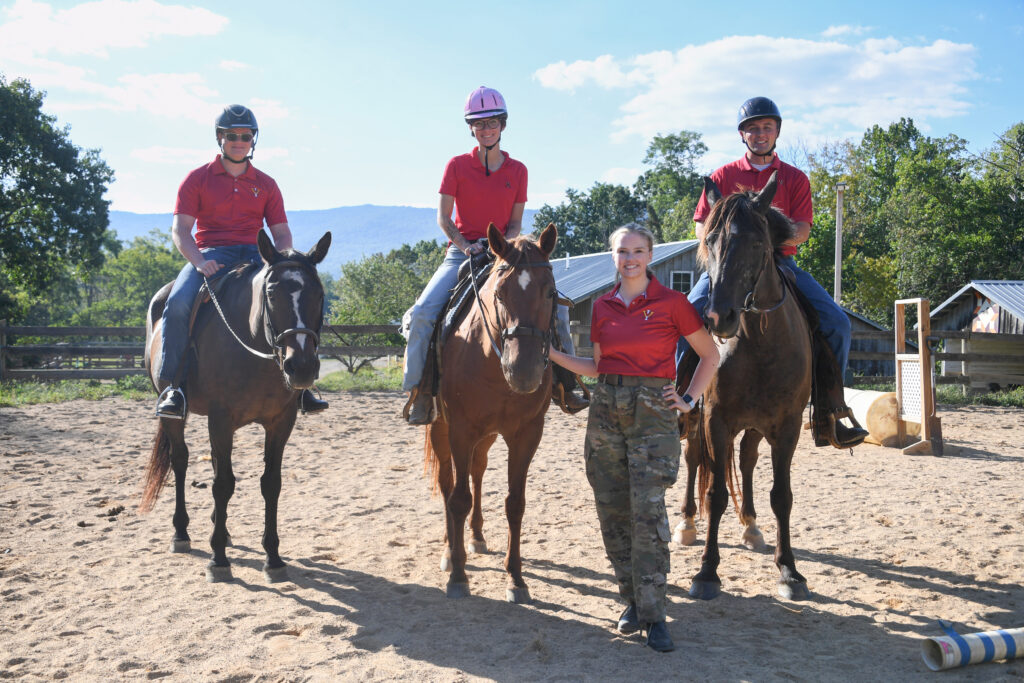
Cadets atop horses while participating in VMI's equestrian club.

No equestrian experience? No problem.  

For cadets interested in joining the equestrian club with no prior horseback riding experience, Hess emphasizes the club’s welcoming and supportive atmosphere.  

“You don’t have to have any gear,” he says, “everything you need is available at the barn.” 

Newcomers can contact Hess to arrange a visit.  

The introductory experience resembles learning to swim, where they will quickly acclimate to the horses, their size, and their temperament.  

“You just kind of throw them on the horse and it’s sink-or-swim,” he said. “You’ve just got to get on the saddle and learn the technique from there.”   
 
“A lot of people who haven’t been around a horse get intimidated,” he said. “But the more you’re around them and get to know them, it’s almost like being around an oversized dog.”  

Currently, the equestrian club is comprised of around a dozen members, with an average of four to five cadets attending each practice. The flexible schedule accommodates the demanding commitments of cadet life, with members deciding on participation shortly before each session.  

Corps Contributions: Dining Services

At Virginia Military Institute, there’s a top team providing high-quality services, support, and supplies to keep the Corps of Cadets running smoothly and looking sharp. In this series, Corps Contributions will take a look at VMI Auxiliary Services, and the people that power VMI behind the scenes. 

Tracy Hiner said he got into dining services at the age of 15. It was a chance at a summer job. He started as a dishwasher but had the opportunity to work with a chef and the rest was history. He enlisted in the Navy to work as a cook, then went on to receive his culinary degree and worked as an executive chef for 15 years.  

Hiner is the general manager for dining services at Virginia Military Institute through Parkhurst Dining. He does a little bit of everything — from managing the dining facilities (Crozet Hall, PX, and The Arsenal), on post to serving up food, and managing a team of 120 employees.  

He’s held this position for about a year, coming from Mary Baldwin University, where he held a similar position.  

“VMI is different,” he said. “I feel like I can make a difference here and I certainly love the team.”

His first day on the job, he walked in, asked what he could do and he was immediately put on the food line. What he wasn’t prepared for was the mass number of cadets that came rushing in for breakfast.  

“It was like 800 to 1,000 cadets at once and so it felt like a swarm of bees around you,” Hiner said. “So you’re constantly saying, ‘Excuse me,’ so that you can put new pounds of food on. But what amazed me was how courteous [the cadets] were.” 

Cadets march down for food twice during the day — once for breakfast and another for supper. This is when the dining hall is abuzz with activity. Breakfast roll call has a march-down at 7 a.m. and it’s served from 7 to 9 a.m. Dinner, or lunch, is from 11 a.m. to 1:30 p.m. Supper roll call has a march-down at 6:30 p.m. and is served from 5:30 to 8 p.m. 

Hiner said they have corporate standards to follow in food preparation and serving — what they call their “gold standard.” They cook from scratch, using fresh ground beef and more. They also hold classes and orientations for their staff to talk about standards and the approach they take in the dining hall.  

There’s a five-week cycle menu that’s written by the chef, which is seasonally based and also changed up with cadet input. It’s constantly changing, he said. Hiner’s goal with regularly-scheduled meetings is to interact with the cadets and ask what they like and what they don’t like, along with any changes dining services need to make. Some main staples include chicken parmesan, pasta dishes, and steak. This year, there will be an Asian fusion bar available.  

There are monthly dining service committee meetings, where cadets can come and give their input. Hiner said that sometimes the cadet count ranges from 30 to 100, giving their opinion on what should be served.  

“We just make sure that we listen,” he said. “There’s been a lot of subtle changes that we’ve made based on them. We interact with them, we make sure they’re happy. It’s kind of like at home when you put a meal together and you serve it to your family. You’re there to make sure that everybody’s happy and they have what they need.” 

In order to ensure the food is served fresh, Hiner says they batch cook. They have grab-and-go options for dinner, but for the larger meals (breakfast and supper), new batches are served and simultaneously swapped out as cadets roll through.  

Hiner credits his staff to being able to pull off an operation like this seamlessly. He also likes to give the spotlight to his staff, featuring them on a rotation through something he calls Parkhurst People. There’s also an associate of the year award.  

“We wouldn’t be able to do this without each other. So we depend on each other. We spend a lot of time together. So the team is everything,” he said.  

There was also a new program started this year to support VMI’s cadet-athletes, Hiner said. Dining services offered each coach an open practice meal — football was one of the first teams to come back and be offered the new program. Staff prepared a special menu and meal specifically for them including, pasta, rice, flank steak, grilled chicken, blackened salmon, roasted zucchini, red onions, tomatoes, and Caesar salad. Hiner said they received a lot of compliments on the food.  

“I enjoy the big picture. I’m a chef by trade so obviously, I love the creativity side. I like making people happy through food,” he said. But, there’s also the business side to the job. “You’re managing relationships not only with your customer but also with your client, so putting all these pieces together like a puzzle, and just making it run as efficiently as it can and being consistent in quality is what drives me.” 

Midshipmen Moments: Samantha Waters ’26

Samantha Waters ’26 chose Virginia Military Institute because she wanted to become the best version of herself.  

“After visiting with my dad, I knew this place offered something great,” she said.

Waters went into VMI knowing it has a tough first year with the ratline, which pushes you past where you thought your limits were.  

“The next three years are filled with rigorous academics, military obligations, and plenty of opportunities to get involved in various leadership positions,” she said. “All while promising a 99% job placement after graduation. It also has a reputation for producing great leaders. I knew I wanted to be a part of this.” 

She also decided as a rat to sign up for Naval ROTC. She was initially interested in NROTC because of her father, who served in the Marine Corps, and brother, who attends the Naval Academy. She said she looked up to both her father and brother, but also wanted to serve her country.  

“Participating in NROTC as a rat was great,” she said. “NROTC was my break from the ratline, and I was able to learn about the Navy. Since VMI bases its standards on the Army, I was excited to learn new things in Navy class, lab, PT, etcetera.” 

Following graduation, she plans on commissioning into the Navy for an aviation slot, but surface warfare also piques her interest.  

As an economics and business major, she chose VMI’s networking in the business world. She also chose it as a second option if she didn’t stay in the Navy for her entire career — she could have the opportunity with something else that interested her.  

Applying for scholarships 

Waters said she started applying for NROTC scholarships, which are competitive.  

“I applied for the four-year scholarship and was denied,” she said. “It was really upsetting for me, because I knew this is what I wanted to do, and I needed the help paying for out-of-state tuition at VMI.”  

She said her first year at VMI she did everything she could to better herself and make herself more competitive for scholarships. She said she had a lot of support from the NROTC staff and midshipmen.  

In competing for a scholarship, she attended New Student Indoctrination, which is about two and a half weeks of instruction. It’s similar to basic training, Waters said, but in a shorter time frame.  

“About a week after I got home, I got a phone call from my unit’s commanding officer that I was awarded the three-year scholarship. This pays for my tuition, guarantees commission, funds summer cruises, and pays monthly,” she said.  

Waters’ responsibilities with NROTC include being fireteam lead.  

“Everyone in NROTC has their own personal responsibility to turn paperwork in on time, push themselves and others around them to succeed, and make the best out of the opportunities they have been given,” she said. “However, as a fireteam leader, I am responsible for the accountability and well-being of my fireteam. This includes the second half of my squad, which is four people.” 

The biggest draw for her? The impact that she will be making with her future. 

“I loved learning that I would one day serve this country in the Navy. VMI is preparing me to be the best leader I can be, and NROTC at VMI was the best path for me to achieve greatness,” she said.  

Taking Research on the Road: Cadets Attend SoCon Undergraduate Research Forum (SURF)

Four cadets from Virginia Military Institute made their way down to the Southern Conference (SoCon) Undergraduate Research Forum (SURF) to showcase their research efforts. The conference was held Oct. 13-14 at Wofford College in Spartanburg, South Carolina. 

SURF provides an opportunity for undergraduate students to present their research projects via posters or oral presentations. Unlike other undergraduate research gatherings, SURF takes place in the fall, perfect for students such as cadets from VMI who spent their summer months immersed in research. At VMI, such research is conducted through the Summer Undergraduate Research Institute (SURI) through the VMI Center for Undergraduate Research (VCUR). 

Presenting her SURI research about anxiety, family influence and athletic status on college students, Caragh Osborne ’24 said the conference was worthwhile for her.  

“Not only was it a great opportunity to present my own research, but it was also interesting to see what is going on at other schools,” she said. “I was fascinated by all the other research conducted by our peers at different SoCon schools in a variety of fields.” 

William Davidson ’24 gave an oral presentation on his SURI research entitled, “The Survival and Success of Communist Parties and their Successors in Post Communist Countries.”  

“SURF was a great experience, it really helped me to understand better my own research,” he said. “Also, it was great being able to interact with other students from other universities and being able to learn about subjects outside of my field.” 

Anthony Cruz Fernandez-Grimes ’25 also shared his SURI research in poster format. He discussed his summer project involving the role of psychological capital and motivation to lead in predicting transformational leadership among VMI cadets.  

“My trip to SURF was an amazing opportunity to learn what others are researching and share my research discoveries,” he said. “I learned that despite a vast difference in what another researcher was studying, there was still much to be learned that broadened my own understanding of my world. I would recommend going on this trip because of the opportunities that can be discovered that I was completely unaware of.”  

Gabriella Handford ‘24 attended her third SURF Conference in her cadetship. She did an oral presentation, sharing her research completed at the National Institute on Drug Abuse (NIDA), in Baltimore, Maryland last summer. She described her project, entitled “The HAIR Project” (Health Advocates in-Reach and Research) where both cortisone and fentanyl were extracted from hair samples for quantification.  

The Extra Mile: Glee Club

On Matriculation Day in 2020, Joyce Ellis ’24 wore a shirt that said, “I was in chorus in high school.” It caught the attention of Col. John Brodie, Virginia Military Institute’s music director. 

“He was like, ‘Oh my gosh, you sing!’ she said. “He just had this crazy personality and he told me that I was coming to glee club, wrote my name down, then emailed me later.” 

She’s been in the VMI Glee Club since she was a rat — it’s one of the only clubs that rats can join. Glee club is also one of the oldest clubs on post. The club was first listed in the VMI yearbook, The Bomb, back in 1885, where the club performed with vocals, guitars, mandolins, and violins. 

According to Brodie, in the early days of glee, cadets would sing on the stoops around post and perform for the other cadets.  

The more-than-a-century-old club has been in high demand since its inception, performing around the country and the globe. Members like Ellis, who is the club’s vice president, say that their spring trip is often the highlight of the year, performing in places like Florida and even Puerto Rico. 

Club president Rommel Meza ’24 has an extensive background in vocal experience. The tenor was part of a professional acapella group at his high school in Petersburg, Virginia. It was something he wanted to continue, no matter what school he ended up at for his degree.  

Ben Lovingood ’25, the glee club secretary, has been in choir since elementary school. But, prior singing experience isn’t a prerequisite for joining the glee club. 

Cadets sing in the glee club.

Overall, the club has a welcoming vibe. Meza said they encourage incoming rats and cadets who are showing up for the first time to step out of their comfort zone. The range of experience varies — some people have spent much of their life singing or being involved in music while others have never touched sheet music or even sung before. 

“You have kids like us who are willing to step in, help, encourage them, and teach them the ropes,” Meza said. “We’re just trying to keep an open and welcome vibe, ensuring that they step out of their comfort zone a little bit and try something new.” 

The club rehearses twice a week and includes two smaller ensembles — the “Men In Grey,” a male acapella group, and the “Sentinels,” a mixed voice specialty septet. 

“One of our main points is that you don’t have to have any singing experience,” Lovingood, a baritone, said. “Obviously it helps. But if you’ve literally never sung a song in your entire life, and you’re like, ‘I want to try this,’ then we’re very welcome to that.” 

Ellis, an alto, said the club really drives inclusivity, especially with the acceptance of rats into the club. 

“It makes it feel like more of a family for them, like stress relief from their day-to-day. So that’s kind of a big pull,” she said.  

For Ellis, the glee club was something she could look forward to every week. 

“I would know Mondays and Thursdays, I could be with some of my closest friends. And I would be able to just sing, which is what I really enjoy doing,” she said. “I just really love the environment, like how nice everyone was and how inclusive everyone was.” 

Members of the glee club also act as ambassadors for the Institute. 

“For the glee club, it’s not just performance-based. We’re also interacting with a lot of people, civilian speaking and alumni, too,” Lovingood said.  

“Every time we go out, we are acting as representatives for the Institute at all times,” Meza added.

Two years ago, the club went to Puerto Rico and performed at the governor’s mansion and for Congress. Last year, they performed in Florida. This spring, the club is headed back to Puerto Rico.

Brodie said the glee club allows cadets to have a musical outlet. With more than 60 other clubs on post, glee has to compete with a lot of variety. Brodie said there are only a few fine arts club cadets can choose from, glee being one of them. With the busy schedules, he said it can be tough for some cadets to fit it in, especially with the later practices twice a week.

“Singing kind of lets off steam,” he said.  

Brodie gets to put his hat in the ring for the music selection, picking more patriotic tunes and old standard acapella music. But, the members also get a say. In the past, they’ve done Disney songs, Beach Boys, and even Backstreet Boys. This year, Brodie said they’re working on “Killer Queen” by Queen and potentially some songs from the musical Hamilton.  

Overall, Brodie likes the musicality of the glee club and how it not only provides the members solace, but it gives those who are listening to it an experience they won’t forget.  

“I’ve had much more meaningful musical experiences, conducting concert music with the glee club than I ever get with the band or the jazz band or stuff like that,” he said. “It’s kind of cool. I’ve had times when the glee club could bring you to tears, like emotionally and you know, playing ‘Hey, baby’ doesn’t bring you to tears.”

Corps Contributions: The Tailor Shop

At Virginia Military Institute, there’s a top team providing high-quality services, support, and supplies to keep the Corps of Cadets running smoothly and looking sharp. In this series, Corps Contributions will take a look at VMI Auxiliary Services, and the people that power VMI behind the scenes. 

It takes three years to train as a tailor in the tailor shop at Virginia Military Institute. Those who work in the shop only work on a certain garment for a certain portion of the year, starting with blouses in the fall, tailor shop manager Cindy Hartbarger said. Then they move on to overcoats, but it might be an entire year before you touch either one of those items again, she said.  

“The first year, you’re learning. [In] the second year, you will remember part of it. The third year, by the end, you should know the whole process,” she said.

In the summer, those in the tailor shop are stripping and putting chevrons on coatees and blouses. They open up the sleeve, put the strip in, then sew it back up. It’s all done by hand — in fact, the majority of the stitching and sewing is done by hand.  

Hartbarger is in charge of 10 tailors who work year-round at mending cadet and staff clothing. She said it’s been a challenge to fill spots in the shop, for a couple of reasons. It takes a long time to train individuals, but also sewing and tailoring is a skill that a lot of people don’t know, have, or want to learn.  

“That’s why I have so much trouble finding people to work in here because it’s not a normal place to work. Sewing as an art is dying because there are no people to do it,” she said. “So we’re blessed that we can come in here and do this every day. We’ve learned a skill. Most people don’t know we can fix stuff that not regular people can do because we’ve learned something.” 

When Hartbarger took over the shop more than a year ago, she implemented some changes and the process is more factory-like.  

“We take the sleeves apart and somebody will stripe it, then somebody else will do the seam up, and somebody else will finish it,” she said. It’s more of an assembly line where the garment is passed from one station to the next.  

Striping means they are adding different class stripes to the coatees. Rats have no stripes. 1st Class cadets have three stripes, 2nd Class have two stripes, 3rd Class stripes have one. In order to do this, they have to split the seam of the coatee along the sleeve, place the stripe in, sew it back up, then sew the lining up. They do this for every cadet prior to them coming back for the fall semester.  

Everything they do in the tailor shop is tedious work that takes time and concentration. To put a stripe on could take half an hour. A chevron would take an hour, but the higher the rank, the longer it could take — potentially up to two hours.  

The longest alteration? The tails on a coatee can take about three hours, Hartbarger said.  

“You actually take every piece of the bottom of that coatee apart,” she said. “It’s like a mind game because it’s like a puzzle. You have to figure out which piece goes to what when you take it apart. When you take it apart it’s hanging by threads and then you have to put it all back together.” 

The day after matriculation, alterations start. The fittings are done at the VMI Military Store and then sent down to the tailor shop. That’s the first batch of major alterations. Then at the end of September, the blouses for rats are due. After that, they’ll start fitting the rats for their wool pants and overcoats, which will be worked on until November. The coatees are due in February. By March, overcoats will be turned in for repairs and the shop will begin to prepare for commencement.  

They aim to do a total of 30 alterations a day, but it all depends on what is being worked on and how time-consuming the alterations are, and also on walk-ins. Cadets are aware of the tailor shop. If they split a seam, get a hole, or something like that, they head to the tailor shop to get their uniforms fixed .  

Her advice: start slow. It’s all a learning process. If you try to speed through it, you’ll mess it up. It’s a point of pride for Hartbarger and her staff to see the cadets wearing the uniforms they had their hands in. She likes them to look sharp. 

“It’s great to see what work we’ve done and how nice they look in their uniforms,” she said. “We critique it because we know what it’s supposed to look like. We might even stop and say ‘hey, you need to take your pants and get them refitted or your blouse is too tight … get it fixed!’ because we like to make it look nice. That’s our goal, to make it nice and professional.” 

Hartbarger has worked at VMI for nearly 25 years. She started in laundry services, then the military store, then the post office. She’s been at the tailor shop for about 17 years. Even though she does the administrative side of the tailor shop, she’s still mending clothes. One of the first things she did when she took over as manager was move her sewing machine to her new desk. Now, she mends, emails, answers calls, and manages the team.  

“I love my team. I have the best team on the hill,” she said. “We work together, we laugh, and when somebody hurts, we cry. We’re family. And that’s the part I absolutely love. We have been short people for several years and we’ve had to work extra, extra hard and we’ve jumped in and done what we’ve had to do.”

Cadet–Alumni Networking Forum Focuses on Opportunities

More than 50 alumni and nearly 1,100 cadets gathered in Memorial Hall and Cocke Hall Saturday, Sept. 29, for the Cadet–Alumni Career Networking Forum, an annual event designed to help cadets take advantage of one of VMI’s top resources: The alumni network. 

Ongoing now for more than 15 years, the forum offers cadets the chance to mix and mingle, either in small groups or one-on-one, with alumni representing a wide range of fields. This year, career fields represented included health and healthcare, information technology and cybersecurity, law enforcement, banking and finance, government, National Guard/reserve, and more.

New this year was an event specially designed for members of the Rat Mass of 2024+3. They gathered in Memorial Hall to hear from two alumni—retired U.S. Army Lt. Gen. J.D. Johnson ’77 and Bill Miller III ’89—about how to start the process of preparing for life after VMI. 

Miller, the father of both an alumnus and a current cadet, urged his listeners to focus on the end goal of employment from the beginning of their cadetships. “Every college student needs to get multiple full-time job offers,” he said. To that end, it’s important to focus on internship season, which begins in the summer after a cadet’s 3rd Class year, and make sure to reach out to alumni working for companies offering internships. 

“Older VMI people help younger VMI people,” said Miller, a founding partner of the boutique investment firm 1839 Capital. “That’s what makes VMI people unique and different.”

Johnson, who was attending the event for the first time because he’d been overseas in years past, echoed Miller’s statement about the importance of not putting off career preparation. “This is important to start as early as possible, helping the cadets to think about what’s next, whether it’s a military career or a career in business, and how to go about doing that,” he stated. “It’s spooky, sometimes intimidating to people to get started, so to have an opportunity to speak to people who’ve been through that and have managed to make it out alive is an opportunity that cadets need to have.”

Johnson noted that he graduated in the era of mandatory commissioning—but now, with a multitude of opportunities available to them, cadets need guidance in navigating those opportunities. “Especially nowadays, it’s a competitive world,” he said. “I think VMI sets the cadets up to compete in ways with all kinds of advantages. But they need to understand how to take advantage of that, and they have to be willing to step forward.”

In Cocke Hall, upperclass cadets had the chance to speak directly with alumni and sit down one-on-one with select alumni for resume reviews.

Whitney Matthews ’07, a professional chef who’d attended the forum in the past, said she makes the event a priority on her calendar. “For me, it’s important that the female cadets see female alums,” she stated. “That’s what I hope to accomplish. In addition to talking to all the cadets, I try to show the female cadets that we are here … that there’s [an] alumnae base that wants to support them.”

Also attending the forum was Chuck Story ’91, who works in sales for Wesco Distribution, a global wholesale distributor of electronic equipment. “I’m finding that most cadets don’t really understand what the alumni network is,” he commented.

Story’s message to cadets was simple—make those connections, attend local chapter events back home, and for those commissioning, attend officer calls when they have the chance, as connections made now can be of enormous benefit down the road. “I know handfuls of brother rats that were in the service that can say, ‘Hey, I served with Major General Wins [’85] when we were in the Army,’” he said.

Cadets attending the networking forum said the event was well worth attending. “I’m going into the Army, but it’s great to hear about career paths after the Army because I don’t plan on staying in that long,” said Cadet Rachel Roberson ’25, a psychology major who was attending the forum for the first time this year. Roberson is still weighing her options in terms of post-Army careers with thoughts toward either law or nursing and was very appreciative of the chance to meet with so many alumni. 

“There’s not a lot of schools that have [events like these],” she commented. “We’re really lucky at VMI—they care where we go after [graduation] and want us to succeed.” 

Cadet Nathan Vanness ’25, a physics major, also noted his appreciation for the “spectacular” opportunity the networking forum provided. “This is an opportunity that a lot of people don’t realize is useful until they come down here and see it,” he said. Vanness added that one of his roommates, who is interested in law, took some coaxing to come to the networking forum but was fully engrossed in the event from the moment he arrived.

After VMI, Vanness plans to commission into the Air Force—and while his initial career path is set, he was very glad to have help with soft skills like networking. “I’ve been able to look at making a resume and connecting and doing networking with the rest of the alumni network, which I’m sure is like 100% a useful skill that I’m going to need to know,” he stated. “VMI is a place that provides opportunities that are unexpected.”

Story originally published by VMI Alumni Agencies.

The Extra Mile: Ducks Unlimited

Growing up, Reese Devries ’24 spent a lot of time on the water. His family owned a marina on the James River in the 1960s. As the seasons changed, so did their hobbies.  

“Fishing and being on the boat were kind of a segue into duck hunting,” he said. “Once the summer runs out, we’re switching over and trying to find something new to do on the weekends.” 

After spending time on both federal and state land, he was inspired to preserve the land he loved. Eventually, his family boating trips turned into clean-up efforts.  

“We would go out, and pick up trash, or rebuild blinds,” he said. “We wanted to keep the habitat up for fish, waterfowl, and everything else.”  

Throughout his childhood, Devries spent weekends hunting with his uncle and grandfather, and occasionally attended Ducks Unlimited meetings. During his first year at Virginia Military Institute, he learned that his uncle–dyke (a roommate of his senior mentor) was one of the founding members of VMI’s Ducks Unlimited Club.  

“He asked if any of us wanted to go to the club, and I was like, ‘Yeah, I love Ducks Unlimited,’” he said. “And now here I am — three years later, as a chairman.”  

What is Ducks Unlimited?  

The mission of Ducks Unlimited is to conserve, restore, and manage wetlands and associated habitats for North America’s waterfowl. The VMI Ducks Unlimited Club hosts an annual banquet at the Commonwealth Club in Richmond, which is accomplished by fundraising through a live auction, raffle, donations, and selling tables.  

Last year at the annual banquet the VMI club raised $27,000 for Ducks Unlimited.  

“All of that money goes towards the conservation mission,” said Devries.

“We’re not just a VMI club — we’re also a part of a national organization,” said Devries, who is the cadet in charge of the club. “We get to work with people who have been doing this for 20 to 30 years, as opposed to us, who have only been in the club for three years.”  

With nearly 4,000 Ducks Unlimited chapters across the nation, the VMI Ducks Unlimited Club is making a huge mark.  

“We’ve been recognized as both a silver and an all-American chapter at our National Collegiate Conference,” said Devries. 

The VMI Ducks Unlimited Club works directly with the VMI Alumni Association, the regional director of Ducks Unlimited, and the chairman of the Richmond Ducks Unlimited Chapter, Elliot Warren ’17. With these resources at hand, the VMI club can send out invitations and orchestrate large-scale events.  

Devries shared that the banquet is much greater than a networking event — It’s a chance to connect with likeminded individuals and make lasting relationships.  

“Alumni will come to their reunion, and they’ll recognize me and shake my hand and say, ‘Hey, man, when’s the next Ducks Unlimited banquet?’” he said. “The banquet doesn’t just impact us as a chapter — but the people that get to come and experience it really enjoy it.”  

A club strictly for hunters and fishermen? Nope.  

When it comes to hunting, deer, duck, squirrel, and rabbit are all fair game to Lucas Wood ’24. Growing up in Eastern North Carolina, he started hunting with his dad at a young age. 

Wood, an economics and business major, interned with Ducks Unlimited last summer. After graduating from VMI, he hopes to return to their corporate office. “I’m looking at potentially going back there to work for Ducks Unlimited, or going into agricultural sales,” he said.   

There’s a common misconception about Ducks Unlimited. It’s a conservation group, not a hunting club, according to Wood, the assistant cadet in charge.  

The biggest challenge the organization faces? Convincing hunters to practice conservation.  

“When somebody gets that itch, they want to take people with them,” said Devries. “They want to get other people involved … so they have somebody to go with and Ducks Unlimited is a great place to find people to go with.”  

The group has two main recruiting pools: “people who enjoy hunting and people who are solely there for the conservation efforts,” said Devries.  

For hunters, the organizations’ goal is to educate and inform them.  

“The biggest thing that anybody that’s out hunting can do … is making sure that they’re following all of the regulations,” said Wood.  

While these rules may seem strict to the average person, they are in place for a reason.  

“If they have a limit on how many ducks you can kill, there’s actually a scientist and biologist who figured out that that is the best way that we can grow the population of the waterfowl,” said Wood.  

Ducks Unlimited is open to all cadets, including rats. The club hosts their annual event during the Spring semester and encourages members to take on leadership roles within the club. “It’s really nice having [the rats] come back… and then they can give guidance as 3rd Class cadets,” said Devries. “Then, they can take on a leadership role as a 2nd or 1st Class cadet.”