Post View Unavailable »
New Website Launched »

The Extra Mile: Firefighting Club

As a junior in high school, Heaton Lawrence ’26 was inspired by his science teacher to become a volunteer firefighter. Within a year, he began volunteering his time at Goochland County Fire and Rescue.  

“I completed the academy, got all of my certifications, and started volunteering which was two nights a week of 12-hour shifts,” said Lawrence, the assistant cadet in charge of the VMI Firefighting Club.  

For John Taxiarchou ’24, the decision to become a firefighter wasn’t quite as easy. 

One of his friends volunteered at the local fire department and encouraged him to join. He was interested in becoming a firefighter but gave himself two weeks to simmer on the idea.  

“I told myself, if I don’t like it, I could always decide that it was not for me,” said Taxiarchou, the cadet in charge of the VMI Firefighting Club. After several nudges from his friend, he turned in the paperwork and began volunteering as a firefighter at Long Valley Fire Company.  

“Within the first call, I was pretty much hooked,” said Taxiarchou.  

From jumping on the engine to rushing through town, he experienced a thrill that encouraged him to keep serving.  

“For me it’s a humbling experience to see people at their lowest point and have them look to you for help,” he said. “The lights and sirens and going fast to call gives me an adrenaline rush.” 

Becoming a volunteer firefighter 

To become a firefighter, you must be state certified. It’s a lengthy and grueling process, Lawrence said.  

Before receiving your certification, you complete an academy which requires six months of training.  

“I was in the academy on Mondays and Wednesdays from 6 p.m. until 10 p.m., and again on Saturdays from 8 a.m. until 4 p.m.,” Lawrence said. “Then, you’re ready to take your state exam.”  

Cadets in the VMI Firefighting Club have the option of serving at three different departments — Lexington Fire Department, South River Fire Department, or Kerrs Creek Fire Department. Members of the firefighting club are permitted to volunteer for two days each week — once during the academic week, and once on the weekends.  

As a volunteer, Taxiarchou works 12-hour shifts on weekdays. His shift begins shortly after supper roll call (SRC) and ends the next morning at breakfast roll call (BRC). On the weekends — his shifts range from 24 to 48 hours.  

Volunteer firefighters work alongside full-time firefighters at the Lexington Fire Department. Taxiarchou shared that this has been a highlight of his volunteer experience.  

“You volunteer and you’re embedded with the career staff,” said Taxiarchou. “They uphold all the same standards, and they expect of you the same as they would any other firefighter, whether you’re a career or volunteer.”  
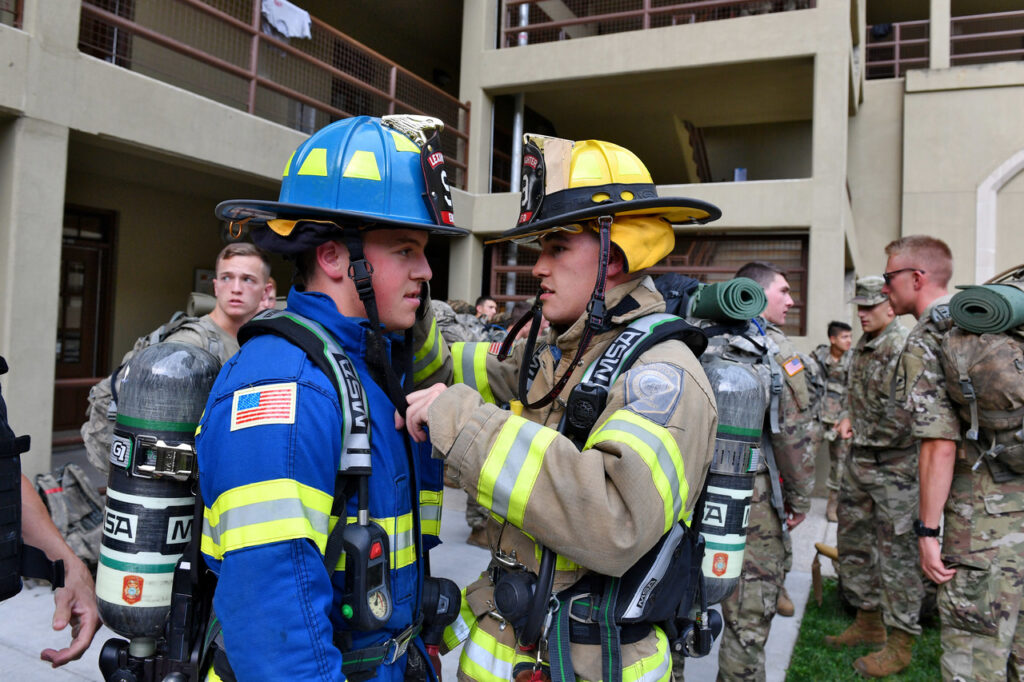
Two cadets gear up in firefighting equipment in barracks.

The reward outweighs the risk 

Firefighting is a large time commitment, but one that Taxiarchou enjoys. He shared that many people ask him why he volunteers his time. His response – “If I can help even one person, that’s enough for me.”  

For Lawrence, the brotherhood among firefighters is what keeps him going. He is especially close with his home department, the Goochland County Fire and Rescue.  

“I feel honored to have run calls with them,” he said. “I couldn’t say enough good things about the people in that department.”  

Firefighting on post 

In addition to serving the community, the VMI Firefighting Club also serves the Corps. “We focus on educating people in the Corps about firefighting and fire safety,” said Lawrence.  

During room inspections, members of the club go from room to room and ensure the fire escape plans are up to date. The club also hosts the 9/11 Memorial Stair Climb each year.  

“I helped run the 9/11 stair climb this year, which was an incredible experience,” said Lawrence.   

This year, the club hopes to improve room inspections, drill with the local firehouses, and continue to educate the Corps and the community. To accomplish this — they have set a goal of producing a public service awareness campaign.  

Before cadets leave for Thanksgiving furlough, the club is planning to hold a public safety announcement on post.  

“We are working to organize some kind of event to bring awareness of the dangers of drinking and driving, one potential option being explored is the possibility of a real-life vehicle extrication drill that would simulate a drunk driving accident,” he said. 
Corps Contributions: Barbershop

At Virginia Military Institute, there’s a top team providing high-quality services, support, and supplies to keep the Corps of Cadets running smoothly and looking sharp. In this series, Corps Contributions will take a look at VMI Auxiliary Services, and the people that power VMI behind the scenes.  

Music is playing in the background as plastic squeaks beneath a man who is sitting in a barber’s chair. A smocked woman places a cape around him and picks up her clippers. With a few glances, she examines his hair and begins to transform his look.  

It looks as though you’ve walked into any normal barbershop, with the red, white, and blue emblem on the window outside. Except, this barbershop is located in the basement of barracks at the Virginia Military Institute. 

Glenda Dudley is no stranger to a set of shears. She has been doing hair for almost 40 years. She picked up on the trade while her husband was a major in Army Aviation, and eventually was able to cut hair at each base he was stationed at. She’s been the manager of VMI’s barbershop for the past 12 years.  

The VMI Barbershop is busy, she said. Typically a barber completes 20 haircuts a day on cadets, but that number can spike. During busier times of the year, such as when cadets return from furlough, they may do 30-40 cuts a day. 

The barbershop is one of the first stops for matriculants on the day they arrive on post.  

“You’ve come to VMI, you’re going to get the VMI experience by getting a haircut,” she said. “And I think that’s very important for males and females.” 

They use an adaptation of the AR 670 haircut regulations from the United States Army. Although they follow these regulations, there is much room for interpretation among cadets.  

Some enter the barbershop and request a “high and tight” haircut similar to the Marines. For some male cadets, a haircut may only last for two weeks.  

Male rats are required to have a buzzed head throughout the Rat Line. To maintain this, they visit the barbershop every seven days until Breakout. Female cadets, including rats, have their hair cut to the shoulder blade. Dudley says they cut it so when the hair is in a ponytail, it’s not dropping any further than the shoulder. Female cadets after Breakout have more flexibility with how they can wear their hair — even short.  

“Their haircut is part of their uniform. So we’re just trying to give them a style cut and keep them within regulations,” she said. “We’re upholding the standard because the haircut is part of that uniform. It just keeps looking sharp … and the haircuts are part of that.” 

Female cadets are encouraged to come into the barbershop every two weeks, but not for hair cuts. Instead, Dudley said they offer shampoo and conditioning treatments, which both male and female cadets can utilize. Other services include scalp treatments and eyebrow waxing.  

She has a staff of 10, including one esthetician. She’d like to get more people on staff to add to the rotation with the six chairs in the shop.  

“This barbershop cannot function the way we do without that team I have. My team is probably the best in my opinion on this side of the Mississippi. They work together for the cadets and for each other,” she said.  

Besides her staff, she loves meeting the cadets.  

“I love the cadets. You get to meet so many different people from so many different walks of life. We’re learning from them, just getting to know them,” she said.  

She said she likes to provide a relaxed environment, especially during that first day for the incoming class. When the rats come in, they’re getting so much thrown at them so fast, she said it’s like getting information through a firehose. 

“I think we try to make them just settle down and encourage them that they can do this, that they’ve got this. And that’s what we do throughout the entire Rat Line,” she said. “So when I encourage all of them to keep coming back … you’re paying for it, keep coming back. Sometimes they don’t necessarily need the haircut — maybe just a shampoo and let us just wash a little of the week down the drain.” 

Good Morning Rome! Cadet’s Study Abroad Experience Turns Into Radio Broadcast

Louis Wiltenmuth ’25, a mechanical engineering major, wanted to get ahead in classes this past summer, while also gaining some cultural experience. What started as a study abroad experience in Rome, turned into him becoming the cadet in charge of the program.  

It took a simple question to Patricia Hardin, associate director in global education, on how to attain bus passes for her to hand off the torch of communication to him. 

 “I made the mistake of asking the question, ‘How are you going to get them to us?’ and she says you’re in charge,” he said. “I would make sure that everyone knew what was happening for upcoming classes, specifically the global engineering [classes] because for that class we did a lot of excursions out to cultural sites.” 

Patricia Hardin said the cadet in charge position depends on the program and program director. Col. Jon-Michael Hardin, professor and head of the mechanical engineering department, hadn’t had a designated cadet in charge for his summer study abroad program in Rome.  

“It’s always helpful to have a cadet in charge so that they can assist with crowd management,” Patricia Hardin said. “Cadet Wiltenmuth’s role as the cadet-in charge evolved naturally at the beginning of the Rome engineering study abroad program.”  

Wiltenmuth became the key point of contact when it came to the program. He decided he’d make it a little bit more fun, rather than just passing messages along. Instead, he turned the correspondence to the VMI Rome News Station.  

“We went to Pompeii, the Vatican Museum, the Colosseum, and a lot of other places that we would all need to meet up at a certain time so we could catch a shuttle that we had scheduled,” he said.  

The correspondence he did was an effort to create coordination between the other cadets participating in the five-week program. His “radio program” was actually messages sent to them through GroupMe, a chat application that can be used on your smartphone.  

He started each “broadcast” with “Good evening and welcome back to your VMI Rome News Station” followed by a rundown of the day’s events and upcoming excursions. 

“If we went to any cultural site that day I tried to end each message each night with a different fun fact or a different way to call Rome. So usually somewhere in the last paragraph, it would go like this, ‘and that is all for this evening’s news. Thank you once again for joining us. We hope you enjoy your stay here in the Eternal City of 1,000 fountains.”  

He would send out a message each day from Sunday until Thursday.  

“Sometimes the messages were a lot longer than others. But what helped was the Hardins had given us a schedule of roughly when we would go to our excursions or cultural sites. I would republish that … and I would put more information out as I got it,” he said.  

Patricia Hardin said the way Wiltenmuth disseminated information was effective, yet creative. It was also a way for someone to learn leadership skills — something Wiltenmuth did successfully.  

“I believe this approach was effective since the information came from one cadet to the other cadet participants, rather than from a professor to cadet participants,” she said. “I also believe that Cadet Wiltenmuth’s way of imparting the information provided cadets with something to look forward to every evening.”  

As the co-program director of the VMI Engineering Summer Study Abroad program, Patricia Hardin tries to get to know each cadet participant in order to learn their strengths and talents, and then provide an outlet for them. 

“Wiltenmuth has a knack for telling stories and disseminating information in a very creative way, so I nurtured his talent and provided him with the opportunity to hone in on his talent,” she said. 

Parachute team brings patriotism to VMI football game

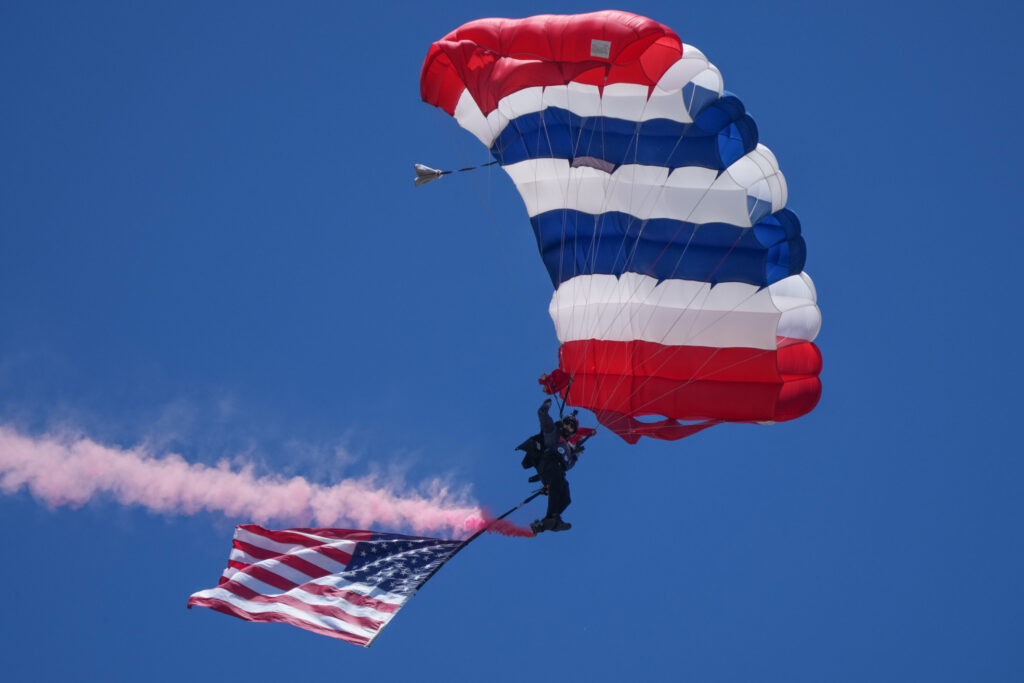
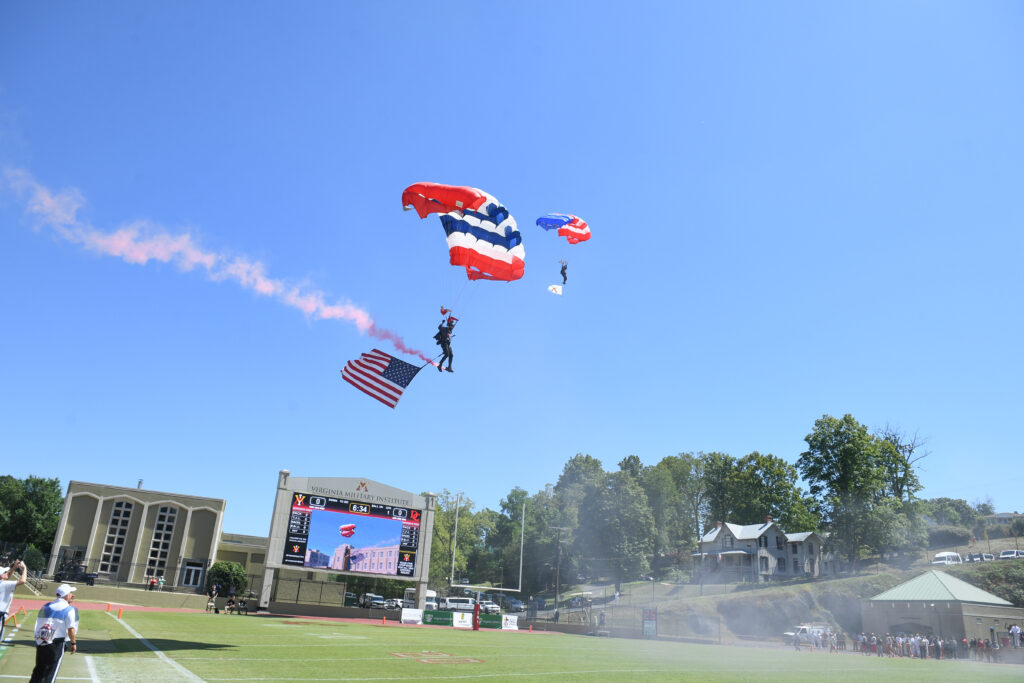
Retired Army Master Sgt. Chris Malone and two other jumpers are 5,000 feet in the air. It’s a Saturday afternoon and the Keydets are getting ready to play their first football game of the season.  

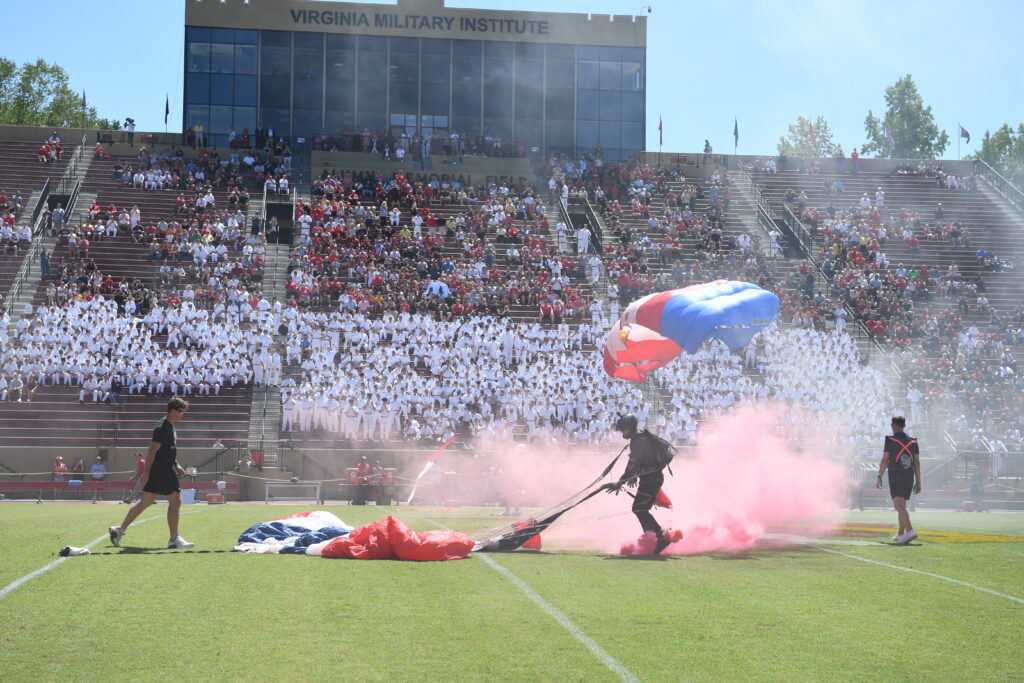
Malone’s entrance to the game is far from ordinary. That’s because he is preparing to jump from a small plane into Foster Stadium.  

Is he nervous? No. He’s focused

“What we’re doing, we have to be focused on where we’re jumping in because if we miss our exit at the proper location right above the field or just in the area, then we’re not going to land where we are supposed to land and that kind of botches the whole situation,” he said.  

Malone, along with Retired Chief Warrant Officer Chris Wilkerson and Retired Sgt. 1st Class Roy Shaw, is part of the All Veterans Group (AVG), which performs parachute demonstrations, leads tandem parachute experiences, and assists with brand ambassador programs, sponsorships, and special events. AVG was started in 2011, by Mike Elliot, a former Golden Knight with the U.S. Army.  

Jumping into the stadium for home games has been happening at VMI for three seasons now with AVG. 

Malone said Elliot developed the team in 2009 to showcase and support veteran initiatives throughout the country. Now, the team has grown to more than 60 members.  

“It has become a place for people like me, and people who I used to work with, in the U.S. Army Special Operations Command Black Daggers Parachute Team. And now that I’ve since retired, this has given me an outlet to be able to continue jumping in and showcasing what our military capabilities are,” he said. “For me personally, to be able to continue to go out and do really neat jumps like this, it’s just an awesome opportunity.” 

Those part of AVG are able to pick their jumps — or at least sign up on a roster for preferred jumps. They utilize either their own planes or reach out to friends or supporters to find aircraft to aid in jumps. This time, the plane was their own and they flew out of Roanoke.  

“For this event, specifically, it was kind of unique because we had three Black Daggers jumping into the event. Normally we have a Golden Knight, a Black Dagger, and a Silver Wing or something like that going to these different backgrounds.” 

What are the different types of parachute teams? 

The Army has a number of parachute and jumping teams including the Golden Knights, Black Daggers, and Silver Wings — all of which are highly skilled members.  

The Army Parachute team is known as the Golden Knights. They are made up of parachute teams, aircraft pilots, and jump logistics. The Golden Knights have several teams that compete, perform demonstrations, and also do base jumping and skydiving maneuvers.  

The U.S. Army Special Operations Command Parachute Demonstration Team — the Black Daggers — is made up of volunteers from the Army special operations community. The team is a group of highly-trained soldiers who are dropped behind enemy lines to disrupt the movement of enemy troops and supplies to the front lines by using parachutes to go undetected. They are able to jump with more than 100 pounds of additional equipment and withstand high winds, cold temperatures, and low oxygen levels.  

The U.S. Army Maneuver Center of Excellence Command Exhibition Parachute Team are known as the Silver Wings. They are the official demonstration parachute team of Fort Benning, Georgia. This team is made up of U.S. Army Paratroopers and their mission is to perform live aerial demonstrations in support of the Army. 

Tradition and prestige 

Doing these jumps at VMI is something special — showcasing life after military service to cadets at a military college.  

“Being able to jump into the home opener and get everybody excited, but also show them the kind of a lineage of where people who have served past or at are now and where our capability is … it’s nice to be able to showcase those capabilities and show our future military members our capabilities are continuing to progress,” he said.  

Jumping out of an airplane — while displaying an American flag — is a form of patriotism that defines the mission of AVG. For some, life after military service can be uncertain. But, this group aims to empower service members and veterans, while boasting a spirit of Americanism.  

“It’s something that they can kind of look forward to in the military … whether that’s airborne training or air assault training. It’s all about pushing yourself to high-intensity situations and being able to stay calm, cool, and execute at a high level.” 
 
The act of parachuting serves as a form of entertainment for spectators, but for AVG members, its all skill. AVG members aren’t always doing this for fun – but to display the expertise they obtained in their military careers.  

He says a lot of people ask him if it’s scary to jump out of a plane, but for him, it’s exhilarating.  

“We’re very focused and we’re kind of having fun in the aircraft, kind of messing around and talking. But once we get to about two minutes out, that’s when the interfaces turn on,” he said.  

Before jumping, they return to the mindsets that they used in the military.  

“Everybody gives a high five to each other. And then as we look outside the aircraft to our landing location, our target, that’s really where that focus gets in. So we have nerves, but we’re not nervous. We just want to make sure that we’re doing everything we’re supposed to be doing — to make sure we’re on time and on target.” 

Corps Contributions: The Military Store

At Virginia Military Institute, there’s a top team providing high-quality services, support, and supplies to keep the Corps of Cadets running smoothly and looking sharp. In this series, Corps Contributions will take a look at VMI Auxiliary Services, and the people that power VMI behind the scenes. 

Katherine “Blaine” Noel has a two-count system. Everything in Virginia Military Institute’s Military Store is counted once. Then it’s counted again, for inventory purposes. If those numbers don’t match, you start all over. It’s important to have the proper count — the store has nearly $8 million worth of items in stock and Noel doesn’t want to waste money. She and her team need to be accountable.  

“Sometimes I’ll get a third counter,” she said. “But if it’s a bunch of stuff that doesn’t match, then I’ll throw the counts out and I’ll make people start over. I want to be fiscally responsible for what comes and goes, so I take pride in being able to look at that and hope that I do a good job and a good service, as well as to the state of Virginia, to make sure you’re not overspending or underspending or all those things.”

Noel is the quartermaster at the VMI Military Store, a place which serves as the first stop for rats and cadets to get their uniforms and everything that goes with them at the start of the year. It’s also the place they can go if they need to exchange an item or replace lost items. Everything a cadet needs to be outfitted with comes from here, from the pants, the shirts, the shoes, and jackets to the buttons, cuffs, padding and more. 

On average, each cadet is issued $4,500 in uniform items. During Matriculation in mid-August, Noel and her team equip approximately 500 new cadets with 60,000 uniform items. Within the corps, there are nearly 200,000 uniform items that are altered, exchanged, or replaced throughout the school year.  

“They change body sizes, they build muscle and get bigger or they could lose weight, get trimmer or any variation thereof,” she said. “We accommodate that.” 

They have a wide range of sizes for most items. For instance, the boots available run from size 1 to size 20.  

“We’re prepared for those unusual circumstances,” she said. 

Summer is the store’s busy time, Noel said. It’s spent upping inventory, doing audits, organizing, and more.  

“It takes a lot of people and a lot of effort during the summer to make sure that we’re prepared for all the people who are coming and you never know who’s going to come through the door,” Noel said.  

During the school year, the store runs as a regular military shop — cadets come in and purchase new gloves or need to replace random items throughout the year.  

“Mostly we’re an exchange. So if your pants are too snug, if they’re too short, if something ripped … we replace those uniforms,” she said. “We swap one for one. The thing that we don’t exchange is close contact body items so, we’re not going to take gym shirts back.” 

Noel has been working at VMI for 18 years. When she first started, they took measurements by hand and filled out a sheet. Now everything is computerized and a system will help select what sizing a cadet fits into. Her career at VMI began with fitting females for their uniforms, which is something she still participates in, and then worked her way up to the quartermaster. She credits Col. Michael P. Friski Sr. as a great mentor.  

She’s able to look at her job as an integral part of VMI’s operations.  

“One, we are a military school, so uniforms are essential, right? They don’t go here unless they’re in uniform. So we are the first stop. We issue them everything that they need, with the exception of any ROTC items,” she said.  

She also enjoys hearing the stories of the incoming cadets, learning about where they’re from and why they chose VMI. 

“I love to hear those stories,” she said. “Every once in a while you’ll meet a couple of them that just grab your heartstrings a little bit.” 

What keeps her at VMI is her work environment. They all have each other’s back, she said. Even if they joke around, they know when to get serious and work hard.  

“We work cohesively, we’re a good team. It’s just a welcoming environment,” she said. “I’m confident in what I’m doing. I’m confident in my job and I think the people that are here are confident in what they’re doing as well. So it definitely makes for a good career.”

Matriculation Reflections: 1st Class Remembers Their Rat Year

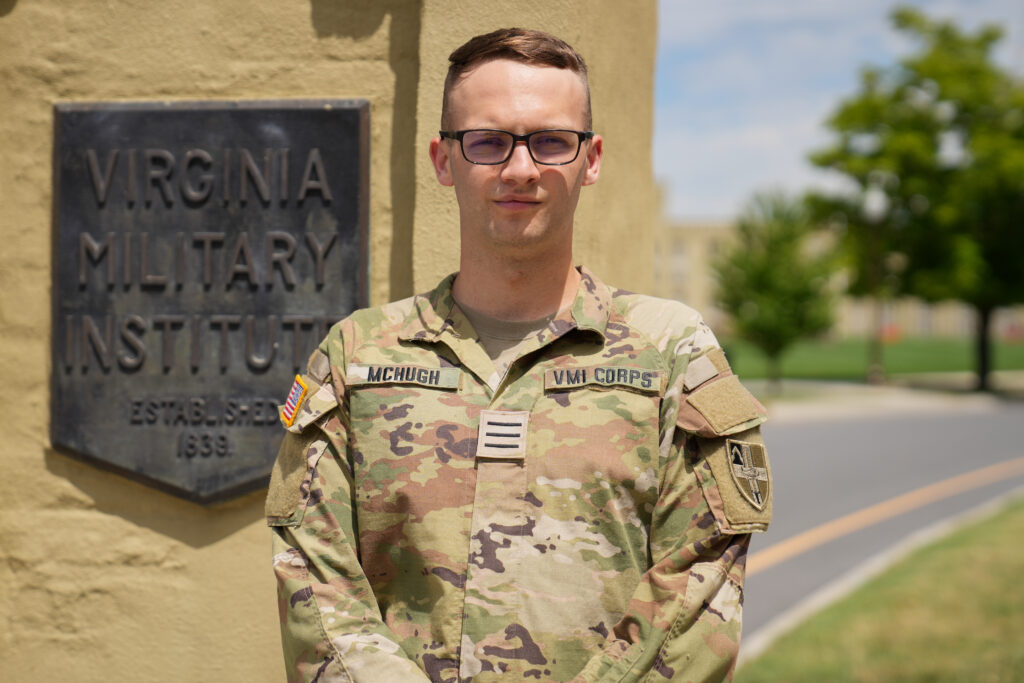
The road twisted through the fog as Noah McHugh ’24 and one of his best friends made their way to the start of their lives for the next four years. The international studies major remembers waking up before the sun and making the drive from Lynchburg to Lexington.  

It was Matriculation Day at Virginia Military Institute in 2020. Things were a little different then, thanks to COVID-19, and the normally one-day event held on a Saturday in August was split into two. McHugh was with the second wave on Sunday. 

“Driving on a windy road your stomach sank and your heart dropped and you’re like, ‘Oh my gosh, this is real. I’m really going to VMI,’” he said. 

His experience is much like that of many cadets — trepidatious. But the day for him was a blur and he can only recall certain aspects of it. He remembers signing the Matriculation Book and thinking, this is it, there’s no turning back now. 

“It’s pretty impactful,” he said.  

Throughout Matriculation Day, the tension grew. Families took their incoming rats through move-in, the matriculation fair, uniform fittings, and their final meal together. Seated in Cameron Hall, a quiet, collective understanding can be felt. Rats sit with their families, legs bouncing up and down, hands twining together — all the while trying to keep their emotions in check. It’s the fear of the unknown, except these incoming students know what waits for them. It’s akin to the gauntlet, waiting to be called down to their companies and ushered up to barracks.  

McHugh sat there quietly with his family waiting for his company letter to be called. When he heard his company’s letter, he got up, hugged his mom, shook a family friend’s hand, and started down to the floor of Cameron Hall.  

“I just ran down there and formed up with the rest of my brother rats,” he said.  

Hannah White ’24 said she was a nervous wreck. She also matriculated in 2020. She arrived at VMI a couple of weeks before Matriculation Day because she’s on the women’s soccer team. She said it allowed her to get more comfortable with barracks and how VMI operated.  

She remembers going through the matriculation fair, getting her last meal with her family, and arriving at Cameron Hall waiting for her company to be called. 

“There’s really no feeling like it when you’re sitting in Cameron Hall and they call out your company. And you have that same letter on your tag and you say goodbye to your mom and dad, and mom’s crying because their little girl’s about to go do the military thing,” she said. “It’s a feeling of excitement because it’s a whole new thing that you’ve never experienced before. A feeling of fear because there’s really nothing you can do to prepare for it and you don’t really know how you’re gonna react to all this stress and pressure that’s about to happen.” 

White said looking back on it, her VMI journey allowed her to learn how to handle her emotions. 

“This place really drives how to deal with stress and pressure, and it begins literally on day zero when you get there,” she said. 

White appreciates being on the other side now. Each year, it’s exciting to her. Looking back on how she felt leaving her family behind, marching up from Cameron Hall, and reaching barracks — she’s been in the new matriculants’ shoes.  

“It’s the start of the VMI journey. It’s something that everybody goes through, and it’s the same way every single year and everyone has that shared experience, no matter what class you’re in,” she said. “Just seeing where they start on Matriculation Day to Breakout and seeing that transformation is always a really cool thing to see.” 

There are times during Matriculation Week when it can be overwhelming. White advises rats to stick it out.  

“Don’t give up too soon. Because now being a 1st Class [cadet] and looking back at where I was three years ago, as a little rat coming in, I’ve developed so much, not even only during the Rat Line, but 3rd Class year and 2nd Class year. You learn so many valuable life lessons that I don’t think I would have learned at a regular college. Seeing it through to the end is an accomplishment in itself. You learn such valuable lessons that it’s going to help you with anything life may give you.” 

Because once you do stick it out, you can be like the 1st Class cadets looking back on it.  

“It’s funny looking at the picture now, reflecting on the last three years and seeing what the people who matriculated that day have accomplished,” McHugh said.  

Miles Johnson ’24 also matriculated in 2020. He said during the first day , he wanted to leave.  

“I felt the psychological pressure of not being good enough and letting that affect my attitude toward VMI,” he said. “I stayed at VMI because I asked for this challenging experience, and I wanted it to prepare me for the United States Marine Corps lifestyle. I also stayed because my dyke had a huge influence on me during the Rat Line and I did not want to let him down.” 

Arriving for Matriculation Day was the second time on post for him. He said he remembers being very nervous about what was to come and about being away from his family. But his excitement over meeting his brother rats overrode that. 

“I knew this was where the lifelong bond started,” he said. 

He said he was ready to experience the world for himself, using the wisdom his family instilled in him. He said what followed, though, was tough.  

“I remember the rest of the day being very challenging … during the first workout and once we met our cadre ,” he said. “The noise levels were through the roof and I remember my best not being good enough for my cadre. The demand for excellence at VMI was prevalent the very first day and has continued on through my cadetship.” 

Johnson said looking back, he’s realized how much he’s matured, and matriculation’s purpose is the start of transforming high school graduates into the Rat Mass, then into cadets.  

“This is done so by learning customs and courtesies, basic military skills such as physical fitness, drill and ceremony, and how to wear a uniform properly,” he said. “In the midst of all that, VMI adds external pressure using professionally trained cadre. This is another foundational block to making a VMI graduate stand out amongst their peers.” 

His advice for rats?  

“Do what you’re supposed to do, when you’re supposed to do it, the way you’re supposed to do it all at 100 miles per hour,” he said. “I would also recommend that they focus on academics as they learn to balance the three-legged stool [academics, athletics, and military].” 

What is Cadre Week?

It’s day two of Cadre Week at Virginia Military Institute.

Bryson Minear ’24 is the S3 captain. He’s in charge of the operations for the Corps of Cadets at VMI.

“Cadre are the essence of what VMI produces and to continue the tradition of VMI, one must live and breathe the values,” Minear said.Students at VMI, a military college in Virginia, participate in planning during cadre week.

Cadre Week is a five-day training event that all cadre and support staff take part in. The week is packed with simulations, training, and planning in preparation for the incoming rats on Matriculation Day, Minear said. His role as the S3 captain is to oversee the Corps, especially during Cadre Week and Matriculation Week, making sure cadre and rats are in the right place, at the right time, and in the right uniform. S3 is in charge of operations and is responsible for planning and executing plans to accomplish assigned missions.

Who are cadre?

Cadre are hand-picked, experienced upper-class cadets who are responsible for teaching the incoming rat class.

“Becoming cadre is a highly competitive process,” Minear said. “It involves physical fitness assessments, interviews, and an application process.”

Becoming cadre also starts with a cadet’s academics, Joshua Kent ’24, future operations lieutenant of the S3 staff, said. Cadre must exemplify they have full control over their studies before anything else. Physical fitness also plays a big role, along with the ability to collaborate with others.

Cadre’s goal is to teach discipline, precision, humility, obeying orders, and self-control. They’re needed for the rats to earn the status of 4th Class cadet and make it through the Rat Line.

“Being cadre means that you must hold yourself to the highest standard and perform all your duties above and beyond your peers,” Minear said. “Being Cadre is a privilege and is extremely rewarding to influence young men and women.”

Students at VMI, a military college in Virginia, participate in planning during cadre week.The week before matriculation is Cadre Week, which provides cadre with the opportunity to train and hone their teaching skills before the rats arrive.

“This week is the chance to plan and get as prepared as possible for the rats to arrive,” Minear said.

Minear said that everyone comes to VMI on an even playing field — it doesn’t matter what you did in high school, every new cadet is treated equally.

“The saying ‘Iron sharpens iron’ is never more accurate than at VMI,” he said. “A new cadet leans on his or her brother rats to be successful throughout the Rat Line at VMI. The cadre teach the standard, and your brother rats hold you to the standard after the cadre’s role is complete.”

Being a cadre member means that you are a leader, Kent said.

“You have others looking up to you and you are to exemplify what the right thing to do is, always. We are the role models,” he said.

He said it’s about practice, repetition, and patience.

“Rome was not built in one day, but with a lot of hard work and dedication, things were able to be formed just like how we transform these high school graduates into VMI Cadets,” he said.

Cadre Week is spent making sure standards are being met, Kent said. His role is to serve as battalion liaison for planned activities and to also oversee accountability for his staff.

Some major events during Cadre Week include:

  • Cadre Drill Block, where cadre sergeants prepare a set script of how to teach drills and ceremonies to the new cadets.
  • Crucible rehearsals, which is running through the culminating event of Matriculation Week
  • Nightly commanders meeting where all the cadet captains and regimental executive officers get together and get ready for the next day of training.
  • Rat room set up, where cadre help prep the rooms for the incoming Rat Mass.
Cadets practice saber work in barracks.

Inspections, march-ups, and more

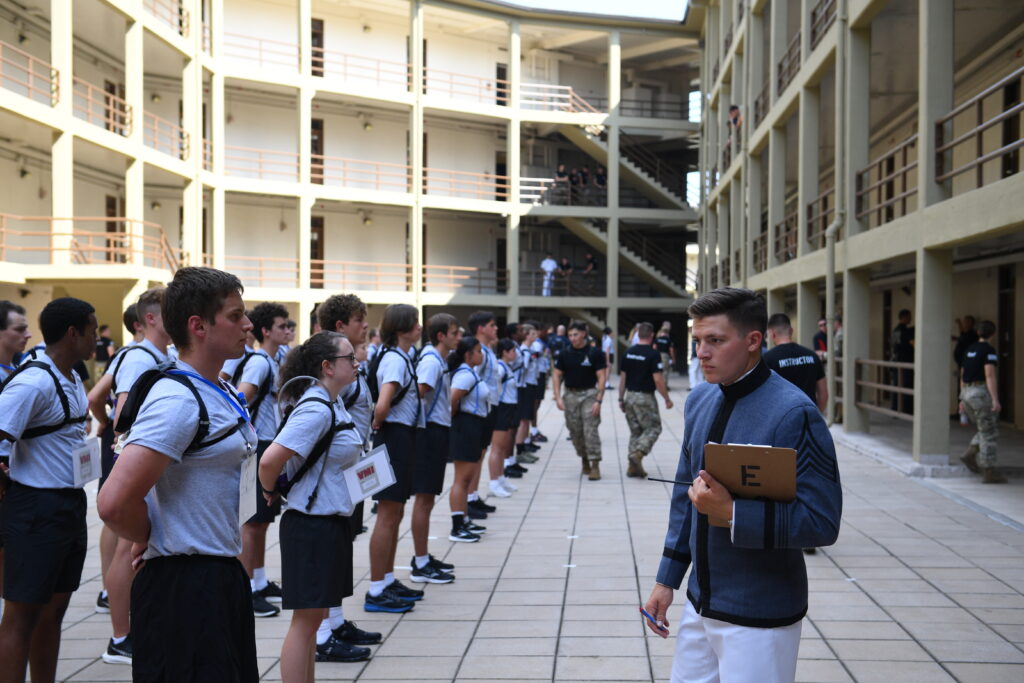
Uniform inspections are conducted once to twice a week and on random occurrences, Minear said. Each company commander will call their respective companies to open ranks march where each platoon provides more space between its ranks allowing room for the inspectors. Inspectors are company sergeants and officers of the S staff, usually accompanied or observed by the company tactical officer, which is a member of the commandant’s staff that advises the company. Each inspector is inspected by a commanding officer prior to them inspecting others.

“The inspectors go person-by-person checking head-to-toe making sure all brass and shoes are shined, the uniform is clean and serviceable, and one has a clean shave and professional haircut,” Minear said.

“We look for anything from the tip of the shoe being shined all the way up to the cleanliness of the cover,” Kent added

Cadre also practices march-ups and march-ins, which are very intense.Students at VMI, a military school in Virginia, participate in Cadre Week, before cadets return to campus.

“We strive for perfection, and it takes a lot of time and preparation to achieve the effect we desire to receive,” Kent said. “We want to open with our best welcome for the incoming freshmen.”

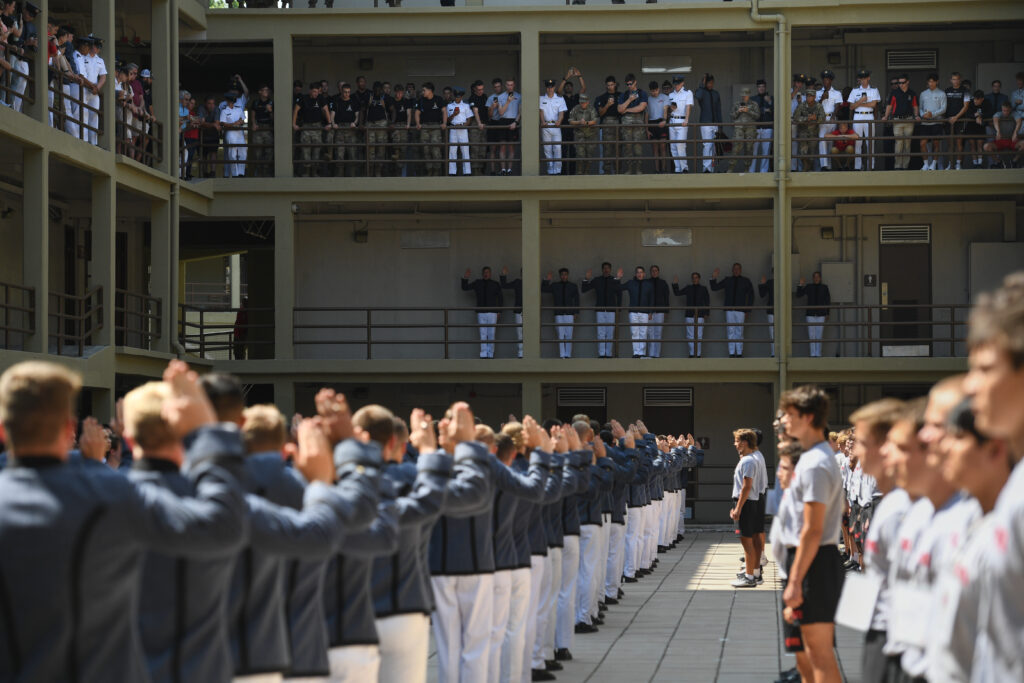
March-up is a long-standing tradition at VMI, and it’s also the first time rats meet their cadre.

Cadets practice line ups outside of barracks.

“On Matriculation Day when the march up occurs, it is supposed to feel intense, nerve-racking, and stressful for the matriculants,” Laini Morgan ’25, S3 operations sergeant, said. “Because of that, and because it is the last chance to get any discrepancies fixed, march-up practices are taken seriously so once Matriculation Day comes it can be executed flawlessly. Everyone included in the march-up is expected to have a perfect bearing, no laughing or looking around, and know how to march correctly and professionally.” 

Morgan said the amount of influence cadre have on incoming rats is a huge responsibility, and something that is taken seriously.

“Being cadre means that you directly work with the incoming freshmen, training and evaluating their progress, while they work toward becoming a cadet,” she said. “You are held to a high standard within the Corps and are expected to hold others to that same standard that has been set.”

Lawrence Porter ’24, 3rd Battalion S3 lieutenant, said being cadre means you are the role model for hundreds of rising college students who want to become model citizens.

“It carries a lot of responsibility but when done right, it has a positive impact on the futures of the incoming rats,” he said.

Cadre Week has a lot of moving parts when it comes to planning, time, and the effort needed to be put in for the upcoming year.

“Cadre Week is arguably the most vital week for the VMI,” Kent said.

SURI: Unlocking the Links Between Spanish Poetry and Culture

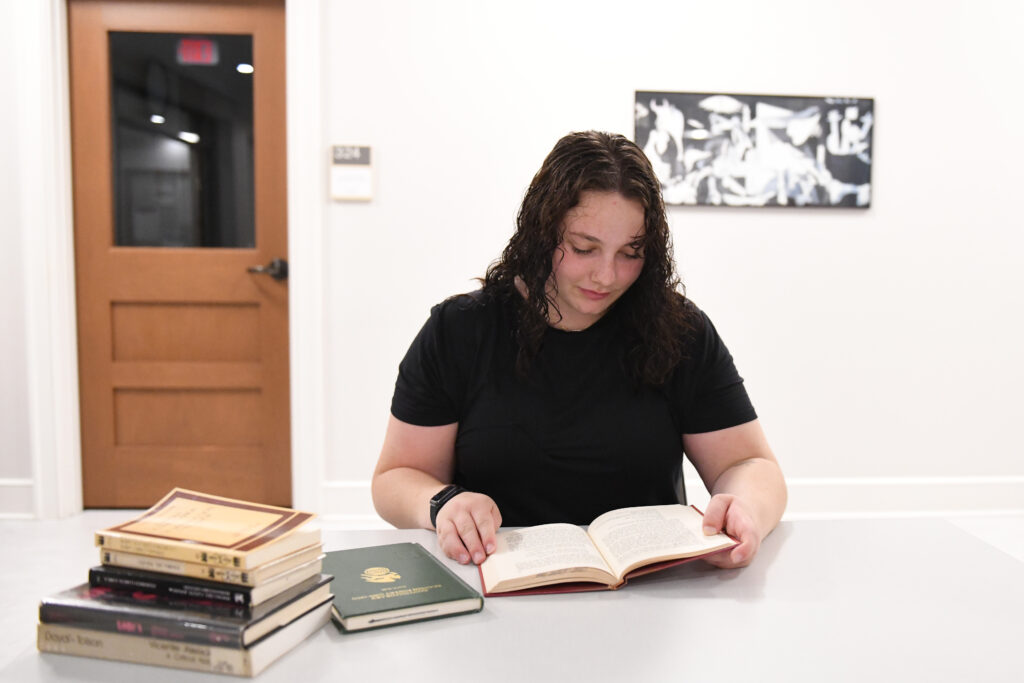
Caitria Catania ’24 has been studying Spanish for eight years, but after taking a Spanish literature class with Col. John Cerkey this past spring, her love of analyzing Spanish poets grew. During her 3rd Class year after taking the 300 level literature class “Nobel Laureates,” she decided to declare a double major in international studies and modern languages and culture and a minor in writing and rhetoric.

“My professor approached me asking if I would be interested in a research project with him on Spanish literature and I thought it would be a great way to enrich my knowledge of poetry and the Spanish language,” she said. A student doing undergraduate research for VMI’s SURI program

As part of Virginia Military Institute’s Summer Undergraduate Research Institute (SURI) program, Catania researched and analyzed two Spanish poets — Vicente Aleixandre and Federico García Lorca — to show their impact on Spanish literature in 1927 and how it impacted modern-day Spanish literature in her project entitled “Revolution in the Poetic Language of the Generation of 1927.”

“These poets were very critical to this literary movement as they focused on the surrealism of the visual arts and animated their words to capture the very marginalized elements of their society to create pieces of art,” she said.

She said she focused a good portion of her research on Lorca, saying she was immediately drawn to him and his way of bringing surrealism to life, and how he was inspired by the 1898 generation of poets. She said both poets utilize the techniques used in older poetry mixing in modern techniques in a special blend.

“I choose Aleixandre and Lorca not only because they were born in 1898 and both come from the southern region of Spain known as Andalucía, but also because their poetic development parallels one another very closely,” she said. “I say ‘parallels,’ but they are completely distinct geniuses whose contributions liberated new directions — as per the title of this project — and allowed their fellow members to explore vastly different poetic registers, from metaphysics to existentialism, to gay thematics — though this latter, somewhat veiled.”

SURI is offered by the VMI Center for Undergraduate Research (VCUR) and provides cadets with a unique opportunity to delve into high-level research that relates to their degree path. It consists of cadet-led research under the direction of a faculty advisor.

Catania devoted six hours on the weekdays to research over the summer and met with Cerkey two to three times a week.

Researching and reading literature in another language did pose some problems. The Spanish to English translations she had weren’t exact. Combining Cerkey’s translations and other English translations allowed Catania to read them and have the poems still retain their original meaning.

“If I were just to Google Translate a poem, it wouldn’t be the meaning I actually want the poems to be,” she said. “It’s been years and years of people researching these to get English translations for them.”

Prior to starting her SURI project, Catania spent a month studying in Spain. This helped her with her research, she said, since she was staying close to the places that both poets touched on in their work. This was helpful in that Lorca used his surroundings and situation to express his pieces of art.

“I went to the place where these two poets were born,” she said. “I could see that culture in a sense, and it’s definitely given me a deeper appreciation for Spanish culture. And not only that, but I took a Spanish history course there, and their poems were published and written during the time of the Spanish Civil War. I’ve spent so much time researching and learning about the Spanish Civil War that I can really understand what they were going through.”

Cadet Caitria Catania, Class of 2024

A student doing undergraduate research for VMI’s SURI programThese poets were protégés of Salvador Dalí, Catania said. One of the distinctive marks of Aleixandre is his ability to transform the surrealism of the visual arts into his unique verbal medium.

“Lorca from his earliest ages, a lover of music and the visual arts, was sublimely in tune with nature and his lyric voice animates, with an organic reality, all of the world and universe that surrounds him,” she said. “He also is touched by surrealism in his later poetry, but his most distinctive milestone was to capture that very marginalized element of his society — the gypsy world, with the same sensibility with which his poetic voice touched all of nature and humanity.”

Through SURI, she was able to gather more knowledge of Spanish culture and history. She said tackling a 21-page paper written entirely in Spanish was a huge feat.

“I think SURI is a very important program at VMI because it gives cadets the ability to choose a topic of their interest and do thorough and intense research and analysis of the topic,” she said. “Not only does it teach research methods, but it also creates a strong and lasting relationship with a professor.”

Cerkey, a professor in the Department of Modern Languages and Cultures, said Catania showed promising signs early on and has only grown in her skills as the project has progressed. His goal, as a professor, is for his students to learn Spanish and get better at the written and spoken word.

“More than anything else, I want you to become good critical thinkers,” he said. “Of all the skill sets that you’ll most benefit from down the road, the most important is critical thinking,” he said. “You may forget your Spanish; you may be only a minor. Even if you’re a major you may not end up using your Spanish down the road. But if I can help you sharpen your critical insight and critical thinking abilities … critical analysis is key.”

Creating A Cyber Secure World: John Barker ‘23

This article is part of The Next Step series. While the four years at VMI are designed for cadets to push themselves academically, physically, and mentally to tackle the demands of life at a premiere military college, they also prepare cadets for life after graduation. Whether that life be one in the military or one in the private sector, VMI faculty and staff provide guidance to cadets along their journeys. One department specifically dedicated to that endeavor of post-Institute success is the Office of Career Services. In The Next Step series, we sat down with cadets preparing to enter the workforce after graduation, as well as those still in the midst of their cadetship preparing for internships over the summer.

Once Virginia Military Institute came into view, John Barker ’23 felt a surge of excitement. He had always dreamt of immersing himself in the world of information technology and making a mark in the industry. Student at VMI, a military college in Virginia

Hailing from Fairfield, just a few miles from post, Barker had entered VMI with determination, declaring himself as a computer science major with a passion for cybersecurity. Fueling his enthusiasm further, he took oversight of the VMI Cyber Club as the cadet in charge, delving deeper into the realms of computer science.

Barker knew to propel his career and bolster his resume, he needed to seek guidance from the VMI Office of Career Services. This office, a sanctuary for graduating cadets, held the key to unlocking his potential.

“They helped me structure my resume and refine my interview skills,” he said. “They also showed me how to network with the various VMI Alumni.”

The Office of Career Services proved to be a goldmine of resources for cadets. From resume workshops to interview preparations, they guided Barker every step of the way, navigating the rough waters of the job market.

Armed with a VMI degree on his resume, Barker became a force to be reckoned with during his interviews, leaving a positive impression on potential employers.

After enduring a tiring process of applications, interviews, and revisions of his resume, Barker emerged victorious. He secured a coveted full-time position with KnackWorks, a software company that provides defense and intelligence solutions, in Fairfax County, Virginia.

As he walked across the stage in May at the commencement ceremony, an adventure awaited him as a systems administrator at KnackWorks. With this role, he would be entrusted with managing systems for clients in the Department of Defense, launching his career further into the world of computer science.

“In 10 years’, I envision myself wielding a master’s degree in computer science, adorned with an impressive array of certifications such as CISSP, CASP+, SSCP, Project+, and PMP,” he predicted.

With determination, Barker embarked on a journey that would combine his passion for computer science with a desire to leave a mark on the world. The road ahead promises challenges and triumphs, but he’s ready to conquer them all, armed with his drive and the guidance he received at VMI.

VMI Cadet Researches Precision in Rockets

Rockets have existed since the first century. In ancient China, they were first used to create explosions during religious festivals, then later used for warfare. In modern times, they are used for fireworks, space exploration, human spaceflight, and to launch satellites into orbit.

Brian Tavenner ’25, an electrical and computer engineering major at Virginia Military Institute, is designing and building a fiberglass rocket to reach the exact height of 1,023 feet using a F-engine motor in his five-week Summer Undergraduate Research Institute (SURI) project titled, “Target Altitude Project.” A student doing summer research at VMI, a military college in Virginia

Tavenner chose the research project in order to enhance his engineering skills including electrical and mechanical design, documentation, construction, and debugging. In addition, he wants to lay the foundation for a VMI rocketry club to compete with other colleges. According to Tavenner, many major colleges and universities including The Citadel, MIT, and Georgia Tech sponsor student-led rocketry clubs as chapters of the National Rocketry Association. “I propose to create a high-power rocketry club for VMI, and lead a team to enter a rocket combination competition in the annual national intercollegiate Battle of the Rockets, Target Altitude Event,” he said. The height of 1,023 is a requirement of the competition to be held in April. The team with the closest altitude to 1,023 wins.

Tavenner pointed out that all the measurements in the design of the rocket must be perfectly accurate to achieve the specific height. “Even if it’s off just a little bit, it just won’t work. It must be perfect. The hard part is determining how much higher the rocket will glide up on its own once I stop the engine and the nose cone has popped off. That will require a lot of test flights,” he said.

Tavenner graduated from Midlothian High School just outside of Richmond, Virginia. He is a NCAA long-distance track and cross country runner, plays the viola in the strings club, and studies Japanese independently through online courses. Tavenner is part of a large STEM family legacy at VMI. He is the son of Andrea and James ’91, who majored in math and played baseball for VMI. His two uncles, Cloyd ’88, an electrical engineering major, and Dave ’03, a history major, as well as his two brothers, Jamie ’16 and Thomas ’19, who both majored in civil engineering, are all alumni. His cousin, Molly will matriculate in the fall.