Post View Unavailable »
New Website Launched »

Honors Week: One Cadet’s Connection to the Greek Resistance

Cadet Chris Cocoris ’23 remembers growing up listening to stories about his great-uncle George Cocoris. They were passed down to his father since his great-uncle had passed before Cocoris was born. George joined the Greek resistance to oppose the Axis occupation in 1941 Greece, Cocoris said.   

For Cocoris’ senior thesis “Suppressing the Red Tide: Greek-American-British Counterinsurgency Efforts Against Greek Communist Insurgents During the Third Phase of the Greek Civil War, 1945-1949, he decided to dive into his Greek heritage.  

“I selected the topic to demonstrate how the Greek government, with American and British assistance, managed to defeat one of the earliest communist insurgencies,” the 1st Class Virginia Military Institute cadet said. “In addition, I wanted to work on a topic for which I could use my fluency of the Greek language, which in this instance proved to be instrumental for the completion of my project.”

The project took nearly two years, and according to his advisor Col. David Gray, it’s more of a graduate-level thesis than an undergraduate. Gray described Cocoris as a go-getter who’s self-motivated. He was impressed with his curiosity, which led Cocoris to visit multiple archives — including some in Greece, the National Archives, the Truman Library, and the George C. Marshall Library on post — to attain research for his thesis.  

“He’s got some good insights and as his young mind is developing both as a historian but perhaps more important in the near term as a future army officer, soon to be this spring, and an infantry man, he will for sure engage in some of these types of operations if he stays in long enough,” Gray said. “So this gives him a great intellectual foundation and hones his own judgment in thinking about these important issues.” 

Cocoris, a history major, will commission into the United States Army as an active-duty Infantry 2nd Lieutenant upon graduation.  

The biggest piece of research he collected was his great-uncle’s journal, something he wasn’t aware his family even possessed.  

“The resistance group he joined was ELAS, which during WWII, had kept its communist character hidden,” Cocoris said. “I was lucky to be given his journal ‘Why we Became Guerrillas of ELAS’ by my father, which unveiled the fact that upon the liberation of Greece, George Cocoris’ partisan group opposed the rule of the Greek government, which is the focus of my study.” 

His thesis was presented March 22 for VMI’s Honor Week. The Greek Civil War is one of the few successful counterinsurgencies in an era of defeats, he said. His great-uncle’s journal proved to give great insight into a firsthand account. Captured and imprisoned by the Greek National Army in 1946, George Cocoris was eventually released in 1947. 

“Military historians tend to focus on leading personalities in warfare, such as general officers and political leaders. While primarily focusing on WWII rather than the Greek Civil War, George Cocoris’ journal allowed me to observe the average insurgent’s opinions and way of life during the civil strife in Greece,” Cocoris said. “His journal reflects his reactions to the Greek government’s counterinsurgency efforts and the insurgent rhetoric’s shift from national liberation towards communism.” 

His thesis required lots of work and dedication — it was a three semester process to complete a 50-page report that went through a myriad of edits and refinements.  

“I truly immersed myself in the study of the Greek Civil War, researching archival sources from several countries, and exploring my family’s past during the civil strife in Greece,” he said.  

Gray gave Cocoris a series of 10 books to start out with the second semester of his 2nd Class year, in order to provide him with some background reading and perspective and context on the period of study.  

“That gave him some clues as to where to start,” Gray said. 

Research carried on over through the summer into the 1st Class year, where Cocoris began producing a thesis. After their first semester they must produce a draft of their thesis and give an oral defense, Gray said. His final semester was spent refining his research and reviewing edits from Gray after each draft of his thesis.
Cybersecurity: VMI Honors Cadet Explains How Cyber-Attacks Affect Physical Infrastructure

“Think back to the last time you watched a movie about a big heist. There is always a scene with a security guard sitting in front of several security camera monitors. He notices a split-second blip in the feed, then false feed begins to run, and the guard thinks that everything is normal because that is what he sees.”

That is how Lt. Col. David Feinauer, associate professor in the Department of Electrical and Computer Engineering at Virginia Military Institute, introduced his student Dominick Lalena ’23 and his senior thesis presentation, “Understanding Visibility as it Applies to Organizational Security through a Phased Acquisition Approach” during Honors Week, held March 20-28. Cadet presenting honors thesis at VMI, a military college in Virginia

“You cannot manage what you cannot see,” began Lalena, to illustrate the necessity of visibility in cybersecurity. “Every time you go online, you enter the cyber realm. For security purposes, an organization should be able to see who enters their cyber space.”

He explained information technology (IT) and operational technology (OT) in organizations and industries have become linked, or converged.

“If a hacker gets into your computer system, not only can information be stolen, but there may be physical ramifications,” he said.

He gave two examples of cyber-attacks which have affected physical infrastructure: In 2017 in Ukraine, malware called “Industroyer” infiltrated the computer system, then caused people to go without power and water; and in 2021, a hacker attempted to poison the water supply in Oldsmar, Florida, by increasing the level of lye. It was later discovered that the water plant’s IT security was extremely lax.

“Medical devices in hospitals and health care offices are often linked to IT systems. Add to that remote access to medical records, and you can clearly appreciate the need for tight cybersecurity,” he stressed.

Lalena explained the solution lies in better security software that provides visuals that aid in operator interaction.

“Dashboard lights in your car are easily recognizable. Everyone can identify the engine light, and knows the car should be serviced immediately. Many security software products on the market are confusing, and the information displayed on the dashboard of the computer monitor often takes time to interpret,” he explained. He also cited redundancy as an effective tool.

“The more messages received from different data sources, the quicker organizations can detect that there is a problem.”

According to Feinauer, Lalena’s thesis work intersects the disciplines of cybersecurity, organizational management, and human factors engineering.

“He has taken on a complex problem that is timely and of great importance, and thoughtfully explored and suggested processes and principles that could lead to better insights and visibility into our modern, connected organizations and world,” said Feinauer.

Lalena would like his work continued to further understand capabilities and limitations of security software, and to further explore best practices for threat investigation.

Lalena will present part of his thesis work as a technical paper at the Institute of Electrical and Electronics Engineers (IEEE) SoutheastCon 2023 in April in Orlando, Florida. It is the IEEE’s annual technical, professional, and student conference for the Southeast.

Lalena attended Colonial Forge High School in Stafford. He is the son of Dennis and Carrie Lalena from Dover-Foxcroft, Maine. After graduation, he will commission into the U.S. Army Reserves. While in the Reserves, he will be working as a software engineer for Boeing in their F22 program. He also plans to attend graduate school online.

The Extra Mile: Marathon Club

Sweat, asphalt, and shin splints are only a few of the fine details that define 26.2 miles. Traveled by foot, these long-distance races are frequented by many seasoned athletes across the United States.  

At VMI, cadets that join the Marathon Club dedicate many hours of their lives to training for a single race. For most people, checking out after a long day would allow for time to relax and rest. The Marathon Club members find relaxation in lacing up their running shoes.   

“I say that we’re the fun run club,” said Zach Wallace ’24. “It’s not about your personal times… it’s about your enjoyment of running and doing what I have found it does for me and trying to help other people.”  

Wallace, assistant cadet in charge of the Marathon Club, comes from a military family that has a long lineage of runners. From 1960 to 1970, Wallace’s grandfather ran 50-milers and was featured in several running magazines. Growing up, Wallace spent many weekends running on trails with his father, who was in the Marine Corps.  

Later, Wallace was inspired by his mom to try long-distance running.  

“My mom started running marathons when I was in elementary school,” he said. “When my mom was training for the Marine Corps Marathon, I decided that I would run the Marine Corps 10k,” he said.  

Wallace initially joined the Marathon Club to improve his three-mile score for the Marine Corps fitness test. The Marathon Club at VMI has been around since the mid-1990s and came to fruition as a way for cadets to improve their running scores for the performance fitness test.  

Ryan O’Connor ’24, cadet in charge of the Marathon Club, had always enjoyed running but was interested in taking his hobby to the next level. He has since fallen in love with the sport and shared that it provides an escape from his daily life.  

“I like how you can sink into your own mental state,” he said.   

Similarly, Wallace shared that he finds an escape in the many miles he spends with his own thoughts. “Running is a form of therapy for me,” he said. “I don’t listen to music, typically, but whatever thoughts come to mind, I know that they are important.”  

Training for the club is done on an individual basis but shared in a group atmosphere. If one cadet is training for intervals, other cadets are invited to join in on this training. Wallace does most of the planning for the club, and even coordinates which races the cadets compete in.  

“It’s the bones of the Marathon Club,” he said. “The planning, the permits, communicating with coaches, rides, paperwork, funding, and registering club members for races.”  

Coming into the club, O’Connor had experience with 5ks and 10ks but had never tested his limits with distance running. Currently, he is training for a half marathon, and next year, he plans to complete a full marathon.   

For Wallace, the distance of choice is still undetermined.  

“The short-term goal I have is the Promise Land 50k that is coming up at the end of April,” he said. “Long term, I will be running the Hellgate 100k.”  

Wallace plans to keep seeking long-distance runs, and with each race, he sets the bar even higher. “It’s about chasing down the next mileage,” he said. “If I like running the 100k, then I’ll go to 100 miles. If I don’t like it, I can say that I have run 66 miles.”  

The Marathon Club meets twice a week to provide information about upcoming races and training programs. The club is open to all interested cadets, and members are only required to complete one race per semester.   

The Extra Mile: Cadet Emergency Medical Technicians

Donnie McBrayer came to Lexington to retire, but it seems to be the furthest thing from what he’s done. As the assistant advisor for Virginia Military Institute’s cadet emergency medical technicians (EMTs), he’s tasked with taking cadets and turning them into certified EMTs.  

When he first came to Lexington, he volunteered for the City of Lexington, worked some VMI football games, and wound up teaching EMT classes. By 2014, he started volunteering with the fire department. In 2016, he was asked to help set up the EMT organization at VMI.  

The unofficial program stems back to the 1990s, with a group of about five to six cadets. In the spring of 2016, it became certified by the state as a non-transport emergency medical service (EMS) agency. Every two years, they need to get recertified as an organization. With that certification, VMI’s cadet EMTs can handle 911 calls on post instead of relying on the Lexington Fire Department’s EMTs to arrive.   

Lexington only gets called if the patient in question needs transportation to a hospital, thanks to the program.  

It started out as a club organization, then morphed into being integrated into the regimental system. In the 2014-15 academic year, the club had 24 cadets. That grew to 73 at one point. Currently, they have 68 cadets.

Cadet EMT Chief Ryan Carpino ‘23, a biology major from Worcester, Massachusetts, has been part of the program for nearly three years. He also volunteers with the Lexington Fire Department. 

He said he’s always been drawn to public service. His grandfather and mother have both served as first responders. 

“I always had that kind of public service thing. I guess you could say in my blood, so to speak,” he said.  

He was also drawn to the military, thus making VMI a perfect fit for him.  

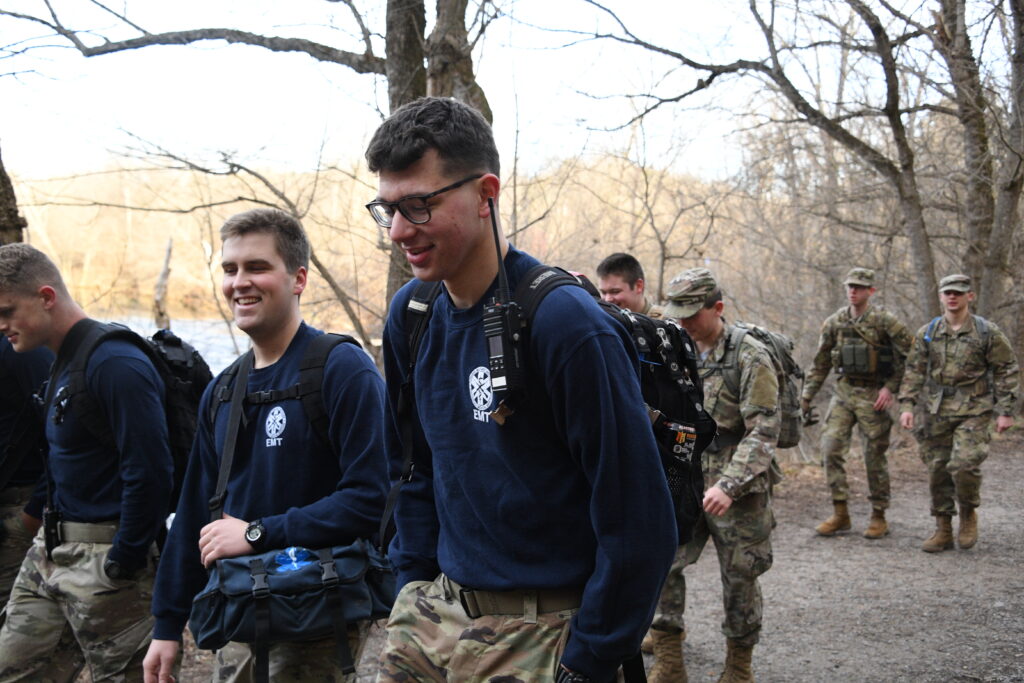
Cadet EMTs during the 20 mile march at VMI.

How the program works 

Training happens on post, but some come in with certifications they obtained while in high school, Carpino explained. In the spring, there’s usually an interest meeting that leads into the interview process. Then the list is made.  

During the first summer session, if accepted, they attend the certification classes. Those participating stay on post with free room and board and their meals paid for during the summer. In turn, cadets also receive three credit hours. The catch is, cadets then owe the program four semesters. 

“There’s quite a bit of money … getting that all done,” McBrayer said. “So we have people that we are able to depend on for those two years.” 

They have 24 slots open currently.  

“We try not to close the door on anybody,” Carpino said. “But at some point, you kind of have to. We always say that if you don’t get a chance to do it through us, there are plenty of other options they can do.” 

Not everyone who participates in the program are commissioning. Some graduate and end up working as emergency room doctors, some become police officers, others are firefighters/EMTs. 

“What we try to do is make sure they have a career when they leave here … that they are marketable,” McBrayer said.  

Where you’d see them 

The VMI cadet EMTs are at every VMI event.  

“During a football game, we have a whole EMS operation — besides the city ambulance — we have our cadet EMTs on that,” McBrayer said. “We have them throughout the stadium. If there’s a civilian that has an injury problem, or medical problem, we can be there for them, too. That’s a big thing of what we also do at every football game, every basketball game, we have one to two EMTs there, things like that.” 

Some EMTs are NCAA athletes. Others are part of cadet leadership during events, there has to be some juggling to make sure events are covered.  

There’s a rank system and an operation to be able to spread their resources around.  

“We have that chain of developing people that allows us to help and each company has entities attached to them,” Carpino said. “So anytime they do any event, they’re always there.”

The deputy chief makes the plan, the operations lieutenant is in charge of staffing. According to Carpino, it works as whoever is free signs up and they will staff certain things. 

“We also have people on guard 24/7, so it’s more like a standby thing,” he said. “There’s always the senior EMT that has the experience and we have the younger EMT there so they can learn and grow.” 

McBrayer said it’s a rewarding experience working with the cadet EMTs, especially knowing that the cadets will be leaving to do greater things in life.  

“That’s the most rewarding part … to see them find their career path and to be able to succeed,” he said. 

Carpino likes that you can see instant change in the work they’re doing.  

“The most rewarding calls are the ones when you get to make an immediate direct change in your brother rat’s darkest time, whether that be relieving pain or just being there emotionally for them,” he said.  

Female Cadets Participate in Physics Conference at Princeton

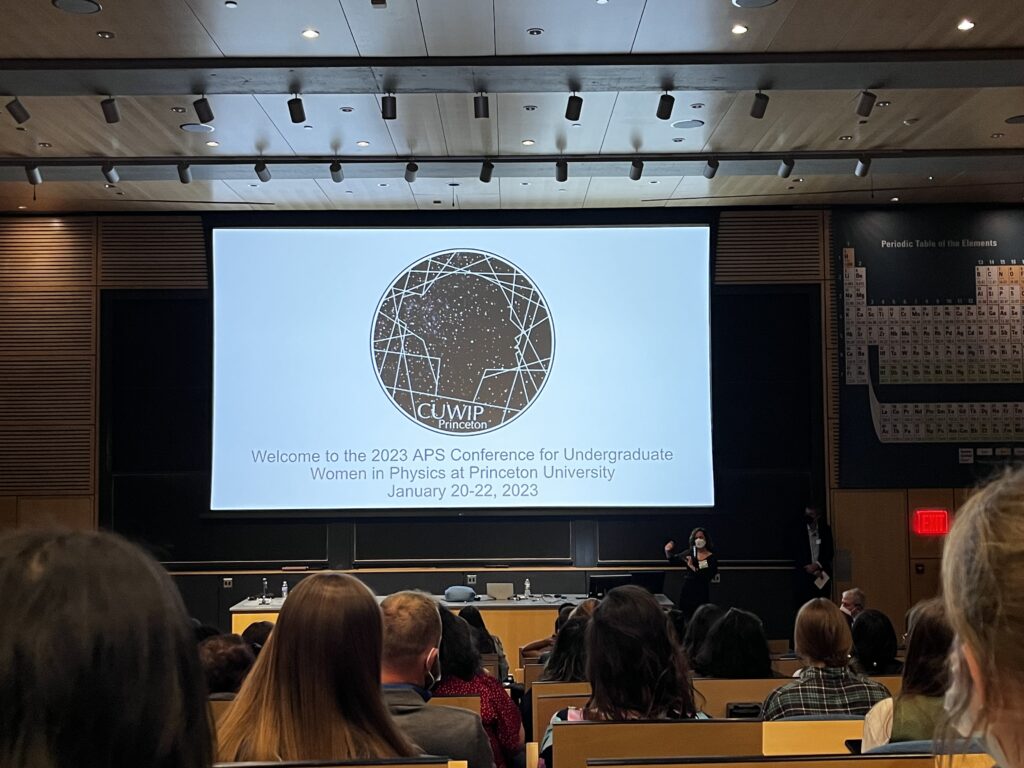
Four cadets participated in the Conference for Undergraduate Women in Physics at Princeton University in January. Grace Waters ‘23, Talli Tarring ‘24 (President for WiSE), Abby Fiorillo ‘25 (Vice President) and Angelina Garcia ‘25 were the four in attendance and are all members of the Women in Science and Engineering (WiSE) group at Virginia Military Institute.

Waters also presented her capstone research results, “Multi-wavelength Polarization Measurements of Be Stars,” that she worked on with Col. G. A. Topasna, VMI professor in the Department of Physics and Astronomy.

The conference was held Jan. 20 through 22. The cadets were sponsored by the American Physical Society to attend the conference, according Col. Daniela M. Topasna, VMI professor in the Department of Physics and Astronomy. Those interested applied through the American Physical Society platform in September and were notified in November of their acceptance.

Only undergraduates — mainly women — attend the conference, Topasna said.

“This gives them a community in which they feel comfortable to share and learn from experiences as a woman STEM major,” she said. “It is a great learning experience outside VMI’s comfort zone. For many, it is the first time they attend a professional conference. They have the opportunity to attend workshops and plenary talks and to hear from professors, researchers, and graduate students.”

The Conference for Undergraduate Women in Physics at Princeton University.

At the conference, cadets were able to hear from professional women about their career paths and life experiences; sharing how they overcame challenges and became successful. Topasna said she worked with cadets on their resumes, which proved helpful with the conference’s career fair where participants could learn about internships, graduate school, and career opportunities. It also provides good networking opportunities.

“Although the conference is sponsored by the physics society, undergraduates from other disciplines can and do attend; it emphasizes the interdisciplinary nature of STEM fields and of research,” Topasna said. “What else can be more inspiring?”

Waters said she attended because it was an opportunity to engage with others interested in STEM, but also a way to step out of her comfort zone. It allowed her to engage more than she has in the past.

“We had the freedom to learn and do wherever and whatever we wanted,” she said. “It emphasized physics and personal experiences, allowing me to see different perspectives on both subjects.”

Fiorillo, who is the vice president of VMI’s WiSE group, said with her being contracted to the Army, she wasn’t sure how beneficial the conference would be. She was pleasantly surprised.

“I met a professor from West Point who I connected with very well,” she said. “Since then, I have been in contact with her to try to obtain an internship in Alabama this summer, and I am very thankful I went to the conference because of this opportunity I now have.”

The WiSE group has been active at VMI since 2015 — when the women cadet population was only 10%, with even fewer studying in STEM fields. The group welcomes any women who are interested in STEM fields. According to Topasna, the group provides cadets with the opportunity to connect with other women in STEM, develop leadership skills, participate in professional events and increase the visibility of women in STEM through outreach activities like open house, recruiting and more.

“I am passionate about informing cadets and helping them explore the many opportunities that exist for undergraduates — being research, internships, workshops, and conferences, or graduate school and other career opportunities,” Topasna said. “I hope more cadets will participate in research, attend such conferences, and be active in professional groups and in their communities.”

VMI Cadets Train with Shaolin Kung Fu Master

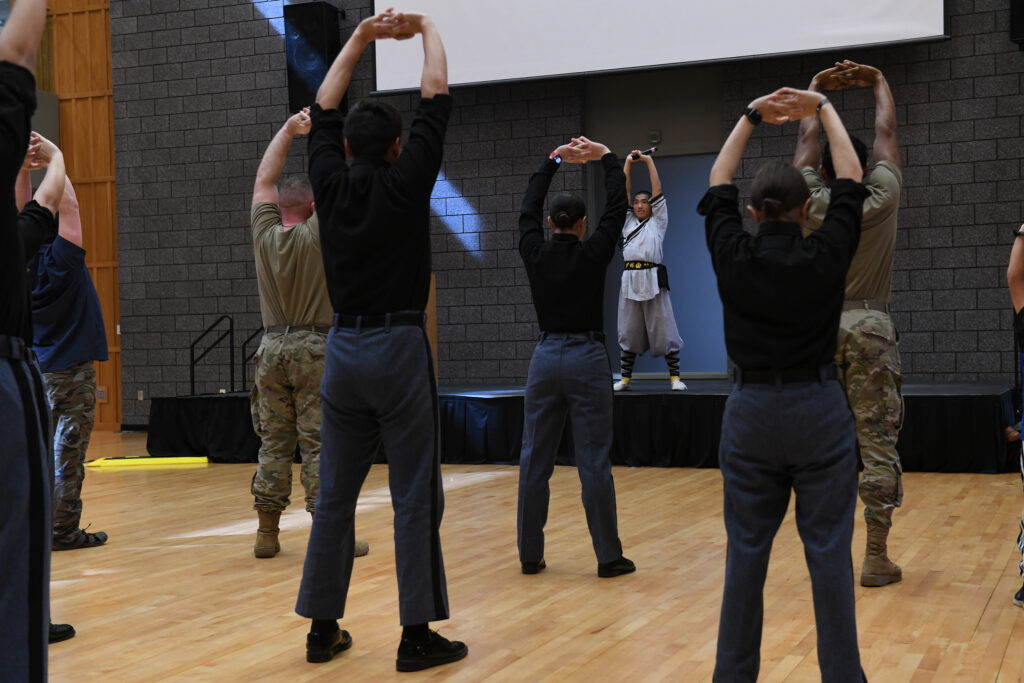
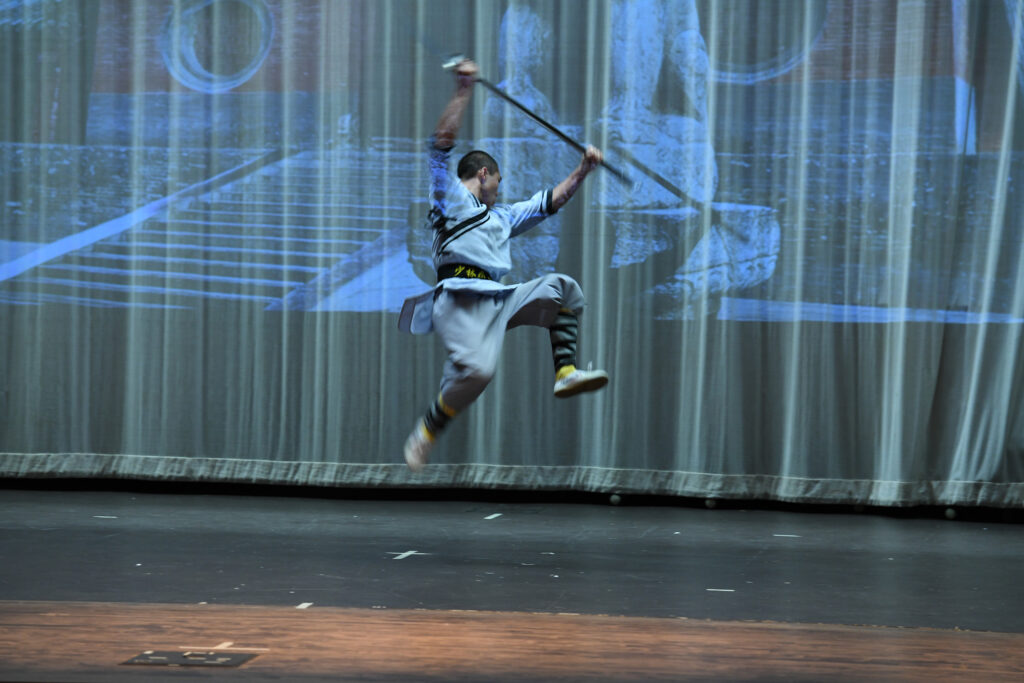
Virginia Military Institute welcomed kung fu master Heng Yue and his students from the Shaolin Temple Culture Center in Herndon Sunday, March 5 in Marshall Hall.

The martial arts group demonstrated kung fu moves and techniques with traditional martial arts weapons including the sword, staff, cane, and whip in Gillis Theater.

Following the demonstration, the master led an interactive workshop in the Hall of Valor.

Participants, including cadets, alumni, and community members, learned the basic moves of Shaolin kung fu, a distinct form of Chinese martial arts.       

-VMI-

The Extra Mile: Boxing Club

Aidan Simmons ’23 wraps his hands in black wraps before shoving them into a pair of gloves and heads towards the bag. Taking several warm-up swings, his breath is timed out with every jab.   

Simmons is one of the co-captains of Virginia Military Institute’s Boxing Club. 

After a hiatus due to COVID-19, the club — dubbed The Regulators — took to nationals last year sweeping the competition.  

The club, which offers participants the chance to compete in a variety of competitions, took 14 athletes to the United States Intercollegiate Boxing Association (USIBA) National Championships in Atlanta, Georgia, in March 2022. Five cadets donned championship belts and seven cadets received individual all-American honors, ultimately winning the national championship and all-American honors overall. 

“The fact that most of the team either got all-American status or national champion status is like a crazy feat … all the other teams were shocked,” said co-captain Walter Elias-Perez ’23. “The fact that we performed so well last year at nationals is really something only cadets could do. It was something that took a lot of time and discipline in order for us to actually get the results that we did.”

This year, they aim to do it again.  

Coming off the high of winning, Elias-Perez and Simmons said they are amped for the competition, which VMI is hosting at the end of March. 

Overcoming the club’s pause for the 2019-2020 and 2020-2021 academic years due to the coronavirus pandemic, the program was revamped in the summer of 2021, Simmons said. During the club’s break, coach Joe Shaffer also had to step back. By 2021, the team rallied to get him back and move forward. Shaffer coached a volunteer summer session in July 2021 and everything was back to normal by that September.  

“That’s when it got very serious again. We started prepping for nationals, training five days a week,” Simmons said.  

The two tried to downplay last year’s successes.   

“It was one of those things where it’s like we were very shocked to see our hard work and dedication actually pay off, especially since all these other schools had no breaks and they were way more financed,” Elias-Perez said. 

According to Shaffer, the boxing program dates back to the late 1800s on post. Shaffer started out as a volunteer assistant coach in 2009 and worked his way up. By 2017, he took over as head coach.  

Boxing and how they found it 

Simmons started boxing his senior year of high school. He wasn’t big into team sports and wanted something more disciplined — a theme reflected in much of his life, like choosing VMI as his school.  

“I liked being in an environment with people like myself, having the same mentality and discipline to actually show up for training and make it productive,” he said.  

Wanting to commission, he came to VMI. Then he found the boxing program.  

“I found it’s like 110% the closest group here at VMI, like a brotherhood within a brotherhood kind of,” he said.  

Elias-Perez has been boxing since he was a child. He would watch fights with his father growing up.  

“It was always something I thought was such an awesome thing to do. And I just wanted to really feel the experience of me being in a ring,” he said.  

He was committed to boxing for six years and then sometime in high school he gave wrestling a shot. Overall, boxing won out. He liked the camaraderie he felt with boxing; it resonated with him more.  

“I didn’t feel like I was alone in the ring. I had my family support and my friends,” he said. And that family grew once he came to VMI — his brother rats and his coach became his family.  

Practice and prep 

The club practices three days a week. Tuesdays are cardio workouts — 30-minute stair run, jump roping, and then into technical sparring. Tuesdays aren’t at 100%, they said. Wednesdays are circuit workouts — a station for every person at practice. Thursdays are dedicated to hard sparring.  

As they get closer to competitions, like nationals, the club tries to spend as much time in the gym as possible.  

“On our off time we’re still practicing. We have to do a certain amount of runs. We aim for about 50 miles a week, so you’re expected to do runs on your off time,” Simmons said. “A lot of us will do bag work in the gym in our free time as well, for one to two hours a day. So when we say it’s three days a week, it’s not truly three days.” 

At some points in the season, they’re training six to 10 hours a week, Simmons said.  

The team takes a certain mental commitment, the two captains said.  

“Most people at first don’t want to do it … they don’t want to fight,” Elias-Perez said. “But then they see other people fighting and they’re like, ‘Man, that looks kind of fun.’” 

Once they get into and start fighting, they’re hooked.  

“They get into it, come out with a bloody nose or something and they’re like, ‘I love this, I want to do this again,’” Elias-Perez said.  

Right now, the club has about a dozen athletes looking to compete at nationals. That number could grow, though. Tryouts are still ongoing.  

“We’re looking for consistency in the gym and dedication if they can listen to Coach or not,” Simmons said. “So we plan on growing that prior to nationals.” 

According to Shaffer, some cadets are part of the club for solely the workouts and don’t travel for bouts. 

“Every cadet is welcome to the gym and they can try out for the competitive team,” he said. “The most rewarding part of coaching boxing at VMI is seeing the cadets develop true confidence while developing and maintaining a humble outlook in all aspects of the program that translates into success in life after post.” 

For the cadets, the most rewarding part is showing their coach their capabilities. They sacrificed spring break to train last year, and Simmons pointed out that Shaffer gave up time from his full-time job to do the extra sessions.  

“Everyone gave everything they had out there and then seeing the smile on Coach’s face when he got the trophy and the belt … he had been putting in just as much effort and sacrificing countless hours from his full-time job losing money to come out and make sure that we could train.” 

The Extra Mile: Combat Shooting Team

For cadets at Virginia Military Institute, joining an extracurricular club offers opportunities to explore interests, master new skills, and engage with others. The combat shooting club team, currently consisting of 13 cadets, meets every Tuesday and Thursday at a location known as “the barn” at North Post. At 6 p.m., these cadets meet with their coach, whom they refer to as “Gunner,” and prepare for practice.  

Braden Kerr ’23 is the cadet in charge (CIC) of the team. “To become a member of the team, cadets must try out. The team is interested in recruiting accurate shooters; however, we are more interested in pursuing team members with strong character. We only take 4th Classmen because we expect them to be on the team the entire time they are at VMI, receiving four years of training before they graduate,” he said. 

Aside from traditional team practices, cadets can compete and gain certifications. Each year, the combat shooting team travels to New Hampshire where they participate in a shooting competition called “Relentless Warrior Championship,” a six-hour shooting challenge where the team competes against schools from across the country. “We compete against other service academies like West Point, the Naval Academy, the Air Force Academy, the Coast Guard, as well as other senior military colleges like the Citadel and Texas A&M,” said Kerr.  

When cadets join the club, they begin membership with basic NRA pistol training. As 3rd Class cadets, they participate in basic NRA rifle training. As members progress in school, they receive more training. “Going into your 2nd Class year you become an NRA range safety officer. Then going into your 1st Class year, you become an NRA instructor, and teach 4th Class cadets NRA pistol,” said Kerr.  

When asked about their favorite aspect of the combat shooting team, both Kerr and Garrett Kelenske ’24, assistant CIC shared that the people are the best part. “There’s just something about every Tuesday and Thursday. Going to North Post, the range, and you see all the guys. When we’re shooting, it’s very serious, but we also enjoy our time just talking and interacting with each other,” said Kelenske. 

All 4th Class cadets are encouraged to try out for the team this spring. “I think we have a great group of members, and I hope to see it grow,” said Kerr.  

‘Finding a Calling’ Forum Shines Light on the Joy of Teaching From Two Alumni

Annika Tice always wanted to be a teacher. Spending time in her grandmother’s classroom growing up, she would play pretend school with her siblings. The small act of pretending blossomed into her love for the selfless service of education and impacting generations to come.

“I hope to teach in order to build a foundation towards working in higher administration,” she said. “I want to be a leader of change in our education systems.”

Tice was one of two speakers for Virginia Military Institute’s Department of English, Rhetoric, and Humanistic Studies (ERHS) Alumni Forum, “Finding a Calling” held Feb. 20 in Scott Shipp Hall. Tice, a 2019 VMI graduate, was joined by Joseph Murray, VMI Class of 2021, to speak to cadets on how they discovered the joy of teaching.

ERHS’ forum showcased the discoveries and decisions of two English graduates, who found their major gave them flexible and enduring skills, and courage to discover callings in and out of the military, educating various populations. As Tice and Murray expressed, life after VMI can feel incredibly open with possibility, brimming with choices. The transition is exciting, but it can also overwhelm, unless one listens to and pursues what calls them.

In recent years, the ERHS department has invited English alumni back to share careers in the military, business, education, and communications. They discovered the best attended forums featured newer graduates who pursued diverse fields and callings. Continuing that success, their newest series, ‘Finding A Calling’ offers current students a glimpse of life after VMI in teaching, law and other fields. As forum co-planner Lt. Col. Mary “Polly” Stewart Atwell, associate professor in the Department of English, Rhetoric, and Humanistic Studies, notes, “VMI’s enthusiastic and engaged alumni are one of the Institute’s greatest resources. These forums give us the opportunity to showcase our department’s strengths and connect current cadets with alumni in their fields.”

Tice and Murray both discovered their interest in education through their forays in ERHS Fieldwork courses, and in their Honors Projects — Tice in language, educational theory and practice, and Murray in philosophy. They made, and continue to make their own success after VMI, offering current students not just career models, but an attitude towards shaping interesting paths that bring meaning, even reward surprises in their lives ahead.

Tice, who completed a Fulbright Teaching Assistantship teaching English in Africa’s Ivory Coast, went on to four years active duty as an Adjutant General Officer for the Army at Fort Jackson, South Carolina, while completing a M.Ed from University of Virginia’s Curry School of Education. This June she starts a teaching residency in California’s High Desert region with Alder Graduate School of Education, which will earn her another M.A. to teach multiple subject disciplines in K-6.

She said it’s important for cadets to hear from alumni in order to build a network between the VMI community — both past, present and future.

“To this day, VMI still impacts my life and literally has changed the course of my future for the better,” she said. “I wouldn’t be who I am today without the never-ending support and connections along the way.”

While at VMI, Tice worked four on-post jobs, completed double Honors in English and French, and was the first woman to serve as an officer on the Honor Court. Tice chose VMI because she craved structure and discipline, but also saw it as a challenge. She hopes her discussion of her experiences, like the Fulbright, the Army, and VMI will help shed some light for cadets on charting a path after graduation.

“I am hoping to be candid and answer any questions that cadets may have. I am bringing my most vulnerable self,” she said. “The truth is that I am no expert in my field, but I am a lifelong learner. I hope the audience can appreciate this message on life.”

Murray graduated from VMI with a B.A. in English with concentrations in philosophy, literary studies, and writing and rhetoric. He served as Regimental Executive Officer of the Corps of Cadets, participating in the VMI Newman Club, and presented his honors thesis on Aristotelian and Thomistic philosophy. After graduating, he began working as a high school English teacher at Riverside Academy, a preparatory boarding school in Georgia. He is currently applying to doctoral programs in philosophy for next year.

“Every experience, from participating in the ratline to planning the ratline to presenting my honors thesis, was deeply formative,” he said. “Aside from my work on the ratline and in barracks, the ERHS department at VMI influenced me deeply, and I would not have enjoyed my time at VMI nor embarked on the path I am on if it were not for the excellent curriculum provided to English majors. My professors in the ERHS department continue to inspire and guide me in my career.”

Originally, Murray came to VMI seeking to commission in the Marine Corps, but ended up pursuing education and academia.

“Teaching was the logical next step for me, and it has been an extremely formative and rewarding experience,” he said. “I highly recommend education as a field for cadets who desire to follow their love of learning and hone the skills of leadership and mentorship they learn at VMI.”

He hopes his discussion on taking the road less traveled will inspire other cadets to explore their options outside of VMI, which are endless. “The education and experience at VMI is valuable for reasons other than military training”, he said.

“The ‘varied works of civil life’ for which cadets are prepared — according to the VMI Mission — are not confined to a single profession or skillset, they represent the ocean of possibilities that are open to cadets as VMI men and women,” he said. “Wherever they go, whether or not it involves military service, cadets are equipped with the tools to excel.”

VMI Hosts Middle School Math Day

Middle School Math Day was held Feb. 16 at Virginia Military Institute’s Marshall Hall.

Area middle and high school students have been participating in mathematics events hosted by VMI’s Department of Applied Mathematics since 2013. The middle school events have proved to be most popular, drawing up to 600 students each year. At each event, students take a test as part of a national mathematics contest, listen to an engaging talk on math and science from VMI faculty, and take a cadet-led tour of post.

During the pandemic, the events were put on pause, which provided the opportunity to reevaluate the program’s interactions with area students. With the reevaluation, it was seen that high school events were still hitting the mark, as the national math test was challenging and at the appropriate level for the students who came. The program saw the middle school events, although popular, could see improvement.

Instead of reinforcing negative views of mathematics, the department chose to revamp the competition portion of the middle school event. Relying on the expertise of their faculty, and in consultation with area middle school math teachers, a new competition focusing on “mathematical modeling” was created.

At Middle School Math Day, students were given one question to answer: “How many people are streaming video right now?” They were also given data about the population of the world, time zones, internet access, and more. Students were not judged by whether or not they get the right answer; rather, they were judged by their process of determining an answer. While the old math competition relied on individual mathematical problem-solving skills, the new competition is team-based making it more accessible to everyone and allows for more creativity.

The room was full of energy as students worked through their solutions, later creating a PowerPoint presentation explaining their work, then shared their findings with students from other schools.

When asked about their favorite part of the day, participants referenced the satisfaction of completing the challenge, being able to present to their peers, and generally having fun at the event. One teacher even remarked to VMI faculty how for the first time she had students rushing to her afterwards to share their answers, something that had not happened with the previous testing format.