Post View Unavailable »
New Website Launched »

The Extra Mile: Cyber Club

Cadet John Barker ’23 wasn’t big on socializing in middle and high school. He found that interacting with computers was what made him comfortable. You’d never guess that now. Barker is well spoken, engaging and Virginia Military Institute’s Cyber Club cadet in charge, among other things.  

“Computers are a lot easier to interact with,” he said. “I did that for a little while and then I guess I became more comfortable with people, and the more comfortable with people I got, the more interested I became, in not just the being technical part, but being in an organization and trying to develop an organization that does more technical things for other people.” 

VMI’s Cyber Club boasts 104 members, making it one of the largest club organizations on post. And it hasn’t been around for long — it started in 2017. 

According to Barker, this year the Cyber Club has gone through a more specific change. The club has partnered with a number of companies and organizations in order to provide different opportunities for its members. That includes professional networking, certification training, off-post activities like capture the flag competitions, paid opportunities, and expanded leadership opportunities.

“I believe that Cyber Club is really just what the people make it,” said Joey Flynn ’25. He said the leaders and the cadets in charge really get people involved. “You fall in love with it. It’s what really pushes it to grow and develop.” 

The big activity they do as a club is capture the flag (CTF) competitions. The club doesn’t capture a physical flag. Instead, it’s a hacking competition between the club and other schools. At these competitions, the schools are given a data set and you are equipped with tools made by other people that you use to capture the theoretical flag.  

VMI’s Cyber Club spearheads about three of these competitions a year — the big one coming up in April, which is the NSA Cyber Exercise. To prepare, it depends on a variety of factors, Barker said. 

“It depends on what the CTF is, how big it is, and then what people like to do,” he said. “It’s a whole wide variety of things. Whether that’s looking at the website and breaking it or whether it’s looking at a database and trying to break it.” 

Those in the club can use their experience outside of VMI. The club allows for them to get certifications and training — many of which are free to the club or at a discounted price due to the club’s involvement with different organizations. One of those is TestOut Corporation, which provides professional grade certifications, which gives the club 50% off certifications. To offset the other costs, VMI’s Cyber Defense Lab has agreed to pay for any club member to get a certification for free, if the cadet gets three free mini certifications from the Cisco Networking Academy. It’s important to get some of these like certifications because it’ll help club members in the job market in the future. 

Barker, a computer science major, said he hopes club members are building valuable networks. 

Many just found themselves in the club. For Flynn, he got involved as a 4th Class cadet in 2021.  

“I never touched a computer, anything that in any way that mattered besides (Microsoft) Word until I got to college and I decided to be a computer science major,” Flynn said. “I just wanted to be the best in my field that I could, and the Cyber Club is just like giving me the opportunity to do that.” 

Flynn said he’s using the club to his advantage by establishing as many connections as possible through the club events.  

“I just want to expand my knowledge, my base knowledge,” he said. “You need to be able to adapt. That type of knowledge is what we learn in Cyber Club, and I think that helps a lot in the future.” 

The club isn’t heavily funded, which in turn creates some blocks in certain opportunities, Barker said. The club has to travel to places for several days, so it’s a challenge to get off post and find transportation.  

“CTF next year, for example, it’s hosted at the NSA, or it’s hosted at Virginia Tech, or it’s hosted in Langley, Virginia. These fantastic places that are impossible to get off post,” Barker said. “It’s a two-day event and you have one day for travel and one day to come back. You’re looking at a four-day permit. And anybody that looks at that balks at it very quickly. So you lose that networking opportunity.” 
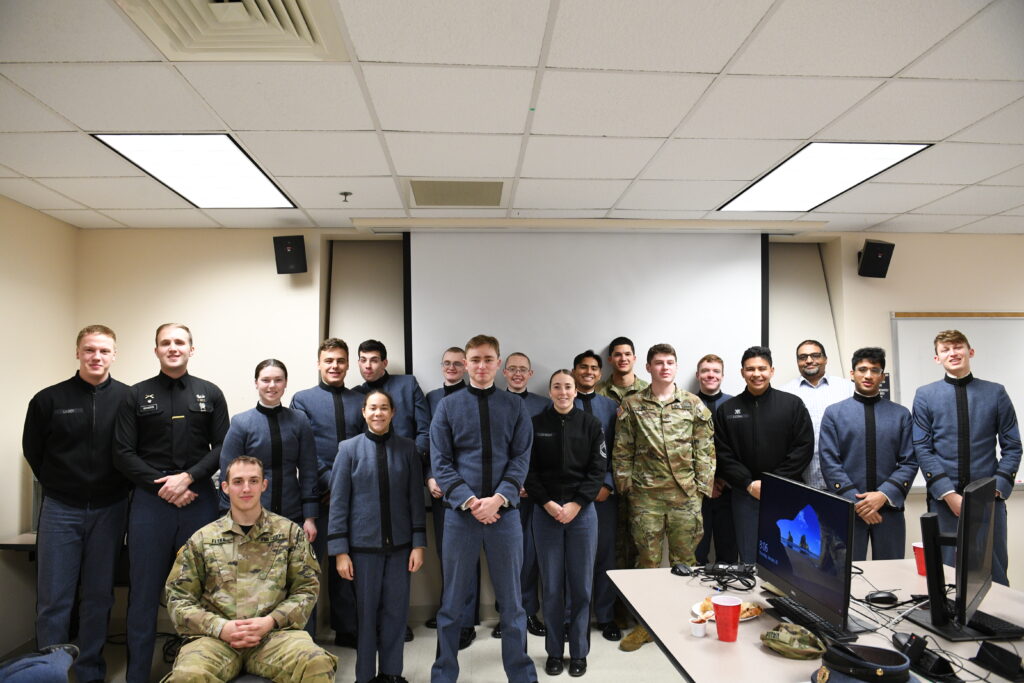
The cyber club at VMI inside a classroom.

Amish Parikh, IT specialist and systems engineer in VMI’s Cyber Defense Lab, is the CTF coach for the Cyber Club and a mentor and instructor to the Cyber Captains within Cyber Club. He said he loves working with cadets because of their professionality and their desire to learn and enact educational experiences into their lives.  

“The cadets are always looking for opportunities to gain further knowledge at VMI and after VMI in the direction that they will be heading into whether it be for government or private sectors,” he said.  

Parikh said the club is important especially due to the need for cybersecurity. The club presents real world cyber situations and develops a strong contingent of confident cyber members to society.  

Cyber Club is taking our citizen soldiers to becoming cyber citizen soldiers with the knowledge and know-how to protect and defend our personal data into the future,” he said. “Cyber is a growing space with that in mind the Cyber Defense Laboratory is training cyber captains and Cyber Club members to expand their horizons into AI machine learning, robotics, autonomous technologies, cyber teams, and application/web development where we can provide cadets of all calibers both in STEM and non-STEM programs to learn about cybersecurity in a multitude of directions.” 

Cyber Club meets on Thursdays at 8 p.m. in Mallory Hall. 
VMI Cadet Researches Physical Fitness Motivation

Philip Argauer ’23, an electrical and computer engineering major with a mathematics minor at Virginia Military Institute, is very interested in fitness and training. He conducted a year-long research project on cadet motivation with physical fitness and presented his findings in his senior thesis titled, “Increased Physical Fitness With Volt” during Honors Week, held March 20-28.

“Physical fitness and ROTC (Reserve Officers’ Training Corps) training are very important and crucial parts of the VMI experience,” opened Argauer. He referenced the VMI three-legged stool, and the aspects of VMI represented by the three legs: physical training, military, and academics. “Two thirds of the stool is actually applicable to this honors thesis, since fifty percent of the cadets will commission into the military, and they all have to pass physical assessments each semester.” Student presenting at Honors Week at VMI, a military college in Virginia

In conducting research in the usefulness of physical fitness apps for mobile phones, Argauer referenced a study done in Finland in which teenagers were told they were getting fitness technology, and to download a certain app. They were not told that they had to use it, nor how to use it. The study centered on the effects of self-efficacy, the belief or thought process that what you do will actually change the outcome. What the study found is that intervention through the fitness technology app, strengthened the relationship between self-efficacy and the intention of becoming more physically fit.

Argauer’s thesis question is: Does the Volt athletics app increase the Air Force ROTC cadet exercise frequency versus non-Volt using cadets? Does Volt alter perceived benefits and barriers to exercise among Air Force ROTC cadets? What is the impact of Volt on physical fitness test scores and body composition?

He provided the app to 24 Air Force ROTC cadets, randomly placed them into test and control age-matched groups, conducting pre- and post-work-out tests, and tracked all physical training for 12 weeks during the fall semester. He collected and analyzed hundreds of exercise logs from the cadets. He found that, while the app may aid with personal workout goals for the cadets, it was not a useful tool for the pre-set ROTC physical rigors.

Maj. Daniel Baur, assistant professor in the Department of Human Performance and Wellness, and Argauer’s advisor on the project said, “In our continuing efforts to improve the training and long-term impact of VMI’s physical program, Argauer’s study provides valuable information as to current cadet exercise habits and attitudes. It is clear from his work that cadets value fitness, but more work needs to be done to determine the best ways VMI can support them.”

Argauer is from Vienna, Virginia, where he was homeschooled. He is the son of Betsy and Tim Argauer. He is vice president for investigation on the Honor Court, he is 3rd Battalion commander, president of Tau Beta Pi, president of Eta Kapp Nu, and IEEE chapter chair. After graduation, he will commission into the Air Force where he will fly helicopters.

Baseball Opening Day Welcomed with Event in Crozet

To celebrate the opening day of the Major League Baseball season, several employees joined forces to plan and produce a hot dog bar in Crozet Hall. As a fan of the MLB and ballpark fare, Tracy Hiner, Parkhurst Dining general manager at VMI, worked with a team to produce a new experience for cadets.

 ”A little over a month ago, Keith [Ashley] mentioned the idea of a hot dog bar for the opening of baseball season,” said Hiner. “As a fan of both, I said ‘Let’s do it!’ “

The idea was spurred by Keith Ashley, director of operations for Parkhurst Dining at the Institute, and he was the primary force in planning the event. Hiner shared that Ashley wrote the menu, which included hot dogs from all regions, ordered decorations, and turned the items over to Mamie Trussell, supervisor, for the final touches.

“While I may have supplied the idea to celebrate the opening of baseball season, it was a collaborative effort from Mamie Trussel, supervisor, Brad Hamilton, executive sous chef, and their staff,” said Ashley.

At the event, cadets walked through an assembly line to create all different kinds of hot dogs. If cadets did not want to create their own, the team created a menu of several different hot dogs to guide them through the process. The menu included a Cincinnati style dog, West Virginia slaw dog, Texas style dog, Coney Island dog, and many others.

“A list of hot dog recipes was provided for fan favorites like Kansas City, Chicago, Coney Island style, and some unfamiliar combinations like the ‘Classy Lady,’ featuring crushed potato chips and cheese sauce,” he said.

Aside from hot dogs, cadets had their choice of side items, and finished off the meal with baseball themed cupcakes. The event was topped off with baseball themed tablecloths and balloons.

“I certainly see this as a tradition moving forward,” said Hiner. 

Parkhurst employees are continuously looking for ways to boost morale, and they are hopeful that this event will return for years to come. “Despite the extra work, a change-up event such as this is worth it,” said Ashley. “Bringing change to our routine, and cadets, may provide a bit of joy to a cadet’s day.”

VMI Cadet Strives to Comfort Parents of Hearing Impaired Children

New parents have hopes and dreams their newborn will be happy and healthy. All too often though, infants are born with some type of impairment, and the parents are devastated and confused, and are unsure where to turn for support.

Binh Tran ’23, an electrical and computer engineering major at Virginia Military Institute, is working to help parents of children with hearing impairments, and presented his research in his senior thesis titled, “C# Frequency Sampling-Based FIR Filter Design” during Honors Week, held March 20-28. Student giving honors presentation at VMI, a military college in Virginia

The ultimate goal of this multi-student project is to develop an app to help parents of hearing impaired children perceive the same sense of hearing that their children hear. The app will be easily accessible and free to all who need it. The research project will span a period of six years. Tran has personally worked on it for the first three years, and a second Institute Honors scholar will continue the research next year.

Using complex mathematical formulas, Tran has developed an open-source filter that can take any arbitrary sound and modify it as dictated by any person’s unique audiogram. The audiogram describes the person’s ability to hear sounds at different volumes and frequencies. While this ability has been available for years to researchers using expensive software such as MATLAB and proprietary audiology hardware, Tran’s contribution is to create it as an open-source project, so anyone may incorporate it into their projects for free.

Tran will present his thesis work as a technical paper at the Institute of Electrical and Electronics Engineers (IEEE) SoutheastCon 2023 in April in Orlando, Florida. It is the IEEE’s annual conference for both undergraduates and professionals in the Southeast. His paper has already been peer reviewed by three professors of electrical engineering and found worthy of being published as a full-length technical conference proceeding in the professional division.

Col. James Squire, professor of engineering and Tran’s advisor said, “Many people know Binh for being a very successful cadet, whether as Regimental S2 captain, or Air Force ROTC cadet wing commander, or for publishing graduate school level engineering papers. But what distinguishes him is that he can do all these things while remaining humble. Leaders can be the brash Pattons, but they can also be the quiet, thoughtful MacArthurs.”

Col. Nichole Scott, commander of the Air Force ROTC at VMI said, “Tran is our Delta Commander this semester, and has enabled the detachment to be successful and exceed the required training objectives. He regularly demonstrates excellent leadership and followership traits in his daily interactions. He believes in building coalitions and promotes teamwork to get the mission accomplished. His work ethic is phenomenal, and he will continue to be successful as a 2nd lieutenant in the United States Space Force!”

Tran has begun transitioning with a 3rd Class cadet who will spend three years further developing the program, and will work with an audiologist in the Virginia School for the Deaf and the Blind to make the application available to audiologists throughout the country.

Tran is from Ashburn, Virginia, and attended Riverside High School in Leesburg. He is the son of Man Tran and Bich Nguyen. He is the Delta Commander in the Air Force ROTC and has served as an academic staff (S2) captain, group president for the Cadet Investment Group, financial officer for the Arnold Air Society, vice-president for Eta Kappa Nu, secretary for IEEE, and a member of Tau Beta Pi, and Omicron Delta Kappa. After graduation, he will commission into the U.S. Space Force as a developmental engineer.

Dyslexic Cadet Focuses Research on ADHD and Dyslexia for Honors Week Presentation

“Good afternoon. I am a 1st Class cadet here at VMI, and I have dyslexia.” That is how Claire Curtis ’23, a biology major at Virginia Military Institute, began her senior thesis titled, “Learning Differences at VMI” during Honors Week, held March 20-28.   

To a captivated audience, Curtis shared that the U.S. Department of Education defines a learning difference as being “A disorder in one or more of the basic psychological processes involved in understanding or in using language, spoken or written, which may manifest itself in an imperfect ability to listen, speak, read, write, spell, or to do mathematical calculations.”

Curtis then focused her discussion on two fairly common learning differences: ADHD, a neuropsychological disorder characterized by hyperactivity, inattention, and impulsiveness; and dyslexia, a neuropsychological disorder personal to Curtis, and characterized by issues in reading, writing, and understanding written language, and affects 20% of the population. She postulated that because the two are the most prevalent learning disorders, there may be a number of students with one or both at VMI. 

Curtis shared that her parents believed her capable of reading at the age of four, but she had only memorized the story books that her parents had read to her. They became aware of a problem when she was off by a page, but told the story verbatim. She was officially diagnosed with dyslexia when she was in 3rd grade. However, she is considered to be a twice-exceptional learner, that is a student who has both a high cognitive ability and who has a learning disorder, which is why she is an honors student at an exceptionally challenging senior military college. 

Curtis cited federal and state laws currently in place that prohibit discrimination, and allow accommodations for students with learning differences. She examined several colleges and universities in Virginia, such as George Mason University, James Madison University, Randolph-Macon College, University of Virginia, Virginia Tech, and Virginia Commonwealth University, who all offer between three to six different accommodations. But according to Curtis, using accommodations for learning differences disqualifies one from enlisting or commissioning, as well as attending a military college.

“VMI’s accommodations include assistive technology, priority registration, extra time on tests, a separate testing location, and academic assistance. I compared those accommodations to what is offered at the Citadel, a college very similar to VMI. Their accommodations include learning assistance, a test-taking center, assistive technology, peer note-takers as well as note-taking alternatives, and priority registration. Like VMI though, they cannot accommodate those who are commissioning,” she explained. 

Curtis spent much of the year researching, reviewing, and interpreting brain scans, and seeking best practices at places of higher education with regard to learning differences. She sought to educate and advocate, and identified ways to further support VMI cadets with learning differences, including additional funding for programs and support staff.  

Maj. Molly Kent, assistant professor in the Department of Biology and Curtis’ advisor stated, “Claire approaches material and data differently than many in the sciences, but her unique perspective and voice have been educational for me. I have learned so much from Claire’s project and hard work over the past several semesters. I can’t wait to see what she does next.” 

Lt. Col. Sara Whipple, assistant professor in the Department of Psychology said, “I’m impressed with the breadth of information Claire has covered, from the neuroscience of dyslexia and ADHD, to federal and state policies, down to an analysis of services and accommodations that a variety of colleges offer. Advising her on this project allowed me to recognize ways I could improve inclusivity and accessibility in my own classrooms.”  

Curtis is from Louisville, Kentucky, where she attended high school at Presentation Academy. She is the daughter of Diane and Brian Curtis. Her minors are history and chemistry. She is part of the Institute Scholar program, an S7 lieutenant, works as a cadet assistant athletic trainer, serves as an EMS member, is a member of the Cadet Superintendent’s Advisory Board, and plays volleyball. After graduation, she hopes to commission into the military and attend medical school.   

Guns for Hire: Honors Research Explores Use of Private Military Companies

“Is there a pattern in behavior of states that use Private Military Companies (PMC) as military providers?” asked Nick Schaefer ’23, an international studies major, minoring in national security at Virginia Military Institute, in his senior thesis titled, “Picking up the Slack: Why Non-Democratic Regimes Rely on Private Military Companies to Fight Their Wars” during Honors Week, held March 20-28.

Schaefer stated that if a state’s military organizational practices are good, they will have a good military, and if they are bad, they will have a bad military, either by accident, or by design. Non-democratic regimes, personalistic regimes (one person holds all the power), and military dictatorships, all who have increased threats of a violent coup followed by a violent transition of power, instill measures to prevent a coup from taking place, which is called “coup proofing.” They purposefully maintain a poor state military incapable of pulling off a coup. “Enter the PMCs,” declared Schaefer. He continued, “PMCs are private entities with resources and power to provide various military services such as logistics and support, advising and training, and fighting on the frontlines. PMCs can be employed by an independent third party or by the state government.” Student presenting during Honors Week at VMI, a military college in Virginia

Schaefer hypothesized that is if a state engages in military organizational practices that are harmful to its military, it will use PMCs in combat operations. Two case studies he discussed were Russia, a non-democratic regime, who has hired the Wagner Group to engage directly in combat in the war in Ukraine; and Mexico, a democratic state, who only uses PMCs in non-combat support roles in their battle against the drug cartels.

Schaefer concluded his presentation stating that states that have poor military organizational practices are more likely to hire PMCs for combat operations, while states with effective military organizational practices may employ PMCs, but relegate them to roles away from combat, such as logistical operations, and advising and protective details. “These findings can be used to better understand our next war. Understanding how our enemy may fight will give us an opportunity to better prepare for it.”

Col. Spencer Bakich, professor of international studies and Schaefer’s advisor said, “This thesis looks at a fascinating question—one that hasn’t yet been examined in the security studies literature. Schaefer’s work strongly suggests that regimes that have systematically weakened their military organizations (either intentionally or not), will have need for PMCs in a fighting role.  On the other hand, states that have strong, professional military organizations lack this need, and use PMCs in strictly support and training capacities.  Schaefer has done fantastic work on this project over two years.  It is wonderful to see this project culminate.”

Schaefer is from Leesburg, Virginia, where he attended Loudoun County High School. He is the son of Caroline and David Schaefer. He is a VMI EMT, a cyber captain, and a member of the military skills club. After graduation, he will commission into the U.S. Army as an infantry officer with a military intelligence branch detail.

VMI Boxing took to the ring for the USIBA 2023 National Tournament March 23 through 25 bringing home several accolades — for their sporting and academic endeavors.

Valor Boyd ’24 was named champion in his division and Male Boxer of the Tournament. Aiden Simmons ’23 claimed the champion title in his division, and coach Joe Shafer was named Coach of the Tournament.

College athletics are about more than just success on the field, on the court, or in the ring. They teach important life lessons about teamwork, perseverance, and time management.

The two cadets — along with a third from the club sport — were recognized for their achievements in balancing athletics and academics. Jackson Miller ’24 and Boyd were named USIBA Academic All Americans and Simmons received the Ira Mitzner Collegiate Boxing Scholarship.

The Academic All Americans was actually suggested by Miller’s father to reflect superior boxing skills and academic performance. Gold is awarded to those with a GPA of 3.8 to 4.0; silver with a GPA of 3.60 to 3.79; and bronze with a GPA of 3.4 to 3.59.

Miller is in VMI’s Institute Honors program, an English major, from Rockville, Maryland and was awarded the Academic All American gold. He is working as a neurosurgery research assistant this summer at Johns Hopkins University Medical School.

“Boxing teaches me how to problem-solve under pressure, which is an invaluable skill that has helped me in a lot of other areas of my life,” he said.

Boyd is an international studies major from Dallas, Texas. He was awarded the Academic All American silver.

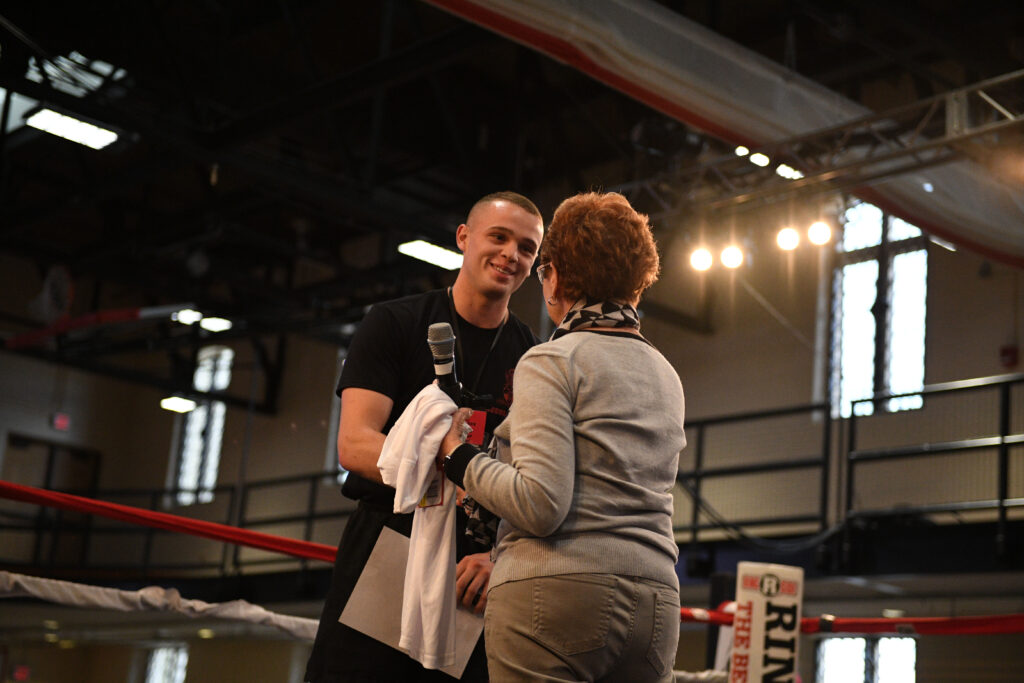
VMI boxer accepts award in the ring.

“The demands, challenges, and iterated trials of college boxing have propelled every facet of my development as an individual,” he said. “Before even getting to the point of taking advantage of access to incredible opportunities I never would have seen without USIBA, I have had to increase my affinity for time management, capacity for personal discipline, continually develop my athleticism, increase mental and physical resilience, and generally strengthen my character in order to keep up with the greatly increased load on my person and already near maxed-out VMI schedule. For me, college boxing has meant an unparalleled boon in my ongoing pursuit of excellence.”

Simmons was one of two people who received the Ira Mitzner Collegiate Boxing Scholarship, which was established to allow a student, who demonstrates the same love and dedication to the sport of boxing, to pursue an education and enable them to develop the character needed to be as successful as Ira was in both school and on the stage of life. Simmons, from Aldie, is an international studies major who also serves as U.S. Coast Guard AUP unit commander at VMI.

Student athletes apply for the $2,500 scholarship by having a GPA higher than 2.5, multiple recommendations, being registered with USIBA and registered with the national tournament and more.

Rachel Mitzner, Ira’s widow, said her husband took up boxing at the age of 50. When he passed, to honor him, she said she wanted to give a scholarship to a boxing organization and to a young person, because Ira loved to mentor young students. 

Additional event photos are now available on VMI’s Flickr account.

The Extra Mile: Brazilian Jiu-Jitsu Club

Cadet Audrianna Kelly ’25 had never heard of jiu-jitsu prior to coming to Virginia Military Institute. Previously doing martial arts, kung fu, karate, and wrestling, she was looking for a way to stay active while on post.  

That’s when she found VMI’s Brazilian Jiu-Jitsu (BJJ) Club as a rat. She aspired to get physically stronger and find more ways to defend herself to help aid her in her future military career.  

“As soon as I got the list of clubs that were available, and I saw Brazilian jiu-jitsu I was immediately intrigued,” she said. 

Jiu-jitsu is a grappling-based martial art and combative sport, which uses skill and control to resist opponents. It also serves as a form of self-defense. 

Kelly is one of the few females in the club. Out of the nearly 50 people in the club, only five are female. 

“I think that being one of the few females in the club is cool because it goes along with the saying, ‘Women can do anything a man can do, but in heels,’” she said. 

Sparring with guys doesn’t bother her, because they’re all there to learn martial arts and to become strong. But she’s noticed some guys don’t want to spar with the girls.  

“I guess because most of them are either physically bigger than us or more skilled, and they don’t want to hurt us. I don’t like that thought process because, while it is sometimes true, it leads to a clear line that separates the guys and girls of the club that is ultimately putting a damper on our training,” she said. “When guys don’t want to spar with girls, it leaves us girls to spar with each other and there is no variety, no change. Overall, I don’t mind when I spar with guys or girls.” 

Coach Col. Paul R. Moosman, Jr. started BJJ because of his wife, Deanne, who happens to be the assistant coach for the club.  

“I got into jiu-jitsu because I needed to learn how to protect myself against my wife who was also learning,” he said. “And I think we both got into coaching because we got connected with the club early on.” 

“Paul felt like he couldn’t just let me do jiu-jitsu and beat him up, so he started to take jiu-jitsu classes with me,” Deanne joked. 

The club started in 2009 with Capt. Jim Whitten as the coach. The Moosmans got involved around 2015, then officially became coach and assistant coach two years ago. Both are purple belts — the third level, with belt ranks going white, blue, purple, brown, and black.  

Deanne said she got involved with jiu-jitsu after taking boxing classes and Muay Thai. She was familiar with jiu-jitsu because there are combative (classes) in the Department of Human Performance & Wellness, where she works.  

She loved the physical and mental components of the sport. Jiu-jitsu is like a game of chess on the mats where you have to anticipate your opponent’s moves.  

“When you’re rolling with someone, you can bait someone to set something up like you can in chess,” she said. “You can think like two, three, or four moves ahead and set things up.” 

Deanne said by the time participating cadets graduate, they should be able to think two moves ahead.   

“There’s an aspect of you getting comfortable being uncomfortable,” she said. “So you’re in a difficult position or situation and you really have to maintain your composure and think through that situation strategically.” 

It also doesn’t matter your size or weight — if you have your techniques down, you can go up against anyone, Deanne said.  

“You can go up against someone who’s like 50 pounds heavier, a lot heavier than you, stronger than you and you can use the technique to out-technique them.” 

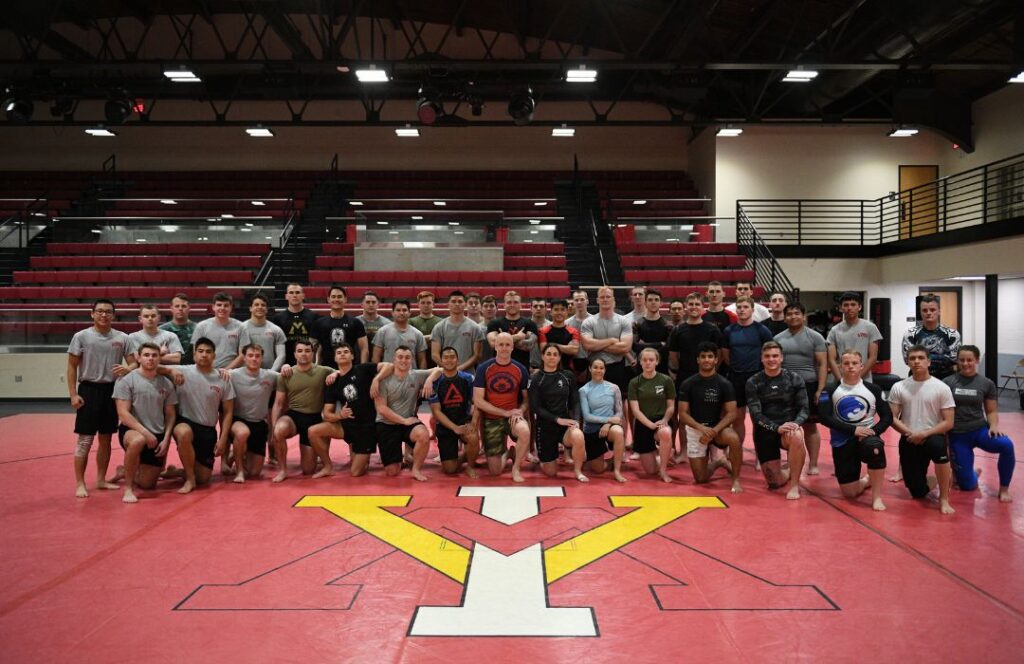
The Brazilian Jiu-Jitsu Club at VMI pose for a picture on the mat.

Practice and dedication 

Club members practice two to three times a week, totaling about five hours a week.  

Cadet Walker Powell ’23, cadet in charge of the club, signed on as a rat, along with his roommate David Amos ’23, the assistant cadet in charge. Both are blue belts.  

The club also competes in several competitions throughout the year. Both Powell and Amos participate in those, along with about a dozen more.  

“I just wanted to be good at something unique. Then I started doing it; I just fell in love with it,” Powell said.  

It takes persistence and dedication. Powell said it can take up to 20 years to accomplish a black belt — a longer timeline than most martial arts. Powell and Amos say at their respective home gyms they may dedicate about 15 to 20 hours a week to practice. 

Powell echoed the notion that jiu-jitsu is like chess.  

“You can’t get good at a strategy or position unless you work it as often as possible,” he said. “You can’t really work these things out like chess where you can play by yourself. You have to have that other person with you. So, it may not seem like a team effort, but it really is a team effort to do the sport.” 

For some, it’s not about competition, it’s more about the workout and release. 

“It’s like a workout in that afterward you feel exhausted but good, confident about yourself. Or when you’re sad or mad about your day, this is a great way to let it out,” Kelly said. 

Cadet Holly Hein ’23 is preparing to commission into the Marine Corps. After leaving the VMI swim team to focus on ROTC, she was able to join a club she wanted to. It also didn’t hurt that she’s had martial arts experience — she’s a black belt in Taekwondo.   

“I like the skills that I’m learning. It’s a lot of self-defense skills, but it’s also useful,” she said. “I’m going to the Marine Corps and we have a Marine Corps martial arts program that uses a lot of jiu-jitsu and Judo techniques. So, I’m getting some background experience in that. And it’s also a really great de-stressor. Mondays and Wednesdays, I know that I’m going to go there and I’m going to get all of my frustration from the day out.” 

Paul said he loves seeing the cadets grow with the club.  

“It’s great to have your students outside the classroom,” he said. “It definitely makes it good for us because we can really connect with them. We’re not always seeing them in the classroom and you just kind of get to interact with them in a different way and you get to know them better. 

“As a cadet, you come in and you know nothing so we practice two days a week, at the most maybe three days a week. It just takes a long time to sort of pick up the basic skills,” he added. “It’s really impressive to us when cadets are able to graduate from white belt to blue belt, which is a major milestone.” 

Most recently, the club took five cadets to Charleston, South Carolina for the Annual WVGO Gi and No Gi Spring Championship bringing home several awards. 

“This week we’ll be addressing weaknesses I saw in all of their games,” Paul said. “This is one of the reasons we encourage cadets to compete — it provides invaluable feedback on one’s technical abilities. By addressing the issues that reveal themselves in the high stress environment of a tournament, you can become a much better BJJ practitioner.”

Oddly Unordinary: How this Theatre Production Showcases VMI’s Clubs

It took six weeks to pull the production of “The Odd Couple” together. Normally, it takes more than two months for a production this size, said Cadet Matthew Frazier ‘23.

Frazier and the cast of “The Odd Couple” just closed out their production Sunday, March 26. For Frazier and fellow castmate Cadet Ted Harris ‘23, this was their last VMI Theatre production.

The play centers around a New Yorker who recently separated from his wife and moves in with his best friend. The drama revolves around their attempt to share an apartment without driving each other crazy. Oscar Madison, the perpetually broke slob, is played by Harris, and Felix Unger, the meticulous and fussy photographer, is played by Frazier. Students at VMI, a military college in Virginia, performing a play

Frazier, the cadet in charge of Virginia Military Institute’s Theatre Club, said the show was a challenge to put on due to the time constraints and the number of lines that had to be memorized.

“Despite all the stress, it is worth it, and I think we (had) a pretty funny show for everyone,” he said.

With prior experience in theater in high school, Frazier was convinced by upperclassmen to join the Theatre Club when he started at VMI. He said that clubs, like theater, are crucial at VMI.

“Personally, when I joined as a rat, it became my escape,” he said. “It was one of the few places where I could interact with both upper-class cadets as well as people from the outside world who come to see our shows as well as perform with the community theater. It certainly isn’t the type of thing people think about when they picture a military school, but for those of us in the club it’s incredibly fun, and it allows us to develop more as leaders and individuals in the process.”

Harris echoed that sentiment, saying clubs like this are necessary for creating healthier environments for cadets.

“The military and academic aspects of VMI are huge, but that’s just the surface of what VMI is,” he said. “Clubs like theater provide a break from that aspect of VMI. I also think that the balance between clubs and the military-academic side is what makes VMI so special. It keeps you busy, but you learn a lot.”

There can be a certain stigma about being in the theater club, Frazier said, but he doesn’t let it bother him.

“Things like that don’t get to me, you can’t survive at a school like VMI if you don’t have thick skin. I can’t imagine what my cadetship would’ve been like without theater, it’s a place where we all get to unwind, be weird, and not care what people think,” he said.

Students at VMI, a military college in Virginia, performing a playJoining a club like theater is exactly what any normal college experience should be about.

“To me, college is about trying things out and seeing what you like,” Harris said. “You never know what you really want to do until you try it. As long as you find something you like doing, your cadetship will be busier, but it will be a lot more fun.”

Harris said he thinks this will be his last performance — which has been the biggest role of his acting career — at VMI. He said it was a challenge, but one he took head-on.

“As we like to say around here, ‘Don’t Do Ordinary,’” he said. “We somehow find a way to put the show together and give the audience a fun evening.”

Starting at the Drawing Board: Cadet Research Focuses on Infrastructure

Infrastructure is the basic physical systems of an area, such as roads, bridges, tunnels, and water and sewer systems. According to the American Society of Civil Engineers, America’s infrastructure report card for 2021 earned a grade of C minus, due to water main breaks, wear and tear on roads, and aging bridges throughout the country. Colin Butler ’23, a civil engineering major at Virginia Military Institute, has conducted a year-long research project on concrete support beams. He presented his findings in his senior thesis titled, “High Strength Fiber Reinforced Concrete and its Application in Composite Beams” during Honors Week, held March 20-28.

Butler described the difference between high strength fiber reinforced concrete (HSFRC) and normal concrete.

“Normal concrete is made when sand (fine aggregate) and stone (coarse aggregate) are mixed together with cement, which binds the aggregate together. HSFRC contains more fine aggregate and small fibers usually made of steel or polymer, instead of coarse aggregate (stone) and requires less water to mix. It is at least 1 ½ times stronger than normal concrete and has a minimum compressive strength of 6,000 psi (pounds per square inch) or more. HSFRC is regarded as the ‘step’ between normal and ultra-high-performance concrete (UHPC),” he said.

Butler started his research where most research starts — at the drawing board. With complex mathematical formulas, he designed a 3.5 inch by 7 inch beam made of normal concrete, with a half-inch thick HSFRC laminate layers on either the top, bottom, or both.

“My hypothesis was that the beams with the HSFRC reinforced layers on top and bottom would withstand greater pressure than beams made exclusively of normal concrete (the control beam), as well as beams with laminate layers solely on the top, and beams with laminate layers solely on the bottom,” he stated. Student presenting during Honors Week at VMI, a military college in Virginia

He built wood frames in which to pour the wet concrete to form the beams. He made a total of 12 beams, three of each type: the control, top reinforced, bottom reinforced, and top-bottom reinforced. He covered each form with burlap and allowed them to cure for 28 days. He then treated the surface of each beam with muriatic acid, which dissolves cement paste on the surface of the beam, and used a power drill with a metallic brush attachment to flick away debris in order to increase surface area, and allow for a stronger bond between the normal concrete and the HSFRC.

Butler tested the beams with an applied load in the engineering lab. The results both confirmed his hypothesis, but presented revelations as well. As predicted, the top-bottom beams outperformed the other three types, but Butler was surprised that the control beam outperformed both the top reinforced and the bottom reinforced.

Butler concluded his presentation by recommending further research and suggested laminate thickness, rather than laminate location, be examined. He also suggested using commercially provided UHPC.

Maj. Kacie D’Alessandro, assistant professor in the Department of Civil and Environmental Engineering and Butler’s advisor said, “Butler’s honors project expands on prior research accomplished here at VMI.  We had previously only considered the high strength laminate on the bottom of the beam, so it has been exciting to see what happens when the location of the laminate is changed.  This expanded research on composite beams could lead to future applications in new construction or repair of concrete structures,” she said. 

Butler will present his research, alongside Jack Cross ’23, a cadet who worked on mix development of high strength concrete, at the American Concrete Institute (ACI) Concrete Convention in San Francisco, California, in April.

Butler is from Fairfax Station, Virginia, where he attended South County High School. He is the son of Dawn and Michael Lehrfeld, and the grandson Lloyd Thacker who graduated from VMI in 1959. He is majoring in civil engineering with minors in physics and applied mathematics. He plays the trumpet in the VMI Brass quintet, is a bugler, and regimental drum major. After graduation, he will commission in the Army as an aviation officer.