Post View Unavailable »
New Website Launched »

The Extra Mile: Theatre Club

Tori Wright ’24 was looking for anything to escape COVID-19 on post as a rat. The catch — there were not a lot of activities for rats to join due to the amount of work that was required of them in the Rat Line. Nevertheless, Virginia Military Institute’s Cadet Theatre was one she could.  

“My experiences with the theater were just always amazing. It was like this little safe place away from barracks,” she said. “It was honestly like a second home, so I kind of just stayed year after year.” 

With about four performances a year, the club is a little different than others offered on post. It’s technically two entities — the VMI Theatre and the VMI Community Theatre. Both involve cadets, but the community program wrangles in local participants when it’s tough to fill out a production. Cadet-in-charge Matthew Frazier ’23 said that usually happens for the holiday and summer productions, mainly because cadets have left to go home.  

Wright has been a key player in leading the summer sessions of theater for the past few years, something she says is a little bit more relaxed than when school is in session. She prefaces that it’s still very much a military school activity, but it’s different because they’re all in civilian clothes and can interact with the community on a personal level.  

“It’s a lot more relaxed. There’s a lot more time,” she said. 

Frazier said overall, VMI Theatre is a good escape for cadets — a point that Wright agreed with.  

“Because we’re here at VMI, it’s such a militaristic environment,” Wright said. “Even in classes, in other clubs, things like that, t’s very rigidly structured. There’s a set time, a set place, a set way of doing everything. But theater is so much more flexible.” 

The flexibility is in the creative freedom you get with performing or changing up a few props.  

“The general environment is so much more relaxed,” she said. “It’s a good way — especially during the Rat Line — of escaping to a much friendlier place.” 

Byron Rivey ’26 has been involved with theater since a young age. The first show he can remember being in was in sixth grade doing a rendition of “Beauty and the Beast.” 

“Ever since I can remember I was hooked,” he said.  

With the pandemic, he drifted from theater.  

“A distance grew between my fellow castmates,” he said. “This distance forced me to quit theater in high school. However, this year was the first time on stage for a while. My biggest supporter was my dyke, Ted Harris ’23, who is also in theater.” 

Both Frazier and Harris recently completed their last performance with VMI Theatre, performing “The Odd Couple.” A bittersweet exit, the two both said the club provided a place of refuge for them — something Rivey said as well.  

“Clubs like theater allow cadets and rats to escape from the daily stresses and portray a different person,” Rivey said. “Daily stresses include academic or Rat Line stresses. It also allows you to meet cadets from different companies.” 

VMI Theatre is in its 53rd consecutive year, according to director Joellen Bland. She’s been the director since 1982.  

“I have hundreds of treasured memories … but the thrill of seeing cadets blossom and grow on a stage before a live audience, and seeing the flush of pride on their faces when applause surrounds them, and their high-fives when they unwind after a performance is worth every moment of doing theater at VMI,” she said.  
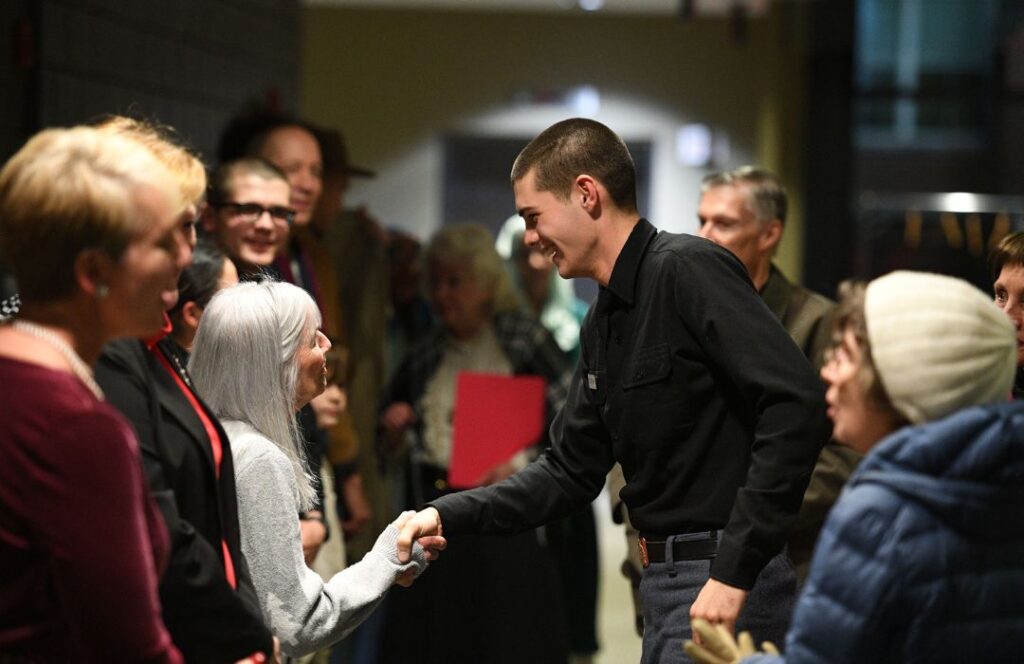
A cadet talks with audience members after a theater performance.

Bland said she doesn’t view VMI Theatre as a club but as more than that.  

“Even though we have never had a venue to truly call our own, and even though there is no theater course or major at VMI, and even though cadets do theater by choice and not by academic requirement, we are alive and continuing to struggle to stay alive at VMI today,” she said. 

Working with cadets is an adventure, she said, considering how many different directions they’re pulled in on a daily basis.  

“Doing theater is not like anything else they might tackle,” she said. “Auditions, rehearsals, learning lines-cues-entrances-and-exits for performances, set-building, prop-gathering, costume assembling, publicity selecting, etcetera, etcetera, are all part of getting a show together and performing it for the public. And guess what? All of this has absolutely nothing to do with handling a ball of any kind.” 

Colin J.M. Nicassio ’26 started acting on a whim with a production during his senior year of high school. After enrolling at VMI, he started getting emails about different activities and saw there was a summer theater — something that would be perfect for him while enrolled in VMI’s Summer Transition Program.  

“Being in theater at VMI is a very unique experience in the fact that few know about the program, and even fewer participate,” he said. “It is a small crew of 10 or so familiar faces that show up when their schedules allow them to and memorize their lines the day before opening night. It’s a challenge to be in the shows, but as Joellen always says, ‘Somehow, some way, we will do it because we’ve done it before.’” 

Nicassio said that VMI Theatre is crucial for the image of the Institute and also for breaking up the monotony of cadet life. 

“Perceptions are hard to change and improve, even when they should be. To the common person, activities like this or any of the things that go on around post are hard to portray to someone who is not in the system because of the overshadowing of those giant tan walls that encompass all of cadet life as many people think,” he said. “There should be a strong emphasis on these extracurricular activities at VMI because they’re much more than a time commitment, they’re a haven from the day-to-day monotony of life. It’s these cracks and holes in the image of the Institute that really help cadets stay engaged and strong at the Institute.” 

He said that activities like theater need to be emphasized at VMI.  

“Not only is this a military institute, but it is for developing leaders to grow and develop as characters themselves. That is what theater is all about. It’s about making friends backstage and working together to achieve a common goal that many others can enjoy. 

There is no point in making a show if there is nobody to watch it,” he said. 
Computer-Controlled Golf Cart Designed by Cadets Debuts at VMI

Cadets at Virginia Military Institute recently demonstrated a computer-controlled golf cart to assist those who have trouble with mobility. The idea came about when the VMI Alumni Association got requests for golf cart transportation around post during reunions.

According to Lt. Col. David Feinauer, associate professor in the Department of Electrical and Computer Engineering, within this past academic year, six cadets designed a computer system that controls a full-scale golf cart. Still not completely driverless, the design is a significant step toward the goal of an autonomous system. Multiple departments collaborated on the project including Civil and Environmental Engineering, Electrical and Computer Engineering, Computer and Information Sciences, and the Cyber Defense Lab.  

Using a computer keyboard, a cadet sits in the driver’s seat and commands the computer (located on the back of the golf cart) to accelerate, brake, and steer. There is no reason to touch the steering wheel or use the foot pedals. This system is helpful to anyone who needs to use hand controls exclusively. 

Joseph Lieber ’23, an electrical and computer engineering major who graduates in May said the project is the foundation of an autonomous driving vehicle, allowing the computer to control the vehicle instead of a person, and acts as the interface between the virtual world and the physical world. “It has two different levels of failsafe that respond anytime a person presses the brake pedal: an analytical one, in which it will force the vehicle to stop; and a digital one, in which the computer can tell that the brake pedal has been pressed, and the computer goes into an emergency stop. At that point it can still be driven manually, but must be reset before it can again be driven using the computer system.

Plans for fall semester involve cadets working on mapping and building softw

VMI Team Wins Awards at International Competition on the Law of Armed Conflict

A team of cadets enjoyed success when it traveled to Sanremo, Italy, in late March to participate in the annual International Competition on the Law of Armed Conflict. The competition draws cadets from military academies all over the world and is hosted by the International Institute of Humanitarian Law. This year, 76 cadets competed from 16 different nations, including Germany, Norway, Thailand, France, Japan, and the United Kingdom. Cadets from all U.S. service academies, as well as The Citadel, were also in attendance.

This was the eleventh year that VMI has competed, with VMI’s program developed by former international studies instructor, Col. Bob James. This year’s team consisted of six 1st Class cadets: Ridge Clark ’23, Fatoumata Diallo ’23, Cassidy Dufour ’23, Katie Lloyd ’23, Brandon Marks ’23, and Justin Miller ’23. Throughout the week, the cadets worked in mixed teams alongside those from other academies to advise on the law pertaining to a fictional conflict scenario. As the situation evolved over the week, they offered legal insights into questions concerning the use of particular weapons, the treatment of different kinds of people, and how war can legally be conducted at sea and in the air.

The cadets spent several months prior to the trip becoming experts in humanitarian law, under the guidance of Maj. Tim Passmore, assistant professor of international studies. “These cadets have worked phenomenally hard and have acquitted themselves with excellence during the whole process. I couldn’t be prouder of their commitment to the competition and to one another in taking on this task,” Passmore said.

VMI walked away from the competition with three awards, the most it has ever won. Dufour, an international studies major, won 2nd place overall in the individual category, while Miller won 4th place. Dufour also won 2nd place in the team category for her work alongside cadets from the German Air Force and the U.S. Coast Guard.

Dufour, who will attend the University of Virginia’s Law School this coming fall and who has already been accepted to the JAG Corps upon completion of her studies, found the competition to be highly enjoyable. “Between the opportunity to practice international law and meet future officers from other countries with the backdrop of the gorgeous Mediterranean, this trip was easily my favorite thing I’ve done with VMI,” she said.

“The competition was a tremendous experience,” says Clark, a history major. “It gave me an opportunity to both further my knowledge of the law while also understanding what it would be like to apply it in a real setting.”

Passmore added, “This is such a good experience for cadets and will help develop skills they’ll need professionally, either as commissioned officers or as civilians. It’s also a wonderful venue for cadets from all over the world to convene over an important issue, while forging strong relationships at the same time. I hope for and expect some of these people to go on and become major decision makers in the future.”

Having made a statement this year, VMI will return next March with a new team ready to bring home more awards for the Institute.

The Extra Mile: Scuba Club

In 2018, Laura Fenske ’25, assistant cadet in charge of the Virginia Military Institute Scuba Club, was introduced to scuba diving by her parents, who had been diving for many years. Fenske’s parents discovered their love for scuba diving on their honeymoon and have since adapted the skill to fit their lifestyle.  

Fenske’s first diving experience was far from impressive.  

“It was a cold pool, and I did it up in Northern Virginia,” she said. “I went to a quarry, so it was dull freshwater, and it wasn’t that great of an experience.” 

The Fenske family decided that the cold water wasn’t ideal for their diving adventures, but they still wanted to dive year-round. They explored different options and finally landed on warm-water-only diving.  

“We went down to Florida and did some diving in the [Florida] Keys, and then went up to Pompano Beach,” she said. During that trip, Fenske’s family embarked on wreck dives and drift dives, which led to her newfound hobby. “That’s where I fell in love with diving.”  

Two years into scuba diving, Fenske wanted to take her diving experience to the next level. To improve her skills and increase credibility, Fenske sought out professional certifications through the Professional Association of Diving Instructors (PADI).  

With several certifications, including PADI Divemaster and Scuba Schools International (SSI) Instructor, she knew that she could turn diving into a career. All along, Fenske knew that she wanted to use these certifications to encourage her friends to share her love for scuba diving.  

“Of course, I could make a career out of it,” she said. “It’s a fun hobby… and I really just use the professional certifications to be able to teach people how to do it and recruit all my friends.”  

Scuba diving scenarios  

When thinking of a military college in Southwest Virginia, the VMI Scuba Club is probably not on anyone’s radar.  

Surprisingly, cadets have applied this fun club to real-life experiences and necessary job training.  

“Cadets join the Scuba Club if they have a trip coming up, and they want to get certified, or it might pertain to their career,” said Akhil Thadur ’24, cadet in charge of the Scuba Club.  

Thadur is a PADI Advanced Diver (Nitrox) and is currently working towards certification as a rescue diver.  

“The course teaches me how to manage a life-or-death situation,” he said. “If something bad happens to someone, how do I organize their evacuation? How do I contact authorities? How do I manage a rescue team?”  

By joining the Scuba Club, cadets have access to resources, including many of these certification courses.  

“If they want to be a diver in the U.S. Navy, a commercial diver, or if they want to go into special operations … this club can be a good steppingstone for them, and their skills,” said Thadur. 

If cadets are interested in pursuing certifications, most of the legwork is completed on their own time. Once a cadet has prepared for the written portion of their certification, they move on to complete the in-person diving tests.  

“You do the bookwork, and then you go to the instructor for your dives, and you take several tests,” said Thadur. After completing the certification, cadets can use their credentials in real-time with the Scuba Club.  

“We take a weekend, and travel to a place called Lake Phoenix, which is a quarry,” he said. “It’s one of the best dive sites on the East Coast.”  

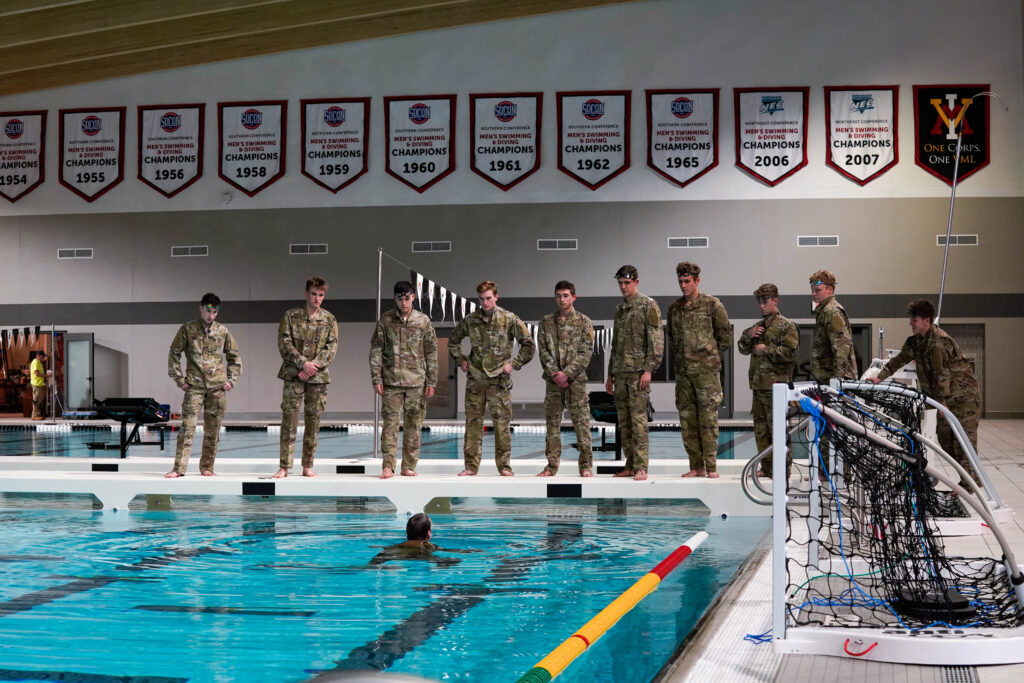
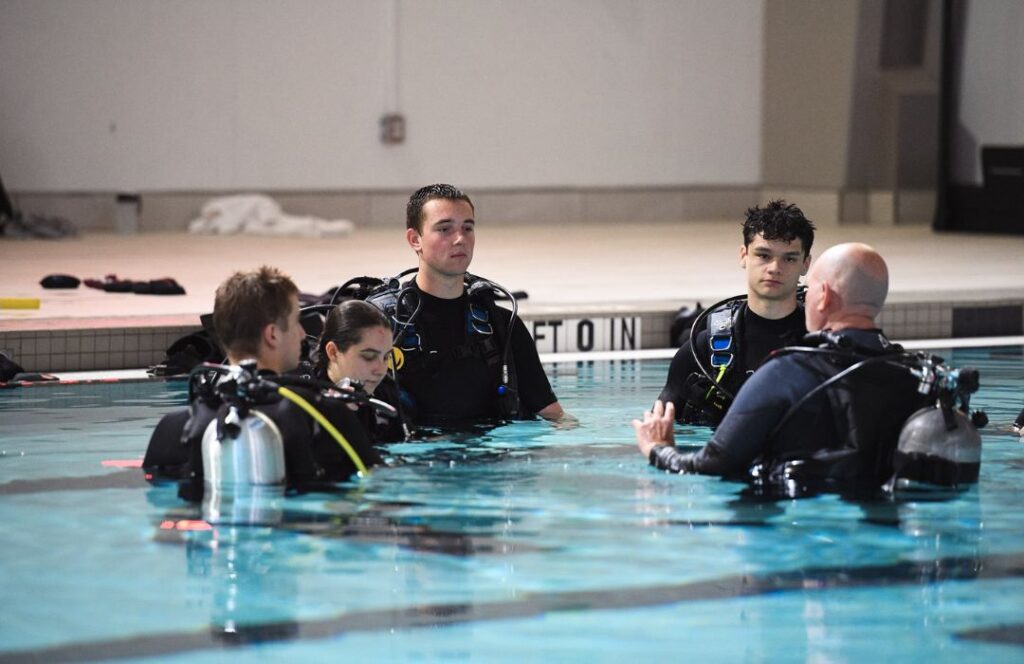
Cadets await instruction with scuba gear in the pool.

How to immerse yourself in the club 

Cadets have the option of taking their first dive with the Scuba Club, or if they have diving experience, they can expand their skills.  

“The purpose of the Scuba Club is to introduce cadets to scuba diving,” said Thadur. “For those that are already certified, we want to provide them with advanced training and minimize some of the costs that are associated with diving.”  

During the ratline, Fenske joined the Scuba Club as an escape from her day-to-day activities. She was asked to assist the club due to her professional certifications and deep knowledge of diving. 

“It broke up part of the ratline for me,” she said. “On Sundays, I got to help teach diving at the scuba club … and it was a lifesaver.”   

Fenske shared that her diving skills prepared her for a cadetship at VMI, and more importantly – these skills have prepared her for life. From learning to breathe through a regulator to staying calm underwater – Fenske has trained herself to find tranquility in the chaos.  

“It teaches you to stay calm,” she said. “Either way, I have air coming in … I don’t want to shoot to the surface, or I could get injured.”  

During the school year, Fenske shared that life on post can be hectic. Those busy times have allowed Fenske to apply her underwater skills in scenarios on land.   

“I just have to stop and take a breath,” she said. “I tell myself, ‘Remember, you have air,’ and it’s all fine.”  

Each year during the spring semester, the club travels to a quarry and completes one to two dive trips. All cadets are welcome to join, and no diving experience or equipment is necessary.  

Soybean Research Project Taken Abroad During Spring Furlough

Entering Virginia Military Institute, Chris Kushner ’24 signed up for a Biology 111 class with Col. Anne Alerding. Little did he know that when he was asked to join a research project, it would be something he would continue throughout his time at VMI.

The research material in question? Soybeans. He admits it’s a subject he didn’t know a lot about. The project was of interest to him — allowing him to learn something that was more interdisciplinary by applying machine learning along with the biological approach to research.

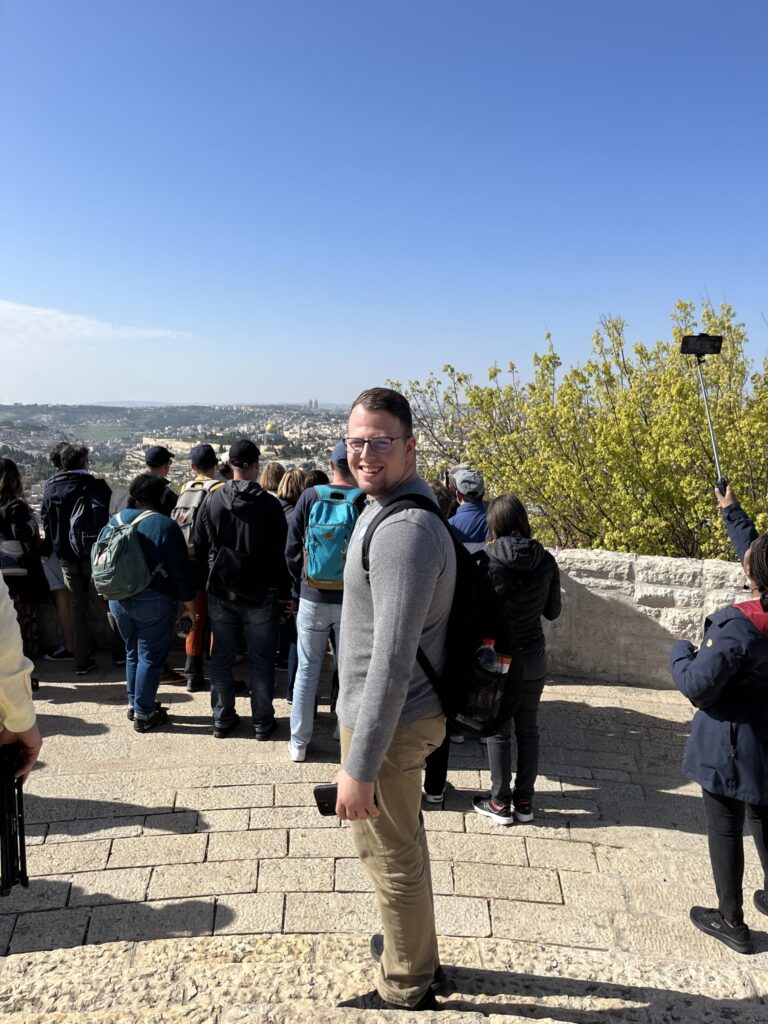
He’s been able to present some of his findings alongside Ph.D. candidates, which Kushner described as a humbling experience. Student conducting research in Israel with the Department of Biology at VMI, a military college in Virginia

“I’ve [been able] to do some pretty interesting work that really hasn’t been researched too much in the field. So I definitely think it’s interesting to be on a team where the research is actually novel,” he said.

Kushner began his research by analyzing soybean cross-sections and morphing them into machine-learning options for image analysis. These actions ultimately led him to his Summer Undergraduate Research Institute (SURI) project in 2022. He compared two different machine-learning tools and their outputs to examine how effectively they could be utilized for the rest of the project’s workflow.

Alerding’s research stems back to 2017 when she received research money from the Jackson-Hope Fund and the Virginia Soybean Board to initiate a project on soybean fields. The work was steady, but then it became clear that she couldn’t complete it alone.

That’s when she started recruiting cadets to help her out each semester.

Alerding, a professor in the Department of Biology, said her mentoring relationship with Kushner started to help him navigate the Rat Line. It then morphed into a lengthy process, with him staying on board for further research.

Alerding had been working with Dr. Aryeh Weiss from the Faculty of Engineering of Bar-Ilan University in Israel for several years. Weiss spent several years traveling back and forth, from Israel to the United States, with one goal in mind: research. When the pandemic hit, travel halted, but the research was far from finished.

As the project grew, Kushner and Alerding began meeting with Wiess, via Zoom, to learn new computer programs and skills. Zoom only scratched the surface. The goal for both Kushner and Alerding was to meet with Weiss in person, but the group had to wait until COVID-19 restrictions were lifted.Student conducting research in Israel with the Department of Biology at VMI, a military college in Virginia

In January, Kushner applied for funding through the VMI Center for Undergraduate Research (VCUR) to travel overseas to Israel as a continuation of his research. The week-long trip, held over spring furlough, was to help him and Alerding perfect the methodology used to classify soybeans through machine-learning and bioimage analysis programs.

Chris Kushner ’24 traveled overseas to Israel as a continuation of his research on soybeans.

“The goal of VCUR is to promote the undergraduate research experience here at VMI,” according to Maj. Kaitlyn “Kaitie” Cartwright, assistant professor in the Department of Chemistry. “The undergraduate research experience is one of the most meaningful outside-of-the-classroom experiences that we can give the cadets, and the funding VCUR provides is aimed to help facilitate and maximize these uniquely impactful opportunities for intellectual and professional development.”

Student and professor conducting research in Israel with the Department of Biology at VMI, a military college in VirginiaThe Jackson-Hope Fund, which funds VCUR, allows cadets to travel for conferences or research-related things, Cartwright said. To receive these funds, cadets are required to prepare a written proposal, which includes an explanation and justification.

It took Alerding and Kushner one and a half days to get to Israel — leaving early on a Saturday morning and arriving on a Sunday afternoon. Once their plane landed, the pair dove straight into research. For four and a half days, they arrived at the lab and worked from 8 a.m. to 9 p.m., only taking breaks at mealtimes.

While in Tel Aviv, Kushner furthered his research with the machine-learning program called Ilastik. This program classifies pixels in an image and assigns them to a specific class. Results from this program can then be entered into a bioimage analysis program, which collects data on the ratios between certain classes. That data is later used to identify high-yielding plants.

The trip also helped Kushner further his Institute Honors thesis. Student conducting research in Israel with the Department of Biology at VMI, a military college in Virginia

Kushner’s original intent was to study chemistry, Alerding said. Over the course of his first year at VMI, Kushner decided to work longer with Alerding, so she slowly gave him more work to do.

“I gave him a little bit of different work and he dabbled around in a bunch of different projects until we decided on his thesis project,” she said.

Alerding said that a lot of the research Kushner has collected she’s been using, especially while occupied writing a paper. She said that Kushner is a high-performing student — something she’s seen from the very beginning of his VMI career.

“I feel like he’s really blossomed at VMI,” she said. “It’s given him opportunities to take leadership roles. It’s helped him realize what his true potential is, and I think in the last year he’s shown incredible growth.”

The Extra Mile: Hockey Club

A group of nearly two dozen cadets pack into vans and travel over an hour to hit the ice in Lynchburg. Equipment is loaded into two vehicles as cadets pour in and head to face-off for practice.  

Practice starts at 7 p.m. on Wednesdays or Thursdays and most of the time, they do not return to post until after midnight.  

Liberty University is the closest place the Virginia Military Institute’s Hockey Club team can get ice time, according to VMI Hockey captain Rory Groat ’23. Arriving on post in the wee hours only to get up again at 6 a.m. can take a toll on cadets with their Corps responsibilities. But, for Groat and his team, it’s just another week for them — and hockey is life.

The club team, which has been around since the early 2000s, brought up its roster number this year, Groat said, mainly made up of 4th Class cadets. Although numbers were up, the number of players completing the Rat Line this year proved to be difficult in filling spots for games. Low roster numbers shouldn’t be a problem heading into the next year’s season. 

Since it’s a club sport, anyone can play — even with little-to-no experience. In order to play a game though, you have to try out for the line. Only 22 can be put on the roster. The tryouts will be a new addition for next year, incoming captain Patrick Cavanaugh ’24 explained. 

“Everyone is welcome,” Cavanaugh said. “You can come practice. I don’t care if you don’t even have skates. We’ll find you ways to get skates and get you on the ice.” 

The number of people who have come onto the team who haven’t skated before is relatively high — and everyone works together to get their skill levels up. Don’t have gear? The team will help outfit you with whatever leftover equipment they have. Hockey is an expensive sport, with the bare basics costing in the upwards of $500. Skates alone can cost that much.  

Bonding of a brotherhood 

Despite that cap on players per game, the club has a camaraderie that really resonates with each of the cadets.  

“Hockey is kind of like a brotherhood … kind of like the Corps.You’re going to battle with all your friends on the ice and it’s like it’s a big family,” Cavanaugh said. 

He said that connection with each of his teammates ties into what VMI stands for.  

“You’re with your brother rats, they’re like family. And then you have the upperclassmen you look to for leadership, just like you would look to a captain on a hockey team. Then, underclassmen, you learn how to mentor them. You learn how to guide them, make them better, develop their skills,” Cavanaugh said. 

Much of the team started playing hockey young. Groat said he’s been skating since he was 3 and has been playing on travel hockey teams since he was a child. Cavanaugh has been playing since the fifth grade and the other incoming co-captain Jake Clift ’24 has been playing since he was 8. 

The three team members all grew up in different parts of the country — Groat and Clift in Virginia and Cavanaugh in New York — so their experiences with building in the sport were slightly opposite. For Groat and Clift, their time was spent playing on travel teams, while Cavanaugh worked his way up to play for a AAA team, the New Jersey Avalanche.  

The VMI Hockey Team is part of the Atlantic Coast Collegiate Hockey League, which is a non-NCAA collegiate ice hockey league in the Mid-Atlantic and southeast regions of the United States. This year they played teams from Old Dominion University, William & Mary, Citadel, Mary Baldwin University, Christopher Newport University, and more.  

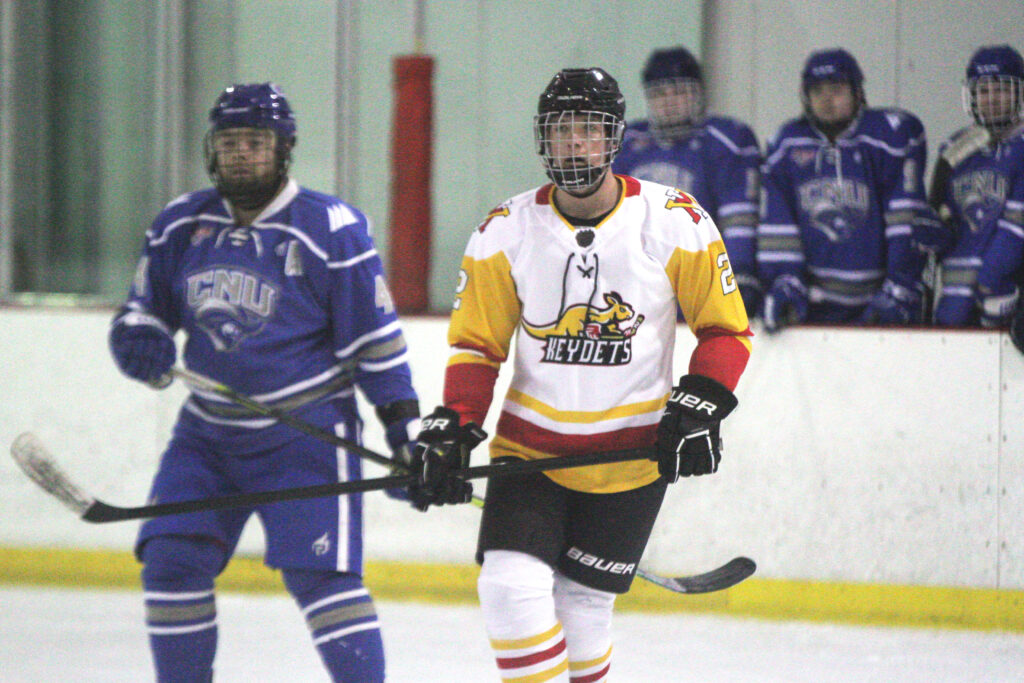
A hockey player on the ice mid-play.

Creating chemistry and building a team 

Their record this year was not stellar. They won one game out of 16. A contributing factor to the low number of wins was the availability of players. With the majority of their playing line being rats, they couldn’t come out to every game due to Rat Line activities.  

This was Coach David Turner’s first year, and he has no previous hockey experience. 

“There are some games where we only had nine people and there’s five on the ice at a time,” Turner ’22 said. “Usually you have upwards of 20 and you’re able to switch out for lines, but we didn’t even have two [lines].”  

Although it was a learning curve for Turner, he said it was easy to build respect and chemistry with the team.  

“Even though I wasn’t as skilled as them, it was instant respect and instant chemistry. I was able to relate to them really easily,” he said.  

The hockey team also provides a sense of normalcy — something needed in a military school setting, Cavanaugh said. 

“It builds on the values VMI establishes in your cadetship, but the biggest thing for me is not having to act like a cadet … you get this sense of normalcy and being like a normal college kid, you know when you’re out in Lynchburg for practice or wherever the games are. So that’s my favorite part about it,” Cavanaugh said. 

There’s also a different sense of camaraderie with parallels to VMI life, Clift said. 

“We take this group of individuals who come in or who have already been here, and we’re making a whole new team just like the way VMI does during the Rat Line,” Clift said. “We’re taking all these different guys and we’re building the chemistry. We’re getting that sense of camaraderie. I don’t know how to explain it but what makes hockey different from other sports is the sense of camaraderie and just the brotherhood of it.” 

For team manager Sean Daffron ’24, even though he doesn’t play on the team, he joined so he could hang out with his friends.  

“I play rugby for the school, and we have our group for sure, but hockey is probably the closest with the guys that I’ve personally experienced,” he said. “You come out to practice and then everybody knows each other. It’s pretty instant. It’s impressive.” 

That connection can be seen on and off the ice. During a game, if a teammate is chasing the puck, you know someone will back you up.  

“Hockey is a very gritty, all-out sport where if I’m going to go into a corner chasing a puck I know for example, Jake is going to have my back if I just get completely laid out,” Cavanaugh said. 

The Extra Mile: Rugby

When Kenny Howerton ’23 entered high school, he discovered that his school had one of the only high school rugby teams in Virginia. This was a perfect match for someone who had been playing the sport since age 10. Howerton joined his high school’s team and the rest, as they say, is history.  

“From men’s clubs to high school, and now at VMI. I have immersed myself in rugby, and I love it,” he said. 

Howerton leads VMI Rugby as team captain. He was introduced to the sport through his uncle, who played at the collegiate level.   

Howerton shared that the team is one of the most diverse teams on post. “From former NCAA athletes to cadre members and privates, we all come together with a common goal: to play rugby.”   

Playing the game  

In the game of rugby, each number on a jersey corresponds to a specific job and role on the team. Passing, catching, and tackling are the basic skills required of each player on the VMI Rugby team. Players wearing the numbers one through eight typically have a large build, an aggressive style of play, and consistently fast-paced movements. These players, known as the “forward pack,” are tasked with carrying the ball into tight pockets of space.  

Players nine through 15 are traditionally the speedier players, referred to as “backs.” These players have the job of working the ball towards the outside of the field and scoring for their team.  

The sport of rugby is very popular across the globe, but for many Americans, it falls under the general category of sports and does not draw the same crowds as football, basketball, or baseball. Nate Mayfield ’24, co-captain of VMI’s Rugby team, shares that the sport has carried him through very challenging times.  

In his first year at VMI, Mayfield had serious doubts about the length of his cadetship. With the help of his coaches, Mayfield was able to persevere, and has found his place at VMI on the rugby field.   

“My coaches had a really big impact on me and gave me something to work for that was bigger than myself, and bigger than the things going on around me,” he said.  

Both cadets shared that the sport has taught them lessons that will last beyond their four years on the team. Two of the bigger lessons are sacrifice and leadership 

“You’re out there with 14 of your best friends. You can’t win a game without all 15 people working together and you learn to sacrifice,” he said. “You use a lot of pain and fatigue to help fight alongside the other 14 guys and protect them. You all push each other towards the same common goal.”  

When it comes to leading a team, Mayfield shared that there is an unseen side to leadership. “Being a rugby captain is not very glamorous,” he said. “It means you are the first one down to the pitch for training. You’re going to be the one sweeping out the sheds or cleaning out the buses after a tournament.”  

Mayfield explained that he is no stranger to sacrifice, and in many ways, VMI prepared him to lead a team.  

“I’m better prepared to sacrifice for my teammates who I know, when it comes down to it, they are going to be willing to sacrifice themselves for me during a game.”  

Creating a community with camaraderie  

When Howerton speaks about rugby, one word that rings true is community. 

“The biggest thing that I love about rugby is the camaraderie that I’ve built with every single team that I’ve played with, especially at VMI,” he said. “From passing each other in the hallway, going to class, walking in barracks, or eating down in Crozet, anytime I see one of the guys on the team, my face lights up. I know that guy has my back, and I can always count on them.” 

When asked about the meaning of the sport, Howerton shared that the brotherhood within rugby is long-lasting and deeply supportive.  

“You have fifteen other guys on the field that are willing to help you and be there for you every step of the way, to make sure that you get to where you need to be,” he said.  

Once the final whistle is blown, the aggressive game comes to an end and players join to create friendships.  

“There’s a brotherhood that is built in between the tackles and the tries. At the end of my four years on VMI’s Rugby team, I can honestly say that it is the best decision I have made,” Howerton said. 

The rugby revival  

Last year, VMI Rugby ended its season at the national championship in New Orleans. From injuries to attitudes, the team did not perform at the high level that they had planned for. Through this difficult season, the team found hope and began to prepare for its current season.  

“In all of our eyes, we saw the level of competition. We saw where we were, versus where we wanted to be. From that moment on, we kind of had a different attitude,” Howerton said.  

To build the team from the ground up, Howerton said they all had to become students of the game. “We saw our goals and what they needed to be, and we knew that it was going to take a lot of work to get back to where we were and to achieve even greater than we had.”  

Mayfield further explained this concept: “Our biggest goal for this year would definitely be building our game knowledge from where we were last semester and making sure that all seven guys on the field are working as one unit and really playing fundamental rugby.”  

This year, the team is hopeful for an invitation to the national tournament, held in Washington, D.C., and an even better outcome. Mayfield explained that there is a large population of VMI alumni in D.C.  

“We expect a lot more support this year,” he said. “We’d really like to have some home crowds there to come watch us and really be able to put on a big show.”  

The rugby team has one final opportunity to qualify for the national tournament.  VMI Rugby will travel to East Carolina University April 15. If they succeed, they will appear at the national tournament from April 28-30.  

Microfinance as Tool to Reduce Global Poverty: VMI Cadet Presents During Honors Week

How can people living in extreme poverty in developing nations around the world lift themselves and their families out of hardship and provide a new life for generations to come? Brandon Marks ’23, an international studies major at Virginia Military Institute, conducted a two-year-long research project on microfinance, and presented his findings in his senior thesis titled, “The Impact of Domestic Context on Microfinance Provision and Effectiveness” during Honors Week, held March 20-28. 

Marks opened by telling two stories. This first about a woman named Jacqueline from a poor province in Rwanda. She had lost her siblings from disease and war, but she had a dream of starting a sewing business to take her family out of poverty. She took out a $100 microfinance loan, co-signed by eight other women, and bought a sewing machine. Six microfinance loans later, her business began to expand and became profitable. Once unable to provide schooling for her children, Jacqueline successfully lifted her family out of poverty, sent her daughter to college, and hired tutors for her three sons. Marks quoted Jacqueline as saying, “The loan changed my life.” 

The second story was about a woman named Madhuka from Sri Lanka, who had a similar dream as Jacqueline’s. She wanted to start a mat making company to lift her family out of poverty. Unbeknownst to her husband, she took out a $425 microfinance loan and started the company. However, when the rains came down and flooded the streets that she needed to sell those mats, she could not make the $30 monthly payment. Her husband panicked when he found out, and she fell into despair. In the dark of night, she went outside and poured kerosene over herself and lit herself on fire. Hearing her screams, her husband rescued her and took her to the hospital. Even at the hospital, the microfinance loan officers came to her bedside and demanded payment for the loan.  

The two very different stories led Marks to his research question: How do domestic factors influence microfinance provision and effectiveness?  

He stated that worldwide poverty effects nearly 698 million people, or 9% of the global population, who live in extreme poverty. “Roughly 2 billion adults across the world are unbanked, meaning they cannot apply for a loan. Microfinance is a tool that provides a way for people to take themselves out of extreme poverty, and build a new life for themselves and their families,” he stated.    

Microfinance provides capital in the form of small loans with high interest rates, joint liability, and no collateral, with the goal of creating entrepreneurship, productivity, and social capital in borrowers. Proponents of microfinance say it reduces poverty, uses capital for entrepreneurial pursuits, and increases economic growth, as seen in the success story of Jacqueline. Opponents of the practice though say it is a debt trap, demands high interest rates, and tends to saturate the market with similar businesses. Marks discovered that 50% of households eligible for a loan choose not to get one because they perceive it as a risky endeavor, are unwilling or fear of going into debt, and see the cost of the loan as too high.  

Theorizing that high trust and regulation would lower the perception of risk for the borrower, Marks’ hypothesis for his research project was, “All else equal, countries with a higher societal perception of regulatory quality should experience greater levels of microfinance provision.” After much research and statistical analysis though, he found that his hypothesis is suggested to be wrong. He found that the opposite was true, that as levels of trust and government regulations decrease, microfinance provision increases. Highly regulated and trustworthy institutions are associated with efficient microfinance operations that can offer lower interest rates to borrowers. Ironically, in areas where microfinance is most needed, institutions are the least efficient and loans are the most expensive, putting borrowers at risk. On effectiveness, Marks notes that market saturation of similar businesses has a strong impact on microfinance. Countries with low regulation continue to provide business loans even after markets reach capacity, leading to hyper-competition, decreased profits, and business failure. High-regulation countries provide fewer business loans and more household loans to avoid market saturation. To effectively reduce poverty, Marks argues government and microfinance institutions should regulate lending to prevent market disruption and indebtedness among borrowers. 

Maj. Megan Roosevelt, assistant professor of international studies and Marks’ advisor on the project said, “Brandon’s research is a great example of how the social scientific research method should work – with all its ups and downs. Trying to square a classroom discussion on microfinance with his travels in developing countries led him to an interesting and under-explored research question on an issue with major significance to policymakers, donors, and people living in poverty around the globe. Even when, after a year or more of gathering literature and quantitative data, his results disconfirmed his hypothesis, he used those unexpected findings to highlight a fascinating and maybe counterintuitive reason why microfinance has such mixed results for the poor. The whole research process has really been a testament to his creativity, hard work, and intellectual curiosity.” 

Marks is from Staten Island, New York, where he attended Staten Island Technical High School. He is the son of Len Marks and Cary Berwald. He is president of the Honor Court and operations officer of the Cadet Superintendent’s Advisory Board. After graduation, he will enter the field of real estate development, creating hotels. 

Swim Classes Are Historic Part of VMI

“The pool is an excellent classroom,” a manual reads. “Let it be used.”

The purpose of swimming instruction is to teach a cadet how to stay alive in the water, according to the first sentence of an old swimming and survival instructional manual. The book dates back to the 1970s, but swim classes at Virginia Military Institute have been required for nearly 90 years.

Col. James “Jimmy” Coale, head of the Department of Human Performance & Wellness (HPW), says this fitness requirement sets VMI apart from other colleges and universities. For seven semesters, cadets enroll in one human performance and wellness class, totaling four credit hours. Most of the classes, like swimming, are half credits. Students at a swim class at VMI, a military college in Virginia

Coale said the swim classes are an integral part of not only a student fitness but also whatever cadets choose to do after VMI.

“I think it’s great because we’re waterproofing the cadets. They never know what situation they’re going to be in down the road,” he said. “These are survival skills so that they can save themselves and potentially other people who are in the water as well.”

Pool history at VMI

The HPW department, originally named the physical education department, was founded in 1933, but swimming has been part of the physical requirement since at least 1916, Coale said.

Before a swimming pool was built, cadets used the North River (now known as the Maury River) to swim — and bathe.

According to Mary Laura Kludy, VMI Archives and Records Management specialist, the original Memorial Hall, which was part of barracks, was intended to have a swimming pool and gymnasium,but that was never built. The second Memorial Hall — the one standing today — was built in 1916 as a separate building, where a swimming pool was constructed. That pool remained until a new one was built in 1936 in its place. There was also a tunnel connecting it to Cocke Hall where dressing rooms were located.

In 1969, the annex to Cocke Hall was built, which included a new pool. By 1999, the third floor of Cocke Hall was renovated and the pool was either upgraded or completely replaced at that time, Kludy said the history was unclear.

This year, the new Aquatic Center opened.

Cadets line up to swim in the swimming pool.

The significance of swim class

There’s a confidence that comes from taking these classes, Deanne Moosman, HPW swim instructor, said. A lot of fear of the water stems psychologically. But, she says that it’s totally natural to have some anxiety when it comes to getting in the water.

Students at a swim class at VMI, a military college in Virginia“It’s just trying to get them in the water as much as possible to boost their confidence. When their anxiety levels are lower, their heart rate is lower,” she said.

Going back to that 1970s swimming manual, it said, “The emotional stability of the students participating in these courses is more than likely to be tried. In spite of numerous frustrations and uncertainties, successful completion is possible for everyone. No activity offers a cadet greater opportunity for developing self-confidence than do these courses, and accordingly, he may save not only his own life but that of someone else.”

Swimming also helps with the concept VMI has of overall wellness.

“This is something that they can do throughout their cadetship, maybe with cross training or just enjoyment of getting in the water (and) having a good workout, but then beyond that, too,” Coale said.

Noah Ahrens ’25 signed up to take HPW 201 this semester. He said he hadn’t taken a swim class prior to this or competed in swimming but had experience swimming on his own.

“I think the physical fitness class requirements are a great idea introducing those at VMI to different aspects of fitness and it allows them to see which fitness aspects or activities they enjoy the most,” Ahrens said. “My experience with the class is great. I have been learning new skills in strokes of swimming that I did not know before.”

Athelia Long ’25 is also enrolled in the basic swimming and survival class, with a similar skill level as Ahrens. She said before taking the class, she never knew the proper techniques of different strokes.

“Coming to VMI, I thought it was interesting that there were many physical fitness class requirements,” she said. “This is because it is unusual to see physical fitness classes that are required in other colleges. But, in the end, I knew that VMI is a physically demanding college so I expected classes to have a physical fitness aspect that most colleges wouldn’t have.”

Long said that prior to taking fitness classes, she thought they would be unnecessary.

“After experiencing the classes, I realized how important it is to know these skills in certain circumstances. In Basic Swimming and Survival I have learned skills such as treading water as well as breathing techniques to perform better at swimming,” she said. “So far, my experience with this class has been great. I am able to challenge myself with skills that I did not know before and I know that it will benefit me in the long run. I can say for certain that I feel more comfortable and better skilled in the water.”

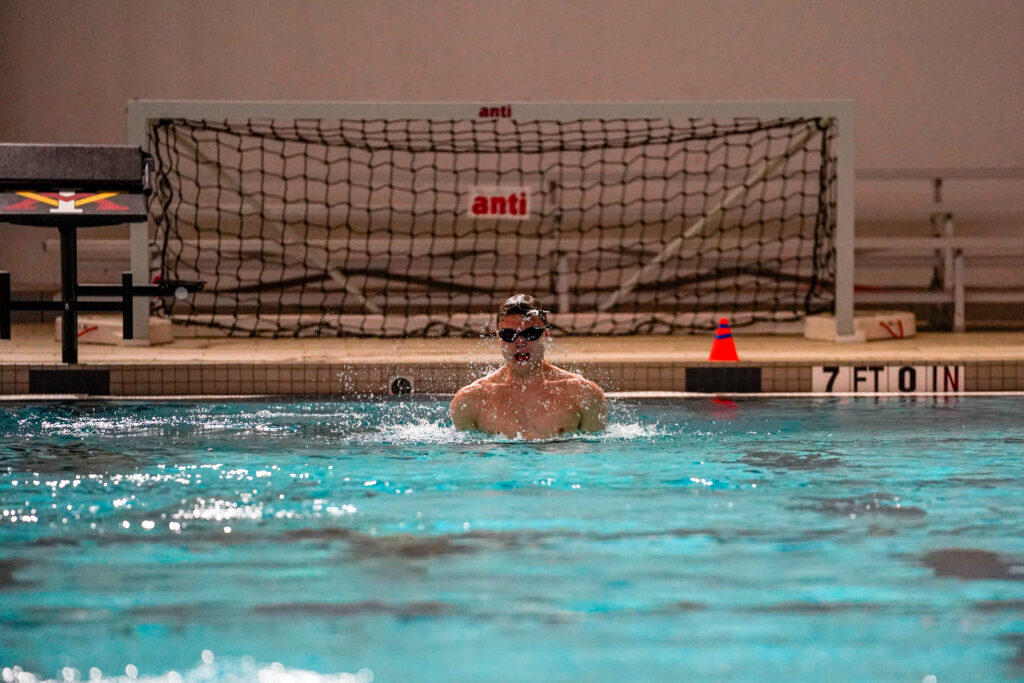
A cadet in the swimming pool.

Swim Requirements at VMI

As a 4th Class cadet, you are required to take two human performance and wellness required courses. When you’re a 3rd Class cadet, that’s when swimming comes in. You are required to take HPW 205 (Principles of Physical Conditioning) and HPW 200/201 (Swimming), one each semester. Upon your final two years, a cadet can opt for HPW electives. Students at a swim class at VMI, a military college in Virginia

Swimming — either HPW 200 (Beginner Swim) or 201 (Swim Survival) — is also required for a cadet to graduate. The 200-level class is for those who may be a bit wary of the water and the 201-level class is for those who have a bit more experience in the water.

“Clearly, everybody is at a different level,” said Moosman. She said in the 201-level class, they build up the cadets to proficiency to meet the skill requirements.

“So, they’re tested,” she said. “We could have somebody who hasn’t been in the water since they were 10 years old. And then we have someone who swam in high school. We work with all levels, and we get everybody to pass those skills tests or they move into HPW 200 and get more time, more personal attention.”

The Extra Mile: Cyber Club

Cadet John Barker ’23 wasn’t big on socializing in middle and high school. He found that interacting with computers was what made him comfortable. You’d never guess that now. Barker is well spoken, engaging and Virginia Military Institute’s Cyber Club cadet in charge, among other things.  

“Computers are a lot easier to interact with,” he said. “I did that for a little while and then I guess I became more comfortable with people, and the more comfortable with people I got, the more interested I became, in not just the being technical part, but being in an organization and trying to develop an organization that does more technical things for other people.” 

VMI’s Cyber Club boasts 104 members, making it one of the largest club organizations on post. And it hasn’t been around for long — it started in 2017. 

According to Barker, this year the Cyber Club has gone through a more specific change. The club has partnered with a number of companies and organizations in order to provide different opportunities for its members. That includes professional networking, certification training, off-post activities like capture the flag competitions, paid opportunities, and expanded leadership opportunities.

“I believe that Cyber Club is really just what the people make it,” said Joey Flynn ’25. He said the leaders and the cadets in charge really get people involved. “You fall in love with it. It’s what really pushes it to grow and develop.” 

The big activity they do as a club is capture the flag (CTF) competitions. The club doesn’t capture a physical flag. Instead, it’s a hacking competition between the club and other schools. At these competitions, the schools are given a data set and you are equipped with tools made by other people that you use to capture the theoretical flag.  

VMI’s Cyber Club spearheads about three of these competitions a year — the big one coming up in April, which is the NSA Cyber Exercise. To prepare, it depends on a variety of factors, Barker said. 

“It depends on what the CTF is, how big it is, and then what people like to do,” he said. “It’s a whole wide variety of things. Whether that’s looking at the website and breaking it or whether it’s looking at a database and trying to break it.” 

Those in the club can use their experience outside of VMI. The club allows for them to get certifications and training — many of which are free to the club or at a discounted price due to the club’s involvement with different organizations. One of those is TestOut Corporation, which provides professional grade certifications, which gives the club 50% off certifications. To offset the other costs, VMI’s Cyber Defense Lab has agreed to pay for any club member to get a certification for free, if the cadet gets three free mini certifications from the Cisco Networking Academy. It’s important to get some of these like certifications because it’ll help club members in the job market in the future. 

Barker, a computer science major, said he hopes club members are building valuable networks. 

Many just found themselves in the club. For Flynn, he got involved as a 4th Class cadet in 2021.  

“I never touched a computer, anything that in any way that mattered besides (Microsoft) Word until I got to college and I decided to be a computer science major,” Flynn said. “I just wanted to be the best in my field that I could, and the Cyber Club is just like giving me the opportunity to do that.” 

Flynn said he’s using the club to his advantage by establishing as many connections as possible through the club events.  

“I just want to expand my knowledge, my base knowledge,” he said. “You need to be able to adapt. That type of knowledge is what we learn in Cyber Club, and I think that helps a lot in the future.” 

The club isn’t heavily funded, which in turn creates some blocks in certain opportunities, Barker said. The club has to travel to places for several days, so it’s a challenge to get off post and find transportation.  

“CTF next year, for example, it’s hosted at the NSA, or it’s hosted at Virginia Tech, or it’s hosted in Langley, Virginia. These fantastic places that are impossible to get off post,” Barker said. “It’s a two-day event and you have one day for travel and one day to come back. You’re looking at a four-day permit. And anybody that looks at that balks at it very quickly. So you lose that networking opportunity.” 

The cyber club at VMI inside a classroom.

Amish Parikh, IT specialist and systems engineer in VMI’s Cyber Defense Lab, is the CTF coach for the Cyber Club and a mentor and instructor to the Cyber Captains within Cyber Club. He said he loves working with cadets because of their professionality and their desire to learn and enact educational experiences into their lives.  

“The cadets are always looking for opportunities to gain further knowledge at VMI and after VMI in the direction that they will be heading into whether it be for government or private sectors,” he said.  

Parikh said the club is important especially due to the need for cybersecurity. The club presents real world cyber situations and develops a strong contingent of confident cyber members to society.  

Cyber Club is taking our citizen soldiers to becoming cyber citizen soldiers with the knowledge and know-how to protect and defend our personal data into the future,” he said. “Cyber is a growing space with that in mind the Cyber Defense Laboratory is training cyber captains and Cyber Club members to expand their horizons into AI machine learning, robotics, autonomous technologies, cyber teams, and application/web development where we can provide cadets of all calibers both in STEM and non-STEM programs to learn about cybersecurity in a multitude of directions.” 

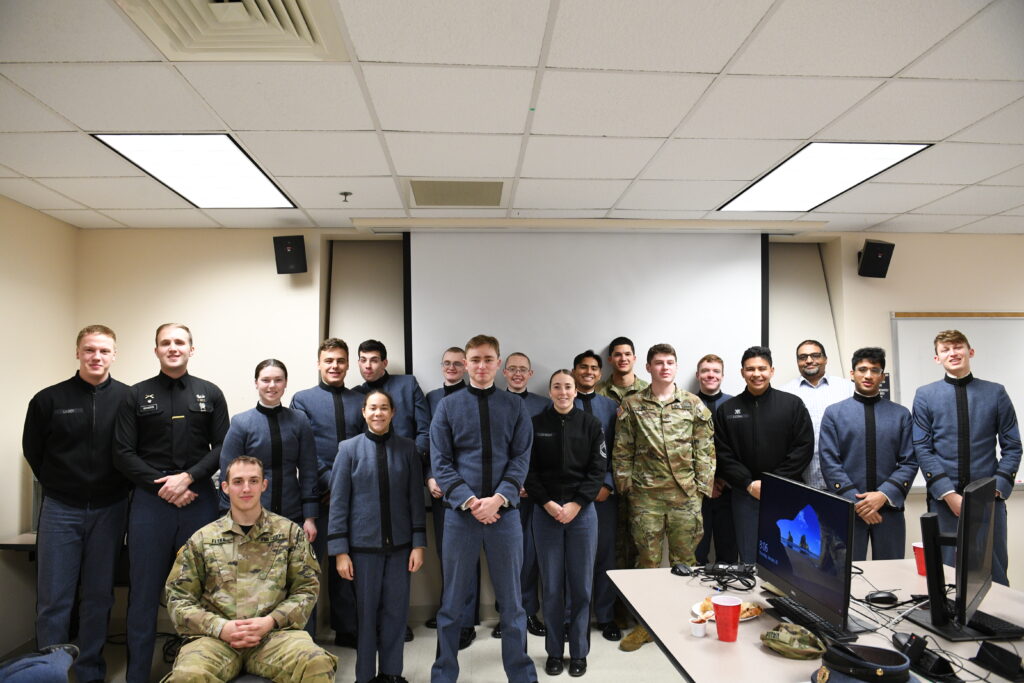
Cyber Club meets on Thursdays at 8 p.m. in Mallory Hall.