Post View Unavailable »
New Website Launched »

A Passion for National Defense: Kevin Linko ’23

This article is part of The Next Step series. While the four years at VMI are designed for cadets to push themselves academically, physically, and mentally to tackle the demands of life at a premiere military college, they also prepare cadets for life after graduation. Whether that life be one in the military or one in the private sector, VMI faculty and staff provide guidance to cadets along their journeys. One department specifically dedicated to that endeavor of post-Institute success is the Office of Career Services. In The Next Step series, we sat down with cadets preparing to enter the workforce after graduation, as well as those still in the midst of their cadetship preparing for internships over the summer. 

Kevin Linko ’23, a physics major from Princeton, New Jersey, minored in mathematics and astronomy. Soon he will begin his professional career with CACI, a company that provides expertise and technology to customers in support of national security missions and government transformation.

Linko was drawn to this industry through his passions for learning about technology and contributing to national defense. He will begin as an entry-level simulation and test engineer. The primary focus of this position is the development of radar threat simulations that will be used during Aircraft Survivability Equipment (ASE) software testing and validation. Tasks include radar signal parameter analysis/interpretation, test plan development and execution, test analysis and reporting, quality assurance, software design, and development for applications.

The support of Career Services and the structure and reputation of the Institute were vital in helping Linko prepare for and apply to this position.

“They [Career Services] were very helpful. I used their conference room for interviews and worked with Major Blake to prepare for frequently asked questions as well as debriefing after the interview and talking about what went well and things to work on for next time.”

Linko credits VMI having “prepared me for this career path because while here, my academic program has taught me all the hard skills needed to be able to do my job, while the VMI experience helped me learn all of the soft skills that I will need in order to be successful.”

Hoping to see himself in ten years contributing to the success of an organization and continuing to increase his skills and education, Linko believes that having VMI on his resume will continue to give him a competitive edge, as the school’s reputation and its structure provided during the interview process for his position at CACI.

-VMI-

SURI: VMI Cadet Examines First Amendment Rights for Military Members

The First Amendment of the U.S. Constitution is considered to be the most important part of the Bill of Rights. It guarantees citizens the freedoms of speech, religion, press, assembly, and petition. The Constitution restricts the government from taking these rights away from ordinary citizens. However, when citizens take a commissioning oath or oath of enlistment into the military, they become subject to the Uniform Code of Military Justice (UCMJ), a set of laws that governs everything from the handling of enemy prisoners to the conduct of ordinary soldiers.

Riley Malone ’25, a history major at Virginia Military Institute is examining the government policy on service members, and how their First Amendment rights have changed from 1900 to the present in his 10-week Summer Undergraduate Research Institute (SURI) project titled, “True Faith and Allegiance: The First Amendment in the Military.” A student doing summer research at VMI, a military college in Virginia

Malone, who has a vested interest in military law since he plans to commission into the Army upon graduating, became interested in the subject when he took a class called U.S. Constitutional History, taught by Lt. Col. Mark Boonshoft, associate professor and holder of the Conrad M. Hall ’65 Chair in American Constitutional History at VMI. “Before I took the class, I had not been aware of the differences between military and civil law. There are a lot of articles in the UCMJ that I didn’t understand, so I began to look into the history of it,” explained Malone.

According to Malone, the UCMJ puts restrictions on First Amendment rights such as speech and freedom of religion. “Officers can be charged for speaking ill of certain officials, including the president of the United States, elected state officials, and superior officers. Enlisted personnel can be charged for saying anything that violates ‘good order and discipline’ within the military. Such broad and restrictive laws would not be permissible in a civilian setting,” he said.

The military places heavy restrictions on fundamental rights for several reasons. It argues that UCMJ laws are fundamental to national security, and helps maintain civil-military relations, citing that it is vital the military remains subordinate to the civilian government, preventing conflict and a politicized military. Military and civilian courts have recently begun calling this reasoning into question.

“I found it amazing that someone off duty can say something political, like any ordinary person, but since they are a part-time soldier, they can be punished and sentenced to hard labor,” said Malone. Though he concedes charges and convictions don’t happen often, since modern courts have become more lenient, when it does happen it is significant. “The most recent example I have looked at so far happened in 2003 when an Army officer refused to deploy for his unit’s assigned rotation to Operation Iraqi Freedom, and accused President Bush of starting the war illegally. The officer was charged with speaking ill of an elected official and disobeying a direct order.”

More recent cases he is examining include the Jan. 6, 2021, incident at the U.S. Capitol building, where many veterans were in attendance, as well as a smaller group of active or reserve military members and national guardsmen. “Some of them were charged with conduct unbecoming of an officer and a gentleman or violating the no politics rule, and I want to see how that has been resolved,” said Malone.

Boonshoft who is serving as Malone’s advisor for the SURI project said, “Malone identified a question of perennial importance, but which is understudied by scholars. This research will make an important and timely contribution. Malone possesses a keen ability to pick up the nuances in judicial reasoning and a sharp sense for placing legal changes within their historical context, necessary skills for a project traversing law and history.”

Malone predicts he will have additional questions after the 10-week SURI session is over, so he plans to incorporate the project into his capstone and thesis for the Institute Honors program.

Malone graduated from Fishburne Military School in Waynesboro, Virginia. He is the son of Jaime and Jerry Allen of Seattle, Washington, and the grandson of Patricia Waldrop of Austin, Texas. He is the training sergeant for VMI’s EMT agency, a member of the Ethics team, and vice president of the Phi Alpha Theta history honors society. Upon graduating, he hopes to become an aviation or infantry officer in the Army. Constitutional history is an area he would like to focus on after his military career.

Striving for Political Greatness: Jimmy Murphy ’24

Jimmy Murphy ’24 has been working the past two summers in the U.S. Capitol, jumping between the U.S. House of Representatives and the U.S. Senate. The international studies major and national security minor from Golden Valley, Minnesota, took his first internship the summer of 2021 as a legislative intern with the Office of Congressman Jim Hagedorn (R-Minnesota).

“I knew that getting internships would aid me in rounding out a well-crafted resume for law school applications, along with opening the door for valuable connections down the road,” he said.

The following summer he spent as a committee intern with the Senate Committee on Homeland Security and Governmental Affairs. This summer he will be an intern with Van Scoyoc Associates, a government affairs team based in Washington, D.C.

Starting his political journey his junior year of high school, he’s been able to add his work in the U.S. House and U.S. Senate to his resume, along with being a published political columnist and making media appearances with the Ben Shapiro Show and RealAmericasVoice network.

He applied to multiple internships at various lobbying firms before landing one at Van Scoyoc Associates. He said his VMI connection with the firm aided in getting the full-time summer position.

“I had already had experience in the public sector working for Congress, so I wanted to diversify my experiences,” he said. “I ultimately chose Van Scoyoc Associates due to its strong reputation among my D.C. network in addition to the fact that I would be able to work with a VMI alum, Marine Colonel (Ret.) Michael Shupp ’81.”

What drew him to the firm was its reputation in D.C., its VMI connection, and its diverse legislative portfolio, which aligned with his interests and past experiences working with Congress.

This summer he will be assisting the firm in various duties like preparing materials for client meetings, researching relevant Congressional legislation, and attending different Congressional hearings relevant to the issue area project he’s been assigned to.

He said that VMI has taught him the tools of time management and organization, something he applies to himself daily as a Division I student athlete with several extracurriculars.

Murphy does not take anything for granted.

“I was born to a poor single mother and was moved around the foster care system before I was adopted from South Korea,” he said. “Every day I am reminded of how grateful I am to be an American and this has greatly fueled my burning passion to help and serve those around me. And this desire has manifested itself into a deep passion and interest in American politics.”

After VMI, Murphy said he will be pursuing law school, where he will work to earn a commission in the Navy, Air Force or Army JAG Corps.

“I eventually desire — either following active duty or while in reserve status — to return to my home state of Minnesota and run for political office to represent the people, state, and country that has given me so much,” he said.

VMI Cadets and Peers Enjoy Once-in-a-Lifetime Trip to Israel

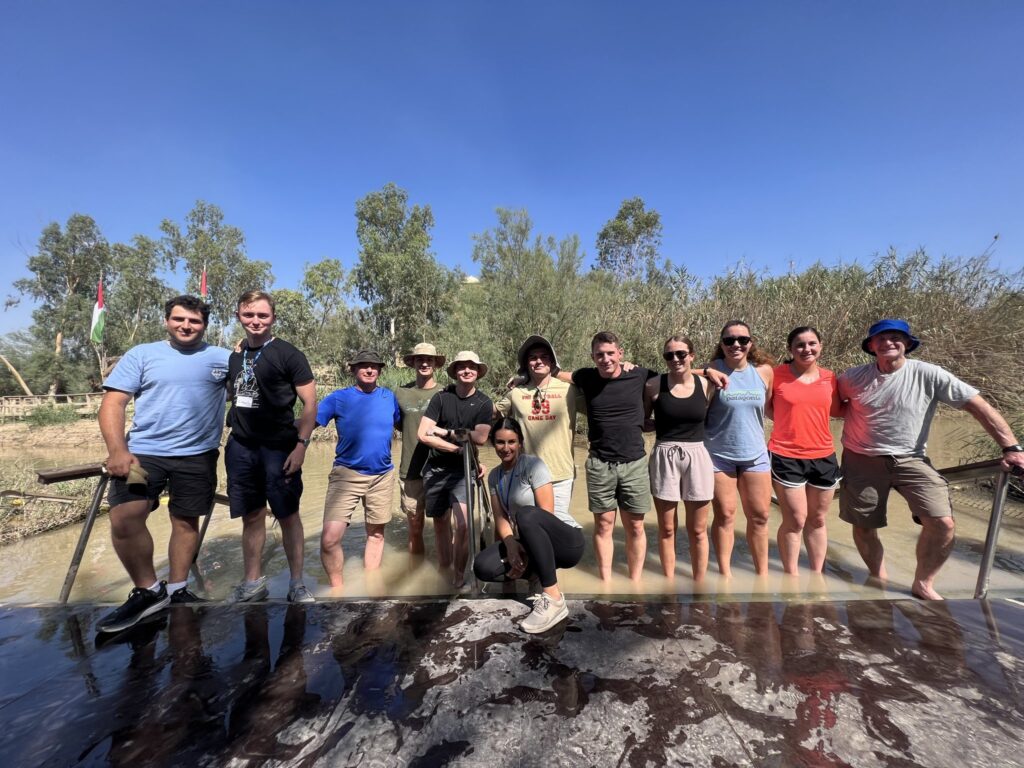
Cadets from Virginia Military Institute joined peers from the U.S. Military Academy at West Point and the Royal Military College Saint-Jean in Canada for a two-week Israel Strategy & Policy Tour (I-SAP) held June 2 through 17. The New York-based MirYam Institute initiated the two-week tour in partnership with the U.S. Department of Defense and each participating military academy. The program’s mission is to bring an awareness of the history and shared values between the U.S. and Israel to future officers. This is VMI’s second year in a row participating in the program. Students from VMI, a military college in Virginia, visit in Israel

I-SAP is a unique program exclusive to the MirYam Institute tailored for future officers of the U.S. armed forces currently enrolled in U.S. military academies. This program targets cadets planning to commission into the U.S. Army, Navy, Air Force, or Marine Corps, or those seeking careers within government intelligence.

This year, the trip began with a two-day visit to Poland. “The Poland leg of the trip was new this year,” explained faculty advisor Corps Sgt. Maj. Tom Sowers. He continued, “The trip takes the delegates on a journey from ashes to new life.” They visited the Rapoport monument for a ceremony honoring the heroes of the Warsaw Ghetto, the POLIN Museum of History of Polish Jews, and the death camps at Majdanek and Auschwitz-Birkenau before departing for Tel-Aviv, where the Israel leg of the tour began. The itinerary in Israel lasted 12 days, crisscrossing the entire country.  I-SAP cadets heard briefs by elected officials, generals, ambassadors, media analysts, jurists, ministers, and more to learn more about Israel, its place among the nations, and its relationship with the United States. 

While in Israel, delegates attended various presentations and cultural activities, including tours by way of Jeep, bike, and hikes in the region. Cadets also applied what they learned during the trip to debate a policy issue.

Paul Murray ’24 described the trip as an experience of “immersive historical reliving [that] encourages a political awareness and knowledge.” He said, “The ability to discuss things openly despite the proximity to danger… really struck me” and challenged his “flawed understanding of a complex situation which requires the attention of future leaders like ourselves.”

Students from VMI, a military college in Virginia, visit in IsraelMelina Bulger ’25 said, “By seeing every border and the battlefield sites, we were able to visualize what Israel’s gone through to maintain their statehood.”

Several cadets appreciated the ability to hear speakers from both the Israeli and Palestinian points of view, which gave them a better grasp of the whole conflict. They also agreed that the depictions of Israel in the news only included a slanted point of view, that of a region in constant war and turmoil, without sharing any success stories.

Cadets said they gained insights into regional geopolitics, learned about the vibrant and diverse culture, explored historical and religious landmarks while dining on delicious cuisine, and made valuable connections with diplomats, policymakers, and locals.

Cadets from Virginia Military Institute joined peers from the U.S. Military Academy at West Point and the Royal Military College Saint-Jean in Canada for a two-week Israel Strategy & Policy Tour.

“The relationships are next level, and you will never have more impactful conversations,” said Ella Flickinger ’24.

During the tour, cadets visited several holy and religious sites.

William Lauerman ’25 said, “Religious sites helped me to understand the historical context and religious beliefs that are shaping Israel.”

Visiting places such as the Church of the Holy Sepulchre, the Temple Mount, the Room of The Last Supper, the Sea of Galilee, the Synagogue in Jerusalem, and more highlighted the significance of the nexus of religious beliefs in the region, and the impact of Jewish religion pre-existing their state. Students from VMI, a military college in Virginia, visit in Israel

When asked about the differences in the trips from the first to second year, Sowers said that during his first trip, he was very interested to see all the holy sites he learned about through his faith tradition. But for the second year, he was able to focus a lot more on Israel as a nation and political ally. He also explained that cadets who participated in this trip were a nice representation of VMI’s three-legged stool, coming from the various military branches, having various ranks, majors, and some NCAA athletes.

Before the trip, cadets had an assigned reading, “ISRAEL – A Concise History of a Nation Reborn,” and some videos and films to watch, such as “The Pianist,” “Schindler’s List,” and a clip from “Band of Brothers.” Also, Col. David Gray, executive director of the Center for Leadership and Ethics, conducted a briefing as part of the preparation to review requirements and share important information regarding international travel. Cadets learned about this opportunity in a recruitment briefing, which is available in the spring semester. Cadets interested in this opportunity can contact Sowers or Gray for more information. Funding for the trip starting from JFK Airport comes from the Office of the Dean and the MirYam Institute.

The Extra Mile: Promaji

In 1975, several Black cadets at Virginia Military Institute joined together to create a community for minorities on post. To better understand VMI, and navigate the Institute as a Black cadet, these students assembled to build what is now known as “Promaji.”  

When the club was created, the members made it their goal to leave a legacy for Black cadets at VMI.  

“One of the first classes of Black cadets thought that they needed to have a community of people where they felt like they belonged,” said Fatoumata Diallo ’23, last year’s president of Promaji. “It was this idea of togetherness … looking out for each other and looking out for the people that came after them.” 

Promaji comes from the Swahili word “Pamoja,” which translates to “togetherness.” Today, the group still embraces this pillar and has extended its mission to serve all cadets and all minorities.  

Representing the underrepresented  

“The club members have become more diverse over the years to include people from different cultural backgrounds and different genders,” said Diallo.  

Mark Shelton II ’23, council member of Promaji and 2023-24 regimental commander, explained the group’s significance – “We have a lot of underrepresented groups at VMI,” he said. “Promaji gives those individuals a safe space, a place to interact with their peers and people that look like them or may have a similar background.”  

The club meets once a week and holds various events throughout the year.  

“We host movie nights, trivia nights, and open mic nights,” said Shelton. “We also sponsor sporting events, like basketball tournaments and other tournaments.”  

To celebrate different heritages, the club hosts events for most heritage months.  

“We’ve held events for Black History Month, Women’s History Month, Hispanic Heritage Month,” said Shelton.  

The bond among cadets and alumni at VMI is best defined by the term – “One Corps, One VMI.” Shelton shared that this bond is parallel to the mission of Promaji.  

“Togetherness … ‘One Corps, One VMI,’ they’re interchangeable,” he said. “We encourage everyone from different backgrounds to come and share their ideas, beliefs, and to be supportive of everybody because no one person is the same.”  

Building leaders and breaking up the Rat Line 

Shelton and Diallo were both influenced by their dykes to join the club, and they became members during their first year at VMI. When it was time for club meetings, Diallo and several of her brother rats gathered in their dyke’s room to head down for the meeting. “Initially, we didn’t think much of it,” she said.  

Diallo joined the club to accompany her friends and her dyke, but it later grew into a meaningful experience. At one of her first meetings, Diallo noticed that the atmosphere of the club was different.  

“Seeing how welcoming the upperclassmen were to us, even though we were rats…” she said. “Telling us about opportunities we could apply for, telling us how to stand out, and strive at VMI… is what made me interested in staying in Promaji.”  

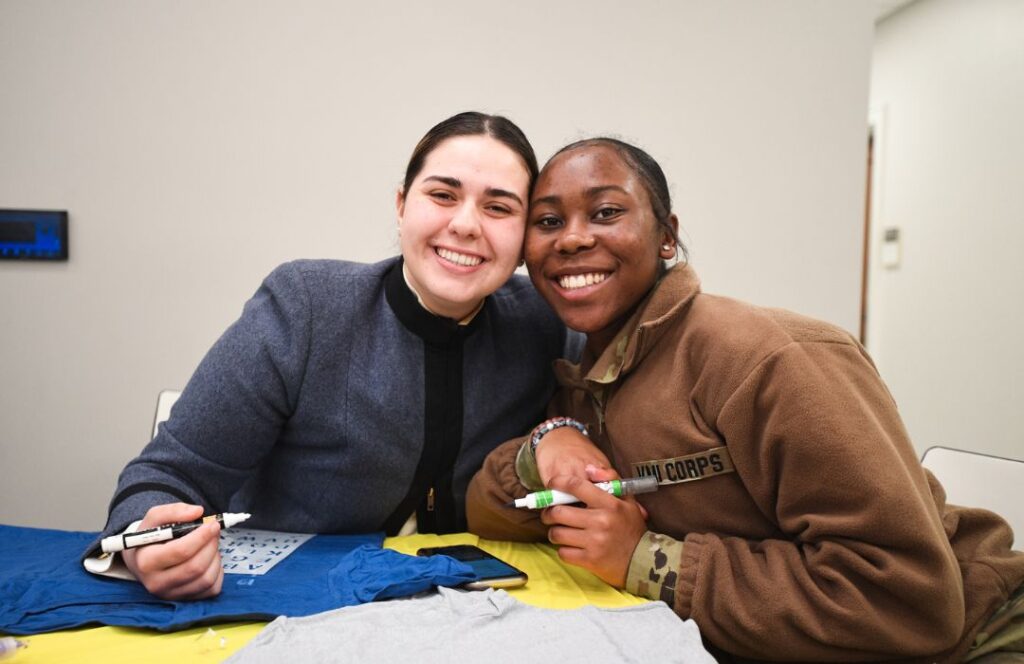
Two cadets pose for a picture.

Diallo shared that the club was instrumental in her leadership journey, helping her take steps towards being someone who stands up for people like herself.  

“I wanted to be a role model for other cadets who came in and looked like me, or who felt like they didn’t see representation in leadership positions,” she said.  

As a rat, Diallo recognized the importance of the club and wanted to follow in her dykes’ footsteps. Holly Jabo ’20 was the president of Promaji in 2019 and spurred a long journey of leadership in her rat. As a 3rd Class cadet, Diallo became the secretary and the following year, she served as the vice president of Promaji.  

The Promaji legacy  

Each year, Promaji alumni ask a single question to the 1st Class club members: “What legacy do you want to leave once you leave Promaji?” For Diallo, the answer is inherently clear.  

“I hope that Promaji remains a club for minorities and that they feel safe to discuss any issues,” she said. “I hope Promaji keeps representing and being a voice for minorities … and that they will not be shackled or submit to any pressure from people or organizations … that’s what makes Promaji unique.”  

Diallo hopes that the club can increase its membership and continue to expand its diverse composition.  

“I hope that Promaji will continue to welcome anyone that is willing to listen or learn,” she said. 

SURI: Exploring the Link Between Athletes, Family Influence, and Anxiety Scores

In recent years, anxiety and depression have emerged as major concerns among college students. The pressures and demands of academic life, coupled with various personal and social challenges, can take a toll on their mental well-being.

Recognizing the urgency of addressing these issues, Caragh Osborne ‘24 aims to identify key contributing factors and raise awareness about their implications.

Osborne has always had a passion for mental health.

This summer, she’s conducting a study focused on anxiety symptom scores among athletes and non-athletes, examining the impact of family influence on the decision to attend college and its potential correlation with anxiety levels. Student doing summer undergraduate research at VMI, a military college in Virginia

“With the spotlight that is cast on anxiety and depression in college students, I think it’s important to take a look at what factors contribute to this – before the students are even at school,” said Osborne.

She will spend the first half of the summer completing research as a part of the Summer Undergraduate Research Institute (SURI) at Virginia Military Institute. This program, offered by the VMI Center for Undergraduate Research (VCUR), provides cadets with a unique opportunity to delve into high-level research that relates to their degree path.

SURI consists of cadet-led research under the direction of a faculty advisor. During class, Osborne asked Maj. Aubrey K. Whitehead, assistant professor in the Department of Psychology, to assist in her research. Whitehead teaches LEAD 344, a mandatory leadership theory course, and in the spring semester, also taught a motivation course for the first time at VMI.

“It came up organically,” said Whitehead. “We were chatting about topics in class, and she came up to me and said, ‘I would like to do research!’”

Based on the relationship they had built in class; Whitehead did not hesitate to accept. The faculty advisor serves as a consultant to the cadet researcher and guides them through the research process.

“Major Whitehead always has really great input,” Osborne said. “So, it was an easy choice.”

Anxiety on post and among athletes

The primary focus of the research is to inventory self-reported anxiety symptom scores among cadets at VMI. By examining the differences in these scores between athletes and non-athletes, Osborne hopes to gain insights into how participation in sports impacts anxiety levels.

As a cadet, Osborne has witnessed first-hand the mental health issues that arise on post, in the realm of athletics and cadet life. As a Division I athlete on VMI’s water polo team, Osborne has a personal connection to her topic and has dealt with performance anxiety throughout her many years of participating in athletics.

During her first year at VMI, she experienced anxiety at water polo practice, due to her status as a rat. Thankfully, her teammates were there to surround her with support.

“When you’re on a team, there’s no First, Second, or Third Class,” she said. “There are no rats … essentially, everyone is on the same team.”

Sports involvement is often associated with various positive outcomes, such as improved physical health, teamwork skills, and stress reduction. However, it is important to understand whether there might be any nuances regarding anxiety within this context.

“During the season, we travel every single weekend,” said Osborne. On some weekends, she and her team are gone from Thursday to Sunday, which can lead to playing catch-up.

“For me, my biggest source of anxiety is how I am going to get my homework done.”

Throughout her research, Osborne aims to investigate the role of family influence on a cadet’s decision to attend college. Specifically, the study explores whether cadets who report perceiving more family influence in this decision exhibit higher anxiety scores.

The stress that led to the study

Student doing summer undergraduate research at VMI, a military college in VirginiaWhitehead and Osborne initially connected through conversations about sports. Eventually, Osborne landed on a topic, which stemmed from her level of stress.

“It kind of came from Caragh’s level of stress and thinking about what was next in her life,” said Whitehead.

Osborne was torn between searching for a post-graduate job or continuing her education in a master’s program.

Family support and expectations can significantly shape an individual’s mindset and approach to college life. Examining this aspect will provide valuable insights into the interplay between familial dynamics, anxiety, and the decision-making process.

To accomplish these objectives, Osborne has dedicated several hours each day throughout the five-week Summer Session I to reading current literature, collecting data, and conducting analysis.

By thoroughly examining existing research and employing rigorous data collection methods, the researcher aims to establish a solid foundation for their study and ensure its validity.

SURI’s success rate

The SURI program at VMI plays a pivotal role in empowering cadets to conduct research in their areas of interest.

“I’m a big fan of SURI,” said Whitehead. “I think this is a unique opportunity that more cadets should take advantage of.”

This unique opportunity allows them to contribute to the field of knowledge while gaining invaluable experience in conducting rigorous research.

“I think the SURI program is important because it allows cadets to conduct high-level research on something they are interested in,” said Osborne.

The findings from this study hold the potential to benefit not only current students at VMI, but also students at other educational institutions. Understanding the factors that contribute to anxiety and mental health challenges in the college setting can inform the development of targeted interventions and support systems.

On a personal level, Osborne aspires to use this experience as a stepping stone for her future graduate work in the field of mental health and clinical outcomes.

Post Briefs, June 2023

McDonald Presents “My Time with Cy” in Vienna

The internationally celebrated artist Cy Twombly remained dedicated to his hometown of Lexington, Virginia, and created many of his most important later works at his studio downtown  during his annual visits. Col. Rob McDonald, associate dean for academic affairs and professor of English and fine arts at VMI, was an acquaintance of Twombly. He often photographed Twombly’s home and in his studio. McDonald’s photographs and mixed-media works are the subject of a solo exhibition at the Anzenberger Gallery in Vienna, Austria, which opened May 11 and runs through August 18. McDonald’s daughter Grace, Class of 2021, living in Edinburgh, joined him in Vienna for the opening reception and lecture. 

Cadets Participate in Datathon 2023

Facing the topic of “Unmasking Maternal Mortality” were Komsun Samngamkeao ’24, Mitchell Meyer ’24, and Jesse Dennis ’24, at this year’s Virginia Datathon held at the Library of Virginia in late April. Each year, a complex challenge is presented, and participants must develop an innovative solution and present their proposed solution. The VMI team took a close look at maternal mortality rates based on age and ethnicity, as well as the leading causes of death. Solutions focused on equal opportunity among public health care plans, regardless of race and age, and to ensure health care workers have knowledge about the disparities in health factors and health care among the different groups.

Norwegian Foot March

Just shy of 300 participants undertook the Norwegian Foot March, or Marsjmerket, Sunday, April 23. In addition to VMI cadets, other college ROTC program cadets, exchange students, and even some serving at bases across the country joined the event in Lexington. This march is a physical challenge to ruck 18 miles with at least 25 pounds in their pack. Upon completion within the time standards based on age, participants receive the Norwegian Proficiency Badge. Cadets will be eligible to wear this badge on their uniforms, and potentially wear it on their future military uniforms.

-VMI-

The Extra Mile: Ranger Challenge

Have you ever wondered what a mix of Army ROTC and a varsity sport would be? You’d get the Army ROTC Ranger Challenge team, which is a club at Virginia Military Institute.  

A cadet has two chances to make it into the Ranger Challenge team at VMI — once in the spring and another in the fall each year. The week-long tryout results in only 50% of those attempting landing a spot. 

What do tryouts entail? Two words — grueling effort. 

The club tests several skills, from written land navigation tests and day orienteering, to basic rifle marksmanship and a grenade assault course. There’s also the M-16 assembly/disassembly test, a mystery challenge that changes every year, and night orienteering. 

According to the Army, the Ranger Challenge team is described as an Army ROTC varsity sport, where teams form early in the semester and train nearly every morning of the week all the way up until the Sandhurst Military Skills Competition at the U.S. Military Academy (USMA) at West Point in mid-spring. 

But that’s not all, the club is also required to complete the Army Physical Fitness Test, which consists of two minutes of push-ups, two minutes of sit-ups, and a two-mile run — all to be completed when participating cadets are operating on less than six hours of sleep. 

Fun, right?  

It is for those who participate. More so, the experience helps prepare them for their future military careers.  

“You’re training for, essentially, what your job is going to be,” Collin Fitzpatrick ’23 said. “It’s a really good stepping stone.” 

The club is associated with Army ROTC, so those who are lucky enough to make the ranks are participating in activities that they will most likely be doing in their careers after VMI. Think of it as the best of the best. The cadets on the Ranger Challenge team often rank the highest in Cadet Summer Training (CST) and VMI’s Army ROTC.  

“It’s definitely a leg up for training for the standard Army ROTC,” Fitzpatrick said.  

The club is more rigorous than other clubs at the Institute. They practice as if they were an NCAA team. They complete physical training each morning that lasts for an hour beginning at 5:45 a.m. Then, every afternoon, they have skills practice for two hours.  

“We don’t have NCAA status, but I think the training time is similar to NCAA teams,” Fitzpatrick said. “We’re definitely one of the more active clubs. The thing is, it’s not really seen as a club because it’s associated with Army ROTC. We do fall in club status, but it’s kind of like limbo.” 

The majority of the team’s career goals are to be entry-level officers in the military.  

“It’s just a group of individuals that all are going toward the same goal. At the end of the day, we’re training for our jobs in the military,” Fitzpatrick said. 

Janine “J.J.” Colantonio ’23 said Ranger Challenge allows her to surround herself with others who are looking to better and challenge themselves.  

“It sounds kind of selfish, but we are preparing ourselves for careers at the end of the day,” she said.

Training for the Ranger Challenge team extends well beyond the academic year. The 2nd Class cadets on the Ranger Challenge team also participate in CST at Fort Knox, which involves platoon-level tactics and 10-level tasks, like individual soldier tests. Others throughout the summer maintain a regime with specified workouts to keep them in shape for the following year’s tryouts. 

The majority of cadets who participate in the Ranger Challenge either continue in schools like the Sapper Leader Course with the Army or Cadet Troop Leader Training (CTLT). 

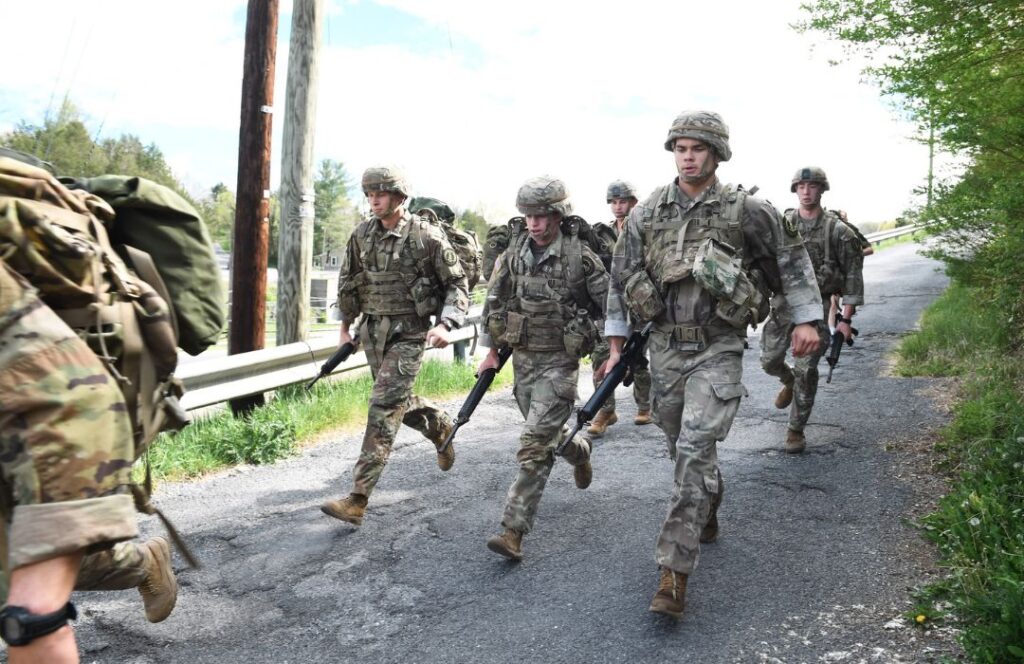
VMI cadets participate in Ranger Challenge, an elite Army ROTC program.

“It’s basically just like the military version of an internship,” Colantonio said. “You’re going to shadow like a [platoon leader] in a certain unit … so a certain job type or description that appeals to you that you’d be interested in. And you’re just seeing what the unit does, what you would do in the future in that specific job.” 

Most recently, the team placed fifth, winning a Sandhurst Medallion for the top five overall teams out of 48 teams in the annual Sandhurst Military Skills Competition April 28 and 29.   

VMI competed against teams from USMA, the Air Force Academy, and the Coast Guard Academy, as well as Army ROTC units across the United States including Texas A&M, Notre Dame University, North Carolina State University, Liberty University, and the University of Central Florida. In addition, 14 international teams competed including the Royal Military Academy Sandhurst (RMAS) in Great Britain, as well as teams from Brazil, Canada, Chile, Denmark, Germany, Korea, Japan, Latvia, Mexico, Poland, Thailand, and Sweden. 

Those competing spent two days running a myriad of obstacles including weapons disassembly/assembly, grenade assault, gas mask function, rifle and pistol shooting, programming a radio, carrying a casualty, land navigation, and lugging their minimum 35-pound rucks for approximately 30 miles. The winner of the competition is chosen based on performance at each of the obstacles as well as the speed with which they complete them.    

The takeaway, despite the arduous efforts in this club, is the relationships made with those who are part of it. 

“It’s people,” Thomas Marlow ’23 said. “The caliber of people that we wake up every single morning with is pretty substantial. That reflects in so many different aspects here at VMI, not just Army.” 

“I’d say a big thing even from the relationships that I formed as a freshman, even the seniors on the team at the time, they’ll reach out to me, or I’ll reach out to them and  that mentorship continues,” Fitzpatrick said. “And as they move forward in life, I kind of move in their footsteps.” 

The Extra Mile: Yearbook Club

The ability to flip through pages and be transported into the past is sort of magical.  

James Burns ’23 and his team spend the academic year scouring post for memories. They come in the form of pictures, words, moments, and more. From the Rat Challenge, Breakout to Ring Figure and graduation, the Virginia Military Institute yearbook, “The Bomb,” takes a snapshot in time that can be memorialized forever. 

“I think of ‘The Bomb’ as a way to remember what happened during the year when you look back in the book 25 years from now. It is truly putting together the collection of moments and people that make VMI special,” he said. 

The yearbook not only records events and cadets, but academics, clubs, sports, and shoutouts to the graduating class.  

For Burns, it’s the job of the editor of the yearbook to make sure those college moments are captured and put into print. It’s also a job he kind of just fell into. His fellow brother rat Sibi Bagavathy ’23 recruited him to help. 

“I showed up to a meeting and I got put directly to work. That was all she wrote,” the cadet-in-charge said. 

Now, he’s in charge. He works closely with Command Sgt. Maj. Suzanne D. Rubenstein with putting the actual yearbook together.  

“At the end of the day what happens to the yearbook is my decision, but I like to take a lot of input from my team in terms of cover, different spreads, themes, colors, etcetera,” he said.   

This year’s theme is “Shadows,” which will feature a series of shadowed photos around post.  

The yearbook was first published in 1885. After a nine year hiatus, it has been published continuously since 1895, with the exception of 1945 and 1946. VMI also digitized the yearbook collection from 1885 to 2010. 

“It is one of the oldest publications,” Rubenstein said. “It’s a year of history captured in the moment. You’re not going to get that back. You’ve got to publish this book and see faces and names.” 

The team spends the year ticking off boxes, hitting up all the clubs, activities, and more on post. It also allows participants to set their own schedule and work at their own pace — as long as deadlines are met. It’s an ongoing process, Anna Yemelianova ’25 said. Although things are wrapping up in mid-to-late April in terms of finalizing the yearbook, there are still things they have to document.  

“We still have so much of the year to get through and there are so many pictures and events that we could get into the yearbook,” Yemelianova said.  

The yearbook staff reiterated that Rubenstein tells them this is a cadet yearbook — not a staff yearbook — so the focus should be on those attending VMI.  

“She’s fantastic in that she allows us to have creative direction,” Bagavathy said. “Like what color it is going to be, or the overall theme of the yearbook. At the same time she’s basically kind of pushing us along where we need to be pushed along.” 

Bagavathy said the club is what you make of it, all depending on what your interests are.  

“For me photography, and I guess the creative direction of the yearbook design itself,” he said.  

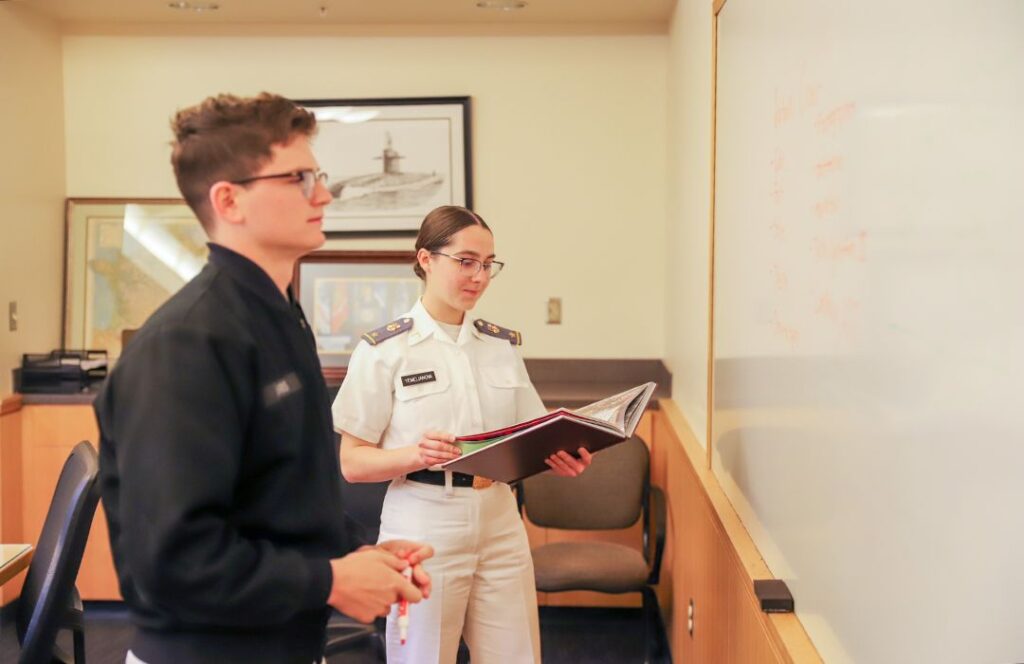
Two students plan out portions of the VMI yearbook, "The Bomb."

Bagavathy was involved with the yearbook while in high school. Overall, he enjoys the creativity of it.  

“Getting together and working in a team group environment … I was really excited to hear that there was something here at VMI just like that,” he said. 

The yearbooks, which are funded by the advertisements sold and placed in the back of them and by the purchases in previous years, are extremely popular.  

“My favorite thing about the yearbook is taking photos during the different events here. Especially when people don’t know the photos are being taken and they are living in the moment,” Burns said. “I think it’s awesome to be able to look at how far you and your class have come in just four short years here.” 

Bagavathy said VMI’s smaller size is a benefit.  

“I think VMI, given its size, is actually able to do a good job of capturing what cadet life is like, in addition to having biographies for each person laid out well. These bigger schools, you can’t really do that,” he said. “I think we do a good job of capturing all the different elements, rather than just making a glorified brochure.” 

It’s more personable, Yemelianova confirmed. 

“You can pick up a yearbook and just flip through it and be like, ‘Oh, I know so many of these people,’” she said. 

“It’s kind of nice having a platform to essentially make those memories into concrete, tangible objects that you can look at,” Bagavathy added. 

The Extra Mile: Drone Club

At 8 years old, Charles Malé ’25 had his eyes set on flight. “I’ve always loved drones, helicopters, and anything that moves,” he said.  

He spent years playing with toy cars as a child but eventually got bored with them. Moving onto toy helicopters, he finally landed on his true passion: drones. 

Malé, assistant cadet in charge of the VMI Drone Club, is a computer science major with a minor in cybersecurity, from Arlington, Virginia. Malé came to VMI with an associate’s degree in computer science and he plans to graduate early in 2024.  

“I’ve done a lot of work with drones over the years,” he said. “But they were quite expensive.” The cost of flying drones and professional gear can reach upwards of $1,000. Due to the expense of drones, Malé decided to take a break from his hobby.  

Luckily for Malé and other cadets at Virginia Military Institute, Dr. Sherif Abdelhamid had other plans for the Drone Club at VMI.  

Abdelhamid, assistant professor in the Department of Computer and Information Sciences, received a grant from the Commonwealth Cyber Initiative. Abdelhamid leads VMI’s Drone Club and has a fellowship from CCI that he uses to sponsor research and cadet development.   

More importantly, he has used the grant to sponsor all the Drone Club’s activities. “Using the grant, we have bought around ten drones of different types, sizes, and purposes, as well as other IoT devices and sensors,” he said.    

While attending a cybersecurity event, Abdelhamid became interested in drones and the role that they play in surveillance and protection. “The drones are no longer just flying toys,” he said. When asked if he would support the Drone Club, Abdelhamid thought it would be a great way to apply his personal and research interests to a cadet involvement opportunity.  

Last year, Malé was approached by Abdelhamid. “He knew I was into drones… we were talking about it in class one day,” Malé said. “He was like, ‘Oh you seem to be into drones.’”  

Malé had no idea that a Drone Club even existed at VMI. With little hesitancy, Malé joined forces with Abdelhamid and the two cadets –in charge, Kolby Quigg ’24 and Stone Summers ’24, to reignite the club.   

The club has a membership total of three to five cadets. Most members of the club are computer science majors. This common trait presents difficulties when cadets have overlapping group study sessions and cannot make it to the club meeting time.  

To accommodate the club’s demographic, and attract cadets from other departments, the club rearranged its schedule to host meetings on Mondays. “We’ve noticed a bigger turnout since then,” Malé said. “Next semester, we’re expecting to see at least five people consistently.” 

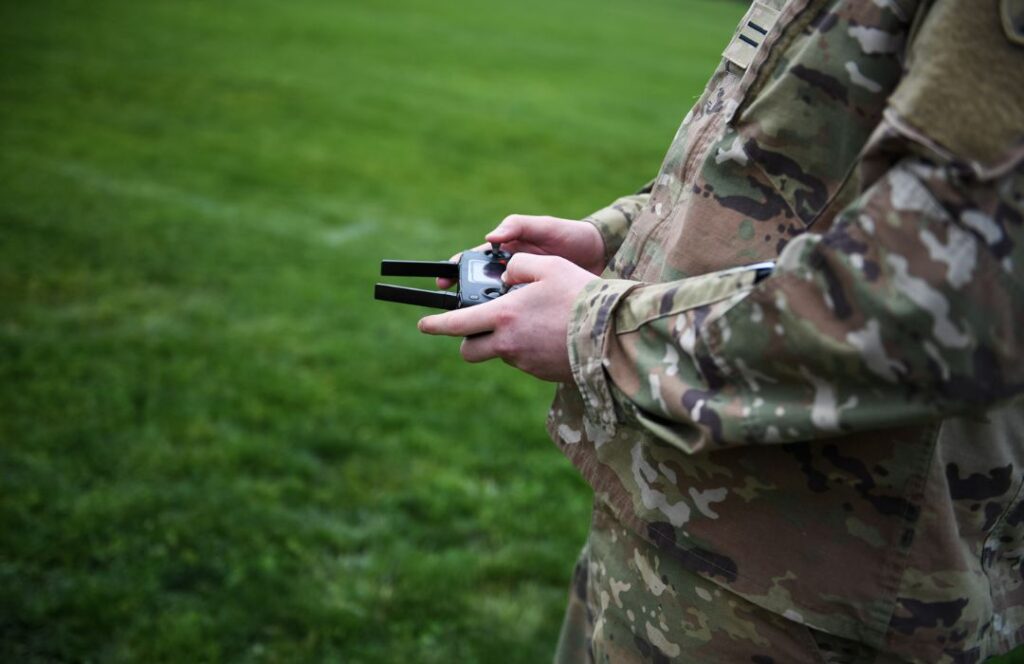
A cadet holds the controls to a drone in their hands.

Simulating flight  

Since the Drone Club had previously existed, the first step for the group was inventory – “We went on a treasure hunt for leftover drone parts,” said Malé.    

“We had to see what kind of drones were left behind and we found this really old brand called 3DR Solo,” said Malé. The club spent its first semester trying to update the software and firmware on these old-school drones.  

The software updates did not make a major difference, and the club moved on to purchasing DJI Phantom 3’s. Through this time, the club realized they were using a lot of large drones and ones that many cadets may be unfamiliar with. When the club came to this realization, Malé had an idea that would transform the club.  

“I introduced the idea of having people come in [to the club] and use my drone simulator,” he said. The Drone Club meets later in the day, around 8 p.m., and has had issues with flying at night.  

“So, we switched to simulators for the meantime, while we figured out the big drone situation,” said Malé.  

In addition to the drone simulator, the club has recently tapped into educational drones. Malé explained that the club is using educational software through a program known as “DroneBlocks.” The software uses visual programming concepts to help students learn to program drones, irrespective of their programming experience level. 

“We’ve been relying on their [educational] drones as a big resource for the first semester, as well as second semester,” said Malé. 

When looking to buy a drone, there are many classes to consider. Malé shared that there are educational-sized drones, racing-sized drones, indoor drones, and outdoor drones.  

Drone credentials and certifications 

To be considered “street-legal,” it is required to register drones that are over one pound. To register a drone and legally fly it, an individual must obtain a license from the Federal Aviation Administration (FAA). In addition to licenses and registrations, cadets in the drone club must work with post-police to make sure that they are following all airspace guidelines.  

This summer, the club hopes to increase its membership and will do so by sponsoring cadets to obtain their FAA licenses.  

“We’re going to sponsor cadets and faculty to apply for the FAA certificate,” said Abdelhamid. The club sent an email to all cadets informing them about this opportunity and has since received six applications.  

“We are planning to sponsor up to 10 cadets,” he said. Abdelhamid plans to use his grant to cover the test fees, study materials, and travel expenses for all interested cadets and faculty members.  

Aside from certification, the club has hopes of attending a drone competition soon. Next fall, the club plans to attend a gated drone competition, with teams competing from several different departments on post.  

Before then, the club received an invitation to participate in community cyber day May 13 in Natural Bridge.  

“On this day, we plan to showcase the work we are doing, the activities, and the drones we have,” said Abdelhamid.