Post View Unavailable:
Post View is currently unavailable due to technical difficulties. More information.Last Updated: 01-08-2026 09:42 AM»
Notice:
VMI.edu has recently been updated and upgraded. Please note that some URLs may have changed. Visitors are encouraged to use the new, expanded site menu and site search to navigate through these changes.
New Website Launched»
The VMI men’s club rugby team has dominated their conference this season, going 6-2 in the fall and 4-0 in the spring. Now they have their sights set on a national championship, which they hope to earn in New Orleans, Louisiana, at the 2022 Collegiate Rugby Championship from May 28 to 30.
“We know we’re blessed to be where we are now,” said Jackson Falkner ’22, cadet in charge and team captain. “Six months ago, we weren’t a national championship-caliber team.”
The team competes in rugby union (15 players) in the fall and rugby sevens (seven players) in the spring, with the championship tournament being rugby sevens. More than 30 cadets strong and coached by John Welsh, the team attracts players from across post. Cadets enjoy the physical challenge of the sport and the camaraderie of the team, and they practice hard every week. Despite their many victories this year, the team isn’t satisfied to rest on their record.
“We’re playing to win a national title,” Falkner said.
Maria Korsnick, president and CEO of Nuclear Energy Institute (NEI) in Washington, D.C., recently visited the Department of Mechanical Engineering and underscored the essential role for nuclear energy.
VMI offers a nuclear concentration option for cadets who plan a military or civilian career in nuclear technology. The concentration includes additional courses relating to nuclear physics and applications of nuclear technology.
“There is so much going on with nuclear energy right now, it’s really quite exciting,” said Korsnick. “Nuclear provides a backbone of carbon-free generation.” She discussed numerous new nuclear power projects and initiatives throughout the country that are gaining traction.
Cadets valued the chance to hear from a seasoned professional in the field.
“I thoroughly enjoyed her insights on de-carbonization, energy security and small modular reactors,” said Dane Hamilton ’22. “I have wanted to work in green energy but never really put much thought to nuclear power in the civilian world.”
“What impacted me most from her presentation was her optimism about the future of nuclear energy in the U.S. and abroad, and how much of a game-changer the newest generation of small modular reactors seems to be,” added Joseph Spears ’22.
Since November, several cadets have been working toward the German Armed Forced Proficiency Badge (GAFPB), a decoration which requires the completion of six physical and military events.
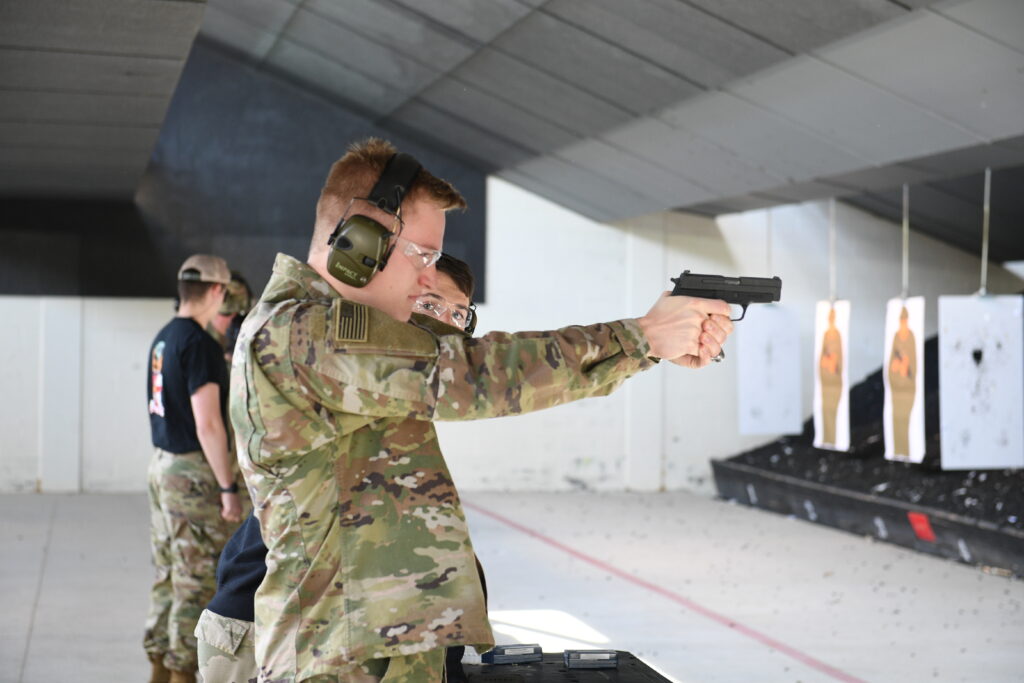
Under the direction of German officer Hauptfeldwebel (Master Sergeant) Christian Bensch, Lt. Col. Bill Bither, marksmanship director, and cadet range safety officers, more than 20 cadets demonstrated their pistol shooting prowess last week at the firing range on north post. Cadets were scored as they fired at targets while standing from three distances.
Upon completion of the tests, cadets can display the badge on their VMI uniform and U.S. Army uniform.
LEXINGTON, Va. April 22, 2025 — The hurdles of college and extracurricular activities mean something a little different for Zach Denton ’27, considering he actually jumps hurdles. As part of the Virginia Military Institute track and field team, Denton is dedicated to going the distance.
“Hurdles was always something I was very attracted to. I started in the 6th grade running hurdles, and it just always excited me so much,” he explained. “I continued it through high school. When I had the opportunity here, the coaches were receptive to me coming in to do hurdles.”
It was a learning curve. Denton said that there’s a height increase in hurdles from high school to the college level — 39 inches to 42 inches.
“It was a big jump freshman year to do that,” he said. “We spent a lot of my freshman year doing adjustments.”
Not only was the height difference something to adjust to, but also the amount of coaching he was getting at VMI. Coming from a military family, he moved from school to school growing up.
“I went to two separate high schools, and for the second half of my high school time, I didn’t have a coach. I had no hurdles coach, so I was basically self-coached,” he stated.
Having a dedicated coach to work on his technique, plus allow for the transition in hurdle heights, Denton admitted the extra work paid off.
“I was finally getting coached in a direction that I could go. I’m really excited for that as well.”
He’s now living out his dream of running Division I track and field — participating in both hurdles and the long jump. The psychology major was also in one of the first classes to be able to receive the Call to Duty scholarship offered at VMI. That, in addition to a U.S. Army ROTC scholarship, the financial aid he was receiving was appealing in his decision to choose VMI.
VMI Team Challenge track and field meet at the Corps Physical Training Facility in Lexington, VA January 11, 2025. (Randall K. Wolf)
He dedicates more than a dozen hours a week to track and field. On top of that, he’s enrolled in 17 and a half credits, and part of Color Guard staff.
Cadet-athletes at VMI not only have their responsibilities with their selected sport but cadet duties on top of that. Cadets are also required to take physical fitness classes twice a week, participate in ROTC all four years, prepare for room and uniform inspections, practice for parade, guard duty, and more.
He said he has to be smart about what activities he chooses.
“For example, for Color Guard staff, a lot of the stuff I need to do I will already be at,” he explained. “We raise the flag at formations, for example, so I’m already there. I’m just tacking that stuff on and then just really knowing what you have to do … a lot of to-do lists. I make a huge list of all the assignments that I know of at the beginning of each semester, and I go through those, just being really meticulous. I always tell people VMI is great at telling you when you don’t have time. So once you know when you don’t have time, you make a list of everything you need to do. And squash it in there.”
He tries to not let the stresses of daily cadet life or the preparation before a big race get to him. He said when it comes to track and field, a lot of his thoughts are centered in the build-up to the event than the actual race.
VMI Team Challenge track and field meet at the Corps Physical Training Facility in Lexington, VA January 11, 2025. (Randall K. Wolf)
“When you’re going through it, you really want your mind just to be conditioned to just do it in that instant, because in hurdles, that race is eight seconds long. Long jump isn’t a very long race,” he admitted. “You really want to get your body prepped and primed, and that’s where all the visualization happens when you’re going through the drills. But once you get on the run, once the gun goes off for the race, ideally, your best races, you have nothing going through your head. It’ll just be all muscle memory.”
He said some of his best races are the ones he doesn’t really remember.
Thanks to his time at VMI, he said he’s become more confident in himself, and it has presented him with a lot of opportunities to step up.
“Whether it’s public speaking or handling yourself under pressure, being a neat and precise person, I would say all those are foundational things. As I go into my 2nd Class year, the main focus is exerting influence on others. As a 3rd Class cadet, I’ve watched the 2nds and the 1sts lead, and I’ve learned from them. Soon it will be my turn to start doing that. I’m really preparing for that moment when I’m primarily leading others instead of being a follower.”
The Virginia Military Institute Army ROTC Blue Ridge Battalion partnered with the Citadel’s Palmetto Battalion to create a military skills competition between the two ROTC organizations.
This past weekend, eight cadets from VMI, two from each class, traveled to Charleston and competed against the Citadel’s team. A series of challenging events and exercises, the competition was designed to foster camaraderie and showcase the best of each institution.
The Citadel’s team claimed the victory at the weekend’s event, but the VMI team looks forward to hosting round two in November, the weekend of the “Military Classic of the South” football game, to claim revenge.
“Being able to lay the foundation for an event that will be happening in conjunction with the VMI versus Citadel football game every year was an honor,” said Jonathan Nardi ’22, cadet in charge of the event. “I can’t wait to see how it will evolve and continue in the future. Thank you to all the Army cadre that made the weekend possible!”
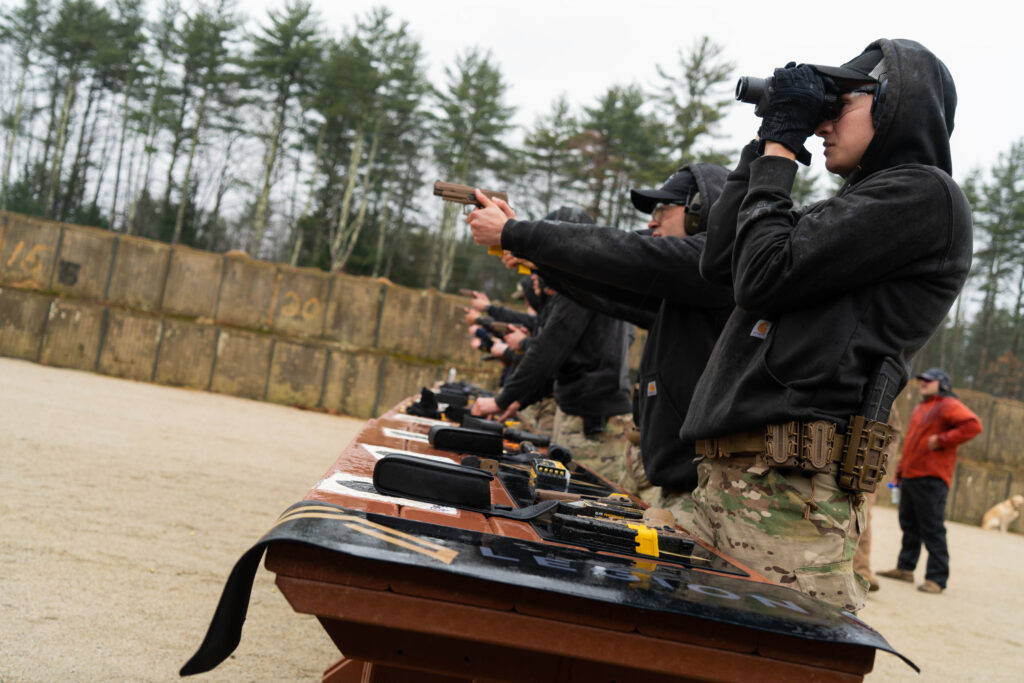
The VMI combat shooting club team represented the Institute at the annual Relentless Warrior Competition hosted by the Sig Sauer Academy in New Hampshire on April 9. At the event, the team competed against federal and senior military colleges in a six-stage combat shooting challenge.
Each stage was comprised of a random mix of paper and steel targets, with a designated course of fire for each. Competitors are graded as individuals but compete as a team. Each individual is scored on speed and accuracy hitting the paper target’s “A” zone and knocking down steel targets. Individual scores are aggregated to create a team score.
The VMI team placed 4th overall, beating out competitors like the Naval Academy and Royal Military College of Canada. Braden Kerr ’23 won a “Top Gun Award” for exceptional marksmanship and earned a Sig M-18 pistol. Kerr and Jack Stafford ’22 were also selected to conduct the POW/MIA Missing Man Table setting ceremony at the concluding banquet. A new club on post, the team is very proud of their performance at the competition.
“We went from having no coach, no money, nor bullets to competing at the biggest collegiate combat shooting event in the country, all within a matter of six months,” said Stafford, cadet in charge. “If the dedication, effort, and skill of the team can carry us this far in one semester, I can only imagine how we will be competing in three years.”
Who are considered the most influential people in building Virginia Military Institute? Appropriate answers may be Francis H. Smith, who served as the first superintendent or John Thomas Lewis Preston, a founder and one of VMI’s first two faculty members, but Christopher M. Hulbert ’22 has a different answer. In his senior thesis “Unearthed Contributors: African-Americans at Virginia Military Institute, 1839-1851,” Hulbert argues that enslaved African-Americans and free people of color in Rockbridge County were equally influential as Smith and Preston and presented his thesis during Honors Week, held March 21-31.
Hulbert is the son of the late Michael W. Hulburt, Jr. and Shay L. Reed-Hulburt of El Paso, Texas. He is the grandson of the late Lt. Col. Don Travis Reed, USMC (retired), who graduated from VMI in 1964. He is majoring in history with minors in literary studies and Spanish. He serves as president of VMI’s Omicron Delta Kappa Circle, is a peer consultant at the writing center, is Golf Company executive officer, a member of Phi Alpha Theta and Sigma Delta Pi, and a prosecutor on the Honor Court.
One major roadblock in Hulburt’s year-long research was a lack of reliable sources still remaining that document full names and family information of enslaved African-Americans and free people of color. He was able to find information in the VMI archives of two enslaved men: Michael Lyle and Ruben Howard, who were musicians and provided the crucial rhythm and cadence for VMI cadets as they marched in parades. Lyle and Howard wore distinctive uniforms consisting of red coats, white pants, and cocked hats. Their uniforms were different from those worn by the cadets, marking a clear hierarchy. At that time, there were less than 50 cadets, all white male, so Lyle and Howard were clearly recognizable and familiar to everyone on post as well as in the city of Lexington.
In addition to Lyle and Howard, Hulburt uncovered records of two additional slaves working on post: Jack, who was a baker and whose surname was not recorded, and Anderson Dandridge, who was a cook and baker. Dandridge worked at VMI for many years, including those during the Civil War, and died in 1871. At his death, one cadet who knew him eulogized him as “a fine baker, good cook, and fair friend.”
In researching free people of color during the years between 1839-1851, Hulburt continued to meet limitations in his findings. Like slaves, laborers were recorded by first name only, the literacy rate was low within this population, so finding personal or familial records was unattainable, and it was not until 1850 when the U.S. census began to count free people of color. However, he was able to find information on a free man named Diego Evans, who had multiple enterprises: sold cigars and other goods, had a barber shop and cut the hair of cadets on post, and operated a livery stable. Records indicated that VMI contributed in part to Evans’ ventures by paying him 41 times for services he provided. In 1850, Evans and his family relocated to Liberia, Africa, and sadly soon after, died from disease.
Hulburt concluded his presentation by arguing that the tasks performed for the Corps of Cadets by the enslaved and free African-Americans during that time, were vital for the day-to-day operations, and had it not been for their contributions, VMI may not have secured the subsequent state support and endowments. He went on to say that these are people who helped craft the narrative of VMI and are worthy of remembrance.
Hulburt will graduate in May and will be commissioned in the Air Force.
Henry Ford’s Model T became a widely accessible and affordable automobile for the average American in 1920. At that time, people began to travel less by railroad as they increasingly drove their cars to their destinations. Roads for cars began to be built and funding for constructing the roads was needed.
Most modern highways and roads are primarily funded through taxes paid at the gas pump, but with the increasing popularity of electric and hybrid vehicles, how will roads be funded in the future? Drew P. Melusen ’22 proposed alternative solutions in his senior thesis at Virginia Military Institute, “The Future of American Road Infrastructure Funding,” during Honors Week, held March 21-31.
Melusen stated that the gas tax is inadequate to fully fund road construction and repair throughout the country, causing massive budget deficits. With electric vehicle sales increasing annually and projected that by year 2050, half of cars on the road will be powered by electricity, he reported that the deficits will dramatically increase unless alternative ways of funding are implemented.
Melusen recommended that registration and user fees should be implemented for electric vehicles. He believes a truck mileage tax should be considered to supplement the fuel tax deficits. He also recommends the continuation of competitive bidding for road construction projects and the development of best practices for efficient spending of limited tax dollars.
Melusen’s parents, Gary and Catherine, of Bristow, Virginia, were in attendance for the presentation. They stated proudly, “Drew chose to attend VMI because of its reputation as an excellent institution of higher learning and because he wanted to be challenged. He has done well at VMI and it has been a great experience for him.”
Melusen is majoring in civil engineering and is a member of Tau Beta Pi, the engineering honor society. After graduating in May, Melusen will pursue a master’s degree in civil engineering at the University of Virginia. While at UVA, he will work as a graduate research assistant for the Virginia Transportation Research Council, which is part of the Virginia Department of Transportation. In spring of 2023, he will commission into the Air Force and begin training as a combat systems officer.
Has the Army improved since the Vietnam war? Has it acknowledged and corrected the mistakes made? Michael M. Hoffmann ’22, who commands the 1st Battalion within the Corps of Cadets at Virginia Military Institute, believes it has and defended his thesis in his presentation titled, “Kicking the Army’s Vietnam Syndrome: The Cultural Renaissance of the Post-Vietnam Army” during Honors Week held March 21-31.
Hoffmann, who is a dual major in history and international studies, is the son of Mario (who recently retired from the Army after serving 20 years) and Tina (who served four years in the Army before becoming a nurse) Hoffmann of Yorktown, Virginia. He is a member of the Army ROTC and ranked 5th in the nation, earning the position above thousands of his peers, based on grade point average, physical fitness, leadership evaluations and technical competency. His younger brother, Daniel is a sophomore at West Point in New York.
In his presentation, Hoffmann reported that after the Vietnam war, the Army was inflicted by malaise, disillusionment, drug use, and terrible morale. Yet just sixteen years later in 1991, there was a decisive military victory in Iraq.
The extreme and significant change, Hoffmann argued, was due to the new culture in the Army, brought on by organizational honesty and leadership with new insight. He describes culture as the linchpin, a vital component that holds all other aspects of the Army together.
Hoffmann credits four conscientious commanders for the turnaround of the Army culture: Gen. William Westmoreland, who saw the importance to invest in people; Gen. John Cushman, who believed in teaching people how to think, rather than what to think, and believed in the strength of providing role models; Gen. Maxwell Thurman, who made organizational improvements and is credited with the slogan, “Be All You Can Be”; and Gen. Paul Gorman, who instituted the National Training Centers, which provide realistic and effective combat training exercises.
Upon graduating in May, Hoffmann will be commissioning into the Army infantry and will attend Infantry Basic Officer Leader Course (IBOLC) in June at Ft. Benning, Georgia.
There are so many uses for soybeans. In fact, soybean yield was the subject of the senior thesis “Performance of Soybean Cultivars in Varying Rural Virginia Sites: Effect of Site Characteristics on Shoot Structure and Yield” presented by Rachael Dickenson ’22, during Honors Week at Virginia Military Institute, held March 21-31.
Not only is the crop used in many food products like tofu, edamame, soymilk, and soy sauce, it is also used as a high-protein animal feed. The oil from soybeans is used in margarine, cooking oil, and in biofuel applications. It is a $168 million crop in the state of Virginia alone.
Dickenson is the daughter of Glenn and Lisa Dickenson of Centreville, Virginia, and the granddaughter of Bill and Eileen Vandermeer of Ankeny, Iowa, Mary Dickenson of Warrenton, Virginia, and Walter Pennino of Fredricksburg, Virginia. She is double majoring in biology and civil engineering with a minor in Spanish. She said she chose to work on the soybean project because, “I believed it to be a balance of my two majors, with applications in biofuels and other engineering aspects.” However, she went on to joke, “though I was strongly discouraged from joining because of all the work involved.”
The soybean project was originally started in 2017 by previous cadets in the biology department and advised by Col. Anne Alerding. It involved planting nine different cultivars, which stands for “cultivated variety”, that is, different types within a species of plant, in two different sites within the state of Virginia. Those sites are Orange, north of Charlottesville, which has a more clayey soil, and Suffolk, which is closer to the coast and has a more sandy soil. Once the plants were harvested, it was the task of the cadets early in the project to remove the leaves, take photographs of them, dry the plants, and manually and painstakingly count and weigh each seed.
Dickenson joined the project, already in progress. She did not continue to do what had been done previously, but began a new phase of the project, involving computer science, statistical analysis, and image analysis. She wanted to find a way, using computer programming to speed up the process of assessing soybean yield and identifying the characteristics of the cultivars associated with an increased yield.
Dickenson was advised to consult with Dr. Aryeh Weiss, professor at Bar-Ilan University in Jerusalem, Israel, an expert in the computer program, Fiji (ImageJ). The two met weekly for nearly a year virtually. Dr. Weiss trained Dickenson in the software and mentored her throughout her research.
The conclusion reached by Dickenson was that soil was less important to the yield of the crop which she confessed, “was a bit of a surprise.” She discovered that the cultivar was more important. The work Dickenson performed will be labor saving for future studies in predicting pod to plant ratio yield.
Dickenson will graduate in May and be commissioned in the Army as an engineering officer.