
Post View Unavailable »
New Website Launched »

Honors Presentation Focuses on Conflict Predictability

Is it possible to know which country will start the next war? Leon M. Thomas ’22, son of Nukhet Viteri and Robert Thomas, and the grandson of Barbara Thomas, all of Newport News, posed this question as the basis of his senior thesis at Virginia Military Institute: “Democracies and Autocracies: Structural Factors that Determine Military Interventions” and presented his findings during honors week, held March 21-31.

Thomas, who is a civil and environmental engineering major, was introduced by his project advisor, Lt. Col. Patrick J. Rhamey Jr., who stated that Thomas was the only non-international studies major who did an international studies thesis. He also said that Thomas’ thesis was “one of the more impressive honors theses” that he has had the opportunity to advise.

Interest in the research question stems from his personal observation of an increase in war and authoritarian insurgence in the world during his lifetime. He stated that this increase was occurring before the recent Russian invasion of Ukraine, “which experts say is the largest military in Europe since World War II.”

Thomas underscored his visualization by sharing that he had traveled with other cadets to Serbia/Bosnia-Herzegovina on a cultural immersion trip recently, and while there, conversed with citizens of the region who felt a greater threat of war than they had for over thirty years.

By researching existing literature in the topic including writings by Immanuel Kant, Bruce Bueno de Mesquita, David Leblang and Steve Chan, Thomas proposed three hypotheses:

If a country has elections giving power to the voters whose approval is required for a leader to maintain power, then that country will be less likely to start a conflict.
If a country is a military regime, then that country will be more likely to start a conflict.
If a regime has existed for a shorter amount of time, then they are more likely to start a conflict.
Thomas put his three hypotheses to six different tests and came to the following conclusions:

Regarding the first hypothesis, only democracies supported this trend, authoritarian regimes did not. Regarding the second hypothesis, the trend was rejected, there was almost no association between military regimes and initiation of conflict. Thomas believes a possible cause for this is that a military regime’s goal is to preserve its powers, and war can deplete resources and cause conflict. Regarding the third hypothesis, only democracies supported this trend as they tend to grow more stable with time, in contrast with authoritarian regimes which tend to lose stability with time.

Thomas will graduate in May. After graduation, he plans to work as a water and wastewater engineer at JMT and to commission into the U.S. Air Force.
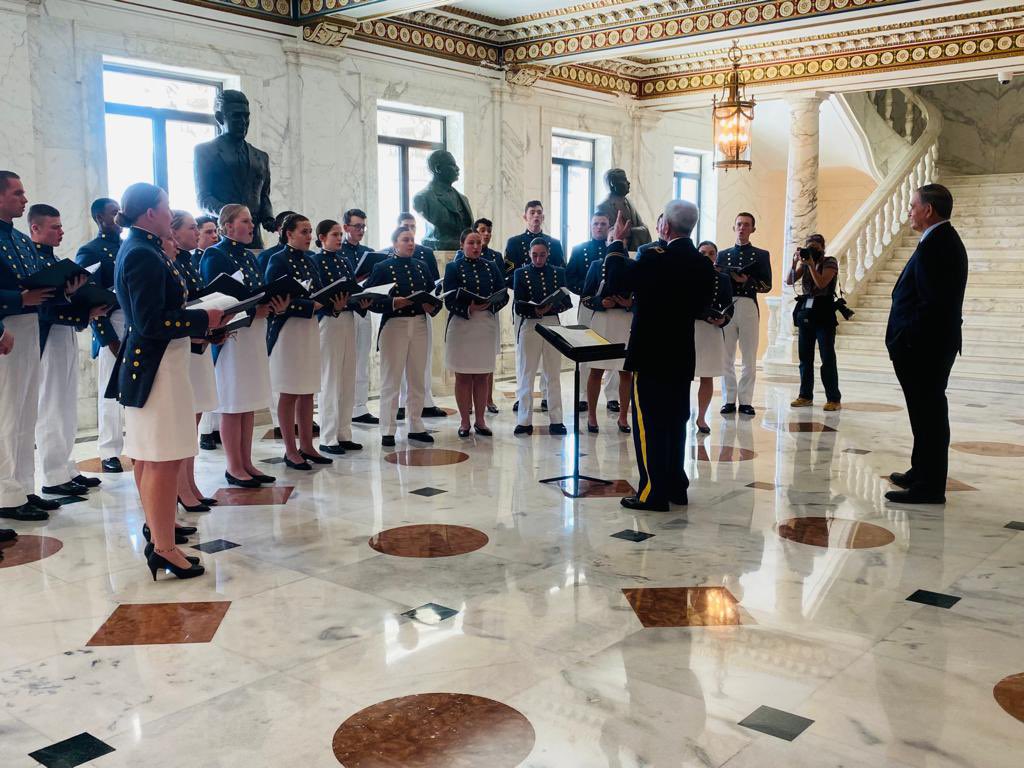
Glee Club Takes Their Craft Abroad

The VMI Glee Club represented the arts for the Institute and enjoyed beautiful weather in Puerto Rico over spring furlough. The group escaped a Virginia snowstorm when they departed from Roanoke Saturday, March 12, and within a day they were at the beach of Luquillo, Puerto Rico.

The Glee Club performed seven times in four days, including performances at the Conservatory of Music in San Juan, a Veterans Hospital in Juanna Diaz, at the residence of the Governor of Puerto Rico, and at the Puerto Rican Senate. Cadets also enjoyed a day of site seeing, visiting the El Yunke Rainforest, Old San Juan, and the beaches at Playa Del Mar and Luquillo.

The trip was led by Col. John Brodie, music director, who was grateful for the support of Roberto Gorbea ’62, Lt. Col. Jose Plaza, Puerto Rican Army Reservists, and many others. Cadets billeted at Camp Santiago and spent 28 hours traveling the island in vans driven by Reservists.

“We had the opportunity to perform for the governor, senators, and the Mayor of Aguadilla as well as numerous veterans, ROTC cadets, and civilians all over the island,” said Lauren Wolf ’22, president of the Glee Club. “It was an amazing experience for us to travel to such a beautiful location to promote our music as well as the Institute.”

The VMI Glee Club represented the arts for the Institute and enjoyed beautiful weather in Puerto Rico over spring furlough.

VMI Cadet Researches Disaster Relief

Volcano eruption in Indonesia, tornadoes in the United States, Hurricane Ida, Cyclone Tauktae, flash floods in India and Nepal, floods in Germany and Belgium are just a few examples of natural disasters that occurred around the world in 2021. In the United States alone, damages from natural disasters that year totaled $145 billion.

Crowdsourcing, which is enlisting the help of a large pool of people, has historically been a valuable way to help with disaster relief. Tanner Mallari ’22 researched that subject in his senior thesis, “Evaluation of Crowdsourcing Applications in Disaster Relief”, during Honors Week at Virginia Military Institute, held March 21-31.

For his thesis, Mallari defined “crowdsourcing” as a virtual crowd, that is internet users, who retrieve or perform organizational tasks, either as volunteers or for pay. His thesis question: “Is crowdsourcing a viable solution for disaster relief?”

To answer the thesis question, Mallari examined five computer applications based on their popularity and relevance for disaster relief: Ushahidi, mTurk, MicroMappers, OpenStreetMap, and GeoCommons and evaluated them using the following criteria:

  • Effectiveness: Can it be used for the intended purpose? Is it fast and convenient?
  • Education: Does it provide support pages and guides to allowing the user to learn?
  • Privacy & Security: Is the data secure and is the user protected?
  • Compliance: Does it adhere to laws, regulations and ethical standards?
  • Mallari found that all five applications were generally effective and have a huge impact in disaster relief, and they all prioritized user education. However, he found they all need improving in providing privacy and security for the user, as well as verifying user reports that have the potential of being false or malicious.

Mallari, the son of Barbara Mallari of Folsom, California and Ricafort Mallari of Rancho Cordova, California, is majoring in computer and information sciences. After graduating in May, he will commission into the Navy as a flight officer. He wants to make a career out of the Navy and to become a permanent military professor.

Cadets Participate in U.S. Air Force Academy Symposium

Kirsten Engel ’22, Glen Lash ’22, and Ryan Carpino ’23 recently attended the U.S. Air Force Academy’s 2022 National Character and Leadership Symposium in Colorado. The conference’s theme this year was “Ethics and Respect for Human Dignity,” and the event featured several keynote speakers and sessions. This trip was part of the VMI Center for Leadership and Ethics’ Cadet Leadership Enrichment Opportunities program that sends cadets to leadership conferences throughout the country each year.

“NCLS was a great opportunity for us to meet and connect with other cadets from USAFA and colleges around the country who we’ll have the privilege to serve with in the coming years,” said Lash, who will be commissioning in the Air Force. “Also, it exposed us to powerful speakers, including Dr. Ben Carson and the Chief of Staff of the Air Force Gen. Charles Q. Brown, who discussed how leadership founded upon ethics and respect for human dignity is crucial to our country’s future.”

“My highlight from the week was connecting with USAFA cadets and hearing from a C-17 crew who worked in Operation Allied Refuge,” Carpino said.

Engel, Lash, and Carpino were hosted by USAFA cadets in barracks for the event, which was “a great way to apply some of the lessons learned throughout the conference,” Engel said.

Club Pistol Team Carries on a Long Tradition

The VMI Club Pistol Team carries on a long tradition of shooting sports at the Institute. An Olympic sport, VMI has competed in pistol shooting in different forms since 1932. The current iteration of the team was formed in 2011 and is coached by Reece McCormick.

Cadets fire two main types of pistols: air-powered pistols firing a .117 caliber pellet and .22 caliber pistols. The team practices in the shooting ranges on post and competes at numerous institutions.

Excellence in pistol shooting comes down to the details: staying calm, focused, and still.

“As you practice, you learn more about breathing, how to focus in, and all of the little nit-picky things you may need,” member Elena Gutierrez ’25 said. “Sometimes just a little tip or pointer makes all the difference, and Coach and the upperclassmen are good at noticing and helping.”

Nailing the shot is extremely satisfying and teaches cadets more than just good aim.

“The best feeling is when you aim down at the target and you just know it’s gonna be a perfect shot as you pull the trigger,” member Riley Won ’24 said. “A big [lesson] is knowing when to shoot and when to step back for a second instead. The same idea applies to day-to-day life, just in a less literal sense.”

Cadets value the camaraderie and atmosphere of the team.

“It’s a big reason I stayed at VMI this year, because it gave me a group to help support me,” member Chris Olsen ’25 said. “I find it enjoyable, and I’ve gotten really good really fast by committing as much time to practice as I can.”

The team has found success throughout this year’s season and hopes to compete at the national tournament. Their next match will take place this weekend at the Citadel.

Bestselling Writer S.A. Cosby to Visit Post for Reading and Q&A

On March 1, cadets across post will have an opportunity to visit with award-winning, New York Times bestselling writer S.A. Cosby, from Southeastern Virginia. The visit was arranged by LTC Mary Stewart Atwell, an associate professor in the department of English, Rhetoric, and Humanistic Studies. Atwell, who teaches courses in creative writing (fiction) and British literature, invites all cadets, faculty, and staff to attend a reading and Q&A with Cosby. The event takes place at 8 p.m., Tuesday, March 1, in Marshall Hall’s Gillis Theater. Atwell notes, “This is an amazing chance for cadets to spend time with a successful, award-winning author and learn about his process.”

On March 2, Cosby will visit cadets in Atwell’s course, ERH 223W, Genre Studies—Fiction, and have lunch with cadets. Any cadets interested in coming to the lunch should email LTC Atwell at atwellms@vmi.edu. Atwell points out that “Cosby’s path to published author has been unusual in some ways, and I hope it reminds our cadets that great art can come from anywhere.” VMI English majors have as one of their top learning outcomes the capacity to analyze and produce creative works that express the richness of the human experience. Atwell sees Cosby’s work as relevant to all cadets, though, because of its Virginia setting, universal themes, and dynamic characters.

The event is sponsored by the Academic Speakers Fund; the Department of English, Rhetoric, and Humanistic Studies; Sigma Tau Delta, the English Honors society; and the Promaji Club.

-VMI-

Support System at VMI Key to Cadet Success

Julian Kim ’24 has found success in martial arts, Army ROTC, and in academics. Hailing from Haymarket, Virginia, Kim is a modern languages and cultures major with a focus on Chinese. After graduation, he plans to commission into the Army and branch aviation or military intelligence.

Kim was raised in a a traditional Korean-American household by parents who immigrated to the United States. His parents own a taekwondo school, and they were a constant encouragement for Kim growing up. Kim trained under his parents and found national success in taekwondo.

“I competed in sparring for the USA Taekwondo National Team for five years, and two of those years I was elected team captain,” Kim stated. “Being team captain of the national team taught me a lot about what it takes to be a leader.”

His father has been a strong role model for Kim and encouraged him to apply to VMI.

“[Not being able to spend] time with my dad is probably the hardest thing for me being here at VMI,” Kim shared. “His experiences in life and his different perspective of how the world works is what helped me become the person I am today. I just wish I could become half the man he is.”

As a cadet, Kim faced challenges in the Rat Line, but he found support from his dykes.

“The Rat Line challenged my physical fitness and mental fortitude with everything that goes on between class, Army time, and cadre time,” Kim said.

“Through the care and mentorship [of my dykes], I was able to build my own understanding of what is expected of a cadet,” Kim continued. “They told me to focus on my academics, and they helped me find ways to relieve my stress during the Rat Line. I played sports with them on the parade field, we worked out together, and I got to hang out in their room after the completion of my academics at night.”

In Army ROTC, Kim has built friendships and relationships amid training hard, especially in Field Training Exercises (FTXs).

“Spring FTX was probably the most miserable, fun thing I’ve gotten to do at this school,” Kim continued. “During Spring FTX, everybody was cold, wet, and sleeping in the rain with just a sleeping bag and a mat. But looking back at those miserable times also brings a lot of good moments with my platoon-mates.”

As he looks ahead to completing his time at VMI, Kim hopes future cadets remember to focus on what is important and “find that balance between academics, physical fitness, and free time.”

Cadets Present Research to ACM International Conference on Advanced Information Science and System

Noah Goldsmith ’22 recently presented research completed with John Barker ’23 in the ACM International Conference on Advanced Information Science and System (AISS 2021) hosted in Sanya, China. Guided by Dr. Youna Jung, associate professor of computer information sciences, the cadets were thrilled at the chance to present their work to an international audience.

“I had a wonderful experience,” Barker said. “It was really amazing to be able to go in-depth more about a subject I was interested in and being able to work so closely with Dr. Jung.”

Under Dr. Jung’s direction, the cadets researched trust management solutions for mission-oriented Internet of Things (IoT) devices.

“We are living in a world full of IoT devices deployed at both home and work,” Jung said. “To fully utilize the capabilities and capacities of IoT devices, we need to guarantee trust-based secure collaboration between devices so that IoT devices organize a group and achieve a common goal without any security concerns. However, existing works do not satisfy the needs of the Mission-oriented IoT (MIoT) systems due to lack of consideration of the heterogeneity of devices, the autonomy of devices, the diverse types of collaboration, the cooperability of devices, and so on. In this research, we introduce existing work on trust management models and systems on IoT and address their limitations. To promote future research on MIoT systems, we identify potential issues to be addressed and discuss some challenges. We strongly believe that this work expands the application domain of MIoT to many other areas in the future.”

“We strongly believe that this work expands the application domain of mission-oriented IoT to many other areas in the future,” Jung continued.

The cadets appreciated applying their studies to a real-world problem.

“It was a unique experience to present research in an international conference, and [it] offered me a great experience to use the skills that I have been learning throughout my education,” Goldsmith stated.

Civil Engineering in the Field

Cadets taking Civil Engineering 121, Surveying, took a field trip to McKethan Park before Thanksgiving furlough to practice flying Unmanned Aerial Vehicles (UAVs or “drones”) used in surveying and mapping.

Led by Maj. Rodney “Buddy” Wilkins, assistant professor, and Steve Neas ’77, the labs introduce entry-level civil engineering students to technology and techniques used in surveying.

“[Cadets] are introduced to a number of methods and instruments to measure distance, elevation, and angles in space,” Wilkins said. “The objective of the Unmanned Aerial Vehicle module is to expose students to cutting edge technology with application in both civilian and military environments.”

Cadets practiced creating models and maps from the data gained from the drones. Wilkins noted skills learned in the class are especially applicable to military careers, from reconnaissance to delivering offensive ordnance.

“Other applications for civil engineers include documenting progress on construction sites, topographical mapping, aerial surveying in challenging spaces, and even thermography,” Wilkins explained.

Rigors of VMI Education Prepare Cadets for Commissioning

“There’s so much knowledge here.”

Leon Thomas ‘22 is a civil engineering major from Newport News, Virginia. After graduating, Thomas plans on commissioning as a pilot in the Air Force.

Thomas was inspired to join the Air Force by his father, an Air Force veteran. As he was exploring colleges, he heard about VMI from one of his teachers. Upon visiting, Thomas appreciated the tight-knit feel of the Institute, something he didn’t experience at larger schools. He received an Air Force scholarship and chose to matriculate.

In the Rat Line, Thomas found challenges and friendships.

“I didn’t really know what to expect,” Thomas stated. “I heard [the Rat Line] was really hard, but it’s completely different than what I thought it would be. It’s very challenging and arduous, but the biggest thing that I got out of it was making friends. What kept me here and motivated me to stay and keep trying was the relationships that I built with people.”

Thomas worked hard to balance all of the “yelling” and “really hard workouts” of the Rat Line with a heavy academic load.

“Since I was rat, I always focused on making sure I hit the books and [made] sure I got an A in every class I could,” Thomas said.

As a civil engineering major, Thomas tackles challenging STEM classes and enjoys learning about transportation and infrastructure. He’s thankful to have professors with prior military service who help him build connections between his classroom learning and future career in the Air Force.

“There’s so much knowledge here,” Thomas commented. “There’s all this different military experience from different branches that you really would never have seen in many other places.”

His hard work in the classroom paid off, as Thomas was able to secure a pilot slot in the Air Force.

“I didn’t know if I’d actually get it or not, but it kind of fell into place and worked out phenomenally,” Thomas shared.

As a 1st Class cadet, Thomas leads the VMI Air Force ROTC cadets as wing commander. He appreciates the emphasis the program places on leadership and the wide array of opportunities cadets have.

As he looks back on his accomplishments, he is thankful for the opportunities that have come his way.

“If you asked me as a freshman if I’d be in the position I am, I’d probably say no way,” Thomas stated. “Really, the way that I did it was I set a goal, tried to figure out the way to get there, and set my mind to it. I did the best I could to stand out and take any opportunity they gave us.”