Post View Unavailable »
New Website Launched »

Photo from Alumni Reunion Reflects Family Legacy

“I hope to experience that deep love they have for this place one day.”

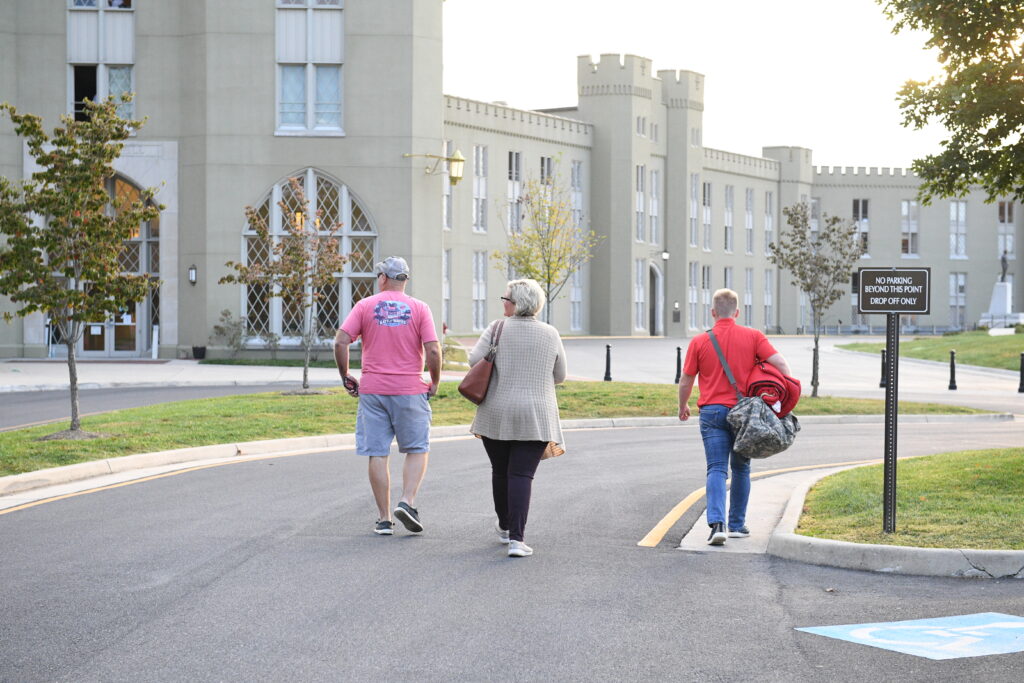
Every picture tells a story, and this picture from an alumni reunion this fall depicts the VMI legacy of the McCown family. Originally from Lexington, Virginia, members of the McCown family have attended VMI since the 1920s.

Jack McCown ‘24 is a history and English major from Richmond, Virginia. After graduation, he hopes to become a JAG officer in the Marine Corps.

For McCown, seeing the lasting impact VMI had on his family inspired him to attend.

“What was very attractive to me was the unique aspects [of VMI]: the honor code, unparalleled in the country right now, and the mental and emotional rigor of the Rat Line,” McCown stated. “That nice dichotomy of a military and civilian education.”

Growing up, McCown was in awe of the cadets he saw marching in parades, the rings his family members wore, and the stories he would hear about VMI.

“It’s impossible to not look at 1,700 cadets [marching] in step in a very sharp uniform [and] not want to go there when you grow up,” McCown shared.

Upon matriculating, McCown began to understand what his family members were talking about.

“Going here, I definitely learned why they love and value it so much,” McCown stated. “I will say, I don’t think any amount of storytelling or reminiscing about the glory days of VMI could have prepared you for the challenge. It’s very, very difficult.”

The experience of the Rat Line crossed generations for the McCowns.

“It was amazing how I could empathize with my grandfather (Albert Lee McCown ‘58),” Jack said. “You go through the same things, have those same experiences. It was really cool. This was something that was that common denominator and really united us all.”

The VMI Honor Code and regimental system imbued honor and character in each McCown.

“Each and every one of them knows when to bite the bullet and do the right thing,” McCown commented. “[Through] living through the honor code [and] abiding by the regimental system, as they all did, I think a strong sense of personal accountability and personal honor was imbued in them, and they certainly set that example for me.”

Though he did not know his great-grandfather, Albert Sidney “Mac” McCown ’31, Jack heard about the deep love he had for VMI.

“My dad had always talked about this stubborn love for VMI that he had,” McCown said. “They would stay in the pouring rain to the very end to watch VMI just get their tails whooped in some football game.”

Now, McCown has his great-grandfather’s class ring, a memento he treasures.
Parade Offers Insight and Encouragement to Attend

“The parade really got me.”

Claire Lee ‘22 is a history major and literary studies minor from Woodbridge, Virginia. A VMI rifle team member, Lee hopes to commission in the Army upon graduation.

Growing up, Lee heard much about VMI from her father, Steve Lee ‘95. Her family visited post often for football and basketball games, but Lee knew she didn’t want to attend VMI.

“I was like ‘this school is weird, I would never do anything like that. Why would they do push-ups during a football game?’” Lee stated.

Her senior year of high school, Lee applied to VMI as her “last” backup choice. Just in case, though, she attended an open house to see what post was like, and as she put it, “the parade really got me.”

“I fell in love with the whole system of VMI: the brotherhood, the discipline people are required to learn, the structure,” Lee said. “I was like ‘I need to come to this school.’”

For Lee, the Rat Line pushed her to find her voice and confidence.

“In high school, I was very shy, and I didn’t talk to a lot of people,” Lee said. “The Rat Line makes you go outside of your box, and that made me realize I need to develop myself into a more confident person so I can survive in this situation.”

At VMI, Lee found the inspiration to succeed from her cadre and Brother Rats. At first, she did not plan on commissioning into the military, but after being immersed in the VMI experience, she learned more about the opportunity.

“I talked to [the Army ROTC] cadre a lot about commissioning in the Army, and they told me I needed a good GPA and PT score,” Lee explained. “I wasn’t really good at PT, but I knew that I would get better if tried every day to be a better version of myself and reach my goals.”

Now, Lee holds leadership roles in Army ROTC and shoots on the VMI rifle team. As she looks ahead to commissioning, she hopes to branch into military intelligence.

“Military intelligence makes you challenge yourself and think outside of the box, and that’s what I want to do,” Lee shared.

Cadet Presents Research at Mid-Atlantic Regional Conference for Undergraduate Scholarship

Mitchell Masterson ’21 and his mentor, Maj. Jochen S. Arndt, travelled recently to the Mid-Atlantic Regional Conference for Undergraduate Scholarship in Lynchburg, Virginia, where Masterson presented his work on “Reporting on Civil War: How Newspapers Explained Township Violence in South Africa, 1990-1994.” Masterson’s extremely well-received presentation reflected the conclusions of his recent summer research which he conducted with the support of one of VMI’s Summer Undergraduate Research Institute (SURI) cadet/mentor awards. Reflecting on the experience, Masterson notes, “The conference presentation was an amazing conclusion to my research: I had the opportunity to stand in front of an audience, tell them about what I found out, and answer their thought-provoking questions.”

Masterson’s research journey began in the fall semester of 2020 when he took a course on South African history with Arndt. “It was fascinating to realize that there are important parallels between the South African past and our own history here in the United States notably with regard to race relations.” After the course, Masterson wanted to learn more about South Africa. “It was sheer luck that Major Arndt taught a capstone course on the rise and fall of South Africa’s apartheid regime in the spring semester of 2021; this gave me the continuity I was looking for,” Masterson says. For his capstone, he developed a project that has not received the scholarly attention it deserves: South Africa’s transition from apartheid to non-racial democratic rule between 1990 and 1994. As Masterson explains, “The transition is often hailed as a miracle because it did not involve a white-against-Black race war; however, while the negotiations to majority rule were going on, a civil war raged in the country’s townships, the places the apartheid regime had designed as segregated urban living spaces for Black workers.”

The capstone paper provided many new insights but it also raised new questions to which Masterson wanted to know the answers. The question that fascinated him the most was how U.S. and South African newspapers reported on the civil wars that raged in the townships during the early 1990s. According to Masterson, “Gaining a better understanding of the media’s coverage is important, because the coverage established the proverbial first draft of the history of this violence—a baseline understanding that influenced all subsequent narratives.”

Mitchell Masterson ’21 presents at and participates in Mid-Atlantic Regional Conference for Undergraduate Scholarship in Lynchburg, Virginia,

He used this project to compete successfully for one of VMI’s SURI awards. As Masterson notes, “The SURI award was a fantastic opportunity because it allowed me to spend an entire summer session on post to do research while receiving a stipend and credits.” Based on a close analysis of U.S. and South African newspapers, Masterson concluded that the media’s reporting initially labelled the violence as a Zulu-Xhosa tribal war, gradually shifted to explaining it as an ANC-IFP political power struggle, and eventually characterized it as a conflict driven by a Third Force comprised of undercover government forces and white supremacists.

With the research completed, it was only logical for Masterson to look for opportunities to present his conclusions to a wider audience. The Mid-Atlantic Regional Conference for Undergraduate Scholarship was a perfect fit and brought all his work over the last year into focus. “I acquired an immense amount of historical knowledge through this process,” Masterson notes, “But I also honed transferable skills notably how to ask important questions, how to develop evidence-based answers, and how to communicate these answers effectively in writing and orally.” He is convinced that these skills will serve him well in his next academic endeavor—law school.

Recent Success for Members of Running Club

Cadets part of the running club at VMI have found much success at recent races in southwest Virginia. Club members ran in both the Chessie Nature Trail races and Harvest Hustle races, with many cadets running personal best times.

In the Chessie Nature Trail races, both full marathon runners finished in the top 4. In the Harvest Hustle races held in Covington, cadets won both the men’s and women’s marathon, placed second in the 5K, and placed third in both the 10K and half marathon.

“The Chessie Half Marathon was a great opportunity to race on familiar ground against local runners and introduce some new club members to competitive running,” Thomas Wiltshire ’22 said. “The Covington race was the following weekend, and the team took the strategy and pacing lessons learned from the Chessie Half Marathon to result in [high placements].”

Cadets also ran in the Richmond marathon and 8K, with a cadet placing 3rd in the 8K.

-VMI-

Overnight Visits Return to Open Houses

As the world adapts to an environment of managing COVID-19 risk, VMI admissions staff have been able to bring back a staple of pre-pandemic life—overnight visits by prospective cadets—but with safeguards in place.

Approximately 55 high schoolers attended the September open house, and two more open houses were also offered this fall. All participants in this year’s open houses are required to submit proof of COVID-19 vaccination upon arrival to be able to stay the night, and are only allowed to stay in rat rooms overnight if all rats in that room have been vaccinated. Any participant who is not fully vaccinated may attend the open house, wearing a mask and staying socially distanced, but is not allowed to spend the night in barracks.

Last year, as the coronavirus pandemic raged, VMI held six open houses, but they were limited to one day only—Saturdays—and prospective cadets could only bring one adult with them.

This year, open houses look much more like they did before the pandemic—an overnight experience with two adults allowed per high school student.

“We wanted to get as close to the pre-Covid schedule as possible, and we pretty much have, outside of some small changes we were going to make anyway in terms of different presenters and moving some things around,” said Maj. William “Chase” Perry ’07, assistant director of admissions.

As in years past, open houses begin on a Friday morning with remarks from the superintendent and dean. A discussion of financial aid is also a part of that first gathering, as is a presentation from VMI Alumni Agencies, which is beginning a program to pair prospective cadets with alumni. After a short talk from a representative of the Center for Leadership and Ethics, high schoolers and their parents head to lunch in Crozet Hall.

The meal is held early, at 11 a.m., so as to not overload Crozet Hall and to allow for social distancing.

Then, it’s time for a major fair, held on the second floor of the Hall of Valor in Marshall Hall. Perry explained that this event gives the visitors a chance to chat with professors from a variety of majors and identify fields of study suited to students’ life goals.

Next are two separate presentations—one for students and one for parents—about ROTC units. Visits to academic buildings come next, so open house attendees can see the classrooms and labs they may someday occupy.

Parents with their child walking to barracks for an open house at VMI.

Students and parents then attend Friday afternoon’s parade, and students go with the S5 staff for dinner, a question-and-answer session with rats, and a tour of the Corps Physical Training Facility.

Parents, meanwhile, attend a Parents Council social after the parade with representatives of academic departments and ROTC units there to answer questions.

The next morning, the commandant speaks to the newly reunited high schoolers and their parents, as do some cadets holding senior leadership positions within the Corps. Wrapping up the event are an admissions brief and a question-and-answer panel with cadets.

The upcoming open houses for this fall filled quickly, with 80 prospective cadets signed up for each.

“It’s a good problem to have,” said Perry.

CIS Major Presents at International Conference

Tanner Mallari ’22, a computer and information sciences major, recently presented at the Association for Computing Machinery (ACM) International Conference on Computer Science and Software Engineering (CSSE 2021).

The research presented was a result of collaboration between Mallari, Emily Hattman ’22, and Dr. Youna Jung, associate professor of computer and information sciences.

“We initiated this idea in the CIS research course and then developed [it into] a research paper,” Jung stated.

Their research explores the effectiveness and security of disaster-responsive software. A lack of standardization and unqualified applications could lead to dangerous situations, so the team proposed a certificate that proves the effectiveness, security, and compliance of a disaster response mobile application.

“It was surreal to present our paper and listen to researchers from all over the world,” Mallari said. “It was inspiring to see the diversity of topics and people at CSSE 2021, [and] it was a great opportunity to see the current scope of computer science research and present at my first conference.”

Mallari believes their research could provide added safety and effectiveness in a disaster situation.

“I am most proud that our work can have a positive impact on people who experience hardship and lack guidance during disaster, especially in a world with so much computing power that could help them,” Mallari said. “I can personally relate to this, as I lived a few miles away from fires that burned thousands of acres near my hometown of Folsom, California in 2019. I am proud to develop this area of research and potentially provide solutions to people who have none left.”

Leading Side-By-Side

Many ceremonious events at VMI have a face and a voice. They’re often that of Maj. Gen. Cedric T. Wins ’85, superintendent, or Kasey Meredith ’22, this year’s regimental commander. The VMI community has become familiar with Meredith from events like Matriculation Day and parades.

The Corps of Cadets marched with pride in a morning parade for Family Weekend as loved ones looked on, but the face and voice leading that event were different–a last-minute substitution for the commander of troops.

Though she still marched in the parade, Meredith was unable to call commands due to losing her voice, and instead Regimental Executive Officer Robert Hoeft ’22 led the parade.

“I had the full trust and confidence he could perform in place of me,” Meredith stated. “This display of teamwork is only a slight insight as to how much we actually work together and support each other in each of our objectives. [We] can always rely on [each other’s] support, because we are not just co-workers in our system, we are brother rats who will go the extra mile to help each other.”

“This was a unique experience in which I got to see how the RCO and I truly have each other’s back,” Hoeft said. “While I had to step up and call commands, Meredith still fought through her sickness and stood behind me at parade to make sure I knew all of the commands. I thought this perfectly portrayed our selflessness and willingness to help another.”

Wins took note of this switch and the examples set by both Meredith and Hoeft that day. “Leadership is not only shown in stepping forward,” Wins said. “Knowing when to step back and perform a support role is also a display of leadership, and it’s a significant one. Both will take this memory with them as they lead in the future.”

Kasey Meredith ’22 and Kathryn Christmas, Citadel regimental commander, exchange memento covers.
Kasey Meredith ’22 and Kathryn Christmas, Citadel regimental commander, exchange momento covers at the Citadel.—VMI Photo by Eric Moore.

Meredith had another unique opportunity to represent VMI at the Oct. 2 football game against the Citadel in Charleston. VMI rats and cadets spent the morning touring the Citadel, meeting their cadets, and witnessing a parade of their Corps of Cadets.

After the parade, Meredith exchanged memento covers with her Citadel counterpart Kathryn Christmas, a historic moment in an already momentous annual event known as the Military Classic of the South.

Christmas is the Citadel’s second female regimental commander, and this is the first time in history that both corps are led by women.

“It was an honor to meet Ms. Christmas,” Meredith stated. “What is monumental is the relationship we’ve formed so that we can learn from each other and seek advice using different perspectives.”

It’s different perspectives that no doubt make up the true strength of the VMI Corps.

Family Weekend Returns in Full Force

Maybe it was because Family Weekend was canceled last year due to the coronavirus pandemic, but the Family Weekend festivities on post held Oct. 8-10 seemed livelier than ever.

Loved ones arrived early to post from across the country on Friday and by the afternoon, parking spots were filled and the sidewalks were busy.

“That face to face contact with other families of VMI was just so awesome,” said Rob Diamond, co-president of the VMI Parents Council. “VMI is an extended family for many, and being able to socialize with families and cadets sure made things seem like they are getting back to normal.”

Photostrip of women’s soccer match and parade.

Friday afternoon, faculty had the opportunity to host cadets with their parents to talk about the academic year so far. The evening hours were filled with fan support at the women’s soccer game against the Citadel, the VMI Commanders and Glee Club joint concert in Memorial Hall, and the VMI Theatre’s production in Gillis Theater.

The theater, which is back in business after taking a break during its 50th year, presented “It’s a ‘Theatre Thing!’” on both Friday and Saturday nights, as well as Sunday afternoon. The variety of one-act plays was open to the public, with nine cadets, including five rats, making up the cast.

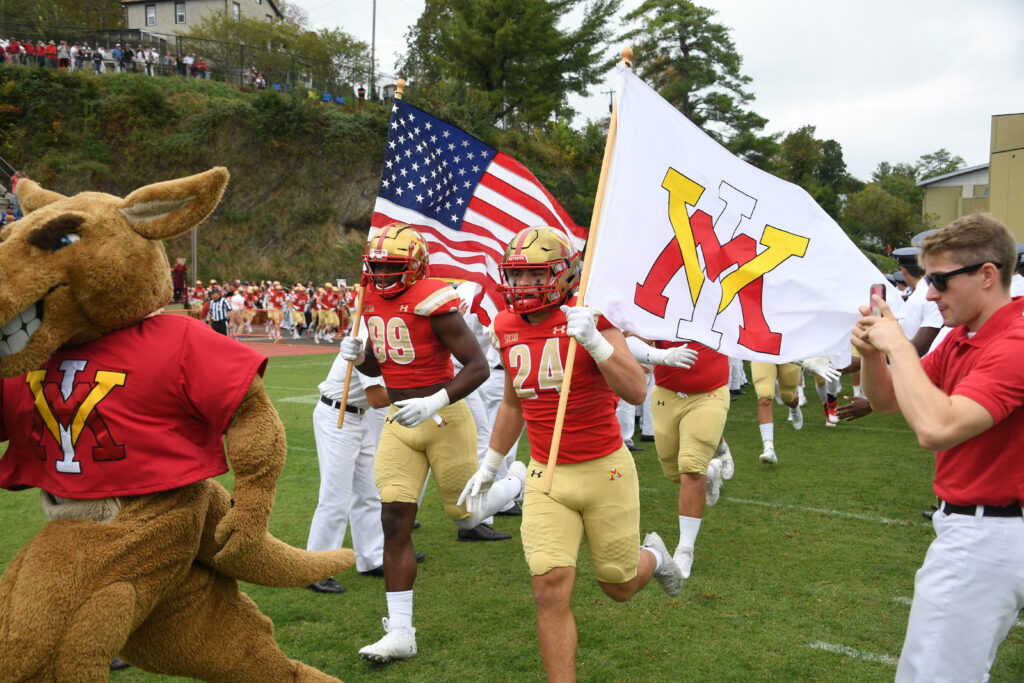
Collage of photos from Family Weekend football game, including Moe, cadets in stands, and football players on field.

Saturday morning was misty and cool, but that didn’t stop the parade on the Parade Ground and tailgating at McKethan Park, located about five minutes from post. Family members were also welcome in a barracks open house. The Keydet football team then put on a show for a large crowd in Foster Stadium, coming off the tough loss at the Citadel the weekend before. The skies cleared and the momentum stayed strong as the Keydets won in overtime against the Chattanooga Mocs, 37-34. Following his 37-yard field goal in overtime to win the game, redshirt sophomore Jerry Rice was named the Southern Conference Special Teams Player of the Week.

Another win of the day was the VMI men’s club rugby team, who beat VCU in a game held on North Post.

Several religious services were held on Sunday morning in Memorial Hall, followed by another women’s soccer home game against Mercer.

Cadets Michael Hoffmann ’22 and Christopher Soo ’22 have been recognized by Army ROTC Cadet Command as top cadets in the nation, with Hoffmann ranking No. 5 and Soo No. 7.

Soo and Hoffmann embody the finest attributes of a VMI cadet through their efforts and the example they set for others.

“Cadets Christopher Soo and Michael Hoffmann earned their positions in the top 10 above thousands of their peers because of their intense focus on excellence in everything they did,” Cpt. David Sperry, professor of military science, explained. “They refused to settle for good enough or competent enough.”

Army ROTC uses a variety of metrics, such as GPA, physical fitness, leadership evaluations, and technical competency, to rank the performance of cadets across the nation.

“Those rankings help in determining cadet component (Active Duty, US Army Reserves, National Guard) as well as their branch within the Army, such as infantry or aviation,” Sperry stated.

Soo and Hoffmann have excelled in their Army ROTC training, and were recognized for their leadership.

“During peer evaluations, they were both recognized by their peers for the positive influence they projected on those around them,” Sperry stated.

-VMI-