Post View Unavailable »
New Website Launched »

Behind the Balance: Pedro Robertson ’27 — Keydet Swim and Dive

Virginia Military Institute’s cadet-athletes have to juggle cadet life, heavy academic course loads, and their NCAA Division I sport. Committed to both academic and athletic pursuits, balancing their rigorous schedule in both sports and school requires a certain level of commitment and discipline. Behind the Balance is a series that focuses on those cadet-athletes and how they handle the hurdles of the day-to-day. 

Pedro Robertson ’27 may have been a little hesitant about attending Virginia Military Institute, but talking with the swim and dive coach coupled with a visit, he began to warm up to the idea.  

“I think seeing the challenge of it all … it looked difficult,” he admitted. “The ‘don’t do ordinary’ of it all was something different.” 

He could see a future for himself at the Institute where he could do something he hadn’t seen many do before. He also wasn’t planning to commission. Instead, he signed up for Air Force ROTC to feel it out. 

“I started to enjoy it a lot. I think it was a good decision, I really enjoy Air Force,” he said. Now, he’s on track to commission into the Air Force.  

This past summer, Robertson attended field training at Maxwell Air Force Base in Montgomery, Alabama.  

“We experienced types of simulated leadership, so it’s similar to VMI,” he explained. “I think that helped me a bit. I’ve already been in that simulated stress.” 

As time continued at VMI, he’s grown to accept more responsibility, like becoming a platoon sergeant in the Old Corps. 

Cadet-athletes at VMI not only have their responsibilities with their selected sport but cadet duties on top of that. Cadets are also required to take physical fitness classes twice a week, participate in ROTC all four years, prepare for room and uniform inspections, practice for parade, guard duty, and more. 

The civil engineering major has 18.5 credits this semester, while he’s in season for swimming. His days can start as early as 5:30 a.m., even after staying up until midnight the night before finishing work. He has class all day then heads to practice around 4 p.m., which lasts until 7 or 7:30 p.m. He said during swim conference weeks, the practice times dwindle a bit in order to reset for the upcoming competition.  

“I try to get classwork done in between things as much as I can,” he commented. “I try to find a happy medium — I can do one assignment and give myself some rest. I’m trying to find those little pockets in my day where I can do something productive.”

Pedro Robertson swimming for Virginia Military Institute.
VMI Swim & Dive vs. Howard & Saint Francis Action Shot

Preparing for races doesn’t always mean spending time in the pool. Robertson spends time researching other swimmers he’s set to face off with. That way, he’s able to set goals for himself or see which swimmers to watch out for or pace with.  

“Having some sort of race plan helps it go by faster,” he said. Since Robertson is a long-distance swimmer — the mile, the 500 meter, and the 200 meter — he’s in the water for a long time. “I like singing a little song, too. I’ll have something playing in my head while I’m swimming.” 

Those songs can range anywhere from Frank Sinatra to Ice Spice.  

He knew coming to VMI he would be in a competitive environment, in and out of the pool. 

“I’m very competitive, and I want to be in a place where I’m competing not only with swimming, but with academics or the Rat Line, or on the hill. I’m trying to be the best version of myself,” he said. 

Experiencing different leadership styles has also been beneficial for him.  

“It’s how to respond to these different leadership styles and develop your own,” he said. “You’re leading in some way and you’re leading yourself.” 
English Major Attends Strategic Crisis and National Affairs Conferences, Collaborates on Winning Essay

In February, Heaton Lawrence ’26, Regimental Chief of Staff, attended two conferences at Texas A&M, College Station. Lawrence participated in the Army War College’s prestigious International Strategic Crisis Negotiation Exercise (ISCNE). Alongside graduate and undergraduate students from other colleges and universities, Lawrence engaged in diplomatic simulations and strategic planning. He was accompanied by Nathan Payne ’26, Devin Auzenne ’26, Gabe Thompson ’26, and Michael Hatfield ’26.

Lawrence also participated in Texas A&M’s Student Conference on National Affairs (SCONA 71), hosted by the Bush School of Government and Public Service. He attended talks by senior leaders from the U.S. government and military. He also worked with teammates from other schools to write an argumentative essay about how to reform the U.S. State Department to promote America’s values in the most effective way possible. Lawrence’s team won the competition for best essay with their policy proposal, “Accords over Ammunition: A Strategic Reform Proposal for the U.S. Foreign Service.”

Behind the Balance: Evelyn Anderson ’27 — Keydet Track and Field

Virginia Military Institute’s cadet-athletes have to juggle cadet life, heavy academic course loads, and their NCAA Division I sport. Committed to both academic and athletic pursuits, balancing their rigorous schedule in both sports and school requires a certain level of commitment and discipline. Behind the Balance is a series that focuses on those cadet-athletes and how they handle the hurdles of the day-to-day. 

Evelyn Anderson ’27 thrives on structure. The international studies major has 17.5 credits this semester, while holding rank as regimental sergeant major for the Corps, and balancing a Division I sport. With a hefty academic load, she’s fitting schoolwork in whenever she can. Her regimental duties can range from cadet leadership meetings to Honor Court trials, which also take up a chunk of her time and effort. She is also planning on commissioning into the U.S. Marines Corps, so she has ROTC responsibilities. 

Originally, she wanted to relieve her parents of the burden of paying for college. Even though Anderson had never heard of Virginia Military Institute, she was recruited for track and field, resulting in a full ride. 

“I have three younger siblings, so I figured I’d take the load off a little bit, and I did a visit here, and I really enjoyed it,” she said. “I needed the structure, so that’s really what led my decision.” 

Anderson started out as a soccer player when she was younger, then joined cross country and track to stay active leading up to soccer season.  

“With track, you see the time, and it’s a reflection of you every single time,” she said. “There’s no denying that if you didn’t do well, it’s because of your own actions leading up to the meet. I think it has more accountability of whether or not you’re actually putting in the effort. I like seeing my gains and/or losses based off the effort that I put in.” 

Cadet-athletes at VMI not only have their responsibilities with their selected sport but cadet duties on top of that. Cadets are also required to take physical fitness classes twice a week, participate in ROTC all four years, prepare for room and uniform inspections, practice for parade, guard duty, and more. 

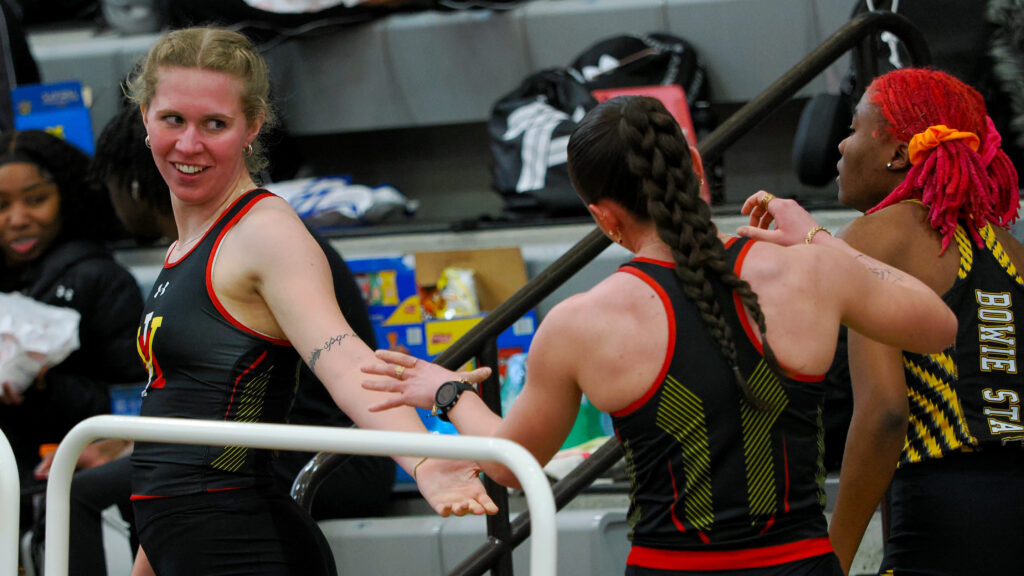
Evelyn Anderson, part of the VMI Team Challenge track and field meet at the Corps Physical Training Facility in Lexington, VA January 11, 2025.

She’ll go straight from class to practice some days, which results in some late nights finishing schoolwork.  

“I’m big on the Google calendar schedule. I have everything that I’m ever doing in Google calendar, so I try to plan it out ahead of time,” she explains.  

Even when it becomes overwhelming, Anderson reminds herself that there’s been so many before her that have been able to tackle the tasks that VMI puts forth.  

“This isn’t new. It’s just overwhelming for me because I haven’t been in that situation,” she admitted. “If other people can do it, you can as well. If you’re uncomfortable, everyone else is also uncomfortable. I’m not the only person with responsibilities. Everyone at VMI is pretty much invested in some aspects of the school. I just try to tell myself not to be dramatic.”Sometimes, you just have to call it a day. 

“My biggest life hack is knowing when to give up. And that sounds so bad, but I think that there comes a time where you realize going to bed is worth more and will do more for your mental health than trying to push out an assignment or complete last-minute things,” she explained. “You can’t operate on fumes.” 

The challenges are worth it, she said. Anderson credits VMI with improving her interpersonal skills. In high school, she moved and then went through COVID-19 where she wasn’t around people, and her life revolved around school, track, and being at home. 

“Coming to VMI, I feel uncomfortable kind of all the time, but it’s in a good way. I’m growing skills, learning how to interact with different people from different backgrounds,” she explained. “I come from a more rural area that has one high school. It’s a lot different for me, dealing with all different people, especially in stressful ways. I have to orchestrate and hit deadlines. I think that that’s really helping prepare me for the professional world.” 

I Am VMI: Julia Ward ’26 

What truly defines Virginia Military Institute are the people. Cadets, faculty, and staff, both past and present, are what make it “No Ordinary College.” I AM VMI will showcase the outstanding individuals who have accepted the challenges and embraced the spirit of VMI. Their perspectives provide authentic insights into life at the Institute and the value of this unique military college. 

I Am VMI: Julia Ward ’26 

  • VMI Class: 2026  
  • Major: Electrical & Computer Engineering  
  • Hometown: Frankfort, Illinois 
  • NCAA Sport: Water Polo  
  • Commissioning Plans: U.S. Navy – Hoping to service select Subs  
  • Other Clubs/Societies/Activities: VMI Pipes & Drums, Honor Court, Society Women’s Engineers (SWE) 

Julia Ward ’26 came to Virginia Military Institute uncertain of herself and her leadership abilities.  

“I wanted to challenge myself,” she said. “I knew I wanted to put myself in a better position as a newly commissioned officer. I figured there was no other place to take opportunities and learn to flourish. I liked the family aspect of VMI and the alumni connections that come from time spent at VMI.” 

Ward said there’s always something to do at VMI and she enjoys the busy pace. 

“Whether it is a sporting event, a debate, a dinner, a speaker, or simply just class work, it keeps you busy. I like to be active and VMI is the place for that,” she explained. “It isn’t always military either; there are plenty of clubs or activities to get engaged in the Corps.” 

She had the opportunities for engagement to help build her and others into a family, noting there’s always a group of supporters for each cadet— either with the staff, faculty, or other cadets.  

“Everyone wants you to succeed. This year strengthened that bond with a lot of people at school. I had a death of two very close people to me at the beginning of the semester that made me almost not come back for the semester. Having the support system I have here let me come back, get back on my feet, and keep leading for a deeper purpose,” she said. “I had a lot of responsibilities before leaving and I knew if I didn’t return, I would be letting a lot of people down, but I would also not be living for the two that I lost. I would not have come back if it was not for the support system of the commandant staff, my professors, and the people around me who lift me up every day.” 

VMI is rigorous, but rewarding, Ward explained. Each day brings a new set of challenges she can work through.  

“I think it has forced me to come out of my shell a lot. I have honestly fully transformed from the person I was three years ago sitting in a high school seat ready to graduate,” she said. “It is a surreal feeling to watch your dreams unfold in front of you. I have wanted to serve in the military for a while and having that dream come to life in the next year is still unreal to me, not to mention all of the experiences I have been able to have to travel, to lead, to put myself out there, and get hands on instruction is something I would not have had if I chose to go anywhere else. It’s very rare that you go to any other college and NCAA is just another thing you do because there are so many other opportunities like holding rank and cadet government that can bring experience to your time at a school.” 

“I think it has forced me to come out of my shell a lot. I have honestly fully transformed from the person I was three years ago sitting in a high school seat ready to graduate. It is a surreal feeling to watch your dreams unfold in front of you.”

The electrical and computer engineering major originally wanted to pursue mechanical engineering. When she first came to VMI, she was interested in a career in biomedical engineering after commissioning into the U.S. Navy. She saw that the electrical engineering department had more to offer in that background, so, she made a last-minute switch.  

“I have no further regrets, and I do not question my future success using a technical degree in the Navy or in industry based on the instruction I have been able to receive in the classroom,” she said. 

Julia Ward during Virginia Military Institute's 1st Class rank announcements.

Ward admits that VMI has made her a more confident person.  

“It puts you in positions that force you to make hard decisions in a low-risk situation so the time that it really matters we will know how to react or step up to the plate to lead because that’s just our nature now,” she commented. 

VMI has also prepared her for her future in the Navy. She’s been able to see that during summer training for Naval ROTC, but credits the confidence boost the Institute instills to be a big factor in her future successes.  

“I think it really is the confidence we exude from our decision-making abilities and the way we interact with teams of all different backgrounds. We already know what it feels like to get beat down and build ourselves back up again,” she said. “There is a lot of resilience that comes from going here and it allows graduates to bring creative solutions to the table and to work harder than everyone in the room because the thought of failure doesn’t scare us, we just pick ourselves back up and keep going.” 

Ward said it’s been easy to fit in at VMI — no matter what, you find your people. Overall, the pride she has gained being a VMI cadet has been the best experience.  

“How hard the average person works here is tenfold above every other school,” she described. “How eager to help and get involved people are here is something that doesn’t get spoken about enough at our school, how close we are to everyone.” 

Behind the Balance: Miller Tatum ’28 — Keydet Lacrosse

Virginia Military Institute’s cadet-athletes have to juggle cadet life, heavy academic course loads, and their NCAA Division I sport. Committed to both academic and athletic pursuits, balancing their rigorous schedule in both sports and school requires a certain level of commitment and discipline. Behind the Balance is a series that focuses on those cadet-athletes and how they handle the hurdles of the day-to-day. 

Growing up in Richmond, Virginia Military Institute was never a mystery to Miller Tatum ’28. Between family stories passed down from his grandfather — an alumnus himself — and a reputation that carried weight back home, the Institute was always somewhere in the background.  

Choosing VMI meant stepping away from the “normal” college path and diving into something harder. Tatum also held onto the belief that four demanding years could shape the next 40. That challenge combined with the chance to compete at the Division I level in lacrosse made the decision feel worth it.

In high school, Tatum wasn’t even sure lacrosse would be the avenue he’d pursue in college. He started playing around 8 years old in a recreational league and ended up playing all the way up to high school.  

“I transferred to a private high school in Richmond for my freshman year, and at that point I was really small and not good at lacrosse, and I hated it for a few years,” he admitted. “Freshman through junior year, I did not enjoy it, I didn’t want to play in college, and had no aspirations of doing it.” 

By his junior year, Tatum ended up filling out and hitting a growth spurt putting him in line with everyone else. From there, his mentality towards the game improved, as well as his skill. At that point, the former VMI head lacrosse coach had seen Tatum and invited him to a game day.  

It took some convincing from Tatum’s father, but he ended up attending the game day. He was then offered a spot on the team and knew it was too good of an opportunity to give up. 

Cadet-athletes at VMI not only have their responsibilities with their selected sport but cadet duties on top of that. Cadets are also required to take physical fitness classes twice a week, participate in ROTC all four years, prepare for room and uniform inspections, practice for parade, guard duty, and more. 

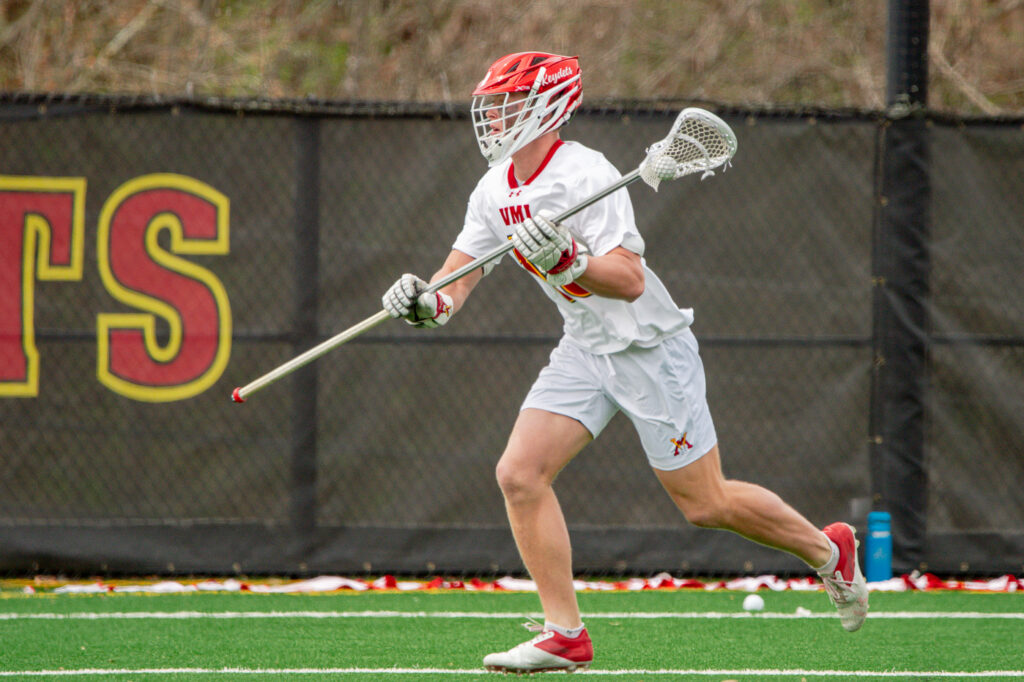
Miller Tatum playing lacrosse for Virginia Military Institute.

His days start early at 5:30 a.m. for weightlifting, then it’s a constant flood of one thing after the other until the afternoon. The economics and business major has 17.5 credits this semester, while in season. To stay on top of things, he’s completing assignments between all his other commitments.  

Luckily, his away games happen mostly on weekends. He and his teammates tend to front load their schedules to have classes earlier in the week.  

“I only have two classes on Friday, so I’m not actually missing that much class,” he said.

Having the initiative to utilize the small breaks during the day to get a head start on assignments will end up in your favor, he said.  

 “When you come back to do it at 7:30 or 8 p.m. after eating and going to practice, you’ve already put a dent in it.” 

During away trips, he and his teammates are dedicated to doing work while on the road.  

“You’ll see people with makeshift desks on the bus doing homework or on their computers or reading something for a class,” he explained. 

Their academic dedication can be seen, especially with the announcement last season that they earned Team All-Academic honors by the United States Intercollegiate Lacrosse Association. In order to achieve this status, the program must hold a team cumulative GPA of 3.0, which the team surpassed with a 3.2 for the 2024-25 academic year. 

“A lot of guys are pretty motivated in class. When you’re on the bus and everyone around you is doing homework, you almost feel like you’re getting left behind if you’re not trying to do something productive with that time,” he said. 

Despite a busy schedule, Tatum said being able to practice with his best friends daily is his favorite part of the Institute.  

“Doing something that you have a common shared joy of doing … I think there’s not a lot of opportunities to do that anymore,” he said. 

Motivation and time management have been big factors in how VMI is shaping Tatum.  

“I think having the opportunity to lead and be in the spotlight in front of other people is something a lot of college students don’t get at other schools and VMI prepares you well for,” Tatum stated. “I think that you have to use VMI as a foot in the door and then use the skills that VMI has taught you to be successful.” 

Behind the Balance: TJ Johnson ’28 — Keydet Basketball

Virginia Military Institute’s cadet-athletes have to juggle cadet life, heavy academic course loads, and their NCAA Division I sport. Committed to both academic and athletic pursuits, balancing their rigorous schedule in both sports and school requires a certain level of commitment and discipline. Behind the Balance is a series that focuses on those cadet-athletes and how they handle the hurdles of the day-to-day. 

TJ Johnson ’28 has been shooting a basketball ever since he can remember. He comes from a basketball family — both his parents played, and now he and his younger brothers have joined the family tradition.  

The economics and business major saw attending Virginia Military Institute as a great opportunity from the standpoint of being an athlete and also a cadet.  

“My dad played basketball at West Point, so the idea of a military institute wasn’t foreign to me. I grew up hearing his stories about West Point,” he said. “I knew it was going to be challenging, but at the same time, I knew there were a lot of benefits that would come with it as well. It wasn’t something I was afraid of. I thought it was a great opportunity for me, both on the court and off the court.”

Johnson is a second-year transfer, so there was an adjustment period entering the Rat Line.  

“Everything is stripped away. I’m getting yelled at by guys who are my age or younger. It was challenging for me to accept,” Johnson admitted. “There were times when I was really frustrated and angry and questioned a lot of things. I think the transition from last year to this year; I’ve learned a lot about myself.” 

He said he’s been able to adapt to different situations well. The Rat Line definitely tested that, but he came out stronger.   

“I’m a very calm person. I try not to get too high or too down. I’d say, my ability to handle stress and pressure has improved,” he said. 

The way he’s able to traverse a busy schedule as a cadet-athlete and taking 14 credits is also something he works on daily. Cadet-athletes at VMI not only have their responsibilities with their selected sport but cadet duties on top of that. Cadets are also required to take physical fitness classes twice a week, participate in ROTC all four years, prepare for room and uniform inspections, practice for parade, guard duty, and more. 

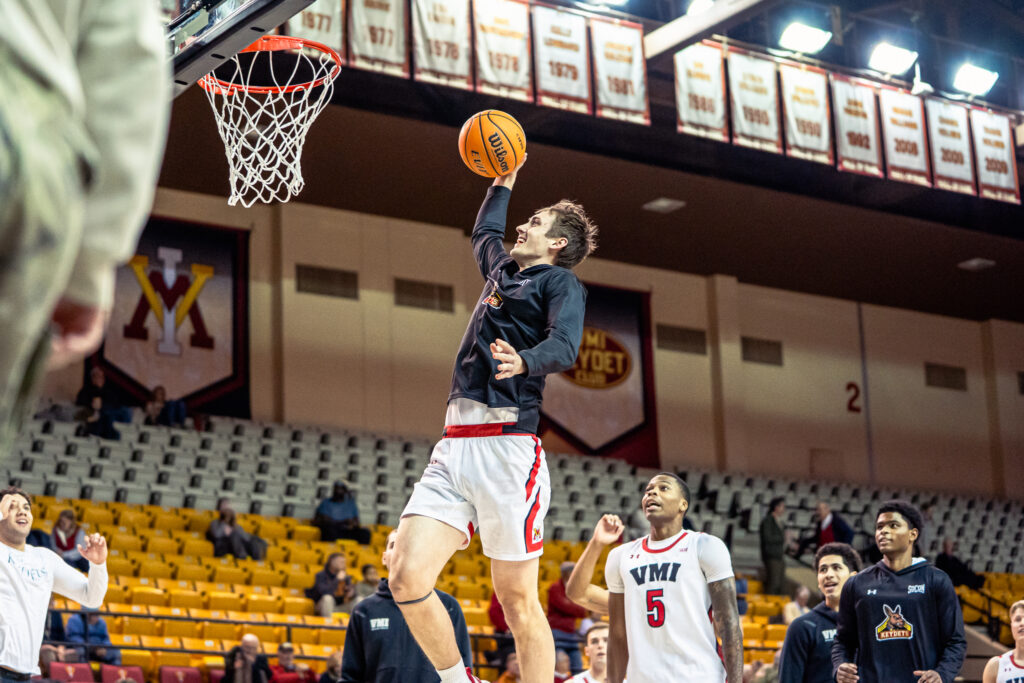
TJ Johnson dunking a basketball during a game for Virginia Military Institute.

The weeks when the team has two away games, they’ll leave on a Tuesday and return late Saturday night, for example. 

“It makes it difficult. We just have to communicate with our instructors and tell them what days we’re going to be missing, and then they’ll let us know what work we need to make up,” he explained. “So many things are digital now that you can just do it on your computer in the hotel room or on the bus. I spend a lot of time on the bus working on schoolwork, writing papers, that kind of thing.” 

His days while on post start early at 6:30 a.m. to review film footage at 7 a.m. Then, it’s onto breakfast and classes. He tries to work in weightlifting between classes and his daily practices, too, along with an individual workout with an assistant coach. Practice is at 4 p.m., which can last up to an hour or longer. He eats dinner, heads back to his room and it’s homework for the rest of the night. He says he’s up until about midnight some nights finishing assignments. Then, the cycle repeats.  

“I really don’t get too overwhelmed. I try to put things in God’s hands and know He’s going to take care of me,” Johnson said. “He’s gotten me this far. So why wouldn’t He help me get through an essay or an exam? I try to not stress about it too much. It is difficult trying to fit everything in and get everything done and turned in on time with quality work. You make it work.”

Johnson has also proved his responsibility to the team and to the Institute. He was recently selected to serve as one of three student-athletes nationwide to serve on the NCAA Division I Board of Directors. As a student-athlete on the committee, Johnson will be tasked with giving an athlete’s perspective of everything happening in the current collegiate sports landscape such as NIL, the transfer portal and many other areas. 

He finds comfort in talking with his family as much as possible. He calls his parents multiple times a week and tries to catch up with his brothers — one who’s away at college on the West Coast and the other still in high school. 

“I’m really close with both my parents, and don’t get to see them often either. But, you know, it’s something I’ve gotten used to.” 

Johnson said that VM offers the tools to face any of his challenges. 

“There’s a lot of adversity, and you learn to adapt to adversity and overcome it,” he said. “The way the Institute is set up, it will help me whenever life starts to hit in the future, I will have already been through an extended period of time of adversity and learned how to how to face it.” 

Plus, the bonds he’s made with his teammates help push him. Last year, the team had eight players going through the Rat Line at the same time.  

“We were all going through the same challenges, same adversity, and we were able to  lean on each other.” 

Study Abroad Ambassadors: Edward Menton ’26

At Virginia Military Institute’s Office of Global Education, more than 10% of cadets each year choose an international learning experience. Through semester or summer programs, cadets not only widen their global perspectives — but build critical thinking, resilience, independence, and the ability to communicate across cultures. Learn more about these first-hand experiences through our Study Abroad Ambassadors.

Name: Edward Menton

Class: 2026 

Major: Economics and Business Major 

Which program did you do?

I first studied abroad in the spring semester of 2024 at the American University of Rome and then completed an internship this past summer in Castiglion Fiorentino, Tuscany, working with De’ Magi – Alchimia de’ Formaggi, an Italian cheese refiner. 

What made you decide to participate in this program?

I grew up in a small town, so I’ve always been drawn to the idea of traveling. I wanted to broaden my global perspective, experience life outside of the United States, and make meaningful memories along the way. Studying in Rome gave me the chance to learn international business and economics in a European setting, while my internship provided valuable hands-on experience working as a U.S. liaison for an artisan Italian company. 

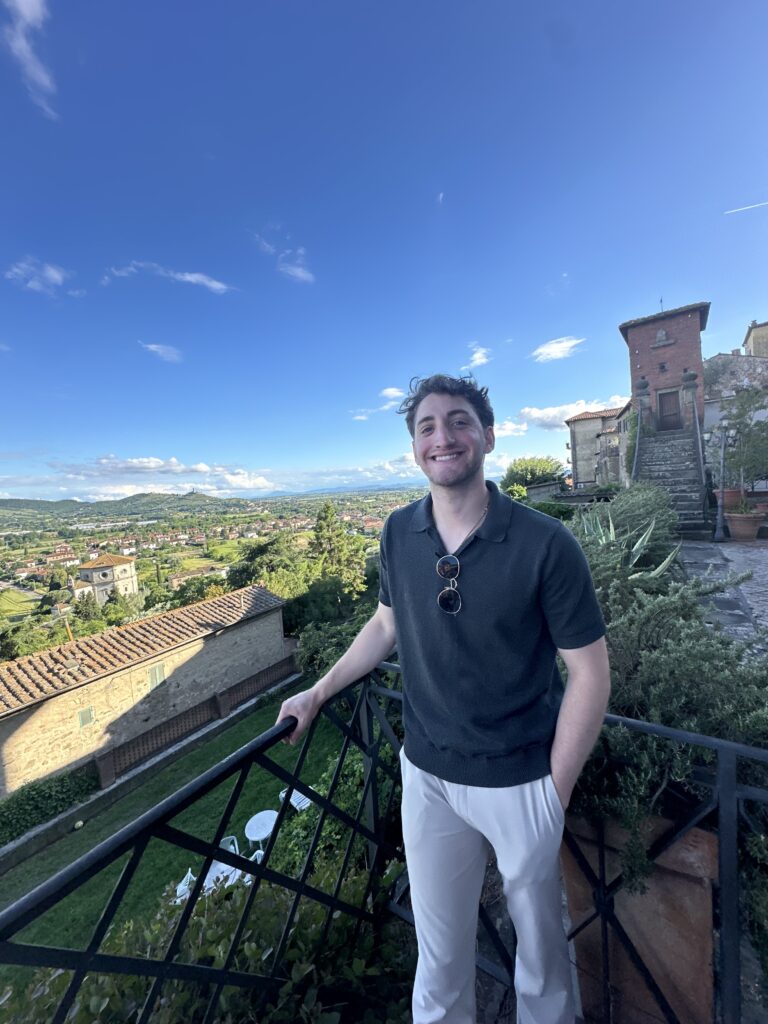
Edward Menton during his study abroad program in Italy.

How did you balance this program with VMI’s unique educational approach? 

The values VMI teaches, such as discipline, time management, and professionalism, helped me in both settings. In Rome, they kept me focused as I adjusted to a different classroom style and culture. During my internship, these skills were most evident, enabling me to manage projects independently, meet deadlines, and effectively represent both myself and VMI in a cross-cultural business environment.

What were your keys to success?

Keys to my success were adaptability, time management, confidence, curiosity, and communication.  

How do you think participating in this program will aid you in your future? 

These experiences have given me international awareness, professional confidence, and practical skills in business and logistics. Now I understand better how cultural differences impact trade and business. This global experience will benefit me in my future career, first as I pursue a path in the U.S. Army, and later as I hope to move into international business or operations management. 

What was the best part of the program?

In Rome, it was living in a historic city and having the ability to travel to different countries with my best friends.  For the internship, it was working directly with Andrea Magi, the owner of the company, and seeing how passion and attention to detail can elevate a small business into an internationally recognized company. Also, Florentine steaks.  

What was the most surprising thing about the county you visited? 

How much Italian culture and tradition influence everyday life, from business practices to meals.  

Favorite memory? 

My favorite memory was getting the chance to visit the Vatican multiple times and experiencing Rome during Easter. It was unforgettable to be in the city at such a meaningful time. 

Behind the Balance: Sydney Smith ’26 — Keydet Water Polo

Virginia Military Institute’s cadet-athletes have to juggle cadet life, heavy academic course loads, and their NCAA Division I sport. Committed to both academic and athletic pursuits, balancing their rigorous schedule in both sports and school requires a certain level of commitment and discipline. Behind the Balance is a series that focuses on those cadet-athletes and how they handle the hurdles of the day-to-day. 

Sydney Smith ’26 had her sights set on attending the Air Force Academy after high school. Both of her parents were athletes there and she wanted to follow in their footsteps. One thing made her hesitate; Smith played water polo and there was no NCAA women’s water polo team at the academy. Instead, she forged her own path that led her to Virginia Military Institute.  

“I started to look at schools with ROTC programs where I could also play water polo. Coach [Danielle] Montenegro found me, and I came on my official visit, and I was like, this is it.”

Smith swam her entire life but picked up the sport of water polo because her father played. 

“I like the physicality. I like the aggression. It’s more interactive,” she explained. “I also like that it is a team sport. Swimming, it’s a team sport, but you’re still competing against your teammates for points. Whereas water polo, you can’t do it without each other. I like being on a team, it’s more fun.” 

The biology major will be commissioning into the United States Air Force come May when she graduates. From there, she will head to Pensacola, Florida, to be a combat systems officer at the Naval Navigation School in July. Her time at VMI has helped her prepare for her upcoming post.  

She is one of the three 1st Class cadets on the water polo team who holds rank. Her position as S6 lieutenant gives her firsthand experience with communications, standard operating procedures, radios, and writing — all things she will need to know in the Air Force.  

Holding a leadership position also embodies the four core values the water polo team has — support, pride, energy, and focus. Nearly everyone on the team holds rank. 

“We make it a point to support each other, even if it does get challenging,” she said. “We’ve created these four core values on our team, and we actually say each one of them when we’re doing our cool down at practice and before every lap.” 

The structure of VMI was appealing to Smith, as well as the option to commission. But the bonds she’s made with her brother rats and those on her team have really stood out. 

“We definitely have one of the best team dynamics, but I’m probably a little biased,” she admitted.  

She said it was kind of surreal to see what good friends everyone is on the team. It’s more like a family. They even established a rule that none of them would live together in barracks, just so they wouldn’t get sick of each other. 

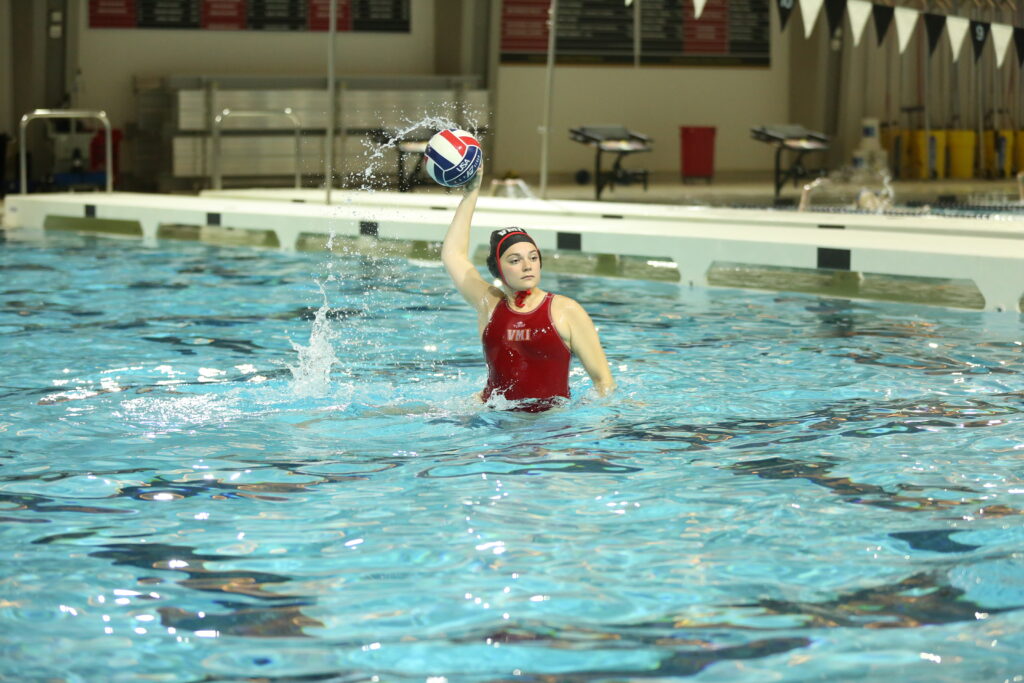
Sydney Smith in the pool playing water polo for Virginia Military Institute.

“It played out very well. None of us were in the same company, so we never lived together, but we’ve never had any issues,” she said. “Through our years here, we’ve told the 4th Class cadets that same thing: try not to live together. That can cause problems. And they’ve all made that a rule, too. And all of them are super close, too. We all hang out, and we do team dinners all the time, especially after practice in season. We make a point to all just go eat together and hang out all the time. A few of us are all the same majors. We have class together.” 

She said those on the team strive to be overachievers. From holding rank to other activities, Smith has a booked schedule.  

Cadet-athletes at VMI not only have their responsibilities with their selected sport but cadet duties on top of that. Cadets are also required to take physical fitness classes twice a week, participate in ROTC all four years, prepare for room and uniform inspections, practice for parade, guard duty, and more. 

Growing up, Smith and her sister, who is at the Naval Academy, were always told they needed to have diverse activities.  

“We’ve both been told you’re going to do other things. You are each going to play a sport, and you are going to play an instrument, and you’re also going to find a leadership role,” she said. 

Smith is also on the Glee Club, while spending two to three hours in the pool a day. That doesn’t include early morning practices or weightlifting. She’s thought ahead though, by taking summer classes every year she’s been here to lighten her academic load while she’s in season. Hence, her last semester is 13.5 credits.  

In order to keep everything straight, Smith has a large calendar she keeps in her room that’s color coded with all her activities and assignments. She said that VMI has prepared her in terms of how to handle a busy schedule. 

“Everything that I’ve had to do and manage with stress, school, and water polo, I’ve kind of compartmentalized all of it,” she said. “I think it has been the most beneficial thing. If I can handle being this busy, I can handle anything.” 

Breakout and Brotherhood – VMI 1st Class President Reflects

Breakout marks one of the most defining moments of the Rat Line, symbolizing both the culmination of challenging months and the beginning of a cadet’s life in the Corps. Behind the scenes, its success depends on deliberate leadership, careful planning, and a shared commitment from upperclass cadets to uphold tradition while supporting the Rat Mass. In this Q&A, the 1st Class President Maximus Ankrah ‘26 reflects on the responsibility of guiding rats through the Rat Line, the priorities behind planning Breakout, and the pride that comes with welcoming the newest cadets into the Corps.

Q: There are a lot of moving pieces and responsibilities placed on leadership within the Corps during the Rat Line and on the day itself. How would you define what is expected of upperclass cadets to support these traditions?

Ankrah: For the upperclassmen, their role is to ensure the Rat Line is as challenging and up to standard as possible. Correcting rats, encouraging them, and pushing them to their max potential is their obligation. If we’re not doing that as upperclassmen, we’re doing the rats a disservice. That goes for Breakout too; the culmination of hard work throughout the months deserves to be celebrated not just alongside rat’s brother rats, but also the Corps. It takes a village to develop the next generation of new cadets.

Q: As 1st Class President and General Committee president, what were your top priorities for a successful Breakout?

Ankrah: As my team and I were narrowing down Breakout dates, we had to weigh the priorities of choosing a weekend or maximizing the amount of personnel that would be attending Breakout. This was a difficult dilemma at the time of deciding, as we wanted Breakout on a Saturday rather than a weekday  — as it was in years past. It was important to ensure that everyone had at least the opportunity to participate in this important event.

I was asked this hypothetical question: When the rats one day have their 5, 10, 50-year reunions, will they be able to share this sacred memory together or only most of them? At the end of the day, Breakout isn’t what defines the Rat Line; it’s one’s brother rats. We wanted to ensure that the mass can all share the memory of Breakout and ensure the BR spirit doesn’t end at the Rat Line but only marks the beginning of other joyous memories.

Q: You had some powerful words of wisdom for the Rat Mass following their Fakeout: “Success breeds complacency. Complacency breeds failure.” How do you think VMI helps develop and nurture that drive to keep pushing and keep succeeding?

Ankrah: There is a quote I’ve heard that applies to VMI: “We are what we repeatedly do. Therefore, excellence isn’t an action but a habit.” Everyone goes through personal trials and tribulations, but it’s important to keep pushing. Nothing great in life ever came without facing adversity. You must overcome obstacles continuously and that’s exactly what VMI provides. It’s going through those tough times that build character and overcoming adversity that keeps you resilient.

Q: How would you describe the atmosphere in Barracks during that first Old Yell?

Ankrah: It’s an extremely rewarding feeling. To put in many hours, days, and weeks into such a big event and have it come out flawlessly was amazing to see. I love my position as class president because I get to be part of such important moments. Besides Ring Figure and graduation, Breakout is one of the moments that everyone cherishes during one’s cadetship, and it was humbling to be part of that.

Q: What emotions were you feeling as you stood and looked out over the latest rats to become cadets?

Ankrah: Immense pride. To be the one to initiate a class’s first Old Yell, where more than 400 rats yell their class number and pump their fists in the air, together; in perfect synchronization — you can’t describe that feeling. I’m extremely honored to have led such fine men and women who’ve come from all different walks of life. I’m proud of them. 

They’ve accomplished something so big. To enter VMI is one thing, but to have earned Breakout is another. Proud of these rats, now cadets, and I look forward to seeing them grow.

Q: Looking back at the Class of 2029’s Breakout and your own Breakout, how do you think it encapsulates the VMI experience and the tradition of shared suffering?

Ankrah: Breakout is just the beginning of one’s cadetship, but it’s the Rat Line that proves you can overcome anything during your cadetship. VMI is what it is because of the people. The people are what make it worth coming back, and it’s the people that you must lean on, specifically one’s Brother Rats, to excel at VMI — this is what The Rat Line and Breakout symbolize. There can be no brotherhood without shared suffering, and the new cadets now understand what this means.

Study Abroad Ambassadors: Morgan Fraser ’27

At Virginia Military Institute’s Office of Global Education, more than 10% of cadets each year choose an international learning experience. Through semester or summer programs, cadets not only widen their global perspectives — but build critical thinking, resilience, independence, and the ability to communicate across cultures. Learn more about these first-hand experiences through our Study Abroad Ambassadors.

Name: Morgan Fraser 

Class: 2027  

Major: International Studies 

Which program did you do? Spanish language program in Madrid, Summer of 2025 

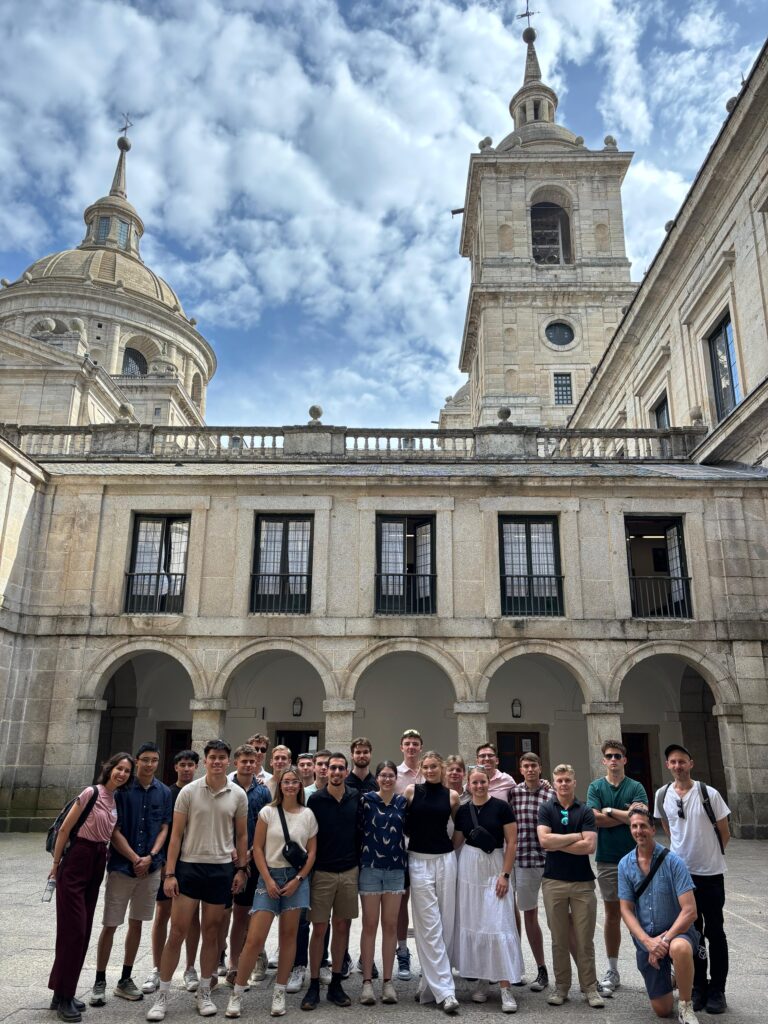
I studied abroad in Madrid, Spain through the Spanish language program, which gave me the chance to really dive into both the language and the culture. Other cities visited include: Toledo, Consuegra, Barcelona, El Escorial, and Valencia. 

What made you decide to participate in this program? 

I’ve always wanted to improve my Spanish, but more than that, I wanted to challenge myself by living in a different country. I had never been outside the U.S. before Spain so there were a lot of firsts. The idea of experiencing Spain firsthand; the history, the food, and the daily life, it was something I knew I couldn’t pass up.   

How did you balance this program with VMI’s unique educational approach? 

VMI teaches you how to manage your time, stay disciplined, and handle challenges head-on. I relied on those same skills abroad — keeping up with classes, adapting to new and different routines, and making the most of every day and opportunity. 

What were your keys to success? 

Being open-minded and willing to step out of my comfort zone were keys to my success. I tried to speak Spanish as much as possible, even when I made mistakes, and I said “yes” to experiences that felt unfamiliar at first. I would always walk into a café or restaurant with the urge to use my Spanish to get better, and most of the time they would work with me, even when I struggled. I was just so thankful to be there that I knew I wanted to succeed and try my very best in classes while I was being taught by Spanish speakers from Spain.  

How do you think participating in this program will aid you in your future? 

It sounds cliché, but it gave me confidence in adapting to new situations and showed me the value of seeing the world through a different lens. Those lessons will carry over into both my career and personal life, especially in environments that demand flexibility and strong communication skills. You have to be willing to adapt in a country that’s not yours and it was a humbling experience, but also cool and amazing. 

Morgan Fraser during her study abroad Spanish language program in Madrid in the summer of 2025.

What was the best part of the program? 

My favorite part was definitely the people, both the students I traveled with and the locals I met. Sharing meals, exploring new places together, and hearing stories from people who grew up in Spain made the whole experience unforgettable. One of my favorite people from my study abroad trip was my professor, Maria, from Spain. She was just great, very down to earth, and we would share so many stories back and forth during class time. We both wanted to learn about each other’s backgrounds, and it just made the classes so personal, and I truly learned a lot.  

What was the most surprising thing about the county you visited?

The slower pace of life was the most surprising thing. In Spain, meals are long, people take time to connect, and there’s less of a rush. The work-to-life ratio is insane and they appreciate slowing down. It really stood out to me, especially compared to the constant go-go-go I’m used to at VMI. It was a good place to be to re-center yourself and appreciate all the little things. 

Favorite memory? 

There is a place in Madrid called Temple of Debod. It is an ancient Egyptian structure that was donated to Spain in the 20th century as a thank you gift. It’s on an overlook in the center of the city and you can see the entire landscape of Madrid; it was absolutely beautiful. We went one evening to watch the sunset, because that’s where everyone went to watch the sun go down, and people would bring their guitars and sing and bring food, and it was just amazing. Such a good memory and experience overall.