Post View Unavailable »
New Website Launched »

I Am VMI: Devin Auzenne ’26 

What truly defines Virginia Military Institute are the people. Cadets, faculty, and staff, both past and present, are what make it “No Ordinary College.” I Am VMI will showcase the outstanding individuals who have accepted the challenges and embraced the spirit of VMI. Their perspectives provide authentic insights into life at the Institute and the value of this unique military college. 

I Am VMI: Devin Auzenne ’26 

  • Name: Devin Auzenne  
  • VMI Class: 2026  
  • Major(s) (and minor if applicable): History, with a concentration in military history   
  • Hometown: Opelousas, Louisiana   
  • NCAA and/or Club Sports: Boxing (4th and 3rd Class years), aviation club (2nd Class year), and Jiu-Jitsu club  
  • Post-Graduation Plans: Commission, U.S. Marine Corps 
  • Other Clubs/Societies/Activities: Member of the Virginia History Society and Omicron Delta Kappa   

Devin Auzenne ’26 knew the ethics and maturity needed for the U.S. Marine Corps would best be fostered in a place like Virginia Military Institute. He also knew by attending the Institute, he would be prepared to lead in the Marine Corps. 

After watching a YouTube video by VMI labeled “Don’t Do Ordinary,” he instantly knew this was the college he wanted to attend. 

“I chose VMI because I wanted something different. I didn’t want to do the regular college thing,” he explained. 

Going into his senior year of high school, he received a Marine Corps scholarship, which solidified his decision. He said he was looking for the right avenue to make him the best when it came time to commission after graduating.  

Auzenne has always had a deep appreciation for history. Thanks to an influential high school teacher, his eyes were opened to the analytical and argumentative sides of the subject, which spurred him to study it further. VMI’s deep history and historical site, along with an incredible faculty, pushed him to be a history major.  

“I really love history, and I know the program that we have here is really good, especially with getting a minor in military history,” he said. “I wanted to delve deeper into that. When I go into the Marine Corps, I’ll have this knowledge of history, and with a deeper understanding of military history and it can really help me in my career.” 

He says the people he’s encountered at VMI are truly exceptional.  

“I also enjoy how unique each year’s challenges are. Overall, the ability to always have someone here to have your back is very special,” he explained.  

The experiences at VMI have helped him gain intangible skills he believes he couldn’t have thoroughly developed in any other environment.  

“Skills such as patience, time management, grit, and flexibility have allowed me to find ways to succeed in foreign environments,” he said. “My experience at VMI is adversity that is ever changing, opportunities that are once in a lifetime, bonds that can never break, and a great place to be from but not at.”    

His experience at VMI has also made him more self-aware. He’s able to understand who he is when under pressure or stress, and how to balance everything while still progressing forward.  

“Skills such as patience, time management, grit, and flexibility have allowed me to find ways to succeed in foreign environments. My experience at VMI is adversity that is ever changing, opportunities that are once in a lifetime, bonds that can never break, and a great place to be from but not at.”    

“It’s helped me to understand how to take these experiences, try and do the best in the moment, and then reflect upon them, so that the next time something comes around, I’ll be better for it,” he stated. “It’s building this flexibility and this resilience in me that I don’t think I could have received at any other college. Being resilient and also being able to think and make decisions on the fly is something I think is invaluable in the context of the military system.” 

These qualities will transfer to anything he chooses to do later in life.  

“My time at VMI will translate into me being more certain of who I am as a leader and a man,” he said. “When I graduate and commission into the Marine Corps, I am certain that because of my time at VMI, I will have an advantage compared to my peers.” 
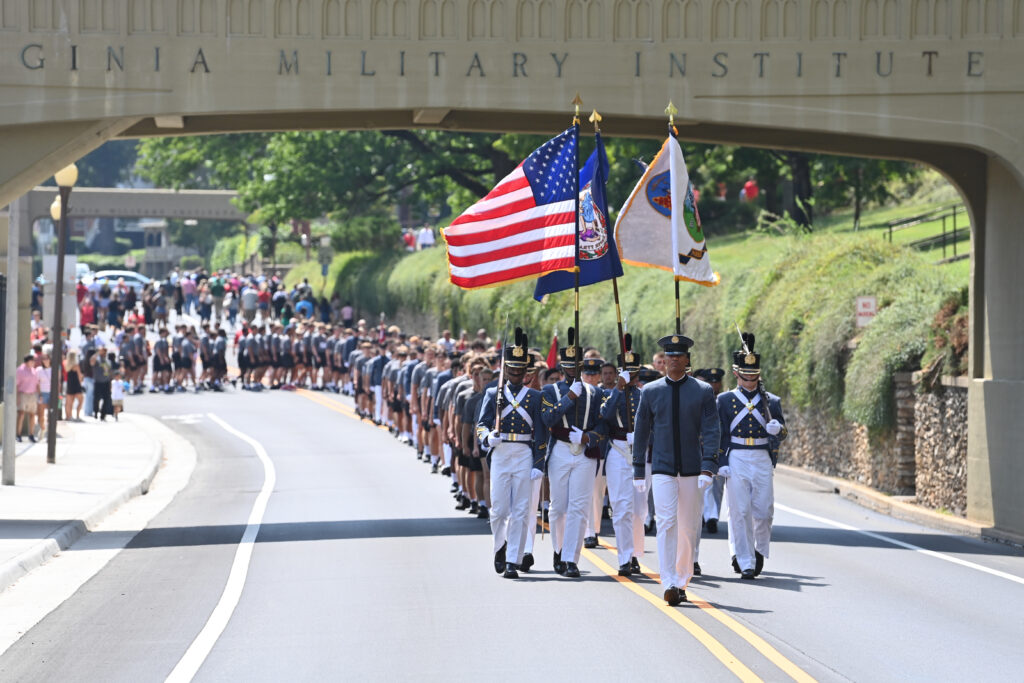
Devin Auzenne leads the Corps of Cadets in Lexington during Matriculation at Virginia Military Institute.

Auzenne wants those outside the VMI world to know that the Institute is not just a school, but a community and a culture.  

The end result of the VMI system is forged through the rigors of the regimental, class, and honor systems, but the extraordinary people are the defining factor that sets VMI apart,” he stated. “The illustrious history of VMI cadets and alumni, and, despite the differences in the times, the common experience we all share makes me proud to say that I am a VMI cadet.” 

Study Abroad Ambassadors: Ryan Getgood ’26

At Virginia Military Institute’s Office of Global Education, more than 10% of cadets each year choose an international learning experience. Through semester or summer programs, cadets not only widen their global perspectives — but build critical thinking, resilience, independence, and the ability to communicate across cultures. Learn more about these first-hand experiences through our Study Abroad Ambassadors.

Name: Ryan Getgood 

Class: 2026 

Major: International Studies with a Chinese minor 

Which program did you do? 

I did the Huayu BEST program, which allowed me to study at National Chengchi University in Taipei, Taiwan. 

What made you decide to participate in this program? 

I decided to participate in this program because I really wanted to learn more Chinese and practice in an active environment. I also thought teaching English to kids would be fun and a valuable experience to prepare me for teaching abroad after graduation. Plus, the scholarship covered most of my expenses. 

How did you balance this program with VMI’s unique educational approach?  

VMI’s educational approach is pretty strict; cadets are expected to balance athletic, academic, and military commitments. While in Taiwan I had academic commitments, but still worked out and found ways to participate in athletics, like during the dragon boat racing event. Instead of military commitments, I chose to dedicate time to exploring local cultural sites. In short, I still modeled my commitments after VMI’s unique three-legged stool approach. 

What were your keys to success?

My key to academic success was dedicating an appropriate amount to study writing, speaking, and listening. My key to overall language success was fully immersing myself in Taiwan’s environment, speaking Chinese (even if it was bad) instead of English whenever possible. 

The Taiwan wetlands from Ryan Getgood's study abroad trip to Taipei.

How do you think participating in this program will aid you in your future? 

I think my participation in language exchange with Taiwanese elementary school students will make me more competitive when applying to teach English abroad after graduation. The challenges I faced while adjusting to life abroad have given me more resilience, a calm composure, and a genuine passion for adventure. I believe interacting with Taiwanese people of all ages has exposed me to new perspectives and worldviews, which has improved my critical thinking and decision-making ability. 

What was the best part of the program? 

The best part of this program in particular was the freedom that came with it. I got to explore places I was interested in within Taiwan and was also allowed to leave the country to visit South Korea and Japan. 

What was the most surprising thing about the county you visited? 

The most surprising thing about Taiwan was how easy it was to travel. I could take the mass rapid transit or bus 45 minutes to the heart of the city which was filled with impressive skyscrapers that lit up at night. I could take the high-speed rail to the south; I went to Taizhong where I visited Sun Li-jen’s Class of 1927 (a famous Chinese VMI alumnus) family home. 

Favorite memory? 

Times meeting up with my BRs while abroad became my favorite memories. I met up with Chen Po-Yen ’26 to visit Sun Li-Jen’s house and the GaoMei wetlands, met up with Benjamin Shyu ’26 to explore Xinyi in Taipei, and met up with Zebadiah Barrett ’26 to hike Mount Fuji in Japan. 

The Vanguard — Diego Henao Ospina ’28

The Vanguard series highlights cadets of Virginia Military Institute who exemplify promise, perseverance, and the true spirit of leadership. While they may not be the top-ranking students or those in prestigious positions, these individuals’ dedication, resilience, and growth embody the essence of being a VMI cadet. By sharing their stories, including the challenges they’ve faced and overcome, we shine a spotlight on the diverse paths to success at the Institute, proving that leadership and excellence come in many forms.   

When Diego Henao Ospina ’28 first considered life after high school, he weighed several paths within the armed forces. Enlisting seemed like a possibility, but advice from others who knew Virginia Military Institute helped shift his focus.  

A former Navy pilot whose son attended VMI spoke highly of the Institute, and soon after, a graduate from his own high school — now a 2nd Class cadet — returned for a recruiting visit. The way that cadet carried himself, sharp in his uniform and confident, left a lasting impression on Henao Ospina. 

Entering the Institute, Henao Ospina began as a history major. He enjoyed his time in the history department but found more of an interest in economics and business. He also plans on commissioning into the United States Air Force.  

“I’m very thankful to the history department. I really enjoyed it. But ultimately, I want to do something in the management sector, whether it’s logistics in the military or in the civilian world,” he explained. “Once I get out, I want to get into the corporate world. And economics, in my opinion, has always had that right amount of math where it’s very applicable.” 

Choosing the Air Force as his branch was another intentional decision. Many of the service members he spoke with before VMI were Air Force officers and enlistees, and he admired the long-term career paths available.  

“The Air Force seems like the best career,” he said. 

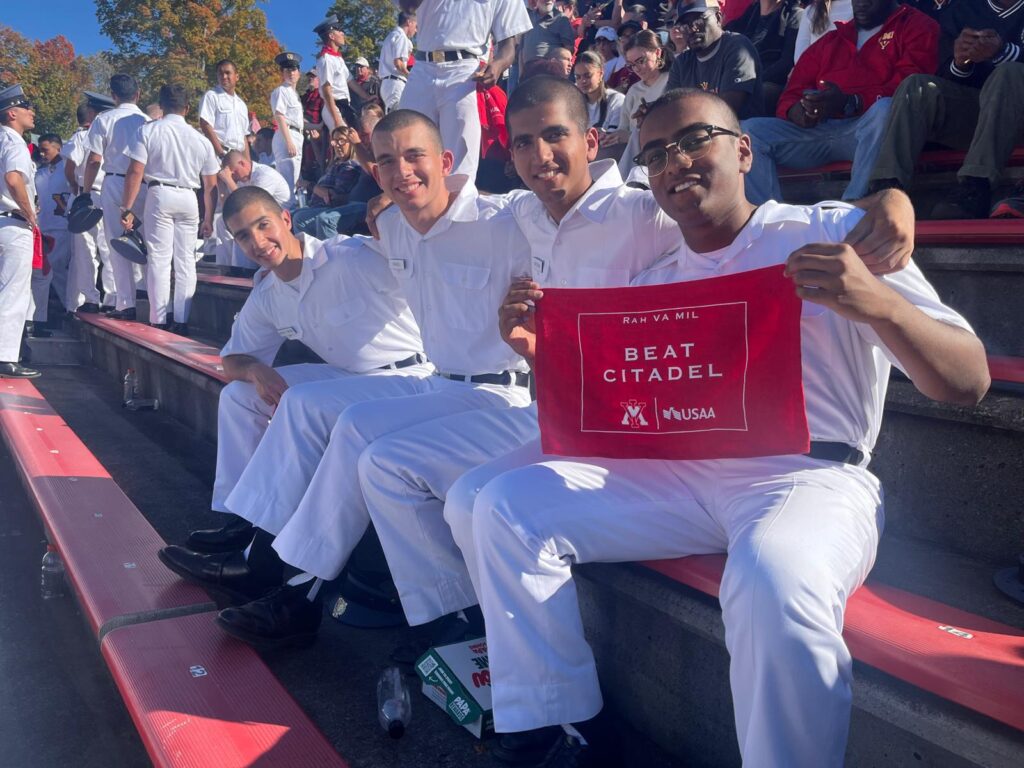
Diego Henao Ospina with his brother rats at a football game at Virginia Military Institute.

At VMI, he describes himself as a steady student — disciplined in habits, punctual with work, and willing to seek help when needed. Asking for help wasn’t always easy. He said at first, he resisted asking for help, but by the end of high school, he had learned that leaning on others could make all the difference.  

“There’s nothing shameful in that,” he said. “My main advice that I would give others is to seek help when they need it.”

As a cadet, he holds himself to high standards, striving to lead by example and instruct others. In Hotel Company, he serves as an alternate cadre corporal, managing an Old Corps squad during inspections and accountability checks, and assisting with rat training events. For him, the role was about belonging and contributing to the company that gave him his first sense of identity at VMI. A conversation with one of his own cadre corporals during the Rat Line solidified that calling.  

“That sense of belonging really impacted me,” he said.  

The journey hasn’t been without challenges. He admits that time management has been one of the steepest learning curves. Balancing academics, military duties, and the personal tasks of daily life, from making phone calls home to working through difficulties outside of VMI.  

“It can be overwhelming,” he shared. To cope, he leans on his mother for advice and strength, and grounds himself in his faith. 

Over the years, he says he’s grown vastly as a cadet. From struggling with basic drill movements on Matriculation Day to embracing the philosophy that “you get out what you put in,” he’s learned to see VMI as a system that rewards effort and resilience. Each duty — academic, military, or personal — has become an opportunity for improvement. 

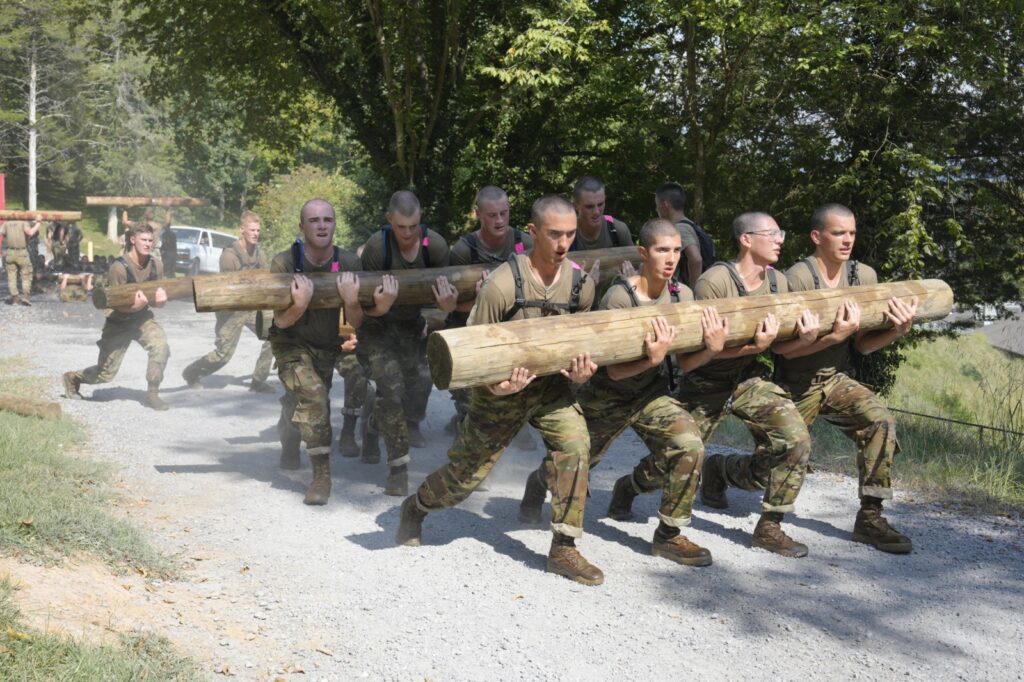
Cadets perform physical training activities on post at Virginia Military Institute.

Mentorship has also shaped his time. Col. John Cerkey from the Department of Modern Languages and Cultures has been a guiding influence since his rat year, both in the classroom and in supporting his ambitions to pursue a summer research project.  

Cerkey said he first had Henao Ospina in a literature class that focuses on Medieval and Renaissance Periods. 

“This was his first semester, rat year. These two literary periods are very challenging, and for most students, it was the first time that they had been introduced to literary and/or analytical techniques,” Cerkey explained. “With all the pressures that rats already have, Diego was outstanding. He, as well as the others, had to absorb and implement these new ways of thinking— he accomplished this to a superlative degree. He demonstrated originality of thought and clearly invested the effort to strive for excellence in this process. The result was that he was far and above, the best student in the class.” 

Born in Colombia, Henao Ospina eventually moved to the U.S. with his mother. He has faced several challenges, but Cerkey pointed out that Henao Ospina was able to overcome a lot.  

“Diego has remained focused and dedicated to achieving the goals that his education is making available to him. He doesn’t complain; he embraces all his challenges, crosses, and trials, with a good heart,” Cerkey said. “And at the center of his good heart, is his unwavering dedication to his Catholic faith, which strengthens him in his daily challenges, and keeps him Christ-centered.” 

Looking back, Henao Ospina sees VMI not as a finished process, but as a constant evolution.  

“You get out of the system what you put into it, and then you’re growing every day,” he said. “From the way I see it, it doesn’t end. It evolves. And it’s an opportunity to just continue learning, continue growing, despite the difficulties. The system is going to push you through difficulties, because there’s room for improvement.” 

Behind the Balance: Destin Moore ’27 — Keydet Football

Virginia Military Institute’s cadet-athletes have to juggle cadet life, heavy academic course loads, and their NCAA Division I sport. Committed to both academic and athletic pursuits, balancing their rigorous schedule in both sports and school requires a certain level of commitment and discipline. Behind the Balance is a series that focuses on those cadet-athletes and how they handle the hurdles of the day-to-day. 

Virginia Military Institute offered a path to success, Destin Moore ’27 explained. The psychology major from Georgia wasn’t familiar with VMI at first, but after talking to several football coaches, he was inspired.  

“I really fell in love with the culture they were trying to build and what the school offered,” he said. “I don’t like to fail. So, I know the challenge wasn’t something people look for … normally people take the easy route. To know that I could be amongst the few that got through this — it was desirable to me.”

Moore isn’t a stranger to a packed schedule. As a dual sport athlete, his entire year is figuring out how to balance his schedule with both football and track and field.  

“I try to configure my schedule, I try to have a middle block where I can have two classes and then I’ll have a dead period after lunch so I could do any homework that I need to do, or do any homework that I’ve just received to get ahead,” he said. 

This became a challenge last spring when Moore was participating in the SoCon Track and Field Championships. He went directly from football practice to track practice. For the championship, he placed second, pushing him into the finals the following day.  

“I came right off the track, with my track jersey and my compression shorts, and I ran from the Corps Physical Training Facility to the football field,” he recounted. “I got done with that the football practice, went to sleep and had to wake up at 8 a.m. to run in the championship.” 

Cadet-athletes at VMI not only have their responsibilities with their selected sport but cadet duties on top of that. Cadets are also required to take physical fitness classes twice a week, participate in ROTC all four years, prepare for room and uniform inspections, practice for parade, guard duty, and more. 

He explained that coming to VMI and being a cadet-athlete, he had to change his mindset. He couldn’t look at the tasks he had to accomplish as something he had to do, but instead something he got to do.  

“If I didn’t, I probably wouldn’t have competed like I did or did it at all. Since I wanted to do it, I had to find a way,” he said.  

It’s all about prioritizing. He figures out the thing he’s least enthusiastic about and finishes that first, allowing him to do the things he wants to do. He said that’s something that will transfer to what he can accomplish later in life.  

“If that’s me waking up for my job at seven in the morning, like I have done for BRC [breakfast roll call], I can get my whole schedule done, have everything planned out, do what I need to do. So, in two months, I can go on vacation or something.”

Moore plays wide receiver, point return and kick return. But he wasn’t one for paying much attention to football when he was on the field in his younger days.  

“I was always one of those kids who was at practice, but wasn’t in the practices,” he stated. “I’d be crisscross applesauce on the floor, playing with the dandelion grass.” 

Destin Moore on the football field running a play for Virginia Military Institute.

He said that he got bored with that and started to put in more effort.  

“I was always pretty fast, so I would run. And the coaches saw that one day, and they were like, let’s see what this guy can do,” Moore said. “I ended up playing and being slightly good at it.” 

He started to take it more seriously in his sophomore year of high school and decided he wanted to go to college for it.  

As for the stressful times at VMI, Moore leans on his friends and teammates. 

“Within my friend group, we try to motivate each other and hold each other accountable, whether that be in football or in school, because being at VMI we can have the hardest workers. We need to control what we can control and be the best at it,” he explained. 

The way Moore accomplishes this is by not looking at the big picture. He needs to take it piece-by-piece.  

“You can’t eat a sandwich all in one bite. You have to take it bite-by-bite. Break it off. Have little sections. Complete that section. Reward yourself forward so you can do the next thing.” 

The Vanguard — Caleb Chandler ’27

The Vanguard series highlights cadets of Virginia Military Institute who exemplify promise, perseverance, and the true spirit of leadership. While they may not be the top-ranking students or those in prestigious positions, these individuals’ dedication, resilience, and growth embody the essence of being a VMI cadet. By sharing their stories, including the challenges they’ve faced and overcome, we shine a spotlight on the diverse paths to success at the Institute, proving that leadership and excellence come in many forms. 

Caleb Chandler ’27 wanted a challenge when it came to deciding what language to study at Virginia Military Institute.  

“When I saw the different language options, I didn’t want to take Chinese, I didn’t want to take Spanish or French, I kind of thought they were too basic,” the modern languages and cultures major admitted. “I wanted that challenge of Arabic, and I’m glad I did.”

He was inspired to explore Arabic after observing his father, an aviation mechanic in the U.S. Navy during the War on Terror. He said that area of the world had consumed his father’s life, so it was really all he knew growing up. 

Chandler originally set his sights on VMI because he was recruited for the wrestling team. Growing up in a military family, the Institute was appealing to him. But he left the team last year and decided the club rugby team was more up his alley.  

“Being a NCAA athlete is not for the weak,” he said.  

Instead, he’s taken on more roles for the Corps, like being elected the class historian, which means he’s in charge of housing for all the cadets. 

“If there’s ever room disputes or anything like that, usually I’m the primary mediator,” he explained. “Or if the room does need to be changed, I’ll change it and make sure all parties are on the same side, as well as the commandant staff. That’s my primary job.”  

By being part of the General Committee, if there are violations of the class system or the white book, he is part of the committee that prosecutes. 

Chandler’s passion for Arabic earned him a scholarship for the Project Global Officer (Project GO) program last year, which provides ROTC students with opportunities to study strategic languages and cultures abroad. The scholarship is funded by the Department of Defense and the experience lasts about two months, specifically for critical language speakers, Chandler said.  

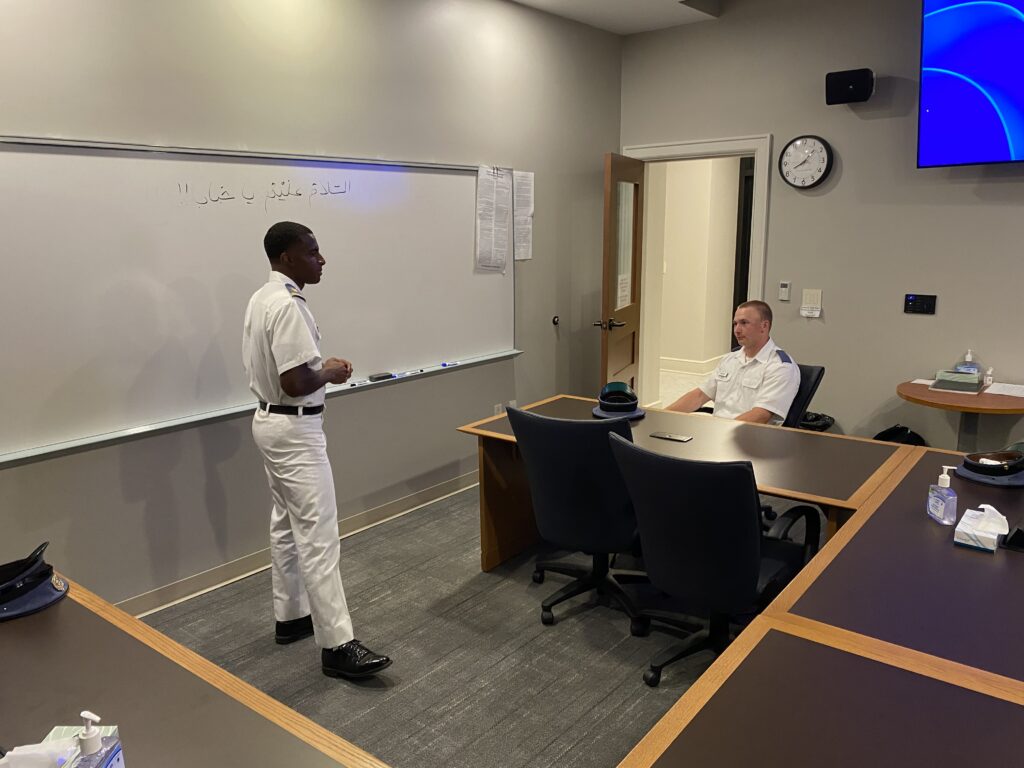
Cadets in a classroom at Virginia Military Institute.

“That could be anything from Arabic, Chinese, Swahili, Russian, those types of languages that the government deems necessary for young officers to speak,” he said. “You basically spend two months there in intensive learning.” 

He said that sometimes he’d be in the classroom for four hours or even up to eight hours — all Arabic instruction with culture lessons mixed in.  

While participating, Chandler said he visited eight cities in Morocco, rode a camel in the Sahara Desert, all while expanding his language capabilities.  

“I got used to hearing [Arabic] from native speakers, because there’s only so much you can do in the classroom,” he stated. “When you have hours that you can dive into it and you can see what your weaknesses are, you can become better. My speaking became better, my listening, my comprehension, everything.” 

His studies were centered at the American Language Center, which was close to his host family. His host mother didn’t speak any English, and he had to communicate entirely in Arabic at home, unless his host brothers were there to help.

“I was nervous initially. I had only completed the 100 level of the language by this point. I could do basic greetings and stuff like that,” he admitted. “I’d say about by the halfway point, I had kind of gotten a schedule down, and most things that my host mother would ask me, I would be able to understand.” 

Maj. Hicham Assaoui, assistant professor of Arabic in the Department of Modern Languages and Cultures, said studying and living in Morocco was a rigorous and immersive experience, one that Chandler not only met, but thrived in.  

“He quickly adapted to his host family, developed meaningful relationships, and served as what I can only consider as a cultural bridge between American and Moroccan communities,” Assaoui explained. “He is both mature and resilient. In terms of academic promise, his strong performance in the Moroccan history and culture course and his growth in Arabic proficiency signal a strong potential for future success.” 

His commitment to the study of Arabic continues on post. An active participant in the Group Study Session (GSS) tutor group, he holds group study sessions once a week for the 101 or 102 levels of Arabic. He’ll also attend lower-level Arabic classes to understand what each class is working on so he can tailor his study sessions to best fit those who need help.  

“I’ll write down notes to myself and what they need to work on in conjunction with the professor, and when we come in to the group study sessions, we’ll spend that entire hour, maybe on verb conjugation or reviewing vocabulary — it’s completely what they want,” he said. “I try and make it as close to possible to what helped me succeed.” 

Caleb Chandler on a camel in the desert.

According to Lt. Col. Jason Schroepfer, assistant professor in the Department of Modern Languages and Culture, the way Chandler approaches learning Arabic has stood out to him. He describes him as a leader to those wishing to learn Arabic, where his fellow cadets look to him for guidance.  

“In communication activities, he quietly takes stock of the task at hand by actively taking notes. He then applies the knowledge undeterred by the fear of making mistakes. He also takes feedback on some areas of improvement, if need be,” Schroepfer said. “In Arabic reading tasks, he’s also not afraid to take measured risks by making educated guesses on the meanings of words and structures that are just a little bit more advanced than his current level. These hallmarks of a motivated, independent student, more often than not, payoff for him. Most importantly, these are traits that are shared by highly successful people in general.”

Mohammed Shihab, Arabic professor in the Department of Modern Languages and Culture, said Chandler possesses a proactive drive to serve. Shihab has observed him during study and tutoring sessions with other cadets where Chandler doesn’t give them the answers, instead he guides them on how to study, breaking down difficult course material into understandable segments.  

“His initiative in seeking out those in need of help and his selfless dedication to their success is a rare and valuable trait that speaks directly to his character and potential as a leader of character,” Shihab said. “Cadet Chandler is the complete package: a brilliant and diligent student, a born leader, and a person of profound integrity. He is precisely the type of individual — one who leads with intelligence, compassion, and unwavering reliability.” 

Chandler said he’s grown more as a person while being at VMI. He started out as a shy individual, but with the roles he’s taken on and embrace, he’s become more confident. 

“I have to assert myself, and I’ve become so much more confident, and I can actually believe what I’m saying,” he stated. “I don’t get as nervous as much. Public speaking always killed me, but now it’s just something that’s required. I kind of just evolved.” 

He admits he enjoys every second of VMI, something he’s said others may find a little weird. 

“These are some of the best memories in the world,” he commented. “Like nights when you’re just staying up with the roommates, doing homework until maybe one or two in the morning. But you can just look back and it all makes it worth it. Just the bonds here.” 

He says he’s grown as a student. 

“I want to learn as much as possible, but I find it frustrating that there’s not enough class time for me to dive into it. I get so passionate about it,” he said. 

Chandler will be commissioning into the U.S. Army with the hopes to be a military intelligence officer, utilizing his love of Arabic. 

Assaoui has observed Chandler’s work in multiple contexts. Every week Chandler helps man the Arabic language table, he was also Assaoui’s student for study abroad in Morocco, and currently he’s enrolled in his upper-level Arabic 302 class.  

Assaoui said Chandler exemplifies the kind of cadet that VMI strives to cultivate.  

“He stands out for his initiative, adaptability, and genuine passion for learning,” he explained. “While many students are content to meet expectations, he consistently goes above and beyond to excel. His ability to build rapport with classmates, instructors, and host families reflects strong interpersonal skills and emotional intelligence.” 

The Vanguard — Aidan Carman ’27

The Vanguard series highlights cadets of Virginia Military Institute who exemplify promise, perseverance, and the true spirit of leadership. While they may not be the top-ranking students or those in prestigious positions, these individuals’ dedication, resilience, and growth embody the essence of being a VMI cadet. By sharing their stories, including the challenges they’ve faced and overcome, we shine a spotlight on the diverse paths to success at the Institute, proving that leadership and excellence come in many forms.  

Aidan Carman ’27 can be described as committed to whatever Virginia Military Institute can do for him. His professor, Col. John David, professor in the Department of Applied Mathematics and Jackson-Hope Distinguished Professor of Natural Science, said Carman is trying to get everything he can from his time at the Institute — utilizing his math degree track and plans of commissioning into the U.S. Navy.

“I feel like there’ s been a lot of good Naval officers come out of our department, and I think he’s going to be another one,” David said. “I think beyond his effort and hard work is the fact that he seems to fit in well with his [brother rats] and other math majors. He’s a great kid. My job would be easy if they were all like him.” 

Carman says he’s focused and confident in himself, but he’s still trying to improve himself. The math major said he’s academically sound.  

“I’m fortunate that I can grasp a lot of material. Not to say that I don’t have to put in any work, but it seems, for the most part, I pick up things pretty quickly, so that’s good. I’ve been able to keep good grades,” he admitted. 

There was a bit of a learning curve in his first year, especially when it came to time management.  

“That was a very big shock coming here, especially throughout the Rat Line, was learning how to manage my time,” he stated. “As a high school student, I didn’t have to put any effort at all into it. I never brought home homework. It was all done by the end of the day. I didn’t have labs. So, learning how to balance school with also getting sleep and managing all that time to do the little in between things. 

“The biggest thing I had to learn was not doing homework the night before it was due, but when it was assigned,” he said. “Procrastination is what really gets people. All the little things start to add up. Once I started just getting the smaller stuff out of the way, I had a lot more time for bigger projects and tests.” 

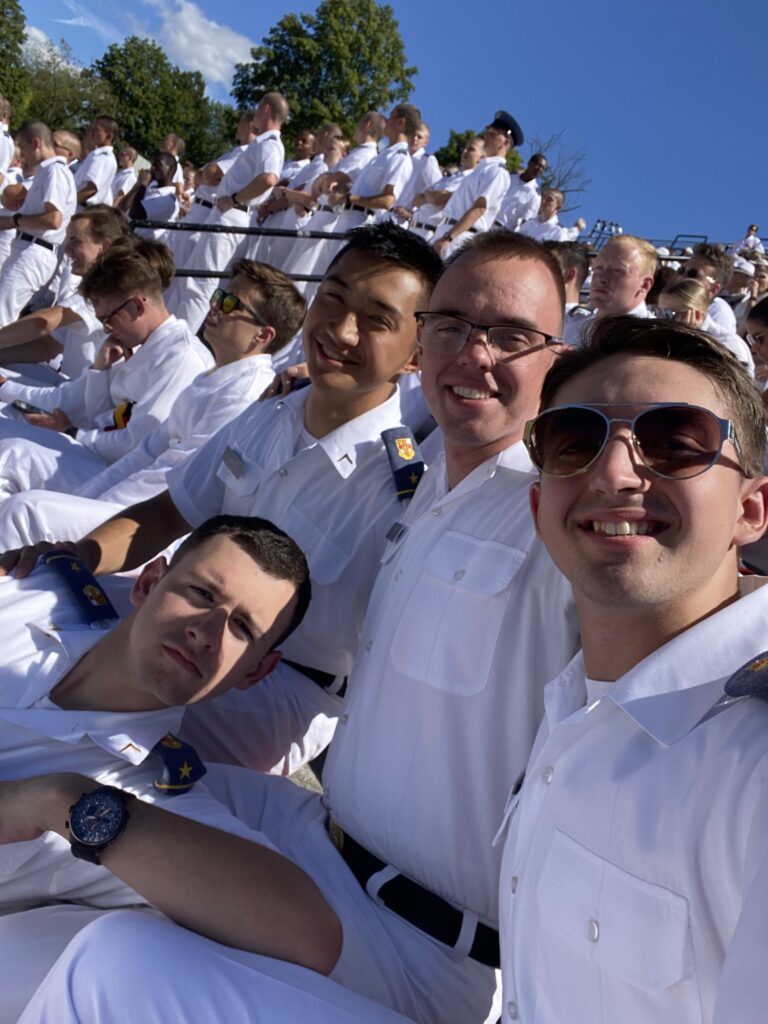
Aiden Carmen with his brother rats at a football game at Virginia Military Institute.

One of the biggest lessons Carman has learned is to be comfortable with being uncomfortable.  

“Throughout the Rat Line, just some of the mental challenge of not quitting when that’s the easy way out, and even if something’s harder to do, still doing it and just grit your teeth and do it,” he explained. “I feel like I was not that way before coming here. I was the, ‘take the easy way out,’ but that changed when I got here. I learned to just grit my teeth and do the hard way over the easy.”

As a platoon sergeant for the Old Corps, his day begins and ends with accountability.  

“Mostly it’s just being accountable at formations,” he explained. “For BRC [breakfast role call] and SRC [supper role call] every morning and evening, I stand out in front, get accountability, report it back, and then march down.” 

But even with a system in place, each year at VMI brought its own unique challenges.  

“As a rat, you just do what you’re told and go where you’re told — you’ve got your dyke (senior mentor) to support you,” he said. “By 2nd Class year, you know the people who will have your back, and you know the school a lot better. Third Class year, though, is tricky. You’re not completely alone, but it feels like it sometimes. You’re trying to figure out your support system, both personally and academically, and really learn what works for you and what doesn’t.”

Aiden Carman with his brother rats in barracks at Virginia Military Institute.

One of the places he found direction was in the math department, where he got involved in research opportunities. Through the Summer Undergraduate Research Institute (SURI), there’s a program called AIM, or Applied Industry Mathematics. Carman explained that it’s focused on working with local businesses or even departments at VMI. He’s worked with VMI’s financial aid and administration office, but most recently he partnered with a company in Buena Vista.

Those experiences gave him something more than classroom learning — real-world work experience. 

“You get credits, a stipend, and, most importantly, the chance to apply what you’ve learned to actual problems. Sometimes in class you’re just solving for a number,” he explained. “I feel like I got a very wide breadth of experience from working with different entities in a professional line of work and applied the things I’ve learned in class and put them into practice to see how they can solve real world problems. That’s a valuable skill.” 

“He always does what he’s supposed to do,” David, director of the AIM program, said.  

Carman has enrolled in three of David’s classes and in 2024, did research to help VMI’s admissions and financial aid offices analyze what factors best predict whether cadets will stay at the Institute and ultimately graduate. 

“He just seems to be really committed to getting everything he can out of his time at VMI,” David commented. 

Behind the Balance: Colin Crenshaw ’27 — Keydet Cross Country

Virginia Military Institute’s cadet-athletes have to juggle cadet life, heavy academic course loads, and their NCAA Division I sport. Committed to both academic and athletic pursuits, balancing their rigorous schedule in both sports and school requires a certain level of commitment and discipline. Behind the Balance is a series that focuses on those cadet-athletes and how they handle the hurdles of the day-to-day. 

Uncertainty after high school is normal and something Colin Crenshaw ’27 faced upon graduation. It’s one of the reasons he decided to attend Virginia Military Institute. 

“I didn’t really know what I wanted to do after high school, but I knew if I came here, there would be lots of doors that would be open,” he admitted.  

The chemistry major also had the opportunity to run cross country and track at VMI, something he fell in love with at a young age. 

“I started running cross country in middle school because my mom convinced me to, because she told me I’d get faster for basketball,” he said. “I ended up not being that good at basketball. I fell in love with running. I had a good coach when I first started, and he kind of helped me fall in love with the sport and just pushed me to see how good I could be.” 

He likes how cross country makes him more accountable. 

“I like that it’s all on me,” he commented. “I don’t have to rely on other people. If I do bad, it’s on me. I think it really tests what you’re made of when you’re out there by yourself.” 

The 2nd Class cadet has a heavy load this semester with 19.5 credit hours. 

“Especially here at VMI, there are not a lot of moments where you get to sit back and think,” Crenshaw commented. “I use running to do that.” 

Cadet-athletes at VMI not only have their responsibilities with their selected sport but cadet duties on top of that. Cadets are also required to take physical fitness classes twice a week, participate in ROTC all four years, prepare for room and uniform inspections, practice for parade, guard duty, and more. 

He’s up before 6 a.m. most days for morning runs. His weekly mileage is between 55 and 60 miles. He’s then in class from 8 a.m. until 3:30 p.m., then he’s off to a 4 p.m. practice.  

“I just take it one thing at a time and try not to get overwhelmed,” he said. “I know it’s just going to prepare me well for the future.” 

Crenshaw said he tries to fit in schoolwork between classes, so he’s not staying up late to finish assignments.  

The workload he has at VMI — with academics, athletics, and cadet responsibilities — will help him later in life. Something he is looking to pursue after graduating is attending medical school. Crenshaw is currently a cadet EMT.

“I think the biggest thing is time management. That’s something I really learned here that I didn’t have to focus on before,” he stated. “I also think VMI teaches you that you’ve got to be doing what you’re supposed to be doing. I think that just that discipline will help me in the future.” 

Colin Crenshaw running cross country for Virginia Military Institute.

He tries to take victories where he can and start with the small things.  

“One thing I like to do when I’m working is if I have something small or not that significant, that’s not going to take me very long, I like to do that thing first, so I can get one thing done,” he explained. “Rather than trying to do an overwhelming project first.” 

As a cadet EMT, Crenshaw is able to pick and choose what events he’s able to cover. It all has to fit into his sports and academic schedule.  

“I always knew that I wanted to do something where I actually made a difference and helped people,” he said. “I didn’t want to just sit behind a desk and click around in Excel files. That’s something I’ve always known about myself.” 

The busyness of life at VMI is something Crenshaw enjoys and thrives on.  

“That’s the one reason I thought I would do well here,” he said. “I don’t like sitting around being bored. That’s when I get myself into trouble. It’s not good for me to be bored.” 

Behind the Balance: Natalia Dias ’28 — Keydet Cross Country

Virginia Military Institute’s cadet-athletes have to juggle cadet life, heavy academic course loads, and their NCAA Division I sport. Committed to both academic and athletic pursuits, balancing their rigorous schedule in both sports and school requires a certain level of commitment and discipline. Behind the Balance is a series that focuses on those cadet-athletes and how they handle the hurdles of the day-to-day. 

Natalia Dias ’28 wanted to be set up success, and that meant finding a way to pay for college or leave her with minimal debt. She had three clear goals in school: an engineering program, U.S. Army ROTC, and cross country and track. 

Although she made the switch to economics and business, she found that Virginia Military Institute could offer her what she was looking for. 

“I always knew that I wanted a college that would take me further in my career, and VMI does that in every aspect,” she said. 

Thanks to an Army scholarship, she’s able to afford tuition, and will be commissioning into the Army upon graduation.  

The 3rd Class cadet is currently enrolled in 18 credit hours, which takes a lot of planning.  

Cadet-athletes at VMI not only have their responsibilities with their selected sport but cadet duties on top of that. Cadets are also required to take physical fitness classes twice a week, participate in ROTC all four years, prepare for room and uniform inspections, practice for parade, guard duty, and more. 

How does she handle it? Carefully. 

“I think my whole day is planned out in my planner,” she admits.  

Yes, a real physical planner. Inside is a carefully written schedule that soon becomes overloaded with extra sticky notes and highlights.  

“There are some days I have morning practice, and I don’t stop moving until dinner that evening,” she explains. “Then I go straight to the library, and get my homework done. If it’s an early night, I get excited because I get to go to bed.” 

Her days start sometimes as early as 5:30 a.m. and continue straight through until past 10 p.m. Then, it starts all over again.  

She also holds rank — as a corporal in the Old Corps, which means she’s in charge of upperclassmen and to make sure they’re there for formation and do things like rifle checks. She says she dedicates about an hour or two a day to that role.  

“I wanted a role more than what I already was responsible for,” she explained. “Because as a rat you don’t really have any choices. I wanted to be in charge of something.” 

She said since she wasn’t chosen for cadre, the Old Corps allows her to balance that role with her responsibilities with athletics, academics, and other cadet duties.  

Natalia Dias running cross country for Virginia Military Institute.

“It doesn’t take up as much of my time, which is probably a good thing,” she said. “This is a good introduction to holding rank. It’s really important because these men and women that are in my squad depend on me to make sure they don’t get in trouble, every single day.” 

As for running — it’s her escape. She’s been running track and cross country since middle school. 

“I love my team,” she stated “It’s one of my favorite parts of my day to go down to even just practice. It’s a good escape. It’s away from the Institute, in a way, and makes me feel a little more normal, but it’s very freeing. It’s my time where all I have to do is run. All I have to do is workout. All I have to do is lift and that feels good sometimes, because a lot of things get overwhelming here. It’s just like a freedom where I don’t have to worry about anything else.” 

Dias describes herself as a big planner with a very Type A personality. 

“I write down the things I can control, and I try not to worry about the things I can’t, because there’s a lot of things you can’t control,” she said. “We have really good resources here. We have the Cadet Counseling Center and everything. If I ever need some help, I can go there, or I can talk to my teammates, my coaches, or my classmates. There’s a lot of great support systems here with how the school is set up.” 

Although her family was a little skeptical of her attending VMI, Dias knows she made the right decision. It was confirmed after an overnight visit where she learned how many opportunities there were for people — especially female cadets. She could feel how close-knit everyone was.  

“To me, it’s not just to further my life, but it’s to experience all of this with my classmates, to get the military experience, to be able to pursue my dreams,” she said.  

The Vanguard — Nat Lavender ’26

The Vanguard series highlights cadets of Virginia Military Institute who exemplify promise, perseverance, and the true spirit of leadership. While they may not be the top-ranking students or those in prestigious positions, these individuals’ dedication, resilience, and growth embody the essence of being a VMI cadet. By sharing their stories, including the challenges they’ve faced and overcome, we shine a spotlight on the diverse paths to success at the Institute, proving that leadership and excellence come in many forms.   

Nat Lavender ’26 was sitting in class one day on her sixth page of notes when her hand started to cramp. She only had one thought — she was miserable as an economics and business major.  

“I thought to myself, I could do this, but do I really want to be miserable for the next three years?” she questioned. “I switched my major, and I went to English. It was always my favorite subject and I’d missed it my rat year since I tested out.” 

The switch created a fire in her. She became so passionate about her major and studies.

“I’m very humanities brained. The creativity and the complexity of connotations and literature and how words shape reality is so fascinating to me, especially because words are such a reflection of ourselves,” she said. “You read someone’s writing, you’re sharing their mind for a few minutes. I think it’s fascinating and beautiful. I think books are by far the most versatile form of entertainment of learning, because you could read the same book five different ways, depending on the layers of symbolism, you can’t do that with anything else.” 

The way Lavender speaks about writing and reading, anyone can see her dedication and desire for it. She explained that the ability to read a book in a completely different way than the person sitting next to her, just due to personal experience, is so intriguing to her.  

“We’re all just sharing and having a silent conversation,” she stated.  

Although Lavender doesn’t hold rank, she’s held a bevy of different jobs on post. For two years she worked as a history group study session facilitator. Most recently, she’s been working as the cadet in charge for the Daniel’s Library. She also works at the Writing Center, where she serves as a consultant for her peers.  

“I love that job,” she said of the Writing Center gig. “I’m not a very extroverted person, but I like to pick a couple things I’m passionate about and really commit.” 

In addition to being an exceptional student, she has also been an outstanding athlete, competing on VMI’s NCAA Division 1 Cross-Country and Track teams, lettering in all seven seasons. 

A self-proclaimed nerd, she finds solace in studying. 

“I enjoy locking myself away and reading and studying. Nobody’s really with me on that, which is understandable,” she said.  

She’s currently working on her thesis, which focuses on post-World War I Avant-garde art movements of Dadaism and Surrealism in their modern context and conversations and seeing if she can recreate that — if possible. Lavender’s goal is to see if the arts can be limited to a time period in its historical context or not.  

Nat Lavender with her brother rats at Virginia Military Institute outside barracks.

Col. Catharine Ingersoll, professor in the Department of English, Rhetoric, and Humanistic Studies, said Lavender is a bright student who is disciplined and intensely curious.  

“If I have a stack of tests or papers to grade, I save hers to do last — like a dessert — because she always does such an excellent job on assignments,” she admitted. 

Ingersoll has seen this in the cadet’s work on her honors thesis and explained her project shows great promise and combines her enthusiasm for art history and studio art. Ingersoll went on to say that Lavender comes in for their meetings with innovative ideas that reveal how thoroughly she’s been thinking of how to convey the theme of her thesis. 

“Cadet Lavender always manages to fulfill her responsibilities to a high level of finish, even when she is feeling stressed or when she has a lot on her plate  — and even during times when she, herself, seems unconvinced that she can get everything done,” Ingersoll said. “She never lets things get away from her, even in the midst of the chaos of day-to-day life at VMI.” 

Lavender had not always been so committed to school, she admits. 

“I was not a good student in high school at all. I showed up 30 minutes late to class and sat in the back,” she said. “I mean, I did decent on my work, but I’d help my friends with their essays and turn mine in two days late. I was never that worried about it. It was kind of a shock coming here. 

Nat Lavender with her family during family day at Virginia Military Institute.

She said being diagnosed with ADHD at the age of 18 helped her realize the gaps in how she was able to study and figured out how her brain operated.  

Coming to VMI has allowed her to grow and discover herself.  

“I really thought I knew who I was in high school. I think most people do, and college is a place to grow from the bubble you’ve grown up in,” Lavender explained. “Here it’s just the absolute lack of anything that precedes your actual actions, words, and personality. It forces you to know who you are without the clothes or the car and those kinds of materialistic things. Without the materials, you have to look in the mirror. I’d say I’m much more aware and much better for it. I think the stress of this place really illuminates your flaws, and you’ve got to be like, okay, I can’t ignore this anymore.” 

At times she has found VMI to be lonely, but with being on the track team and the friendships she’s made with her roommates and through her major, she’s been able to surround herself with a close group. 

“I think my roommates are such a blessing. I love them so much. I’ve made so many connections here. I think the biggest thing is just knowing that even when you’re feeling lonely, it doesn’t mean you’re alone,” she said. 

She’s set to graduate early this December with Institute Honors; a B.A. in English; a minor in French; and concentrations in literary studies, philosophy, rhetoric and writing, and art history and visual culture. The need to be constantly moving pushed her to add extra classes to her schedule with the intent to drop them. Except, she never dropped them. She’s currently applying to graduate programs — most notably to be a Rhodes Scholar.  

Col. Emily Miller, professor of English and head of the Department of English, Rhetoric, and Humanistic Studies, describes Lavender as an outstanding student with a broad range of academic interests.  

“She has a remarkable amount of intellectual curiosity, which is evident in all of her endeavors,” Miller said. “For example, last November she presented a paper that she wrote in my honors seminar on Shakespeare at a professional conference (the South Atlantic Modern Language Association Conference), and she revised it multiple times, thoughtfully working over each sentence until it captured her exact meaning. She did a superb job of presenting the paper and answering questions from the audience. Similarly, in class she always offered meaningful observations and questions about Shakespeare’s plays.” 

Miller said Lavender’s work ethic seems to arise very naturally from intellectual curiosity.  

“She is humble, thoughtful, and generous, always ready to help her fellow cadets however she can. With her excellent performance in all of the areas I have mentioned, she is a very strong candidate for a Rhodes Scholarship.” 

Behind the Balance: Amari Benjamin ’27 — Keydet Men’s Soccer

Virginia Military Institute’s cadet-athletes have to juggle cadet life, heavy academic course loads, and their NCAA Division I sport. Committed to both academic and athletic pursuits, balancing their rigorous schedule in both sports and school requires a certain level of commitment and discipline. Behind the Balance is a series that focuses on those cadet-athletes and how they handle the hurdles of the day-to-day. 

A sense of discipline is what drew Amari Benjamin ’27 to Virginia Military Institute.  

“I knew that I wanted that in my life, and I knew that would set me up forever,” he said. “I also wanted the option to commission, because I was on the fence and I got the opportunity to play soccer here as well.”

Benjamin, an economics and business major, plans on commissioning into the U.S. Army. Having the option to play soccer at VMI was a big draw for Benjamin. After a soccer camp with the VMI soccer coach, Nick Regan, his interest was piqued.  

“I wasn’t originally interested in VMI. I didn’t really know what it was, either,” Benjamin admitted. “But then Coach Regan reached out to me saying, we’re interested. He gave me a little breakdown on the school and then did my own research. My dad was in the Navy, so I’ve always been in that military setting at home too … it wasn’t that big of an adjustment.” 

Cadet-athletes at VMI not only have their responsibilities with their selected sport but cadet duties on top of that. Cadets are also required to take physical fitness classes twice a week, participate in ROTC all four years, prepare for room and uniform inspections, practice for parade, guard duty, and more. 

Benjamin has a packed schedule with 17.5 credits as well as serving as an S9 Sergeant. With that comes a multitude of duties including preparing for pep rallies, company athletics activities, and creating permits and Concept of Operations (CONOPS) documents. S9 is primarily made up of athletes, so cadets involved must pick up where it’s needed when those on the staff are in season. 

“S9 is an amazing staff because we all know how much we put in on the field or court, so we are always quick to have each other backs and help when help is needed,” he said. “When it’s S9 time, it’s S9 time. Allowing me to segment my day with school, soccer, and rank allows me to stay on top of things and not get burnt out.” 

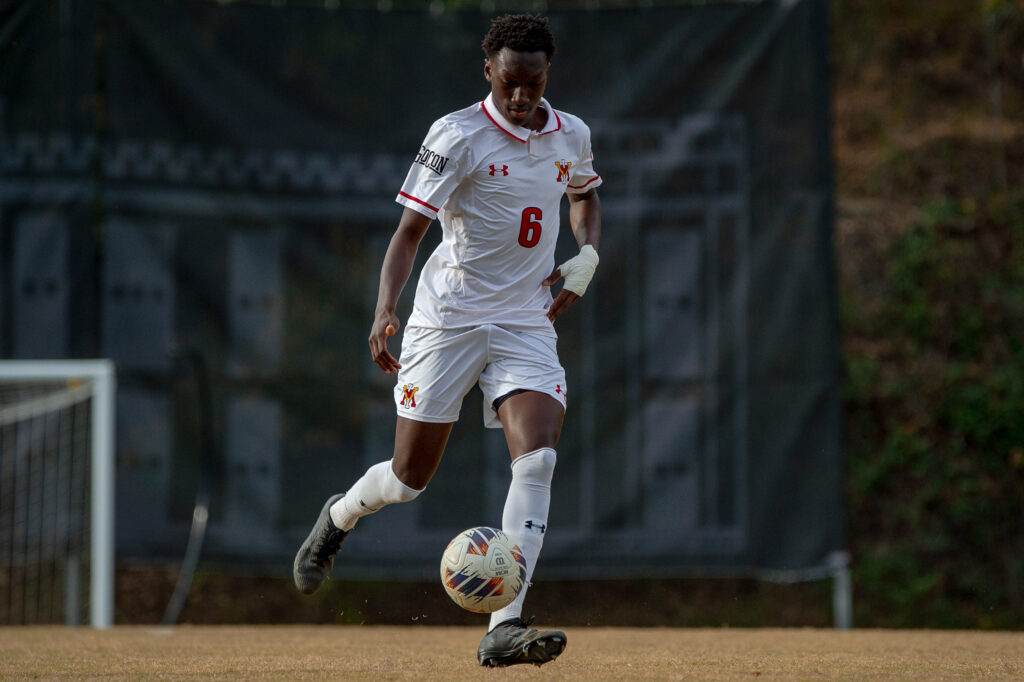
Amari Benjamin playing soccer for Virginia Military Institute.
VMI Men’s Soccer Action Shot vs. Queens

His days start early while he’s in season — around 6 a.m. for a team run or a quick session on the field before breakfast. Then it’s classes until the afternoon and straight to practice, which lasts until after 6:30 p.m. Then he’s back to studying and class assignments.  

“I like to get a lot of my work done out the way early. I don’t want to stay up late because I wake up in the morning feeling groggy,” he explained. “Usually throughout the day, from whenever we finish that first training until before practice, it’s only school. That way, at least at night, I can only focus on whether I have an exam the next day or I can focus on one thing and not have to over stretch myself.”

Benjamin has had to find a balance in structuring all his tasks. In the beginning, he found it tough to do so.  

“My first year playing Division I soccer, all of that was overwhelming. It wasn’t until my sophomore year that I really was able to crack down on it and build good habits and get into a routine,” he stated.  

He especially must plan with traveling for games, which they have a packed schedule of nearly 20 games during a season.  

“When I know I have an away game coming, I try to overly stress the fact that I need to finish all this, because I go into the game with just the game in mind, and not have to worry about an assignment due at 11:59 p.m.,” he explained. “Usually, I try to plan out my days well. I feel like every assignment I get or every reading I’m assigned, I always put in my notes, and I try to get it done that day, if possible. That way, later in the week, when the games do come around, it’s just straight soccer.” 

Benjamin said the skills he’s learned at VMI will translate into his life, no matter what he does. He says the ability to multitask and prioritize has helped him plan his days properly.  

“I feel like one piece of advice that my dyke [senior mentor] also told me was, at the end of the day, you’re going to go to bed, and the next morning you’re going to wake up,” he commented. “You’ve just got to get through the rest of the day, and nothing can really hinder you. At the end of the day, if you just do what you need to do and get through it, there’s a whole new day waiting for you.”