Post View Unavailable »
New Website Launched »

Behind the Balance: Gretal Shank ’25 — Keydet Cross Country

Virginia Military Institute’s cadet-athletes have to juggle cadet life, heavy academic course loads, and their NCAA Division I sport. Committed to both academic and athletic pursuits, balancing their rigorous schedule in both sports and school requires a certain level of commitment and discipline. Behind the Balance is a series that focuses on those cadet-athletes and how they handle the hurdles of the day-to-day. 

Gretal Shank ’25 started running cross country when she was in seventh grade. She almost quit two weeks in. 

“I didn’t like it,” she admitted. “It was hard, but then I realized I was pretty good at it, so I stuck with it and did it all through high school. I did pretty well, I’m still running.” 

She averages running 30 to 40 miles a week. During that time, she treats it as meditation. Shank, an English major, says she spends her runs sometimes formulating stories.  

“I’m also a writer. I do a lot of my thinking about ideas for what I’m going to write, while I run, also just ideas for anything,” she said. “I got a lot of time on my hands.” 

During the harder workouts, though, she’s not thinking about anything. 

“I think a big part of it is mental. It gives me a mental break in the middle of the day. I get a lot of my thinking done while I’m running,” she said. “Also, it keeps me fit, obviously. It gives me goals to work on, from personal goals to team-oriented goals. A big aspect of that is teamwork, but it’s also an individual sport.”

She applied to West Point, but didn’t get in, so she shifted to VMI. Without even seeing post first, she decided to commit. It took one call to the cross country coach for her to get on the team with a partial scholarship. 

“I wanted a college experience that wasn’t going to be ordinary,” Shank said. “But it initially started whenever I was looking into commissioning, because my parents are both in the military.” 

With plans of commissioning into the U.S. Army, Shank’s days are filled and regimented — much like other cadets at VMI. The schedule she keeps ensures she’s able to get all her tasks done. On top of a sport, she’s taken a heavy credit load her entire time at VMI — taking 20 credits this semester, three of which are dedicated to her honor’s thesis. Due to her psychology minor, she must tack on six more classes to fulfill requirements.  
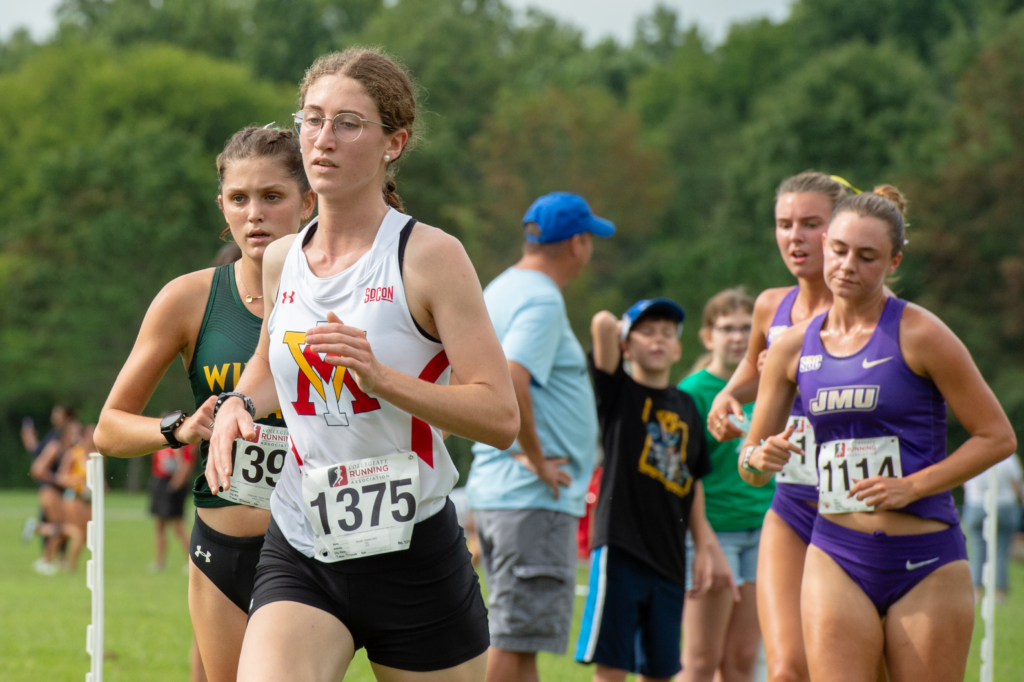
Gretal Shank running cross country for Virginia Military Institute.

Her academic schedule is packed. Mondays, Wednesdays, and Fridays, she has five or six classes, then heads to practice from 3:30 to 7 p.m. Tuesdays and Thursdays, she has Army ROTC lab and classes. 

Cadet-athletes at VMI not only have their responsibilities with their selected sport but cadet duties on top of that. Cadets are also required to take physical fitness classes twice a week, participate in ROTC all four years, prepare for room and uniform inspections, practice for parade, guard duty, and more.   

The continuous activity is something Shank likes. Besides being a DI athlete and having cadet responsibilities, she’s the visual editor for Cadence, the Institute’s fine arts publication. She also works at the VMI Writing Center and is the president of Sigma Tau Delta, the International English Honor Society.

“I think for me, it might make it easier. I haven’t known any different, but I think it’s easier because I have a consistent schedule,” she said.  

Each day has a specific schedule that Shank doesn’t deter from. When it comes to a slower day or a day off, she often doesn’t know what to do with herself. She needs constant activity to push her along.  

“I find that on days that I don’t have practice, which is pretty rare, I actually don’t get more work done,” she said. 

VMI has kept her busy and helped create a lifestyle of structure, she said. She needs to have a designated time for everything, otherwise she’d get nothing done.  

“Honestly, the busier I am, the more I will be able to get done, because otherwise it’s easier for me to just be lazy,” she admitted. “I’ve kind of run into that problem on Tuesdays and Thursdays a little bit to where I just kind of want to relax, because my Monday, Wednesday, Fridays are so busy, but it’s been fun. I’ve gotten all the work done that I need to get done, so that’s what matters.”

Stealing a Moe-ment With VMI’s Mascot

Atop the kangaroo head, there’s a small vent and a fan. Bowlman “Tee” Bowles IV ’26 says it gets hot under there. The fan helps, but it’s often sweltering inside the faux kangaroo costume.  

He also needs a handler walking him around — he can barely see.  

Bowles is one of two cadets who serve as the mascot, Moe, during functions at Virginia Military Institute. The history major, who will be commissioning into the U.S. Army following his time at VMI, joined the Corps of Cadets S9 regimental staff his 3rd Class year. S9 staff are responsible for all issues related to NCAA athletics and club sport events. 

He chose S9 because he had similar duties in high school — working with the sports team, commentating on games, doing social media, and so on. A big draw was the opportunity to become Moe.  

“Every time I watched basketball games, I saw mascots doing stupid things and fooling around with other teams and stuff. I got inspired by seeing those mascots on TV, which gave me interest to do the Moe costume,” he said.  

Moe is a staple around post. He’s present for home football games, pep rally, and other home sporting events. The mascot is around for pictures and overall, a boost in morale.  

“We’re there for the rats,” Bowles said.  

Moe is a key part of the Keydets, specifically with family, friends, alumni, and other guests in attendance at events, Bowles said. That means a lot of pictures being taken — aided specifically by Moe’s handler — and overall hyping of the crowd. This year features a new costume for the mascot. Bowles said the previous suit was falling apart and needed to be replaced. He came in this year and a new suit was there. 

“In the Moe costume, you have to look down when taking pictures. The eyes are looking up. Whenever I’m taking pictures, I’m literally looking at the ground,” explained Bowles, hence the need for the handler.  

Bowles says the handler will tap him on the shoulder when people ask for photos and help him maneuver around the crowd, especially at Foster Stadium.  

“The steps are really steep and hard to get up in those big feet,” he said. 

Moe, VMI's mascot, outside of barracks.

Bowles shares the responsibility with Carter Rees ’27. Rees just started as Moe at the start of the 2024-25 academic year.  

“I love feeling the energy of a crowd, so the opportunity to be at the center of creating that energy was an easy decision for me,” Rees said. “My favorite part of being Moe is making people happy. Whether that’s getting the Corps hyped up or taking pictures with people, I love seeing smiles on people’s faces.” 

Bowles said he tries to break some of the tension during the games, especially any stresses that the rats are facing.  

“It’s super easy to interact with the rats,” he said. “I love going up there and messing with them. Like I’d sit down next to rats and take their drinks and stuff, act like I’m drinking it.” 

He’s also trying to bridge the divide that can sometimes be seen between the Corps and athletics. 

“There’s this stigma that the Corps is detached from athletics, that athlete, non-athlete divide,” he said. “I think Moe can definitely help unlock that by interacting with them as rats, because I can help them unlock interest in athletics.” 

The history behind Moe 

The history behind Moe and the Keydets is a little complicated.  

Keydets have been the term to describe VMI’s athletic teams, although where it originated isn’t clear. While a Keydet is not a kangaroo, the animal was chosen as the mascot in 1947, when two VMI cheerleaders saw a picture of a kangaroo on the front of a magazine and realized how uncommon the animal was as a mascot. Originally named TD Bound, the mascot was renamed Moe later, to appeal to all VMI athletics, not just football. 

It’s said that the term Keydet could have come from the United States Military Academy’s term used to denote the gray of the standard uniform of a cadet. Another definition, one that hasn’t been factually substantiated, due to the Southern drawl of some members of the Corps, the pronunciation of cadet morphed into Keydet.  

VMI has been associated with several nicknames, one of the longest was the Flying Squadron, which referred to the football team. The Flying Squadron nickname started in 1917 at a football game between VMI and North Carolina and it stuck, becoming most popular during the 1920 season. It wasn’t until the 1930s that the term Keydet became associated with VMI athletic teams.  

Learn more here.

Behind the Balance: Ty Swaim ’24 — Keydet Baseball

Ty Swaim ’24 didn’t want a lot of debt coming out of college and he knew one way for him to attain a good education was through a baseball scholarship. Virginia Military Institute wasn’t even a place he was thinking of until he was recruited to play for the Keydets. 

He said ultimately, he based his decision on attending VMI for the opportunity to play baseball, the trust he had with the coaching staff, and the expectations they had for him. But also, it was based on the financial opportunity it presented.  

Coming from a lower income household, he knew he had to get some sort of financial help, which he was able to with a combination of a baseball scholarship and financial aid. 

“Coming in here, it was the closest thing to a full scholarship that I could have gotten, especially for baseball, which is extremely tough to get,” he said.  

He also knew choosing to pursue VMI’s economic and business degree would work greatly for him.  

“The degree has a huge weight and significance,” he said.  

Being able to continue his love of baseball was a plus. His grandfather played professional baseball and his parents were heavily involved in athletics.  

“I feel like I always had a T-ball bat or a plastic bat in my hands,” he said. 

Playing sports has always been in his inventory.  

“It just so happened that baseball was the only one I was half decent at,” he joked. “If I wanted to go to college, it was the only one that I was good enough to play Division I, so that’s kind of how that worked. I love baseball more than anything.” 

Swaim was drawn to baseball because of its competitiveness, combining both a team sport aspect and individual skill – competing as an individual on a team basis.  

“You’re working with your teammates, but a lot of it boils down to individual things where you have the bat on your shoulders,” he said. “You have the ball in your hand where you can get the job done. I know from a hitter’s perspective, when you’re in the box, you’re kind of in a war with the pitcher. It’s just you guys. When you’re on defense, when the ball’s hit, it’s a team sport. You can go help out your pitcher, you can go make a play.” 

Cadet-athletes at VMI not only have their responsibilities with their selected sport but cadet duties on top of that.  Cadets are also required to take physical fitness classes twice a week, participate in ROTC all four years, prepare for room and uniform inspections, practice for parade, guard duty, and more. 

Days start early for Swaim, especially when he’s in season. He’s up most days at 5:15 a.m. to lift weights from 6 to 7:15 a.m. Then he rushes to grab breakfast to-go, so he can head back to his room, shower, change, put his hay up, and get ready for class.  

His schedule varies for certain days — Tuesdays and Thursdays he has class at 8 a.m. Wednesdays and Fridays, he doesn’t have class until 12:35 p.m. He uses his time wisely, though. On his free mornings, he spends them completing homework to get ahead, because he’s usually down on the field for more practice by 2:30 p.m. daily. 

This last semester is a bit different than years past. His previous years had been back-to-back classes then straight to practice. Now, as a 1st Class cadet, he’s given more of a break. 

His goal is to finish his homework during the week, so he can travel on the weekends or play at home for baseball.  

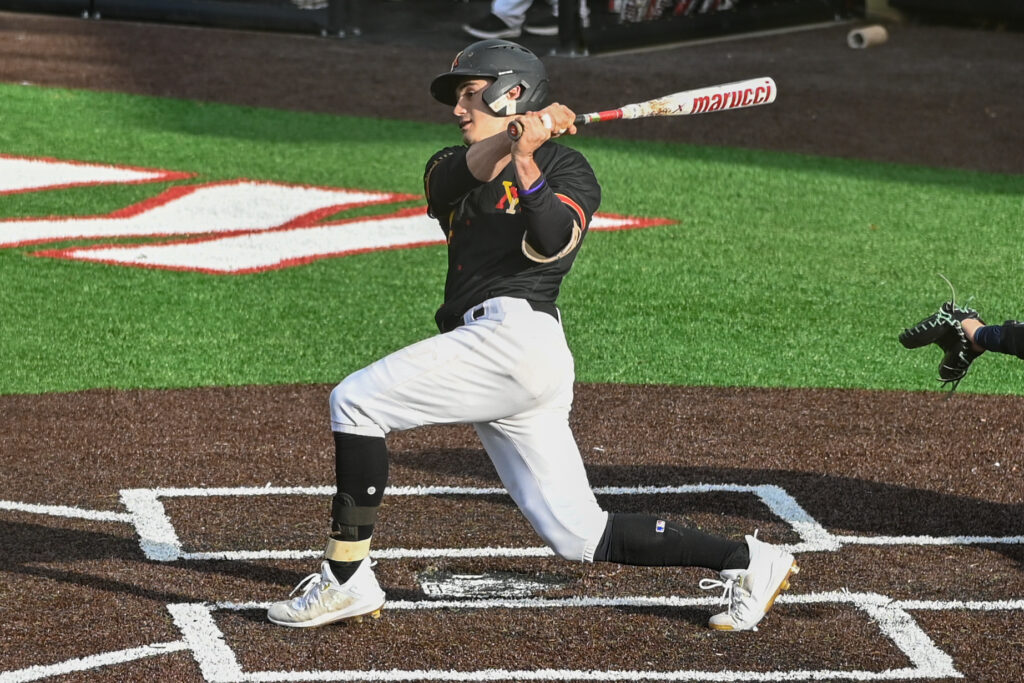
Ty Swaim swings a baseball bat during a Virginia Military Institute baseball game.

“I try to set up all my schoolwork to be done within that week because I know on the weekends, I just want to focus on baseball,” he said. “I know my brain is not going to be in the classroom, so I do all my schoolwork during the day.” 

His top priority right now is finishing strong for baseball. He feels that VMI has prepared him to come out on top in his sport, but also has prepared him for whatever life throws at him after graduation in May. 

“The busier I am, oddly enough, the better I am. This school doesn’t really let up,” he said. “The schoolwork in the past has been extremely tough … when you have three tests a day, it gets crazy. When I was super busy with really hard classes and heavy course loads, I ended up getting better grades because there was absolutely zero time for free time. Sometimes I think I work well in that just because when I do get free time, I tend to slack off.” 

He doesn’t take those slivers of days off for granted. His time at VMI has taught him to savor the downtime and treat it as a reward for working hard, and to acknowledge stress not necessarily being a bad thing.

“Having stress isn’t bad, just being able to understand the stress and use it,” he said. “I think stress gets a bad rap, which obviously when you are stressed it’s terrible. Everything brings you stress. But it gives you things to do, keeps your mind busy and things for you to work on. If there was no stress at all, I don’t know that would be a very fun world to live in. No challenges to get over, there’s nothing to focus on, there’s no goals to meet.” 

Swaim admits he still has room to grow and isn’t quite sure of his next steps following graduation. But, VMI has created a great path for him. 

“I think I’ve matured a lot since I’ve been here. Of course, I think there’s still so much more I can learn,” he said.  

His priorities for the spring — baseball and living in the moment. This is his last chance to play on a large scale. 

“I really want to focus on baseball and just ending on a good note. I have spent so much time in my life on it,” he said.  

Behind the Balance: Kyle Webster ’24 — Keydet Lacrosse

Virginia Military Institute’s cadet-athletes have to juggle cadet life, heavy academic course loads, and their NCAA Division I sport. Committed to both academic and athletic pursuits, balancing their rigorous schedule in both sports and school requires a certain level of commitment and discipline. Behind the Balance is a series that focuses on those cadet-athletes and how they handle the hurdles of the day-to-day.    

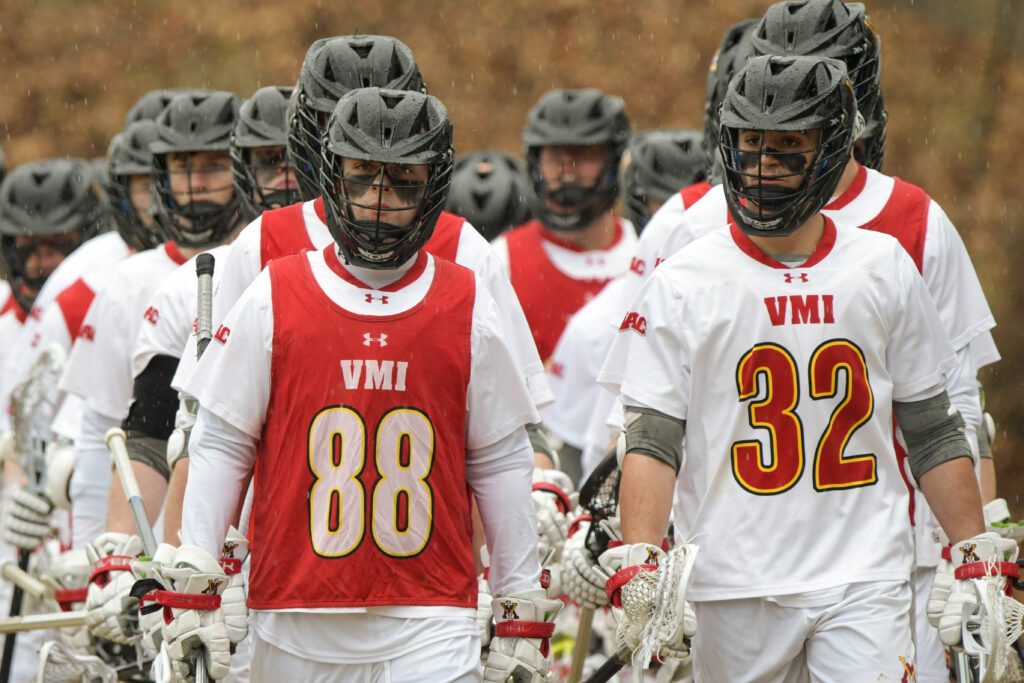
Leadership and regiment have been ingrained into Kyle Webster ’24 since beginning his time at Virginia Military Institute. Choosing a military college wasn’t his first choice, but with an offer to play lacrosse and a best friend from home also attending, those were big incentives.  

He’s been playing lacrosse since he was 7 years old. 

“I fell in love with it,” he said. “It’s a fast pace. People say it’s the fastest game on a field. The physicality and the thrill of scoring a goal or picking up a big ground ball is just awesome.” 

Going to high school in Alexandria, Virginia, he played in one of the top three high school conferences in the country. The sport was incredibly popular in his area, but he was the first in his family to play it.  

For his 1st Class year at VMI, Webster was voted as one of the team captains, alongside A.J. Stamos ’24 and Diego Markie ’25.  

“I’m anywhere from motivation of the team to just checking in on guys,” he said about his role as captain. “I try to make sure that I have a great relationship and a friendship with every single person on the team. I can be that guy that anyone can come to for their problems or just want to talk. I’m trying to lead on the field, by example, and play the right way.” 

Webster and Stamos grew up and have played lacrosse together since they were kids. Webster said it’s been a big motivation, having a friend like that on the team. 

“It was kind of cool to have that full circle moment, since we’ve both played lacrosse together since we were seven. Then we come to college and we’re both captains,” he said.  

In his last semester, he perfected the balance of academics and athletics. Although, he admits it was challenging. 

Cadet-athletes at VMI not only have their responsibilities with their selected sport but cadet duties on top of that. Cadets are also required to take physical fitness classes twice a week, participate in ROTC all four years, prepare for room and uniform inspections, practice for parade, guard duty, and more. 

For him, time management is what helps him. He’s also doing schoolwork between classes, which helps. 

“I just make time for the important things,” he said. “This is a school, most importantly, so you must find time to do academics. When I was younger, I was taking more credits. I struggled at times.” 

Now that he’s about to graduate, managing his time has become easier. Plus, he’s not taking a heavy load — he’s currently enrolled in 15 credits, compared to his average of 18 credits. 

Days are regimented, as to be expected. He gets up at 6:45 a.m., eats, and heads to one morning class Mondays, Wednesdays, and Fridays. After class and until lunch, he’ll do schoolwork. Then after lunch he has three classes back-to-back, which brings him right to practice at 3:30 p.m. Practice is over at 6 p.m., so he’s off to dinner then back to his room for studying and then bed. He aims to go to bed at 10:30 p.m. every night.  

“Sleep is very important,” he said.  

Tuesdays and Thursdays he has one class in the morning and the rest of the day is spent working out, doing schoolwork, or hanging out before he needs to head to practice. Practice is six days a week, he said. 

The economics and business major doesn’t plan on commissioning after graduation. Instead, he recently accepted a job with a government contracting firm out of the D.C. area called SteerBridge Strategies where he will be a project analyst.

He said his time at VMI has been a humbling experience, especially coming in thinking you’re the best. He says the first day, you find out you’re not, but instead you experience unity between your brother rats. 

“I think that one of the best aspects of VMI is that everyone gets humbled, and you’re part of something bigger than yourself,” he said. “I feel like I’ve grown in that aspect, to see that it’s bigger than what the eye sees.” 

Webster also found that accountability is a big factor, along with structure.  

“Having a routine and structure in your life is very important. I feel like this place gets you ready for the real world … you have to be productive and efficient. That’s the main thing that you learn here at VMI,” he said.  

Behind the Balance: Devin Butler ’24 — Keydet Basketball

Virginia Military Institute’s cadet-athletes have to juggle cadet life, heavy academic course loads, and their NCAA Division I sport. Committed to both academic and athletic pursuits, balancing their rigorous schedule in both sports and school requires a certain level of commitment and discipline. Behind the Balance is a series that focuses on those cadet-athletes and how they handle the hurdles of the day-to-day.  

Devin Butler ’24 doesn’t remember a time when there wasn’t a basketball in his hands. He may not have been able to dribble it as a baby, but it was there.  

“Ever since I can remember, I’ve always had a basketball,” the English major said. 

His father was a basketball player, then his brother grew up loving it. Once Butler was born, he said his brother was determined to make him a teammate. So, by the time he could walk, he could dribble a ball.  

While attending The Phelps School outside Philadelphia for high school, Butler wasn’t too interested in attending a military college like Virginia Military Institute. Coaches from VMI had been reaching out to his high school coaches, but he didn’t bite.  

“After the visit I could see how connected the people were here, especially the team,” he said. “It was totally different from any other visit I did. I had no question about it, I chose VMI.” 

This semester — his final one — he’s at 12 credits. Although it’s a lighter load than other semesters, he still has booked days throughout the week.  

Cadet-athletes at VMI not only have their responsibilities with their selected sport but cadet duties on top of that.  Cadets are also required to take physical fitness classes twice a week, participate in ROTC all four years, prepare for room and uniform inspections, practice for parade, guard duty, and more. 

“It does get tough here because of the military aspect of the school, along with academics and basketball,” he said. “I try to find time to pray and center myself religiously, and then to meditate to really be in tune with myself and appreciate all the madness that comes along. Because school is being paid for; I’m totally blessed. I couldn’t have it any better. So sometimes I need to just take time to stop and appreciate that and live in the moment really.” 

Getting up at 6 a.m. daily to hit the weight room by 6:20 a.m. is the norm for Butler. From there, it’s breakfast and onto classes. By noon, he’s got a break where he can grab lunch to-go from Crozet, take a quick nap, then back to classes until about 2 p.m. From there, he’ll head back to the weight room for an hour, then do some skill work for almost an hour before practice starts at 4 p.m. Then it’s on to dinner and back to barracks. He’s usually doing schoolwork a bit at night but has been keeping up with studies during his regular day.  

Devin Butler about to shoot a basketball during a Virginia Military Institute men's basketball game.

He said being on the basketball team really helps with any stress the day brings. 

But now, he’s more nostalgic. Finishing up his last semester, he feels like he can look back and appreciate the trials and tribulations he endured at VMI because it allowed him to become the leader he is now. 

“Now that I’m a 1st Class cadet, I can sit back and appreciate what the school has done for me, how much it has allowed and helped me to grow,” he said. “I’ve become a better leader. This team, this environment has kind of just sprang me into the leader I want to be when I leave here.” 

VMI has helped Butler’s confidence tremendously, he said. From starting as a rat, breaking out and becoming a 4th Class cadet, to receiving rings, and heading for matriculation. 

“All the things that you have to go through here … you have to find when everybody in the world tells you that you’re nothing, you have to find within yourself to say no, I am something,” he said. “So that was kind of my thing throughout the Ratline. I was like, it’s not going to break me. I know I’m worth something. Then as the years have gone by, I’ve seen that resiliency grow. And no matter the issue, no matter the challenge that VMI has thrown me, I’ve been able to kind of take it on.” 

That dedication and resiliency is something he can take with him outside of VMI. After graduating, he plans on attending graduate school.  

“That battle helped me to spring past my peers, because I’ll be able to take the adversity that life throws at you and know how to handle it,” he said.  

Behind the Balance: Courtney Novotny ’25 — Keydet Women’s Water Polo

irginia Military Institute’s cadet-athletes have to juggle cadet life, heavy academic course loads, and their NCAA Division I sport. Committed to both academic and athletic pursuits, balancing their rigorous schedule in both sports and school requires a certain level of commitment and discipline. Behind the Balance is a series that focuses on those cadet-athletes and how they handle the hurdles of the day-to-day.   

Courtney Novotny ’25 starts out each week with a plan. Every Sunday she goes over what needs to be done for the coming week. It’s the only way she can stay organized and on target for all her goals, especially since she’s one of the co-captains of the water polo team, handling her classes along with cadet responsibilities. 

“It just comes down to having good time management skills and organization skills,” she said. “I’m planning out what I have to do every single week, so I know what practices I have to be at and what military obligations that I might have. You always want to be two steps ahead when it comes to school because if you’re not two steps ahead, you’re going to get behind. For me, the balancing of all three of those things is just planning and knowing what you need to do for school.” 

Virginia Military Institute was a place where all her interests could intersect.  

“When I came on my visit to VMI, just the structure of the school and knowing that I can do ROTC, water polo, and major in biology at the same time was just exactly what I wanted. Because at another school, it would be a lot harder to balance all three of those things at the same time,” she said. 

Organization and balance are some things that have been instilled in Novotny’s life since high school, while she took classes outside of her high school and participated in athletics.  

“I was always very organized and always ahead on my schoolwork because I had sports and stuff like that,” she said. “I didn’t have as much free time after school as some other kids did. So, staying on top of those things was crucial and I was able to transfer those skills to VMI.” 

The biology major from Reading, Pennsylvania has been playing water polo since the fourth grade, which is not entirely common on the East Coast. But Novotny said that Pennsylvania has a large water polo community. Growing up in a swim-centric family lent itself to her finding water polo.  

“I just fell in love with it right away. I was just naturally pretty good at it,” she said.  

She loves the team aspect, especially with the small team at VMI. It allows the players to be close with one another. Having that camaraderie is key in a difficult sport like water polo. She said she’s gotten a lot of friendships out of it.  

“It’s a really hard sport because not only do you have to know how to swim but also you have to know how to tread water,” she said. “It’s a unique sport a lot of people don’t really know that much about. It’s a very rewarding sport.” 

She also enjoys getting into the pool every day for a good workout. It allows her to take her mind off all her other responsibilities.  

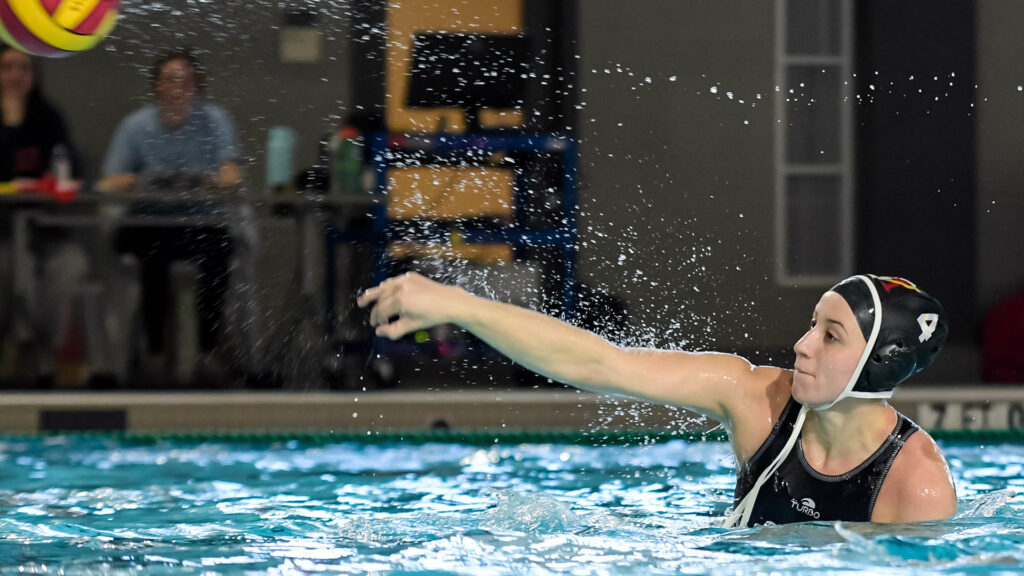
Courtney Novotny in the pool taking a shot for Virginia Military Institute's women's water polo team.

Cadet-athletes at VMI not only have their responsibilities with their selected sport but cadet duties on top of that.  Cadets are also required to take physical fitness classes twice a week, participate in ROTC all four years, prepare for room and uniform inspections, practice for parade, guard duty, and more. 

Her days can vary, depending on her schedule for classes and practice. Some days require an earlier wake-up, like when she does early morning lifting, she gets up at 5:15 a.m. 

Novotny isn’t sure if she will commission after graduating in 2025, but she is part of the Coast Guard auxiliary university program, which entails a lot of outside work and responsibilities. She said to stay on top of things, she takes the days she doesn’t have as many classes to get caught up on schoolwork. She lacks free time in the evenings because of practice.  

“I always try to tell myself even if I am having a bad day or if I do bad on an assignment that’s OK because that happens and I always make it through and overcome,” she said. “Usually, a lot of times, if I’m having a bad day, going to practice helps because it gets my mind off of it. I’ll go to practice, and I’ll be with my teammates. I forget about everything. Then I’m laughing and smiling. That’s the nice thing about playing a sport here is that you kind of get a break from academics.” 

Despite the busy schedule, Novotny said she likes the grind at VMI. Even though some days she wants to ditch practice and take a nap or do homework, she wouldn’t change it.  

“Being so involved at VMI is preparing me for the future,” she said. “When I’m older and I’m working, you’re always going to have a lot of responsibilities. So even though it is hard sometimes and I wish I didn’t always have to go to practice after classes, when I really think about it, it’s good to have this responsibility. Because it’s preparing me for what else is in the future.” 

Keydets Swim and Dive Break Multitude of Records

Keydets Swim and Dive lapped the competition during the America East Conference Championship. The championship was hosted at Virginia Military Institute’s Aquatic Center Feb. 14 through Feb. 17. 

Coach Scott Thacker said it was an incredible week hosting, which marks the first conference swim and dive championship event hosted at the Aquatic Center, which opened in early 2023.  

“The Goodall Pool was packed full of spectators and the energy was electric. It was an honor to host the conference meet and I am grateful for the efforts and dedication from our VMI staff to put on a top-notch championship environment,” he said. 

The VMI Swim and Dive athletes broke 26 program — team, rat, and personal — records during the championship, closing out the 2023-24 season. 

“I am beyond impressed and proud of our team for their accomplishments during the meet,” Thacker said. “Our team broke records a total of 26 times during the meet, totaling 21 new team records set during the championship. Having such a strong showing on post, and our 1sts closing out their athletic careers in our home pool makes it all the more special.” 

The breakdown of records

The first day of the conference meet brought several program records. 

Walden Wilder ’27 clocked a 2:02.45 in the 800-freestyle relay, which is a personal best and top 10 time in program history. 

Three-Legged Stool winner Kate Taylor ’24 became the first female in VMI history to swim a sub-24 second 50-freestyle relay split (23.91), as she anchored the 200-medley relay, according VMI Athletics.  

Two men’s relay teams also set records on the first day of the championship.  

Tinn Nguyen ’27, Chase Lane ’24, Tyler Blackwell ’24, and Matthew Picard ’27 broke the VMI record in the 200-medley relay with a time of 1:30.88. 

Picard, Sam Castle ’27, Elijah Fields ’27, and Dalton Cosner ’24 set a new program mark in the 800-freestyle relay, with a time of 6:47.05. 

Picard also set both a rat and team record in the 200-freestyle (1:41.00). 

The trend of slashing records continued into the second day of the meet, according to VMI Athletics.  

Cadets Chino Vera ’24 and Cosner bookended the 200-yard freestyle relay, as Max Brunner ’27 and Castle helped the Keydets post a new record time of 1:23.51. 

Taylor and Jillian Maher ’24 led off their 200-yard freestyle relay, with Walden Wilder and Noelle Tong for a women’s program record of 1:38.46. 

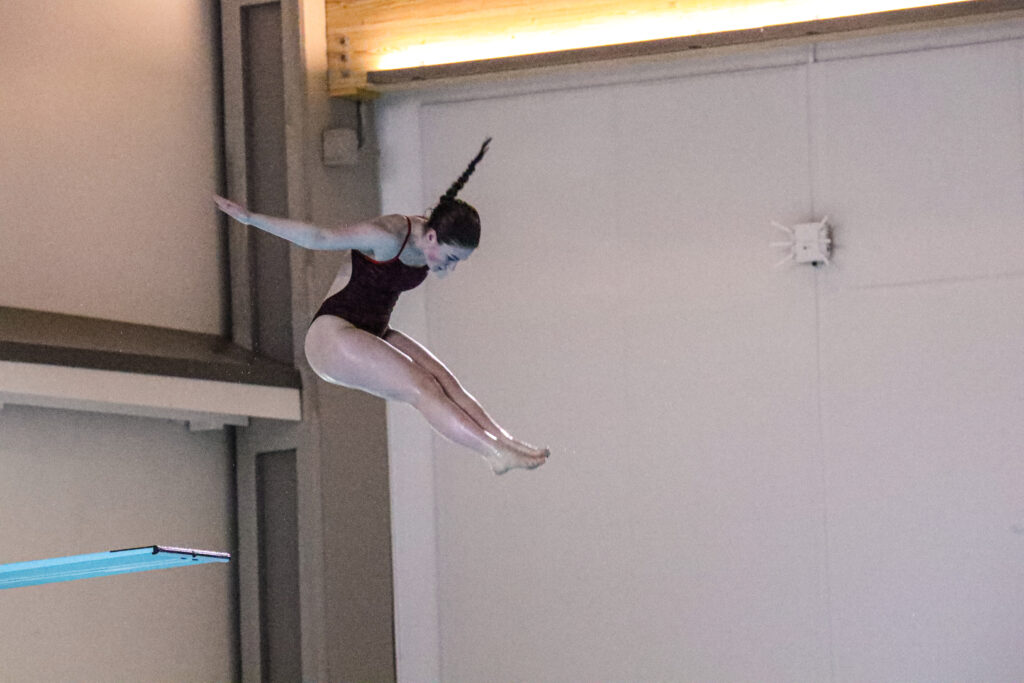
A diver mid-dive off the diving board.

Picard set another rat and team record in the 50-yard freestyle at 20.64 seconds. 

By Friday, the team cannonballed through 11 more records, according to VMI Athletics

  • Ethan Griffith ’25 earned the silver medal in 400 individual medley for a program record time of 3:58.62.
  • Blackwell set the VMI team record with a prelims time of 49.82 in the men’s 100 butterfly.
  • Leading off the 400 medley relay, Castle swam a team and rat record in the 100 backstroke.
  • After the prelims, Brunner would set a new rat record in the 100-yard butterfly
  • In the 100-yard breaststroke, Anne Bowles ’24 set a new team record with a time of 105.76 in the finals.
  • In the prelims of the 400-yard individual medley, Sarah Liebenow ’24 recorded a new women’s team record of 4:49.74.
  • In the 400-yard medley relay, Noelle Tong ’26, Bowles, Maher and Taylor swam a 4:02.37, setting a new women’s record in the process.
  • Castle, Lane, Blackwell, and Picard set the new men’s record in the 400 medley at 3:20.39. 

VMI Athletics said the last day of the meet resulted in five more records being broken. 

  • Picard set a rat and team record of 45.49 seconds in the 100-yard freestyle. 
  • Castle set a new team and rat record in the 200 backstroke at 1:50.28. 
  • Picard, Castle, Vera, and Castle combined for a new program record in the 400-freestyle relay with a 3:02.17 in that event. 

Behind the Balance: Tyler Mousaw ’24 — Keydet Wrestling

Virginia Military Institute’s cadet-athletes have to juggle cadet life, heavy academic course loads, and their NCAA Division I sport. Committed to both academic and athletic pursuits, balancing their rigorous schedule in both sports and school requires a certain level of commitment and discipline. Behind the Balance is a series that focuses on those cadet-athletes and how they handle the hurdles of the day-to-day.  

In first grade, Tyler Mousaw ’24 came home from school with a letter offering a chance to choose between two sports — basketball and wrestling. Mousaw said wrestling seemed like the more enjoyable option, and the rest is history. 

“It’s not like any other sport,” he said. “It’s a team sport and an individual sport. When you’re out there, it’s kind of just you and just something about it that’s fun.” 

The economics and business major plans on working in the private sector after graduating in the spring. He chose Virginia Military Institute because he needed to attend somewhere he could grow. He said he wasn’t a stellar student in high school, so he wanted a place that could push him to be the best he could be. 

“I just needed discipline,” he said. “I knew I needed to go somewhere where I would grow up kind of fast. VMI’s done that for me.” 

The cadet regimen has worked out for Mousaw. Plus, being a D1 athlete on VMI’s wrestling team has enabled him to find ways to balance everything. 

Cadet-athletes at VMI not only have their responsibilities with their selected sport but cadet duties on top of that. Cadets are also required to take physical fitness classes twice a week, participate in ROTC all four years, prepare for room and uniform inspections, practice for parade, guard duty, and more. 

He said he’s good at compartmentalizing. 

“I make the most of my time. When it’s wrestling time, it’s wrestling time. I don’t really think about academics or anything. When I’m not wrestling, I try to get my schoolwork done as quickly as possible so I can relax and do other things.” 

His days usually start with waking up at 5:45 a.m. and getting to Cormack Hall for early practice, which is usually weightlifting. If he still has schoolwork to complete, he’ll return to his room and finish that before heading to breakfast, then onto class. Around noon, he’ll have a break for lunch, but he’s back to classes until about 2 or 3:45 p.m. depending on the day. Following that, it’s back to Cormack for more practice until about 6 p.m. 

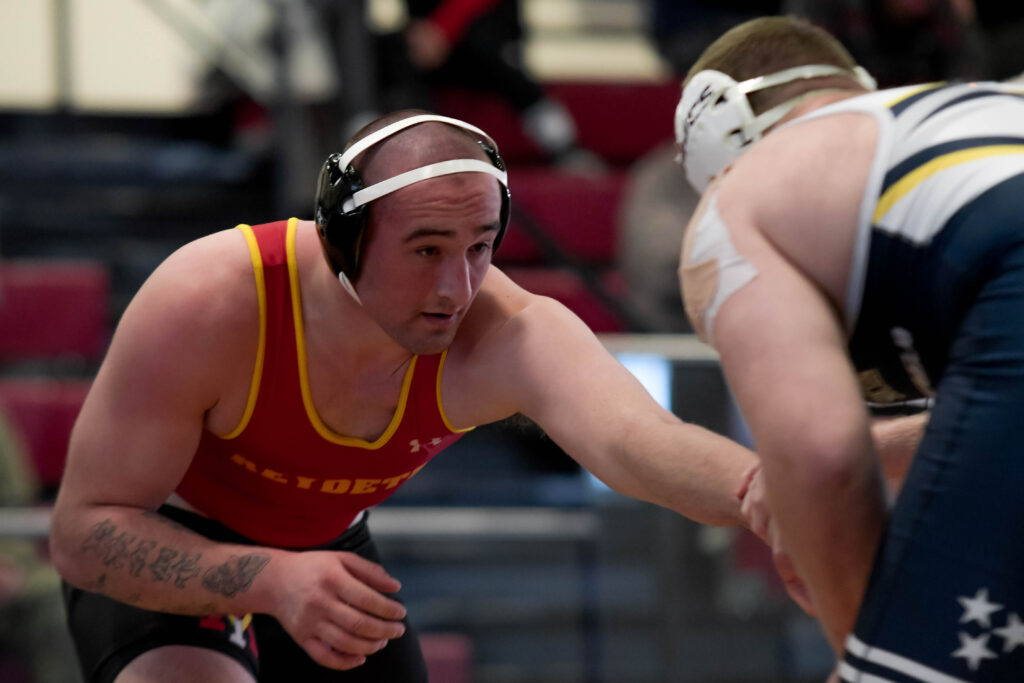
Tyler Mousaw wrestling for Virginia Military Institute.

Mousaw usually gets a break after practice before formation at 7:30 p.m. and then onto supper, so he opts to have some downtime. But after supper, it’s back to the books.   

Wrestling starts immediately upon arriving to post in the fall.

“Pretty much as soon as we get back to school in the beginning of the year, we start preseason [training]. It’s a lot of running and working out getting back in shape,” he said. 

He said the team stayed in Lexington over winter furlough to have two-a-day practices. His season starts in November and goes until about March. Although that may seem rigorous, his favorite part about attending VMI is that he gets to be a part of the wrestling team.  

“It’s just the bonds with the teammates … it’s a pretty tight bond,” he said. “Everybody’s going out there and putting it on the line in front of everybody and it’s a battle. You develop a respect for everybody.” 

But VMI has instilled something bigger in him — honor. 

“The biggest thing is the Honor Code. It’s just something good to live by,” he said. “Don’t lie, cheat, or steal. You’re setting yourself up pretty good right off the bat. My maturity before I came here, I was just like a normal high school kid. You know, a little bit rebellious. Then I came here and it forced me to grow up quickly. I think I’m more attuned to dealing with different situations. I’m more adaptable, and just ready to be done and get into the workforce.” 

Behind the Balance: Katie Grochalski ’24 — Keydet Rifle

Virginia Military Institute’s cadet-athletes have to juggle cadet life, heavy academic course loads, and their NCAA Division I sport. Committed to both academic and athletic pursuits, balancing their rigorous schedule in both sports and school requires a certain level of commitment and discipline. Behind the Balance is a series that focuses on those cadet-athletes and how they handle the hurdles of the day-to-day.  

Katie Grochalski ’24 was taught to shoot a simple action revolver at the age of 8 by her father. She grew up on a farm in Pennsylvania and by the age of 12, she was taught to shoot a .22. By 14, she was allowed to handle any gun that was in the house, if she were to lock it back up and demonstrate proper gun safety. 

“I grew up shooting groundhogs on my property and raccoons because we had chickens,” she said.  

She always wanted to hunt with her father, but she’s not a morning person. Instead, she started diving into other activities. Her initial aspiration was to be a fashion designer — it’s something she had said since kindergarten. She loved creating, sewing, and drawing. She also loved to dance. So, when she announced she wanted to be a Navy SEAL, it was a shock to her parents.  

“My parents were completely blindsided because I never told them I wanted to be a SEAL,” she said. 

The career change was prompted by a teacher when she was in the third grade who would bring in the newspaper every Wednesday. On one Wednesday, the headline regarded SEAL Team Six taking down Osama Bin Laden.  

The self-proclaimed lazy swimmer veered off the path of wanting to be a SEAL and settled on the Marine Corps by the time she reached the seventh grade. Grochalski, a psychology major, will be commissioning into the Marines after graduation.  

“All my friends from public school were Navy, Air Force, Army, so, I just rounded it out as a Marine,” she said. “And ever since seventh grade, this is all I ever wanted to do.” 

She said her family tried to persuade her to do something else, but her mind was set.  

“My response to them was whenever I turn 18, I’m going to do it anyway, so either you love me and you’re with me or you don’t talk to me,” she said. “I’ve been on this journey ever since. I taught myself how to run and taught myself how to do pull ups. I was a dancer growing up, so learning from elegance and grace into being a warfighter was completely different.” 

Joining Junior ROTC in high school, she first started with drill, but was drawn to the sport of rifle.  

“I was a year behind most people on the team because I joined as a sophomore, instead of as a freshman. But man, I loved it,” she said. “Doing rifle gave me a sense of stability, taught me how to really be a person and look at myself. I had an inferiority complex, and rifle taught me how to calm myself down and think through things properly.” 

Junior and senior year of high school, Grochalski transferred to Massanutten Military Academy, which is modeled after Virginia Military Institute. It seemed like the proper track — after high school to attend VMI.  

She found that rifle served as her own personal time, something that she could devote only to herself. Any big decisions or thoughts occurred at the range, she said. The solid black powder, the popping of rifles, it had a calming effect on her, so much so that she could even fall asleep at the range.  

“I think the discipline is fantastic. It does a lot with your mentality and mindfulness. It teaches you how to calm yourself to the point where I can tell my heart rate. I can sit here and physically feel my body shake because my heart rate,” she said.  

Her time at a military high school also instilled discipline, along with her training on the range.  

“I had to eat the same thing every single day. I had to have three meals a day. I had to make sure I worked out the same way every single day. How to be a level head, because I was not. Every Marine is a rifleman, so why not start early?” 

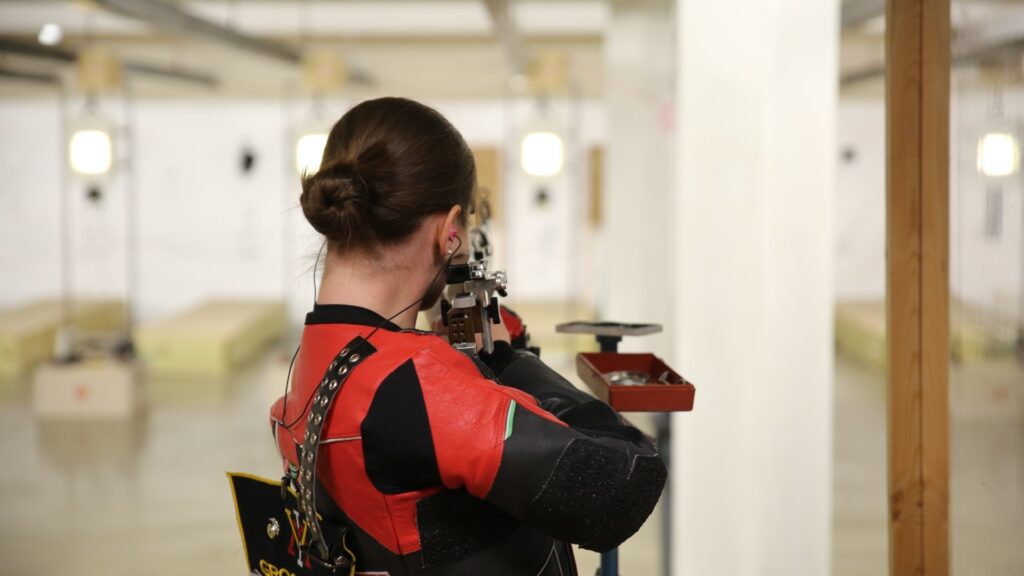
Katie Grochalski shooting a rifle as part of the Virginia Military Institute's rifle team.

On the team, in the classroom, and beyond 

She got involved with VMI’s rifle team by coming to a rifle match at VMI while she was a senior in high school. She toured the school a bit and was introduced to the rifle coach Lt. Col. Bill Bither. Her trip was cut short due to an impending snowstorm, but when she returned to VMI as a rat, she met with Bither and was on the team. 

Cadet-athletes at VMI not only have their responsibilities with their selected sport but cadet duties on top of that.  Cadets are also required to take physical fitness classes twice a week, participate in ROTC all four years, prepare for room and uniform inspections, practice for parade, guard duty, and more.

Grochalski has a stacked schedule, which includes waking up daily at 6:30 a.m. for formation at 7 a.m. On Tuesdays and Thursdays, she’s the drummer for formation, so she has to head to the band room prior to formation. After that, she heads back to her room, and if there’s time before her 10 a.m. class she’ll nap. She has three or four classes a day, depending on the day, but wraps up around 3 p.m. She has an hour after classes before practice for rifle begins at 4 p.m. 

“I’ll have an hour of me time to get things done; do any miscellaneous things,” she said.  

On Tuesdays and Thursdays, she lifts after she shoots at the range. By 9:30 p.m., she’s onto rifle formation.  

Wednesdays and Fridays, she teaches ballroom dance in the evening for the Ballroom Dance Club.  

“I love dancing,” she said. “It’s one thing that really ties me to home. It helps me handle my homesickness.” 

To balance it all, she said it’s best to come to the understanding that you can’t control everything.  

“Understand that you can’t control it all,” she said. “But with all my stuff, I’ve learned how to manage bit-by-bit over the years from first going to regular high school, then to military high school, onto here. Having that stress inoculation helps. It really helps.” 

Behind the Balance: Andrew Granger ’24 — Keydet Track and Field

Virginia Military Institute’s cadet-athletes have to juggle cadet life, heavy academic course loads, and their NCAA Division I sport. Committed to both academic and athletic pursuits, balancing their rigorous schedule in both sports and school requires a certain level of commitment and discipline. Behind the Balance is a series that focuses on those cadet-athletes and how they handle the hurdles of the day-to-day.  

If anyone knows balance, it’s Andrew Granger ’24. Not just with academics and cadet life, but within his event for track and field.  

Granger is a thrower, which requires a steady technique — something he’s perfected throughout the years. He started throwing in high school. 

“When you’re throwing, if you get off balance a little bit in any direction, then you can totally mess up the throw. It doesn’t matter where you are in the stages of the throw,” he said. 

Every move is calculated: the trajectory you must throw it, or the certain angle for the best distance, down to the speed at which you’re rotating. Granger is thinking about all of this just seconds before he throws.  

“You have good body awareness, and you define ‘what did I do wrong?’ That usually tells you what you need to improve and if you can do it. It directly translates to throwing farther and getting better.” 

The English major, who will be attending Naval Officer Candidate School after graduation, decided on Virginia Military Institute after a visit with Coach Zach Scott.  

“I got to see what life was like at VMI. I was really interested in the military aspect,” he said. Granger also figured attending VMI would give him the chance to see if serving in the military was the right choice for him — something he was on the fence about.  

“I didn’t know whether or not I wanted to do it yet. So, I figured it would be a good chance for me to kind of push myself into that sort of life and see,” he said. “Also, I wanted to improve myself and have a good foundation for the rest of my life.” 

He participates in the discus, shot put, and hammer throw events for both indoor and outdoor track. His season, which starts in October, goes on until May, making it one of the longest seasons for athletics at VMI.  

Staying up to date in his 18 credits, while still participating in a Division I sport, can be difficult.  

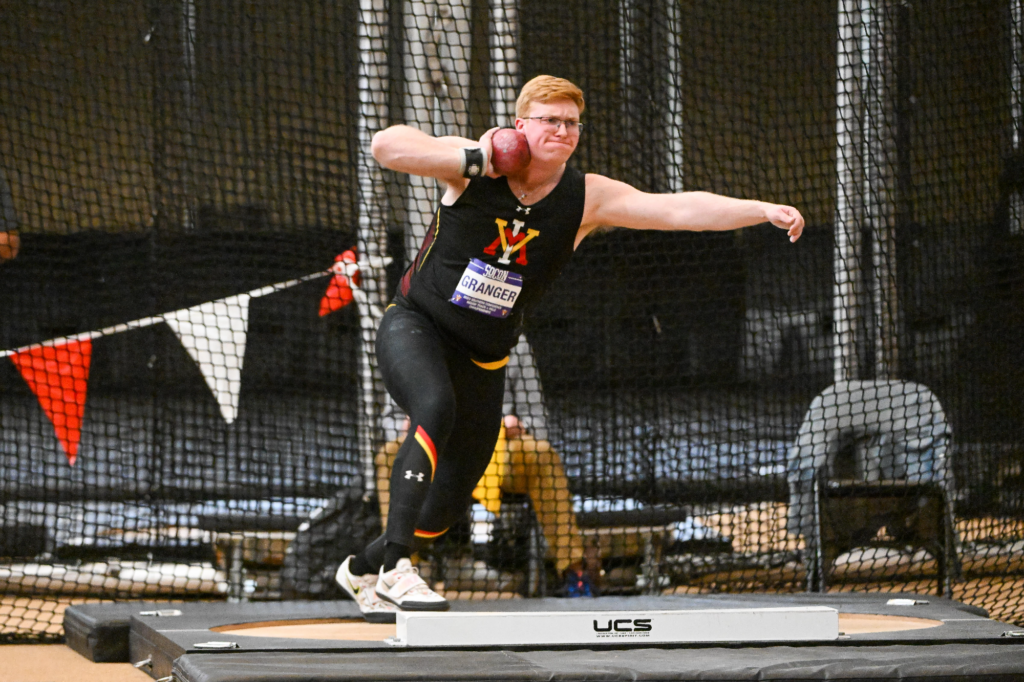
Andrew Granger preparing to throw the shot put during a track and field event for Virginia Military Institute.

Communication is key 

Cadet-athletes at VMI not only have their responsibilities with their selected sport but cadet duties on top of that. Cadets are also required to take physical fitness classes twice a week, participate in ROTC all four years, prepare for room and uniform inspections, practice for parade, guard duty, and more.

With days starting at 6:45 a.m., classes until 4 p.m., and practice until after 7 p.m., then studying and homework until nearly midnight, Granger said it’s a full day. 

“I think the phrase I hear a lot is VMI teaches you to fit a 30-hour workload into like a 24-hour day or something. I guess that it definitely teaches you to manage your time and it taught me to be respectful to everyone.” he said. 

“It’s a lot of work. It’s a balance between the academic and the athletic workload. I kind of have to stay on top of my homework and studying, while also just being ready for practice and working as hard as I can when I’m practicing,” he said. “It’s just about managing the time outside of practice to get your work done.” 

The biggest thing is communication, which is something VMI has instilled in him.  

“I’ve learned to definitely stay in contact with my teachers, especially if I’m missing classes,” he said.  

Emailing or talking in person with his professors is how he makes sure he’s making up what he’s missing out on in classes if he’s traveling for meets.  

“Whenever I have time, which is usually during the travel time when we’re on the bus, I’m getting the work done,” he said.  

Even though his sport is more individual, he said the whole team likes to back each other up. He said they all like to watch each other compete, cheer each other on, and be overall supportive of each other. Granger said they also guide each other and act as a second set of eyes looking at each athlete’s technique.