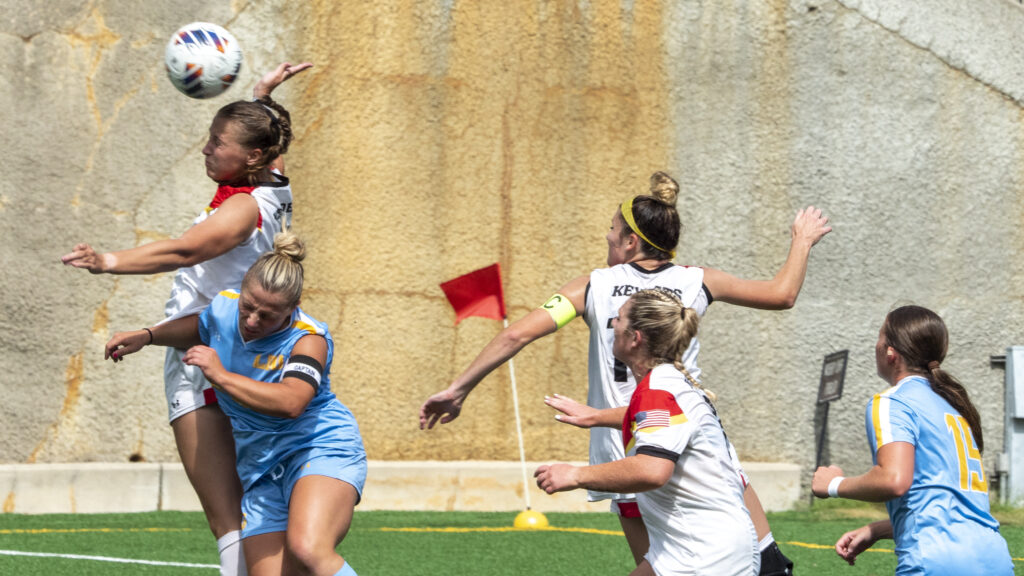
Post View Unavailable »
New Website Launched »

Behind the Balance: Christopher Hicks ’24 — Keydet Rifle

Virginia Military Institute’s cadet-athletes have to juggle cadet life, heavy academic course loads, and their NCAA Division I sport. Committed to both academic and athletic pursuits, balancing their rigorous schedule in both sports and school requires a certain level of commitment and discipline. Behind the Balance is a series that focuses on those cadet-athletes and how they handle the hurdles of the day-to-day. 

Christopher Hicks ’24 takes a deep breath, sets up his sight, braces his weapon, and fires. For Hicks, the sport of rifle is 90% mental. It’s also long and arduous.  

“If I’m having a rough last couple shots, I like to just put the gun down and then take a step back and try to regroup myself instead of letting the anger get to me,” he said.  

If he lets his anger and frustration get to him, he’ll just end up rolling the same set of bad shots.  

“I like to try to start over, reset my position,” he said. “This is a new shot. Forget about the old shots.” 

How the sport of rifle works 

He has two separate kinds of shots — one set of 60 shots with a .22 rifle and another set of 60 shots with an air rifle.  

He said it’s about a shot a minute. There is a time limit for both sections of shots, a total of an hour and a half.  

“It’s not rapid fire. You want to be one shot per minute,” he said. “Regroup yourself, go through the same routine, every shot. Make it the best shot you can.” 

It’s more than just shooting a gun. It’s about position and accuracy.  

When shooting the .22, you have three positions — prone, which is laying down; kneeling, with one knee down; and standing. Each position you get 20 shots, totaling 60 shots with the possibility of 600 points, 10 points per shot.  

For the air rifle, all 60 shots are from the standing position, with the same possibility of points. In this round, the athlete generally scores higher.  
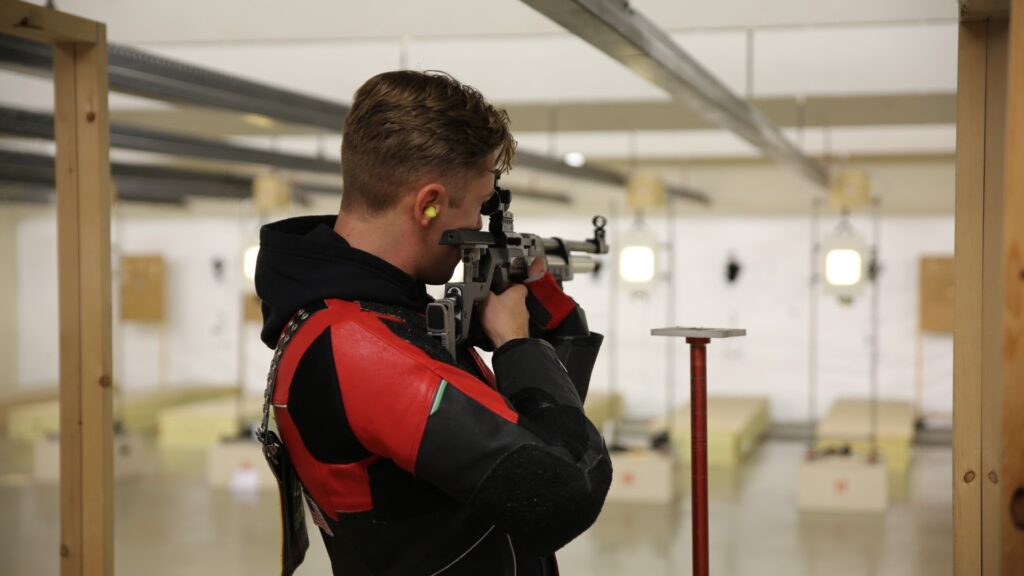
Christopher Hicks shooting a rifle for Virginia Military Institute's rifle tea\m.

Handling studies and sport

Rifle is one of the sports at Virginia Military Institute with one of the longest seasons. Starting in September until early-March. Hicks said the team practices daily from 4 to 5:30 p.m. 

Cadet-athletes at VMI not only have their responsibilities with their selected sport but cadet duties on top of that. Cadets are also required to take physical fitness classes twice a week, participate in ROTC all four years, prepare for room and uniform inspections, practice for parade, guard duty, and more.   

“I would say time management is the biggest thing,” he said. “Being able to know your schedule and then know when you have time and then fitting everything in. That’s what’s helped me the most because I know when I practice and when I have free time, and so I can fit in time for studying.” 

Hicks grew up hunting and knew his way around a gun, but he really got into it when he was part of Marine Corps Junior ROTC. The program has an extracurricular activity of rifle. 

The civil engineering major was originally going to commission, now he’s looking to use his degree in the civil sector. 

He wasn’t looking at schools specifically for rifle. He was selected for the team and entered a trial period. He said now, the team is making more recruiting efforts, but when he started, they were looking for people with prior experience in rifle.

Hicks said he’s a mix between a natural shot and a practiced one. He’s honed his skills on the range with practice — both mentally and in skill. The highest he’s scored is 591 in practice and 589 in competition.  

Drills like removing the monitor where you can gauge your shot also helps in feeling and seeing where you’re shooting, he said.

“Rather than just putting lead downrange and seeing where it goes, it helps you understand where you’re putting the shot and what’s affecting the shot, like trigger pull or anything like that,” he said. 
Behind the Balance: Drew Menges ’25 — Keydet Soccer

Virginia Military Institute’s cadet-athletes have to juggle cadet life, heavy academic course loads, and their NCAA Division I sport. Committed to both academic and athletic pursuits, balancing their rigorous schedule in both sports and school requires a certain level of commitment and discipline. Behind the Balance is a series that focuses on those cadet-athletes and how they handle the hurdles of the day-to-day. 

Drew Menges ’25 had dreamed of attending the United States Merchant Marine Academy, but those dreams were halted when he was not admitted due to colorblindness. That didn’t slash his desire to go to military college, though.  

“I always wanted to go to a military school … So at the last minute we were looking at other options,” he said.

Menges has a strong desire to serve his country because of  his own family’s service. Both his grandfathers served, one in the Navy and one in the Air Force.  

“When I found out about military schools, I didn’t really know what they did,” he said. “I thought it’s pretty cool that you could come here to get a degree and commission.” 

When he found Virginia Military Institute, it was nearly kismet. By attending VMI, he’d also be able to play soccer for the school.  

“Everything worked out with the coach and then I just applied here and got in,” he said.  

When Menges talks about soccer his entire face lights up. You can tell it’s one of his passions. But, he’s serious about it. Starting at the age of 3, he took the field. By the time he entered middle school, he was playing on a club soccer team. There came a time when he had to choose between two sports, though. He was playing both soccer and lacrosse, but they were both during the same season. 

Ultimately, soccer scored higher for him.  

“I decided to stick with soccer because I liked it more. I think I was a little bit better at it too,” he said.  

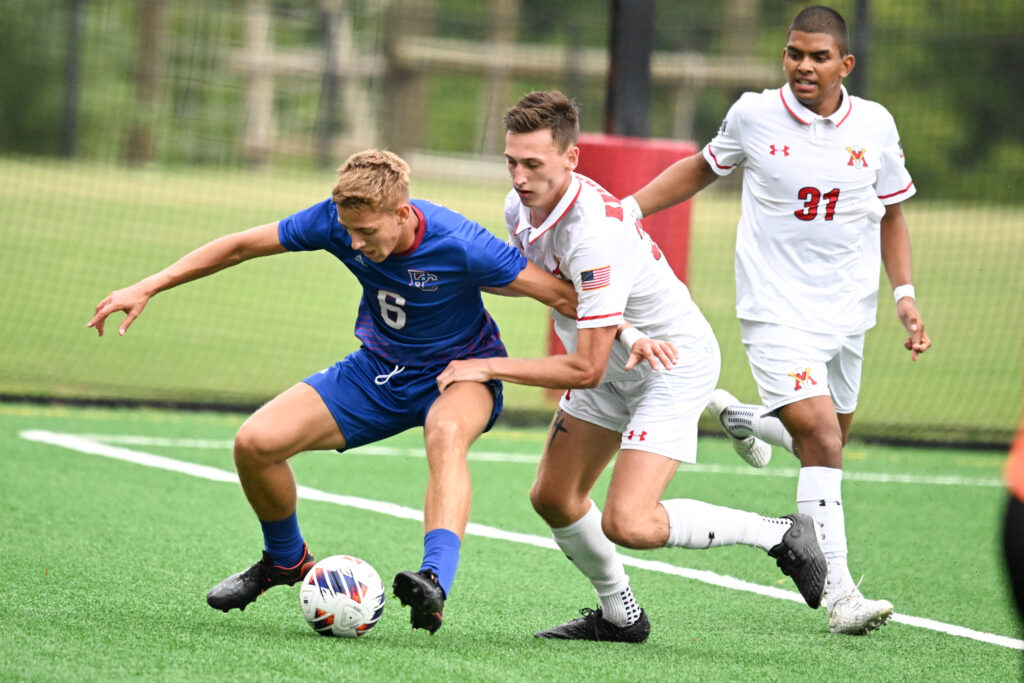
Drew Menges on the soccer field playing for Virginia Military Institute's men's soccer team.

Scoring goals on and off the field 

The mechanical engineering major has a full course load of 18 credits this semester. He’ll also be commissioning into the Army upon graduation. So, his days are tightly packed. 

Getting up at 6:30 a.m. daily, he heads to morning training with the soccer team. Morning practices consist of mostly running or stretching. Then, he’s off to formation at 7 a.m. By 7:05 a.m. he’s back to his room to put his hay up, do a little bit of school work, then he attempts to go to Crozet for breakfast before his first class at 9 a.m. 

On his long days, he has classes from 9 a.m. to 4 p.m. On good days, he’s out of class by 1 p.m. Practice is at 4:30 p.m. so after class, he’s either rushing to practices or doing work or sleeping.  

After practice, he hits up the mess hall, then it’s back to work for the remainder of the night. Sometimes he’s working on class work until midnight. On especially hard nights, he could be up until the wee hours of 4 a.m. completing assignments.  

“It’s pretty difficult. I’m not going to lie,” he said. “And this year it’s definitely ramped up because the mechanical engineering classes have got a lot harder and there’s a lot more work. I just try to knock one thing out at a time.” 

He suggests doing as much as you can with the time you’re given.  

Cadet-athletes at VMI not only have their responsibilities with their selected sport but cadet duties on top of that. There are specific times they can eat, go to class, study, and sleep. They are also required to take physical fitness classes twice a week, participate in ROTC all four years, be prepared for room and uniform inspections, parade preparation, guard duty, and more.  

“Before I came here I was not very good with time management. And everything kind of came easy to me, especially with school,” he said. “So coming here, I’ve definitely learned a lot about what I need to do every day to get stuff done, especially when it’s a heavy workload.”

He also discovered what he’s capable of.  

“You’re able to find out a lot about what you actually can do,” he said. “Like a regular college or if you didn’t come here, you probably would have never found that out by yourselves.” 

One tip he does have is to find time for yourself, even if it’s something small. He says he likes to spend some weekends with friends, just hanging out. 

“I’m also a very big believer in when I’m doing an assignment and it’s not clicking, just taking a break and stepping away from it,” he said. “It really, really helps me. And that’s why on the weekends, I always try to find time to do something for myself, instead of just worrying about school and stuff.” 

Behind the Balance: Grant Swinehart ’24 — Keydet Football

Virginia Military Institute’s cadet-athletes have to juggle cadet life, heavy academic course loads, and their NCAA Division I sport. Committed to both academic and athletic pursuits, balancing their rigorous schedule in both sports and school requires a certain level of commitment and discipline. Behind the Balance is a series that focuses on those cadet-athletes and how they handle the hurdles of the day-to-day. 

Grant Swinehart ’24 didn’t know a lot about Virginia Military Institute until one day the former head football coach Scott Wachenheim came to him with an offer. He had no military intentions. No connection to the military. And he had no clue what a military institute could offer him.  

“It was my only offer for football. So it’s obviously something that I strongly considered,” the running back said. 

He talked to a high school friend who played basketball at VMI to explore the option of becoming a cadet-athlete.  

“He told me a lot about school and that’s when I made my decision to commit here and kind of just ended up just picking in and rolling with it,” Swinehart said. 

Swinehart started playing football at the age of six. It was something his father introduced him to since he played when he was younger and through high school. His father was even his coach for a while. Swinehart was drawn to the physical competitiveness of the sport.  

“It was just different from the other sports that I’ve played,” he said. “It’s a big team sport, but it allows you to be competitive and physical. So that’s why I fell in love with it.” 

Now, as a Keydet Football player, he loves the rush when he takes the field.  

“Waiting for the first kickoff of the game, there’s a lot of anxiety and butterflies, just excited for it to start,” he said. “Just like probably any other sport, but football it’s a big build-up to the first moment and a lot of guys on my team will probably agree that those butterflies don’t really go away until the first play or until the first set and sometimes a couple plays after that. You kind of got to get it out of your system. But it’s a feeling like no other. Just hearing the fans cheer you on and being able to be out there with the guys you’ve been working so hard with. You can’t describe it.”  

Weightlifting, class, practice, studies 

Swinehart is getting up in the early hours to do weightlifting, which starts at 6 a.m. Then it’s team meetings. It’s on to breakfast at 7 a.m. Classes are from 8 a.m. until 3 p.m. Then it’s onto pre-practice meetings and full practice from 5 to 7 p.m.  

After practice, he’s studying during a dedicated study hall period. Finally, it’s dinner time at 8 p.m. More studying. By 10 p.m., it’s free time. 

With a load of 14 and a half credits, he says he tries to get ahead on schoolwork. Cadet-athletes at VMI not only have their responsibilities with their selected sport but cadet duties on top of that. There are specific times when they can eat, go to class, study, and sleep. Cadets are also required to take physical fitness classes twice a week, participate in ROTC all four years, require room and uniform inspections, parade preparation, guard duty, and more.  

“It’s definitely a challenge, but we have great resources with the athletic department to kind of stay on top of those types of things,” he said. “You really just got to be focused and dedicated in any of the free time that you do have to be getting your homework done, reaching out to the teachers, just kind of staying on top of things.” 

He says that if you start to fall behind, it’s going to be almost impossible to catch up.   

“That’s something that VMI kind of taught me, is to not get behind and try to stay on top of things in the first place. Reach out to professors in advance about traveling and what things you might miss,” he said.   

With his travel schedule, which is normally every other weekend, he has letters to give to his professors to alert them he will be missing class and therefore gets the assignments he’ll miss. He’s not doing work on the bus rides, instead, he aims to finish everything before he leaves for away games.  

Grant Swinehart with a football in hand while running down the field.
NCAA Football Championship Subdivision: Keydets rally to defeat Wildcats, 12-7

“There are some days that kind of can hit you, especially when a lot of tests or big assignments fall on the same day. Or you got a big practice ahead of you,” he said. 

He said the small class size at VMI is helpful in these cases because it allows him to have a more personal relationship with not only his classmates but also his professors. 

“It’s really easy to have that close relationship with your professor and meet with them when need be to make up anything you might have missed,” he said.  

Swinehart knows a lot about dedication and it’s something that VMI head football coach Danny Rocco recognized. Prior to the season, Swinehart was awarded the number 0 which is a new tradition started by Rocco. Each year, number zero will be given to the captain of the special teams — someone who embodies what it means to be a cadet-athlete: hard work, dedication, sacrifice, and selflessness. 

The future 

Swinehart is set to graduate in the spring and hopes to put his name in the transfer portal to see if he can play football while getting his master’s somewhere. He has two years of eligibility due to the COVID-19 season and for tearing his ACL in his second year.  

If not, he hopes to pursue something with his psychology degree. He feels his time at VMI has prepared him for the real world.  

“What I kind of say to myself is that it’s very rewarding knowing that you’ve been through all that stuff and you were able to handle multiple different things all at once,” he said. “It’s kind of preparing you for later in life, like with a job and a family and kids and all the other things that are going to come with that. I chose to come to a school like this and to play a sport like this, which I love a lot. It’s all just part of the process, but I wouldn’t trade it for anything in the world ever. I really love it and I know that at the end of the day, it’s helping me become a better person.” 

Behind the Balance: Audrey Davis ’25 — Keydet Soccer

Virginia Military Institute’s cadet-athletes have to juggle cadet life, heavy academic course loads, and their NCAA Division I sport. Committed to both academic and athletic pursuits, balancing their rigorous schedule in both sports and school requires a certain level of commitment and discipline. Behind the Balance is a series that focuses on those cadet-athletes and how they handle the hurdles of the day-to-day. 

It’s 5:45 a.m. on a Tuesday. Audrey Davis ’25 is up before the sun to get a workout in. It’s required — she plays center back for the Virginia Military Institute Women’s Soccer Team. They have some sort of workout or practice daily when they are in season, plus games on Sundays and Thursdays.  

Her days don’t always start before the crack of dawn. Certain ones call for lifting, rehabilitation, reviewing film, or drills. 

On a normal day, while in season, she’s up at 6:45 a.m. so she can be at formation at 7 a.m. where they stand outside and salute the flag. Then it’s breakfast and onto class from 8 a.m. until 2 p.m. After classes, she tries to come down to Paulette Hall to get some rehab work in before practice. Then it’s practice for around two hours.  

Then it’s onto dinner. 

From there she’s studying for up to four hours and her day just repeats.  

“It’s a pretty busy day,” she said.  

It varies on the intensity of what practices look like. Mondays are rest days — no practice whatsoever. Tuesday requires hardcore training. Then Wednesday is to build up for Thursday’s game. They do recovery training on Friday, ramp-up workouts on Saturday, and then play Sunday.  

“We want to have a full week schedule and then during the offseason, we’ll train pretty much every day, just some days might be a lighter load,” the international studies major said.  

Finding her way to VMI 

Davis wasn’t sure what life after college would look like.  

“I had no plan for after college and I just started thinking about what I wanted to do with my life. And I’m the type of person that does need that discipline in that structure,” she said.  

She initially was thinking of another school and being a biology major. Then she did a soccer camp at Virginia Military Institute with head coach Chris Haught-Thompson.  

“He liked me and he said that if I wanted to come here, the spot was mine,” she said.  

She wasn’t even going to commission and at first, was looking at the Marines. Once she was at VMI, she received an Army scholarship and everything started to switch into place.  

“It was just one of those things where I came here and I realized that I really liked this lifestyle and it’s really good for me,” she said.  

Audrey Davis hits the soccer ball on the field.
VMI’s #19 Audrey Davis. VMI vs Long Island Unv. women’s soccer game and senior day celebration September 10, 2023 at Drill Field #2 in Lexington. LIU won 2-1. (Randall K. Wolf / VMI )

Balancing studies and sports 

Cadet-athletes at VMI not only have their responsibilities with their selected sport but cadet duties on top of that. There are specific times of when they can eat, go to class, study, and sleep. Cadets are also required to take physical fitness classes twice a week, participate in ROTC all four years, require room and uniform inspections, parade preparation, guard duty, and more.  

It’s crucial to stay regimented with each activity.  

“I’ve become really productive in class, like staying on task so I don’t fall behind or so I don’t have to make up anything from class,” Davis said. “A lot of it is just really grinding it out like late at night like we’re done with dinner around 8 p.m., so normally I’d stay out from like 8 p.m. to midnight so I get like a good four hours of homework and then I try to get right to bed after that.” 

After graduation, she has committed to the U.S. Army for eight years. Her focus, which is undecided at the moment, is wavering between military intelligence and aviation. 

Her commitments to the Army while at VMI include control time weekly at school, Advanced Camp this summer, plus the commitment of eight years after graduation. 

When the days are long and tiring — both exhausting mentally and physically — Davis said she can’t give up.  

“You don’t really have a choice here, you really have to learn that line between giving up and seeing it as adversity and using it to push you,” she said.  

She’s seen firsthand overcoming a large obstacle with recently having ankle surgery.   

“One of the trainers here told me that if you push through even on your worst days … the next day is going to be better regardless. And I think that applies,” she said. “I started using that for not only soccer, but on the hill. So you really don’t have a choice. Because if you mess up one day here you fall behind and you can spend the whole semester trying to recover.” 

Behind the Balance: Zach Denton ’27 — Keydet Track and Field

LEXINGTON, Va. April 22, 2025 — The hurdles of college and extracurricular activities mean something a little different for Zach Denton ’27, considering he actually jumps hurdles. As part of the Virginia Military Institute track and field team, Denton is dedicated to going the distance.  

“Hurdles was always something I was very attracted to. I started in the 6th grade running hurdles, and it just always excited me so much,” he explained. “I continued it through high school. When I had the opportunity here, the coaches were receptive to me coming in to do hurdles.” 

It was a learning curve. Denton said that there’s a height increase in hurdles from high school to the college level — 39 inches to 42 inches.  

“It was a big jump freshman year to do that,” he said. “We spent a lot of my freshman year doing adjustments.” 

Not only was the height difference something to adjust to, but also the amount of coaching he was getting at VMI. Coming from a military family, he moved from school to school growing up.  

“I went to two separate high schools, and for the second half of my high school time, I didn’t have a coach. I had no hurdles coach, so I was basically self-coached,” he stated.  

Having a dedicated coach to work on his technique, plus allow for the transition in hurdle heights, Denton admitted the extra work paid off. 

“I was finally getting coached in a direction that I could go. I’m really excited for that as well.” 

He’s now living out his dream of running Division I track and field — participating in both hurdles and the long jump. The psychology major was also in one of the first classes to be able to receive the Call to Duty scholarship offered at VMI. That, in addition to a U.S. Army ROTC scholarship, the financial aid he was receiving was appealing in his decision to choose VMI.  

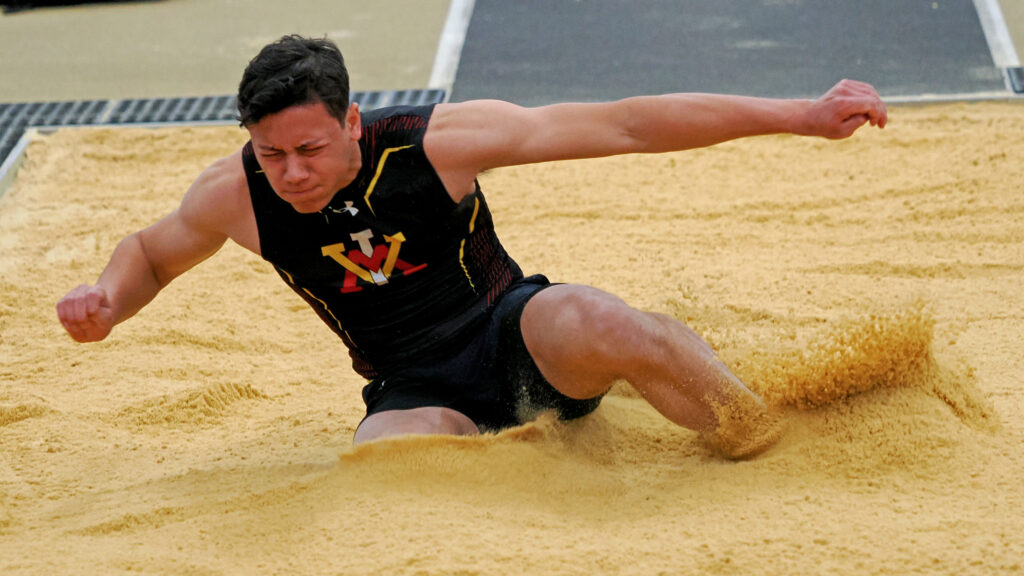
Zach Denton jumping hurdles during a track and field meet at Virginia Military Institute.
VMI Team Challenge track and field meet at the Corps Physical Training Facility in Lexington, VA January 11, 2025. (Randall K. Wolf)

He dedicates more than a dozen hours a week to track and field. On top of that, he’s enrolled in 17 and a half credits, and part of Color Guard staff.  

Cadet-athletes at VMI not only have their responsibilities with their selected sport but cadet duties on top of that. Cadets are also required to take physical fitness classes twice a week, participate in ROTC all four years, prepare for room and uniform inspections, practice for parade, guard duty, and more. 

He said he has to be smart about what activities he chooses.  

“For example, for Color Guard staff, a lot of the stuff I need to do I will already be at,” he explained. “We raise the flag at formations, for example, so I’m already there. I’m just tacking that stuff on and then just really knowing what you have to do … a lot of to-do lists. I make a huge list of all the assignments that I know of at the beginning of each semester, and I go through those, just being really meticulous. I always tell people VMI is great at telling you when you don’t have time. So once you know when you don’t have time, you make a list of everything you need to do. And squash it in there.”

He tries to not let the stresses of daily cadet life or the preparation before a big race get to him. He said when it comes to track and field, a lot of his thoughts are centered in the build-up to the event than the actual race.  

Zach Denton jumping at a track and field meet at Virginia Military Institute.
VMI Team Challenge track and field meet at the Corps Physical Training Facility in Lexington, VA January 11, 2025. (Randall K. Wolf)

“When you’re going through it, you really want your mind just to be conditioned to just do it in that instant, because in hurdles, that race is eight seconds long. Long jump isn’t a very long race,” he admitted. “You really want to get your body prepped and primed, and that’s where all the visualization happens when you’re going through the drills. But once you get on the run, once the gun goes off for the race, ideally, your best races, you have nothing going through your head. It’ll just be all muscle memory.” 

He said some of his best races are the ones he doesn’t really remember.   

Thanks to his time at VMI, he said he’s become more confident in himself, and it has presented him with a lot of opportunities to step up.  

“Whether it’s public speaking or handling yourself under pressure, being a neat and precise person, I would say all those are foundational things. As I go into my 2nd Class year, the main focus is exerting influence on others. As a 3rd Class cadet, I’ve watched the 2nds and the 1sts lead, and I’ve learned from them. Soon it will be my turn to start doing that. I’m really preparing for that moment when I’m primarily leading others instead of being a follower.”