Post View Unavailable »
New Website Launched »

Behind the Balance: Woongchan Oh ’25 — Men’s Keydet Soccer

Woongchan Oh ’25 grew up in the Korean countryside. He said there wasn’t much to do, but with a ball and a field, the possibilities were endless.  

“With a soccer ball, you can start playing without any other equipment,” he said.  

He’s been playing since he was a child and had dreams of going professional.  

“I joined the local soccer team when I was in fourth grade. Since then, I’ve been in a very competitive environment,” he said. 

He was in a soccer pro-academy for most of his time in Korea. Then once he was in the United States during high school, he was in a soccer development academy, which is the highest youth level. He spent his high school years in Maryland and his family now lives in Harrisonburg, Virginia. 

When looking for the next step after high school, Oh wasn’t initially considering military school or even joining the military. His father had been part of the Korean military, so he was familiar. When he was approached by the Virginia Military Institute soccer coach for an offer to play for the team, he talked it over with his parents.  

“My father thought it would be great to start a career as a commissioning officer,” he said. “I did some research, and I grew with this opinion, so I decided to join VMI.”

Oh says playing soccer at VMI is a different atmosphere due to the smaller nature of the school. 

“It’s different because you’re playing with your classmates and roommates and we’re going through everything that’s going on here together. It’s more special,” he said. 

The civil engineering major has a full plate. He plans on commissioning into the U.S. Army and has kept a full load of classes for much of his cadetship.  

Cadet-athletes at VMI not only have their responsibilities with their selected sport but cadet duties on top of that. Cadets are also required to take physical fitness classes twice a week, participate in ROTC all four years, prepare for room and uniform inspections, practice for parade, guard duty, and more. 
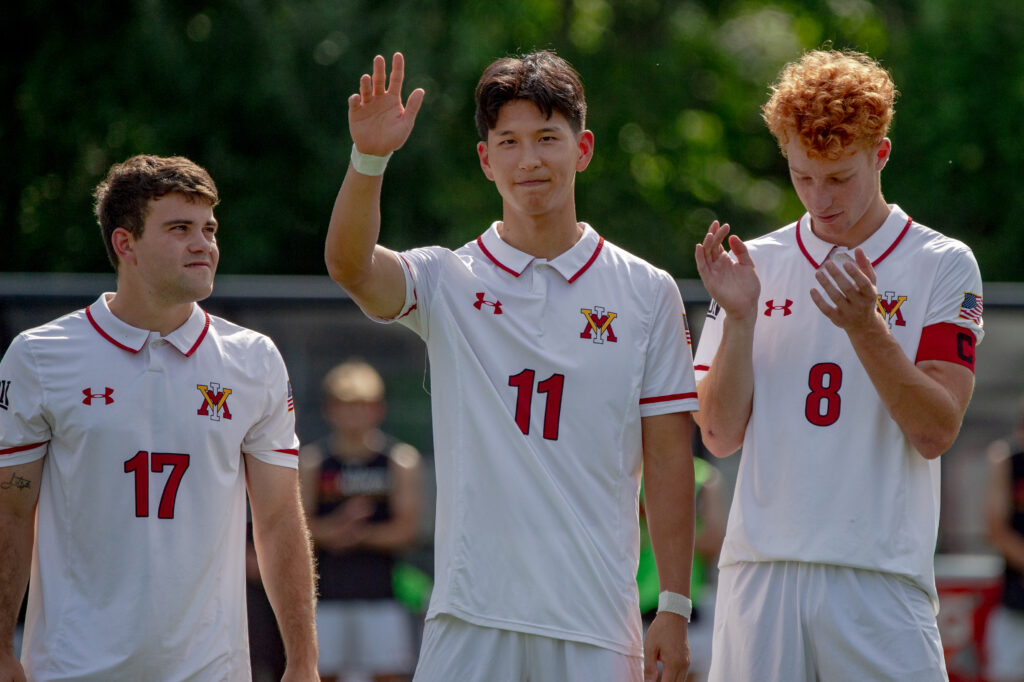
VMI MSOC Action Shot vs. Howard

Oh says he’s not one to play video games or get involved in similar distractions. Instead, he comes up with a game plan of how he’ll be able to finish all his work in a timely manner. 

“I had to make a base plan. Like, get food from Crozet and come to my room and study and eat at the same time,” he said. 

He’s up at 6:30 a.m. daily, with classes and practice until 7 p.m., then he’s doing homework until at least 11 p.m. He says there’s not a lot of breaks in between.

“If you don’t spend time on your phone and other stuff …” he said it’s easy to stay on task. 

Playing soccer serves as a way for him to let loose and cope with stress. 

“I don’t think about academics on the field, I just focus on soccer,” he said. “It’s not just an individual sport. It’s just playing with my friends and building relationships with other people.” 

His time at VMI has taught him how to manage his time, which will be useful for his future career.  

“I think as a lieutenant in the military, you have to work ahead, and you have to know what your role is. I think even in the classroom or on the field, you have to know what to do next, just being proactive,” he said.  
Honors Week: Barracks Security At VMI

Serving as cadet operations sergeant for Band Company her 2nd Class year, Annie Townsend ’24 was able to set up a cadet guard team, which would perform the security for barracks at Virginia Military Institute. The team would oversee locking gates, coordination during emergency situations, enforcing uniform or disciplinary standards within the Corps, and posting members of the guard team for the security of the Corps of Cadets.  

As her experience grew in that capacity, it piqued her interest in the security of barracks. Specifically, the interaction of infrastructure with the implementation of security.

“In conjunction with my interest in architecture — and particularly historic architecture — I developed my research to include aspects of security engineering, structural engineering, architecture, and the historical development of security at VMI,” she said. 

Townsend, a civil and environmental engineering major, started her honors thesis midway through her 2nd Class year.  

“I started by brainstorming, speaking with professors and finding faculty advisors, and writing a prospectus (research proposal),” she said.  

Col. Chuck Newhouse, head of the Department of Civil and Environmental Engineering, served as Townsend’s advisor. He said when she approached him with the idea of combining her interests in engineering with the role of VMI’s guard team to take a critical look at the security at VMI, he was a little hesitant.  

“Initially, I was reluctant to recommend that she pursue this because it is a controversial topic,” he said. “It is controversial because not everyone agrees on the best ways to provide security.  Also, VMI doesn’t fall into one clearly defined category. It is, on the one hand a public college, and on the other hand an institution with a strong military presence. Should security follow requirements provided for colleges, or for military bases? It is not an easy question.”

She presented her thesis “A Security Analysis of the Virginia Military Institute’s Barracks through the Lens of Infrastructure” during VMI’s Honors Week.

Initially, her research had gone through several phases. She said she hoped to study the blast resistance of barracks based on the structural design, in the context of security and antiterrorism security.  

“After realizing that I’d like to pursue architecture after graduation, I wanted to mold my topic to account for the architectural aspects of barracks as well,” she said. “I ultimately ended up blending architecture and structural/security engineering together to develop my final topic, a security analysis of barracks through the lens of infrastructure.”

Her research aimed to identify whether modern-day security that governs cadet life in barracks is sufficient.  

The focus of the research was on four topics: 

  • Military influences on VMI’s security 
  • 9/11 and its impacts on institutions of higher learning 
  • How historical developments connect to security upgrades 
  • How the research relates to barracks infrastructure, architecture, and structural engineering 

“VMI’s barracks is the center of cadet life — it’s where we train, sleep, assemble for formations and parade, and get to know the brother rats that will be there for us throughout the rest of our lives,” Townsend said. “It’s where our cadetships begin on Matriculation Day, the center of our cadet organizations and activities throughout our four years, and where our cadetships end on graduation day.  

“Ultimately, it houses VMI’s most valuable asset — the Corps of Cadets,” Townsend continued. “My research analyzes how the structure of barracks itself, and supporting human elements, reinforce and affect the security of the Corps of Cadets.” 

A survey was conducted as part of Townsend’s research. The goal of the survey was to identify the Corps’ opinion on existing security infrastructure and the relevance of the guard team in security of barracks. The survey was voluntarily completed by 177 cadets, or 10.4% of the Corps, her research said.  

The research showed that VMI’s approach to security is currently acceptable, but there’s significant room for improvement. Townsend says about 76% of the Corps felt entirely safe living in barracks, while about 14% said they feel neither safe nor unsafe living in barracks. But, nearly 10% of the Corp — 35% of that section were female cadets — did not feel entirely safe. 

There are plans in place to ensure more security measures are met. According to the VMI Post Facilities Master Plan, roads, foot paths, parking areas, lighting, emergency lights and phones, along with signage are to be considered to enhance security. New security technologies are to be adopted with the attention to historical facilities, the plan said.  

“As time progresses, change will remain the only constant in VMI’s approach to security — just as it has been in the past,” Townsend said in her thesis. “It is important to approach the security of VMI in the broader context; considering that it is neither a traditional college campus or a military installation, the approach to security is, and will always be, complex.” 

Townsend said her research allowed her to develop insight into VMI’s unique history of security development, along with the culture of the Corps of Cadets that facilitates the security of barracks.  

Her hope after graduation in May is to pursue a master’s degree in architecture, and study historic architecture and adaptive reuse. She’s also interested in the impact of architecture on the security of facilities and structures. 

Midshipmen Moments: Addison Hagan ’24

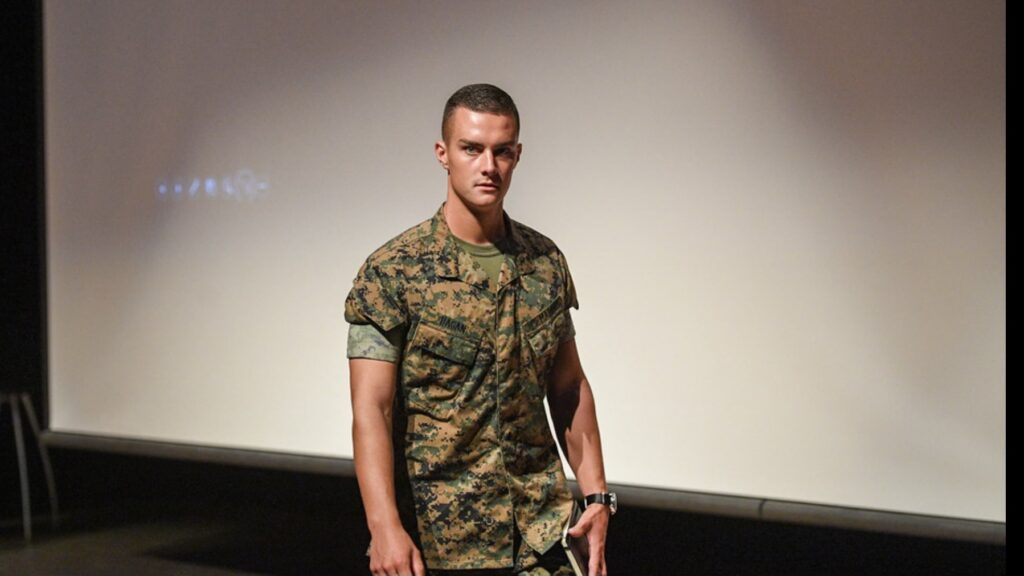
Joseph Addison Hagan V ’24 always admired the men in his family who attended Virginia Military Institute. It was a part of his family history he wanted to claim.  

“VMI is the hardest small military college and there is no better school to prepare me for service in the United States Marine Corps,” he said.

The civil engineering major applied for a four-year Marine Option Naval ROTC scholarship when he was a senior in high school. Those selected applicants for the NROTC scholarship program are awarded scholarships through a highly competitive national selection process. If awarded, they receive full tuition, a book stipend, educational fees, and other financial benefits. Once they graduate, the midshipmen are commissioned as officers in the U.S. Navy or U.S. Marine Corps. 

Hagan was lucky enough to be awarded the scholarship, which allowed him to contract to be a Marine Corps officer upon his graduation from VMI.  

The Naval ROTC program provides two programs in which cadets can enroll in — U.S. Navy or U.S. Marine Corps. 

The mission is to develop midshipmen mentally, morally, and physically, and to instill the highest ideals of duty, honor, and loyalty to commission them as Navy or Marine officers. The NROTC program fosters high-level responsibilities of command, citizenship, and government.  

Hagan has participated in a few summer assignments. His first was Marine Month West at Camp Pendleton, California, staying at Camp Talega. His next summer assignment was Marine Month East at Camp Lejeune in Jacksonville, North Carolina. Both assignments focused on training like land navigation, endurance courses, obstacle courses, hikes, physical fitness, academics, and small unit leadership. 

“Both of these experiences were filled with really great training and a lot of fun times,” he said. 

This past summer, he attended Officer Candidates School (OSC) at Marine Corps Base in Quantico. OSC is to educate and train officer candidates in Marine Corps knowledge and skills within a controlled and challenging environment. The school evaluates and screens individuals for the leadership, moral, mental, and physical qualities required for commissioning as a Marine Corps officer. 

Some trainings and activities included: combat conditioning, obstacle course, close order drill, academic classes and discussions, fire team assault course, leadership reaction course, stamina and endurance course, small unit leadership evaluation, and daily platoon staff evaluation.

Joseph Addison Hagan V, Class of 2024
Screenshot

“OCS was the toughest thing I’ve done so far, and it was an extremely rewarding experience,” he said. 

Currently, he is the midshipmen company commander for the Marine Company. This means, he ensures that every cadet who is a Marine option midshipman has what they need to prepare for their future as a second lieutenant in the U.S. Marine Corps.  

“I get to help decide what we do for our training, and I have the opportunity to work closely with the NROTC Staff,” he said. “I would say that I get to lead others and give back to an organization that prepared me well for OCS. I am now in a position where I can put the principles and information I have learned over the past three years to work training the next few classes of midshipmen.” 

Behind the Balance: Christopher Hicks ’24 — Keydet Rifle

Virginia Military Institute’s cadet-athletes have to juggle cadet life, heavy academic course loads, and their NCAA Division I sport. Committed to both academic and athletic pursuits, balancing their rigorous schedule in both sports and school requires a certain level of commitment and discipline. Behind the Balance is a series that focuses on those cadet-athletes and how they handle the hurdles of the day-to-day. 

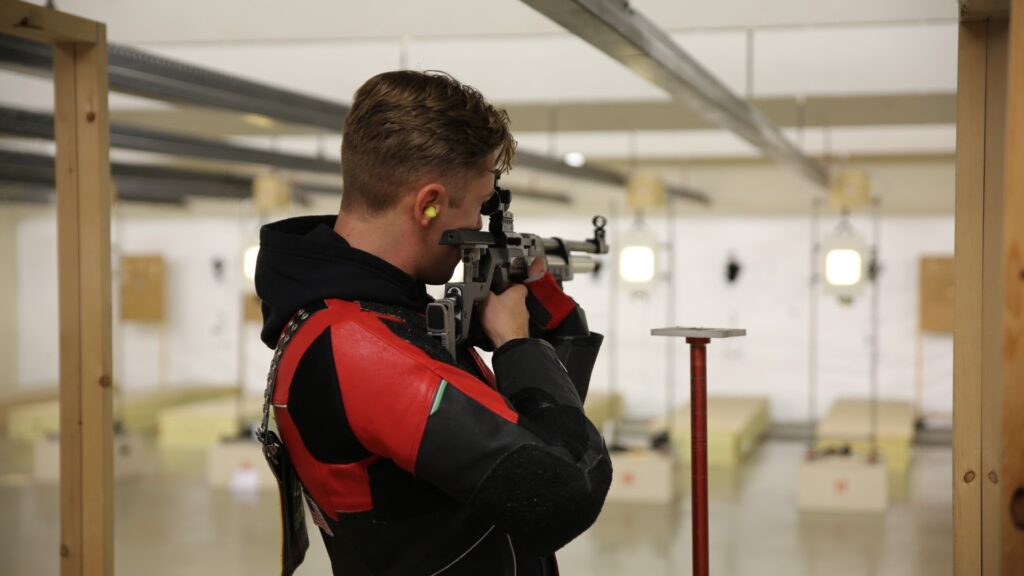
Christopher Hicks ’24 takes a deep breath, sets up his sight, braces his weapon, and fires. For Hicks, the sport of rifle is 90% mental. It’s also long and arduous.  

“If I’m having a rough last couple shots, I like to just put the gun down and then take a step back and try to regroup myself instead of letting the anger get to me,” he said.  

If he lets his anger and frustration get to him, he’ll just end up rolling the same set of bad shots.  

“I like to try to start over, reset my position,” he said. “This is a new shot. Forget about the old shots.” 

How the sport of rifle works 

He has two separate kinds of shots — one set of 60 shots with a .22 rifle and another set of 60 shots with an air rifle.  

He said it’s about a shot a minute. There is a time limit for both sections of shots, a total of an hour and a half.  

“It’s not rapid fire. You want to be one shot per minute,” he said. “Regroup yourself, go through the same routine, every shot. Make it the best shot you can.” 

It’s more than just shooting a gun. It’s about position and accuracy.  

When shooting the .22, you have three positions — prone, which is laying down; kneeling, with one knee down; and standing. Each position you get 20 shots, totaling 60 shots with the possibility of 600 points, 10 points per shot.  

For the air rifle, all 60 shots are from the standing position, with the same possibility of points. In this round, the athlete generally scores higher.  

Christopher Hicks shooting a rifle for Virginia Military Institute's rifle tea\m.

Handling studies and sport

Rifle is one of the sports at Virginia Military Institute with one of the longest seasons. Starting in September until early-March. Hicks said the team practices daily from 4 to 5:30 p.m. 

Cadet-athletes at VMI not only have their responsibilities with their selected sport but cadet duties on top of that. Cadets are also required to take physical fitness classes twice a week, participate in ROTC all four years, prepare for room and uniform inspections, practice for parade, guard duty, and more.   

“I would say time management is the biggest thing,” he said. “Being able to know your schedule and then know when you have time and then fitting everything in. That’s what’s helped me the most because I know when I practice and when I have free time, and so I can fit in time for studying.” 

Hicks grew up hunting and knew his way around a gun, but he really got into it when he was part of Marine Corps Junior ROTC. The program has an extracurricular activity of rifle. 

The civil engineering major was originally going to commission, now he’s looking to use his degree in the civil sector. 

He wasn’t looking at schools specifically for rifle. He was selected for the team and entered a trial period. He said now, the team is making more recruiting efforts, but when he started, they were looking for people with prior experience in rifle.

Hicks said he’s a mix between a natural shot and a practiced one. He’s honed his skills on the range with practice — both mentally and in skill. The highest he’s scored is 591 in practice and 589 in competition.  

Drills like removing the monitor where you can gauge your shot also helps in feeling and seeing where you’re shooting, he said.

“Rather than just putting lead downrange and seeing where it goes, it helps you understand where you’re putting the shot and what’s affecting the shot, like trigger pull or anything like that,” he said.