Post View Unavailable »
New Website Launched »

Exploring Cost-Efficient Exercise Programs for the Elderly Through SURI

VMI cadet Hai-Hsin Huang ’25, an applied mathematics major with a minor in physics, is evaluating cost-efficient exercise programs for the elderly as part of the Summer Undergraduate Research Institute (SURI) at the Virginia Military Institute. 

Huang has a keen interest in mathematical modeling and its applications across scientific fields and has previously undertaken independent studies and research projects in biological mathematical modeling and operations research. 

This summer, he is combining his mathematical expertise with a meta-analysis of existing studies to determine which types of exercises. These include aerobic, strength training, or balance exercises that offer the best health outcomes for the elderly while remaining economically viable. 

“SURI is a great opportunity that allows me to focus on my research without distractions,” said Huang. “The environment here at VMI is conducive to academic exploration and provides the resources necessary for thorough research.” 

Huang’s research, supervised by Col. Mike Krackow, professor of human performance and wellness, aims to generate recommendations for healthcare providers and policymakers. These recommendations will help optimize aging and reduce healthcare costs.  

Krackow, whose background includes healthcare and strength conditioning focusing on fall prevention for the elderly, has guided Huang through the research process. 

“My role is to advise him on the process, provide resources, and ensure he produces a high-quality paper that could potentially be published or presented at a conference,” said Krackow. 

Huang is optimistic about the potential impact of his work. 

“Eventually, I hope this research can inform healthcare providers and policymakers about which exercise programs are most beneficial for the elderly while being cost-effective,” Huang explained. 

Both Huang and Krackow agree on the importance of the SURI program for cadets, noting the development of critical thinking and problem-solving skills that are invaluable for future academic and professional endeavors. 

“SURI helps cadets gain research experience that is beneficial for graduate school and professional fields,” Krackow said. “It allows them to disseminate relevant information and develop expertise in their specific areas of interest.” 

Huang encourages future cadets to participate in SURI, advising them to take full advantage of available resources, seek guidance, stay organized, and choose research topics they are passionate about. 

“SURI is a fantastic program that offers a unique opportunity to engage in academic research beyond regular coursework,” Huang said. “I highly recommend it to anyone interested in expanding their academic horizons.” 
Embarking on an Influential Internship at U.S. Army War College: Earl Filgo ‘25

This article is part of The Next Step series. While the four years at VMI are designed for cadets to push themselves academically, physically, and mentally to tackle the demands of life at a premiere military college, they also prepare cadets for life after graduation. Whether that life be one in the military or one in the private sector, VMI faculty and staff provide guidance to cadets along their journeys. One department specifically dedicated to that endeavor of post-Institute success is the Office of Career Services. In The Next Step series, we highlight cadets preparing to enter the workforce after graduation, as well as those still in the midst of their cadetship preparing for internships over the summer. 

An internship at the U.S. Army War College was something Earl Filgo ’25 wouldn’t pass up. It was not a particular goal he had been striving for, but something he was required to do to complete his national security minor.  

The international studies major from Jakarta, Indonesia, said he had applied to several other internships, but he was a little late to the game. He said thanks to the help of Col. Spencer D. Bakich, professor of international studies and the director of the National Security Program at VMI, he was able to gain an internship with the Army War College. He said without Bakich’s endorsement, he doesn’t believe he would have received the internship. 

“Being a VMI cadet was what opened up the door and brought me through the finish line with regards to obtaining this internship,” he said. “This internship with the Army War College is very much relevant to my future military career in the Army and I hope that it would make me stand out for my preferred branch of military intelligence.” 

In his position, he will develop scenarios that will help the Army assess senior leaders’ ability to think strategically.  

Thanks to the opportunities and resources VMI has presented, Filgo has had great assistance to his personal and professional development.  

“I would not be where I am now if I had not gone to VMI, a commissioning track with an Army ROTC scholarship, the Institute Honors Program, and the various connections through alumni and faculty,” he said.  

In the next decade, he sees himself either retired from the Army, setting up a business in either the space or security sector, or continuing with his military career while being involved diplomatically as a military liaison in the U.S. State Department. All of which, he said, wouldn’t be possible without the inspiration he gained from his father.  

“My dad inspired me,” he said. “For most of my middle and high school years, I did not know what path to embark on, I was directionless, so I decided to start on a similar path as he did.”

Tracing the History of Mob Violence: Investigating American Political Unrest through SURI

With movements like Black Lives Matter and events of January 6, 2021, Michael “Bane” London ’25 had one question — what makes American’s gather like this to get their message across and how far back does it go? 

As part of the Summer Undergraduate Research Institute (SURI) program at Virginia Military Institute, London is focusing on the ways in which a citizen or a group of citizens are trying to push a political goal, aspiration, or way of thinking on to another group. His topic, “Mob Violence in America” is being advised by Lt. Col. Mark Boonshoft, associate professor in the Department of History.  

“While this may seem to be a contemporary issue, in reality “mob” violence has been used throughout American history,” London said in his preliminary SURI research. “I will trace this history through six case studies: the Stamp Act Riots in 1765, The Whiskey Rebellion which lasted from 1791 to 1794, the Philadelphia Riots of 1844, the 1863 New York City Draft Riots, the Great Railroad Strike that occurred in 1877, and the resurgence of the Klu Klux Klan in the 1920s.” 

His research will analyze when and why “mob” violence is used as a political strategy in the United States.  

“Two perspectives will form the basis of my analysis, social and economic,” London said of his research. “The social perspective will investigate issues such as race, culture, and religion. An economic perspective instead analyzes issues like taxation and trade regulation. Overall, I am looking to answer why and how ‘mob’ violence is used as a political strategy in the United States, and what issues have acted as a catalyst for this type of violence.” 

SURI is offered by the VMI Center for Undergraduate Research (VCUR) and provides cadets with a unique opportunity to delve into high-level research that relates to their degree path. It consists of cadet-led research under the direction of a faculty advisor. 

London, a history major, is spending about 30 hours a week on research for his project this summer. His hope is to apply this research to a capstone come fall.  

Growing up in rural South Carolina, London wasn’t a stranger to political change. He remembers as Confederate statues were torn down and how significant that was for his community and the country. 

Participating in the SURI program enables him to work on his critical thinking skills, plus tackle a larger scale research paper with no other distractions as it would be during the normal school year.  

“It’s really important and it gives cadets who pursue a serious project a marketed advantage over other students,” he said.  

He even surprised himself that he could take an abstract topic and dive into a well-developed thesis.  

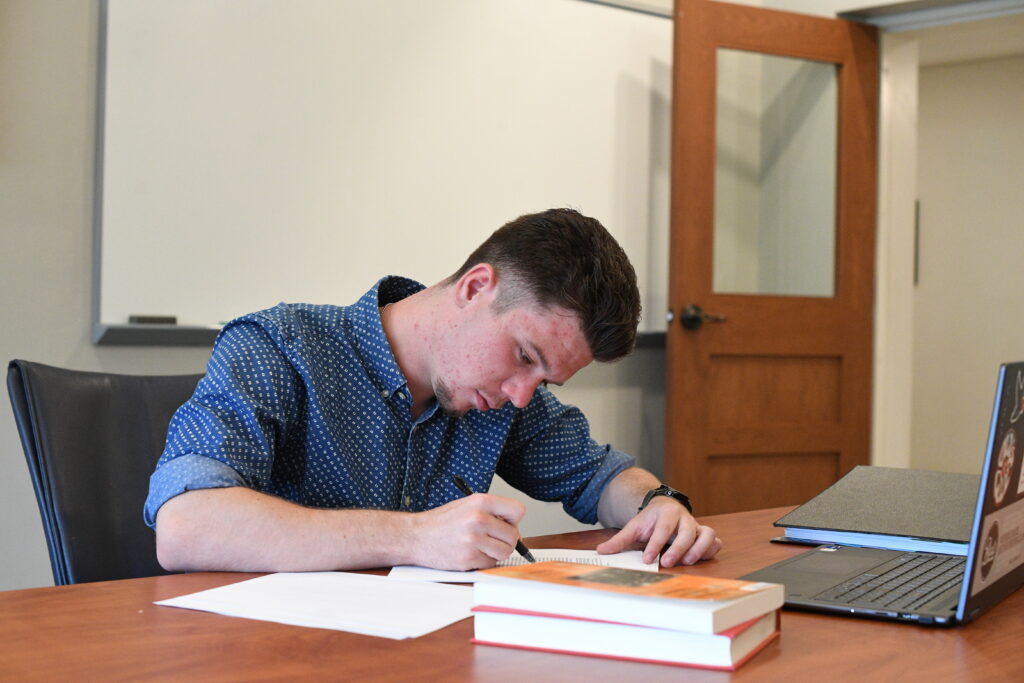
A student studying in front of a computer in a classroom.

“That sounds really kind of basic, but doing this really core academic research is something I hadn’t been exposed to,” he said. “Getting that under my belt, before graduate school, before the Army I think it’s a good thing.” 

As for Boonshoft, London approached him to be his advisor on the project. He wasn’t even a previous professor of his. Boonshoft taught a class in the fall of 2022 on American political violence, which covered some of what London was researching, which led London to choose him as an advisor.  

“I was pretty hands-on with the proposal stage because he had this interesting idea,” Boonshoft said. “We did a lot of work to build a bibliography so that way he could hit the ground running.” 

Boonshoft said the SURI program is something that is truly unique to VMI because of the way it’s structured, along with the financial support it receives.  

“It effectively becomes a full-time job, which is not normal, it’s not common, and it does give you a leg up in whatever you want to do,” he said.  

Overall, the program gives you some important life skills, Boonshoft said, like having a concept and actualizing it.  

“Knowing how to start with a humongous idea and then figure out how to put guardrails around it so you can wrap your hands around it, that’s a transferable skill,” he said. “Cadets’ time is precious during the semesters and there are ways you can do this. This is a way to make sure that people want to do research but for various reasons it’s complicated to do during semester, can do it.” 

Striving for Financial Advising Success: James ‘Alex’ Baber V ’25

This article is part of The Next Step series. While the four years at VMI are designed for cadets to push themselves academically, physically, and mentally to tackle the demands of life at a premiere military college, they also prepare cadets for life after graduation. Whether that life be one in the military or one in the private sector, VMI faculty and staff provide guidance to cadets along their journeys. One department specifically dedicated to that endeavor of post-Institute success is the Office of Career Services. In The Next Step series, we highlight cadets preparing to enter the workforce after graduation, as well as those still in the midst of their cadetship preparing for internships over the summer. 

Gaining real world experience was a high priority while attending college for James ‘Alex’ Baber V ’25. The economics and business major from Richmond, Virginia, landed an internship at Tandem Investment Advisors, headquartered in Charleston, South Carolina, for the summer. 

He’s known about Tandem since his 3rd Class year and started his interview process last summer. 

“After meeting the employees, I knew that Tandem was a great fit for me and would give me the ability to develop my technical skills,” he said.  

This summer he will be working closely with the investment team, where he will be researching companies by analyzing their financial statements, then presenting his research to the team.  

“Although it will be a lot of work, I am excited to do something that will have a real impact on others,” he said. “There definitely is a little bit of pressure that comes with that, however, I think that is the best way to develop.”

Last summer, Baber interned at Capital Wealth Planning, giving him great experience and pushing him to attain another internship for this summer.  

“The people at Tandem are what drew me to choose them,” he said. “It is a very solid group of people, and they pride themselves on their work and their strategy. I knew that I wanted to work somewhere that I could be proud of, and Tandem is exactly that.” 

Baber credits VMI for giving him opportunities, while instilling a sense of personal honor and responsibility. He said that when a company hires a VMI cadet, they know what they’re getting — an employee who can operate under pressure, who is trustworthy, accountable, and hardworking. All of these are qualities developed at VMI, Baber said, setting a cadet apart from other candidates.  

“I also think this school teaches perseverance, not just as a rat. The day-to-day here isn’t always easy, however learning to overcome challenges will only benefit me,” he said. “I think that the small things like waking up early, having a clean appearance, and being on time are all things that cadets take with them after graduation. These are the qualities that differentiate VMI from other schools.” 

He also said his namesake is an inspiration for his career path in economics and business.  

“My grandfather, the third and my dad, the fourth both had a huge impact on me growing up. I learned about the importance of work ethic, honesty, and building relationships,” he said. “At the end of the day, they drive me to be a better version of myself, and to bring pride to our name.” 

His goal, after graduating VMI and in the next 10 years, is to be a financial advisor with his own book of business.  

“Growing up I had the opportunity to watch my father help others by advising them, and the impact that he had really stuck with me,” he said. “I always wanted to work in the financial industry, but as an advisor you really can forge relationships. I want to be able to help others and be proud of what I do every single day.” 

Headed to Army War College: Connor Cherry ’25

This article is part of The Next Step series. While the four years at VMI are designed for cadets to push themselves academically, physically, and mentally to tackle the demands of life at a premiere military college, they also prepare cadets for life after graduation. Whether that life be one in the military or one in the private sector, VMI faculty and staff provide guidance to cadets along their journeys. One department specifically dedicated to that endeavor of post-Institute success is the Office of Career Services. In The Next Step series, we highlight cadets preparing to enter the workforce after graduation, as well as those still in the midst of their cadetship preparing for internships over the summer. 

Even before attending Virginia Military Institute, Connor Cherry ’25 always knew he wanted to pursue an international studies degree, with his sights set on obtaining the highly competitive national security minor. After an internship with the Army Research Laboratory (ARL) last summer, his interest in the field was cemented. 

The 1st Class cadet and international studies major from Mooresville, North Carolina, will be interning at the U.S. Army War College this summer.  

“I have always wanted to pursue a career in military intelligence through the U.S. Army and possibly a federal career pathway with a three-letter agency afterword. I believe this internship gives me another avenue of approach in understanding the holistic goals of U.S. national security,” he said.

He also applied to the Hertog War Studies program led by ex-CIA director Gen. David Petraeus but did not receive the internship.  

“Luckily the Army War College program fits with my needs for Army certified technology specialist training this summer,” he said. 

For his internship, he will be at the Center for Strategic Leadership, which is the U.S. Army’s strategic wargaming center. The internship will focus on updating scenarios that impact U.S. interests in Africa, Iran, China, Russia, and the Arctic.  

Specific responsibilities include working with regional experts to understand the security environment in these areas and to assess the implications for U.S. national security, assisting in updating existing geo-political scenarios used in the education of senior national security professionals, researching potential sources of conflict 12 years in the future, and develop recommendations for new scenarios. 

Other tasks for Cherry this summer include research, writing, and publishing on topics related to the internship, and participating in wargames, conferences, seminars, and meetings. Interns associated with this program will also develop videos and other injections for the scenario and help with other wargaming projects as required. 

“VMI gave me the opportunity to pursue my goals both militarily and regarding my goals with U.S. national security through the national security minor,” he said. “VMI’s strict rigor and discipline allowed me to lead the path of VMI cadets into the ARL Internship Program and working with their director and senior military college internship coordinator to allow other cadets the opportunity to expose themselves to the goals and processes of ARL and I hope to do the same with the Army War College.” 

To obtain this year’s internship, Cherry worked with Col. Spencer D. Bakich, professor of international studies and the director of the National Security Program at VMI. 

Cherry credits his parents for having a large role in the inspiration for his career and personal goals. He said both of his parents served as officers for the Charlotte Mecklenburg Police Department for 30 years, which motivated him to pursue a career in public service.  

Looking forward, he hopes these internships will help bolster his resume to help him continue as an officer in the Army or hold a position in a federal agency.  

“I believe I have the choice in my pathway and the ability to decide the right career path when the time comes,” he said. “The perception of VMI cadets and their personal values I believe had an impactful role in me obtaining this internship as Army officials value cadets who go through adversity and hardships with strict standards at VMI.” 

Honors Week: Unveiling Key Insights on War Timing in Power Transition Theory

Devin Thomas ’24 presented insights into his honors thesis, “War Onset Power Transition Theory.” His findings included that wars are likely during phases of relative parity and both before and after power transitions.

The power transition theory appealed to Thomas due to its focus on power dynamics and systemic changes, which have significant implications for international relations at various levels. Thomas initially encountered power transition theory in a Theories on War and Peace class with Col. J. Patrick Rhamey, professor of international studies, during his 3rd Class year. Rhamey eventually became Thomas’ academic advisor for his senior thesis presentation for Virginia Military Institute’s Honors Week. 

Thomas became intrigued by the question of when wars are most likely to occur within the context of power transition theory. He noticed a gap in his academic literature regarding the specific timing of war onset before or after power transitions.  

“When I was doing my initial research, fall of my 2nd Class year, this is what I was looking at,” explained Thomas. “It’s like trying to find a question within power transition theory and the question became no one’s really tackled this question of when is war most likely under it.” 

Thomas recognized the practical implications of understanding power transitions and war onset and saw the research topic as important for policymakers and those involved in foreign relations.  

This relevance fueled Thomas’ interest in exploring the subject deeper. Drawing from his academic background, he integrated insights from various theories, including realism, liberalism, and constructivism, to develop a comprehensive framework. 

Collaborating with Rhamey, Thomas identified two causal mechanisms for his research: perception and misperception in international politics, inspired by Robert Jervis’s work, and the concept of time horizons, drawn from David Edelstein’s research.  

During the following semesters, Thomas engaged in extensive literature review, theoretical development, and methodological training, culminating in both quantitative analysis and qualitative case study work. 

Thomas elected rigorous coursework like an International Studies Research Design class, which equipped him with the necessary skills for research design and execution leading up to his culminating presentation during his last year at VMI. 

He collected various datasets pertinent to his research question, encompassing gross domestic product, state capacity, militarized interstate disputes, and United Nations General Assembly 
voting similarity. Employing a blend of quantitative analysis techniques and qualitative research methods, Thomas analyzed the data, using techniques such as interactive logic regression to scrutinize his hypothesis quantitatively.  

“Beyond demonstrating research excellence in the scientific study of international politics, Cadet Thomas’ research also has clear policy implications that allow government to anticipate the timing of conflicts globally,” said Rhamey. “I directed Cadet Thomas to relevant research on his topic to help him develop his project into one that was both targeted to a specific research question and accomplishable within the limited time frame of Institute Honors.” 

“The international studies department does a great job of wrapping it all in and allowing you the most time possible to work on your thesis,” said Thomas. “He was having me do a lot of research because the foundation of power transition theory, the two independent variables, are the reaching parity and the dissatisfaction of the rising challenger. But that doesn’t really get to the question of the timing and the why for the timing.”  

Thomas said his research has helped him understand how the political world operates, mainly through the lens of power transition theory, which examines wars with systemic consequences.  

“I think I’ve gained a much greater understanding for, in a pragmatic sense especially, how the political world works,” Thomas said.  

Thomas said this experience has not only deepened his academic insights but also influenced his career trajectory, steering him to pursue military intelligence and strategic analysis roles after graduation, where he can apply his knowledge to current international issues. 

Behind the Balance: Courtney Novotny ’25 — Keydet Women’s Water Polo

irginia Military Institute’s cadet-athletes have to juggle cadet life, heavy academic course loads, and their NCAA Division I sport. Committed to both academic and athletic pursuits, balancing their rigorous schedule in both sports and school requires a certain level of commitment and discipline. Behind the Balance is a series that focuses on those cadet-athletes and how they handle the hurdles of the day-to-day.   

Courtney Novotny ’25 starts out each week with a plan. Every Sunday she goes over what needs to be done for the coming week. It’s the only way she can stay organized and on target for all her goals, especially since she’s one of the co-captains of the water polo team, handling her classes along with cadet responsibilities. 

“It just comes down to having good time management skills and organization skills,” she said. “I’m planning out what I have to do every single week, so I know what practices I have to be at and what military obligations that I might have. You always want to be two steps ahead when it comes to school because if you’re not two steps ahead, you’re going to get behind. For me, the balancing of all three of those things is just planning and knowing what you need to do for school.” 

Virginia Military Institute was a place where all her interests could intersect.  

“When I came on my visit to VMI, just the structure of the school and knowing that I can do ROTC, water polo, and major in biology at the same time was just exactly what I wanted. Because at another school, it would be a lot harder to balance all three of those things at the same time,” she said. 

Organization and balance are some things that have been instilled in Novotny’s life since high school, while she took classes outside of her high school and participated in athletics.  

“I was always very organized and always ahead on my schoolwork because I had sports and stuff like that,” she said. “I didn’t have as much free time after school as some other kids did. So, staying on top of those things was crucial and I was able to transfer those skills to VMI.” 

The biology major from Reading, Pennsylvania has been playing water polo since the fourth grade, which is not entirely common on the East Coast. But Novotny said that Pennsylvania has a large water polo community. Growing up in a swim-centric family lent itself to her finding water polo.  

“I just fell in love with it right away. I was just naturally pretty good at it,” she said.  

She loves the team aspect, especially with the small team at VMI. It allows the players to be close with one another. Having that camaraderie is key in a difficult sport like water polo. She said she’s gotten a lot of friendships out of it.  

“It’s a really hard sport because not only do you have to know how to swim but also you have to know how to tread water,” she said. “It’s a unique sport a lot of people don’t really know that much about. It’s a very rewarding sport.” 

She also enjoys getting into the pool every day for a good workout. It allows her to take her mind off all her other responsibilities.  

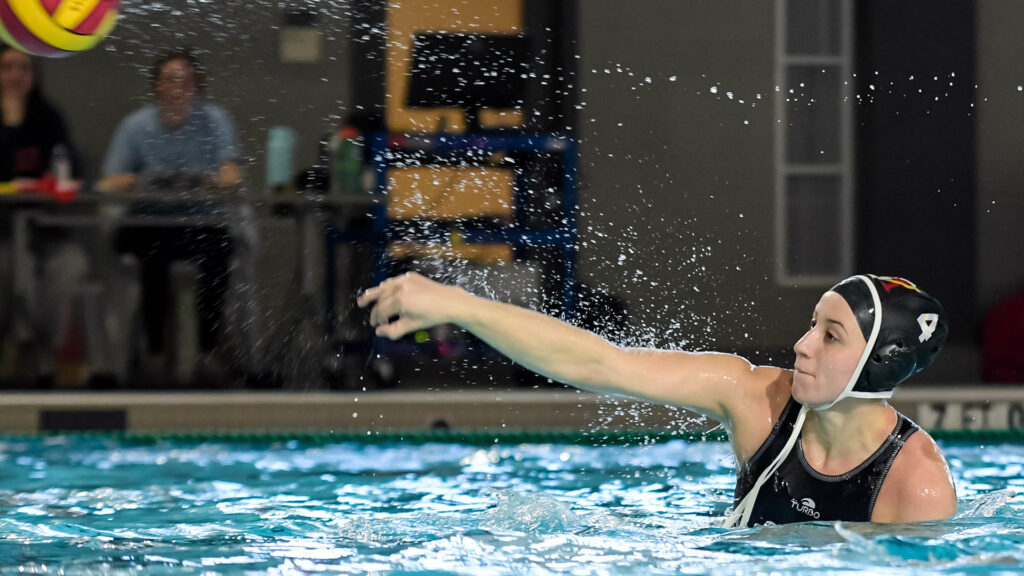
Courtney Novotny in the pool taking a shot for Virginia Military Institute's women's water polo team.

Cadet-athletes at VMI not only have their responsibilities with their selected sport but cadet duties on top of that.  Cadets are also required to take physical fitness classes twice a week, participate in ROTC all four years, prepare for room and uniform inspections, practice for parade, guard duty, and more. 

Her days can vary, depending on her schedule for classes and practice. Some days require an earlier wake-up, like when she does early morning lifting, she gets up at 5:15 a.m. 

Novotny isn’t sure if she will commission after graduating in 2025, but she is part of the Coast Guard auxiliary university program, which entails a lot of outside work and responsibilities. She said to stay on top of things, she takes the days she doesn’t have as many classes to get caught up on schoolwork. She lacks free time in the evenings because of practice.  

“I always try to tell myself even if I am having a bad day or if I do bad on an assignment that’s OK because that happens and I always make it through and overcome,” she said. “Usually, a lot of times, if I’m having a bad day, going to practice helps because it gets my mind off of it. I’ll go to practice, and I’ll be with my teammates. I forget about everything. Then I’m laughing and smiling. That’s the nice thing about playing a sport here is that you kind of get a break from academics.” 

Despite the busy schedule, Novotny said she likes the grind at VMI. Even though some days she wants to ditch practice and take a nap or do homework, she wouldn’t change it.  

“Being so involved at VMI is preparing me for the future,” she said. “When I’m older and I’m working, you’re always going to have a lot of responsibilities. So even though it is hard sometimes and I wish I didn’t always have to go to practice after classes, when I really think about it, it’s good to have this responsibility. Because it’s preparing me for what else is in the future.” 

Behind the Balance: Drew Menges ’25 — Keydet Soccer

Virginia Military Institute’s cadet-athletes have to juggle cadet life, heavy academic course loads, and their NCAA Division I sport. Committed to both academic and athletic pursuits, balancing their rigorous schedule in both sports and school requires a certain level of commitment and discipline. Behind the Balance is a series that focuses on those cadet-athletes and how they handle the hurdles of the day-to-day. 

Drew Menges ’25 had dreamed of attending the United States Merchant Marine Academy, but those dreams were halted when he was not admitted due to colorblindness. That didn’t slash his desire to go to military college, though.  

“I always wanted to go to a military school … So at the last minute we were looking at other options,” he said.

Menges has a strong desire to serve his country because of  his own family’s service. Both his grandfathers served, one in the Navy and one in the Air Force.  

“When I found out about military schools, I didn’t really know what they did,” he said. “I thought it’s pretty cool that you could come here to get a degree and commission.” 

When he found Virginia Military Institute, it was nearly kismet. By attending VMI, he’d also be able to play soccer for the school.  

“Everything worked out with the coach and then I just applied here and got in,” he said.  

When Menges talks about soccer his entire face lights up. You can tell it’s one of his passions. But, he’s serious about it. Starting at the age of 3, he took the field. By the time he entered middle school, he was playing on a club soccer team. There came a time when he had to choose between two sports, though. He was playing both soccer and lacrosse, but they were both during the same season. 

Ultimately, soccer scored higher for him.  

“I decided to stick with soccer because I liked it more. I think I was a little bit better at it too,” he said.  

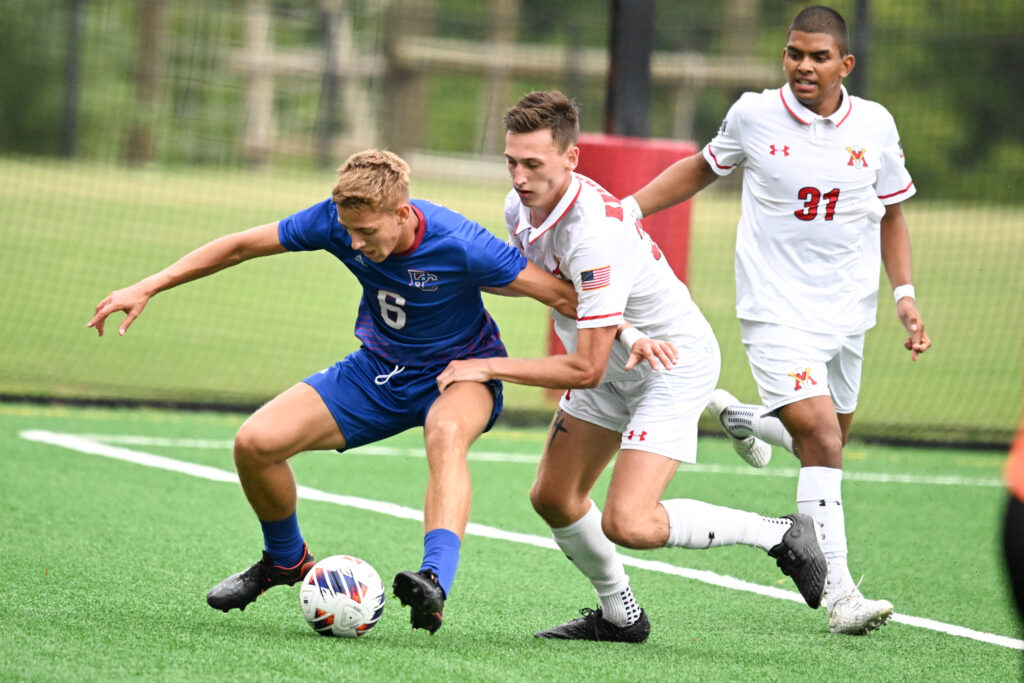
Drew Menges on the soccer field playing for Virginia Military Institute's men's soccer team.

Scoring goals on and off the field 

The mechanical engineering major has a full course load of 18 credits this semester. He’ll also be commissioning into the Army upon graduation. So, his days are tightly packed. 

Getting up at 6:30 a.m. daily, he heads to morning training with the soccer team. Morning practices consist of mostly running or stretching. Then, he’s off to formation at 7 a.m. By 7:05 a.m. he’s back to his room to put his hay up, do a little bit of school work, then he attempts to go to Crozet for breakfast before his first class at 9 a.m. 

On his long days, he has classes from 9 a.m. to 4 p.m. On good days, he’s out of class by 1 p.m. Practice is at 4:30 p.m. so after class, he’s either rushing to practices or doing work or sleeping.  

After practice, he hits up the mess hall, then it’s back to work for the remainder of the night. Sometimes he’s working on class work until midnight. On especially hard nights, he could be up until the wee hours of 4 a.m. completing assignments.  

“It’s pretty difficult. I’m not going to lie,” he said. “And this year it’s definitely ramped up because the mechanical engineering classes have got a lot harder and there’s a lot more work. I just try to knock one thing out at a time.” 

He suggests doing as much as you can with the time you’re given.  

Cadet-athletes at VMI not only have their responsibilities with their selected sport but cadet duties on top of that. There are specific times they can eat, go to class, study, and sleep. They are also required to take physical fitness classes twice a week, participate in ROTC all four years, be prepared for room and uniform inspections, parade preparation, guard duty, and more.  

“Before I came here I was not very good with time management. And everything kind of came easy to me, especially with school,” he said. “So coming here, I’ve definitely learned a lot about what I need to do every day to get stuff done, especially when it’s a heavy workload.”

He also discovered what he’s capable of.  

“You’re able to find out a lot about what you actually can do,” he said. “Like a regular college or if you didn’t come here, you probably would have never found that out by yourselves.” 

One tip he does have is to find time for yourself, even if it’s something small. He says he likes to spend some weekends with friends, just hanging out. 

“I’m also a very big believer in when I’m doing an assignment and it’s not clicking, just taking a break and stepping away from it,” he said. “It really, really helps me. And that’s why on the weekends, I always try to find time to do something for myself, instead of just worrying about school and stuff.” 

Behind the Balance: Audrey Davis ’25 — Keydet Soccer

Virginia Military Institute’s cadet-athletes have to juggle cadet life, heavy academic course loads, and their NCAA Division I sport. Committed to both academic and athletic pursuits, balancing their rigorous schedule in both sports and school requires a certain level of commitment and discipline. Behind the Balance is a series that focuses on those cadet-athletes and how they handle the hurdles of the day-to-day. 

It’s 5:45 a.m. on a Tuesday. Audrey Davis ’25 is up before the sun to get a workout in. It’s required — she plays center back for the Virginia Military Institute Women’s Soccer Team. They have some sort of workout or practice daily when they are in season, plus games on Sundays and Thursdays.  

Her days don’t always start before the crack of dawn. Certain ones call for lifting, rehabilitation, reviewing film, or drills. 

On a normal day, while in season, she’s up at 6:45 a.m. so she can be at formation at 7 a.m. where they stand outside and salute the flag. Then it’s breakfast and onto class from 8 a.m. until 2 p.m. After classes, she tries to come down to Paulette Hall to get some rehab work in before practice. Then it’s practice for around two hours.  

Then it’s onto dinner. 

From there she’s studying for up to four hours and her day just repeats.  

“It’s a pretty busy day,” she said.  

It varies on the intensity of what practices look like. Mondays are rest days — no practice whatsoever. Tuesday requires hardcore training. Then Wednesday is to build up for Thursday’s game. They do recovery training on Friday, ramp-up workouts on Saturday, and then play Sunday.  

“We want to have a full week schedule and then during the offseason, we’ll train pretty much every day, just some days might be a lighter load,” the international studies major said.  

Finding her way to VMI 

Davis wasn’t sure what life after college would look like.  

“I had no plan for after college and I just started thinking about what I wanted to do with my life. And I’m the type of person that does need that discipline in that structure,” she said.  

She initially was thinking of another school and being a biology major. Then she did a soccer camp at Virginia Military Institute with head coach Chris Haught-Thompson.  

“He liked me and he said that if I wanted to come here, the spot was mine,” she said.  

She wasn’t even going to commission and at first, was looking at the Marines. Once she was at VMI, she received an Army scholarship and everything started to switch into place.  

“It was just one of those things where I came here and I realized that I really liked this lifestyle and it’s really good for me,” she said.  

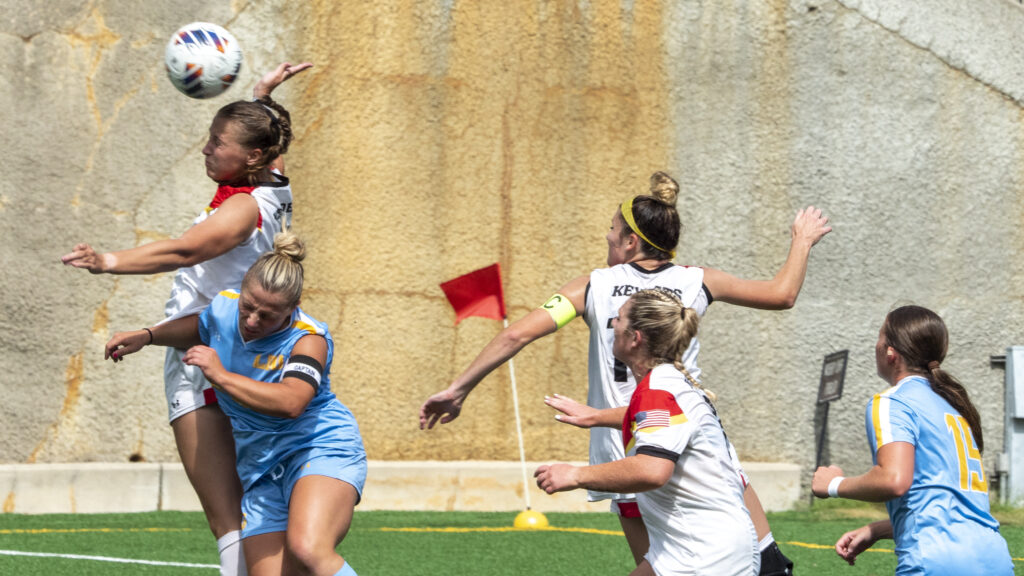
Audrey Davis hits the soccer ball on the field.
VMI’s #19 Audrey Davis. VMI vs Long Island Unv. women’s soccer game and senior day celebration September 10, 2023 at Drill Field #2 in Lexington. LIU won 2-1. (Randall K. Wolf / VMI )

Balancing studies and sports 

Cadet-athletes at VMI not only have their responsibilities with their selected sport but cadet duties on top of that. There are specific times of when they can eat, go to class, study, and sleep. Cadets are also required to take physical fitness classes twice a week, participate in ROTC all four years, require room and uniform inspections, parade preparation, guard duty, and more.  

It’s crucial to stay regimented with each activity.  

“I’ve become really productive in class, like staying on task so I don’t fall behind or so I don’t have to make up anything from class,” Davis said. “A lot of it is just really grinding it out like late at night like we’re done with dinner around 8 p.m., so normally I’d stay out from like 8 p.m. to midnight so I get like a good four hours of homework and then I try to get right to bed after that.” 

After graduation, she has committed to the U.S. Army for eight years. Her focus, which is undecided at the moment, is wavering between military intelligence and aviation. 

Her commitments to the Army while at VMI include control time weekly at school, Advanced Camp this summer, plus the commitment of eight years after graduation. 

When the days are long and tiring — both exhausting mentally and physically — Davis said she can’t give up.  

“You don’t really have a choice here, you really have to learn that line between giving up and seeing it as adversity and using it to push you,” she said.  

She’s seen firsthand overcoming a large obstacle with recently having ankle surgery.   

“One of the trainers here told me that if you push through even on your worst days … the next day is going to be better regardless. And I think that applies,” she said. “I started using that for not only soccer, but on the hill. So you really don’t have a choice. Because if you mess up one day here you fall behind and you can spend the whole semester trying to recover.”