Post View Unavailable »
New Website Launched »

Commencement Held for Class of 2026

The sun shone brilliantly May 17 as Virginia Military Institute held its commencement ceremony in Cameron Hall and conferred degrees on the Class of 2026. The ceremony was livestreamed for family and friends who could not attend the event in person.

This year marks the 25th anniversary of the first female cadets graduating from the Institute in 2001. Appropriately, the commencement speaker was Gov. Abigail Spanberger, who herself graduated in 2001 from the University of Virginia, and is the first female governor of the Commonwealth of Virginia.

The Regimental Band played “Pomp and Circumstance” as nearly 260 cadets marched into the arena with a commanding albeit joyful spring in their stride. Family members, friends, and supporters greeted the graduates with a standing ovation, heartening cheers, jubilant shouts, and a few emotional tears.

Furness’ First Class of Graduates

In his commencement address following his first academic year as VMI superintendent, Lt. Gen. David Furness ’87 welcomed the governor, the Board of Visitors, faculty, staff, cadets, alumni, friends and families. He thanked those in the audience who encouraged and sustained the cadets during their time at VMI, and recognized veterans and current military members. To the graduates, he reminded them of the lessons and training they underwent at VMI, as well as the times they were the ones mentoring other cadets, including the Class of 2029. He commended them on leaving the Corps in good hands, and with heartfelt emotion said, “You will forever be my first class of graduates as superintendent. I could not have asked for a better group of young men and women to lead the Corps this year. There were many distractions, but you overcame those obstacles and stayed focused on maintaining your honor and integrity while pursuing your degrees. I am proud of you and what you have accomplished.”
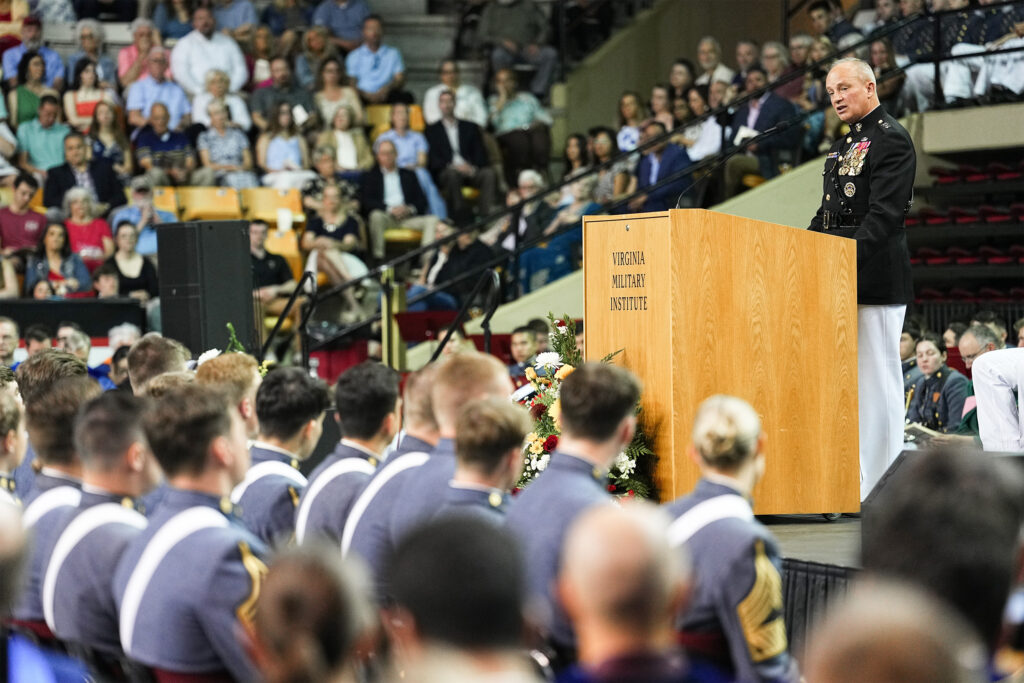
Lt. Gen. David Furness ’87 addresses graduates during Commencement.
Lt. Gen. David Furness ’87 addresses his first class of graduates as superintendent in Cameron Hall. –VMI Photo by H. Lockwood McLaughlin.

Furness closed by noting that through the VMI Alumni Association’s Pass in Review program, the Class of 1976 forged a meaningful relationship with the Class of 2026 and gifted the graduates a commemorative coin designed collaboratively by both classes to serve as a proud symbol of their bond. He then introduced the peer-elected valedictorian, Lukas Maurer.

Forged by Fire

Maurer, a civil engineering major from Lebanon, Pennsylvania, used the metaphor of sword forging to describe the VMI cadet experience, and quoted from the valedictorian speech of Jonathan Daniels ’61, the alumnus Episcopal seminarian who sacrificed his own life to protect that of another. “We have been blasted by the fire in order to be tempered in mind and spirit.” Maurer compared a young matriculant to a rough, sharp-edged block of steel immediately thrown into a world of controlled chaos, confusion, and stress. “Before you know it, you are bald and wondering if you’ve made the right decision coming to this place. But you persevere and rely on the people to your left and right and choose not to quit for them.” He stated that by the time a rat has completed the first milestone of Matriculation Week, the heated block of steel is taken out of the fire, but the hammer strikes hard with the stresses of classes, Rat Line duties, and physical training. With the much-needed rest of the first furlough, the battered block of steel is plunged into the quench to cool. “But the process is far from over. You return to VMI and are immediately thrown into the fire again,” he said, noting the process continues through many milestones like Breakout, the completion of the first academic year, and new responsibilities as a 3rd Class cadet. “Now, that block of steel is beginning to take the shape of a dull blade. However, the blade is far from ready. You hit the ground running, with increased responsibility as a corporal, now helping facilitate the forging process of incoming rats, all while still being forged yourself.” By the time a cadet reaches the 2nd Class year, with more responsibilities and academic demands, the blade is placed against the grinder. “The general shape has formed over the past two years, but now the excess impurities of dull steel are ground away through the grit of hard work and relentless discipline.” By 1st Class year, he stated, “Again you are heated up and tested in ways you didn’t think possible. However, this is necessary, because the remaining impurities are being removed. The final quenching has occurred, and the blade is sharpened and adorned with a beautiful handle and pommel. You finish your last final exam, and successfully hand off any remaining responsibilities, and savor those final lasting memories with your BRs.”

He concluded, “Today, my friends, you have made it! You are fully adorned VMI-hardened blades prepared for duty in the military, academia, or in the civilian world. I am convinced you have made it through the most difficult college in the country. Regardless of the path we have chosen, we have all gone through the VMI forge together; symbolized by the numbers 2026 on our rings. Take pride in this brotherhood, and the fact that you have excelled through this forging process together.”

Maurer served as cadre corporal and first sergeant for Echo Company. He was a member of the Honor Court and was inducted into the Omicron Delta Kappa and Tau Beta Pi honor societies. He is the son of Robert and Tessa Maurer, and commissioned into the Army as an aviation officer.

A Unified Class        

Maximus Ankrah, president of the class, also shared farewell remarks to his brother rats. He pointed out that throughout their cadetship there have been two VMI superintendents, two commandants, two governors of Virginia, and two presidents of the United States. “No matter who’s at the top, no matter who’s calling the shots, no matter the circumstance, we’re able to maintain our integrity and brotherhood as a class, bringing us closer and stronger together.”

He talked of multiple events the class experienced over their four years together that created the strong bond of brotherhood, including the recent Virginia General Assembly action effecting VMI.  “Toward the end of February, when legislative bills threatened our school, arguably one of the most unifying memories of our cadetship, it was the leaders of this class, and the support of this class, that changed the trajectory in a positive way.”

Ankrah reminded the graduates that through all the successes and challenges of being VMI cadets, they have truly mastered the system and are more than ready to graduate. “If you can make it through the toughest, hardest, grittiest military school in our nation, you can make it through anything. I have no doubt that you’ll find yourself to be more than worthy contributors to VMI’s rich legacy of honor and service. As long as you remember the credo that has been instilled in us since we were rats, ‘Everything’s earned, not given,’ and you always justify the space you occupy, you will no longer succeed within the walls of barracks, you will succeed within the limitless horizons that the world has to offer.” Ankrah then introduced Spanberger who was warmly welcomed to the lectern.

As long as you remember the credo that has been instilled in us since we were rats, ‘Everything’s earned, not given,’ and you always justify the space you occupy, you will no longer succeed within the walls of barracks, you will succeed within the limitless horizons that the world has to offer.

Maximus Ankrah ’26, 1st Class president

Paths to Achievements

Spanberger thanked VMI for the honor of being the commencement speaker, and expressed gratitude to the cadets for participating in her inauguration parade in January. “You might remember me as the person expressively trying to tell you something as you marched by, keeping straight faces, as you realized that my microphone wasn’t working, as I was desperately trying to grant amnesty,” she quipped.

The governor read aloud VMI’s mission, ‘“Virginia Military Institute believes that the measure of a college lies in the quality and performance of its graduates and their contributions to society. Therefore, it is the mission of Virginia Military Institute to produce educated, honorable men and women prepared for the very work of civil life, imbued with love of learning, confident in the functions and attitudes of leadership, possessing a high sense of public service, advocates of the American Democracy and free enterprise system, and ready as citizen-soldiers to defend their country in times of national peril.’ That is what makes this place special. That is your charge, Class of 2026, to set forth on a path wherein you will make contributions to our society.”

She described her own career path and admitted that it did not proceed exactly how she had planned. “No path is a straight line. Sometimes the windings of paths will get you exactly where you are supposed to be.” She offered an example of successfully following a blind path during a training exercise she went through early in her career with the CIA. She and her colleagues were tasked to get from point A to point B alone, but all at once in the dark of night, in a wooded area, using only a compass. She set her compass bearing, not knowing where she was going, or what she would walk through. She found herself trudging through a swamp, but instead of turning back, she kept going and finally arrived at her destination. “The point of that exercise wasn’t the destination, it was proving to ourselves that we could do hard, strange, sometimes confusing things, that when the path got genuinely difficult, we wouldn’t turn back. You all have many stories of perseverance to choose from, and on your hardest days, you will be able to draw on the memories of what you have achieved, survived, and been through.”

She acknowledged that the cadets are entering a world with significant challenges. “You’re the products of an academic institution that has been preparing leaders for more than 180 years. I have every confidence that you will leave Lexington, not just ready to adapt to the world as you find it, but ready to use your talents to do your part to make it better.”

She concluded enthusiastically with, “I do have one last order of business to attend to, and thankfully the microphone is working this time.” She then granted amnesty to those cadets with unserved penalty tours and confinement, to which the Corps, mostly the 4th Class cadets in attendance, broke out in raucous cheers.     

Awards Bestowed

Three awards are traditionally given at VMI’s May commencement exercises. The First Jackson-Hope Medal for highest attainment in scholarship, accompanied by The Commander Harry Millard Mason Academic Proficiency Award, went to Macallister Jennings Clark.

Receiving the Second Jackson-Hope Medal, for second highest attainment in scholarship, accompanied by The Colonel Sterling Murray Heflin 1916 Academic Proficiency Award, was Sebastien Patrick Chicas.

Nolan James Savard, received The Society of the Cincinnati Medal, for efficiency of service and excellence of character, accompanied by The Richard J. Marshall and Sumter L. Lowry Awards.

The presentation of candidates for degrees was delivered by Brig. Gen. Robert W. Moreschi, dean of the faculty and deputy superintendent for academics, followed by the conferring of degrees by Furness, then a benediction was offered by Col. John P. Casper ’04, Institute chaplain.

Kimlong Nguyen ’27, the new regimental commander, relieved the Class of 2026 of their duties as they cheered and engaged in the time-honored tossing of their gloves followed by an Old Yell and singing of “The Spirit.”

25th Anniversary of Women Graduates

Sarah Woosley, a graduate who served as 2nd Battalion commander over the past academic year, shared when she first chose to attend VMI, she was a little intimidated by the male to female ratio. “However, during my first few weeks as a rat, I quickly realized I was surrounded by strong female leaders. I looked up to those women and have worked to become the kind of leader that someone else can look up to. The women before me deserve credit for my success because their courage and perseverance paved the way for me to succeed. To downplay being a female at VMI is to overlook the accomplishments and sacrifices of the women who fought to earn their place at VMI.” 

One of those women who came before Woosley is Institute physician, Dr. Melissa S. Krawiec ’01. In recalling her own commencement, Krawiec stated she is fiercely proud to be a member of the first graduating class of female cadets from VMI. “As a class, we overcame some significant obstacles and certainly our story is one of survival, but also of thriving. For me, graduating from VMI meant that I had accomplished the biggest goal I’d ever set for myself in my life. I will tell anyone who asks that VMI was a difficult place to be, but a fantastic place to be from.”
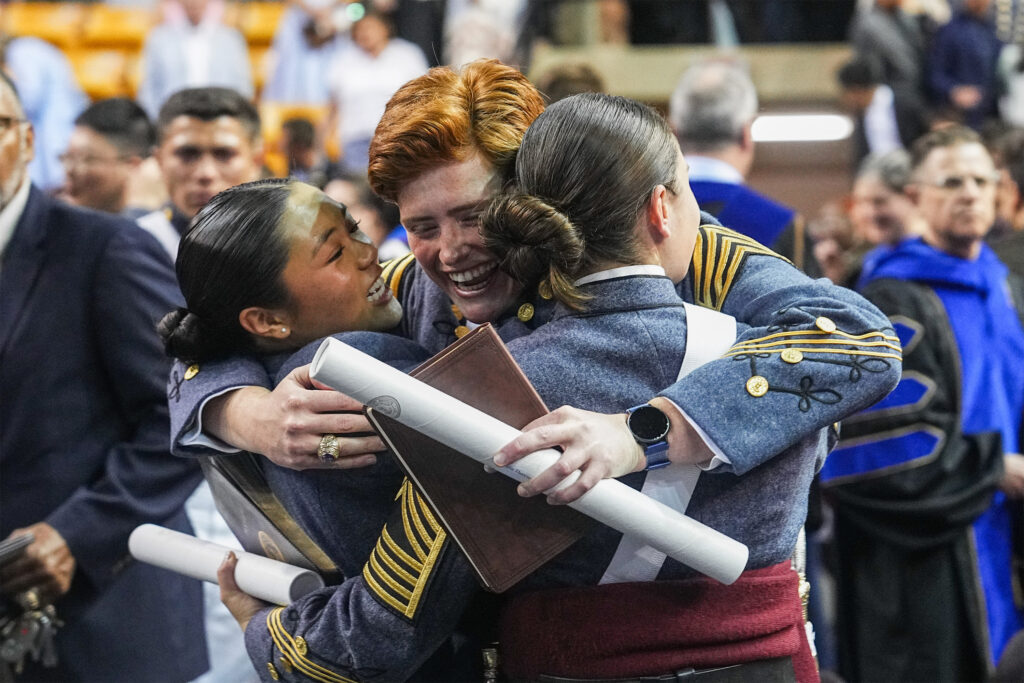
Cadets embrace after receiving their diplomas.
Julia Ward ’26 congratulates her brother rats with celebratory hugs at the conclusion of the commencement ceremony. –VMI Photo by H. Lockwood McLaughlin.

VMI Commissions Military Officers

Virginia Military Institute commissioned nearly 140 cadets into the armed services at the annual Reserve Officers’ Training Corps (ROTC) joint commissioning ceremony May 15 in Cameron Hall. The ceremony was livestreamed for family and friends who could not attend the event in person.

Gen. Christopher J. Mahoney, 13th vice chairman of the Joint Chiefs of Staff, the nation’s second highest-ranking military officer, who arrived to post by helicopter, offered the commissioning officer remarks and administered the oath of office to the cadets beginning their journey of military service as second lieutenants in the U.S. Air Force, Army, and Marine Corps, and as ensigns in the Coast Guard and Navy.

Lt. Gen. David Furness ’87, who just completed his first academic year as the Institute’s 16th superintendent, welcomed the nation’s newest military officers, their friends and families, faculty and staff, and members of the Corps of Cadets to the ceremony. He thanked the ROTC officers, cadre, and staff who were instrumental in teaching and mentoring the young officers, and acknowledged all the veterans and current military members in the audience. “We appreciate the sacrifices you have made and the leadership you have shown. These cadets are following in your footsteps because of the examples you have set,” he said.

Furness reminded the commissioning cadets that VMI has prepared them to face any challenge or adversary, and how honor, courage, and commitment have been instilled in them. “These fundamentals will serve you well for the rest of your life. The time has come for you to take the next step in your careers and serve our great nation.”

He shared three habits he was advised to adhere to when he was a young officer. “First, embrace lifelong learning. You must continually increase your knowledge through practice and self-study. Second, stay physically fit. You will find that when stress arrives, you will be better disciplined to persevere when you are fit, and always remember that a strong mind never grows in a weak body. Last, but most importantly, you must take care of those you lead. Whether in the military, the civilian sector, or your family, people will depend on you to be an ethical and reliable source of strength, to teach, coach, and mentor those you are responsible for.” He congratulated the cadets on attaining a commission, voiced his pride of them, thanked them for making the decision to serve in the military, and wished them Godspeed.  

Furness then introduced Mahoney as a great friend and noted their paths crossed many times throughout their careers. Mahoney graduated from the College of the Holy Cross in Worcester, Massachusetts, with a bachelor’s degree in economics, and commissioned into the Marine Corps. He has served as a pilot with the Marine All-Weather Fighter Attack Squadron known as the “Bengals,” as well as the fighter squadrons known as the “Werewolves,” the “Crusaders,” and the “Bats.” He has held command at the squadron, group, and wing levels. He is a graduate of the Weapons and Tactics Instructor Course, the Marine Division Tactics Course, and the Navy Fighter Weapons School commonly known as TOPGUN. He holds two master’s degrees. One from the University of Canberra in Australia, and one from Air University at Maxwell Air Force Base in Alabama, both with the highest academic distinction.

Mahoney shared he was honored and humbled to speak at VMI, which he described as hallowed ground. To the commissionees, he stated that the era of America’s uncontested dominance is over. “The adversaries you face are capable. They are hungry, and they’re watching you. You’re about to be handed the greatest responsibility the nation can bestow.” He told them they will be tested. “The enemy will jam your communications. Your screens will go black. You will not be able to call higher headquarters for permission. You will not be able to call in a medical evacuation. Will you freeze? Will you wait for perfect information? What will you do? Answering that question will require everything you have. It will require the lessons of this great institution that is built on unrivaled tradition, and these traditions over time have become legend.” Mahoney then cited legendary VMI alumni like Lt. Gen. Chesty Puller, VMI Class of 1921; Lt. Gen. Charles Kilbourne, VMI Class of 1894; Maj. Gen. William Upshur, VMI Class of 1902; and Gen. Lemuel Shepherd, VMI Class of 1917; who all faced dire situations in battle, but instead of hesitating or panicking, they relied on the steel VMI put in their spines. “They did not shrink from violence. They stepped into the breach.” He warned the new officers that because these VMI legendary ghosts set such a high standard, the military has high expectations of VMI graduates. “When a commander sees a VMI ring on a finger, they don’t see a recent college graduate, they see the ghosts of VMI. They expect you to be unbreakable, they expect you to lead from the front, and they expect you to navigate chaos without losing your bearing. Virginia Military Institute has given you the discipline and uncompromised standard. The rest is up to you. The ghosts of VMI are watching you. Our adversaries are preparing for you. What will you do?”    

He then asked the commissioning cadets to stand as he administered the oath of office. Afterward, the brother rats gave each other congratulatory hugs as the audience applauded and cheered.  

Following the ceremony, the separate military branches conducted individual pin-on ceremonies at various locations on post. It was there that the newly commissioned officers followed a tradition of presenting a silver dollar to the active service member or veteran from whom they received their first salute.

According to Capt. Megan Taylor, assistant professor of military science for the Army ROTC George C. Marshall Battalion—formerly known as the Blue Ridge Battalion—at VMI. Many were exemplary, but two were prominent: James Aldinger, an international studies major from Arlington, Virginia; and Matthew Kleinschuster, an applied mathematics major from Richmond, Virginia. “Aldinger served as the Ranger Challenge platoon leader responsible for the training and preparation of the Ranger Challenge team. Under his leadership, the team successfully competed at Exercise Cambrian Patrol in Wales in the United Kingdom; at the 4th Brigade Ranger Challenge at Fort Pickett, Virginia; and at the Sandhurst Military Skills Competition at the U.S. Military Academy at West Point. His ability to coordinate training, planning, and logistics for local, national, and international competitions far exceeded the traditional cadet experience. He ranked within the top 1% of cadets nationwide and is branching in the infantry. Kleinschuster served as battalion commander and was responsible for the oversight, accountability, and training of four companies and more than 1,000 VMI cadets. He had the single greatest impact on the Army ROTC mission and overall success of the battalion over the past year. Through his leadership, work ethic, and very impressive GPA, Kleinschuster earned the distinction of being ranked the No. 8 cadet in the nation and was selected to branch in explosive ordnance disposal,” Taylor said.

Lt. Cmdr. Tom Campbell, naval science instructor for Naval ROTC, designated two cadets who commissioned into the Navy and two who commissioned into the Marine Corps as truly outstanding. Macallister Clark, a mechanical engineering major from Saint Michael, Minnesota, was a four-year national scholarship recipient, and retained a 4.0 four-year GPA. He was selected to be commissioned as a Naval reactors engineer (NRE), an elite technical officer who manages the lifecycle of Navy nuclear propulsion plants. The last year a VMI cadet commissioned as NRE was 2017.

Nicole Samella, an electrical and computer engineering major from Virginia Beach, Virginia, was a four-year national scholarship recipient, maintained a superior GPA and high physical fitness scores, and served as the NROTC battalion commander. As the top ranked surface warfare officer in the nation, she was handpicked to transfer into the Navy Engineering Duty Officer program. 

Kern Aughinbaugh, a biology major from San Marcos, California, served as the Marine Company commanding officer and advisor for the NROTC Bulldog Program, helping prepare candidates for the physical requirements of the Marine Officer Candidate School. Moreover, he served the Corps as Golf Company commander in the regiment. Devin Auzenne, a history major from Opelousas, Louisiana, was a four-year national scholarship recipient. In addition to serving the Corps as regimental commanding officer, he also was an advisor for the NROTC Bulldog Program. Both Aughinbaugh and Auzenne will go to The Basic School in Quantico, Virginia.

Col. Eric Steele, commander of Air Force ROTC, cited two cadets as exceptional. Reese Lassiter, a mechanical engineering and physics double major from Louisa, Virginia, has earned the coveted Distinguished Graduate (DG) award—established to recognize the top 10% of commissioning cadets—from AFROTC. “He’s been a standout cadet his entire time in our program, winning national awards and earning recognition through several highly competitive military training courses. He will be attending undergraduate pilot training at Columbus Air Force Base in Mississippi after commissioning,” said Steele.  

Hannah Buttner, an international studies major from Williamsburg, Virginia, successfully completed a leadership tour as Cadet Wing commander last fall. “Competing through a highly rigorous process at the national level, she was also selected to attend Green Flag-West at Nellis Air Force Base in Las Vegas, Nevada, and at Fort Irwin, California, where she gained broad exposure to Air Force and Army joint air-to-ground operations in a real-world training environment. She is this year’s recipient of the Captain John W. Kennedy ’69 Award for sustained excellence throughout her time as a cadet. She will attend intelligence officer training at Goodfellow Air Force Base in San Angelo, Texas,” Steele explained.    

According to Command Sgt. Maj. Suzanne Rubenstein, director of cadet activities and VMI liaison for the Coast Guard Auxiliary University Program, one cadet who commissioned in the Coast Guard. Shane McKenna, an international studies major from Salt Point, New York, served as commander for the AUP and was Foxtrot Company executive officer.  

Memorial Parade

Earlier in the day the Memorial Parade was held, commemorating the bravery and sacrifice of all alumni who died on the field of honor including the Mexican-American War, the American Civil War, the Spanish-American War, World War I, World War II, the Korean Conflict, the Vietnam War, the Marine Barracks in Lebanon, the Persian Gulf War, and the Global War on Terrorism. The large garrison flags were flown at half-staff, by order of Gov. Abigail Spanberger, in memory and respect of Peace Officers’ Memorial Day, a fitting backdrop as all 591 alumni names were somberly read by Stone Gardner ’28, Sophia Lurey ’28, Garrett Maye ’28, and Jamie Rodriguez ’28. A wreath was laid at the foot of the monument, “Virginia Mourning Her Dead,” as well as at the three barracks arches. A prayer led by Col. John P. Casper ’04, Institute chaplain, was followed by the firing of a three-volley salute. A stirring echo rendition of “Taps” was played by Louis Marangoni ’27 and resonated by Khaidan Piedmonte ’28, followed by the Pipe Band leading the Regimental Band in an emotional delivery of “Amazing Grace.” Col. Lawrence “Ley” Havird ’90, commandant, was joined by Furness in taking review of the parade as the Corps marched from the Parade Ground down Letcher Avenue and ending in barracks.

I Am VMI: Maximus Ankrah ’26 

What truly defines Virginia Military Institute are the people. Cadets, faculty, and staff, both past and present, are what make it “No Ordinary College.” I AM VMI will showcase the outstanding individuals who have accepted the challenges and embraced the spirit of VMI. Their perspectives provide authentic insights into life at the Institute and the value of this unique military college. 

I Am VMI: Maximus Ankrah ’26 

  • VMI Class: 2026  
  • MajorBiology, with a Psychology Minor
  • Hometown: Dumfries, Virginia
  • Club Sport: Brazilian Jiu Jitsu 
  • Commissioning PlansU.S. Air Force
  • Other Clubs/Societies/Activities: VMI Class President of 2026, Emergency Medical Technician, Former Cadre Instructor   

The choice of attending Virginia Military Institute was a chance for Maximus Ankrah ’26 to obtain a clean slate.

Every accomplishment and accolade I could achieve was earned, not given; I really wanted to deserve what was given to me,” he explained.

The biology major also serves as the president of the VMI Class of 2026, an emergency medical technician (EMT), and a former cadre instructor. Ankrah chose biology because he wants to be a medical doctor in the U.S. Air Force, which he is commissioning into.

Every accomplishment and accolade I could achieve was earned, not given.

“The biology department has been excellent, and I’ve enjoyed the extensive curriculum,” he said. “I want to go through the medical route. Hopefully go across the world, do humanitarian work, and help out those in need. My family is from Ghana, so I want to go to a developing country like Ghana and be able to help other kids, help other parents, help other people.”

It comes down to the people, Ankrah said. There are struggles that come with attending VMI, but he says the people he’s encountered and formed bonds with have made it worth it.

“I’ve met some of the most admirable and motivating people at VMI, and it’s my friends here, my brother rats, that keep me going every day,” he said. “What I enjoy most about VMI is it’s not the place necessarily, but the people. There are some amazing people who I would never have come across if I didn’t choose to come to VMI. Lots of hardworking people, lots of compassionate people in whatever field it is that they decide to do. It definitely pushes me to be better. I’m always constantly looking for the next best thing; what I can do to improve from yesterday. “

Ankrah’s experience at VMI can be compared to work in a laboratory, he said.

“It’s the challenges you face at VMI that help you build resilience, grit, and integrity.”

“The mistakes, the successes, the wins, and losses; VMI is a place where you learn so much about yourself and other people that it forces you to mature as a person,” he commented. “It reveals your potential, and it’s up to you to make the most of it.”

He said it’s helped him grow in the realization that he’s bound to fail — except he’s failing forward.

“It’s the challenges you face at VMI that help you build resilience, grit, and integrity.”

His time at VMI will translate into his future seamlessly.

“Academically, it will translate into giving my absolute best and knowing that I did everything honorably and to the best of my knowledge,” he said. “Leadership-wise, influencing people is achieved through trust and reputation; your example is your most effective tool. Lastly, knowing I attended the hardest school in the nation gives me pride and confidence that I can overcome anything life throws at me.”

He’s done some difficult things and overcome challenges that others may not see, but that shared suffering and battling adversity make Ankrah proud to be a VMI cadet.

This place is difficult, but if you justify the space you occupy, prove why you belong here, and buy into the system, you’ll get so much more out of VMI than you expect,” he stated.

Study Abroad Ambassadors: Anthony Pate ’26

At Virginia Military Institute’s Office of Global Education, more than 10% of cadets each year choose an international learning experience. Through semester or summer programs, cadets not only widen their global perspectives — but build critical thinking, resilience, independence, and the ability to communicate across cultures. Learn more about these first-hand experiences through our Study Abroad Ambassadors.

Name: Anthony Pate

Year: 2026 

Major: Economics and Business 

Which program did you do?

I did the internship with Pasta Fabianelli. 

What made you decide to participate in this program? 

I wanted to participate in this internship to gain hands-on work experience with the opportunity of being abroad in Europe. 

How did you balance this program with VMI’s unique educational approach? 

The program included Italian classes along with the internship. It also provided certain educational experiences in the town. I balanced these activities by completing all of my work as soon as I received it. I also kept reminding myself that I was there representing VMI.  

What were your keys to success? 

My keys to success were trying to bring a positive attitude to each day and working my hardest. Adaptability is taught at VMI, so I just tried my best to adapt to any situation possible. 

How do you think participating in this program will aid you in your future?

The participation in this program gave me quality work experience that I can bring to my future jobs.  

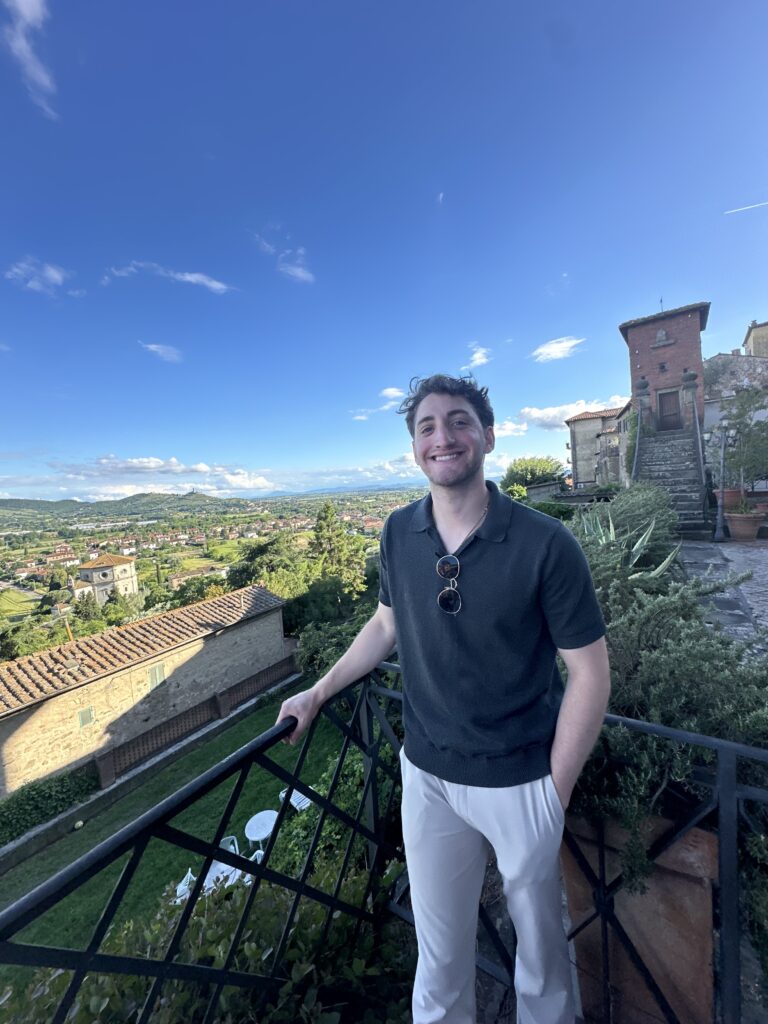
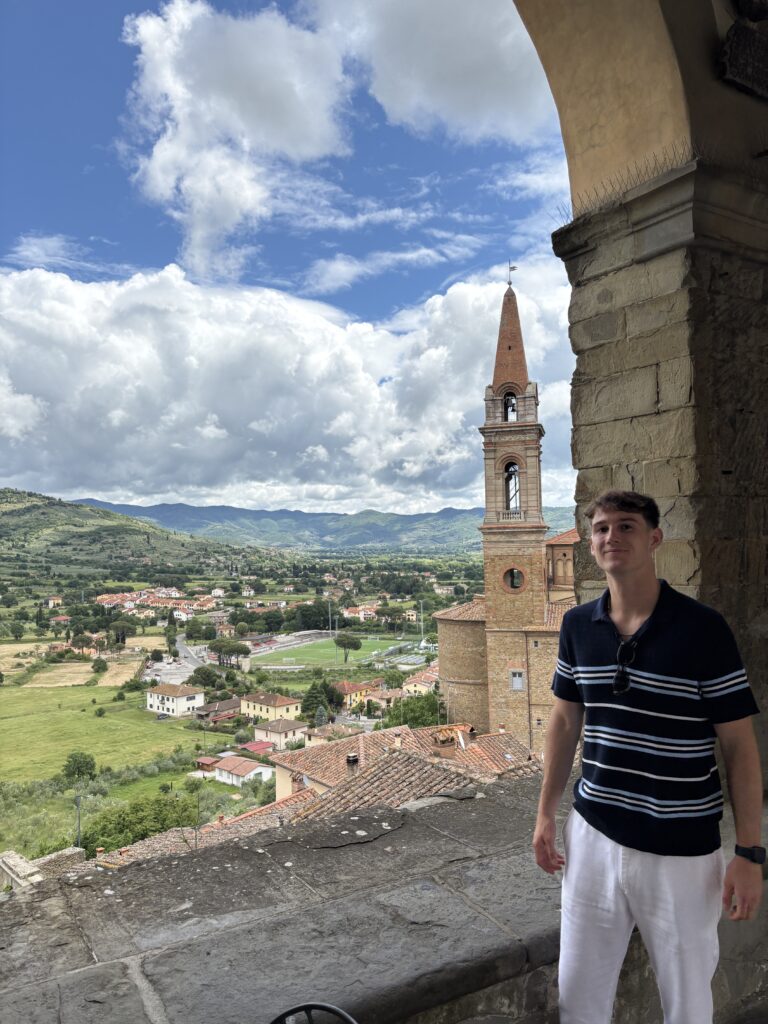
Anthony Pate during his study abroad internship in Italy.

What was the best part of the program? 

The best part of the program was to be able to experience a whole new culture while also gaining work experience. 

What was the most surprising thing about the county you visited? 

There were many more English speakers than I anticipated. I also was surprised how beautiful Tuscany was. 

Favorite memory? 

My favorite memory was visiting a restaurant recommended by my roommates’ parents. We had to jump through hurdles to get there, but it was the best steak I have ever eaten. Another fond memory from the internship was talking about soccer everyday with my colleagues. When they found out that I loved soccer they would speak to me about the games. 

Behind the Balance: Ray Cmil ’26 — Keydet Wrestling

Virginia Military Institute’s cadet-athletes have to juggle cadet life, heavy academic course loads, and their NCAA Division I sport. Committed to both academic and athletic pursuits, balancing their rigorous schedule in both sports and school requires a certain level of commitment and discipline. Behind the Balance is a series that focuses on those cadet-athletes and how they handle the hurdles of the day-to-day. 

Wrestling brought Ray Cmil ’26 to Virginia Military Institute, but it was the people that made him stay. He was drawn to the community and the relationships he started building at VMI and what that would mean for him later in life.

“After considering all the schools I was looking at, I decided VMI would be the best place for my future and to develop myself as a person,” he said. 

He’s made close friends at the Institute, especially his teammates. 

“We’ve spent so much time together, and it would be weird without them. We eat every meal together, practice together all day, and we’re hanging out in the room together,” he explained.  

The English major has a heavy load of 17 credits his last semester while being in season with wrestling. Most days he’s up at 5:30 a.m. for a morning weightlifting session before heading off to breakfast and class. He has about four classes a day, breaks for lunch and then heads down to practice an hour early to get some extra work in.  

“I don’t really write it down that much. It’s kind of just in my head — my day-to-day routine,” he said. “I think the easiest part for me is just taking the first step. Starting all my homework, or just doing whatever ever I need to do and not procrastinate.” 

Cadet-athletes at VMI not only have their responsibilities with their selected sport but cadet duties on top of that. Cadets are also required to take physical fitness classes twice a week, participate in ROTC all four years, prepare for room and uniform inspections, practice for parade, guard duty, and more.

“I’ve been forced to step out of my comfort zone a lot,” Cmil admitted. “With communication and leadership, just stepping up and forcing yourself to do things you don’t want to do. Especially this year, seeing all the 4th Class cadets coming in and trying to be a mentor for them. I had so many important older guys when I was coming up that I want to be a positive impact on the [incoming class].”

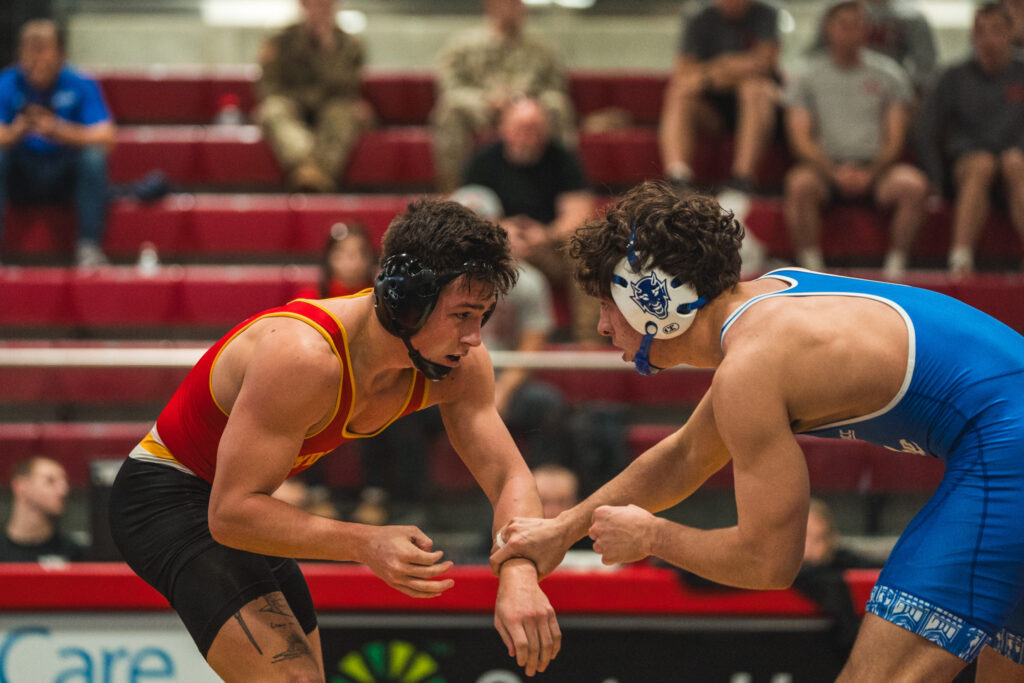
Ray Cmil during a wrestling match at Virginia Military Institute.
VMI Wrestling vs. Duke Action Shot

Cmil started wrestling in the third grade, but he grew up hearing stories from his father who wrestled. The thing he enjoys the most is that it’s one-on-one. 

“The work you put in is a direct representation of the output you get,” he stated. “If you put in the work and dedicate yourself to it, you’ll get results.” 

Being at VMI has forced him to crack down on his responsibilities and time management for his demanding schedule.  

“I think the fact that you have so many responsibilities, and there’s so much asked of you, you get used to it here,” he said. “From a broader perspective, you realize that other people haven’t done what you’ve been doing for the past four years. I think being in that mode and mindset, VMI builds prepares you for what’s to come.” 

The Vanguard —Sara Mihalovich ’26

The Vanguard series highlights cadets of Virginia Military Institute who exemplify promise, perseverance, and the true spirit of leadership. While they may not be the top-ranking students or those in prestigious positions, these individuals’ dedication, resilience, and growth embody the essence of being a VMI cadet. By sharing their stories, including the challenges they’ve faced and overcome, we shine a spotlight on the diverse paths to success at the Institute, proving that leadership and excellence come in many forms.  

A NARP is a common term around college campuses — a non-athletic regular person — and a way Sara Mihalovich ’26 describes herself, but she is far from ‘regular.’ Although she can be laid back, the 1st Class cadet at Virginia Military Institute is determined and excels at whatever she puts her mind to.

It’s something her professors and peers notice.

“Cadet Mihalovich stands out to me because she can really sustain long-term attention to research, learning, and writing, which of course produces superior work,” Col. Michelle Iten, professor in the Department of English, Rhetoric, and Humanistic Studies (ERHS), commented. “I also admire her authenticity. She does hard things, such as the half Ironman and writing powerful papers, but she feels no need to make sure everyone knows she is doing hard things. She walks the walk, as they say.”

From working at the library, participating in the literary journal Cadence, being the triathlon club cadet in charge to serving on the Rat Disciplinary Committee (RDC), Mihalovich has taken advantage of what VMI sets cadets up with — a foundation for achievement. 

“I was very quiet when I first got here. I was very uncomfortable in probably every single situation possible I was put in,” she admitted. “I think being uncomfortable in those situations has made me grow. Now you can put me in any situation, and I will do a lot better. I was able to be uncomfortable and it pushed me over the edge a little bit.” 

Col. Mary “Polly” Stewart Atwell, associate professor in the Department of ERHS, has taught Mihalovich in four different classes and said she’s distinguished herself in each one. 

“She’s actively engaged in class discussion, and though she’s generally a quiet person, it’s clear that her classmates respect her and listen when she talks,” Atwell explained. “She’s an incredibly talented writer, and won first prize in both the fiction and poetry categories in the Cadence journal’s Creative Arts Contest — something I’ve never seen before in 11 years at VMI. I always appreciate her intelligent, measured, and thoughtful participation in class.” 

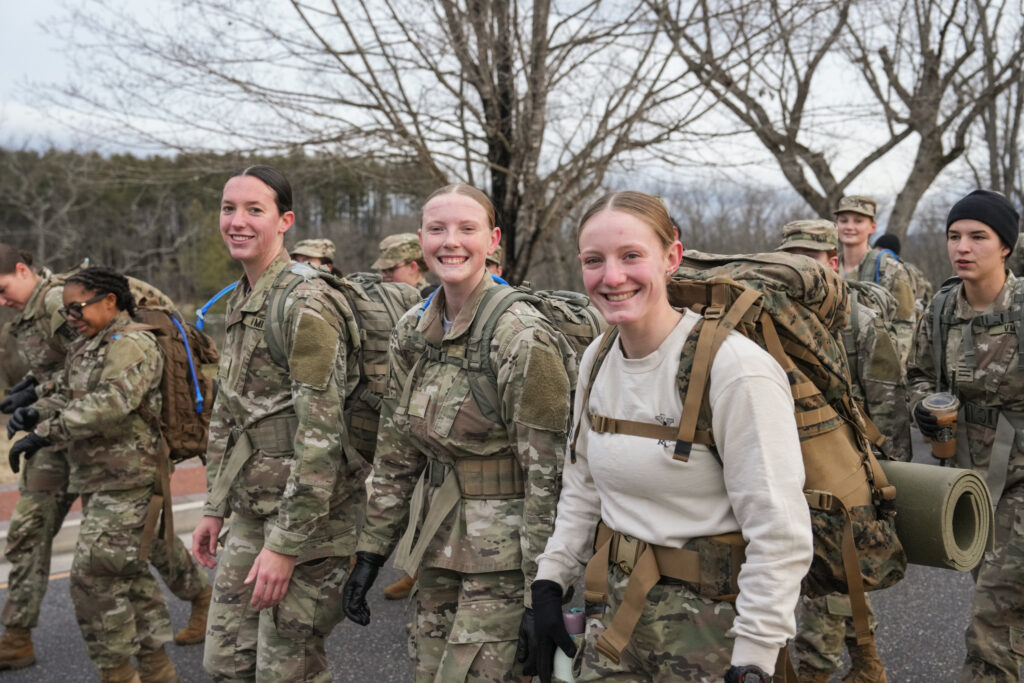
Cadet Sarah Mihalovich rucks with her brother rats at Virginia Military Institute.

Mihalovich puts herself out there. She’s more involved. 

“I was mostly a ghost my rat year and 3rd Class year. I didn’t really know what the school was all about yet. I had to figure my way through life a little bit,” she said.  

Taking a position with the RDC got her involved at a higher level. She was one of two female cadets chosen to take a spot. 

“I like how intense the RDC is. I wanted to be part of the Rat Line in some way my senior year. Then I could be part of the it when my rat is also going through it,” she explained. 

The experience allowed her to bond with her rat but also keep tabs on the upcoming class. She was able to get workouts in and stay active, too.

“I’m very physically active, so already that’s a big part of the RDC. We do a lot of physical activity with them, and I’d be able to keep up,” she said.  

Physical activity is a must for Mihalovich. She’s participated in triathlons since she was 8 years old. In the fall, she completed a half Ironman. That’s a 1.2 mile swim, 56 mile bike ride, and 13 mile run.  

Since Mihalovich knows structure thanks to VMI, her triathlon and half Ironman training regime was easy to come by. From spending hours on the bike, going from long runs, and taking time in the pool, she felt prepared to do her first half Ironman. She also fed off the energy of her fellow racers. 

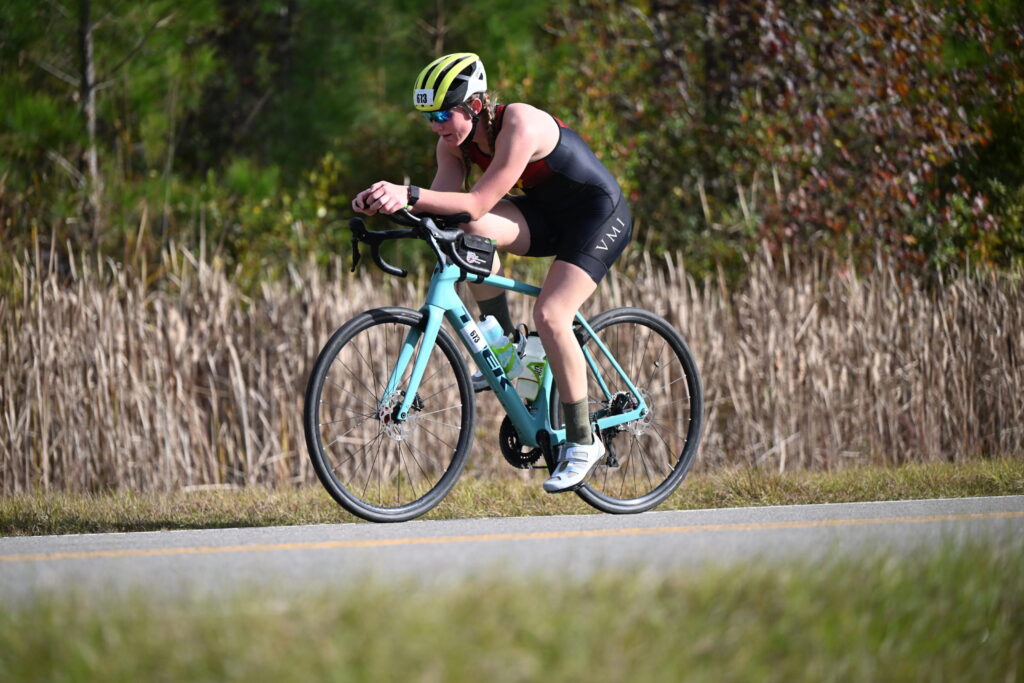
Cadet Sara Mihalovich rides a bike.
Md5: 9aaf5eec177b7c4acb545f8738a2213e

“Everybody really wanted to do it. It was a very cool environment to be in. Finishing was insane, because I enjoyed every single second,” she said. “The crowds were insane. You didn’t need music at all. You were just listening to everybody cheering for you. The finish line was obviously the loudest, through the big arch, and you feel like you’re going to collapse, but then other people are holding you up. It was an amazing experience.” 

Committed to schedule, Mihalovich likes to have all her daily tasks done by 10:30 p.m. 

“I like getting my sleep, so I try to do all my homework and everything during the day,” she said. “My day is very, very busy.” 

She’s thought ahead, too. Frontloading her class schedule in her first years at VMI has helped. In her last semester, she’s taking 14 credits.“I’m good in any high stress situation. Time management is a huge thing, too. Having 18 credit hours per semester was insane and then having triathlon stuff on top of that was just a crazy workload for an 18- to 20-year-old to have,” she stated.  

Mihalovich admits the academics have been challenging for her.  

“We take a lot more credit hours than most people, and we don’t have as much time to complete everything,” she said. “We have our inspections, we have our mandatory games, we have our ROTC time, we have PT [physical training], we have all that.” 

The English major is currently focusing a lot of her energy on her senior capstone project — a 12 to 15-page research paper focusing on French artist Fragonard, looking at his paintings and how he paints desire and love through a narrative. 

“She is willing to wrestle with her ideas and with uncertainty, to dig deep into her research, and to draft and revise many times. I really admire this trait as sustained focus is increasingly hard for all of us,” Iten continued. “Cadet Mihalovich’s capacity to remain engaged over a long process of research and writing shows great promise. I know she will take this intellectual endurance into planning and problem-solving in her service as an officer in the USMC.” 

Col. Steven Knepper, professor in the Department of ERHS, agreed that Mihalovich is skilled at bringing research and analysis together. 

“This is evident in her excellent senior capstone about the paintings of Jean-Honoré Fragonard,” he said. “She does impressive academic work, and she also helps her fellow cadets. She gives pointed but encouraging feedback in class discussions and in peer review.” 

She spent last semester doing the bulk of her research for her capstone, so she’s now in full research paper writing mode. The idea for her thesis was sparked from one painting that caught her eye early on — “The Swing.” 

“I built off what key aspects were in that painting,” she said. “I looked at some of his other paintings and how he portrayed similar themes within the other ones. It took off from there.” 

Mihalovich plans to attend Marine Corps Officer Candidate Course, with the intent to commission. It took several different other ventures into VMI’s ROTC branches for her to land on the Marines.  

“I like the structure of the Marine Corps, their morals and their mission,” she said. “I like how they’re smaller, more compact team.”  

I Am VMI: Julia Ward ’26 

What truly defines Virginia Military Institute are the people. Cadets, faculty, and staff, both past and present, are what make it “No Ordinary College.” I AM VMI will showcase the outstanding individuals who have accepted the challenges and embraced the spirit of VMI. Their perspectives provide authentic insights into life at the Institute and the value of this unique military college. 

I Am VMI: Julia Ward ’26 

  • VMI Class: 2026  
  • Major: Electrical & Computer Engineering  
  • Hometown: Frankfort, Illinois 
  • NCAA Sport: Water Polo  
  • Commissioning Plans: U.S. Navy – Hoping to service select Subs  
  • Other Clubs/Societies/Activities: VMI Pipes & Drums, Honor Court, Society Women’s Engineers (SWE) 

Julia Ward ’26 came to Virginia Military Institute uncertain of herself and her leadership abilities.  

“I wanted to challenge myself,” she said. “I knew I wanted to put myself in a better position as a newly commissioned officer. I figured there was no other place to take opportunities and learn to flourish. I liked the family aspect of VMI and the alumni connections that come from time spent at VMI.” 

Ward said there’s always something to do at VMI and she enjoys the busy pace. 

“Whether it is a sporting event, a debate, a dinner, a speaker, or simply just class work, it keeps you busy. I like to be active and VMI is the place for that,” she explained. “It isn’t always military either; there are plenty of clubs or activities to get engaged in the Corps.” 

She had the opportunities for engagement to help build her and others into a family, noting there’s always a group of supporters for each cadet— either with the staff, faculty, or other cadets.  

“Everyone wants you to succeed. This year strengthened that bond with a lot of people at school. I had a death of two very close people to me at the beginning of the semester that made me almost not come back for the semester. Having the support system I have here let me come back, get back on my feet, and keep leading for a deeper purpose,” she said. “I had a lot of responsibilities before leaving and I knew if I didn’t return, I would be letting a lot of people down, but I would also not be living for the two that I lost. I would not have come back if it was not for the support system of the commandant staff, my professors, and the people around me who lift me up every day.” 

VMI is rigorous, but rewarding, Ward explained. Each day brings a new set of challenges she can work through.  

“I think it has forced me to come out of my shell a lot. I have honestly fully transformed from the person I was three years ago sitting in a high school seat ready to graduate,” she said. “It is a surreal feeling to watch your dreams unfold in front of you. I have wanted to serve in the military for a while and having that dream come to life in the next year is still unreal to me, not to mention all of the experiences I have been able to have to travel, to lead, to put myself out there, and get hands on instruction is something I would not have had if I chose to go anywhere else. It’s very rare that you go to any other college and NCAA is just another thing you do because there are so many other opportunities like holding rank and cadet government that can bring experience to your time at a school.” 

“I think it has forced me to come out of my shell a lot. I have honestly fully transformed from the person I was three years ago sitting in a high school seat ready to graduate. It is a surreal feeling to watch your dreams unfold in front of you.”

The electrical and computer engineering major originally wanted to pursue mechanical engineering. When she first came to VMI, she was interested in a career in biomedical engineering after commissioning into the U.S. Navy. She saw that the electrical engineering department had more to offer in that background, so, she made a last-minute switch.  

“I have no further regrets, and I do not question my future success using a technical degree in the Navy or in industry based on the instruction I have been able to receive in the classroom,” she said. 

Julia Ward during Virginia Military Institute's 1st Class rank announcements.

Ward admits that VMI has made her a more confident person.  

“It puts you in positions that force you to make hard decisions in a low-risk situation so the time that it really matters we will know how to react or step up to the plate to lead because that’s just our nature now,” she commented. 

VMI has also prepared her for her future in the Navy. She’s been able to see that during summer training for Naval ROTC, but credits the confidence boost the Institute instills to be a big factor in her future successes.  

“I think it really is the confidence we exude from our decision-making abilities and the way we interact with teams of all different backgrounds. We already know what it feels like to get beat down and build ourselves back up again,” she said. “There is a lot of resilience that comes from going here and it allows graduates to bring creative solutions to the table and to work harder than everyone in the room because the thought of failure doesn’t scare us, we just pick ourselves back up and keep going.” 

Ward said it’s been easy to fit in at VMI — no matter what, you find your people. Overall, the pride she has gained being a VMI cadet has been the best experience.  

“How hard the average person works here is tenfold above every other school,” she described. “How eager to help and get involved people are here is something that doesn’t get spoken about enough at our school, how close we are to everyone.” 

Study Abroad Ambassadors: Edward Menton ’26

At Virginia Military Institute’s Office of Global Education, more than 10% of cadets each year choose an international learning experience. Through semester or summer programs, cadets not only widen their global perspectives — but build critical thinking, resilience, independence, and the ability to communicate across cultures. Learn more about these first-hand experiences through our Study Abroad Ambassadors.

Name: Edward Menton

Class: 2026 

Major: Economics and Business Major 

Which program did you do?

I first studied abroad in the spring semester of 2024 at the American University of Rome and then completed an internship this past summer in Castiglion Fiorentino, Tuscany, working with De’ Magi – Alchimia de’ Formaggi, an Italian cheese refiner. 

What made you decide to participate in this program?

I grew up in a small town, so I’ve always been drawn to the idea of traveling. I wanted to broaden my global perspective, experience life outside of the United States, and make meaningful memories along the way. Studying in Rome gave me the chance to learn international business and economics in a European setting, while my internship provided valuable hands-on experience working as a U.S. liaison for an artisan Italian company. 

Edward Menton during his study abroad program in Italy.

How did you balance this program with VMI’s unique educational approach? 

The values VMI teaches, such as discipline, time management, and professionalism, helped me in both settings. In Rome, they kept me focused as I adjusted to a different classroom style and culture. During my internship, these skills were most evident, enabling me to manage projects independently, meet deadlines, and effectively represent both myself and VMI in a cross-cultural business environment.

What were your keys to success?

Keys to my success were adaptability, time management, confidence, curiosity, and communication.  

How do you think participating in this program will aid you in your future? 

These experiences have given me international awareness, professional confidence, and practical skills in business and logistics. Now I understand better how cultural differences impact trade and business. This global experience will benefit me in my future career, first as I pursue a path in the U.S. Army, and later as I hope to move into international business or operations management. 

What was the best part of the program?

In Rome, it was living in a historic city and having the ability to travel to different countries with my best friends.  For the internship, it was working directly with Andrea Magi, the owner of the company, and seeing how passion and attention to detail can elevate a small business into an internationally recognized company. Also, Florentine steaks.  

What was the most surprising thing about the county you visited? 

How much Italian culture and tradition influence everyday life, from business practices to meals.  

Favorite memory? 

My favorite memory was getting the chance to visit the Vatican multiple times and experiencing Rome during Easter. It was unforgettable to be in the city at such a meaningful time. 

Behind the Balance: Sydney Smith ’26 — Keydet Water Polo

Virginia Military Institute’s cadet-athletes have to juggle cadet life, heavy academic course loads, and their NCAA Division I sport. Committed to both academic and athletic pursuits, balancing their rigorous schedule in both sports and school requires a certain level of commitment and discipline. Behind the Balance is a series that focuses on those cadet-athletes and how they handle the hurdles of the day-to-day. 

Sydney Smith ’26 had her sights set on attending the Air Force Academy after high school. Both of her parents were athletes there and she wanted to follow in their footsteps. One thing made her hesitate; Smith played water polo and there was no NCAA women’s water polo team at the academy. Instead, she forged her own path that led her to Virginia Military Institute.  

“I started to look at schools with ROTC programs where I could also play water polo. Coach [Danielle] Montenegro found me, and I came on my official visit, and I was like, this is it.”

Smith swam her entire life but picked up the sport of water polo because her father played. 

“I like the physicality. I like the aggression. It’s more interactive,” she explained. “I also like that it is a team sport. Swimming, it’s a team sport, but you’re still competing against your teammates for points. Whereas water polo, you can’t do it without each other. I like being on a team, it’s more fun.” 

The biology major will be commissioning into the United States Air Force come May when she graduates. From there, she will head to Pensacola, Florida, to be a combat systems officer at the Naval Navigation School in July. Her time at VMI has helped her prepare for her upcoming post.  

She is one of the three 1st Class cadets on the water polo team who holds rank. Her position as S6 lieutenant gives her firsthand experience with communications, standard operating procedures, radios, and writing — all things she will need to know in the Air Force.  

Holding a leadership position also embodies the four core values the water polo team has — support, pride, energy, and focus. Nearly everyone on the team holds rank. 

“We make it a point to support each other, even if it does get challenging,” she said. “We’ve created these four core values on our team, and we actually say each one of them when we’re doing our cool down at practice and before every lap.” 

The structure of VMI was appealing to Smith, as well as the option to commission. But the bonds she’s made with her brother rats and those on her team have really stood out. 

“We definitely have one of the best team dynamics, but I’m probably a little biased,” she admitted.  

She said it was kind of surreal to see what good friends everyone is on the team. It’s more like a family. They even established a rule that none of them would live together in barracks, just so they wouldn’t get sick of each other. 

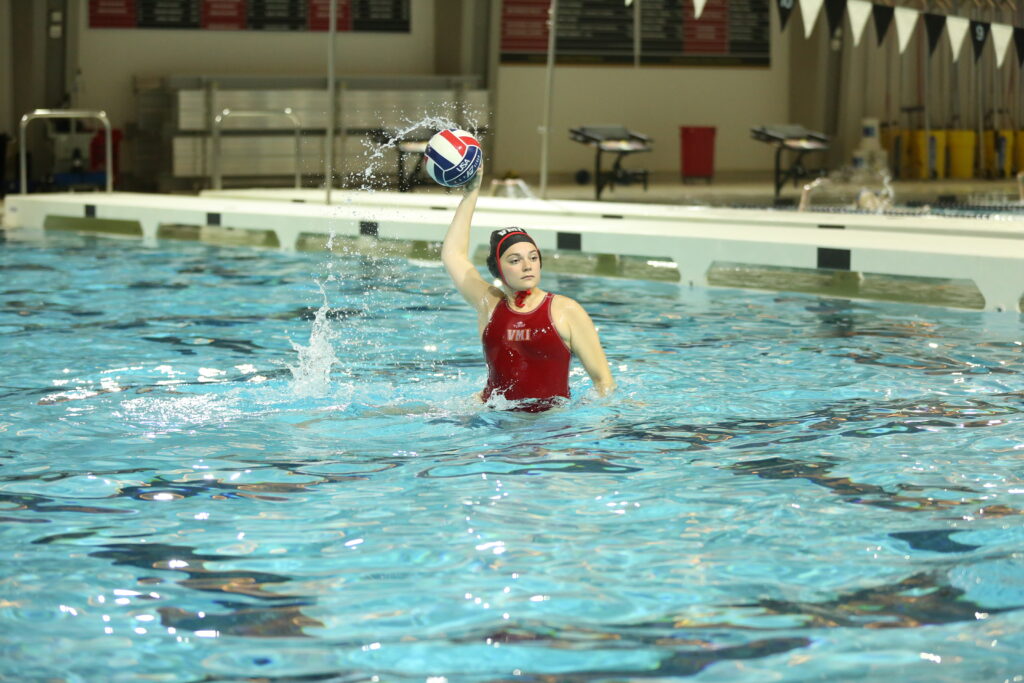
Sydney Smith in the pool playing water polo for Virginia Military Institute.

“It played out very well. None of us were in the same company, so we never lived together, but we’ve never had any issues,” she said. “Through our years here, we’ve told the 4th Class cadets that same thing: try not to live together. That can cause problems. And they’ve all made that a rule, too. And all of them are super close, too. We all hang out, and we do team dinners all the time, especially after practice in season. We make a point to all just go eat together and hang out all the time. A few of us are all the same majors. We have class together.” 

She said those on the team strive to be overachievers. From holding rank to other activities, Smith has a booked schedule.  

Cadet-athletes at VMI not only have their responsibilities with their selected sport but cadet duties on top of that. Cadets are also required to take physical fitness classes twice a week, participate in ROTC all four years, prepare for room and uniform inspections, practice for parade, guard duty, and more. 

Growing up, Smith and her sister, who is at the Naval Academy, were always told they needed to have diverse activities.  

“We’ve both been told you’re going to do other things. You are each going to play a sport, and you are going to play an instrument, and you’re also going to find a leadership role,” she said. 

Smith is also on the Glee Club, while spending two to three hours in the pool a day. That doesn’t include early morning practices or weightlifting. She’s thought ahead though, by taking summer classes every year she’s been here to lighten her academic load while she’s in season. Hence, her last semester is 13.5 credits.  

In order to keep everything straight, Smith has a large calendar she keeps in her room that’s color coded with all her activities and assignments. She said that VMI has prepared her in terms of how to handle a busy schedule. 

“Everything that I’ve had to do and manage with stress, school, and water polo, I’ve kind of compartmentalized all of it,” she said. “I think it has been the most beneficial thing. If I can handle being this busy, I can handle anything.” 

Breakout and Brotherhood – VMI 1st Class President Reflects

Breakout marks one of the most defining moments of the Rat Line, symbolizing both the culmination of challenging months and the beginning of a cadet’s life in the Corps. Behind the scenes, its success depends on deliberate leadership, careful planning, and a shared commitment from upperclass cadets to uphold tradition while supporting the Rat Mass. In this Q&A, the 1st Class President Maximus Ankrah ‘26 reflects on the responsibility of guiding rats through the Rat Line, the priorities behind planning Breakout, and the pride that comes with welcoming the newest cadets into the Corps.

Q: There are a lot of moving pieces and responsibilities placed on leadership within the Corps during the Rat Line and on the day itself. How would you define what is expected of upperclass cadets to support these traditions?

Ankrah: For the upperclassmen, their role is to ensure the Rat Line is as challenging and up to standard as possible. Correcting rats, encouraging them, and pushing them to their max potential is their obligation. If we’re not doing that as upperclassmen, we’re doing the rats a disservice. That goes for Breakout too; the culmination of hard work throughout the months deserves to be celebrated not just alongside rat’s brother rats, but also the Corps. It takes a village to develop the next generation of new cadets.

Q: As 1st Class President and General Committee president, what were your top priorities for a successful Breakout?

Ankrah: As my team and I were narrowing down Breakout dates, we had to weigh the priorities of choosing a weekend or maximizing the amount of personnel that would be attending Breakout. This was a difficult dilemma at the time of deciding, as we wanted Breakout on a Saturday rather than a weekday  — as it was in years past. It was important to ensure that everyone had at least the opportunity to participate in this important event.

I was asked this hypothetical question: When the rats one day have their 5, 10, 50-year reunions, will they be able to share this sacred memory together or only most of them? At the end of the day, Breakout isn’t what defines the Rat Line; it’s one’s brother rats. We wanted to ensure that the mass can all share the memory of Breakout and ensure the BR spirit doesn’t end at the Rat Line but only marks the beginning of other joyous memories.

Q: You had some powerful words of wisdom for the Rat Mass following their Fakeout: “Success breeds complacency. Complacency breeds failure.” How do you think VMI helps develop and nurture that drive to keep pushing and keep succeeding?

Ankrah: There is a quote I’ve heard that applies to VMI: “We are what we repeatedly do. Therefore, excellence isn’t an action but a habit.” Everyone goes through personal trials and tribulations, but it’s important to keep pushing. Nothing great in life ever came without facing adversity. You must overcome obstacles continuously and that’s exactly what VMI provides. It’s going through those tough times that build character and overcoming adversity that keeps you resilient.

Q: How would you describe the atmosphere in Barracks during that first Old Yell?

Ankrah: It’s an extremely rewarding feeling. To put in many hours, days, and weeks into such a big event and have it come out flawlessly was amazing to see. I love my position as class president because I get to be part of such important moments. Besides Ring Figure and graduation, Breakout is one of the moments that everyone cherishes during one’s cadetship, and it was humbling to be part of that.

Q: What emotions were you feeling as you stood and looked out over the latest rats to become cadets?

Ankrah: Immense pride. To be the one to initiate a class’s first Old Yell, where more than 400 rats yell their class number and pump their fists in the air, together; in perfect synchronization — you can’t describe that feeling. I’m extremely honored to have led such fine men and women who’ve come from all different walks of life. I’m proud of them. 

They’ve accomplished something so big. To enter VMI is one thing, but to have earned Breakout is another. Proud of these rats, now cadets, and I look forward to seeing them grow.

Q: Looking back at the Class of 2029’s Breakout and your own Breakout, how do you think it encapsulates the VMI experience and the tradition of shared suffering?

Ankrah: Breakout is just the beginning of one’s cadetship, but it’s the Rat Line that proves you can overcome anything during your cadetship. VMI is what it is because of the people. The people are what make it worth coming back, and it’s the people that you must lean on, specifically one’s Brother Rats, to excel at VMI — this is what The Rat Line and Breakout symbolize. There can be no brotherhood without shared suffering, and the new cadets now understand what this means.