Post View Unavailable »
New Website Launched »

I Am VMI: Devin Auzenne ’26 

What truly defines Virginia Military Institute are the people. Cadets, faculty, and staff, both past and present, are what make it “No Ordinary College.” I Am VMI will showcase the outstanding individuals who have accepted the challenges and embraced the spirit of VMI. Their perspectives provide authentic insights into life at the Institute and the value of this unique military college. 

I Am VMI: Devin Auzenne ’26 

  • Name: Devin Auzenne  
  • VMI Class: 2026  
  • Major(s) (and minor if applicable): History, with a concentration in military history   
  • Hometown: Opelousas, Louisiana   
  • NCAA and/or Club Sports: Boxing (4th and 3rd Class years), aviation club (2nd Class year), and Jiu-Jitsu club  
  • Post-Graduation Plans: Commission, U.S. Marine Corps 
  • Other Clubs/Societies/Activities: Member of the Virginia History Society and Omicron Delta Kappa   

Devin Auzenne ’26 knew the ethics and maturity needed for the U.S. Marine Corps would best be fostered in a place like Virginia Military Institute. He also knew by attending the Institute, he would be prepared to lead in the Marine Corps. 

After watching a YouTube video by VMI labeled “Don’t Do Ordinary,” he instantly knew this was the college he wanted to attend. 

“I chose VMI because I wanted something different. I didn’t want to do the regular college thing,” he explained. 

Going into his senior year of high school, he received a Marine Corps scholarship, which solidified his decision. He said he was looking for the right avenue to make him the best when it came time to commission after graduating.  

Auzenne has always had a deep appreciation for history. Thanks to an influential high school teacher, his eyes were opened to the analytical and argumentative sides of the subject, which spurred him to study it further. VMI’s deep history and historical site, along with an incredible faculty, pushed him to be a history major.  

“I really love history, and I know the program that we have here is really good, especially with getting a minor in military history,” he said. “I wanted to delve deeper into that. When I go into the Marine Corps, I’ll have this knowledge of history, and with a deeper understanding of military history and it can really help me in my career.” 

He says the people he’s encountered at VMI are truly exceptional.  

“I also enjoy how unique each year’s challenges are. Overall, the ability to always have someone here to have your back is very special,” he explained.  

The experiences at VMI have helped him gain intangible skills he believes he couldn’t have thoroughly developed in any other environment.  

“Skills such as patience, time management, grit, and flexibility have allowed me to find ways to succeed in foreign environments,” he said. “My experience at VMI is adversity that is ever changing, opportunities that are once in a lifetime, bonds that can never break, and a great place to be from but not at.”    

His experience at VMI has also made him more self-aware. He’s able to understand who he is when under pressure or stress, and how to balance everything while still progressing forward.  

“Skills such as patience, time management, grit, and flexibility have allowed me to find ways to succeed in foreign environments. My experience at VMI is adversity that is ever changing, opportunities that are once in a lifetime, bonds that can never break, and a great place to be from but not at.”    

“It’s helped me to understand how to take these experiences, try and do the best in the moment, and then reflect upon them, so that the next time something comes around, I’ll be better for it,” he stated. “It’s building this flexibility and this resilience in me that I don’t think I could have received at any other college. Being resilient and also being able to think and make decisions on the fly is something I think is invaluable in the context of the military system.” 

These qualities will transfer to anything he chooses to do later in life.  

“My time at VMI will translate into me being more certain of who I am as a leader and a man,” he said. “When I graduate and commission into the Marine Corps, I am certain that because of my time at VMI, I will have an advantage compared to my peers.” 
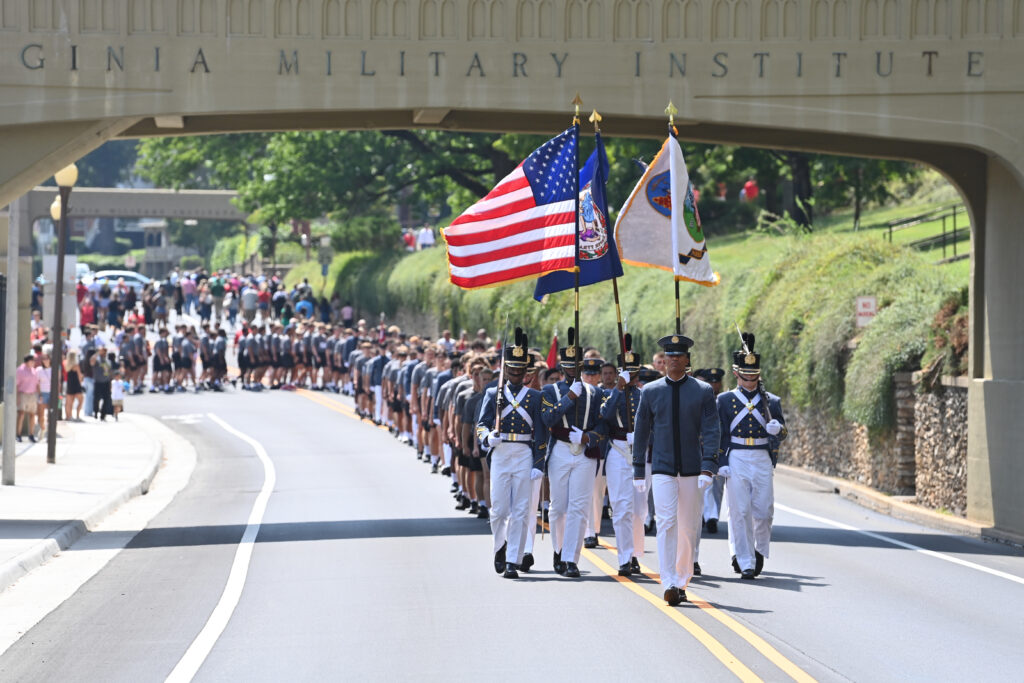
Devin Auzenne leads the Corps of Cadets in Lexington during Matriculation at Virginia Military Institute.

Auzenne wants those outside the VMI world to know that the Institute is not just a school, but a community and a culture.  

The end result of the VMI system is forged through the rigors of the regimental, class, and honor systems, but the extraordinary people are the defining factor that sets VMI apart,” he stated. “The illustrious history of VMI cadets and alumni, and, despite the differences in the times, the common experience we all share makes me proud to say that I am a VMI cadet.” 

Study Abroad Ambassadors: Ryan Getgood ’26

At Virginia Military Institute’s Office of Global Education, more than 10% of cadets each year choose an international learning experience. Through semester or summer programs, cadets not only widen their global perspectives — but build critical thinking, resilience, independence, and the ability to communicate across cultures. Learn more about these first-hand experiences through our Study Abroad Ambassadors.

Name: Ryan Getgood 

Class: 2026 

Major: International Studies with a Chinese minor 

Which program did you do? 

I did the Huayu BEST program, which allowed me to study at National Chengchi University in Taipei, Taiwan. 

What made you decide to participate in this program? 

I decided to participate in this program because I really wanted to learn more Chinese and practice in an active environment. I also thought teaching English to kids would be fun and a valuable experience to prepare me for teaching abroad after graduation. Plus, the scholarship covered most of my expenses. 

How did you balance this program with VMI’s unique educational approach?  

VMI’s educational approach is pretty strict; cadets are expected to balance athletic, academic, and military commitments. While in Taiwan I had academic commitments, but still worked out and found ways to participate in athletics, like during the dragon boat racing event. Instead of military commitments, I chose to dedicate time to exploring local cultural sites. In short, I still modeled my commitments after VMI’s unique three-legged stool approach. 

What were your keys to success?

My key to academic success was dedicating an appropriate amount to study writing, speaking, and listening. My key to overall language success was fully immersing myself in Taiwan’s environment, speaking Chinese (even if it was bad) instead of English whenever possible. 

The Taiwan wetlands from Ryan Getgood's study abroad trip to Taipei.

How do you think participating in this program will aid you in your future? 

I think my participation in language exchange with Taiwanese elementary school students will make me more competitive when applying to teach English abroad after graduation. The challenges I faced while adjusting to life abroad have given me more resilience, a calm composure, and a genuine passion for adventure. I believe interacting with Taiwanese people of all ages has exposed me to new perspectives and worldviews, which has improved my critical thinking and decision-making ability. 

What was the best part of the program? 

The best part of this program in particular was the freedom that came with it. I got to explore places I was interested in within Taiwan and was also allowed to leave the country to visit South Korea and Japan. 

What was the most surprising thing about the county you visited? 

The most surprising thing about Taiwan was how easy it was to travel. I could take the mass rapid transit or bus 45 minutes to the heart of the city which was filled with impressive skyscrapers that lit up at night. I could take the high-speed rail to the south; I went to Taizhong where I visited Sun Li-jen’s Class of 1927 (a famous Chinese VMI alumnus) family home. 

Favorite memory? 

Times meeting up with my BRs while abroad became my favorite memories. I met up with Chen Po-Yen ’26 to visit Sun Li-Jen’s house and the GaoMei wetlands, met up with Benjamin Shyu ’26 to explore Xinyi in Taipei, and met up with Zebadiah Barrett ’26 to hike Mount Fuji in Japan. 

The Vanguard — Nat Lavender ’26

The Vanguard series highlights cadets of Virginia Military Institute who exemplify promise, perseverance, and the true spirit of leadership. While they may not be the top-ranking students or those in prestigious positions, these individuals’ dedication, resilience, and growth embody the essence of being a VMI cadet. By sharing their stories, including the challenges they’ve faced and overcome, we shine a spotlight on the diverse paths to success at the Institute, proving that leadership and excellence come in many forms.   

Nat Lavender ’26 was sitting in class one day on her sixth page of notes when her hand started to cramp. She only had one thought — she was miserable as an economics and business major.  

“I thought to myself, I could do this, but do I really want to be miserable for the next three years?” she questioned. “I switched my major, and I went to English. It was always my favorite subject and I’d missed it my rat year since I tested out.” 

The switch created a fire in her. She became so passionate about her major and studies.

“I’m very humanities brained. The creativity and the complexity of connotations and literature and how words shape reality is so fascinating to me, especially because words are such a reflection of ourselves,” she said. “You read someone’s writing, you’re sharing their mind for a few minutes. I think it’s fascinating and beautiful. I think books are by far the most versatile form of entertainment of learning, because you could read the same book five different ways, depending on the layers of symbolism, you can’t do that with anything else.” 

The way Lavender speaks about writing and reading, anyone can see her dedication and desire for it. She explained that the ability to read a book in a completely different way than the person sitting next to her, just due to personal experience, is so intriguing to her.  

“We’re all just sharing and having a silent conversation,” she stated.  

Although Lavender doesn’t hold rank, she’s held a bevy of different jobs on post. For two years she worked as a history group study session facilitator. Most recently, she’s been working as the cadet in charge for the Daniel’s Library. She also works at the Writing Center, where she serves as a consultant for her peers.  

“I love that job,” she said of the Writing Center gig. “I’m not a very extroverted person, but I like to pick a couple things I’m passionate about and really commit.” 

In addition to being an exceptional student, she has also been an outstanding athlete, competing on VMI’s NCAA Division 1 Cross-Country and Track teams, lettering in all seven seasons. 

A self-proclaimed nerd, she finds solace in studying. 

“I enjoy locking myself away and reading and studying. Nobody’s really with me on that, which is understandable,” she said.  

She’s currently working on her thesis, which focuses on post-World War I Avant-garde art movements of Dadaism and Surrealism in their modern context and conversations and seeing if she can recreate that — if possible. Lavender’s goal is to see if the arts can be limited to a time period in its historical context or not.  

Nat Lavender with her brother rats at Virginia Military Institute outside barracks.

Col. Catharine Ingersoll, professor in the Department of English, Rhetoric, and Humanistic Studies, said Lavender is a bright student who is disciplined and intensely curious.  

“If I have a stack of tests or papers to grade, I save hers to do last — like a dessert — because she always does such an excellent job on assignments,” she admitted. 

Ingersoll has seen this in the cadet’s work on her honors thesis and explained her project shows great promise and combines her enthusiasm for art history and studio art. Ingersoll went on to say that Lavender comes in for their meetings with innovative ideas that reveal how thoroughly she’s been thinking of how to convey the theme of her thesis. 

“Cadet Lavender always manages to fulfill her responsibilities to a high level of finish, even when she is feeling stressed or when she has a lot on her plate  — and even during times when she, herself, seems unconvinced that she can get everything done,” Ingersoll said. “She never lets things get away from her, even in the midst of the chaos of day-to-day life at VMI.” 

Lavender had not always been so committed to school, she admits. 

“I was not a good student in high school at all. I showed up 30 minutes late to class and sat in the back,” she said. “I mean, I did decent on my work, but I’d help my friends with their essays and turn mine in two days late. I was never that worried about it. It was kind of a shock coming here. 

Nat Lavender with her family during family day at Virginia Military Institute.

She said being diagnosed with ADHD at the age of 18 helped her realize the gaps in how she was able to study and figured out how her brain operated.  

Coming to VMI has allowed her to grow and discover herself.  

“I really thought I knew who I was in high school. I think most people do, and college is a place to grow from the bubble you’ve grown up in,” Lavender explained. “Here it’s just the absolute lack of anything that precedes your actual actions, words, and personality. It forces you to know who you are without the clothes or the car and those kinds of materialistic things. Without the materials, you have to look in the mirror. I’d say I’m much more aware and much better for it. I think the stress of this place really illuminates your flaws, and you’ve got to be like, okay, I can’t ignore this anymore.” 

At times she has found VMI to be lonely, but with being on the track team and the friendships she’s made with her roommates and through her major, she’s been able to surround herself with a close group. 

“I think my roommates are such a blessing. I love them so much. I’ve made so many connections here. I think the biggest thing is just knowing that even when you’re feeling lonely, it doesn’t mean you’re alone,” she said. 

She’s set to graduate early this December with Institute Honors; a B.A. in English; a minor in French; and concentrations in literary studies, philosophy, rhetoric and writing, and art history and visual culture. The need to be constantly moving pushed her to add extra classes to her schedule with the intent to drop them. Except, she never dropped them. She’s currently applying to graduate programs — most notably to be a Rhodes Scholar.  

Col. Emily Miller, professor of English and head of the Department of English, Rhetoric, and Humanistic Studies, describes Lavender as an outstanding student with a broad range of academic interests.  

“She has a remarkable amount of intellectual curiosity, which is evident in all of her endeavors,” Miller said. “For example, last November she presented a paper that she wrote in my honors seminar on Shakespeare at a professional conference (the South Atlantic Modern Language Association Conference), and she revised it multiple times, thoughtfully working over each sentence until it captured her exact meaning. She did a superb job of presenting the paper and answering questions from the audience. Similarly, in class she always offered meaningful observations and questions about Shakespeare’s plays.” 

Miller said Lavender’s work ethic seems to arise very naturally from intellectual curiosity.  

“She is humble, thoughtful, and generous, always ready to help her fellow cadets however she can. With her excellent performance in all of the areas I have mentioned, she is a very strong candidate for a Rhodes Scholarship.” 

The Vanguard — Matthew Atienza ’26

The Vanguard series highlights cadets of Virginia Military Institute who exemplify promise, perseverance, and the true spirit of leadership. While they may not be the top-ranking students or those in prestigious positions, these individuals’ dedication, resilience, and growth embody the essence of being a VMI cadet. By sharing their stories, including the challenges they’ve faced and overcome, we shine a spotlight on the diverse paths to success at the Institute, proving that leadership and excellence come in many forms.  

Coming to Virginia Military Institute wasn’t an easy adjustment for Matthew Atienza ’26. He was across the country, in an unfamiliar place, and unsure of it all.  

His original intent was to commission into the Air Force and be an international studies major. But that shifted when Atienza realized he wanted to be a teacher. It took one class during the Summer Transition Program (STP) to win him over and switch to be an English major.

“I loved what we learned. I loved learning about rhetoric in that class,” he explained. “And as I was going through the international studies major, I realized I didn’t really enjoy what I was doing I looked back through my post view, I have an A in every single English class I’ve ever taken. So why not do something I’m not only good at, but passionate about?” 

He was inspired by George Abry, instructor in the Department of English, Rhetoric, and Humanistic Studies, during that STP session. He credits Abry to his switch from international studies to English. Abry said Atienza has a quiet confidence about him, without the need for fanfare or recognition. 

“One thing I remember most about Matthew was the work he put into his essays,” Abry said. “If I recall, at times he struggled with his own writing structurally and at the sentence level, which means he worked hard to improve through conferencing, peer review, and revision. Ultimately, I think his own struggles with writing will make him a stronger teacher.” 

Atienza is the type of person to get things done early. He wants to finish a task the moment it’s assigned.  

“As a student, I always try to get on top of everything as quickly as I possibly can,” he said.  

He feels like he’s evolved, not only as a student, but also as a cadet.  

“I came here when I was 17 years old, skinny, unathletic, pretty lazy, grades were terrible, but I had a lot of good people behind me who supported me,” he admitted. “I think as a rat or as a 4th classman, I didn’t feel like I deserved to be a cadet.” 

Instead of having doubts overtake him, he was able to pick himself up and take control of his own life. By transferring out of Air Force ROTC and changing his major, he made huge life decisions. 

Matthew Atienza with his brother rats at Virginia Military Institute in barracks.

“I really put my career in my own hands. I’m on the Dean’s List now,” he said. “I think as a cadet, I have been very resilient. I faced a lot of hardships here. I am from across the country, so it’s lots of financial challenges and managing relationships from so far away.” 

It took some time, but Atienza can now reflect on his journey of becoming physically and mentally stronger. He remembers from his time on the Rat Line they were learning a drill maneuver called inspection arms, where they’d have to pull the bolt back on a rifle.  

“During that time, I was super weak, and I couldn’t do it. I was one of the only people that couldn’t do it,” he explained. “I remember my first sergeant at the end of training was like, ‘you either need to cut your bolt so it’s easier or get stronger.’” 

Atienza said for about two to three weeks, he practiced. He got stronger. And made sure it was perfect.  

“I remember one day we were supposed to drill outside, but it started raining, and we just did inspection arms for an hour straight, and I executed it perfectly every single time without messing up,” he stated. “I didn’t get any acknowledgement from it, but I was really proud of myself in that moment. And whenever I think I can’t do something, or I’m not as strong enough, or I don’t have the willpower to do this. I remember back when I was only 17 years old here. It seems so small, but it’s very significant.” 

He also had to learn how to live far away from his family. Originally from California’s Bay Area, he said it was a bit of a culture shock when he came to Lexington.  

“I lived in a place with different beliefs, different ideologies, and I guess more diverse,” he said. “I had a really rough time.” 

During his rat year, he said everything kind of fell apart. Two of his neighbors in barracks, who were some of his closest friends, ended up leaving VMI. Plus, all his roommates he had his rat year all left the school. 

“I was the only person left,” he said.  

The one thing that helped was getting rank — he served as part of the color guard. He said it allowed him to connect with more people. 

He also had some humbling moments at VMI. From what was easy in high school for him was shockingly challenging at the Institute.  

“There are levels to education that I was not aware of, and I struggled greatly my rat year to 3rd Class year. My GPA was below 2.5, my grades were bad. But I learned how to not procrastinate. I taught myself how to study. I think most importantly, I taught myself how to ask for help. That’s something I never did. It’s something that I was always scared to do.” 

Last summer, Atienza worked at Breakthrough Silicon Valley, a nonprofit focused on education equity. There he taught students from lower-income homes and immigrant backgrounds to close the education gap.  

Matthew Atienza with his brother rats at Virginia Military Institute.

“I was a 9th grade teacher and taught two English classes and one public speaking class,” he explained. “Working hands-on with my students opened my eyes to bigger issues in marginalized communities and gave me a new sense of duty. Working at Breakthrough has inspired me to not only continue a career in education, but to also be an active member in my community as an advocate for education equity.” 

At the end of his internship, he received the Americorps Segal Education Award, a scholarship of about $1,500. 

Col. Emily Miller, Professor of English and English, Rhetoric, and Humanistic Studies department head, described Atienza as a conscientious, thoughtful, and reflective student. She said he contributes to class discussion with excellent comments and questions. His writing is strong. Miller cites that his essays explore works of literature in their cultural context. 

“He brings an intellectual curiosity to his classes that makes him a pleasure to have in class. He has a strong commitment to education and a passion to serve others,” she said. “He is an attentive listener, reflective reader, and a mature and independent thinker. He is humble but confident. He also has a great sense of humor.” 

As a 1st Class cadet, Atienza’s advice is to not be afraid of asking for help — or asking anything in general. 

“Don’t be afraid to reach out, in the sense of asking help from your professors. Or reaching out to your brother rat that lives next door to become friends,” he said.  

Behind the Balance: Ben Hagerich ’26 — Keydet Cross Country

Virginia Military Institute’s cadet-athletes have to juggle cadet life, heavy academic course loads, and their NCAA Division I sport. Committed to both academic and athletic pursuits, balancing their rigorous schedule in both sports and school requires a certain level of commitment and discipline. Behind the Balance is a series that focuses on those cadet-athletes and how they handle the hurdles of the day-to-day. 

Prestigious people attend Virginia Military Institute, claims Ben Hagerich ’26 — and he was determined to be one of them. That drive, along with the chance to run cross country and track, drew him to the Institute. 

After being offered a scholarship, the computer science major attended an official visit and got to stay in barracks. He said it was an exciting night and got to see a lot of the inner workings of VMI. 

Although coming in as a rat, he said his biggest critic was himself. He wasn’t hitting the times he thought he would while running. He said it was challenging, physically and mentally.  

“As a rat I was, I was probably pretty scared to do a lot of things, whereas now there’s like no cowardice behind anything,” Hagerich admitted. “I would beat myself up a lot as a rat because I wasn’t performing the way I wanted to. It’s hard to expect yourself to do good. Something that’s changed is how I look at performance going to VMI. I’m going have to go through some tough stuff, so you have to be able to balance that with also being able to be an athlete.” 

Cadet-athletes at VMI not only have their responsibilities with their selected sport but cadet duties on top of that. Cadets are also required to take physical fitness classes twice a week, participate in ROTC all four years, prepare for room and uniform inspections, practice for parade, guard duty, and more. 

On top of his responsibilities with athletics, he is also the cadet in charge for the VMI Programming Club and a cyber captain.  

“The number one thing for me when it comes to balancing all that is probably that I’m passionate about all of them, so I really enjoy them,” he explained. “It allows me to sort of cultivate my own schedule. I love doing all these things. I know programming club is always on Wednesday, so I’ll know I’ll be able to lead that and create a lesson for that. While also knowing I’ve got to perform in track or cross country over the weekend. I know I need to eat right on top of that. I take things one step at a time.” 

As a mid-distance runner, he’s averaging about 35-40 miles a week. He got into running at the age of 8. He and his twin brother played baseball. While his twin stayed with baseball, Hagerich found more joy in running the bases. 

Ben Hagerich running at a cross country meet for Virginia Military Institute.

“I think your teammates make it everything. It’s so much fun. Then the competitiveness … I love the feeling of crossing that line first and scoring points for my team. It makes it so much fun competing against the best people, and being able to say that you gave 100% in a race that lasts for cross country about 25 minutes, and on the track upwards of two minutes … it’s pretty crazy how all that is all tied together,” he said. “Giving your all every single time you step out there and you get one shot at it.” 

He runs by leading by example for his teammates. He tends to be one of the stronger runners on the team, so he hopes he’s able to push others.  

“I always think that everyone behind me … if I can be a good example for everyone ahead of me then I know my teammates behind me are going to be encouraged to either try to keep up with me, or know that if I’m pushing strong, then they can do it as well,” he said.  

Although his days are long and he has a lot of responsibilities, he’s about to juggle it all knowing he has a strong support system around him. He also tends to go with the flow and not let the stresses of the everyday get to him.  

“In high school over four years, I barely knew the other events. I barely knew the sprinters, the jumpers, hurdlers or the throwers,” he admitted. “When I was a rat, in the first four months, I knew basically everyone on the team, and everyone was buddy-buddy. I’d never seen something like that before. Seeing us all at the event groups, we were always rooting for each other. It was so cool to see that everyone was like an actual team and helping each other out. And whether that’s a college thing or a VMI thing, I’m not sure, but I love it.” 

His hope after VMI is to secure a cybersecurity analyst role or go into network engineering with possibly the Department of Defense or another company that branches off the government. He is set to graduate in May.  

Behind the Balance: Cadee Hegarty ’26 — Keydet Women’s Soccer

Virginia Military Institute’s cadet-athletes have to juggle cadet life, heavy academic course loads, and their NCAA Division I sport. Committed to both academic and athletic pursuits, balancing their rigorous schedule in both sports and school requires a certain level of commitment and discipline. Behind the Balance is a series that focuses on those cadet-athletes and how they handle the hurdles of the day-to-day. 

Cadee Hegarty ’26 wanted to compete at a high level but also was drawn to the organization and discipline that Virginia Military Institute offered. Getting a soccer scholarship to the school allowed her to form a future at VMI.  

Her recruitment was a little different since it was when the coronavirus pandemic was limiting how sports were played. Instead, she attended a soccer camp, which was hosted by former women’s soccer coach Chris Haught-Thompson. From there, all it took was a visit to VMI. 

“I always wanted a team that had girls that were so close and had a bond that wasn’t like anything else,” she explained. “At VMI, it’s something else no one will understand except the people who go here. I was drawn to the school because of them.” 

The biology major is now in her last year and serving as the S9 captain, which includes preparing for pep rallies, company athletics activities, and creating permits. S9 is primarily made up of athletes, so cadets involved must pick up the slack when those on the staff are in season. As the S9 captain, she’s fully responsible for NCAA athletes, especially the rats — moving them around, making sure they’re able to do practice, but also participate in the Rat Line.  

“When it’s S9 time, it’s S9 time, and100% of my energy goes into that,” she said. “But when I’m at practice, or when we’re traveling, or when it’s game day, 100% goes to game day. Then schoolwork or in class, I’m fully dedicated to school. If I have free time during the day before soccer starts, I try to always get my work done early, because getting behind really catches up to you.” 

She was drawn to holding leadership in S9 because of her love of sports.  

“Being an athlete at this school is very different, and one of the biggest reasons of why I wanted this position was to show athletes that we can do it too, and we are just as part of the school as everybody else,” she commented. “Also to show everybody else that athletes can do it too, and I can do the same things that you guys can do. I have kind of one foot in both doors — athlete and non-athlete, with both my responsibilities, showing people there is a balance, it can happen, and everyone’s allowed to do everything.” 

Although she’s taking a lighter load, she’s previously been pulling nearly 19 credit hours per semester.  

“I try to take summer classes too, to kind of make up because in the fall we travel so much and we miss so much school, you can’t afford to get behind,” she said.  

Cadet-athletes at VMI not only have their responsibilities with their selected sport but cadet duties on top of that. Cadets are also required to take physical fitness classes twice a week, participate in ROTC all four years, prepare for room and uniform inspections, practice for parade, guard duty, and more.

Cadee Hegarty kicking a soccer ball on the field, playing for Virginia Military Institute.
NCAA Women’s Soccer: Midshipmen prevail over VMI, 3-2

From early days to traveling each week, Hegarty works on taking each task as it comes. When the team is traveling, she could potentially miss up to three days of class — that means getting assignments ahead of time and working with her professors to make sure her work is done on time. She and her teammates spend a good amount of time while traveling dedicated to their studies. She struggled in her first year at VMI with balancing everything.  

“My rat year, I didn’t do well in school. That was hard for me. I never needed to study in high school. I never needed to, outside of soccer, go through film and read through plays and do stuff like that, but here you have to or else you’re not going to be able to just skate by,” she admitted. “I learned that sometimes you’ve got to cut out the naps. Sometimes you have to wake up a little earlier or stay up a little later to make sure everything you do gets done. I realized getting ahead is just being on time. I would try the best so I could to stay ahead of all my work. So, if I did travel, or if there was a pep rally or a football game or something where I couldn’t dedicate all my time to school, and I fell back a little bit, I was still on track.” 

The discipline that Hegarty has experienced at VMI is something she can take and build for the rest of her life.  

“If something is given to me, I’m one of those people who can’t sleep until it’s done,” she commented. “Prioritizing what’s most important and getting that done first, and putting all your time, all your energy into that … just one task at a time. I feel like a big part of the real world is priorities and discipline with any type of task. Also, integrity. I feel like a lot of workplaces look for someone who they can trust, who they know will get the job done, and who  lives by their word. And that is something VMI just drills into you.” 

Behind the Balance: Luke Schalow ’26 — Keydet Football

Virginia Military Institute’s cadet-athletes have to juggle cadet life, heavy academic course loads, and their NCAA Division I sport. Committed to both academic and athletic pursuits, balancing their rigorous schedule in both sports and school requires a certain level of commitment and discipline. Behind the Balance is a series that focuses on those cadet-athletes and how they handle the hurdles of the day-to-day. 

It was a goal of Luke Schalow ‘26 to play college football. But he also knew, if he could never play football again, he wanted to go to a school he would be proud to have attended.  

“This was a school that when I visited it was nothing like the high school I had gone through, and I certainly didn’t want to go through high school again,” the economics and business major admitted. 

Cadet-athletes at Virginia Military Institute not only have their responsibilities with their selected sport but cadet duties on top of that. Cadets are also required to take physical fitness classes twice a week, participate in ROTC all four years, prepare for room and uniform inspections, practice for parade, guard duty, and more. 

Schalow is also on the S9 staff, which includes preparing for pep rallies, company athletics activities, and creating permits. S9 is primarily made up of athletes, so cadets involved must pick up the slack when those on the staff are in season. For Schalow, that could mean an early morning remedial PT session or fitness tests. Each morning would be dedicated to S9 or football, he said.  

“Football is always a priority, that’s what I came here to do,” he explained. “S9 can complement that, and it really intertwines with it a lot.” 

He said his duties with football and S9 really go together during Matriculation Week, when he and others on the S9 staff get rats up in the morning, bring them to breakfast and then to train. But sometimes, he will have to choose.  

He’s also part of the Fellowship of Christian Athletes, which meets every Monday, as well as Navigators Bible Study, which meets on Tuesdays.  

His days are planned down to the minute to meet all his obligations. That’s where his time management skills come into play. 

“I really take stuff as it comes. I see kind of what to do and I try to work at what’s in front of me,” he said. “You certainly want to look ahead, but you can’t look too far ahead. I really just handle what’s in front of me and solve that problem. Then we’re moving on to the next.” 

Schalow is usually up at 5 a.m. to weightlift for football. Then it’s on to breakfast and classes. He’s in class from 8 a.m. to 3 p.m. This semester he’s enrolled in 17.5 credits.  

By 3:50 p.m. he’s off to team meetings. That’s followed by a whole slew of different sections of practice that last until 6:45 p.m. He was also elected as captain by his teammates, which means he’s there to lead the team.  

Luke Schalow playing football for Virginia Military Institute.
VMI Football vs. William & Mary Action Shot

“It doesn’t look like just wearing the title and being able to give commands to anybody. That’s not what it is. Instead, it’s to be a servant to them, to figure out what the team needs, and to know the guys on the team and to know what they’re going through, so that you can properly tend to that,” Schalow stated. “Wherever there are problems within the team, or wherever there are problems from the team, to on the hill, that’s where we’re really the liaison.” 

He said he acts as the bridge from the team to other parts of VMI.  

“It’s to solve problems for the team and to keep ourselves to a high standard so that we can be successful on the field. That translates to every aspect of VMI, because how you do anything is how you do everything. As a captain, your job is to set the standard and to encourage others to do the same … to be with them and to help them when they’re struggling to meet that standard,” he said.  

He credits his foundation with God to get him through the day. 

“I’m just not that strong on my own,” he commented. “It’s just the personal relationship with Him that’s really what’s carried me through it all. And then with that as the foundation, I would say that you just need grit. Things are never convenient.” 

Schalow explained that everything at VMI is regimented — time is sectioned off, but there’s always some give and take to be had.  

“You’ve got to be early for things,” he admitted. “There’s no excuse to not be there. There’s no excuse to not make it to something, or to not be in the right uniform or something like that. What you have to do is just manage that. Sometimes you just have to take a deep breath and recognize this is VMI, and it’s just what you have to do.” 

He also leans on his brother rats to get by. 

“The guys on the team are my brothers, especially the guys in my class, we’ve been through everything together,” he said. “The guys on the team, the fellow believers, it’s the bond that we have. Being a Christian, going through VMI, being an athlete at VMI, we understand what each other are going through. 

“Having those guys to carry my burdens and to being able to hopefully carry theirs as well, that’s the way to manage it. That’s been the lifeblood, having fellowship with those guys and leaning on them,” he continued.  

Schalow is set to graduate in December but walk in the May ceremony. He plans to work for Whiting-Turner Contracting Company out of Chesapeake, Virginia. 

I Am VMI: Sadie Smith ’26

What truly defines Virginia Military Institute are the people. Cadets, faculty, and staff, both past and present, are what make it “No Ordinary College.” I Am VMI showcases the outstanding individuals who have accepted the challenges and embraced the spirit of VMI. Their perspectives provide authentic insights into life at the Institute and the value of this unique military college.

Role at VMI: 2nd Class Cadet (Junior), VMI Class of 2026
Major: 
International Studies
Hometown:
 Ontario, California
Featured Activities: 
NCAA Division 1 Water Polo | Hotel Co. Commander 2025-26 | Honors Program
Post-Graduation Plans: 
Government Intelligence

Sadie Smith ’26 was looking for a college that could prepare her for a successful career and life. She said Virginia Military Institute is a place like no other and it offered the kind of lifestyle she was striving for.

“I am a cadet-athlete and VMI makes it possible to balance intense academics, sports, and rigorous military obligations,” she said. “VMI has given me so many tools to succeed and incredible leadership opportunities within the Corps and on the water polo team. I knew I would face many challenges here, but I was looking for that and it has made me into who I am today. VMI has provided me with unique opportunities to build good discipline, honor, and incredible character while putting service before self.”

As an international studies major, she has discovered a passion for national security.

“I enjoy seeing various viewpoints on topics, as well as the variety of skills political science knowledge helps build like writing, reading, debating, and organization. I added a computer science and national security minor because it is very applicable to the field of work that I would like to pursue,” she explained.

Smith went on to highlight the growth her professors encourage. “I especially value the academic challenge here and how well I have gotten to know the professors in the international studies department, they are incredible and always looking to help me succeed.”

She said her experience at VMI has been transformational — for both herself and for her water polo team. VMI has served as a place where she can balance Division I athletics, a challenging major, ROTC, and the opportunity to partake in rank positions within the Corps of Cadets.

“VMI is an environment that fosters professionalism and accountability on a daily basis, which maintains a structured military lifestyle,” she said.

With the opportunity to hold rank, she’s been able to train new cadets by establishing a good culture and spirit. Smith has also been able to balance her responsibilities by practicing good time management skills that have made her a proficient worker, team member, and friend.

“There are very few schools that make it possible to do this, and regardless if you are commissioning or not, you can be involved in incredible leadership opportunities,” she said. “I am involved in training incoming rats at VMI, and have developed so much as a leader and feel that being on a team doing this we give back to VMI by helping to form the incoming rats into a class and setting individuals up to live a successful life here. This all boils down to the connection VMI cadets have with each other and alumni that are long lasting and unlike any other.”

She said she’s proud to be a VMI cadet because she’s been able to embody honor and discipline.

“There is an incredible culture here of hard work and dedication, and I feel that I can rely on anyone to be supportive in the VMI community,” she commented. “The honor system instilled and the ability to sustain it makes VMI special. Discipline and hard work are highly valuable here and will pay off due to all of the incredible opportunities VMI has to offer.”

Although she believes that everyone has the potential to be a leader, she credits VMI for giving her the confidence and support to grow as one.

“This requires facing challenges that are not always pretty or fun in the moment, but they have really shaped me into a well-rounded individual and given me resilience and confidence to attack any challenge with effort and perseverance,” she admitted. “VMI has shown me that when you put your mind to something and are purpose driven, then you can accomplish your goals in all aspects of life.”

Her future hopes include working for the Defense Intelligence Agency. This summer, she is well on her way to that goal with an internship with the agency.

“I feel that VMI has prepared me as a well-versed leader to be able to succeed at this internship and to go out of my comfort zone,” she said. “I feel excited to work in a team environment and hope to receive further opportunities with this agency later after graduation. VMI has also taught me to be prepared for the unexpected and that not everything goes your way all the time. I like to keep an open mind and know that the skills I have learned here will aid me if I receive a job, go to graduate school, or take time to travel after VMI.”

Overall, VMI has given her relationships she knows will last for life.

“I have made so many amazing friends and have had the opportunity to interact with and work with incredible people, teammates, coaches, and professors,” she explained. “VMI, being a small community built on integrity and resilience, allows people to form long lasting bonds and relate significantly on a personal level. Everyone here is on their own path and working at their own goals, however, I love how cadets still feel very connected. VMI also has an amazing support system and resources to succeed in athletics, academic, and military.”

The Vanguard — Nickole Chavez ’26

The Vanguard series highlights cadets of Virginia Military Institute who exemplify promise, perseverance, and the true spirit of leadership. While they may not be the top-ranking students or those in prestigious positions, these individuals’ dedication, resilience, and growth embody the essence of being a VMI cadet. By sharing their stories, including the challenges they’ve faced and overcome, we shine a spotlight on the diverse paths to success at the Institute, proving that leadership and excellence come in many forms. 

Writing is something that comes easily for Nickole Chavez ’26. She says she enjoys writing essays, which may seem like an odd thing, but when English and writing is something that comes easily, it’s a no-brainer. Science and math, she’s not a big fan. But, when she finds something she’s passionate about, it’s simple.  

“It’s always been something I’ve excelled at,” she admitted. “I feel like it comes naturally to me.”

It’s a trait that her professors have noticed. Lt. Col. Michelle Iten, associate professor in the Department of English, Rhetoric, and Humanistic Studies, said Chavez is a highly focused, self-disciplined, and determined learner.  

“She prepares fully for each session, and her high level of attention and engagement in class activities show a determination to stay on task and to learn all she can,” Iten explained. “She has the same demanding schedule as her peers, but if she is ever fatigued, I would not know it from her demeanor and level of engagement in class; she is active and attentive from beginning to end. She stands out among her peers in the class with this tough constitution for learning.” 

Chavez is disciplined in her studies; she spends a lot of time in the library until the late hours trying to get ahead.  

“That’s mainly how I try to set up my week, just seeing what’s coming up soon, getting that done, and then, if there’s anything coming up on the weekend, I’ll try and get ahead on those assignments during the week.” 

She may not hold rank at Virginia Military Institute, but she tries to stay involved as much as possible. The English major has a minor in Spanish, along with concentrations in literary studies, art history and visual culture, and rhetoric and writing. She’s also the women’s soccer team manager and facilitates Spanish group study sessions. 

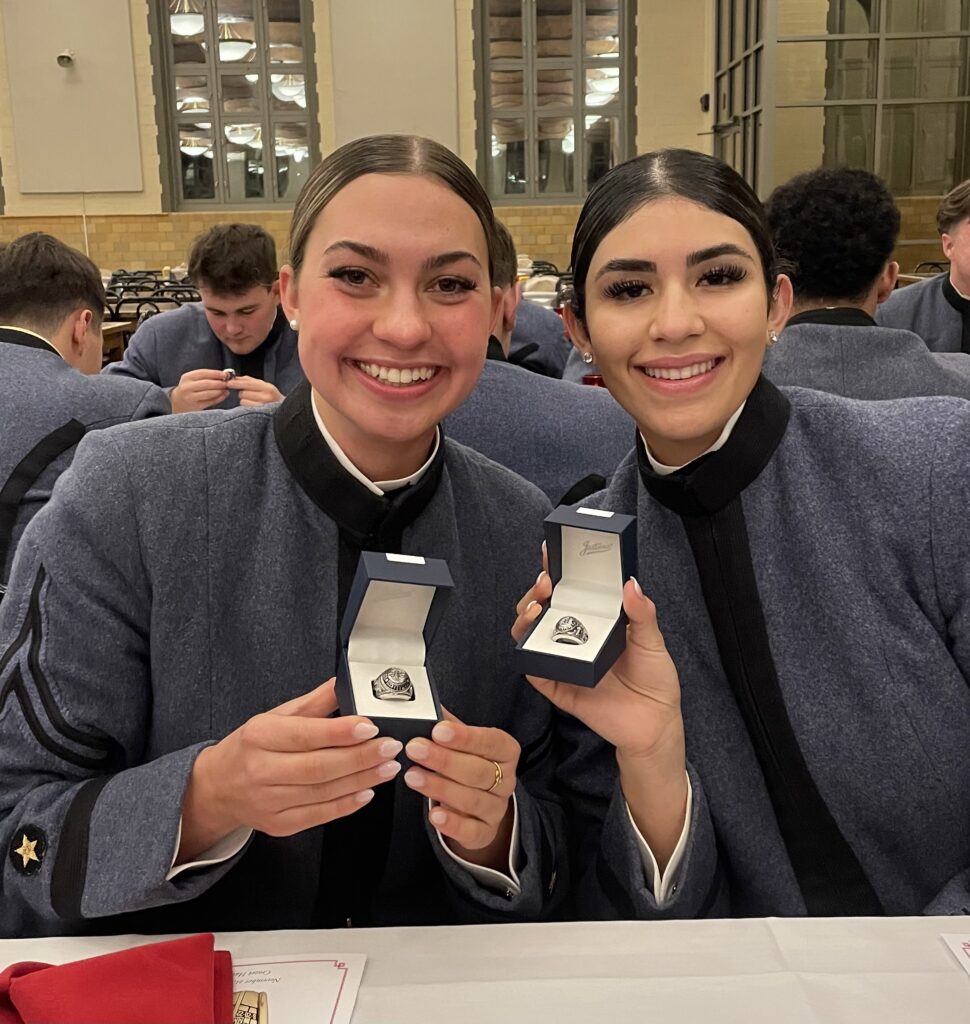
Nickole Chavez showing off her Virginia Military ring.

“I like the school. I like what it stands for, the values. I really try and play into the system as much as I can. I’m just a private and as much as I can, I try to be involved,” she said.

As a 3rd Class cadet, she said she’s seen her growth as a student.  

“I know I need to get my assignments done. I can’t stay in bed all day. Being here has helped me become more motivated and determined,” she said.  

Iten explained that Chavez stands out to her for her level-headedness. 

“In addition to having excellent stamina for learning, Nickole also stands out for her level-headedness and stable self-possession. If she encounters a tough spot or problem in her coursework, she remains calm, articulate, and solution-oriented,” she said. “Cadets can, understandably, get rocked off-balance by the demands of their coursework combined with navigating VMI, but not Nickole. I had a corporate career before becoming a professor, and Nickole is exactly the type of person I would have gladly hired for her capacity to stay grounded and articulate in fast-moving, high-pressure conditions.” 

The routine at VMI has been beneficial for Chavez. She said with the set schedule, it has not only benefitted her during her time at VMI, but outside of it.  

“I feel like I’m already on a set schedule. Even when I’m at home, I’m getting my day started early.” 

She said the schedule she and other cadets must keep has helped her become better with time management. 

“There’s a lot of stuff here we have to participate in, like practice parades, parades, meetings that we need to go to. I feel like just all that stuff kind of pushes you to manage your time a little bit better. During your day, if you get a break, take advantage of that break,” she said. 

Days can be overwhelming, but Chavez’s outlook remains steady. 

“I just try to take a step back and think about why I’m here, because this school can be stressful,” she said. “I just try to think back on why I’m here and what’s my purpose.” 

Behind the Balance: Dyson Dunham ’26 — Keydet Wrestling

Virginia Military Institute’s cadet-athletes have to juggle cadet life, heavy academic course loads, and their NCAA Division I sport. Committed to both academic and athletic pursuits, balancing their rigorous schedule in both sports and school requires a certain level of commitment and discipline. Behind the Balance is a series that focuses on those cadet-athletes and how they handle the hurdles of the day-to-day. 

It’s a mental game for Dyson Dunham ’26, not just while he’s wrestling, but during his day-to-day. He sacrifices a lot when cutting weight for matches, staying on top of assignments, and fitting in his cadet duties. On the mat, he says he’s doing it for himself.  

“It’s kind of like a pride thing,” he admitted. “I want to prove something to myself.” 

Wrestling wasn’t his first choice of sport. It took his older cousin doing it and getting stronger that pushed him to try it.  

“I would go to my cousin’s wrestling tournaments, but then my cousin would beat me up,” he joked.  

The sport became something he enjoyed. It also introduced him to a coach he became close to, who became a mentor. It was his high school coach who suggested Virginia Military Institute to Dunham because he was an alumnus.  

“I wanted to know what connections I could build here and what network I could grow,” he said. 

Sometimes, he struggles with compartmentalizing things, often going on autopilot to get through the day. He’s a big proponent of just pushing forward, especially when stressed.  

“I kind of found ways to shut my brain down and just kind of deal with it.” 

He says he has a high stress tolerance. It pushes him to work harder. It’s paid off, last year, he competed in the NCAA Wrestling Championships in 2024 and secured a win over a Big 10 opponent. He also came in third in the SoCon Championships in 2024.

“I believe that I thrive on that pressure,” he said. “Going into wrestling, I’m a little antsy, a little anxious. That makes me better, makes me get stuff done faster, get to what I want to do.” 

This year, he’s proved that hard work pays off. Dyson was the top wrestler at 133 pounds and earned one SoCon win, to name a few. 

With 18 and a half credits and a being a DI athlete, communication and organization are top priorities for Dunham.  

“I make sure I turn in all my work, coordinate with professors on how I can make things up,” he explained. “Usually, they’re pretty understanding.” 

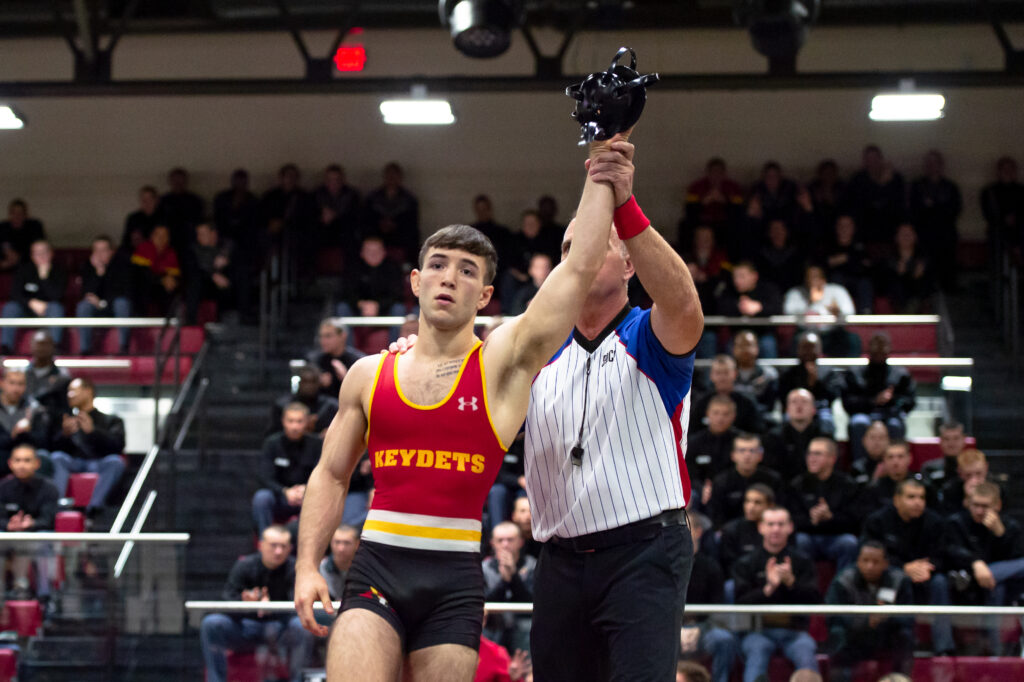
Dyson Dunham during a wresting match at Virginia Military Institute.
VMI Wrestling vs. Seton Hill Action Shot

Cadet-athletes at VMI not only have their responsibilities with their selected sport but cadet duties on top of that. Cadets are also required to take physical fitness classes twice a week, participate in ROTC all four years, prepare for room and uniform inspections, practice for parade, guard duty, and more. 

His days can start early with morning workouts, then onto class until the afternoon, and then back to practice. Since his days are so filled, he sometimes has to take the losses — a lower grade on an assignment — to find some downtime to reset. 

“I find relaxing times very important,” he commented. “They’re hard to come by for me. So anytime that I can push something off and give myself time to just take a break from either wrestling or academics, I do it.” 

It doesn’t mean he’s not committed to his studies or sport; he emphasizes the need to find time for yourself to prevent burnout. Luckily, as a civil engineering major, he stays engaged in class.

“I really enjoy engineering, so I find it easy to pay attention in class. I kind of figure that time is already allotted to class, I’m already using that time anyway. I might as well absorb and pay attention,” he stated. “I just make sure I’m staying engaged in my classes, talking to my professors so they know that I know what I’m doing.” 

The pressures of VMI will serve him well in the future, he stated. The balancing act he performs daily can be applied to his future work environment, especially after graduation when he commissions into the U.S. Army. Even if his daily life isn’t as busy, he has the tools to succeed.  

“I’m learning how to juggle a lot of things at once, like stress management, being able to work under that sort of pressure, and being able to deal with it,” he said.