Post View Unavailable:
Post View is currently unavailable due to technical difficulties. More information.Last Updated: 01-08-2026 09:42 AM»
Notice:
VMI.edu has recently been updated and upgraded. Please note that some URLs may have changed. Visitors are encouraged to use the new, expanded site menu and site search to navigate through these changes.
New Website Launched»
Col. Atin Basuchoudhary, the John and Jane Roberts Institute Professor in Free Enterprise Business in the Department of Economics and Business at Virginia Military Institute, recently co-edited, “The Cambridge Handbook on the Economics of Terrorism.”
Since the turn of the century, few issues have shaped political debate and policymaking more than terrorism. As a result, there has been a huge increase in the amount of academic research devoted to investigating the causes and consequences of terrorism. “The Cambridge Handbook on the Economics of Terrorism” is the first to present a state-of-the art survey of the economics of terrorism. It adopts a rational-choice perspective according to which terrorists are viewed as rational economic actors and presents a framework for analyzing the causes and consequences of terrorism. It explores the causes and consequences of terrorism and shines a light on practical counterterrorism policies and their trade-offs. With contributions from many leading figures in this fast-growing and important field, this book offers an accessible yet comprehensive collection of the economic analysis of terror.
Additional information on the book and purchasing details may be found on the Cambridge University Press website.
At Virginia Military Institute’s Office of Global Education, more than 10% of cadets each year choose an international learning experience. Through semester or summer programs, cadets not only widen their global perspectives — but build critical thinking, resilience, independence, and the ability to communicate across cultures. Learn more about these first-hand experiences through our Study Abroad Ambassadors.
Name: Anthony Pate
Year: 2026
Major: Economics and Business
Which program did you do?
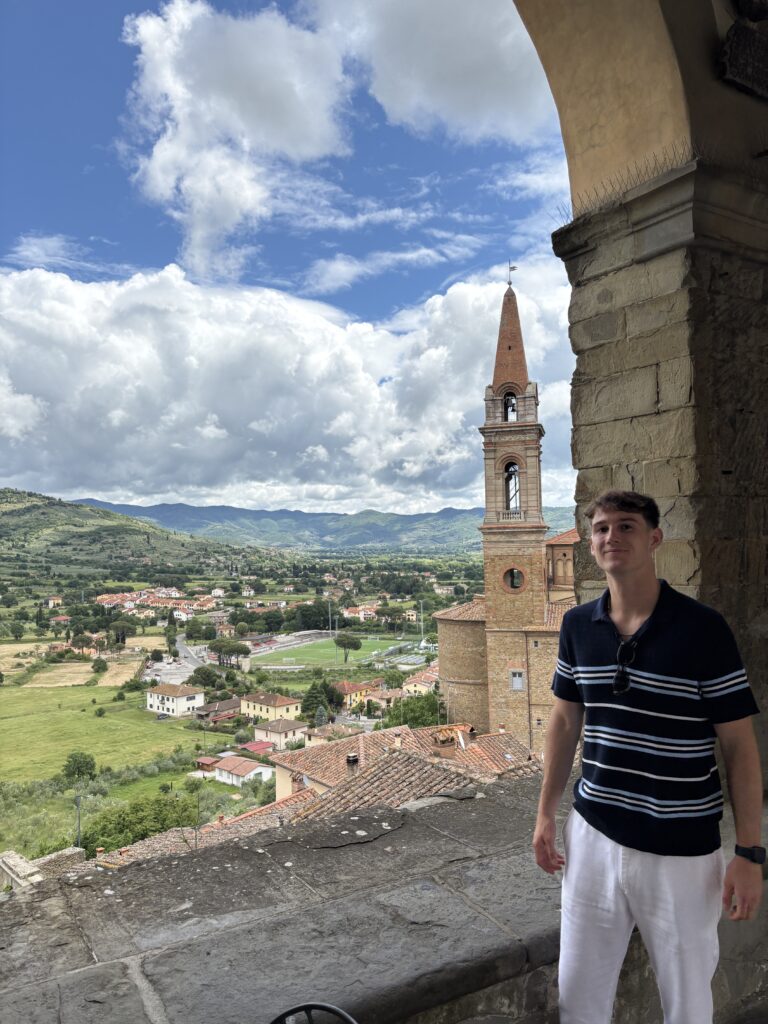
I did the internship with Pasta Fabianelli.
What made you decide to participate in this program?
I wanted to participate in this internship to gain hands-on work experience with the opportunity of being abroad in Europe.
How did you balance this program with VMI’s unique educational approach?
The program included Italian classes along with the internship. It also provided certain educational experiences in the town. I balanced these activities by completing all of my work as soon as I received it. I also kept reminding myself that I was there representing VMI.
What were your keys to success?
My keys to success were trying to bring a positive attitude to each day and working my hardest. Adaptability is taught at VMI, so I just tried my best to adapt to any situation possible.
How do you think participating in this program will aid you in your future?
The participation in this program gave me quality work experience that I can bring to my future jobs.
What was the best part of the program?
The best part of the program was to be able to experience a whole new culture while also gaining work experience.
What was the most surprising thing about the county you visited?
There were many more English speakers than I anticipated. I also was surprised how beautiful Tuscany was.
Favorite memory?
My favorite memory was visiting a restaurant recommended by my roommates’ parents. We had to jump through hurdles to get there, but it was the best steak I have ever eaten. Another fond memory from the internship was talking about soccer everyday with my colleagues. When they found out that I loved soccer they would speak to me about the games.
Jai Vijayan ’26, an economics and business major at Virginia Military Institute, researched military logistics during World War II for his honors project, “Move and Maintain: American Last-Mile Logistics in the Solomon Islands Campaign, 1942-1944.”
Vijayan, who will commission into the U.S. Army as a logistics officer after he graduates in May, explained the definition of military logistics as the practice of moving armies, including transporting military forces, keeping them supplied, planning and road building, and the administrative work carrying out those activities. The focus of his thesis was the final, crucial step of the supply chain; moving supplies from friendly, established bases to contested front lines, known as “the last mile,” specifically, to the Solomon Islands following the Japanese attacks on Pearl Harbor, Southeast Asia, and the South Pacific in 1941.
The Solomon Islands are a chain of islands in the South Pacific, northeast of Australia, and include Guadalcanal, New Georgia, and Bougainville, all locations of significant WWII battles. The Japanese attacks threatened the American supply lines to Australia and New Zealand. For that reason, the Solomons became decisive in ensuring those supply lines remained open and the Japanese advance was halted.
“Guadalcanal is widely regarded as an allied tactical victory, but a logistics disaster. Initially, isolated Marines were forced to subsist on two rations per day and captured Japanese rice. Aircraft sat idle because there was not enough fuel. Gradually, the allied forces were able to sustain their offenses in New Georgia and Bougainville, thanks to the idea of ‘island hopping,’ taking control of the islands one by one, and turning them into support bases,” explained Vijayan.
He went on to report that most historians agree that the U.S. logistics system was a big factor in winning the war for the allies, but they differ on what part of that logistics system was significant. To that end, Vijayan sought to answer the research question, “How and why did last-mile logistics improve past the crises at Guadalcanal?”
To answer his question, Vijayan examined the various logistics methods the military incorporated during the three operations to secure the islands. He discovered the successes, the failures, and how the methods progressively improved throughout the “island hopping.” The first, the Battle of Guadalcanal, codenamed Operation Watchtower, took place from August 1942 to February 1943; followed by the invasion of the New Georgia, codenamed Operation Toenails, from June to October 1943; then the Battle of Bougainville, codenamed Operation Dipper, from November 1943 to May 1944.
He concluded by confirming that circumstances improved with each new operation due to improved access to military facilities, shortened supply lines, absence of time pressure, and diminished enemy capabilities. “It’s easy to understand why the last model was much more effective. Improvements helped the allied forces avoid the crises that took place on Guadalcanal. There was better unloading coordination, supply lines were deliberately planned and proactively built inland, and supply dumps were deliberately placed for a more effective system. All these decisions improved last-mile logistics. There was definitely a learning curve that moved past the mistakes at Guadalcanal,” closed Vijayan.
Vijayan’s advisor, Lt. Col. Joel Christenson ’99, associate professor in the Department of History and director of the John A. Adams ’71 Center for Military History & Strategic Analysis, said it was a pleasure working with Vijayan. “Jai’s project is thoughtful, innovative, timely, and applicable, and I think his investigation into logistics and the Solomon Islands campaign in the Second World War proves that there is new information even in the most studied of conflicts.”
Vijayan is minoring in military history and Chinese. He is an alumnus of the Canadian International School in Singapore and the son of Bharat Vijayan and Archana Velukutty of Tully, New York.
Virginia Military Institute’s cadet-athletes have to juggle cadet life, heavy academic course loads, and their NCAA Division I sport. Committed to both academic and athletic pursuits, balancing their rigorous schedule in both sports and school requires a certain level of commitment and discipline. Behind the Balance is a series that focuses on those cadet-athletes and how they handle the hurdles of the day-to-day.
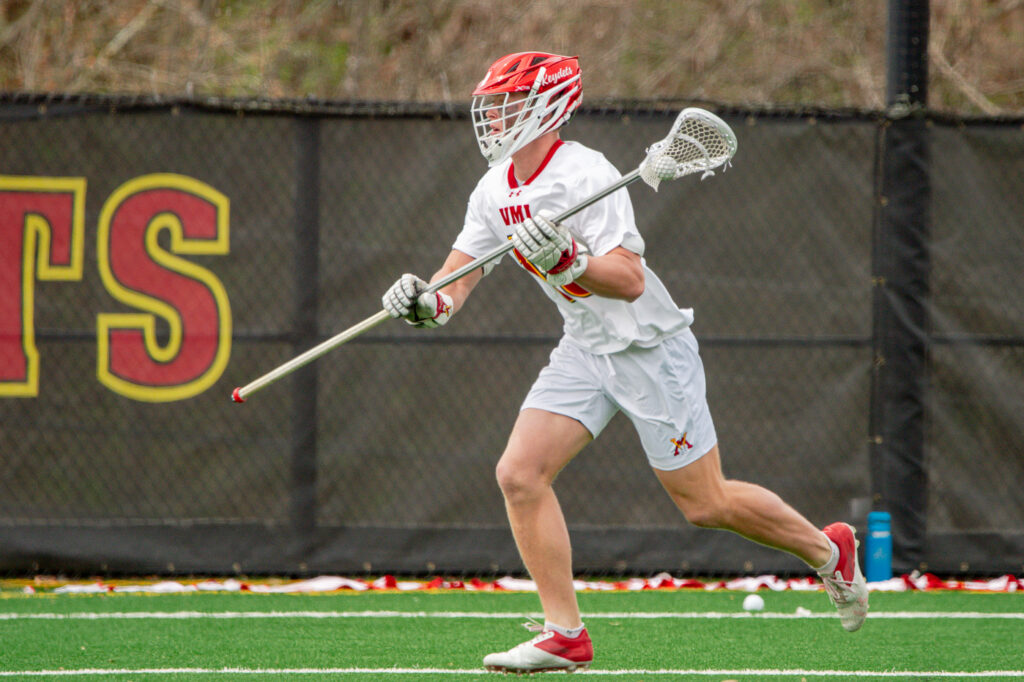
Growing up in Richmond, Virginia Military Institute was never a mystery to Miller Tatum ’28. Between family stories passed down from his grandfather — an alumnus himself — and a reputation that carried weight back home, the Institute was always somewhere in the background.
Choosing VMI meant stepping away from the “normal” college path and diving into something harder. Tatum also held onto the belief that four demanding years could shape the next 40. That challenge combined with the chance to compete at the Division I level in lacrosse made the decision feel worth it.
In high school, Tatum wasn’t even sure lacrosse would be the avenue he’d pursue in college. He started playing around 8 years old in a recreational league and ended up playing all the way up to high school.
“I transferred to a private high school in Richmond for my freshman year, and at that point I was really small and not good at lacrosse, and I hated it for a few years,” he admitted. “Freshman through junior year, I did not enjoy it, I didn’t want to play in college, and had no aspirations of doing it.”
By his junior year, Tatum ended up filling out and hitting a growth spurt putting him in line with everyone else. From there, his mentality towards the game improved, as well as his skill. At that point, the former VMI head lacrosse coach had seen Tatum and invited him to a game day.
It took some convincing from Tatum’s father, but he ended up attending the game day. He was then offered a spot on the team and knew it was too good of an opportunity to give up.
Cadet-athletes at VMI not only have their responsibilities with their selected sport but cadet duties on top of that. Cadets are also required to take physical fitness classes twice a week, participate in ROTC all four years, prepare for room and uniform inspections, practice for parade, guard duty, and more.
His days start early at 5:30 a.m. for weightlifting, then it’s a constant flood of one thing after the other until the afternoon. The economics and business major has 17.5 credits this semester, while in season. To stay on top of things, he’s completing assignments between all his other commitments.
Luckily, his away games happen mostly on weekends. He and his teammates tend to front load their schedules to have classes earlier in the week.
“I only have two classes on Friday, so I’m not actually missing that much class,” he said.
Having the initiative to utilize the small breaks during the day to get a head start on assignments will end up in your favor, he said.
“When you come back to do it at 7:30 or 8 p.m. after eating and going to practice, you’ve already put a dent in it.”
During away trips, he and his teammates are dedicated to doing work while on the road.
“You’ll see people with makeshift desks on the bus doing homework or on their computers or reading something for a class,” he explained.
Their academic dedication can be seen, especially with the announcement last season that they earned Team All-Academic honors by the United States Intercollegiate Lacrosse Association. In order to achieve this status, the program must hold a team cumulative GPA of 3.0, which the team surpassed with a 3.2 for the 2024-25 academic year.
“A lot of guys are pretty motivated in class. When you’re on the bus and everyone around you is doing homework, you almost feel like you’re getting left behind if you’re not trying to do something productive with that time,” he said.
Despite a busy schedule, Tatum said being able to practice with his best friends daily is his favorite part of the Institute.
“Doing something that you have a common shared joy of doing … I think there’s not a lot of opportunities to do that anymore,” he said.
Motivation and time management have been big factors in how VMI is shaping Tatum.
“I think having the opportunity to lead and be in the spotlight in front of other people is something a lot of college students don’t get at other schools and VMI prepares you well for,” Tatum stated. “I think that you have to use VMI as a foot in the door and then use the skills that VMI has taught you to be successful.”
Virginia Military Institute’s cadet-athletes have to juggle cadet life, heavy academic course loads, and their NCAA Division I sport. Committed to both academic and athletic pursuits, balancing their rigorous schedule in both sports and school requires a certain level of commitment and discipline. Behind the Balance is a series that focuses on those cadet-athletes and how they handle the hurdles of the day-to-day.
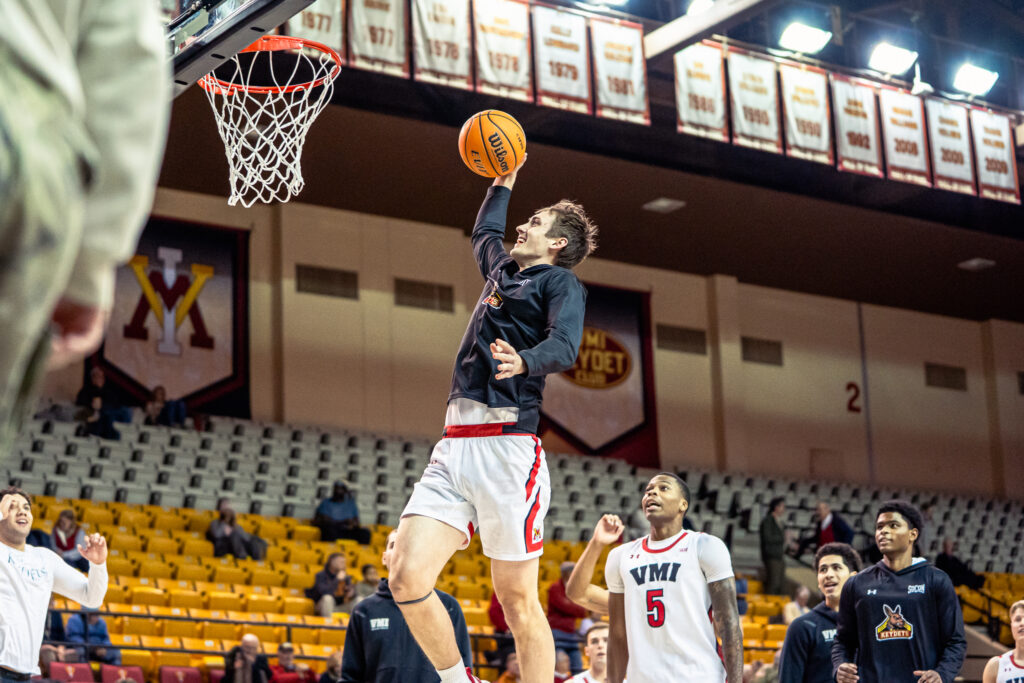
TJ Johnson ’28 has been shooting a basketball ever since he can remember. He comes from a basketball family — both his parents played, and now he and his younger brothers have joined the family tradition.
The economics and business major saw attending Virginia Military Institute as a great opportunity from the standpoint of being an athlete and also a cadet.
“My dad played basketball at West Point, so the idea of a military institute wasn’t foreign to me. I grew up hearing his stories about West Point,” he said. “I knew it was going to be challenging, but at the same time, I knew there were a lot of benefits that would come with it as well. It wasn’t something I was afraid of. I thought it was a great opportunity for me, both on the court and off the court.”
Johnson is a second-year transfer, so there was an adjustment period entering the Rat Line.
“Everything is stripped away. I’m getting yelled at by guys who are my age or younger. It was challenging for me to accept,” Johnson admitted. “There were times when I was really frustrated and angry and questioned a lot of things. I think the transition from last year to this year; I’ve learned a lot about myself.”
He said he’s been able to adapt to different situations well. The Rat Line definitely tested that, but he came out stronger.
“I’m a very calm person. I try not to get too high or too down. I’d say, my ability to handle stress and pressure has improved,” he said.
The way he’s able to traverse a busy schedule as a cadet-athlete and taking 14 credits is also something he works on daily. Cadet-athletes at VMI not only have their responsibilities with their selected sport but cadet duties on top of that. Cadets are also required to take physical fitness classes twice a week, participate in ROTC all four years, prepare for room and uniform inspections, practice for parade, guard duty, and more.
The weeks when the team has two away games, they’ll leave on a Tuesday and return late Saturday night, for example.
“It makes it difficult. We just have to communicate with our instructors and tell them what days we’re going to be missing, and then they’ll let us know what work we need to make up,” he explained. “So many things are digital now that you can just do it on your computer in the hotel room or on the bus. I spend a lot of time on the bus working on schoolwork, writing papers, that kind of thing.”
His days while on post start early at 6:30 a.m. to review film footage at 7 a.m. Then, it’s onto breakfast and classes. He tries to work in weightlifting between classes and his daily practices, too, along with an individual workout with an assistant coach. Practice is at 4 p.m., which can last up to an hour or longer. He eats dinner, heads back to his room and it’s homework for the rest of the night. He says he’s up until about midnight some nights finishing assignments. Then, the cycle repeats.
“I really don’t get too overwhelmed. I try to put things in God’s hands and know He’s going to take care of me,” Johnson said. “He’s gotten me this far. So why wouldn’t He help me get through an essay or an exam? I try to not stress about it too much. It is difficult trying to fit everything in and get everything done and turned in on time with quality work. You make it work.”
Johnson has also proved his responsibility to the team and to the Institute. He was recently selected to serve as one of three student-athletes nationwide to serve on the NCAA Division I Board of Directors. As a student-athlete on the committee, Johnson will be tasked with giving an athlete’s perspective of everything happening in the current collegiate sports landscape such as NIL, the transfer portal and many other areas.
He finds comfort in talking with his family as much as possible. He calls his parents multiple times a week and tries to catch up with his brothers — one who’s away at college on the West Coast and the other still in high school.
“I’m really close with both my parents, and don’t get to see them often either. But, you know, it’s something I’ve gotten used to.”
Johnson said that VM offers the tools to face any of his challenges.
“There’s a lot of adversity, and you learn to adapt to adversity and overcome it,” he said. “The way the Institute is set up, it will help me whenever life starts to hit in the future, I will have already been through an extended period of time of adversity and learned how to how to face it.”
Plus, the bonds he’s made with his teammates help push him. Last year, the team had eight players going through the Rat Line at the same time.
“We were all going through the same challenges, same adversity, and we were able to lean on each other.”
At Virginia Military Institute’s Office of Global Education, more than 10% of cadets each year choose an international learning experience. Through semester or summer programs, cadets not only widen their global perspectives — but build critical thinking, resilience, independence, and the ability to communicate across cultures. Learn more about these first-hand experiences through our Study Abroad Ambassadors.
Name: Edward Menton
Class: 2026
Major: Economics and Business Major
Which program did you do?
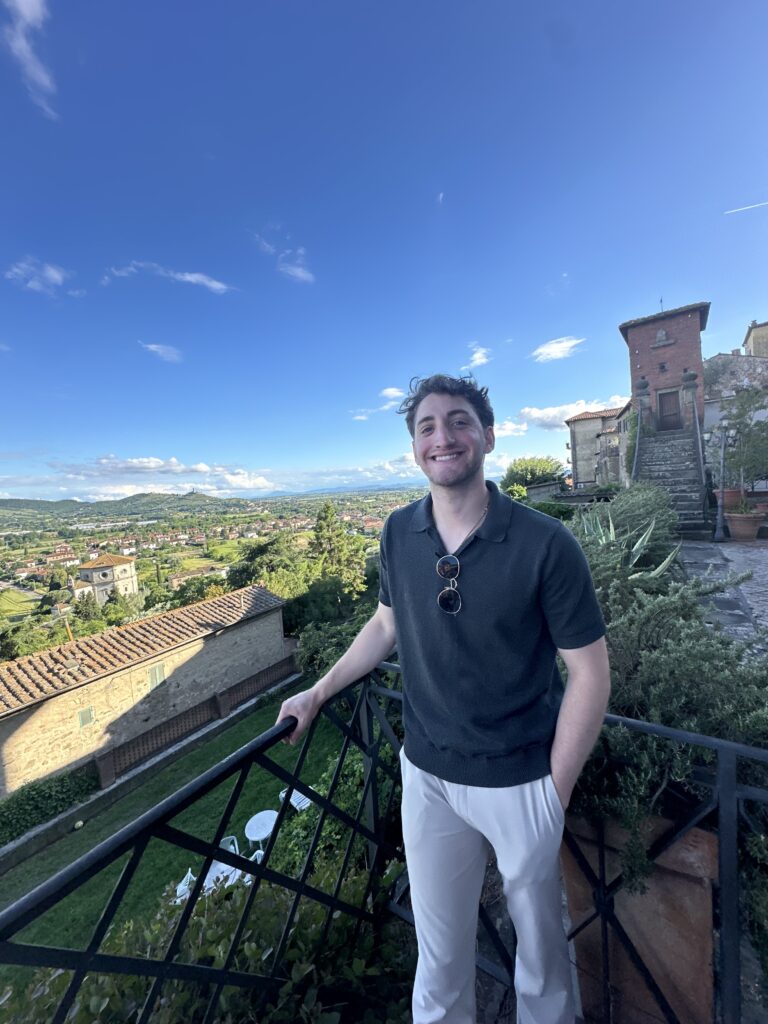
I first studied abroad in the spring semester of 2024 at the American University of Rome and then completed an internship this past summer in Castiglion Fiorentino, Tuscany, working with De’ Magi – Alchimia de’ Formaggi, an Italian cheese refiner.
What made you decide to participate in this program?
I grew up in a small town, so I’ve always been drawn to the idea of traveling. I wanted to broaden my global perspective, experience life outside of the United States, and make meaningful memories along the way. Studying in Rome gave me the chance to learn international business and economics in a European setting, while my internship provided valuable hands-on experience working as a U.S. liaison for an artisan Italian company.
How did you balance this program with VMI’s unique educational approach?
The values VMI teaches, such as discipline, time management, and professionalism, helped me in both settings. In Rome, they kept me focused as I adjusted to a different classroom style and culture. During my internship, these skills were most evident, enabling me to manage projects independently, meet deadlines, and effectively represent both myself and VMI in a cross-cultural business environment.
What were your keys to success?
Keys to my success were adaptability, time management, confidence, curiosity, and communication.
How do you think participating in this program will aid you in your future?
These experiences have given me international awareness, professional confidence, and practical skills in business and logistics. Now I understand better how cultural differences impact trade and business. This global experience will benefit me in my future career, first as I pursue a path in the U.S. Army, and later as I hope to move into international business or operations management.
What was the best part of the program?
In Rome, it was living in a historic city and having the ability to travel to different countries with my best friends. For the internship, it was working directly with Andrea Magi, the owner of the company, and seeing how passion and attention to detail can elevate a small business into an internationally recognized company. Also, Florentine steaks.
What was the most surprising thing about the county you visited?
How much Italian culture and tradition influence everyday life, from business practices to meals.
Favorite memory?
My favorite memory was getting the chance to visit the Vatican multiple times and experiencing Rome during Easter. It was unforgettable to be in the city at such a meaningful time.
Ten members of the Cadet Investment Group (CIG) at Virginia Military Institute, along with advisor Maj. Steve Landgraf, assistant professor in the Department of Economics and Business (ECBU); and Capt. Zebulen Riley, instructor in ECBU, traveled to Wall Street in New York City (NYC) in December, to meet with financial analysts and traders, including VMI alumni who work in the industry.
CIG is a student-led organization that is charged with making investment decisions with actual cash provided by an endowment established by an alumnus. Most members major in economics and business, but it is not a requirement. According to Landgraf, two different groups in CIG manage approximately $380,000 in total. “Group A invests in cyclical sectors, which are consumer discretionary, energy, industrials, technology, and materials. Group B invests in defensive sectors, which are health care, consumer staples, utilities, financials, real estate, and communication services. This annual trip to New York is another great example of how dedicated VMI alumni are to mentoring our cadets. CIG itself provides cadets the opportunity to put their education into practice every week, but the interaction with finance professionals in New York is an experience that’s difficult to replicate anywhere else,” he said.
A tour of the New York Stock Exchange (NYSE) was arranged for the CIG with assistance from Brian Tate ’90, executive managing director and head of Energy and Natural Resources Group at Regions Securities LLC; and Jim Sharp ’93, managing director at Regions Bank. Tate and Sharp flew up from Charlotte, North Carolina, to join the VMI contingent at NYSE for the day.
Later, the CIG visited Bill Argiriou ’81, a commodities trader at RBC Capital Markets. The group met with Charlie Branch ’95, a wealth manager for Merrill Lynch, then proceeded to TM Capital, a middle-market investment bank founded by Gregory Robertson ’65. Robert Browning ’94 at AllianceBernstein, an asset management and investment advisory firm, also spent time with the group providing career advice. The day was capped off with a dinner in Midtown Manhattan hosted by the NYC VMI alumni chapter, presided by Paul Dickinson ’96.
Conner Reid ’27, cadet-in-charge of the CIG, is majoring in economics and business with a concentration in finance. He shared the trip was an incredible experience. “We visited several banks including TM Capital and Bank of America, and even had the opportunity to attend the opening bell of the New York Stock Exchange. The trip was especially impactful because we were able to connect with VMI alumni and professionals who have already walked the path many of us are about to embark on. Building those relationships and receiving guidance from people who have been so successful in their careers has been invaluable, and many of them have become true mentors throughout my journey. It reinforced how powerful it is to foster relationships and form bonds with people 10, 20, or even 40 years ahead of you, who can serve as mentors and role models in your career.”
CIG meets weekly and reviews overall fund performance, discusses current events and their impact on the financial markets, then votes on portfolio additions or deletions, requiring a majority to execute a transaction, either buy or sell.
The Vanguard series highlights cadets of Virginia Military Institute who exemplify promise, perseverance, and the true spirit of leadership. While they may not be the top-ranking students or those in prestigious positions, these individuals’ dedication, resilience, and growth embody the essence of being a VMI cadet. By sharing their stories, including the challenges they’ve faced and overcome, we shine a spotlight on the diverse paths to success at the Institute, proving that leadership and excellence come in many forms.
When Diego Henao Ospina ’28 first considered life after high school, he weighed several paths within the armed forces. Enlisting seemed like a possibility, but advice from others who knew Virginia Military Institute helped shift his focus.
A former Navy pilot whose son attended VMI spoke highly of the Institute, and soon after, a graduate from his own high school — now a 2nd Class cadet — returned for a recruiting visit. The way that cadet carried himself, sharp in his uniform and confident, left a lasting impression on Henao Ospina.
Entering the Institute, Henao Ospina began as a history major. He enjoyed his time in the history department but found more of an interest in economics and business. He also plans on commissioning into the United States Air Force.
“I’m very thankful to the history department. I really enjoyed it. But ultimately, I want to do something in the management sector, whether it’s logistics in the military or in the civilian world,” he explained. “Once I get out, I want to get into the corporate world. And economics, in my opinion, has always had that right amount of math where it’s very applicable.”
Choosing the Air Force as his branch was another intentional decision. Many of the service members he spoke with before VMI were Air Force officers and enlistees, and he admired the long-term career paths available.
“The Air Force seems like the best career,” he said.
At VMI, he describes himself as a steady student — disciplined in habits, punctual with work, and willing to seek help when needed. Asking for help wasn’t always easy. He said at first, he resisted asking for help, but by the end of high school, he had learned that leaning on others could make all the difference.
“There’s nothing shameful in that,” he said. “My main advice that I would give others is to seek help when they need it.”
As a cadet, he holds himself to high standards, striving to lead by example and instruct others. In Hotel Company, he serves as an alternate cadre corporal, managing an Old Corps squad during inspections and accountability checks, and assisting with rat training events. For him, the role was about belonging and contributing to the company that gave him his first sense of identity at VMI. A conversation with one of his own cadre corporals during the Rat Line solidified that calling.
“That sense of belonging really impacted me,” he said.
The journey hasn’t been without challenges. He admits that time management has been one of the steepest learning curves. Balancing academics, military duties, and the personal tasks of daily life, from making phone calls home to working through difficulties outside of VMI.
“It can be overwhelming,” he shared. To cope, he leans on his mother for advice and strength, and grounds himself in his faith.
Over the years, he says he’s grown vastly as a cadet. From struggling with basic drill movements on Matriculation Day to embracing the philosophy that “you get out what you put in,” he’s learned to see VMI as a system that rewards effort and resilience. Each duty — academic, military, or personal — has become an opportunity for improvement.
Mentorship has also shaped his time. Col. John Cerkey from the Department of Modern Languages and Cultures has been a guiding influence since his rat year, both in the classroom and in supporting his ambitions to pursue a summer research project.
Cerkey said he first had Henao Ospina in a literature class that focuses on Medieval and Renaissance Periods.
“This was his first semester, rat year. These two literary periods are very challenging, and for most students, it was the first time that they had been introduced to literary and/or analytical techniques,” Cerkey explained. “With all the pressures that rats already have, Diego was outstanding. He, as well as the others, had to absorb and implement these new ways of thinking— he accomplished this to a superlative degree. He demonstrated originality of thought and clearly invested the effort to strive for excellence in this process. The result was that he was far and above, the best student in the class.”
Born in Colombia, Henao Ospina eventually moved to the U.S. with his mother. He has faced several challenges, but Cerkey pointed out that Henao Ospina was able to overcome a lot.
“Diego has remained focused and dedicated to achieving the goals that his education is making available to him. He doesn’t complain; he embraces all his challenges, crosses, and trials, with a good heart,” Cerkey said. “And at the center of his good heart, is his unwavering dedication to his Catholic faith, which strengthens him in his daily challenges, and keeps him Christ-centered.”
Looking back, Henao Ospina sees VMI not as a finished process, but as a constant evolution.
“You get out of the system what you put into it, and then you’re growing every day,” he said. “From the way I see it, it doesn’t end. It evolves. And it’s an opportunity to just continue learning, continue growing, despite the difficulties. The system is going to push you through difficulties, because there’s room for improvement.”
Virginia Military Institute’s cadet-athletes have to juggle cadet life, heavy academic course loads, and their NCAA Division I sport. Committed to both academic and athletic pursuits, balancing their rigorous schedule in both sports and school requires a certain level of commitment and discipline. Behind the Balance is a series that focuses on those cadet-athletes and how they handle the hurdles of the day-to-day.
Natalia Dias ’28 wanted to be set up success, and that meant finding a way to pay for college or leave her with minimal debt. She had three clear goals in school: an engineering program, U.S. Army ROTC, and cross country and track.
Although she made the switch to economics and business, she found that Virginia Military Institute could offer her what she was looking for.
“I always knew that I wanted a college that would take me further in my career, and VMI does that in every aspect,” she said.
Thanks to an Army scholarship, she’s able to afford tuition, and will be commissioning into the Army upon graduation.
The 3rd Class cadet is currently enrolled in 18 credit hours, which takes a lot of planning.
Cadet-athletes at VMI not only have their responsibilities with their selected sport but cadet duties on top of that. Cadets are also required to take physical fitness classes twice a week, participate in ROTC all four years, prepare for room and uniform inspections, practice for parade, guard duty, and more.
How does she handle it? Carefully.
“I think my whole day is planned out in my planner,” she admits.
Yes, a real physical planner. Inside is a carefully written schedule that soon becomes overloaded with extra sticky notes and highlights.
“There are some days I have morning practice, and I don’t stop moving until dinner that evening,” she explains. “Then I go straight to the library, and get my homework done. If it’s an early night, I get excited because I get to go to bed.”
Her days start sometimes as early as 5:30 a.m. and continue straight through until past 10 p.m. Then, it starts all over again.
She also holds rank — as a corporal in the Old Corps, which means she’s in charge of upperclassmen and to make sure they’re there for formation and do things like rifle checks. She says she dedicates about an hour or two a day to that role.
“I wanted a role more than what I already was responsible for,” she explained. “Because as a rat you don’t really have any choices. I wanted to be in charge of something.”
She said since she wasn’t chosen for cadre, the Old Corps allows her to balance that role with her responsibilities with athletics, academics, and other cadet duties.
“It doesn’t take up as much of my time, which is probably a good thing,” she said. “This is a good introduction to holding rank. It’s really important because these men and women that are in my squad depend on me to make sure they don’t get in trouble, every single day.”
As for running — it’s her escape. She’s been running track and cross country since middle school.
“I love my team,” she stated “It’s one of my favorite parts of my day to go down to even just practice. It’s a good escape. It’s away from the Institute, in a way, and makes me feel a little more normal, but it’s very freeing. It’s my time where all I have to do is run. All I have to do is workout. All I have to do is lift and that feels good sometimes, because a lot of things get overwhelming here. It’s just like a freedom where I don’t have to worry about anything else.”
Dias describes herself as a big planner with a very Type A personality.
“I write down the things I can control, and I try not to worry about the things I can’t, because there’s a lot of things you can’t control,” she said. “We have really good resources here. We have the Cadet Counseling Center and everything. If I ever need some help, I can go there, or I can talk to my teammates, my coaches, or my classmates. There’s a lot of great support systems here with how the school is set up.”
Although her family was a little skeptical of her attending VMI, Dias knows she made the right decision. It was confirmed after an overnight visit where she learned how many opportunities there were for people — especially female cadets. She could feel how close-knit everyone was.
“To me, it’s not just to further my life, but it’s to experience all of this with my classmates, to get the military experience, to be able to pursue my dreams,” she said.
Virginia Military Institute’s cadet-athletes have to juggle cadet life, heavy academic course loads, and their NCAA Division I sport. Committed to both academic and athletic pursuits, balancing their rigorous schedule in both sports and school requires a certain level of commitment and discipline. Behind the Balance is a series that focuses on those cadet-athletes and how they handle the hurdles of the day-to-day.
A sense of discipline is what drew Amari Benjamin ’27 to Virginia Military Institute.
“I knew that I wanted that in my life, and I knew that would set me up forever,” he said. “I also wanted the option to commission, because I was on the fence and I got the opportunity to play soccer here as well.”
Benjamin, an economics and business major, plans on commissioning into the U.S. Army. Having the option to play soccer at VMI was a big draw for Benjamin. After a soccer camp with the VMI soccer coach, Nick Regan, his interest was piqued.
“I wasn’t originally interested in VMI. I didn’t really know what it was, either,” Benjamin admitted. “But then Coach Regan reached out to me saying, we’re interested. He gave me a little breakdown on the school and then did my own research. My dad was in the Navy, so I’ve always been in that military setting at home too … it wasn’t that big of an adjustment.”
Cadet-athletes at VMI not only have their responsibilities with their selected sport but cadet duties on top of that. Cadets are also required to take physical fitness classes twice a week, participate in ROTC all four years, prepare for room and uniform inspections, practice for parade, guard duty, and more.
Benjamin has a packed schedule with 17.5 credits as well as serving as an S9 Sergeant. With that comes a multitude of duties including preparing for pep rallies, company athletics activities, and creating permits and Concept of Operations (CONOPS) documents. S9 is primarily made up of athletes, so cadets involved must pick up where it’s needed when those on the staff are in season.
“S9 is an amazing staff because we all know how much we put in on the field or court, so we are always quick to have each other backs and help when help is needed,” he said. “When it’s S9 time, it’s S9 time. Allowing me to segment my day with school, soccer, and rank allows me to stay on top of things and not get burnt out.”
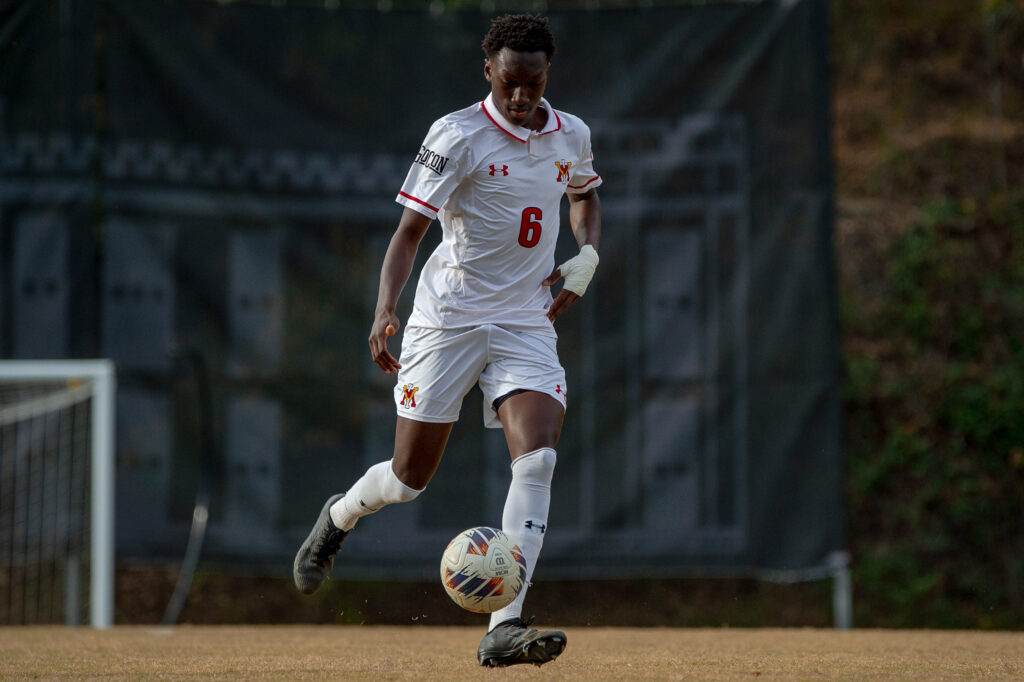
VMI Men’s Soccer Action Shot vs. Queens
His days start early while he’s in season — around 6 a.m. for a team run or a quick session on the field before breakfast. Then it’s classes until the afternoon and straight to practice, which lasts until after 6:30 p.m. Then he’s back to studying and class assignments.
“I like to get a lot of my work done out the way early. I don’t want to stay up late because I wake up in the morning feeling groggy,” he explained. “Usually throughout the day, from whenever we finish that first training until before practice, it’s only school. That way, at least at night, I can only focus on whether I have an exam the next day or I can focus on one thing and not have to over stretch myself.”
Benjamin has had to find a balance in structuring all his tasks. In the beginning, he found it tough to do so.
“My first year playing Division I soccer, all of that was overwhelming. It wasn’t until my sophomore year that I really was able to crack down on it and build good habits and get into a routine,” he stated.
He especially must plan with traveling for games, which they have a packed schedule of nearly 20 games during a season.
“When I know I have an away game coming, I try to overly stress the fact that I need to finish all this, because I go into the game with just the game in mind, and not have to worry about an assignment due at 11:59 p.m.,” he explained. “Usually, I try to plan out my days well. I feel like every assignment I get or every reading I’m assigned, I always put in my notes, and I try to get it done that day, if possible. That way, later in the week, when the games do come around, it’s just straight soccer.”
Benjamin said the skills he’s learned at VMI will translate into his life, no matter what he does. He says the ability to multitask and prioritize has helped him plan his days properly.
“I feel like one piece of advice that my dyke [senior mentor] also told me was, at the end of the day, you’re going to go to bed, and the next morning you’re going to wake up,” he commented. “You’ve just got to get through the rest of the day, and nothing can really hinder you. At the end of the day, if you just do what you need to do and get through it, there’s a whole new day waiting for you.”