Post View Unavailable »
New Website Launched »

Behind the Balance: Conner Reid ’27 — Keydet Men’s Soccer

Virginia Military Institute’s cadet-athletes have to juggle cadet life, heavy academic course loads, and their NCAA Division I sport. Committed to both academic and athletic pursuits, balancing their rigorous schedule in both sports and school requires a certain level of commitment and discipline. Behind the Balance is a series that focuses on those cadet-athletes and how they handle the hurdles of the day-to-day. 

A different college experience was what Conner Reid ’27 was searching for. He said that Virginia Military Institute offered that and it’s what attracted him.  

He was looking at the University of Virginia, but he didn’t make it into the soccer program there. So, he broadened his search. 

“I started looking at other schools, and VMI really stood out to me,” he said. “It’s not the typical college experience.” 

But when he started reaching out, he found that the alumni network was exuberant.  

“I’m from Richmond, so the second I brought up VMI, people started coming from everywhere,” he admitted. “I think that really stuck it to me.” 

The economics and business major said VMI has helped shape him for the future.  

I think VMI sets you up best for life compared to other colleges,” he explained. “Regardless of when your classes start, you’re waking up at 6 a.m. and you’re getting your day started just like you would in the real world. Here you have to do a lot of things that you don’t necessarily want to do, but that’s kind of how life is. I’d say mastering discipline and doing things I don’t want to do along with time management here, especially while playing a sport, is a skill I’ve almost perfected. Those are the skills that I’ve really gained from VMI that have prepared me for life.” 

Cadet-athletes at VMI not only have their responsibilities with their selected sport but cadet duties on top of that. Cadets are also required to take physical fitness classes twice a week, participate in ROTC all four years, prepare for room and uniform inspections, practice for parade, guard duty, and more. 

He was used to balancing multiple things in high school by playing two sports — basketball and soccer — while keeping up with his studies.  

“Here I’ve really been able to put it on full display, adding the military aspect on top it,” he said. “I’ve never really traveled for sports, but here you’re on the road half the week during the soccer season, so I’ve honed that in and perfected that here. It’s something I plan to continue to carry on.” 

With an 18-credit hour semester and early mornings and practices bookending his school time, he likes to tackle things the minute he gets them.  

“If I can just knock out assignments as soon as possible, that’s best. I don’t typically do work on the bus just because I get motion sickness really badly. So, whether it’s in the hotel or on weekends, when I can finally catch up or get ahead, that’s where I knock out most of my work. I’ve been able to find a good rhythm,” Reid said. “I just roll with it and take it as it comes. Unless I know I have a test coming up, I’ll try to get ahead so I can just study that week and not have to worry about assignments. Most of the week, I just roll with the punches.” 

Reid also holds rank as an S2 sergeant, which is a front facing person for academics in the Corps. 

“So anytime rats need reminding of what their academic standards are or pairing them up with a tutor, we do a lot of that,” he explained.  
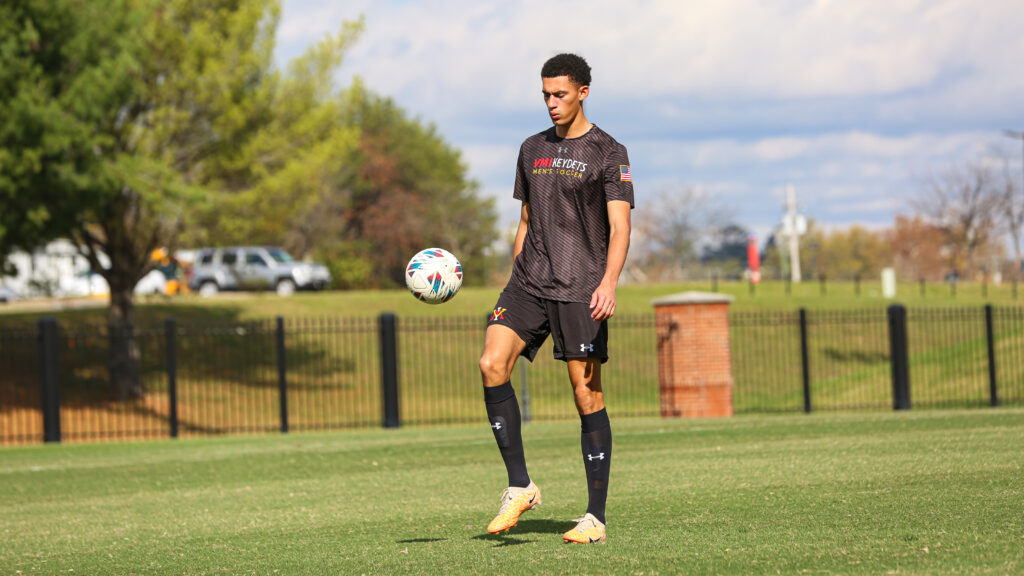
Conner Reid on the soccer field with a ball, playing for Virginia Military Institute.
VMI Men’s Soccer vs. Wofford at SoCon Championship

They also have Miller Academic Center Saturdays, where they meet up with rats and teach them study habits and how to do better in college, to help with the transition from high school. 

“I feel like academics is a strong suit for me, and I want to do my best to help other people succeed in college,” Reid commented. “I know it can be very different moving from high school to college. The workload and the difficulty of the work pick up. I’m trying to help people succeed.”

He’s a part of the Cadet Investment Group, which helps manage part of the school’s endowment. He says as a group of select individuals, they are able to manage real money and pitch stocks to the group and invest.  

“It’s pretty cool getting to actively manage real money and make investment decisions.” 

He jokes that he got a free group of friends when he started at VMI, especially with his teammates.  

“College can be a very daunting place; you meet new people and start all over. But the soccer team coming in from day one, we have these three weeks to a month of pre-season. You just get to meet people and then spend so much time with them during the Rat Line,” he said. “I’ve grown really close with my class. It’s a brotherhood. You’re closest with everybody on your team more than you are probably anybody else in the Corps.” 

His advice coming in? School should be the focus.  

“I know a lot of people here they’ll focus on the Rat Line, or they’ll spend their free time playing video games or something like that. To me, soccer is going to end one day. School is the most important,” he stated. “Prioritize getting your assignments done. Put in as much effort as you would on the soccer field in the classroom.” 
Behind the Balance: Luke Schalow ’26 — Keydet Football

Virginia Military Institute’s cadet-athletes have to juggle cadet life, heavy academic course loads, and their NCAA Division I sport. Committed to both academic and athletic pursuits, balancing their rigorous schedule in both sports and school requires a certain level of commitment and discipline. Behind the Balance is a series that focuses on those cadet-athletes and how they handle the hurdles of the day-to-day. 

It was a goal of Luke Schalow ‘26 to play college football. But he also knew, if he could never play football again, he wanted to go to a school he would be proud to have attended.  

“This was a school that when I visited it was nothing like the high school I had gone through, and I certainly didn’t want to go through high school again,” the economics and business major admitted. 

Cadet-athletes at Virginia Military Institute not only have their responsibilities with their selected sport but cadet duties on top of that. Cadets are also required to take physical fitness classes twice a week, participate in ROTC all four years, prepare for room and uniform inspections, practice for parade, guard duty, and more. 

Schalow is also on the S9 staff, which includes preparing for pep rallies, company athletics activities, and creating permits. S9 is primarily made up of athletes, so cadets involved must pick up the slack when those on the staff are in season. For Schalow, that could mean an early morning remedial PT session or fitness tests. Each morning would be dedicated to S9 or football, he said.  

“Football is always a priority, that’s what I came here to do,” he explained. “S9 can complement that, and it really intertwines with it a lot.” 

He said his duties with football and S9 really go together during Matriculation Week, when he and others on the S9 staff get rats up in the morning, bring them to breakfast and then to train. But sometimes, he will have to choose.  

He’s also part of the Fellowship of Christian Athletes, which meets every Monday, as well as Navigators Bible Study, which meets on Tuesdays.  

His days are planned down to the minute to meet all his obligations. That’s where his time management skills come into play. 

“I really take stuff as it comes. I see kind of what to do and I try to work at what’s in front of me,” he said. “You certainly want to look ahead, but you can’t look too far ahead. I really just handle what’s in front of me and solve that problem. Then we’re moving on to the next.” 

Schalow is usually up at 5 a.m. to weightlift for football. Then it’s on to breakfast and classes. He’s in class from 8 a.m. to 3 p.m. This semester he’s enrolled in 17.5 credits.  

By 3:50 p.m. he’s off to team meetings. That’s followed by a whole slew of different sections of practice that last until 6:45 p.m. He was also elected as captain by his teammates, which means he’s there to lead the team.  

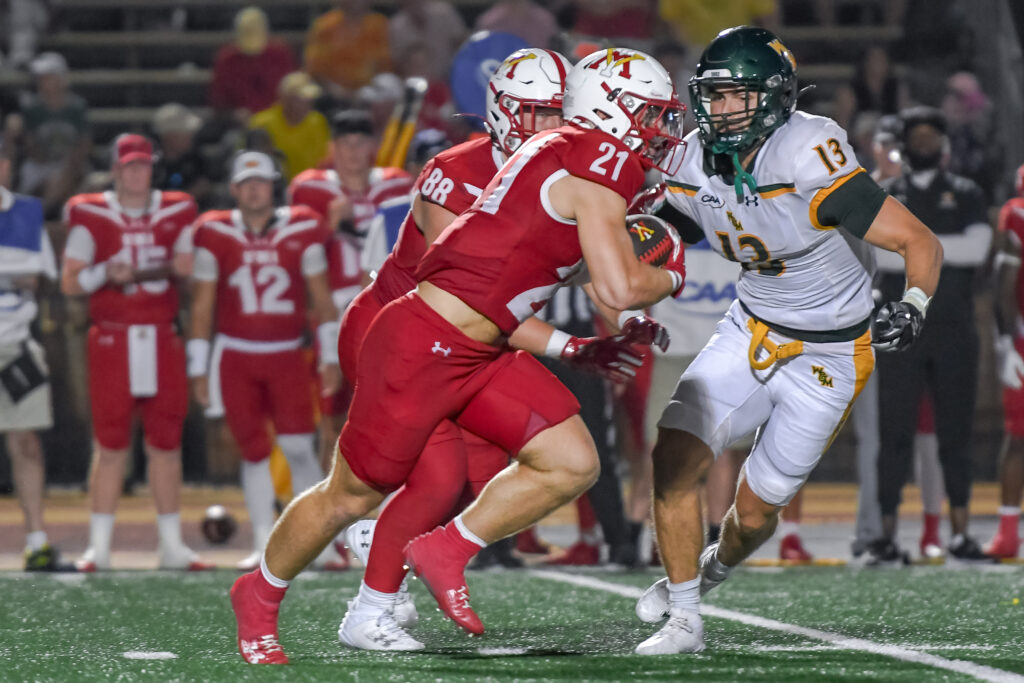
Luke Schalow playing football for Virginia Military Institute.
VMI Football vs. William & Mary Action Shot

“It doesn’t look like just wearing the title and being able to give commands to anybody. That’s not what it is. Instead, it’s to be a servant to them, to figure out what the team needs, and to know the guys on the team and to know what they’re going through, so that you can properly tend to that,” Schalow stated. “Wherever there are problems within the team, or wherever there are problems from the team, to on the hill, that’s where we’re really the liaison.” 

He said he acts as the bridge from the team to other parts of VMI.  

“It’s to solve problems for the team and to keep ourselves to a high standard so that we can be successful on the field. That translates to every aspect of VMI, because how you do anything is how you do everything. As a captain, your job is to set the standard and to encourage others to do the same … to be with them and to help them when they’re struggling to meet that standard,” he said.  

He credits his foundation with God to get him through the day. 

“I’m just not that strong on my own,” he commented. “It’s just the personal relationship with Him that’s really what’s carried me through it all. And then with that as the foundation, I would say that you just need grit. Things are never convenient.” 

Schalow explained that everything at VMI is regimented — time is sectioned off, but there’s always some give and take to be had.  

“You’ve got to be early for things,” he admitted. “There’s no excuse to not be there. There’s no excuse to not make it to something, or to not be in the right uniform or something like that. What you have to do is just manage that. Sometimes you just have to take a deep breath and recognize this is VMI, and it’s just what you have to do.” 

He also leans on his brother rats to get by. 

“The guys on the team are my brothers, especially the guys in my class, we’ve been through everything together,” he said. “The guys on the team, the fellow believers, it’s the bond that we have. Being a Christian, going through VMI, being an athlete at VMI, we understand what each other are going through. 

“Having those guys to carry my burdens and to being able to hopefully carry theirs as well, that’s the way to manage it. That’s been the lifeblood, having fellowship with those guys and leaning on them,” he continued.  

Schalow is set to graduate in December but walk in the May ceremony. He plans to work for Whiting-Turner Contracting Company out of Chesapeake, Virginia. 

Honors Week: Analyzing U.S. – China Conflict Asymmetries

John Kennedy ’25 used his Virginia Military Institute Honors Week presentation to tackle how asymmetries between the United States and China shape the potential for conflict in his thesis titled, “Asymmetries Between the U.S. and China in the Context of Conflict. 

Kennedy, an economics and business major, will marry after graduation and commissioning, before heading to Fort Moore for infantry officer training. 

“I started VMI the same week Abbey Gate was bombed during the Afghanistan withdrawal,” Kennedy said. “That moment made it clear to many of us that peace isn’t guaranteed. I wanted to examine what future conflict could actually look like, especially with China.”

Kennedy focused his research on China’s conventional military capabilities, strategic doctrine, and economic leverage.  

“Public rhetoric makes China seem like a looming military threat,” he said. “But my research suggests that their economic power may be the more serious concern.”  

“Cadet Kennedy has done a remarkable job of taking a very large topic and reducing it to its bare bones,” Col. Atin Basuchoudhary, Kennedy’s faculty advisor, said. “He has combined various elements of his learning experience to answer his thesis question.” 

The thesis process began during Kennedy’s 2nd Class year with topic selection and continued through a series of formal submissions. Most of his work was done this spring.  

“I spent about three hours a week on it, mostly reading and refining ideas,” he said. “The Rat Line made it tough to make real progress last fall.” 

Kennedy says he’s gained both insight and perspective through the process of his thesis.  

“This research helped me think critically about the reality behind the headlines,” he said. “It’s easy to be alarmed by military posturing, but understanding the economic side gives you a fuller picture.” 

Kennedy also acknowledged the importance of mentorship throughout the project.  

“I want to thank Colonel Basuchoudhary and Colonel [Spencer] Bakich for their guidance,” he said. “Their support helped make this project possible.” 

The Vanguard — John Gibson ’26

The Vanguard series highlights cadets of Virginia Military Institute who exemplify promise, perseverance, and the true spirit of leadership. While they may not be the top-ranking students or those in prestigious positions, these individuals’ dedication, resilience, and growth embody the essence of being a VMI cadet. By sharing their stories, including the challenges they’ve faced and overcome, we shine a spotlight on the diverse paths to success at the Institute, proving that leadership and excellence come in many forms. 

High school was a breeze for John Gibson ’26. He thought coming to Virginia Military Institute, he wouldn’t have to put in any extra effort. 

Except, he was wrong.

“My GPA the fall semester of my rat year was just atrocious,” he explained. “I thought I’m having so much fun here, being a rat with my friends, taking these classes, that I can’t really afford to lose it just because I’m not willing to do my homework. I need to do the work. That spring semester, I just really put the axe to the grindstone and did the work. Then I fell in love with doing the work as well.” 

He was drawn to economics and business as a major because it applies to a lot in his life. 

“I’d say it’s applicable to everyone’s lives,” he stated. “Whether it’s you’re learning about inflation rates or unemployment, you can read the news and understand it.” 

As his classes went on and became more major-focused, his interest and devotion to learning grew. 

He said his classes became more competitive and his professors found interesting ways to engage cadets. In his business finance class with Col. Jeffrey Smith, they’re presented with academic sporting events. Gibson explained that the approach to these events is not to be seen as studying for an exam but working hard and treating it like a race. He said switching the way he thought about preparing for it was more geared toward steady preparation. 

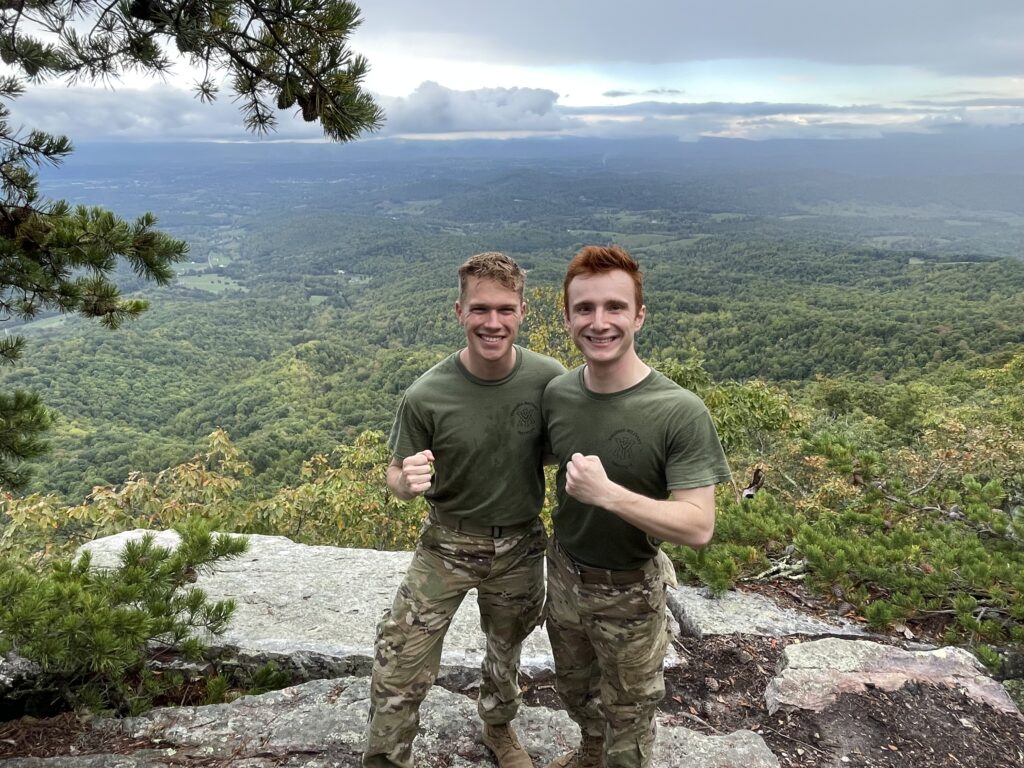
John Gibson atop House Mountain in Lexington during a hike with the Corps of Cadets at Virginia Military Institute.

“I think of it as practicing for the exam in the same way as when I go for a run,” he explained. “I’m not just running to tire my legs out, but it’s to prepare for my upcoming race. It’s like building endurance in both instances.”

Col. Samuel Allen, professor in the Department of Economics and Business, said Gibson is thoughtful and good at asking questions that will help him, along with the rest of the class, better understand the content. 

“John shines without taking the spotlight away from anyone else,” Allen said. 

Allen said he saw great promise in Gibson when he was on the Rat Line and it was a challenging first semester.  

“The rigors of being a rat knocked him down, metaphorically, yet he rebounded, redoubled his efforts, and emerged committed growing as a scholar,” Allen said.

Gibson said he knows the difference between when it’s time to work and time to play.  

“I’ve become a much harder worker, and not just because I have to, but now I enjoy hard work,” he admitted. “When I matriculated, I was lazy. But with one of my brother rats, we joke about how we have figured out how to use all 24 hours of our day.” 

Gibson tries to stay as involved as possible, with participating in cadre for Charlie Company and working at the Miller Academic Center. 

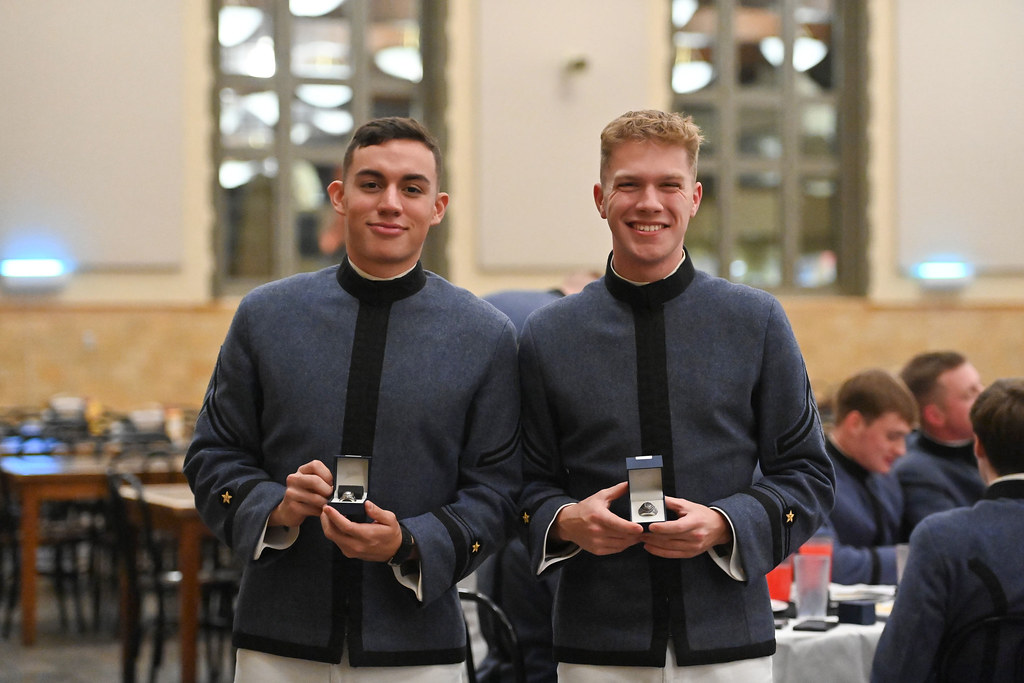
John Gibson shows off his Virginia Military Institute ring.

“I try and interact with as many people as I can,” he said. 

Capt. Meghan Ferguson, academic support coordinator at the Miller Academic Center, said Gibson is a highly sought-after peer tutor. This year he’s conducted nearly 50 tutoring sessions, she said. He also serves as the cadet facilitator for a health and performance wellness group study session.  

“Through his work for the Miller Academic Center, he exemplifies both exceptional leadership and academic achievement,” Ferguson said. “As a further example of Gibson’s leadership, he has guided a struggling new cadet to the Miller Academic Center for advising and academic support. Cadets have great influence over one another, and we appreciate Gibson’s mentorship and promotion of our academic services. When he observes concern or struggle, he provides resources, support, and a plan of action. We are thankful that he uses his academic skills and leadership for the benefit of others.” 

Honors Week: Cadet Looks at U.S. Debt

American investor and philanthropist Warren Buffett said, “It’s never paid to bet against America. We come through things, but it’s not always a smooth ride.” Harrison Williams ’25, a cadet at Virginia Military Institute majoring in economics and business, researched the wisdom of investing in the United States for his honors project, “Sustainable Debt Limit Estimates for the U.S. and 20 Other OECD Countries.”

The goal of Williams’ project was to estimate the debt level of the U.S and how much money the country can continue to borrow before a default occurs.

Williams opened his presentation by reminding his audience that the nation was founded in 1776 with the idea of the American dream, allowing people from all over the world to immigrate to the foundling nation, start businesses, and grow wealth to provide better lives for themselves and their families. “One way to grow your wealth in the U.S. is by investing in stocks and bonds. U.S. bonds provide a guaranteed return on investment because the U.S. has never defaulted on debt. However, this guaranteed payment on U.S. bonds may not last forever. The U.S. currently has $36 trillion in gross debt. This is more than the combined debts of China, Japan, France, Germany and the United Kingdom (UK). How much is $36 trillion? Thirty-six trillion one-dollar bills stacked on top of each other will reach the moon and back over nine times, spanning 2,200,000 miles. That’s the distance of traveling from Lexington to San Francisco and back nearly 500 times. To put it in another perspective, between 2020 and 2024, the U.S. government spent $320,000 every second,” Williams stated.

He pointed out that when a country’s interest payments on debt begin to exceed its defense budget, that marks the beginning of the end for that country, and that happened for the United States in 2024. “If you look at countries or empires like the Ottoman Empire, Great Britain, Spain, and France, the beginning of their demise started as soon as their interest payments on debt began to exceed their defense budget. So why is this important? If the U.S. defaults on its debt, the beginning of one of the most catastrophic economic disasters since the Great Depression will occur,” predicted Williams.

His research was based off a paper released by the American Enterprise Institute (AEI) from September 2024, in which the debt limits for the U.S. and 26 other countries in the Organization for Economic Cooperation and Development (OECD) were calculated. “OECD countries are generally considered high-income economies, European countries, Canada, Japan, the UK, and the U.S. I modeled my equations off of that paper, but the main difference between mine and theirs is that they covered a different time period. Their debt limits included variables spanning from 1984 to 2022. My data covered 1996 to 2022. The AEI paper used 26 OECD countries, I only used 21 due to data limitations. I also took the U.S. out of the sample because the U.S. is the greatest economy in the world, so its numbers have a great impact in the sample. With the U.S. taken out of the equation, the debt limits for each country decreases,” explained Williams.

After running a series of complex calculations, comparing gross debt and net debt, Williams completed his research. He shared his concern for the U.S. economy at the conclusion of his presentation. “This debt ratio hasn’t been this high since World War II, and if it’s already this high, what if the U.S. gets in World War III today? Will we be able to afford to fund it in the long run? That is troubling.”

Maj. Steven Landgraf, assistant professor in the Department of Economics and Business who served as Williams’ advisor on the project, stated that a few studies in this field have been criticized for lack of reproducibility. “The fact that Harrison used similar methods and confirmed some results of past research is valuable, but his work also shows that economists should be more careful about using U.S. data to calibrate models meant to inform non-U.S. countries.”

Williams is the son of Lang and Lucy Williams of Norfolk, where he graduated from Norfolk Collegiate School. Following graduation, he hopes to go into the field of finance and eventually become an entrepreneur.  

Behind the Balance: Cameron Thomas ’27 — Keydet Men’s Track and Field

Virginia Military Institute’s cadet-athletes have to juggle cadet life, heavy academic course loads, and their NCAA Division I sport. Committed to both academic and athletic pursuits, balancing their rigorous schedule in both sports and school requires a certain level of commitment and discipline. Behind the Balance is a series that focuses on those cadet-athletes and how they handle the hurdles of the day-to-day. 

College was the last thing on Cameron Thomas’ ’27 radar in high school. Instead, he was looking to enlist in the military once he graduated. That was until he started track his junior year, specifically competing in pole vault. 

Thomas admits he used to fear heights, but now catapulting over the pole is no big deal. Instead it’s something he highly excels at. Recently, he broke a more than two decade old Virginia Military Institute record for pole vault for indoor track and broke the record last year for outdoor track. In 2024, he also won the pole vault individual title at the SoCon Championships for All-SoCon recognition. 

“Pole vaulting is a very mental sport so staying calm and focused is crucial to competing at this high of a level,” he explained. “Trusting the process on one day that you have practiced for the entire year can be very stressful, especially in front of a large audience.” 

To combat that, he’s come up with breathing techniques and nutrition plans for the days leading up to competition.  

“As long as you do as much as you can to prepare yourself, everything you do on that day during competition should feel easy and effortless,” he said. “My best days are ones where I’m not forcing anything. So, in a way pole vaulting on competition day should just feel like a run and jump; everything else is irrelevant.” 

Keeping stress down and staying organized are ways he stays in the zone.  

Cadet-athletes at VMI not only have their responsibilities with their selected sport but cadet duties on top of that. Cadets are also required to take physical fitness classes twice a week, participate in ROTC all four years, prepare for room and uniform inspections, practice for parade, guard duty, and more.

Taking 16 and a half credits as an economics and business major, Thomas says this is a lighter load than he had last year with over 18 credits. His days usually start at 6:30 a.m. when he gets up and heads to breakfast. This semester he has classes until noon, which allows him several hours to complete any class assignments.  

“The schedule I have right now is really nice because right after my classes, that’s what I’m the most focused,” he explained. “So, getting right into my homework, I can get pretty far ahead.” 

Sometimes, he can fit in a power nap before heading to practice at 4 p.m., which lasts until 7 p.m. He eats at 7:30 p.m. then studies until he’s ready for bed, which he has a pretty rough stop at 9:30 p.m. 

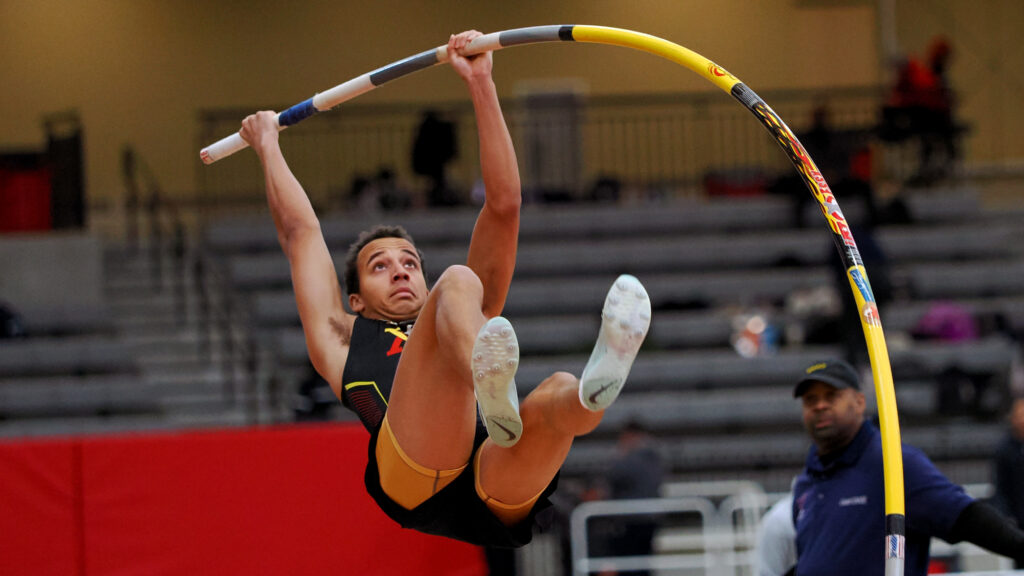
Cameron Thomas pole vaulting during a track and field meet for Virginia Military Institute.
VMI Team Challenge track and field meet at the Corps Physical Training Facility in Lexington, VA January 11, 2025. (Randall K. Wolf)

“I had a bad habit last year going to bed at like 10:30 p.m. because that’s when taps is, so it’s like the average bedtime. But I realize if I get way more sleep, I feel a lot happier,” he said.  

Originally, Thomas was a biology major. Enrolling in the Summer Transition Program prior to matriculating, he took a class with Col. Wade Bell, but instead of focusing on biology, Thomas was trading stocks.  

“He would always laugh at me because I’d be in the back of the class just yelling whenever I make money,” he said. “He really prompted me to go toward the economics and business major, because I didn’t even know that was the thing.” 

Thomas said he is interested in learning how the economy works, especially this year with his more major-centric classes that are focused on it. He said in high school he was stock trading.  

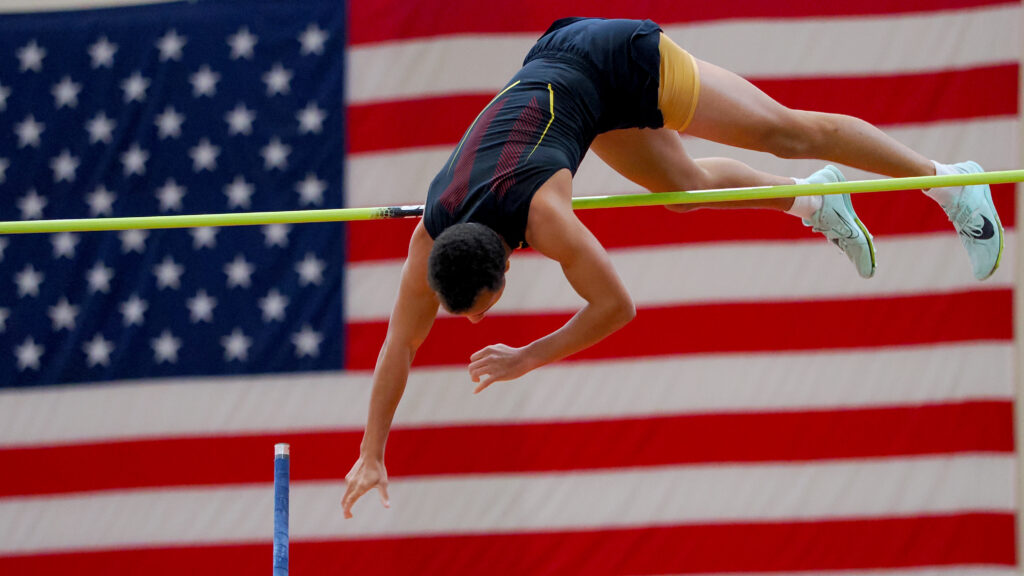
Cameron Thomas pole vaulting during a track and field meet for Virginia Military Institute.
VMI Team Challenge track and field meet at the Corps Physical Training Facility in Lexington, VA January 11, 2025. (Randall K. Wolf)

“I got really obsessed with stock trading and learning how numbers work. I’ve always been a math guy as well, way more than writing or reading,” he commented “I like making money or sometimes losing money. You know, it’s all process.” 

Coming to VMI was a process for him as well, especially learning how to adapt to a strict schedule. 

“I think I’m a lot more mature since I’ve been here. Before I was doing things like staying up late, and not really thinking about how my days coincide with each other on like a day-to-day basis,” he admitted. “I’d always wait to do my work until the last minute. Now I realize that getting it done early is going to be easier in the long run.” 

He’s also committed to his daily practices at track. 

“It was very difficult when I first got here during the Rat Line, because we also had the other stuff. Like last year, I kind of went down with my progression, because I was doing push-ups before the meets, I was marching in new boots and walking in low quarters. A lot of stuff to get used to.” 

He’s learned how to hold himself accountable. His growth in understanding responsibility will help him in the future, especially with dreams of joining the World Class Athlete program with the U.S. Army. Currently, he’s seeking to commission into the Army. The program enables athletes to train for the Olympics. If that doesn’t pan out, he’s looking to be part of the Finance Corps in the Army. 

Study Abroad: A Spanish Summer for VMI Cadets

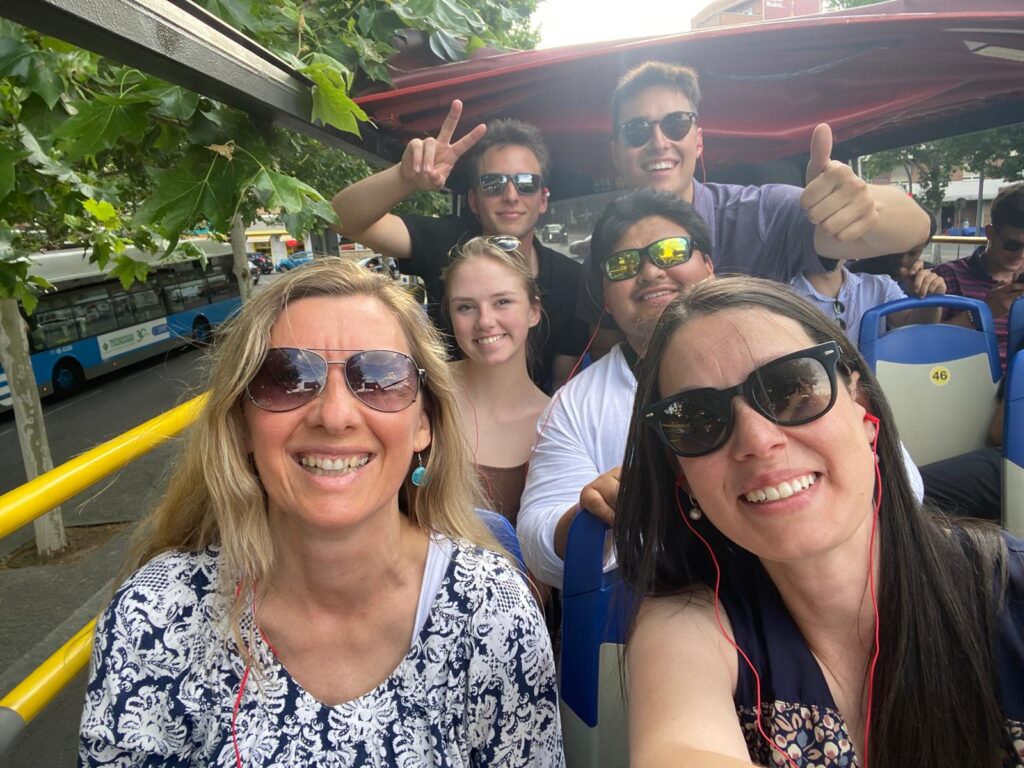
Trips to Barcelona, Granada, Madrid, and more were just the perks for a group of Virginia Military Institute cadets this summer. 

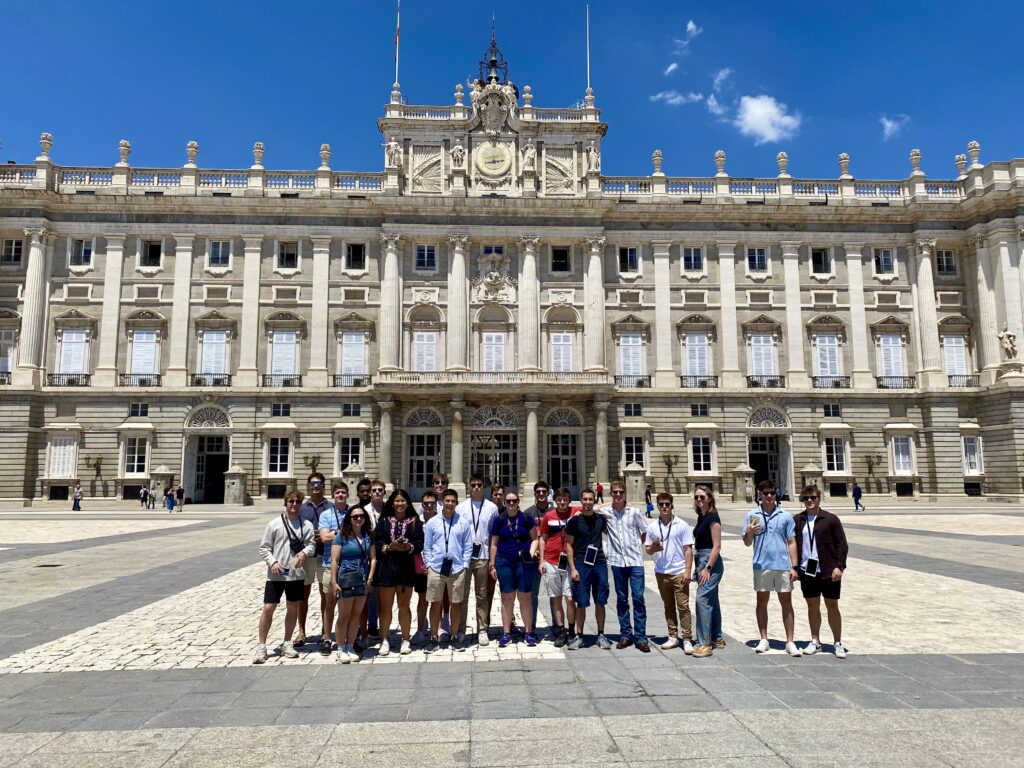
Nearly two dozen traveled to Spain this summer for a study abroad program, with varying majors and minors represented, from economics and business, modern languages, history, computer science, engineering, and more.  

The five-week program allowed cadets to take three classes at the Universidad de Alcalá in Alcalá de Henares near Madrid. They were enrolled in two Spanish classes taught by the university professors and an economics elective class, which was taught by VMI’s Col. Valentina Dimitrova-Grajzl, professor of economics and business.

“Study abroad programs are important because they humanize the rest of the world and introduce the students to new ideas and different ways of living, working, and interacting,” she said. “In a world of so much polarization, such programs can be a bridge for better understanding and cooperation.” 

Dimitrova-Grajzl said cadets are able to develop an open-mindedness about the world by participating in study abroad programs like this one. She said it was rewarding to see how each cadet’s knowledge and worldviews were expanding and changing organically.  

“Students experienced how the definition of economic and social well-being can differ across countries and cultures, how the architecture and design of cities can incentivize people to be active and socially integrated, and how the structure of a workday varies based on geography and climate,” she said.  

The program was put together by Dr. Sabrina Laroussi, associate professor of Spanish in the Department of Modern Languages and Cultures, who has led the program for the past six sessions. Laroussi said she gets immense satisfaction seeing her students’ Spanish language skills progress.  

“Every student has his or her own strategies to overcome language barriers as they go from being shy to order food in a restaurant or a coffee shop, or purchase something in a store, to making every effort to speak some of the local language to get around, connect with locals, and make friends,” she said. “Even if it is through using plain language or basic Spanish phrases such as ‘Hola’ (hello), ‘Gracias’ (thank you), ‘Un café con hielo, por favor’ (iced coffee, please).” 

Students participate in a study abroad program in Spain.

Firsthand experience and gaining credits 

Connor Franklin ’26 decided to sign up for the Spain study abroad program because he and a friend both needed six more credit hours of Spanish language, plus it was his first time traveling to Europe for school. The economics and business major said the classes were very laid back but interactive. He was able to meander between classes, check out cafes, and enjoy the culture. 

“The experience was awesome; it was the most fun I have had. I learned so much about the culture of Spain and a lot about the European Union,” he said. “It was very interesting to see how people operated throughout their day and also to see how different their priorities were from people from the U.S.” 

Franklin said surrounding himself in the Spanish culture gave him a different way to learn the language.  

“You are surrounded by the language, so you are forced to learn it. To me it is one of the best ways to learn a language,” he said. 

This program allowed Cadlee Jarvis ’26, a history major, to travel abroad for the first time. Taking classes in a foreign country did take some adjusting, he said, especially compared to the structure that VMI has.  

“I think this program is important to have at VMI because it gives cadets the opportunity to travel abroad and learn new information about different cultures,” he said. “It also helps cadets gain new experiences and memories that will last a lifetime.” 

In addition to class time, cadets took trips to Southern Spain (Granada and Sevilla), to Northern Spain (Barcelona), and several day or half-day trips to Madrid to the U.S. Embassy, the Royal Palace, the Prado Museum, and several tours of the city. 

Laroussi said she enjoyed seeing everyone embrace new experiences and step out of their culinary comfort zones.  

“When we visit very touristy cities such as Seville, Barcelona, or Toledo, I always emphasize to students to avoid tourist traps: restaurants on big, popular squares or near major tourist attractions, or restaurants with a menu featuring multiple languages,” she said. “So, at the end of the day, when they tell me that they went to a restaurant where there were only locals, the waiters did not speak English, the menu was entirely in Spanish, and they ordered a local specialty… that is my greatest satisfaction.” 

The students lived in a dorm at the Universidad de Alcalá along with Spanish students and other international students who were taking summer classes in Alcalá. They got to practice their Spanish language regularly since it is a town that is less touristy and provides a very authentic experience of living in a Spanish town. 

Students participate in a study abroad program in Spain.

Suzanne J.P. Leaptrot ’25, an English major, decided on the study abroad program so she could lighten her course load in her final year at VMI. This is her second study abroad opportunity. In the spring of 2023, she did a semester at Oxford. Spending a month in Spain, taking three classes was also the most cost-effective opportunity, she and others said. For nine credits, she only spent $5,400 on the classes, plus the flight to get to Spain. 

“Part of what makes this trip so valuable is the weekend trips we took. One thing I kicked myself for when I was in England was not traveling more and seeing the major England things. This trip took all the planning and energy out of my hands and took me to the major Spanish sites, and I’m so glad it did,” she said. “Alone, I never would have gone to the Picasso Museum in Barcelona, which was my favorite of all the places we visited.” 

Thanks to taking an immersive language class, Leaptrot was forced to figure out ways to describe things when the vocabulary in the other language is limited.  

“For example, toward the end of my trip, I was looking for Post-it notes at a grocery store and I did not know the word, so I asked a worker if they had sticky papers to take notes in books, the worker understood and told me where to go to find them. Three hours a week in a classroom just does not compare to an immersion class,” she said. 

Colton Jones ’26, an international studies and political science major with a minor in national security, was intrigued by the program after seeing posters about it around post. A driving factor in going was so he could knock out his Spanish requirements, while being able to apply what he’s learning in real-time situations. 

“It gives cadets a chance to really focus on their Spanish studies in a way that are unable to when they are at VMI,” he said. “They also get to experience a different culture and it may open their eyes to new experiences and new things that they otherwise never would have seen.” 

From VMI to Private Equity: Warner Collier ’24

This article is part of The Next Step series. While the four years at VMI are designed for cadets to push themselves academically, physically, and mentally to tackle the demands of life at a premiere military college, they also prepare cadets for life after graduation. Whether that life be one in the military or one in the private sector, VMI faculty and staff provide guidance to cadets along their journeys. One department specifically dedicated to that endeavor of post-Institute success is the Office of Career Services. In The Next Step series, we highlight cadets preparing to enter the workforce after graduation, as well as those still in the midst of their cadetship preparing for internships over the summer. 

Business and computer science were two industries that Warner Collier ’24 saw opportunity in. Coming to Virginia Military Institute, he wanted to cast as wide of a net as possible, which brought him to major in economics and business, with concentrations in decision analytics and financial analysis, along with computer science and cybersecurity minors.  

“As I progressed through rat year, I knew I wanted to work in finance after joining the Cadet Investment Group,” he said. “I did more research on careers in finance and gravitated towards private equity.”

Hailing from Midlothian, Virginia, recent graduate Collier is now set to work for Civitas Growth Partners as an analyst.  

“I will be involved in all aspects of the deal sourcing process,” he said. “This will include identifying and reaching out to potential investment opportunities. Also, I will analyze company financials, KPIs, build out financial models, and communicate key insights. Lastly, I will sit in on portfolio company board meetings and monitor the financial and operating performance of the portfolio companies.” 

Coincidentally, Collier said this was the first job he applied for.   

 ”I wanted to work for an organization which aligns with my moral values. For the same reason I chose VMI, I wanted to be a part of a firm which believes in doing things the right way,” he said.  

Working for a small company like Civitas was what was most attractive to Collier. He said it would allow him to have more learning opportunities and contributions.  

“I was drawn to private equity as I enjoy analyzing companies, figuring out what makes them work, and implementing strategies which yield real results,” he said.  

He believes that having VMI on his resume aided him in landing this job.  

“The number one reason Civitas hired me is because they know they can trust me. The foundation of VMI, honor, is the competitive edge I have over others,” he said.  

VMI has taught him to be comfortable in the uncomfortable. 

“VMI puts you in high stress situations which give you valuable tools that translate to the workplace. I’m confident in my abilities and work ethic due to VMI,” he said.  

Striving for Financial Advising Success: James ‘Alex’ Baber V ’25

This article is part of The Next Step series. While the four years at VMI are designed for cadets to push themselves academically, physically, and mentally to tackle the demands of life at a premiere military college, they also prepare cadets for life after graduation. Whether that life be one in the military or one in the private sector, VMI faculty and staff provide guidance to cadets along their journeys. One department specifically dedicated to that endeavor of post-Institute success is the Office of Career Services. In The Next Step series, we highlight cadets preparing to enter the workforce after graduation, as well as those still in the midst of their cadetship preparing for internships over the summer. 

Gaining real world experience was a high priority while attending college for James ‘Alex’ Baber V ’25. The economics and business major from Richmond, Virginia, landed an internship at Tandem Investment Advisors, headquartered in Charleston, South Carolina, for the summer. 

He’s known about Tandem since his 3rd Class year and started his interview process last summer. 

“After meeting the employees, I knew that Tandem was a great fit for me and would give me the ability to develop my technical skills,” he said.  

This summer he will be working closely with the investment team, where he will be researching companies by analyzing their financial statements, then presenting his research to the team.  

“Although it will be a lot of work, I am excited to do something that will have a real impact on others,” he said. “There definitely is a little bit of pressure that comes with that, however, I think that is the best way to develop.”

Last summer, Baber interned at Capital Wealth Planning, giving him great experience and pushing him to attain another internship for this summer.  

“The people at Tandem are what drew me to choose them,” he said. “It is a very solid group of people, and they pride themselves on their work and their strategy. I knew that I wanted to work somewhere that I could be proud of, and Tandem is exactly that.” 

Baber credits VMI for giving him opportunities, while instilling a sense of personal honor and responsibility. He said that when a company hires a VMI cadet, they know what they’re getting — an employee who can operate under pressure, who is trustworthy, accountable, and hardworking. All of these are qualities developed at VMI, Baber said, setting a cadet apart from other candidates.  

“I also think this school teaches perseverance, not just as a rat. The day-to-day here isn’t always easy, however learning to overcome challenges will only benefit me,” he said. “I think that the small things like waking up early, having a clean appearance, and being on time are all things that cadets take with them after graduation. These are the qualities that differentiate VMI from other schools.” 

He also said his namesake is an inspiration for his career path in economics and business.  

“My grandfather, the third and my dad, the fourth both had a huge impact on me growing up. I learned about the importance of work ethic, honesty, and building relationships,” he said. “At the end of the day, they drive me to be a better version of myself, and to bring pride to our name.” 

His goal, after graduating VMI and in the next 10 years, is to be a financial advisor with his own book of business.  

“Growing up I had the opportunity to watch my father help others by advising them, and the impact that he had really stuck with me,” he said. “I always wanted to work in the financial industry, but as an advisor you really can forge relationships. I want to be able to help others and be proud of what I do every single day.” 

The Cadet Collective: The Kleinschusters

Virginia Military Institute requires structure and dedication. It also becomes a place where bonds are created that can last a lifetime. Maybe it’s a professor, a coach, or a fellow cadet. No one makes it through VMI alone. The Cadet Collective tells the stories of those relationships that help pave the way for success. 

Matthew Kleinschuster ’26 tagged along to college tours with his brother Jacob “Jake” Kleinschuster ’24, so he got an inside look at whatever places his brother was interested in. Virginia Military Institute wasn’t the immediate choice for Jake, but his senior year of high school he was decided.  

They kept it in the family. Their grandfather, also Jacob, Class of 1964, attended VMI.  

“Seeing him have his buddies over all the time, telling the Rat Line stories … I’ve always wanted something like that with a group of guys I can live life with,” Jake said. 

Jake didn’t pressure Matthew in picking VMI, but he was really gunning for him to.  

“When he did decide, I was very excited that he came here,” Jake said. “I enjoyed being the older brother for the Rat Line because I knew what was coming up for him. Also, I could have some of my other friends go pay Matthew a visit, which was great. Being able to see Matthew go through that, knowing what the weeks and days to come for him would be and get to kind of mess around with him here was really enjoyable for me, but just solidifying our relationship.” 

It wasn’t even a question when Matthew had decided where to attend. 

“Having my brother here was definitely a perk,” Matthew said. “It was nice to know where I’m going to go, I already have a guaranteed friend. We were best friends growing up.” 

The two have always been close — sharing a room growing up, starting a landscaping business during the first year of the COVID-19 pandemic, where they’d work together every afternoon. Their relationship grew as they spent more one-on-one time together as young adults.  

“Fast forward to college. Once I got to the Rat Line, he was always shooting glances here and there kind of encouraging me. Then after the Rat Line, we did Ranger Challenge, which was a lot of fun,” Matthew said.  

He said they wake up and work out together, attend classes, and more.  

“It really solidified that friendship. And that’s what I think kind of encapsulates our relationship,” Matthew said.  

Jake said his friends have become Matthew’s friends and vice versa, making a larger family unit for them both on post. 

“We’re like the glue that links everybody together, because we’re brothers and I’m hanging out with his buddies now,” Jake said. “Having a brother here has been really special because I get to see those friendships I’ve made with my brother rats, but also at the end of day I get to share everything with Matthew.” 

Matthew was intimidated to come to VMI, especially after his brother. He said that Jake had made a name for himself here. 

“Jake definitely excelled here. He made a big name for himself,” Matthew said. “Coming in, I was nervous. It’s hard to hide the last name Kleinschuster. I felt like I had targeted my back. But after a while, I realized at the end of the day, VMI wants you to become your own man.” 

Matthew said having his brother here served as a form of encouragement.   

“I have big shoes to fill, but someone behind me who’s going to support me, whatever I do,” Matthew said. “That was probably the biggest motivation of having a brother here. Not the nerve-wracking and being nervous of not living up to his title, but just knowing no matter what happened, I had someone in my corner.” 

The brothers say after their time at VMI, their relationships will continue to strengthen after having shared the camaraderie of going through the same experience. They even have corresponding majors. Jake, an economics and business major with a math minor, and Matthew, a math major with a business minor. The two plan on entering the U.S. Army after graduating — another shared bond that will continue.  

“We’ll continue to make connections there. Then when I go to the Army, I’m excited to do the same thing,” Matthew said. “We get different furloughs off, come back and hang. The more and more we experienced separately, the more we get to share together, which I’m excited about.” 

Jake said that having Matthew at VMI made him appreciate the small things and not take any day for granted. 

“Knowing that in a few months I’ll be gone for a handful years and just taking these days, slowly enjoying the time to spend with Matthew,” Jake said. “Being here studying, being able to go to the gym with Matthews is a blessing.” 

For Matthew, it’s served as a motivation.  

“It’s fun to know that whatever happens, my brother’s going to support me,” Matthew said. “I push myself every day to be better than Jake, which is pretty difficult, but it’s fun to try and strive for. And he encourages me in all aspects. He’s always behind me, motivating me and then vice versa. We’re kind of pushing off each other.” 

Jake said they’ve created a bond that many admire. 

“When our friends see our relationship, it’s a fun special relationship that I think they look up to,” Jake said. “Being able to just create that big group of guys, everyone just getting along and hanging out regardless of where they came from. It’s been fun.” 

After Jake graduates in the spring, Matthew said he’s not looking forward to finding a new routine without his brother on post.  

“I’m going to continue making a name for myself and lead,” Matthew said. “I’m excited to see what that looks like when he’s gone, when I don’t have that guy in my corner. I’m not too worried knowing that I’ve got other guys in my corner just for me, but I’ll miss him. I’ll need to find another gym partner, another study partner. But, I’m excited for him and I’m excited to see where I go and do my thing.”