Post View Unavailable »
New Website Launched »

Behind the Balance: Ty Swaim ’24 — Keydet Baseball

Ty Swaim ’24 didn’t want a lot of debt coming out of college and he knew one way for him to attain a good education was through a baseball scholarship. Virginia Military Institute wasn’t even a place he was thinking of until he was recruited to play for the Keydets. 

He said ultimately, he based his decision on attending VMI for the opportunity to play baseball, the trust he had with the coaching staff, and the expectations they had for him. But also, it was based on the financial opportunity it presented.  

Coming from a lower income household, he knew he had to get some sort of financial help, which he was able to with a combination of a baseball scholarship and financial aid. 

“Coming in here, it was the closest thing to a full scholarship that I could have gotten, especially for baseball, which is extremely tough to get,” he said.  

He also knew choosing to pursue VMI’s economic and business degree would work greatly for him.  

“The degree has a huge weight and significance,” he said.  

Being able to continue his love of baseball was a plus. His grandfather played professional baseball and his parents were heavily involved in athletics.  

“I feel like I always had a T-ball bat or a plastic bat in my hands,” he said. 

Playing sports has always been in his inventory.  

“It just so happened that baseball was the only one I was half decent at,” he joked. “If I wanted to go to college, it was the only one that I was good enough to play Division I, so that’s kind of how that worked. I love baseball more than anything.” 

Swaim was drawn to baseball because of its competitiveness, combining both a team sport aspect and individual skill – competing as an individual on a team basis.  

“You’re working with your teammates, but a lot of it boils down to individual things where you have the bat on your shoulders,” he said. “You have the ball in your hand where you can get the job done. I know from a hitter’s perspective, when you’re in the box, you’re kind of in a war with the pitcher. It’s just you guys. When you’re on defense, when the ball’s hit, it’s a team sport. You can go help out your pitcher, you can go make a play.” 

Cadet-athletes at VMI not only have their responsibilities with their selected sport but cadet duties on top of that.  Cadets are also required to take physical fitness classes twice a week, participate in ROTC all four years, prepare for room and uniform inspections, practice for parade, guard duty, and more. 

Days start early for Swaim, especially when he’s in season. He’s up most days at 5:15 a.m. to lift weights from 6 to 7:15 a.m. Then he rushes to grab breakfast to-go, so he can head back to his room, shower, change, put his hay up, and get ready for class.  

His schedule varies for certain days — Tuesdays and Thursdays he has class at 8 a.m. Wednesdays and Fridays, he doesn’t have class until 12:35 p.m. He uses his time wisely, though. On his free mornings, he spends them completing homework to get ahead, because he’s usually down on the field for more practice by 2:30 p.m. daily. 

This last semester is a bit different than years past. His previous years had been back-to-back classes then straight to practice. Now, as a 1st Class cadet, he’s given more of a break. 

His goal is to finish his homework during the week, so he can travel on the weekends or play at home for baseball.  
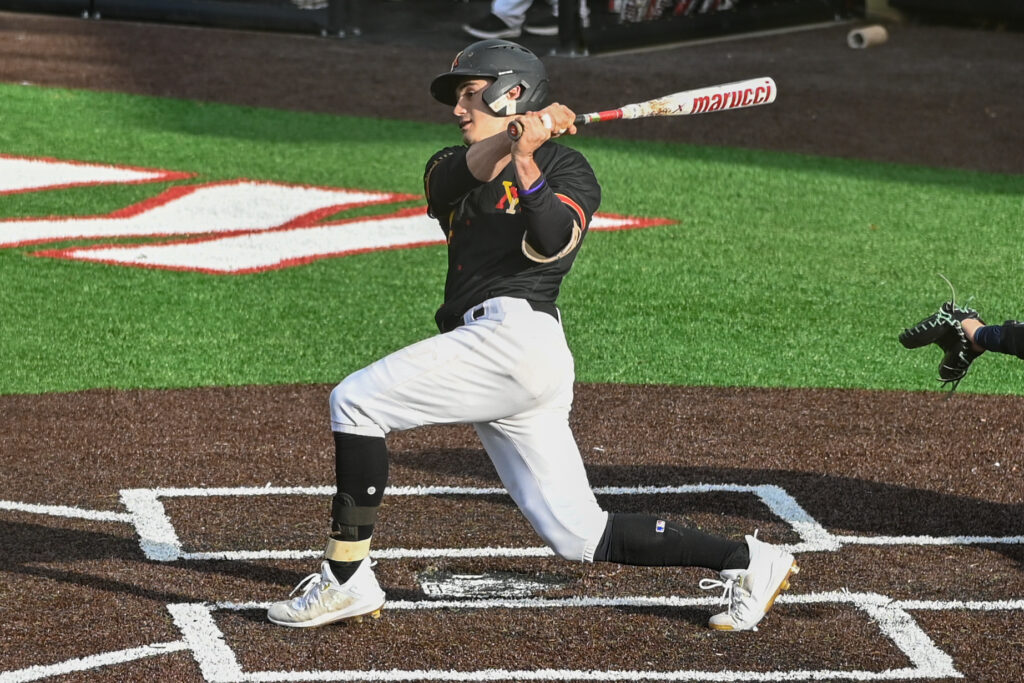
Ty Swaim swings a baseball bat during a Virginia Military Institute baseball game.

“I try to set up all my schoolwork to be done within that week because I know on the weekends, I just want to focus on baseball,” he said. “I know my brain is not going to be in the classroom, so I do all my schoolwork during the day.” 

His top priority right now is finishing strong for baseball. He feels that VMI has prepared him to come out on top in his sport, but also has prepared him for whatever life throws at him after graduation in May. 

“The busier I am, oddly enough, the better I am. This school doesn’t really let up,” he said. “The schoolwork in the past has been extremely tough … when you have three tests a day, it gets crazy. When I was super busy with really hard classes and heavy course loads, I ended up getting better grades because there was absolutely zero time for free time. Sometimes I think I work well in that just because when I do get free time, I tend to slack off.” 

He doesn’t take those slivers of days off for granted. His time at VMI has taught him to savor the downtime and treat it as a reward for working hard, and to acknowledge stress not necessarily being a bad thing.

“Having stress isn’t bad, just being able to understand the stress and use it,” he said. “I think stress gets a bad rap, which obviously when you are stressed it’s terrible. Everything brings you stress. But it gives you things to do, keeps your mind busy and things for you to work on. If there was no stress at all, I don’t know that would be a very fun world to live in. No challenges to get over, there’s nothing to focus on, there’s no goals to meet.” 

Swaim admits he still has room to grow and isn’t quite sure of his next steps following graduation. But, VMI has created a great path for him. 

“I think I’ve matured a lot since I’ve been here. Of course, I think there’s still so much more I can learn,” he said.  

His priorities for the spring — baseball and living in the moment. This is his last chance to play on a large scale. 

“I really want to focus on baseball and just ending on a good note. I have spent so much time in my life on it,” he said.  
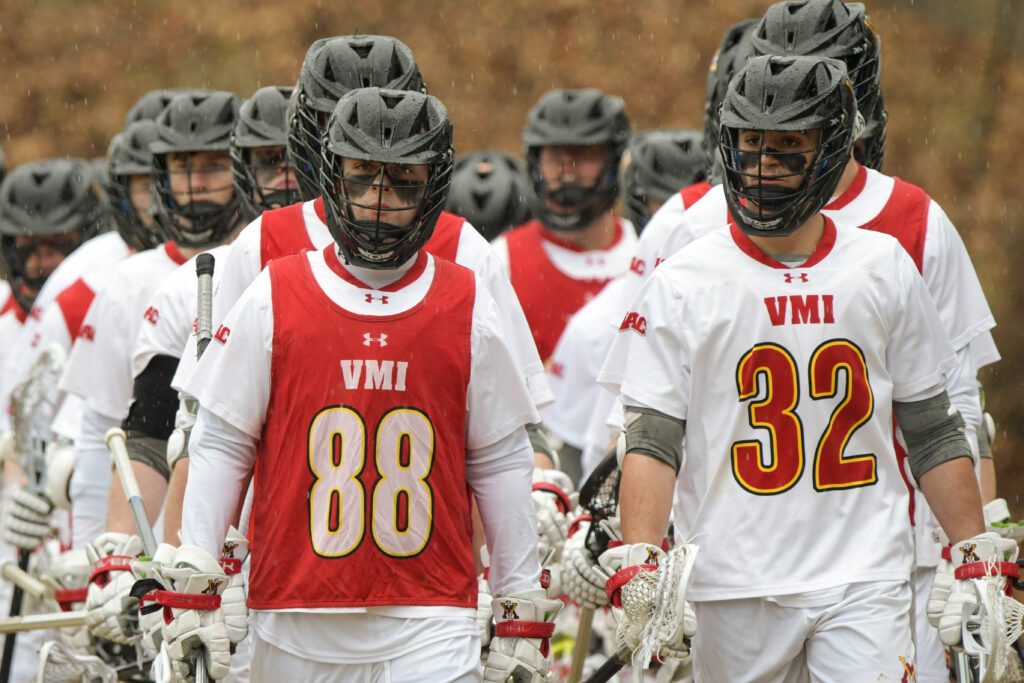
Behind the Balance: Kyle Webster ’24 — Keydet Lacrosse

Virginia Military Institute’s cadet-athletes have to juggle cadet life, heavy academic course loads, and their NCAA Division I sport. Committed to both academic and athletic pursuits, balancing their rigorous schedule in both sports and school requires a certain level of commitment and discipline. Behind the Balance is a series that focuses on those cadet-athletes and how they handle the hurdles of the day-to-day.    

Leadership and regiment have been ingrained into Kyle Webster ’24 since beginning his time at Virginia Military Institute. Choosing a military college wasn’t his first choice, but with an offer to play lacrosse and a best friend from home also attending, those were big incentives.  

He’s been playing lacrosse since he was 7 years old. 

“I fell in love with it,” he said. “It’s a fast pace. People say it’s the fastest game on a field. The physicality and the thrill of scoring a goal or picking up a big ground ball is just awesome.” 

Going to high school in Alexandria, Virginia, he played in one of the top three high school conferences in the country. The sport was incredibly popular in his area, but he was the first in his family to play it.  

For his 1st Class year at VMI, Webster was voted as one of the team captains, alongside A.J. Stamos ’24 and Diego Markie ’25.  

“I’m anywhere from motivation of the team to just checking in on guys,” he said about his role as captain. “I try to make sure that I have a great relationship and a friendship with every single person on the team. I can be that guy that anyone can come to for their problems or just want to talk. I’m trying to lead on the field, by example, and play the right way.” 

Webster and Stamos grew up and have played lacrosse together since they were kids. Webster said it’s been a big motivation, having a friend like that on the team. 

“It was kind of cool to have that full circle moment, since we’ve both played lacrosse together since we were seven. Then we come to college and we’re both captains,” he said.  

In his last semester, he perfected the balance of academics and athletics. Although, he admits it was challenging. 

Cadet-athletes at VMI not only have their responsibilities with their selected sport but cadet duties on top of that. Cadets are also required to take physical fitness classes twice a week, participate in ROTC all four years, prepare for room and uniform inspections, practice for parade, guard duty, and more. 

For him, time management is what helps him. He’s also doing schoolwork between classes, which helps. 

“I just make time for the important things,” he said. “This is a school, most importantly, so you must find time to do academics. When I was younger, I was taking more credits. I struggled at times.” 

Now that he’s about to graduate, managing his time has become easier. Plus, he’s not taking a heavy load — he’s currently enrolled in 15 credits, compared to his average of 18 credits. 

Days are regimented, as to be expected. He gets up at 6:45 a.m., eats, and heads to one morning class Mondays, Wednesdays, and Fridays. After class and until lunch, he’ll do schoolwork. Then after lunch he has three classes back-to-back, which brings him right to practice at 3:30 p.m. Practice is over at 6 p.m., so he’s off to dinner then back to his room for studying and then bed. He aims to go to bed at 10:30 p.m. every night.  

“Sleep is very important,” he said.  

Tuesdays and Thursdays he has one class in the morning and the rest of the day is spent working out, doing schoolwork, or hanging out before he needs to head to practice. Practice is six days a week, he said. 

The economics and business major doesn’t plan on commissioning after graduation. Instead, he recently accepted a job with a government contracting firm out of the D.C. area called SteerBridge Strategies where he will be a project analyst.

He said his time at VMI has been a humbling experience, especially coming in thinking you’re the best. He says the first day, you find out you’re not, but instead you experience unity between your brother rats. 

“I think that one of the best aspects of VMI is that everyone gets humbled, and you’re part of something bigger than yourself,” he said. “I feel like I’ve grown in that aspect, to see that it’s bigger than what the eye sees.” 

Webster also found that accountability is a big factor, along with structure.  

“Having a routine and structure in your life is very important. I feel like this place gets you ready for the real world … you have to be productive and efficient. That’s the main thing that you learn here at VMI,” he said.  

Behind the Balance: Tyler Mousaw ’24 — Keydet Wrestling

Virginia Military Institute’s cadet-athletes have to juggle cadet life, heavy academic course loads, and their NCAA Division I sport. Committed to both academic and athletic pursuits, balancing their rigorous schedule in both sports and school requires a certain level of commitment and discipline. Behind the Balance is a series that focuses on those cadet-athletes and how they handle the hurdles of the day-to-day.  

In first grade, Tyler Mousaw ’24 came home from school with a letter offering a chance to choose between two sports — basketball and wrestling. Mousaw said wrestling seemed like the more enjoyable option, and the rest is history. 

“It’s not like any other sport,” he said. “It’s a team sport and an individual sport. When you’re out there, it’s kind of just you and just something about it that’s fun.” 

The economics and business major plans on working in the private sector after graduating in the spring. He chose Virginia Military Institute because he needed to attend somewhere he could grow. He said he wasn’t a stellar student in high school, so he wanted a place that could push him to be the best he could be. 

“I just needed discipline,” he said. “I knew I needed to go somewhere where I would grow up kind of fast. VMI’s done that for me.” 

The cadet regimen has worked out for Mousaw. Plus, being a D1 athlete on VMI’s wrestling team has enabled him to find ways to balance everything. 

Cadet-athletes at VMI not only have their responsibilities with their selected sport but cadet duties on top of that. Cadets are also required to take physical fitness classes twice a week, participate in ROTC all four years, prepare for room and uniform inspections, practice for parade, guard duty, and more. 

He said he’s good at compartmentalizing. 

“I make the most of my time. When it’s wrestling time, it’s wrestling time. I don’t really think about academics or anything. When I’m not wrestling, I try to get my schoolwork done as quickly as possible so I can relax and do other things.” 

His days usually start with waking up at 5:45 a.m. and getting to Cormack Hall for early practice, which is usually weightlifting. If he still has schoolwork to complete, he’ll return to his room and finish that before heading to breakfast, then onto class. Around noon, he’ll have a break for lunch, but he’s back to classes until about 2 or 3:45 p.m. depending on the day. Following that, it’s back to Cormack for more practice until about 6 p.m. 

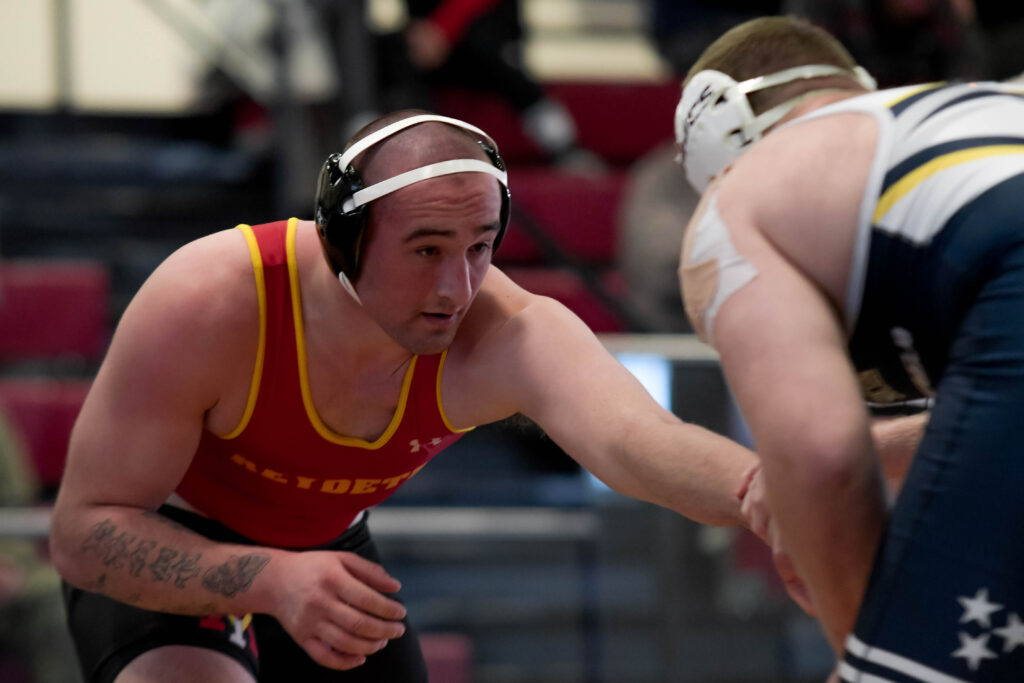
Tyler Mousaw wrestling for Virginia Military Institute.

Mousaw usually gets a break after practice before formation at 7:30 p.m. and then onto supper, so he opts to have some downtime. But after supper, it’s back to the books.   

Wrestling starts immediately upon arriving to post in the fall.

“Pretty much as soon as we get back to school in the beginning of the year, we start preseason [training]. It’s a lot of running and working out getting back in shape,” he said. 

He said the team stayed in Lexington over winter furlough to have two-a-day practices. His season starts in November and goes until about March. Although that may seem rigorous, his favorite part about attending VMI is that he gets to be a part of the wrestling team.  

“It’s just the bonds with the teammates … it’s a pretty tight bond,” he said. “Everybody’s going out there and putting it on the line in front of everybody and it’s a battle. You develop a respect for everybody.” 

But VMI has instilled something bigger in him — honor. 

“The biggest thing is the Honor Code. It’s just something good to live by,” he said. “Don’t lie, cheat, or steal. You’re setting yourself up pretty good right off the bat. My maturity before I came here, I was just like a normal high school kid. You know, a little bit rebellious. Then I came here and it forced me to grow up quickly. I think I’m more attuned to dealing with different situations. I’m more adaptable, and just ready to be done and get into the workforce.”