Post View Unavailable:
Post View is currently unavailable due to technical difficulties. More information.Last Updated: 01-08-2026 09:42 AM»
Notice:
VMI.edu has recently been updated and upgraded. Please note that some URLs may have changed. Visitors are encouraged to use the new, expanded site menu and site search to navigate through these changes.
New Website Launched»
Eighteen Virginia Military Institute cadets joined approximately 5,000 participants at the National Conference on Undergraduate Research (NCUR) held at the Greater Richmond Convention Center in Richmond April 13-15.
NCUR is an organization dedicated to promoting undergraduate research, scholarship, and creative activity in all fields of study. It offers a unique environment for the celebration and promotion of undergraduate student achievement, as well as student career readiness development. The location for the conference changes each year, in various places across the country. In 2005, it was held at VMI and Washington and Lee University.
Lt. Col. Molly Kent, director of the VMI Center for Undergraduate Research (VCUR) and associate professor in the Department of Biology, also attended the conference. She said this year’s group of cadets who applied and were accepted to present their work at NCUR was the largest since she assumed the role of VCUR director in 2024.
“We were pleased that the close proximity of this year’s conference allowed so many cadets to attend, and VCUR was able to fully fund the trip. Our cadets showcased the full breadth of the Institute’s academic excellence — from the arts and humanities to cutting‑edge engineering — through research conducted by cadets, alongside dedicated faculty mentors.”
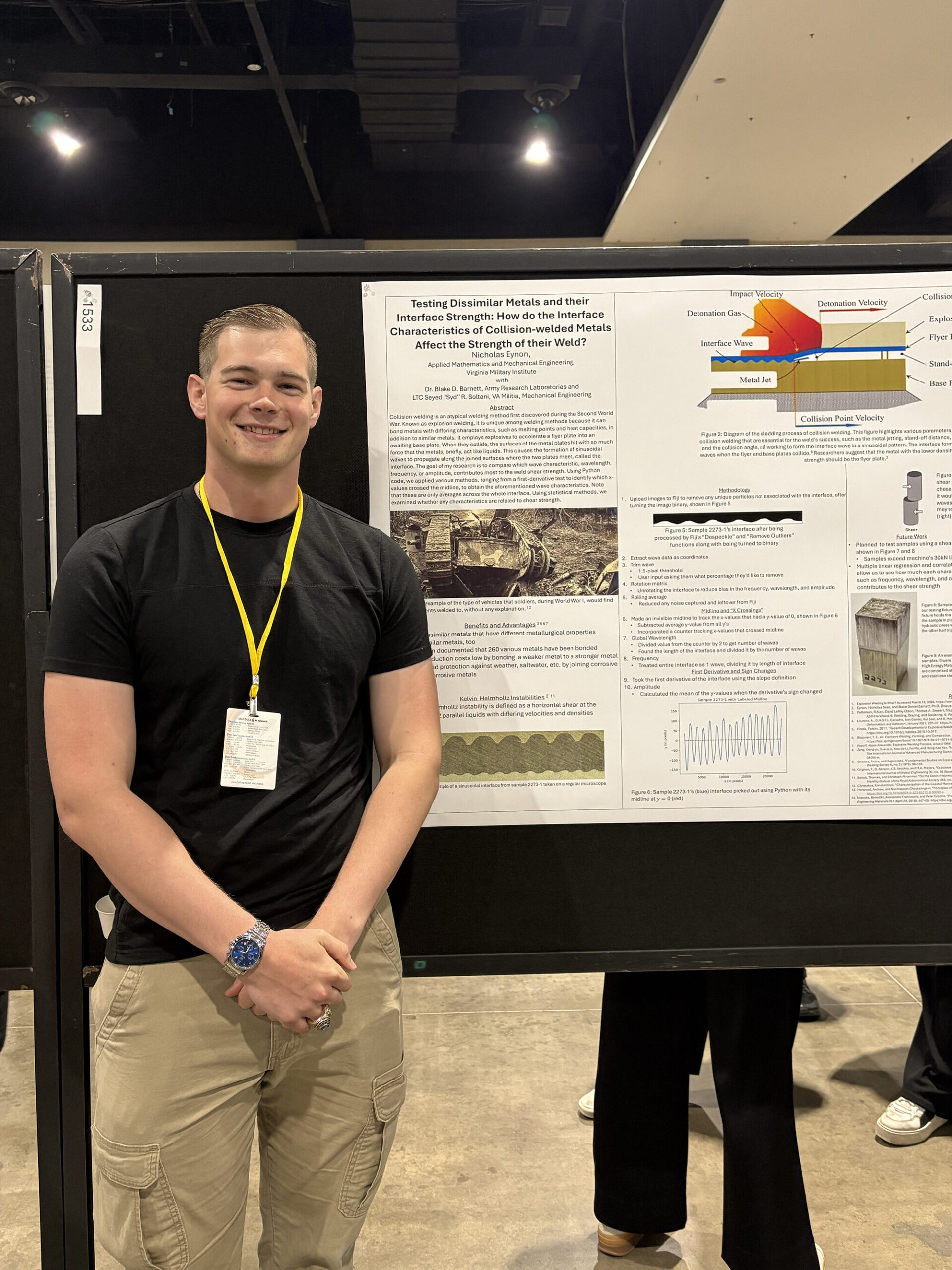
Nicholas Eynon ’26, an applied mathematics major minoring in philosophy, presented a poster based on his honors thesis, “Testing Dissimilar Metals and their Interface Strength: How do the Interface Characteristics of Collision-welded Metals Affect the Shear Strength of their Weld?”
Nicholas Eynon ’26 presents his poster at NCUR in Richmond. –Photo courtesy of Lt. Col. Molly Kent.
His research focused on collision welding, specifically its relationship between its shear strength and its interface characteristics. Eynon admitted he had fun at NCUR. “It was very enjoyable to present my work, not only as a reward, but to share the name and vision of VMI to other college students, show them the hard work I put into my research, and show them the same respect. It was interesting to hear about other students’ research, and in some instances, we discussed how our topics overlapped and could be used in tandem. Overall, I am very grateful for my time with NCUR.” Following graduation in May, Eynon will commission into the U.S. Army.
Nickole Chávez ’26, an English major minoring in Spanish, presented her project, “Bridging the Confidence Gap: ELL Mentorships and Narrative Exploration of the Mexican- American Student Experience.”
Her research involved an independent study working with an English Language Learner (ELL) student in Lexington, which led her to write a narrative of her own education using reflexive thematic analysis. “I used my experience of working in the school and my memories of growing up in a failing education system to corroborate articles I read about the lack of resources in schools for bilingual and immigrant students,” Chávez explained. She presented her findings in a crowded room, which she admitted was a little nerve wracking. “NCUR was an amazing experience. I was able to share a personal project that I worked on for two semesters. Sharing my story and experiences with a room full of students and professors from other schools was something I never thought I would do.” Chávez hopes to work for the Department of Homeland Security after graduating.
The Vanguard series highlights cadets of Virginia Military Institute who exemplify promise, perseverance, and the true spirit of leadership. While they may not be the top-ranking students or those in prestigious positions, these individuals’ dedication, resilience, and growth embody the essence of being a VMI cadet. By sharing their stories, including the challenges they’ve faced and overcome, we shine a spotlight on the diverse paths to success at the Institute, proving that leadership and excellence come in many forms.
When Gracie Harlow ’27 started her collegiate career, she felt like she was going through the motions and not obtaining any growth. She started at Hollins University, an all-female college near Roanoke, but ended up transferring to Virginia Military Institute after two years.
“There was no challenge. I was just living,” she admitted. “I wanted a challenge. My brother went to The Citadel and I come from a military family. I wanted something different. I knew I could get somewhere from here.”
The transfer as a junior didn’t mean she’d end up a 2nd Class cadet. She went directly to the Rat Line and started over.
“You can’t skip it,” she said of the Rat Line. She turned 21 right after Breakout.
“It was kind of rough in the beginning. I struggled a lot. My dyke helped me a lot,” she stated. “It took a lot of getting used to, but I feel like everything I went through and I have been through so far has helped me grow in these couple years.”
Harlow also knew she needed financial assistance for school. She received a scholarship for track and field, which she participated in her first two years as a cadet. All of her aid is covered by VMI scholarships, either from the school or alumni.
“These have been crucial to me getting through school due to my financial situation at home,” she explained. “Having those opportunities that are free or I have an avenue to make it free means a lot.”
She has her plate full. A history and English double major, she also has several writing and photography extracurricular activities. Originally, she started out as an international studies major, but felt uninspired and was looking for something she enjoyed more. She switched to history, but found she needed to fill more classes.
“I had a lot of schedule to fill, so I picked up the double major in English. That has helped me branch out and meet people,” she commented.
Maj. Madeleine Ramsey, assistant professor of history and Harlow’s academic advisor, has worked closely with Harlow for the past two years. Although she hasn’t taught her, she’s heard her colleagues speak about Harlow’s influence in the classroom. Ramsey noted Harlow’s academic diligence as even more impressive because she’s been able to achieve it while participating in a DI sport of track and field and the demanding regimental system.
“She is always prepared, ready to engage with the material at hand, and willing to participate actively in classroom discussions. She is a committed student, as I have seen firsthand through the numerous visits to both my colleagues’ offices and mine, to ask questions and seek assistance with her papers,” Ramsey commented. “As she has done throughout her academic career, Ms. Harlow applies the same discipline and dedication to VMI’s Corps of Cadets. She excels both inside and outside the classroom and now holds rank as a corporal.”
The dive into history and English allowed her the opportunity for an internship with the American Battle Monuments Commission where she was given the opportunity to research for them. She also traveled to France to present her research with the commission.
Being involved has been a huge goal for Harlow.
“I like trying new things, but I feel like VMI has given me more opportunities to do that,” she said. “Hard work is more recognized here than a lot of colleges. I know we have the uniforms that look the same, but you can always tell the difference.”
She will be studying abroad this summer in Spain, spending four weeks at the University of Alcalá. She previously went to Poland in the summer of 2024 through the MirYam Institute’s program, I-SAP (Israel Strategy & Policy) tour, which is designed for U.S. military cadets to travel, learn about a country, its place among the nations, and its relationship with the United States.
Despite any shortcomings Harlow has faced in her personal life, Ramsey said she’s been able to hold numerous part-time jobs and also received an internship from John A. Adams ’71 Center for Military History and Strategic Analysis to travel to Normandy.
“Quite simply, Ms. Harlow is one of the hardest -working cadets I have encountered at VMI, a place where hard work is a part of everyday life,” Ramsey said.
As a student, she’s improved with planning things out. She used to be more sporadic with things and the regiment of VMI has pushed her to become more solid in her foundation.
“I feel like I literally have to plan out everything. I’m a big planner,” she stated.
Ramsey said that Harlow is one of the most organized and disciplined students she’s ever met.
“She arrives promptly for every meeting and is always prepared. She has faced a variety of challenging circumstances in her life that for many would have been reason to seek an easier path,” Ramsey stated. “Ms. Harlow sought out, and has excelled in, one of the most challenging systems in higher education, which speaks to her strength of character.”
Her roommate calls her OCD because she’s very strict about her uniform and how tidy their room is. She prides herself on never having any demerits.
“I hate being in trouble. I just do my best to avoid it.”
She tends to be more quiet in the classroom but will always speak up if she needs help.
“I try to do my hardest to work with my professors and get the help I need. I lean a lot on my roommate. My dyke helped me a lot my rat year. I still talk to her a lot. I met my boyfriend here,” Harlow said. “The whole support system is how I buckle down and deal with it. VMI teaches you to move forward no matter what’s in your way right now. You have to get past it. And having that support system to get past it helps.”
“Fiction does not spring into the world fully grown, like Athena. It is the process of writing and rewriting that makes a fiction original, if not profound.” —John Gardner.
Ben Bowen ’26, an English major at Virginia Military Institute, introduced his honors presentation by disclosing that it is not intended to prove an esthetic point or make a literary argument. Rather “Writing Happy Endings: Practice and Theory” is a work of literature. “I’m simply trying to write a story and tell you why I wrote it,” he stated.
Bowen confessed that because he has a deep love for reading, he did not think creative writing would be hard for him. “And then I started writing, and I found it to be extremely difficult and painful. I didn’t want to turn in any assignments. I wanted to keep revising.” To help overcome his struggles, he sought to discover why people read books, and the elements of a good story. He examined the underlying driving principles of two of his favorite authors: Edgar Allen Poe, who evoked emotion — especially melancholy — to grip the reader; and John Gardner, who believed good literature should have a moral aim and should have staying power and keep the reader engaged.
To illustrate the two writers differing points of view, Bowen used examples in his own creative writing. In both his short story, “Starbs Run,” and his novella, “Wild Turkey,” Bowen applies Poe’s principle of using strong emotional language, which he confessed was a great effort to write. He explained the purpose in writing the difficult scenes was to make the story real and not overly sentimental. “Nobody wants to read about a protagonist who is perfect. They want to read about a real person,” he explained. Bowen also wanted to genuinely represent trauma in his work, and make the reader question what they would do if placed in the character’s position.
Additionally, Bowen applies Gardner’s principle of using staying power. “No one is going to read a story for pleasure that doesn’t entertain them or isn’t interesting. So, I had to constantly think about using devices to keep the reader interested. I was constantly trying to use stories or little side tangents of action or of comedy to keep the reader entertained.”
Bowen concluded his presentation by sharing with the audience that his novella is not yet complete, and in keeping with the title of his honors presentation, he anticipates a happy ending. “There are a lot of good things coming, like hope and romance.”
Bowen’s advisor, Col. Polly Atwell, professor in the Department of English, Rhetoric, and Humanistic Studies, shared that what has impressed her most about Bowen is his enthusiasm and curiosity. “He’s one of the only students I’ve ever had who actually seeks out the work of his professors, not to get points, but just because he’s genuinely interested in what interests them. When I first read Ben’s fiction, I found he was a very talented and dedicated writer, and advising him on his novella has been incredibly fun and rewarding for me. His work ethic, his genuine desire to learn, his humor, and the connection he’s found between his writing and his personal ethics have all made him a true pleasure to work with.”
Bowen’s concentrations under his English major are writing and rhetoric, philosophy, and literary studies. He is the son of Floyd and Lisa Bowen of Forty Fort, Pennsylvania, and attended Wyoming Valley West High School. Following graduation, he will commission into the Marine Corps.
The Vanguard series highlights cadets of Virginia Military Institute who exemplify promise, perseverance, and the true spirit of leadership. While they may not be the top-ranking students or those in prestigious positions, these individuals’ dedication, resilience, and growth embody the essence of being a VMI cadet. By sharing their stories, including the challenges they’ve faced and overcome, we shine a spotlight on the diverse paths to success at the Institute, proving that leadership and excellence come in many forms.
Sofia Fleming ’28 describes her older sister as a trailblazer. It just so happens a big part of that is because she graduated from Virginia Military Institute. Although it was before Fleming was born, she grew up idolizing her.
“She was very goal-oriented, very driven,” she said. “I have looked up to her my entire life, so it really inspired me to follow her path here.”
Fleming wasn’t sure what her plans would be after high school — if she would attend community college or a four-year institution. She was faced with a big decision.
“I wanted to get the most out of school. I looked into some other four-year colleges, and I wanted a school that would define me or be a defining experience in my life that set me up for a future career,” she explained. “I saw that in VMI. I saw it could give me more than any other school that I looked into could. And it really has … I’ve seen the changes it’s made.”
She compromised though. Before coming to the Institute, she did a year at community college. This served as a good transition from high school — she was homeschooled — and allowed her to overcome any difficulties.
“Going into classes and having to sit and listen to professors was one thing I wasn’t accustomed to,” she admitted. “I have met some really amazing professors here. I’ve enjoyed the experience of getting to know different professors, getting to have the experience of different teachers, which is something that I never had in high school. It’s shaped me and how I do academically.”
The English major said the past year at VMI has made her more resilient.
“It’s definitely pushed me beyond my limits. I feel like I have come so far and such a long way from when I first came here on Matriculation Day,” she said. “It’s given me better time management skills, self-discipline, and it’s testing me academically in so many ways.”
She said that VMI’s most challenging part is academics.
“Even though it’s something that I excel in, it’s also something I struggled to adjust to, but something I’ve been able to overcome as time has gone on at VMI,” she explained.
Despite VMI’s rigorous academic program, Fleming was able to achieve a 4.0 GPA as a 4th Class cadet. She credits her professors in pushing her academically and helping her improve her writing skills. She also began working at VMI’s Writing Center as a peer writing consultant.
As a disciplined student, Fleming likes to get her work done ahead of time, opting to get started on her work right away.
“I’m very methodical about my work. I like to write it, let it sit for a while, come back to it, and then work on it again,” she stated. “In high school I’d always do it last minute. Here, I learned that it doesn’t work like that, especially since I want to get good grades. I have changed my style of how I write and how I work as a student.”
Col. Steven Knepper, professor in the Department of English, Rhetoric, and Humanistic Studies, agreed on her dedication as a student.
“Sofia is a diligent, high-achieving cadet who excels in the classroom and beyond. She is an excellent writer and an incisive thinker,” he said.
Fleming does lean on her professors for extra help if she gets overwhelmed. To get over the first struggles and nervousness she faced while on the Rat Line, she wrote a poem and attached illustrations to it. It started out with lines like “this rat wants a protein shake,” with an illustration of a cartoon rat drinking a shake. She sent it to her parents and they suggested making a children’s book around it.
“VMI’s funny title for freshman inspired me to write a children’s book on the VMI Rat Line called ‘This Rat … A Military College Story.’ I created each drawing as an actual rodent, completing different activities to add levity to the challenging VMI Rat Line,” Fleming explained. “Each drawing was based on a memory that I have about the Rat Line. It feels nostalgic since I broke out just a year ago. Every time I see one of my drawings, it makes me smile because it reminds me of all the funny moments and good times that I had during that challenge.”
She’s self-publishing the book and is in talks with the VMI Museum for them to carry it.
“Cadets lead busy lives, but Sofia found the time to write and illustrate a children’s book,” Knepper commented. “I expect it will be a hit. It’s very well done. Sofia continues to write fiction, poetry, and creative nonfiction beyond her coursework and Corps responsibilities. She has rare talent and skill, but she also consistently puts in the work.”
Despite the difficulties she has faced and will continue to face at VMI, she likes the structure of her day-to-day.
“There’s certain times for me to work out and rest. I’ve really found that helps me a lot in getting things done,” she said. “I was really amazed that the schedule and the structure that VMI has made such an impact on me, and that’s increased my productivity in so many ways.”
She says she wouldn’t have been able to experience such a wide array of opportunities anywhere else. Last year, she was a member of the pistol team, where she competed in a national college level competition. She’s active in VMI’s Newman’s Society, the aviation club, and became a Matriculation Week corporal to train the next class of rats.
Col. Mary “Polly” Stewart Atwell, associate professor in the Department of English, Rhetoric, and Humanistic Studies, described Fleming as extremely engaged, thoughtful, and conscientious.
“She always goes the extra mile with her assignments on top of what is required. She’s willing to take constructive criticism and wants to learn and improve,” Atwell said. “Although Sofia is a 3rd Class cadet, she always holds her own in class discussions when she is one of the younger students in the class. I think she shows great promise as a writer and a scholar.”
The Vanguard series highlights cadets of Virginia Military Institute who exemplify promise, perseverance, and the true spirit of leadership. While they may not be the top-ranking students or those in prestigious positions, these individuals’ dedication, resilience, and growth embody the essence of being a VMI cadet. By sharing their stories, including the challenges they’ve faced and overcome, we shine a spotlight on the diverse paths to success at the Institute, proving that leadership and excellence come in many forms.
Playing a part in the bigger picture was one of Jackson Geisendaffer’s ’28 goals when he came to Virginia Military Institute. He wanted a school that would challenge him to be the best leader and prepare him to move forward, especially when those plans are to commission into the U.S. Army.
“I saw that to become that leader of value, I would have to go through challenges and struggle with myself,” he said.
His father was a VMI graduate. Growing up, he learned of his time at the Institute and said it was a big determining factor in attending versus enlisting.
It’s also the reason he became a corporal in the Old Corps. Geisendaffer said he wanted to be part of the team and serve as a leader, while taking accountability and ensuring everyone is responsible and doing their best.
“I take accountability for everybody that’s in my squad, make sure that their uniform appearance is up to standard and make sure that people are doing what they’re supposed to do in my company,” he explained.
Originally entering the Institute on the cross country team, Geisendaffer switched to Ranger Challenge, which is described as an Army ROTC varsity sport. Teams form early in the semester and train nearly every morning of the week all the way up until the Sandhurst Military Skills Competition at the U.S. Military Academy (USMA) at West Point in mid-spring.
“I think the biggest factor is being able to work within a team. When I was in high school, I was doing sports throughout. I had a hard time expressing my ideas and my thoughts within a group, and hearing out other people’s ideas,” he said. “But here, you have a job to do, so you must get along, and be able to communicate in a way other people understand. I think fundamentally, that’s probably one of the biggest things for officers to have. I think it sets me up for success.”
The English major is forward thinking. He grew up reading and loved literature, especially classics like Charles Dickens’ novels. It was something he was naturally good at and was drawn to. He also saw the merit of choosing that major.
“I feel like having an English degree is going to give me the skills to be an effective communicator as an officer and as a team leader in general,” he said.
Maj. Adam Cody, assistant professor in the Department of English, Rhetoric, and Humanistic Studies, describes Geisendaffer as insightful and inventive, with a strong work ethic, precise attention to detail, and a productive rapport with peers.
During an in-class peer review workshop, Cody said Geisendaffer showed great promise in his leadership skills. He had a constructive and conscientious approach to peer mentorship, where he was patient and attentive with his classmates and his instructor, and his feedback on his peers’ writing reflected a diligent commitment to helping others improve their writing skills.
“Cadet Geisendaffer may consistently be relied upon for his keen understanding and thoughtful judgment,” Cody said. “In class, he displays a tendency to notice key details that other students overlook, and his critical and lateral thinking skills enable him to make connections between ideas and to integrate unfamiliar concepts into a coherent system of knowledge.”
Geisendaffer prefers not to procrastinate, which is a complete departure from his days in high school. Admitting that he was below average in high school, he didn’t take pride in his grades or think he was going to college. He decided he needed to make a change. Since coming to VMI, he’s disciplined and on the ball.
“I kind of blew a lot of the stuff off and went by doing the bare minimum,” he stated. “Then I got here, and I realized that there’s more opportunities that come when you actually dedicate yourself to the grades and to these challenges. I found when I applied myself and I studied hard, I got the results that I wanted and the results that I deserved because of the changes that I made.
“I stayed on top of everything, especially during rat year, and I saw results, so I just kept sticking with it,” he continued. “I keep a detailed schedule of where I need to be, when I need to be there. I ask questions. I don’t waste time.”
Lt. Col. Jochen Arndt, associate professor in the Department of History, has known Geisendaffer since he was a rat and enrolled in his world history course. He was impressed with his vigor for learning and his ability to earn high marks.
“Cadet Geisendaffer navigated the Rat Line with aplomb and performed in the top ten percent of my course, earning an ‘A’ for that semester — far above the average grade of a ‘C,’” he said. “He paid attention to detail, completed the assigned readings, came to class ready to participate, and took good notes. Given the amount of work required to perform well in this class, I am sure Cadet Geisendaffer had to work many late hours, especially in preparation for the course’s two research paper assignments and the 3-hour final exam, all of which he completed with superior grades.”
Arndt also noted that he uses his skills well by becoming a writing center consultant, where he’s able to help his peers become better writers and students. It was something that set him apart from his classmates.
“Cadet Geisendaffer struck me always as modest in spite of his superior performance. He went about his work in a professional manner, with seemingly no drama and no wasted energy,” he commented. “When he showed up at my door to discuss his paper assignments, for instance, I was pleasantly surprised to find that he came well prepared with completed drafts ready for my review. When I suggested changes, he listened carefully, asked good questions, and then implemented the required changes.”
Dr. Luke McNulty, adjunct professor in the Department of English, Rhetoric, and Humanistic Studies, said of his 57 students in a course where the current average grade is a C, Geisendaffer is one of 12 currently sitting at an A.
“I can rely upon Cadet Geisendaffer to have read and understood these difficult materials before our class meetings, and to share his thoughts as a leading participant in our group discussions,” he said. “He has served me as a valuable interlocutor, and he has served his peers as a model of clear, careful thinking and speaking. I hasten to add that he has also been a model of character in his willingness publicly to express and defend his ethical principles.”
Virginia Military Institute’s cadet-athletes have to juggle cadet life, heavy academic course loads, and their NCAA Division I sport. Committed to both academic and athletic pursuits, balancing their rigorous schedule in both sports and school requires a certain level of commitment and discipline. Behind the Balance is a series that focuses on those cadet-athletes and how they handle the hurdles of the day-to-day.
Wrestling brought Ray Cmil ’26 to Virginia Military Institute, but it was the people that made him stay. He was drawn to the community and the relationships he started building at VMI and what that would mean for him later in life.
“After considering all the schools I was looking at, I decided VMI would be the best place for my future and to develop myself as a person,” he said.
He’s made close friends at the Institute, especially his teammates.
“We’ve spent so much time together, and it would be weird without them. We eat every meal together, practice together all day, and we’re hanging out in the room together,” he explained.
The English major has a heavy load of 17 credits his last semester while being in season with wrestling. Most days he’s up at 5:30 a.m. for a morning weightlifting session before heading off to breakfast and class. He has about four classes a day, breaks for lunch and then heads down to practice an hour early to get some extra work in.
“I don’t really write it down that much. It’s kind of just in my head — my day-to-day routine,” he said. “I think the easiest part for me is just taking the first step. Starting all my homework, or just doing whatever ever I need to do and not procrastinate.”
Cadet-athletes at VMI not only have their responsibilities with their selected sport but cadet duties on top of that. Cadets are also required to take physical fitness classes twice a week, participate in ROTC all four years, prepare for room and uniform inspections, practice for parade, guard duty, and more.
“I’ve been forced to step out of my comfort zone a lot,” Cmil admitted. “With communication and leadership, just stepping up and forcing yourself to do things you don’t want to do. Especially this year, seeing all the 4th Class cadets coming in and trying to be a mentor for them. I had so many important older guys when I was coming up that I want to be a positive impact on the [incoming class].”
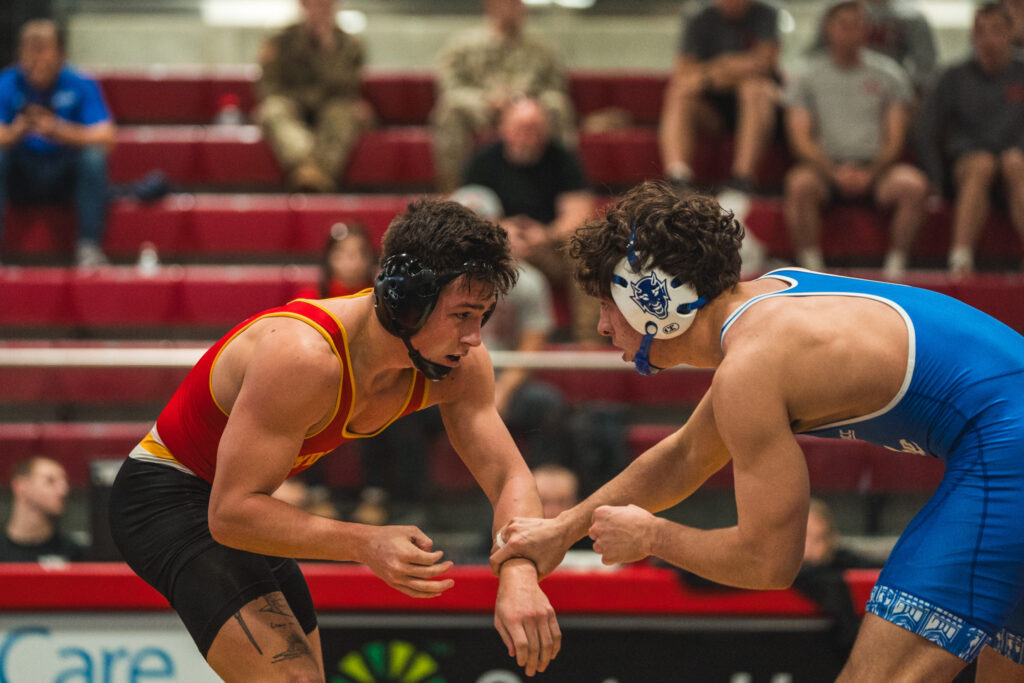
VMI Wrestling vs. Duke Action Shot
Cmil started wrestling in the third grade, but he grew up hearing stories from his father who wrestled. The thing he enjoys the most is that it’s one-on-one.
“The work you put in is a direct representation of the output you get,” he stated. “If you put in the work and dedicate yourself to it, you’ll get results.”
Being at VMI has forced him to crack down on his responsibilities and time management for his demanding schedule.
“I think the fact that you have so many responsibilities, and there’s so much asked of you, you get used to it here,” he said. “From a broader perspective, you realize that other people haven’t done what you’ve been doing for the past four years. I think being in that mode and mindset, VMI builds prepares you for what’s to come.”
The Vanguard series highlights cadets of Virginia Military Institute who exemplify promise, perseverance, and the true spirit of leadership. While they may not be the top-ranking students or those in prestigious positions, these individuals’ dedication, resilience, and growth embody the essence of being a VMI cadet. By sharing their stories, including the challenges they’ve faced and overcome, we shine a spotlight on the diverse paths to success at the Institute, proving that leadership and excellence come in many forms.
A NARP is a common term around college campuses — a non-athletic regular person — and a way Sara Mihalovich ’26 describes herself, but she is far from ‘regular.’ Although she can be laid back, the 1st Class cadet at Virginia Military Institute is determined and excels at whatever she puts her mind to.
It’s something her professors and peers notice.
“Cadet Mihalovich stands out to me because she can really sustain long-term attention to research, learning, and writing, which of course produces superior work,” Col. Michelle Iten, professor in the Department of English, Rhetoric, and Humanistic Studies (ERHS), commented. “I also admire her authenticity. She does hard things, such as the half Ironman and writing powerful papers, but she feels no need to make sure everyone knows she is doing hard things. She walks the walk, as they say.”
From working at the library, participating in the literary journal Cadence, being the triathlon club cadet in charge to serving on the Rat Disciplinary Committee (RDC), Mihalovich has taken advantage of what VMI sets cadets up with — a foundation for achievement.
“I was very quiet when I first got here. I was very uncomfortable in probably every single situation possible I was put in,” she admitted. “I think being uncomfortable in those situations has made me grow. Now you can put me in any situation, and I will do a lot better. I was able to be uncomfortable and it pushed me over the edge a little bit.”
Col. Mary “Polly” Stewart Atwell, associate professor in the Department of ERHS, has taught Mihalovich in four different classes and said she’s distinguished herself in each one.
“She’s actively engaged in class discussion, and though she’s generally a quiet person, it’s clear that her classmates respect her and listen when she talks,” Atwell explained. “She’s an incredibly talented writer, and won first prize in both the fiction and poetry categories in the Cadence journal’s Creative Arts Contest — something I’ve never seen before in 11 years at VMI. I always appreciate her intelligent, measured, and thoughtful participation in class.”
Mihalovich puts herself out there. She’s more involved.
“I was mostly a ghost my rat year and 3rd Class year. I didn’t really know what the school was all about yet. I had to figure my way through life a little bit,” she said.
Taking a position with the RDC got her involved at a higher level. She was one of two female cadets chosen to take a spot.
“I like how intense the RDC is. I wanted to be part of the Rat Line in some way my senior year. Then I could be part of the it when my rat is also going through it,” she explained.
The experience allowed her to bond with her rat but also keep tabs on the upcoming class. She was able to get workouts in and stay active, too.
“I’m very physically active, so already that’s a big part of the RDC. We do a lot of physical activity with them, and I’d be able to keep up,” she said.
Physical activity is a must for Mihalovich. She’s participated in triathlons since she was 8 years old. In the fall, she completed a half Ironman. That’s a 1.2 mile swim, 56 mile bike ride, and 13 mile run.
Since Mihalovich knows structure thanks to VMI, her triathlon and half Ironman training regime was easy to come by. From spending hours on the bike, going from long runs, and taking time in the pool, she felt prepared to do her first half Ironman. She also fed off the energy of her fellow racers.
Md5: 9aaf5eec177b7c4acb545f8738a2213e
“Everybody really wanted to do it. It was a very cool environment to be in. Finishing was insane, because I enjoyed every single second,” she said. “The crowds were insane. You didn’t need music at all. You were just listening to everybody cheering for you. The finish line was obviously the loudest, through the big arch, and you feel like you’re going to collapse, but then other people are holding you up. It was an amazing experience.”
Committed to schedule, Mihalovich likes to have all her daily tasks done by 10:30 p.m.
“I like getting my sleep, so I try to do all my homework and everything during the day,” she said. “My day is very, very busy.”
She’s thought ahead, too. Frontloading her class schedule in her first years at VMI has helped. In her last semester, she’s taking 14 credits.“I’m good in any high stress situation. Time management is a huge thing, too. Having 18 credit hours per semester was insane and then having triathlon stuff on top of that was just a crazy workload for an 18- to 20-year-old to have,” she stated.
Mihalovich admits the academics have been challenging for her.
“We take a lot more credit hours than most people, and we don’t have as much time to complete everything,” she said. “We have our inspections, we have our mandatory games, we have our ROTC time, we have PT [physical training], we have all that.”
The English major is currently focusing a lot of her energy on her senior capstone project — a 12 to 15-page research paper focusing on French artist Fragonard, looking at his paintings and how he paints desire and love through a narrative.
“She is willing to wrestle with her ideas and with uncertainty, to dig deep into her research, and to draft and revise many times. I really admire this trait as sustained focus is increasingly hard for all of us,” Iten continued. “Cadet Mihalovich’s capacity to remain engaged over a long process of research and writing shows great promise. I know she will take this intellectual endurance into planning and problem-solving in her service as an officer in the USMC.”
Col. Steven Knepper, professor in the Department of ERHS, agreed that Mihalovich is skilled at bringing research and analysis together.
“This is evident in her excellent senior capstone about the paintings of Jean-Honoré Fragonard,” he said. “She does impressive academic work, and she also helps her fellow cadets. She gives pointed but encouraging feedback in class discussions and in peer review.”
She spent last semester doing the bulk of her research for her capstone, so she’s now in full research paper writing mode. The idea for her thesis was sparked from one painting that caught her eye early on — “The Swing.”
“I built off what key aspects were in that painting,” she said. “I looked at some of his other paintings and how he portrayed similar themes within the other ones. It took off from there.”
Mihalovich plans to attend Marine Corps Officer Candidate Course, with the intent to commission. It took several different other ventures into VMI’s ROTC branches for her to land on the Marines.
“I like the structure of the Marine Corps, their morals and their mission,” she said. “I like how they’re smaller, more compact team.”
In February, Heaton Lawrence ’26, Regimental Chief of Staff, attended two conferences at Texas A&M, College Station. Lawrence participated in the Army War College’s prestigious International Strategic Crisis Negotiation Exercise (ISCNE). Alongside graduate and undergraduate students from other colleges and universities, Lawrence engaged in diplomatic simulations and strategic planning. He was accompanied by Nathan Payne ’26, Devin Auzenne ’26, Gabe Thompson ’26, and Michael Hatfield ’26.
Lawrence also participated in Texas A&M’s Student Conference on National Affairs (SCONA 71), hosted by the Bush School of Government and Public Service. He attended talks by senior leaders from the U.S. government and military. He also worked with teammates from other schools to write an argumentative essay about how to reform the U.S. State Department to promote America’s values in the most effective way possible. Lawrence’s team won the competition for best essay with their policy proposal, “Accords over Ammunition: A Strategic Reform Proposal for the U.S. Foreign Service.”
The Vanguard series highlights cadets of Virginia Military Institute who exemplify promise, perseverance, and the true spirit of leadership. While they may not be the top-ranking students or those in prestigious positions, these individuals’ dedication, resilience, and growth embody the essence of being a VMI cadet. By sharing their stories, including the challenges they’ve faced and overcome, we shine a spotlight on the diverse paths to success at the Institute, proving that leadership and excellence come in many forms.
Nat Lavender ’26 was sitting in class one day on her sixth page of notes when her hand started to cramp. She only had one thought — she was miserable as an economics and business major.
“I thought to myself, I could do this, but do I really want to be miserable for the next three years?” she questioned. “I switched my major, and I went to English. It was always my favorite subject and I’d missed it my rat year since I tested out.”
The switch created a fire in her. She became so passionate about her major and studies.
“I’m very humanities brained. The creativity and the complexity of connotations and literature and how words shape reality is so fascinating to me, especially because words are such a reflection of ourselves,” she said. “You read someone’s writing, you’re sharing their mind for a few minutes. I think it’s fascinating and beautiful. I think books are by far the most versatile form of entertainment of learning, because you could read the same book five different ways, depending on the layers of symbolism, you can’t do that with anything else.”
The way Lavender speaks about writing and reading, anyone can see her dedication and desire for it. She explained that the ability to read a book in a completely different way than the person sitting next to her, just due to personal experience, is so intriguing to her.
“We’re all just sharing and having a silent conversation,” she stated.
Although Lavender doesn’t hold rank, she’s held a bevy of different jobs on post. For two years she worked as a history group study session facilitator. Most recently, she’s been working as the cadet in charge for the Daniel’s Library. She also works at the Writing Center, where she serves as a consultant for her peers.
“I love that job,” she said of the Writing Center gig. “I’m not a very extroverted person, but I like to pick a couple things I’m passionate about and really commit.”
In addition to being an exceptional student, she has also been an outstanding athlete, competing on VMI’s NCAA Division 1 Cross-Country and Track teams, lettering in all seven seasons.
A self-proclaimed nerd, she finds solace in studying.
“I enjoy locking myself away and reading and studying. Nobody’s really with me on that, which is understandable,” she said.
She’s currently working on her thesis, which focuses on post-World War I Avant-garde art movements of Dadaism and Surrealism in their modern context and conversations and seeing if she can recreate that — if possible. Lavender’s goal is to see if the arts can be limited to a time period in its historical context or not.
Col. Catharine Ingersoll, professor in the Department of English, Rhetoric, and Humanistic Studies, said Lavender is a bright student who is disciplined and intensely curious.
“If I have a stack of tests or papers to grade, I save hers to do last — like a dessert — because she always does such an excellent job on assignments,” she admitted.
Ingersoll has seen this in the cadet’s work on her honors thesis and explained her project shows great promise and combines her enthusiasm for art history and studio art. Ingersoll went on to say that Lavender comes in for their meetings with innovative ideas that reveal how thoroughly she’s been thinking of how to convey the theme of her thesis.
“Cadet Lavender always manages to fulfill her responsibilities to a high level of finish, even when she is feeling stressed or when she has a lot on her plate — and even during times when she, herself, seems unconvinced that she can get everything done,” Ingersoll said. “She never lets things get away from her, even in the midst of the chaos of day-to-day life at VMI.”
Lavender had not always been so committed to school, she admits.
“I was not a good student in high school at all. I showed up 30 minutes late to class and sat in the back,” she said. “I mean, I did decent on my work, but I’d help my friends with their essays and turn mine in two days late. I was never that worried about it. It was kind of a shock coming here.
She said being diagnosed with ADHD at the age of 18 helped her realize the gaps in how she was able to study and figured out how her brain operated.
Coming to VMI has allowed her to grow and discover herself.
“I really thought I knew who I was in high school. I think most people do, and college is a place to grow from the bubble you’ve grown up in,” Lavender explained. “Here it’s just the absolute lack of anything that precedes your actual actions, words, and personality. It forces you to know who you are without the clothes or the car and those kinds of materialistic things. Without the materials, you have to look in the mirror. I’d say I’m much more aware and much better for it. I think the stress of this place really illuminates your flaws, and you’ve got to be like, okay, I can’t ignore this anymore.”
At times she has found VMI to be lonely, but with being on the track team and the friendships she’s made with her roommates and through her major, she’s been able to surround herself with a close group.
“I think my roommates are such a blessing. I love them so much. I’ve made so many connections here. I think the biggest thing is just knowing that even when you’re feeling lonely, it doesn’t mean you’re alone,” she said.
She’s set to graduate early this December with Institute Honors; a B.A. in English; a minor in French; and concentrations in literary studies, philosophy, rhetoric and writing, and art history and visual culture. The need to be constantly moving pushed her to add extra classes to her schedule with the intent to drop them. Except, she never dropped them. She’s currently applying to graduate programs — most notably to be a Rhodes Scholar.
Col. Emily Miller, professor of English and head of the Department of English, Rhetoric, and Humanistic Studies, describes Lavender as an outstanding student with a broad range of academic interests.
“She has a remarkable amount of intellectual curiosity, which is evident in all of her endeavors,” Miller said. “For example, last November she presented a paper that she wrote in my honors seminar on Shakespeare at a professional conference (the South Atlantic Modern Language Association Conference), and she revised it multiple times, thoughtfully working over each sentence until it captured her exact meaning. She did a superb job of presenting the paper and answering questions from the audience. Similarly, in class she always offered meaningful observations and questions about Shakespeare’s plays.”
Miller said Lavender’s work ethic seems to arise very naturally from intellectual curiosity.
“She is humble, thoughtful, and generous, always ready to help her fellow cadets however she can. With her excellent performance in all of the areas I have mentioned, she is a very strong candidate for a Rhodes Scholarship.”
The Vanguard series highlights cadets of Virginia Military Institute who exemplify promise, perseverance, and the true spirit of leadership. While they may not be the top-ranking students or those in prestigious positions, these individuals’ dedication, resilience, and growth embody the essence of being a VMI cadet. By sharing their stories, including the challenges they’ve faced and overcome, we shine a spotlight on the diverse paths to success at the Institute, proving that leadership and excellence come in many forms.
Coming to Virginia Military Institute wasn’t an easy adjustment for Matthew Atienza ’26. He was across the country, in an unfamiliar place, and unsure of it all.
His original intent was to commission into the Air Force and be an international studies major. But that shifted when Atienza realized he wanted to be a teacher. It took one class during the Summer Transition Program (STP) to win him over and switch to be an English major.
“I loved what we learned. I loved learning about rhetoric in that class,” he explained. “And as I was going through the international studies major, I realized I didn’t really enjoy what I was doing I looked back through my post view, I have an A in every single English class I’ve ever taken. So why not do something I’m not only good at, but passionate about?”
He was inspired by George Abry, instructor in the Department of English, Rhetoric, and Humanistic Studies, during that STP session. He credits Abry to his switch from international studies to English. Abry said Atienza has a quiet confidence about him, without the need for fanfare or recognition.
“One thing I remember most about Matthew was the work he put into his essays,” Abry said. “If I recall, at times he struggled with his own writing structurally and at the sentence level, which means he worked hard to improve through conferencing, peer review, and revision. Ultimately, I think his own struggles with writing will make him a stronger teacher.”
Atienza is the type of person to get things done early. He wants to finish a task the moment it’s assigned.
“As a student, I always try to get on top of everything as quickly as I possibly can,” he said.
He feels like he’s evolved, not only as a student, but also as a cadet.
“I came here when I was 17 years old, skinny, unathletic, pretty lazy, grades were terrible, but I had a lot of good people behind me who supported me,” he admitted. “I think as a rat or as a 4th classman, I didn’t feel like I deserved to be a cadet.”
Instead of having doubts overtake him, he was able to pick himself up and take control of his own life. By transferring out of Air Force ROTC and changing his major, he made huge life decisions.
“I really put my career in my own hands. I’m on the Dean’s List now,” he said. “I think as a cadet, I have been very resilient. I faced a lot of hardships here. I am from across the country, so it’s lots of financial challenges and managing relationships from so far away.”
It took some time, but Atienza can now reflect on his journey of becoming physically and mentally stronger. He remembers from his time on the Rat Line they were learning a drill maneuver called inspection arms, where they’d have to pull the bolt back on a rifle.
“During that time, I was super weak, and I couldn’t do it. I was one of the only people that couldn’t do it,” he explained. “I remember my first sergeant at the end of training was like, ‘you either need to cut your bolt so it’s easier or get stronger.’”
Atienza said for about two to three weeks, he practiced. He got stronger. And made sure it was perfect.
“I remember one day we were supposed to drill outside, but it started raining, and we just did inspection arms for an hour straight, and I executed it perfectly every single time without messing up,” he stated. “I didn’t get any acknowledgement from it, but I was really proud of myself in that moment. And whenever I think I can’t do something, or I’m not as strong enough, or I don’t have the willpower to do this. I remember back when I was only 17 years old here. It seems so small, but it’s very significant.”
He also had to learn how to live far away from his family. Originally from California’s Bay Area, he said it was a bit of a culture shock when he came to Lexington.
“I lived in a place with different beliefs, different ideologies, and I guess more diverse,” he said. “I had a really rough time.”
During his rat year, he said everything kind of fell apart. Two of his neighbors in barracks, who were some of his closest friends, ended up leaving VMI. Plus, all his roommates he had his rat year all left the school.
“I was the only person left,” he said.
The one thing that helped was getting rank — he served as part of the color guard. He said it allowed him to connect with more people.
He also had some humbling moments at VMI. From what was easy in high school for him was shockingly challenging at the Institute.
“There are levels to education that I was not aware of, and I struggled greatly my rat year to 3rd Class year. My GPA was below 2.5, my grades were bad. But I learned how to not procrastinate. I taught myself how to study. I think most importantly, I taught myself how to ask for help. That’s something I never did. It’s something that I was always scared to do.”
Last summer, Atienza worked at Breakthrough Silicon Valley, a nonprofit focused on education equity. There he taught students from lower-income homes and immigrant backgrounds to close the education gap.
“I was a 9th grade teacher and taught two English classes and one public speaking class,” he explained. “Working hands-on with my students opened my eyes to bigger issues in marginalized communities and gave me a new sense of duty. Working at Breakthrough has inspired me to not only continue a career in education, but to also be an active member in my community as an advocate for education equity.”
At the end of his internship, he received the Americorps Segal Education Award, a scholarship of about $1,500.
Col. Emily Miller, Professor of English and English, Rhetoric, and Humanistic Studies department head, described Atienza as a conscientious, thoughtful, and reflective student. She said he contributes to class discussion with excellent comments and questions. His writing is strong. Miller cites that his essays explore works of literature in their cultural context.
“He brings an intellectual curiosity to his classes that makes him a pleasure to have in class. He has a strong commitment to education and a passion to serve others,” she said. “He is an attentive listener, reflective reader, and a mature and independent thinker. He is humble but confident. He also has a great sense of humor.”
As a 1st Class cadet, Atienza’s advice is to not be afraid of asking for help — or asking anything in general.
“Don’t be afraid to reach out, in the sense of asking help from your professors. Or reaching out to your brother rat that lives next door to become friends,” he said.