Post View Unavailable »
New Website Launched »

Honors Week: Freeman Compares Philosophers

Brooks Freeman ’25, an English major at Virginia Military Institute, sought a common core between the philosophies of Jalāl al-Dīn Rūmī, a 13th century Middle Eastern Sufi mystic and poet, and SØren Kierkegaard, a 19th century Danish philosopher, theologian, and poet, in his honors presentation, “Varieties of Mystical Experience: Encountering the Absolute in Rūmī and Kierkegaard.”  

Freeman found inspiration for his research after traveling to England and Morocco in the summer of 2023. In England, he studied existential philosophy and comparative religion.

“Going into the existential philosophy class, the first person we read was Kierkegaard, who is regarded as the original existentialist. He wrote extensively about faith, and I became interested in his ideas. In my comparative religion class, I learned a little about Sufism and Christian mysticism, and found those to be very interesting,” shared Freeman. Upon returning to VMI the following fall, he decided he wanted to compare the two thinkers for his honors thesis. 

Freeman cited Pseudo-Dionysius, an ancient Greek theologian, for his definition of mysticism. “‘The experiential encounter with the utterly transcendental reality that God is.’ Basically, a meeting with God.” 

He described some differences between Christian mysticism and Sufism.

“The first and most obvious difference would be their foundations; Sufism founded from Islam, and Christian mysticism from Christianity. They also have different end goals. Christian mysticism is about union with God while keeping one’s individual characteristics, and Sufism is about annihilation of oneself to form a kind of oneness with God.”

Similarities he listed between the two philosophies include the individual taking an internal journey toward divine union, poetry rich in symbolism, and teaching and guidance.

“Then the final thing is this idea of the absurd that you can see in Kierkegaard’s writing. It has to do with something that cannot be comprehended logically, but is believed through faith, which Kierkegaard wrote is extremely difficult. It is something that is present in Rūmī’s writing as well,” Freeman explained.  

Freeman defended the premise of comparing the two authors because they are still relevant, they are widely read outside of their faith tradition, there is a lack of research comparing them, and they both sought a similar mystical path.  

Freeman concluded that the paths of Kierkegaard and Rūmī are similar, but warned that the commonalities are steeped in their respective traditions, so context must be appreciated. Studying them in conjunction displays that mystical experiences can at once be common and contextualist. 

Freeman’s advisor, Lt. Col. Patrick Eichholz, associate professor in the Department of English, Rhetoric, and Humanistic Studies, has known Freeman for four years.

“I first met Brooks through the adopt-a-rat program, and it’s been a real pleasure to watch him develop as a scholar. I knew there was something different about Brooks the first time he came over to my house. When the other rats asked for the Netflix password, Brooks asked for book recommendations. After Breakout, I saw a lot less of Brooks, but I was not surprised when I heard all the updates that Brooks was joining the honors program, preparing for the LSAT, and traveling overseas for various study abroad opportunities.”  

Freeman is from Noblesville, Indiana, and minoring in Arabic. He is an alumnus of Culver Academies and the son of Lee and Rose Freeman. He plans to attend law school following graduation. 
The Vanguard — Nickole Chavez ’26

The Vanguard series highlights cadets of Virginia Military Institute who exemplify promise, perseverance, and the true spirit of leadership. While they may not be the top-ranking students or those in prestigious positions, these individuals’ dedication, resilience, and growth embody the essence of being a VMI cadet. By sharing their stories, including the challenges they’ve faced and overcome, we shine a spotlight on the diverse paths to success at the Institute, proving that leadership and excellence come in many forms. 

Writing is something that comes easily for Nickole Chavez ’26. She says she enjoys writing essays, which may seem like an odd thing, but when English and writing is something that comes easily, it’s a no-brainer. Science and math, she’s not a big fan. But, when she finds something she’s passionate about, it’s simple.  

“It’s always been something I’ve excelled at,” she admitted. “I feel like it comes naturally to me.”

It’s a trait that her professors have noticed. Lt. Col. Michelle Iten, associate professor in the Department of English, Rhetoric, and Humanistic Studies, said Chavez is a highly focused, self-disciplined, and determined learner.  

“She prepares fully for each session, and her high level of attention and engagement in class activities show a determination to stay on task and to learn all she can,” Iten explained. “She has the same demanding schedule as her peers, but if she is ever fatigued, I would not know it from her demeanor and level of engagement in class; she is active and attentive from beginning to end. She stands out among her peers in the class with this tough constitution for learning.” 

Chavez is disciplined in her studies; she spends a lot of time in the library until the late hours trying to get ahead.  

“That’s mainly how I try to set up my week, just seeing what’s coming up soon, getting that done, and then, if there’s anything coming up on the weekend, I’ll try and get ahead on those assignments during the week.” 

She may not hold rank at Virginia Military Institute, but she tries to stay involved as much as possible. The English major has a minor in Spanish, along with concentrations in literary studies, art history and visual culture, and rhetoric and writing. She’s also the women’s soccer team manager and facilitates Spanish group study sessions. 

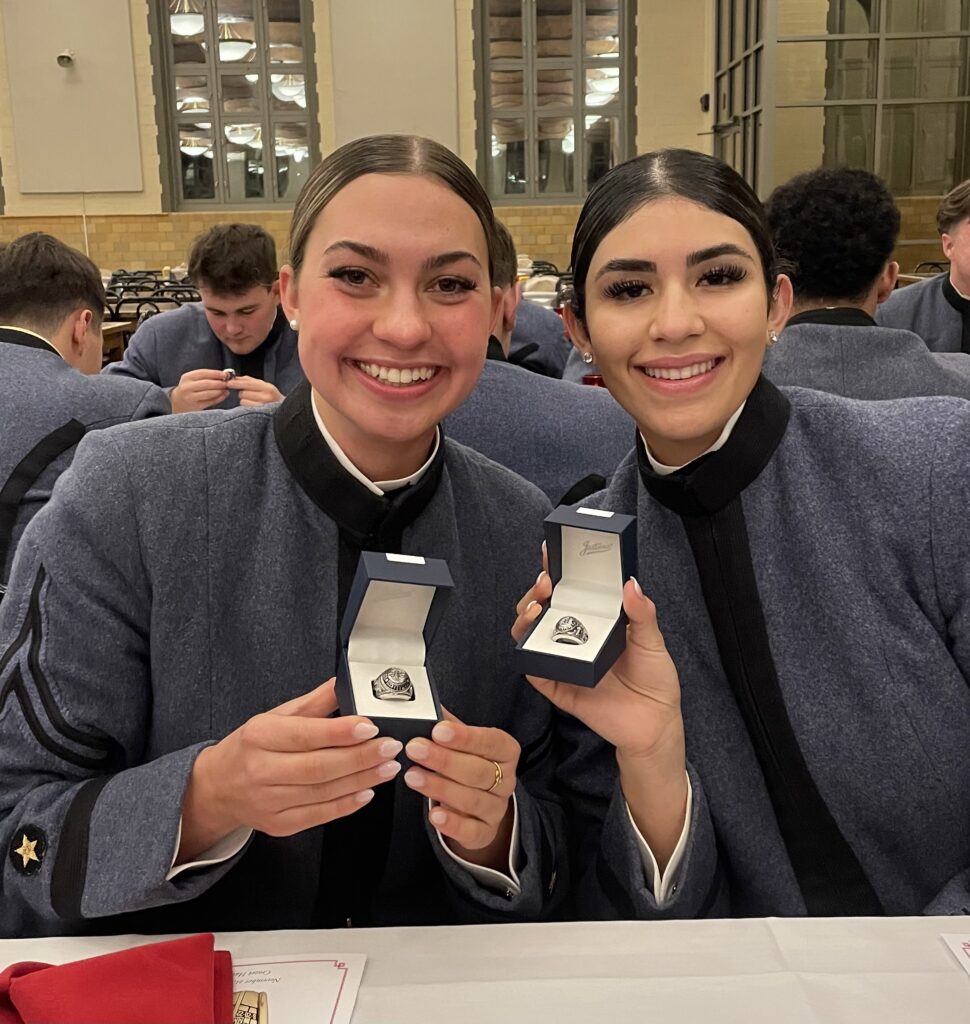
Nickole Chavez showing off her Virginia Military ring.

“I like the school. I like what it stands for, the values. I really try and play into the system as much as I can. I’m just a private and as much as I can, I try to be involved,” she said.

As a 3rd Class cadet, she said she’s seen her growth as a student.  

“I know I need to get my assignments done. I can’t stay in bed all day. Being here has helped me become more motivated and determined,” she said.  

Iten explained that Chavez stands out to her for her level-headedness. 

“In addition to having excellent stamina for learning, Nickole also stands out for her level-headedness and stable self-possession. If she encounters a tough spot or problem in her coursework, she remains calm, articulate, and solution-oriented,” she said. “Cadets can, understandably, get rocked off-balance by the demands of their coursework combined with navigating VMI, but not Nickole. I had a corporate career before becoming a professor, and Nickole is exactly the type of person I would have gladly hired for her capacity to stay grounded and articulate in fast-moving, high-pressure conditions.” 

The routine at VMI has been beneficial for Chavez. She said with the set schedule, it has not only benefitted her during her time at VMI, but outside of it.  

“I feel like I’m already on a set schedule. Even when I’m at home, I’m getting my day started early.” 

She said the schedule she and other cadets must keep has helped her become better with time management. 

“There’s a lot of stuff here we have to participate in, like practice parades, parades, meetings that we need to go to. I feel like just all that stuff kind of pushes you to manage your time a little bit better. During your day, if you get a break, take advantage of that break,” she said. 

Days can be overwhelming, but Chavez’s outlook remains steady. 

“I just try to take a step back and think about why I’m here, because this school can be stressful,” she said. “I just try to think back on why I’m here and what’s my purpose.” 

Honors Week: Do Comedy and Political Rhetoric Mix?

Is it the role of entertainers to take on serious issues and use their celebrity status to sway opinion? Johnny Carson, host of The Tonight Show for nearly 30 years and one of the most famous comedians of the 20th century, once argued that comedians should not use their fame for influence. Rather, their job is to entertain.

Suzanne Leaptrot ’25, an English major with a concentration in rhetoric and writing at Virginia Military Institute, asked, “Where do we situate comedy in our understanding of political rhetoric?” in her honors thesis presentation, “Conventional Comedy: Analyzing Stephen Colbert’s Live Monologues from Democratic and Republican National Conventions.”

According to Leaptrot, comedy is not exempt from providing news. In fact, people are increasingly getting their news from comedy shows like Saturday Night Live, Last Week Tonight with John Oliver, and The Daily Show. “Comedians don’t have the same journalistic obligations that reporters do. Journalists can be called out when they provide false information and are expected to redact their statements and admit when they are wrong. When a comedian provides false information, he can say, ‘Oh, it was just a joke.’ Yet these comedy shows still frame opinions, so I sought to evaluate comedy with the analytic framework of demagoguery,” she said.

Leaptrot referenced the Oxford English Dictionary when defining a demagogue as, “someone who seeks support by appealing to the desires and prejudices of ordinary people instead of using rational argument.” She studied two theories of demagoguery and settled on her own theory, and applied those principles to comedian Stephen Colbert’s live monologues from each side of the Democratic National Conventions (DNC) and Republican National Conventions (RNC) in 2016, 2020, and 2024.

The first theory Leaptrot studied was that of Patricia Roberts-Miller, author of “Demagoguery and Democracy,” who stated that demagoguery is always bad, and the main indicator of demagoguery is when arguments are reduced to an “us versus them” problem. The prime example is Adolf Hitler. The second theory Leaptrot researched is that of Charles Zug, author of “Demagogues in American Politics.” “Zug argues that Americans live in a society that thrives on populism and demagoguery. It paradoxically claims to hate demagoguery, but there is a time and place for political leaders—and political leaders only—to engage in demagogic rhetoric that is beneficial to democracy. He says in a civic emergency when there’s no time for politicians to explain the rationale behind their decisions, they are obligated to engage in demagoguery,” reported Leaptrot.

After comparing the two theorists, Leaptrot concluded that a good demagogue does not exist because a good demagogue isn’t a demagogue at all. “There’s a type of good demagoguery that is only valid in a rhetorical emergency. Someone may use demagoguery as a rhetorical device one time, but demagoguery is not a part of his character. This is where Stephen Colbert comes in.”

Leaptrot, who is a fan of Colbert’s comedy, viewed five hours of his monologues from both the DNC and RNC in 2016, 2020, and 2024. “In theory, they are identical events, but from opposite sides of the political aisle. What better place to look for a disparity in how he talks about each side?” She found that Colbert consistently belittled and criticized republicans, but praised and was favorable of the democrats. She concluded that her parameters of demagoguery apply to Colbert’s monologues in 2020, but not for 2016 nor 2024.    

Maj. Adam Cody, assistant professor in the Department of English, Rhetoric, and Humanistic Studies, served as Leaptrot’s advisor on the project. Cody stated that she reflects some of the noblest aspirations of the liberal arts educational program. “It is in Suzanne’s nature, when confronted with a challenge, to advance toward it, not to retreat from it. She has a fondness for learning and takes joy in discovering new answers to old questions,” he said.

Leaptrot is from McLean, Virginia, where she attended Langley High School. She is the daughter of Jeanne Peck. After graduation, Leaptrot hopes to teach English in Lithuania through the Fulbright Program. She also wants to pursue a master’s degree in intelligence and security studies.

Honors Week: Why Live? Cadet Researches Philosopher’s Personal Resilience

Simon Moore ’25 was drawn to Arthur Schopenhauer’s pessimistic views and honesty about pain and suffering. He said it might be considered a taboo subject, but it intrigued him.  

He presented his thesis, “Why Live?: An Analysis of Arthur Schopenhauer’s Life and Philosophy,” during Virginia Military Institute’s Honors Week. The psychology major decided to commit his time outside his department to a philosophy-focused thesis.

“There’s not really a lot of opportunity to read and learn about philosophy,” Moore admitted. “That was something that I kind of wished that I had.” 

He essentially willed that and was allowed to pursue the topic of Schopenhauer’s life due to his desire to explore something more reading and writing intensive — something he hadn’t really done during his cadetship.  

Moore’s thesis explored why Schopenhauer, despite his pessimistic life and work, did not commit suicide, focusing on his denial of the will through art, philosophy, compassion, and detachment. He analyzed Schopenhauer’s life, including his daily routine, his relationships, and his philosophical pursuits, to determine if he lived up to his own ideals.  

The research involved extensive reading and writing, with a focus on understanding Schopenhauer as a man and the alignment of his life and work.  

Moore pointed out Schopenhauer’s philosophy offers four key principles for personal resilience: art and aesthetic pleasures, philosophical thinking and reading, compassion, and detachment. 

In his thesis, Moore emphasizes that these principles are always available, regardless of life’s circumstances. They provide tools for maintaining perspective and finding meaning, even during personal struggles. The core idea is to consciously choose how to respond to suffering — through art, reflection, compassion, and detachment — rather than being overwhelmed by life’s challenges. 

He began his research last spring, spending about four to five hours a week on reading materials. That amped up in the fall and this spring to about eight to 10 hours a week of research. By February, he was writing his thesis in full force.  

Moore said that this research opportunity allowed him to diversify himself as a student at VMI.  

“That’s something that I’m really proud of doing. Nearing the end of this project, I did something that maybe a lot of other cadets aren’t necessarily willing to do,” he said. “I intend to sort of continue this philosophical interest of mine into my career after VMI.” 

Moore plans to continue exploring philosophy, particularly in the context of wealth management, where understanding individual suffering and resilience is crucial. 

Dr. Duncan Richter, professor in the Department of English, Rhetoric, and Humanistic Studies, was Moore’s academic advisor for his thesis. Richter met with Moore once a week to make sure he was on track, while providing feedback on what he had written and suggesting other readings. 

“He is pretty self-motivated and hasn’t needed much correction, so I feel as though I have been relatively hands-off,” Richter said. “It’s my job as a professor to try to get cadets to think more and better, and this project has certainly got Cadet Moore thinking very carefully about the nature of reality and the meaning of life. If he can share some of his enthusiasm for philosophy and some of the insights he has gained, then that’s good for everyone here.  

“I hope he has enjoyed doing it, but, above all, I think he has really been thinking critically about important questions. That can only be good for his intellectual development,” Richter added. 

The Vanguard — Ryan Halverson ’26

The Vanguard series highlights cadets of Virginia Military Institute who exemplify promise, perseverance, and the true spirit of leadership. While they may not be the top-ranking students or those in prestigious positions, these individuals’ dedication, resilience, and growth embody the essence of being a VMI cadet. By sharing their stories, including the challenges they’ve faced and overcome, we shine a spotlight on the diverse paths to success at the Institute, proving that leadership and excellence come in many forms. 

Lessons learned outside the classroom at Virginia Military Institute are what push Ryan Halverson ’26 to do better. He’s never been one to really enjoy school, but once he was able to apply what’s he’s learning in class to the outside world, his drive grew.  

“I’ve learned a lot more lessons in VMI classrooms just about myself,” he said.

One class he took on civic discourse presented him with a project on how to portray an argument and how to move an audience. He said that being at VMI, he knows it serves the greater good. 

“I think that’s really important for not only business, but in the military as well. Understanding that from that perspective, and not just a school perspective, is important,” he explained. 

Halverson, an English major, originally came to VMI as a civil engineering major. 

“I instantly knew it was a mistake.” 

Lt. Col. Pennie Ticen, associate professor in the Department of English, Rhetoric, and Humanistic Studies described Halverson as a conscientious student, ever since the beginning of his cadetship. She had him as a rat. 

“He came to class having done any assigned reading and/or writing, regularly contributed to class discussion — partly by listening carefully to his peers’ comments and then adding a synthesizing comment or a question designed to further discussion,” she explained. Halverson had approached her when he wanted to switch majors. “Demonstrating the care he brings to all his decision-making, he asked me for materials about the major, made an appointment to meet with me so he could ask questions, and then decided to submit his request to change departments.”

He switched to English because he saw it could really lend itself to what he wants to pursue after college, which is commissioning into the Marine Corps.  

“It was best for me in terms of communication and in leadership,” he said.  

Ticen, who is also Halverson’s advisor, said he is always the first cadet to get in touch with any questions or concerns about scheduling. 

“[He’s] making sure he is making steady progress on his degree, taking his major courses in the order in which we suggest so that he can build up his skills in our challenging humanities curriculum covering — art history and visual culture, literature, philosophy, and rhetoric & writing, etcetera,” she said. “In his cadetship, Halverson has consistently demonstrated his desire to get the most out of his VMI experience.” 

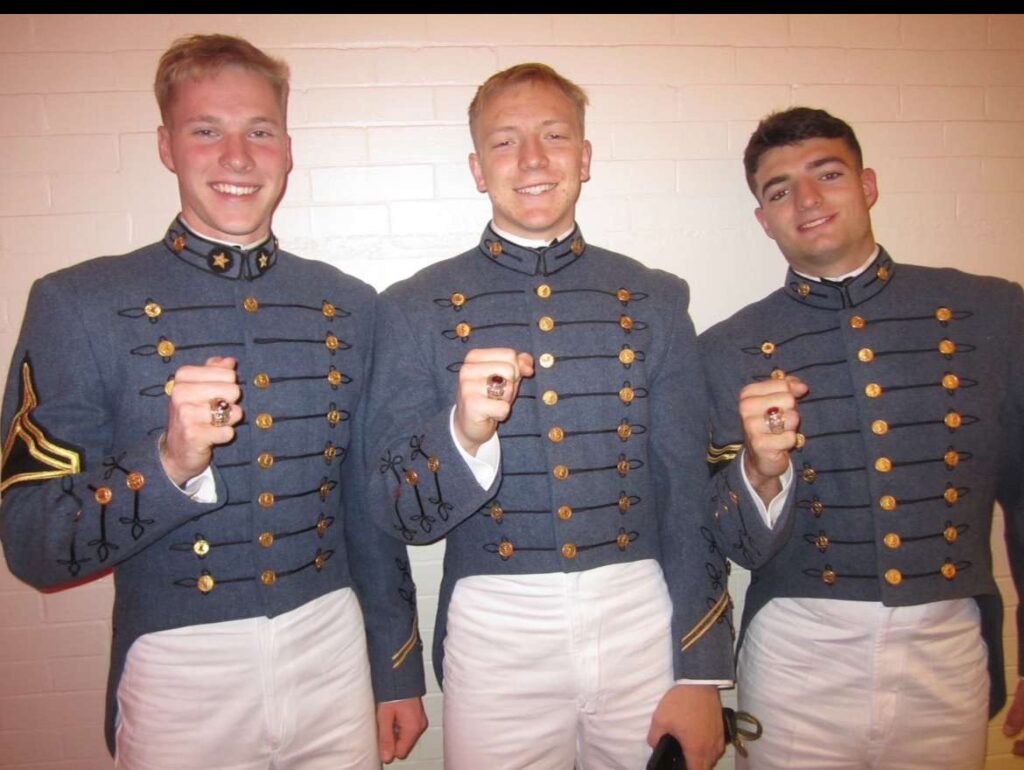
Ryan Halverson showing off his Virginia Military Institute ring with his brother rats.

By serving on the Rat Disciplinary Committee (RDC) and on cadre this year, he will move into the role of RDC president next year.  

“I would just say I’m someone who likes to push those around me. I like to make people better and really show people what they can do,” he commented. “One of my favorite quotes is, as a leader, you don’t show people your superpowers, you show them theirs. I think that’s what I try to do at VMI.” 

It’s a shift for him, he said. When he was in high school, he always wanted to help others but didn’t apply himself much to leadership positions. His time at VMI has helped that. He said the sense of camaraderie and the push to make everyone better was a turning point.  

Although the daily grind at VMI can be challenging, Halverson said his roommates and friends help him keep going.  

“There’s not one challenge here that you can’t overcome, but it’s being able to do that every single day is what’s hard,” he said. 

Col. Michelle Iten, associate professor in the Department of English, Rhetoric, and Humanistic Studies and the one who taught his civic discourse class, said Halverson is an insightful thinker who is strong at critical thinking. She said he also has a strong work ethic and puts in the time needed without cutting corners. 

“From the work he did for my class and our conversations, it’s clear to me that Halverson sees college as a place to expand his knowledge — he wants to learn deeply,” she stated. “He puts in all the careful thought and hard work needed to truly learn. This sets him apart from many cadets who are in class because they have to be and are in college just to get a degree. 

“He also stands out for his critical thinking skills,” she continued. “Ryan often impressed me with his comments in class — he’s insightful beyond his years in seeing cause and effect and in understanding what motivates people.” 

Halverson said being honest with yourself on what you need to improve on is important, especially when you are a rat. 

“It shows you where you’re lacking so that when it’s over, you can develop yourself through the next three years. Know your weaknesses, and I strive every day to become better in those areas,” he said. “You get put in so many stressful and uncomfortable situations that you get through. Doing that over and over just builds confidence.” 

The Vanguard — Virginia Price ’28

The Vanguard series highlights cadets of Virginia Military Institute who exemplify promise, perseverance, and the true spirit of leadership. While they may not be the top-ranking students or those in prestigious positions, these individuals’ dedication, resilience, and growth embody the essence of being a VMI cadet. By sharing their stories, including the challenges they’ve faced and overcome, we shine a spotlight on the diverse paths to success at the Institute, proving that leadership and excellence come in many forms. 

Challenges and a different college experience are a huge draw for those considering Virginia Military Institute. That’s exactly why Virginia Price ’28 chose it. 

It’s a challenge she seems to accept and prospered at within just a few months of being at VMI. The English major has a passion for writing, especially poetry.  

Dr. Duncan Richter, professor in the Department of English, Rhetoric, and Humanistic Studies, said she’s been a model student in the course she’s taken with him. He said she was one of the top three students who he could count on to complete every assignment.  

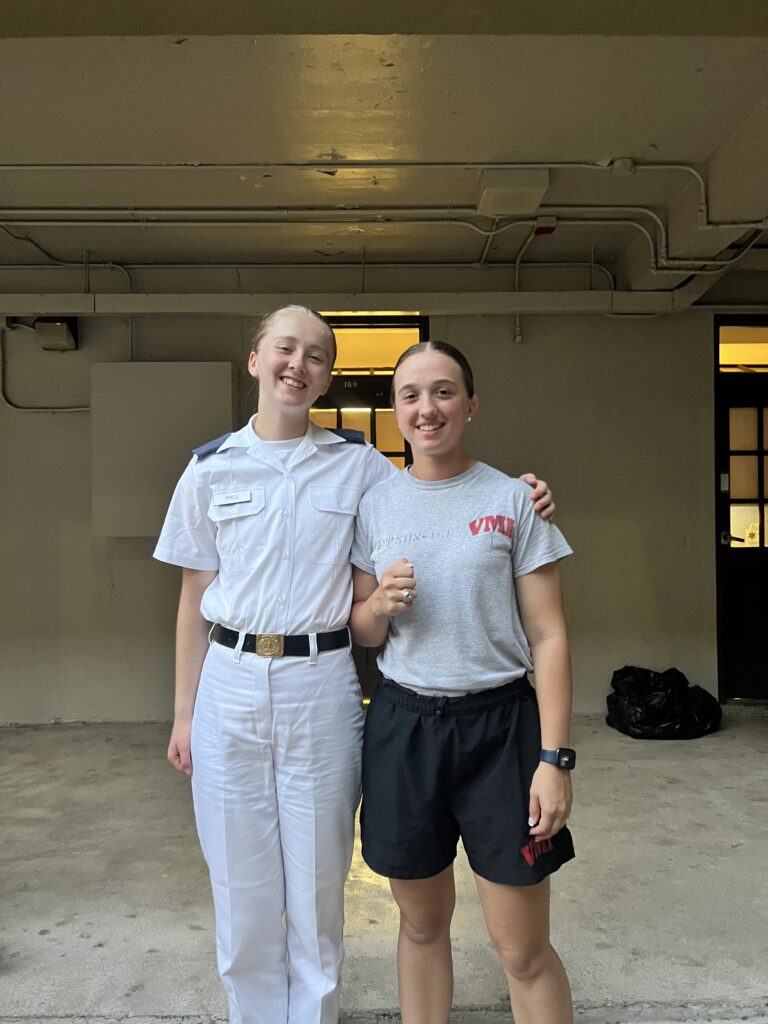
Virginia Price with her brother rat at Virginia Military Institute.

“I don’t know of any struggles she has faced, but already as a rat she has earned a high enough GPA to be a potential candidate for the Institute Honors program,” he said.  

Richter also pointed out Price recently won a contest for her poetry — part of the VMI Writing Contest.  

“She stands out, not by being loud or having a high opinion of herself, but by doing what she needs to do and always having a positive attitude. She never seems to feel sorry for herself or be anything but cheerful,” Richter added. 

Price has always loved reading and writing; she excelled at them in high school and found them to be areas she wanted to pursue in college. 

“I like that you can tell a story and that you can connect to your audience, but you don’t need that many words,” she said about poetry. “You can write a few lines and someone will feel the exact same way that you’re feeling. You can draw them in.” 

She is highly focused on her academics and strives for the best. Currently taking 17.5 credits, she’s finding as she’s into her second semester, she’s enjoying the variety of classes more.  

“I try to just get the most out of my academic experience here, because in the end, that’s what I’m paying for — a college education,” she explained. “I try to prioritize my classes; that’s my number one thing.” 

Transitioning to college life on the Rat Line was tough, she said. It had been the first time in her life that she had been yelled at or commanded to do things. As a non-commissioning cadet, she’s here for the experience itself. Matriculation Week, though, helped her transition more into the Institute.  

“I think it kind of showed me how to work well under pressure,” she said. “You don’t have time to miss home or anything, because you’re automatically in it. Then when you get out of Matriculation Week, you go straight into classes.” 

She’s excited for what’s to come next during her time at VMI: Things like taking leadership positions, which she says sets you up for further success in life, as well as joining club sports and getting to know others in the Corps. She currently participates in the VMI Brazilian Jiu-Jitsu Club the VMI Rock Climbing Club. 

“I feel like at any other college, you don’t really talk to people as much,” she admitted. “Everybody’s kind of in their own little world. But here, we all do things as a mass. You get to meet more people; there’s more of a connection.” 

Behind the Balance: Colin Blandford ’26 — Men’s Keydet Soccer

Virginia Military Institute’s cadet-athletes have to juggle cadet life, heavy academic course loads, and their NCAA Division I sport. Committed to both academic and athletic pursuits, balancing their rigorous schedule in both sports and school requires a certain level of commitment and discipline. Behind the Balance is a series that focuses on those cadet-athletes and how they handle the hurdles of the day-to-day.  

Becoming one of the co-captains of Virginia Military Institute’s men’s soccer team, Colin Blandford ’26 didn’t expect to carry so much weight. It was a stark contrast to him serving as captain in high school.  

“I took a lot more responsibility than I thought,” he said. “It’s nothing like what I actually thought.”

It meant meetings, engaging with people he hadn’t expected, boosting morale, spreading the message of their coach, and more. He said, as a captain, you’re acting as the liaison between the commandant staff and the team.  

“There are different issues that arise every day, because there’s so much going on here,” he said. “You’re advocating for somebody one day, you’re trying to figure out a new rule, sign-outs, how things are going to work, and you’re working with the coach as well to make sure that the team is successful on the field .” 

Blandford said he puts in extra time talking with his coach to ensure his messages are properly portrayed to the team.  

“I think the biggest thing I picked up on is how much more communication and my input are valued —  a lot more than I thought,” he said. 

It’s added to the responsibility as a team player and puts a heavier load on him as a cadet, but that’s the VMI way, he added.  

“Honestly, you’re so forced to be on a schedule here, and they teach you so well how to manage your time and how your whole day is structured that it hasn’t been too hard,” he said. “You go to practice in the morning, go to school all day, go to practice in the afternoon again, then after dinner, the rest of your night is for homework. That’s kind of the schedule I follow every day.” 

Structure is what he needed. 

“I chose VMI because I knew a normal college wouldn’t have suited me well, just based off how I was in high school,” Blandford said. “I knew that if I wanted to be serious about playing sports, that I need to be somewhere where structure was built in.” 

Cadet-athletes at VMI not only have their responsibilities with their selected sport but cadet duties on top of that. Cadets are also required to take physical fitness classes twice a week, participate in ROTC all four years, prepare for room and uniform inspections, practice for parade, guard duty, and more.  

Learning proper communication has become a skill that Blandford relies on. He’s traveling a lot during the season, which means missing classes.  

“I’d say a lot of the problems that I ran into in my earlier years were solved just through communicating with my teachers more effectively,” he said. “The teachers here are very understanding of obligations and especially understanding of time management, because everybody here is strained for time. This year, I’ve noticed that it’s not as difficult to keep up my work, as I found in the past, and that’s based just off communication.” 

Blandford, an English major with a minor in business, has 18 and a half credits this semester, which means he must stay on top of his studies. With a heavy load of classes on Tuesdays and Thursdays, he spends the rest of the week tackling most of his work.  

Colin Blandford kicks the soccer ball on the field during a Virginia Military Institute men' soccer game.

Finding his goal

Blandford has been playing soccer since he was three years old. He played several sports growing up, but soccer was the one that stuck out — it was the one he excelled at. He likes the constant flow of action and how the game can change in just seconds. Mainly, he likes being part of the team. 

“As the years progressively go on, I think being part of the team is amazing. Those are my best friends,” he said. “I spend the most time with them. It’s huge that this group gets along. It’s a tiny school, so you see them at school all day. You go to sports with them all day. You live with them.” 

He credits his coach for bringing the group together. 

“All the guys within the group have done a great job of taking care of each other and buying into what we’re trying to do,” he said. 

Behind the Balance: Gretal Shank ’25 — Keydet Cross Country

Virginia Military Institute’s cadet-athletes have to juggle cadet life, heavy academic course loads, and their NCAA Division I sport. Committed to both academic and athletic pursuits, balancing their rigorous schedule in both sports and school requires a certain level of commitment and discipline. Behind the Balance is a series that focuses on those cadet-athletes and how they handle the hurdles of the day-to-day. 

Gretal Shank ’25 started running cross country when she was in seventh grade. She almost quit two weeks in. 

“I didn’t like it,” she admitted. “It was hard, but then I realized I was pretty good at it, so I stuck with it and did it all through high school. I did pretty well, I’m still running.” 

She averages running 30 to 40 miles a week. During that time, she treats it as meditation. Shank, an English major, says she spends her runs sometimes formulating stories.  

“I’m also a writer. I do a lot of my thinking about ideas for what I’m going to write, while I run, also just ideas for anything,” she said. “I got a lot of time on my hands.” 

During the harder workouts, though, she’s not thinking about anything. 

“I think a big part of it is mental. It gives me a mental break in the middle of the day. I get a lot of my thinking done while I’m running,” she said. “Also, it keeps me fit, obviously. It gives me goals to work on, from personal goals to team-oriented goals. A big aspect of that is teamwork, but it’s also an individual sport.”

She applied to West Point, but didn’t get in, so she shifted to VMI. Without even seeing post first, she decided to commit. It took one call to the cross country coach for her to get on the team with a partial scholarship. 

“I wanted a college experience that wasn’t going to be ordinary,” Shank said. “But it initially started whenever I was looking into commissioning, because my parents are both in the military.” 

With plans of commissioning into the U.S. Army, Shank’s days are filled and regimented — much like other cadets at VMI. The schedule she keeps ensures she’s able to get all her tasks done. On top of a sport, she’s taken a heavy credit load her entire time at VMI — taking 20 credits this semester, three of which are dedicated to her honor’s thesis. Due to her psychology minor, she must tack on six more classes to fulfill requirements.  

Gretal Shank running cross country for Virginia Military Institute.

Her academic schedule is packed. Mondays, Wednesdays, and Fridays, she has five or six classes, then heads to practice from 3:30 to 7 p.m. Tuesdays and Thursdays, she has Army ROTC lab and classes. 

Cadet-athletes at VMI not only have their responsibilities with their selected sport but cadet duties on top of that. Cadets are also required to take physical fitness classes twice a week, participate in ROTC all four years, prepare for room and uniform inspections, practice for parade, guard duty, and more.   

The continuous activity is something Shank likes. Besides being a DI athlete and having cadet responsibilities, she’s the visual editor for Cadence, the Institute’s fine arts publication. She also works at the VMI Writing Center and is the president of Sigma Tau Delta, the International English Honor Society.

“I think for me, it might make it easier. I haven’t known any different, but I think it’s easier because I have a consistent schedule,” she said.  

Each day has a specific schedule that Shank doesn’t deter from. When it comes to a slower day or a day off, she often doesn’t know what to do with herself. She needs constant activity to push her along.  

“I find that on days that I don’t have practice, which is pretty rare, I actually don’t get more work done,” she said. 

VMI has kept her busy and helped create a lifestyle of structure, she said. She needs to have a designated time for everything, otherwise she’d get nothing done.  

“Honestly, the busier I am, the more I will be able to get done, because otherwise it’s easier for me to just be lazy,” she admitted. “I’ve kind of run into that problem on Tuesdays and Thursdays a little bit to where I just kind of want to relax, because my Monday, Wednesday, Fridays are so busy, but it’s been fun. I’ve gotten all the work done that I need to get done, so that’s what matters.”

The Cadet Collective: Conner Felts ’24

Virginia Military Institute requires structure and dedication. It also becomes a place where bonds are created that can last a lifetime. Maybe it’s a professor, a coach, or a fellow cadet. No one makes it through VMI alone. The Cadet Collective tells the stories of those relationships that help pave the way for success.

For many cadets at Virginia Military Institute, the journey through rigorous academic and physical challenges is not a solitary endeavor. Conner Felts ’24, an English major, experienced the profound impact of mentorship and networking that defines the VMI experience with alumni during his time as a cadet.

Felts’ interest in the athletic communications field began with his involvement in photography and social media management for the VMI basketball team. 

It was through these roles that Felts connected with Maj. Gen. Cedric T. Wins ’85, superintendent, ultimately leading to an introduction to Conor Powell ’99, an alumnus of VMI renowned for his extensive career in news reporting.  

“The reason he wanted to connect us is because I want to be a reporter when I graduate VMI,” said Felts. “I want to be a news broadcaster, sports journalist, anything like that. Conor Powell agreed to be my mentor going forward and help me get a job.” 

The mentorship evolved into a weekly phone call routine. “The first time I called him, I addressed him as ‘sir.’ He immediately corrected me, insisting that I just call him Conor. It was like talking to another brother rat,” Felts shared. 

The mentorship was more than just professional advice; it provided an emotional and psychological support system. 

“He understood the VMI life – the lack of sleep, the heavy workload,” explained Felts. “Talking to someone who had been through it made a huge difference.” 

This mentorship greatly enriched Felts’s VMI experience and prepared him for the future.  

“I worked with ESPN on live broadcasts, and Powell’s guidance helped me find my voice and remain calm on air,” he said. 

Felts said he felt confident about his next steps, thanks to the network Powell had helped him build. Powell introduced Felts to prominent figures in the journalism industry, including other VMI alumni. Felts believes these connections have opened doors to opportunities to navigate post-graduation job prospects. 

“I applied for jobs, and through Powell, I connected with prominent figures like Scott Thuman, head news anchor at Channel 7 in DC, and Scott Heilman from NBCUniversal,” said Felts. 

Felts hopes to pay the mentorship he received forward.  

“Powell mentioned he wished he had someone to guide him when he was in my shoes. I want to offer the same support to future cadets,” said Felts. “This relationship showed me that you can’t start at the top. You have to find glory in the work it takes to get there.” 

Powell’s guidance prepared Felts to embark on a promising journalism career grounded in resilience, mentorship, and the indomitable spirit of the VMI legacy as of his graduation in May 2024. 

Becoming a Research Technician at Johns Hopkins Neurosurgical Lab: Jackson Miller ’24

This article is part of The Next Step series. While the four years at VMI are designed for cadets to push themselves academically, physically, and mentally to tackle the demands of life at a premiere military college, they also prepare cadets for life after graduation. Whether that life be one in the military or one in the private sector, VMI faculty and staff provide guidance to cadets along their journeys. One department specifically dedicated to that endeavor of post-Institute success is the Office of Career Services. In The Next Step series, we highlight cadets preparing to enter the workforce after graduation, as well as those still in the midst of their cadetship preparing for internships over the summer. 

Jackson Miller ’24 has aspirations of becoming a doctor. The recent graduate from Rockville, Maryland, will be taking a step in that direction as a research technician at the Johns Hopkins Hunterian Neurosurgical Laboratory starting this summer. 

The Johns Hopkins Hunterian Neurosurgical Laboratory is the nation’s first experimental surgery laboratory, according to its website. The lab houses research groups representing multiple specialties and interests in the neurosurgical community, with a facility fully equipped with a microsurgical laboratory, cell culture and microscopy facilities, quantitative image analysis, certified operating rooms, and radiologic equipment. 

The English major will be working at Hopkins to perform research and earn money before going to medical school.

“I want to practice medicine because it is important work and I like to help others,” he said. 

His duties will include performing cancer research and experimenting with new types of chemotherapy and cancer treatments. As for his future goals, he sees himself as an emergency medicine doctor in the U.S. Army, which is a nod to his mother’s profession.  

“My mom was a surgeon in the Navy for 25 years, and she’s the one who inspired me to think about medicine as a way to serve my country, and to serve others,” he said.  

Miller credits VMI for preparing him for the future.  

“VMI prepared me to embark on this difficult journey by challenging me with academics, the Rat Line, and with my experiences on the boxing team here at the Institute,” he said. “In particular, boxing taught me how to fight hard through adversity and push my limits.” 

But the VMI alumni network gave him a competitive edge, he said.  

 “I would not have the opportunities that I am currently taking full advantage of without the help of VMI alumni. The alumni network here is incredibly strong, and they look out for members of the VMI family by helping them look for jobs as well as through exceptional mentorship,” he said.